Group 12
The members are :
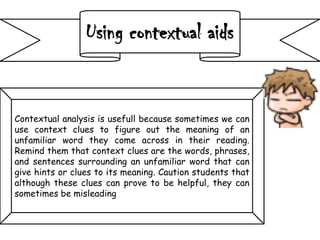
Contextual analysis is usefull because sometimes we can
use context clues to figure out the meaning of an
unfamiliar word they come across in their reading.
Remind them that context clues are the words, phrases,
and sentences surrounding an unfamiliar word that can
give hints or clues to its meaning. Caution students that
although these clues can prove to be helpful, they can
sometimes be misleading
Using contextual aids
Examples of
contextual Analysis
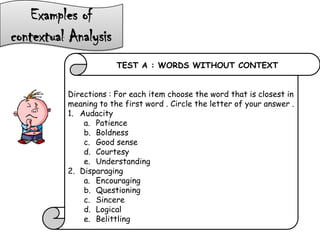
TEST A : WORDS WITHOUT CONTEXT
Directions : For each item choose the word that is closest in
meaning to the first word . Circle the letter of your answer .
1. Audacity
a. Patience
b. Boldness
c. Good sense
d. Courtesy
e. Understanding
2. Disparaging
a. Encouraging
b. Questioning
c. Sincere
d. Logical
e. Belittling
Examples of contextual analysis
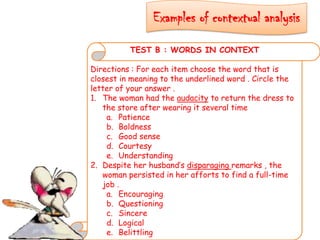
TEST B : WORDS IN CONTEXT
Directions : For each item choose the word that is
closest in meaning to the underlined word . Circle the
letter of your answer .
1. The woman had the audacity to return the dress to
the store after wearing it several time
a. Patience
b. Boldness
c. Good sense
d. Courtesy
e. Understanding
2. Despite her husband’s disparaging remarks , the
woman persisted in her afforts to find a full-time
job .
a. Encouraging
b. Questioning
c. Sincere
d. Logical
e. Belittling
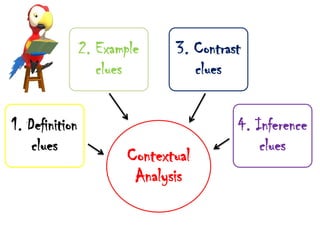
Contextual
Analysis
1. Definition
clues
2. Example
clues
3. Contrast
clues
4. Inference
clues
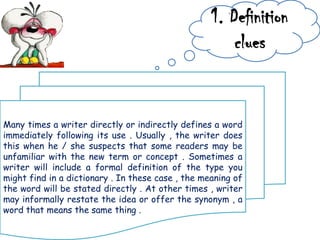
1. Definition
clues
Many times a writer directly or indirectly defines a word
immediately following its use . Usually , the writer does
this when he / she suspects that some readers may be
unfamiliar with the new term or concept . Sometimes a
writer will include a formal definition of the type you
might find in a dictionary . In these case , the meaning of
the word will be stated directly . At other times , writer
may informally restate the idea or offer the synonym , a
word that means the same thing .
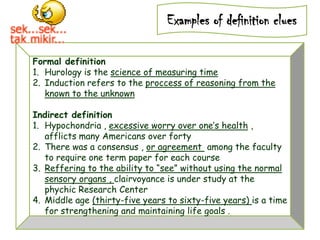
Examples of definition clues
Formal definition
1. Hurology is the science of measuring time
2. Induction refers to the proccess of reasoning from the
known to the unknown
Indirect definition
1. Hypochondria , excessive worry over one’s health ,
afflicts many Americans over forty
2. There was a consensus , or agreement among the faculty
to require one term paper for each course
3. Reffering to the ability to “see” without using the normal
sensory organs , clairvoyance is under study at the
phychic Research Center
4. Middle age (thirty-five years to sixty-five years) is a time
for strengthening and maintaining life goals .
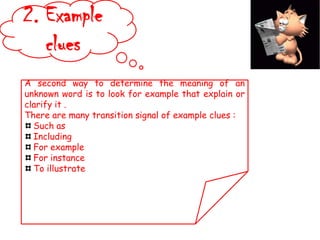
2. Example
clues
A second way to determine the meaning of an
unknown word is to look for example that explain or
clarify it .
There are many transition signal of example clues :
Such as
Including
For example
For instance
To illustrate
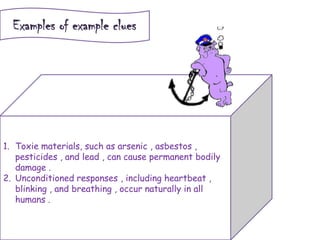
Examples of example clues
1. Toxie materials, such as arsenic , asbestos ,
pesticides , and lead , can cause permanent bodily
damage .
2. Unconditioned responses , including heartbeat ,
blinking , and breathing , occur naturally in all
humans .
3. Contrast
clues
It is sometimes possible to determine the
meaning of an unknown word from a word or
phrase in the context that has an opposite
meaning . Notice , in the following sentence ,
how a word opposite in meaning from the
boldface word provides a clue to its
meaning.There are many transition signals :
 Even though
Although
On the other hand
 However
Despite
 Rather
While
Yet
Nevertheless
Examples of contrast clues
1. I loathe cats even though most of my friends love
them
2. Although the cottage appeared derelict , we
discovered that a family lived there on weekends
3. Pete , through long hours of study , successfully
passed the exam ; on the other hand , Sam’s efforts
were futile
4. Inference
clues
Many times you can determine the meaning of a
word you do not know by guessing of figuring it
out . This proccess is called “ drawing an
inference” . From the information that is given in
the context you can infer the meaning the
meaning of a word you aren’t familiar with .
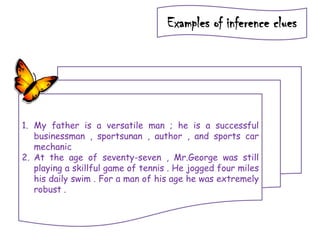
Examples of inference clues
1. My father is a versatile man ; he is a successful
businessman , sportsunan , author , and sports car
mechanic
2. At the age of seventy-seven , Mr.George was still
playing a skillful game of tennis . He jogged four miles
his daily swim . For a man of his age he was extremely
robust .
ANALYZING
WORD CLUES
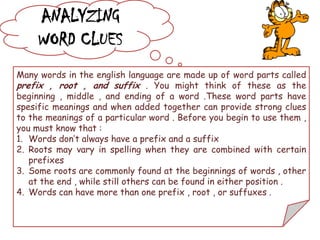
Many words in the english language are made up of word parts called
prefix , root , and suffix . You might think of these as the
beginning , middle , and ending of a word .These word parts have
spesific meanings and when added together can provide strong clues
to the meanings of a particular word . Before you begin to use them ,
you must know that :
1. Words don’t always have a prefix and a suffix
2. Roots may vary in spelling when they are combined with certain
prefixes
3. Some roots are commonly found at the beginnings of words , other
at the end , while still others can be found in either position .
4. Words can have more than one prefix , root , or suffuxes .
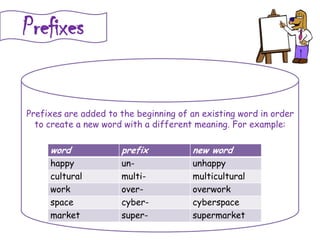
Prefixes
Prefixes are added to the beginning of an existing word in order
to create a new word with a different meaning. For example:
word prefix new word
happy un- unhappy
cultural multi- multicultural
work over- overwork
space cyber- cyberspace
market super- supermarket
Suffixes
Suffixes are added to the end of an existing word. For
example:
word suffix new word
child -ish childish
work -er worker
taste -less tasteless
idol -ize/-ise idolize/idolise
like -able likeable
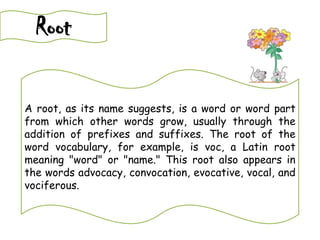
Root
A root, as its name suggests, is a word or word part
from which other words grow, usually through the
addition of prefixes and suffixes. The root of the
word vocabulary, for example, is voc, a Latin root
meaning "word" or "name." This root also appears in
the words advocacy, convocation, evocative, vocal, and
vociferous.
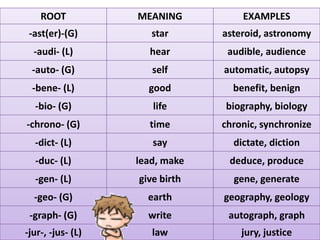
ROOT MEANING EXAMPLES
-ast(er)-(G) star asteroid, astronomy
-audi- (L) hear audible, audience
-auto- (G) self automatic, autopsy
-bene- (L) good benefit, benign
-bio- (G) life biography, biology
-chrono- (G) time chronic, synchronize
-dict- (L) say dictate, diction
-duc- (L) lead, make deduce, produce
-gen- (L) give birth gene, generate
-geo- (G) earth geography, geology
-graph- (G) write autograph, graph
-jur-, -jus- (L) law jury, justice
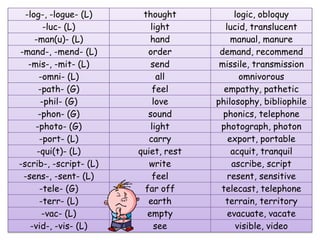
-log-, -logue- (L) thought logic, obloquy
-luc- (L) light lucid, translucent
-man(u)- (L) hand manual, manure
-mand-, -mend- (L) order demand, recommend
-mis-, -mit- (L) send missile, transmission
-omni- (L) all omnivorous
-path- (G) feel empathy, pathetic
-phil- (G) love philosophy, bibliophile
-phon- (G) sound phonics, telephone
-photo- (G) light photograph, photon
-port- (L) carry export, portable
-qui(t)- (L) quiet, rest acquit, tranquil
-scrib-, -script- (L) write ascribe, script
-sens-, -sent- (L) feel resent, sensitive
-tele- (G) far off telecast, telephone
-terr- (L) earth terrain, territory
-vac- (L) empty evacuate, vacate
-vid-, -vis- (L) see visible, video
Thank you for
your attention
And
Good evening


aids to vocablury development

  • 1.
  • 2.
    Contextual analysis isusefull because sometimes we can use context clues to figure out the meaning of an unfamiliar word they come across in their reading. Remind them that context clues are the words, phrases, and sentences surrounding an unfamiliar word that can give hints or clues to its meaning. Caution students that although these clues can prove to be helpful, they can sometimes be misleading Using contextual aids
  • 3.
    Examples of contextual Analysis TESTA : WORDS WITHOUT CONTEXT Directions : For each item choose the word that is closest in meaning to the first word . Circle the letter of your answer . 1. Audacity a. Patience b. Boldness c. Good sense d. Courtesy e. Understanding 2. Disparaging a. Encouraging b. Questioning c. Sincere d. Logical e. Belittling
  • 4.
    Examples of contextualanalysis TEST B : WORDS IN CONTEXT Directions : For each item choose the word that is closest in meaning to the underlined word . Circle the letter of your answer . 1. The woman had the audacity to return the dress to the store after wearing it several time a. Patience b. Boldness c. Good sense d. Courtesy e. Understanding 2. Despite her husband’s disparaging remarks , the woman persisted in her afforts to find a full-time job . a. Encouraging b. Questioning c. Sincere d. Logical e. Belittling
  • 5.
  • 6.
    1. Definition clues Many timesa writer directly or indirectly defines a word immediately following its use . Usually , the writer does this when he / she suspects that some readers may be unfamiliar with the new term or concept . Sometimes a writer will include a formal definition of the type you might find in a dictionary . In these case , the meaning of the word will be stated directly . At other times , writer may informally restate the idea or offer the synonym , a word that means the same thing .
  • 7.
    Examples of definitionclues Formal definition 1. Hurology is the science of measuring time 2. Induction refers to the proccess of reasoning from the known to the unknown Indirect definition 1. Hypochondria , excessive worry over one’s health , afflicts many Americans over forty 2. There was a consensus , or agreement among the faculty to require one term paper for each course 3. Reffering to the ability to “see” without using the normal sensory organs , clairvoyance is under study at the phychic Research Center 4. Middle age (thirty-five years to sixty-five years) is a time for strengthening and maintaining life goals .
  • 8.
    2. Example clues A secondway to determine the meaning of an unknown word is to look for example that explain or clarify it . There are many transition signal of example clues : Such as Including For example For instance To illustrate
  • 9.
    Examples of exampleclues 1. Toxie materials, such as arsenic , asbestos , pesticides , and lead , can cause permanent bodily damage . 2. Unconditioned responses , including heartbeat , blinking , and breathing , occur naturally in all humans .
  • 10.
    3. Contrast clues It issometimes possible to determine the meaning of an unknown word from a word or phrase in the context that has an opposite meaning . Notice , in the following sentence , how a word opposite in meaning from the boldface word provides a clue to its meaning.There are many transition signals :  Even though Although On the other hand  However Despite  Rather While Yet Nevertheless
  • 11.
    Examples of contrastclues 1. I loathe cats even though most of my friends love them 2. Although the cottage appeared derelict , we discovered that a family lived there on weekends 3. Pete , through long hours of study , successfully passed the exam ; on the other hand , Sam’s efforts were futile
  • 12.
    4. Inference clues Many timesyou can determine the meaning of a word you do not know by guessing of figuring it out . This proccess is called “ drawing an inference” . From the information that is given in the context you can infer the meaning the meaning of a word you aren’t familiar with .
  • 13.
    Examples of inferenceclues 1. My father is a versatile man ; he is a successful businessman , sportsunan , author , and sports car mechanic 2. At the age of seventy-seven , Mr.George was still playing a skillful game of tennis . He jogged four miles his daily swim . For a man of his age he was extremely robust .
  • 14.
    ANALYZING WORD CLUES Many wordsin the english language are made up of word parts called prefix , root , and suffix . You might think of these as the beginning , middle , and ending of a word .These word parts have spesific meanings and when added together can provide strong clues to the meanings of a particular word . Before you begin to use them , you must know that : 1. Words don’t always have a prefix and a suffix 2. Roots may vary in spelling when they are combined with certain prefixes 3. Some roots are commonly found at the beginnings of words , other at the end , while still others can be found in either position . 4. Words can have more than one prefix , root , or suffuxes .
  • 15.
    Prefixes Prefixes are addedto the beginning of an existing word in order to create a new word with a different meaning. For example: word prefix new word happy un- unhappy cultural multi- multicultural work over- overwork space cyber- cyberspace market super- supermarket
  • 16.
    Suffixes Suffixes are addedto the end of an existing word. For example: word suffix new word child -ish childish work -er worker taste -less tasteless idol -ize/-ise idolize/idolise like -able likeable
  • 17.
    Root A root, asits name suggests, is a word or word part from which other words grow, usually through the addition of prefixes and suffixes. The root of the word vocabulary, for example, is voc, a Latin root meaning "word" or "name." This root also appears in the words advocacy, convocation, evocative, vocal, and vociferous.
  • 18.
    ROOT MEANING EXAMPLES -ast(er)-(G)star asteroid, astronomy -audi- (L) hear audible, audience -auto- (G) self automatic, autopsy -bene- (L) good benefit, benign -bio- (G) life biography, biology -chrono- (G) time chronic, synchronize -dict- (L) say dictate, diction -duc- (L) lead, make deduce, produce -gen- (L) give birth gene, generate -geo- (G) earth geography, geology -graph- (G) write autograph, graph -jur-, -jus- (L) law jury, justice
  • 19.
    -log-, -logue- (L)thought logic, obloquy -luc- (L) light lucid, translucent -man(u)- (L) hand manual, manure -mand-, -mend- (L) order demand, recommend -mis-, -mit- (L) send missile, transmission -omni- (L) all omnivorous -path- (G) feel empathy, pathetic -phil- (G) love philosophy, bibliophile -phon- (G) sound phonics, telephone -photo- (G) light photograph, photon -port- (L) carry export, portable -qui(t)- (L) quiet, rest acquit, tranquil -scrib-, -script- (L) write ascribe, script -sens-, -sent- (L) feel resent, sensitive -tele- (G) far off telecast, telephone -terr- (L) earth terrain, territory -vac- (L) empty evacuate, vacate -vid-, -vis- (L) see visible, video
  • 20.
    Thank you for yourattention And Good evening 