¡Pronunciaressencillo!Perhaps the most important component in learning a second language is being able to read that language effectively. Follow these steps and you should have no problem reading new Spanish words thereafter. Spanish is a very easy language to decode (you are lucky you already know how to read English, which is a very difficult language to decode).
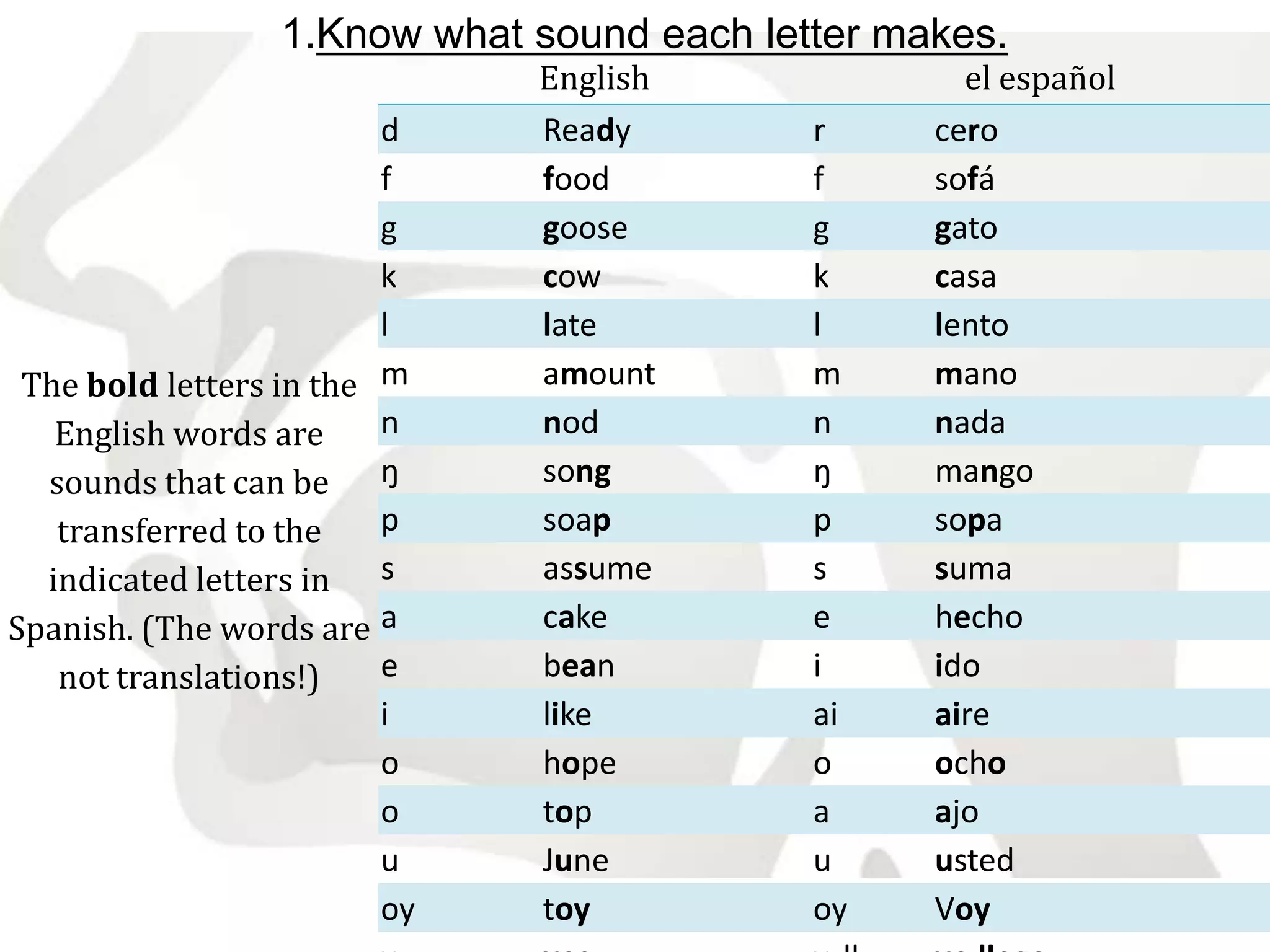
Know what sound each letter makes.
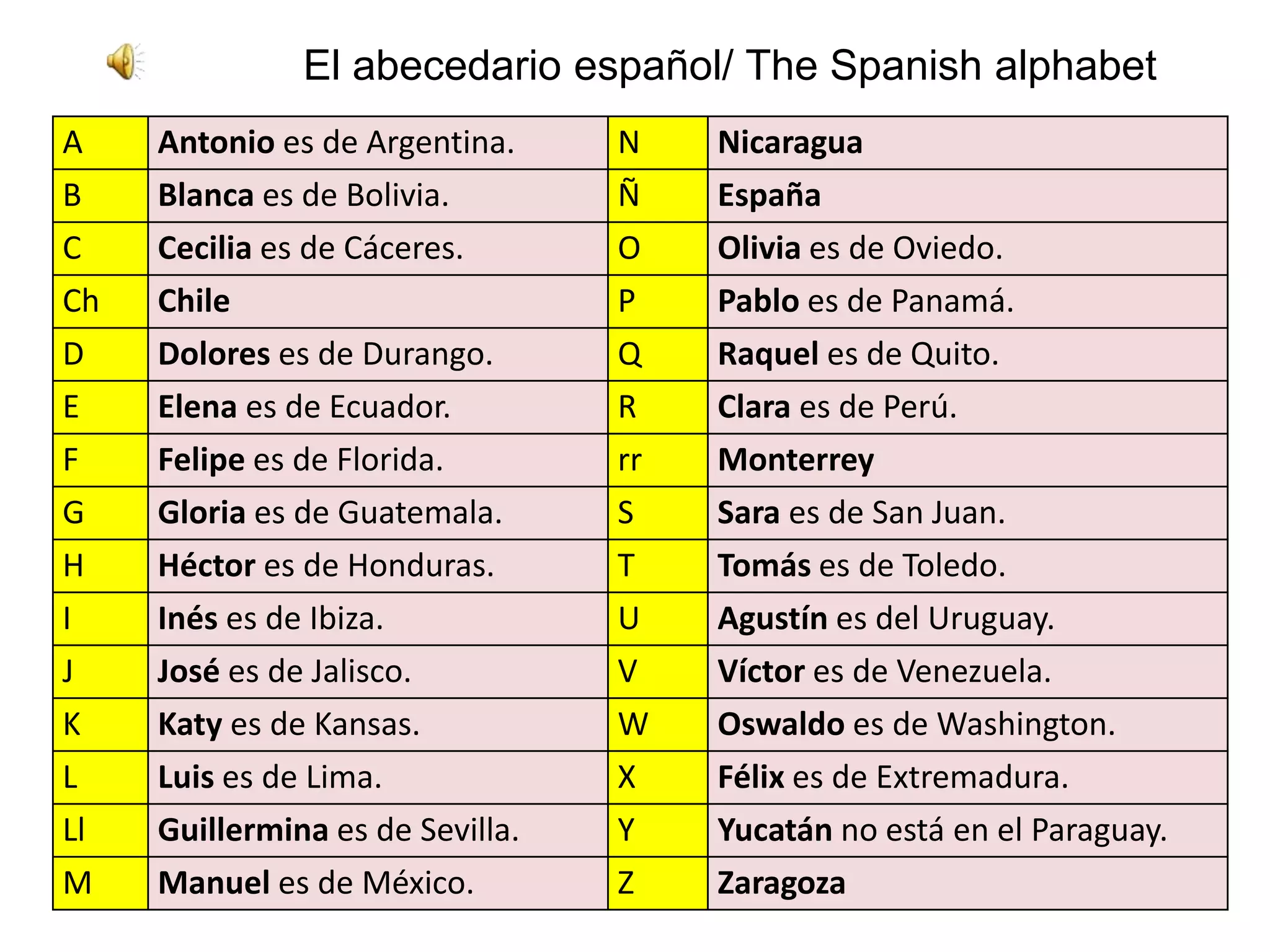
El abecedario español/ The Spanish alphabet
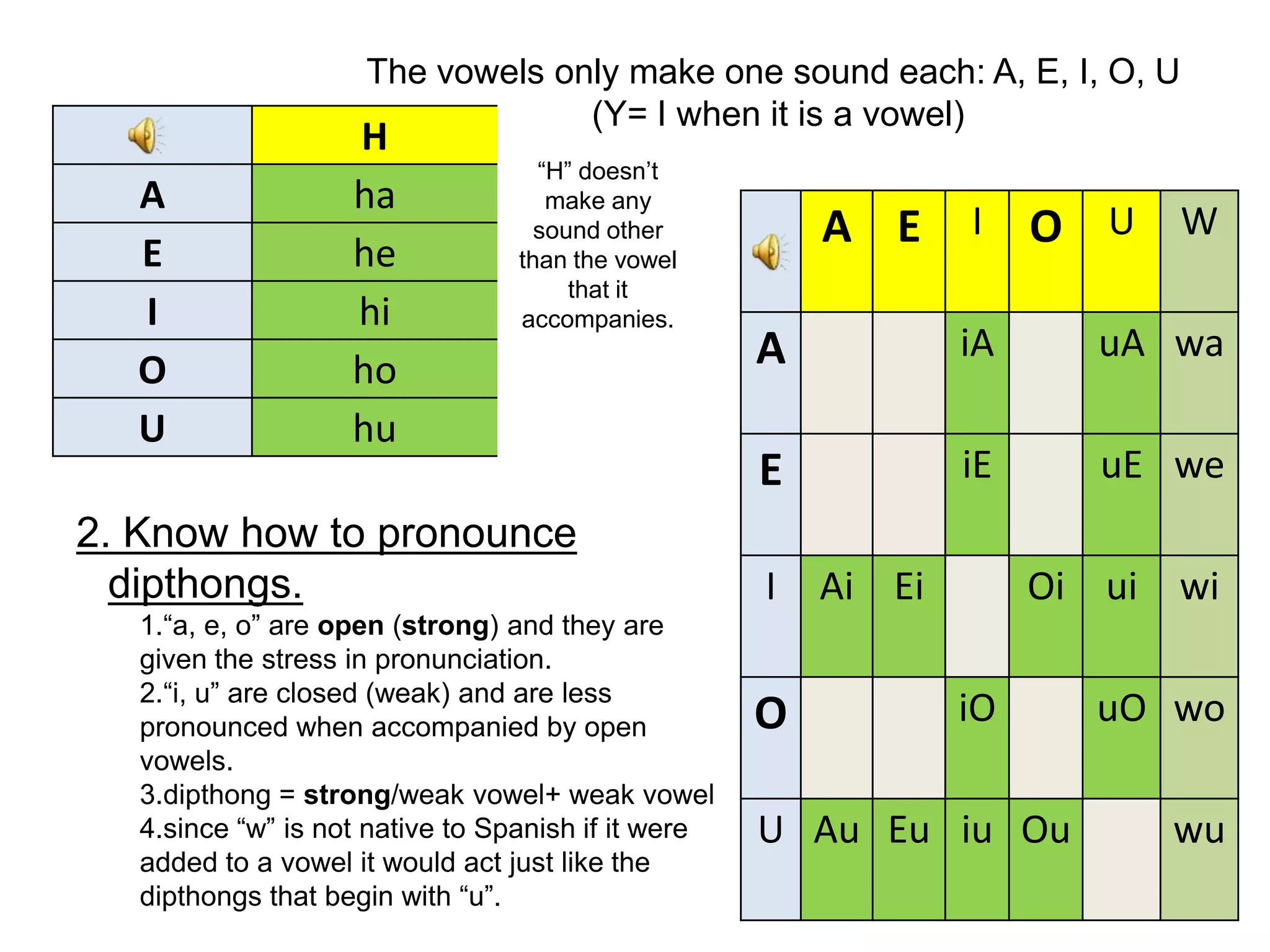
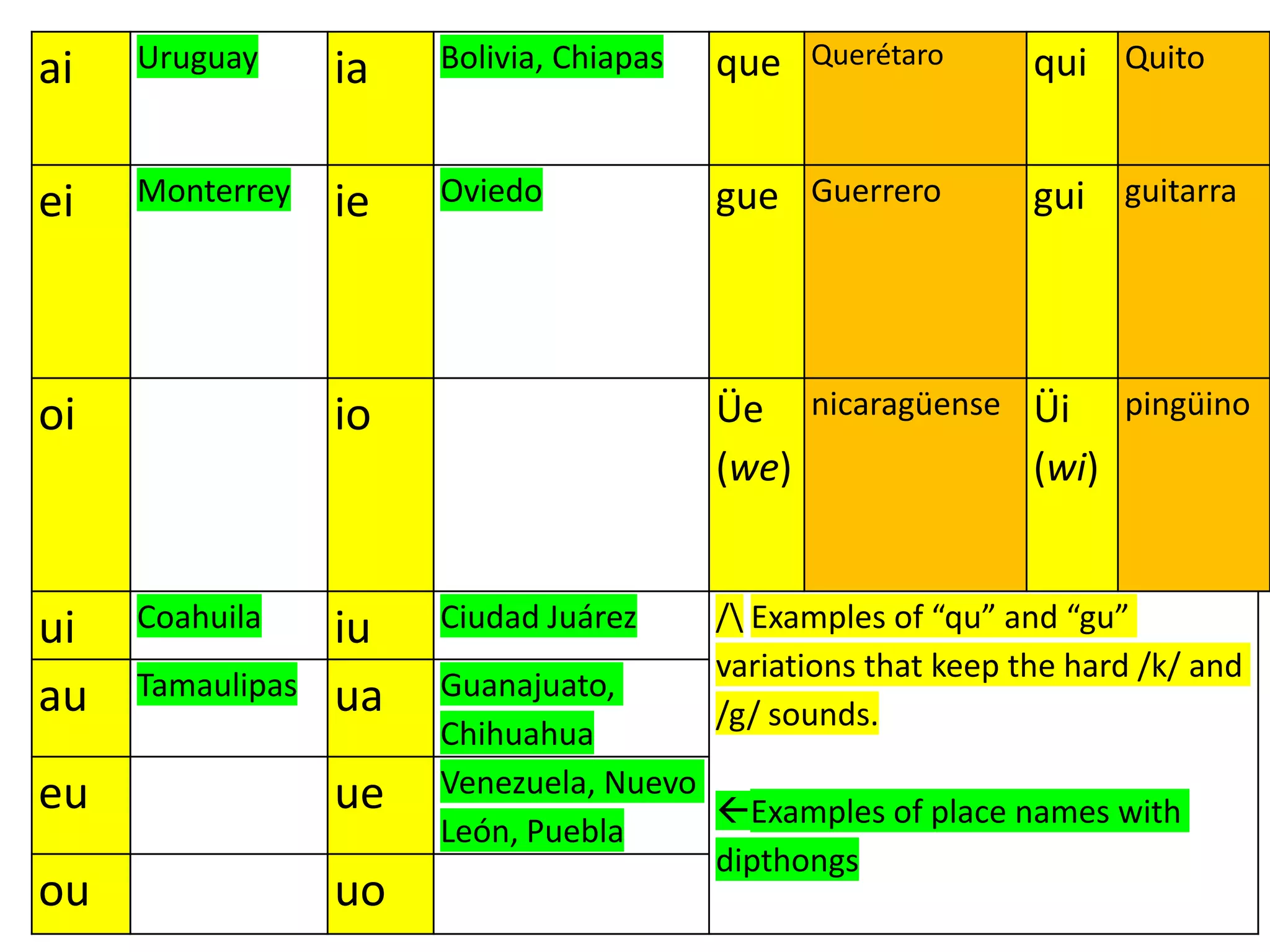
The vowels only make one sound each: A, E, I, O, U (Y= I when it is a vowel)“H” doesn’t make any sound other than the vowel that it accompanies.2. Know how to pronounce dipthongs. “a, e, o” are open (strong) and they are given the stress in pronunciation.“i, u” are closed (weak) and are less pronounced when accompanied by open vowels.dipthong = strong/weak vowel+ weak vowel since “w” is not native to Spanish if it were added to a vowel it would act just like the dipthongs that begin with “u”.
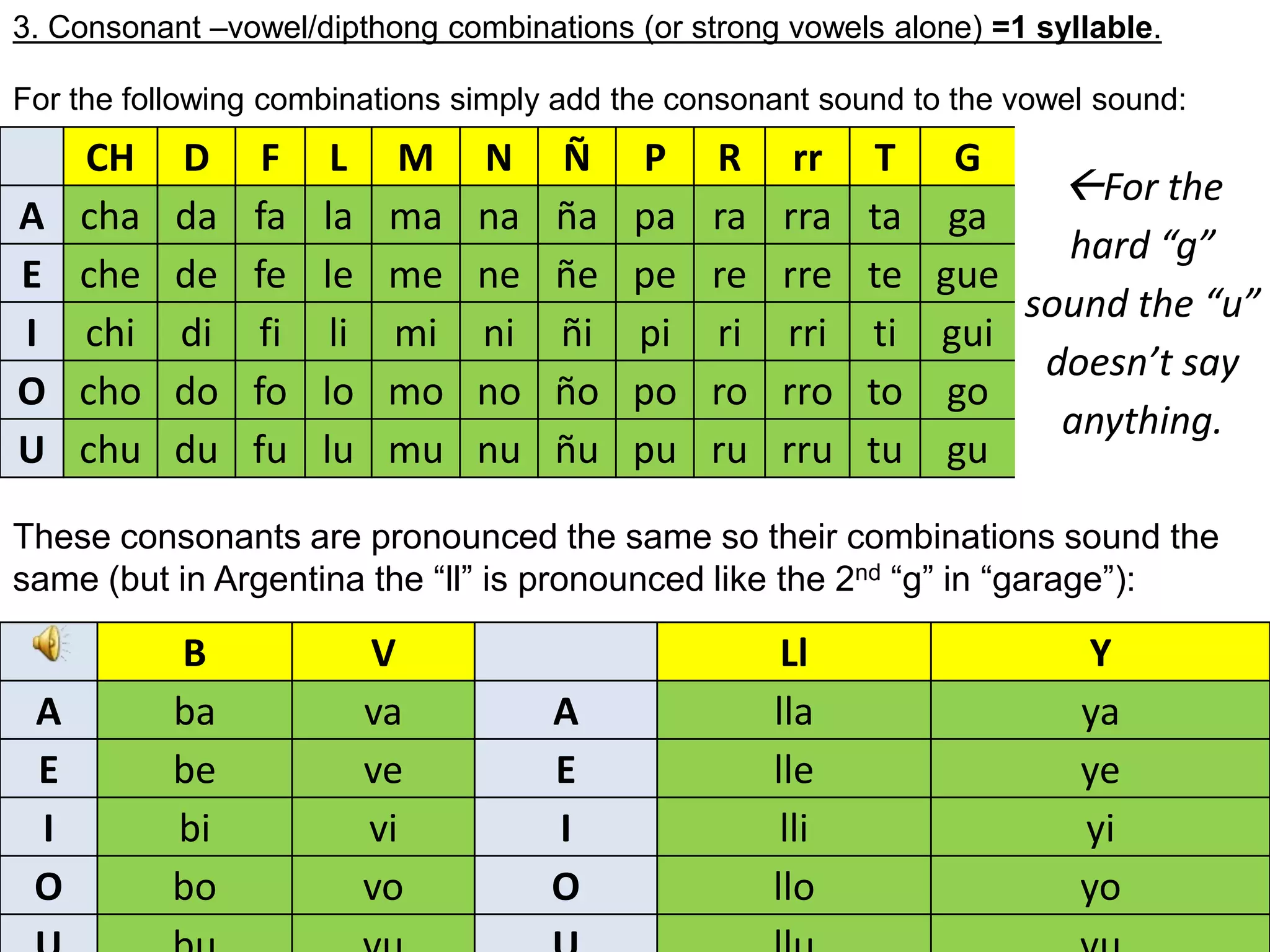
3. Consonant –vowel/dipthong combinations (or strong vowels alone) =1 syllable.For the following combinations simply add the consonant sound to the vowel sound:These consonants are pronounced the same so their combinations sound the same (but in Argentina the “ll” is pronounced like the 2nd “g” in “garage”):
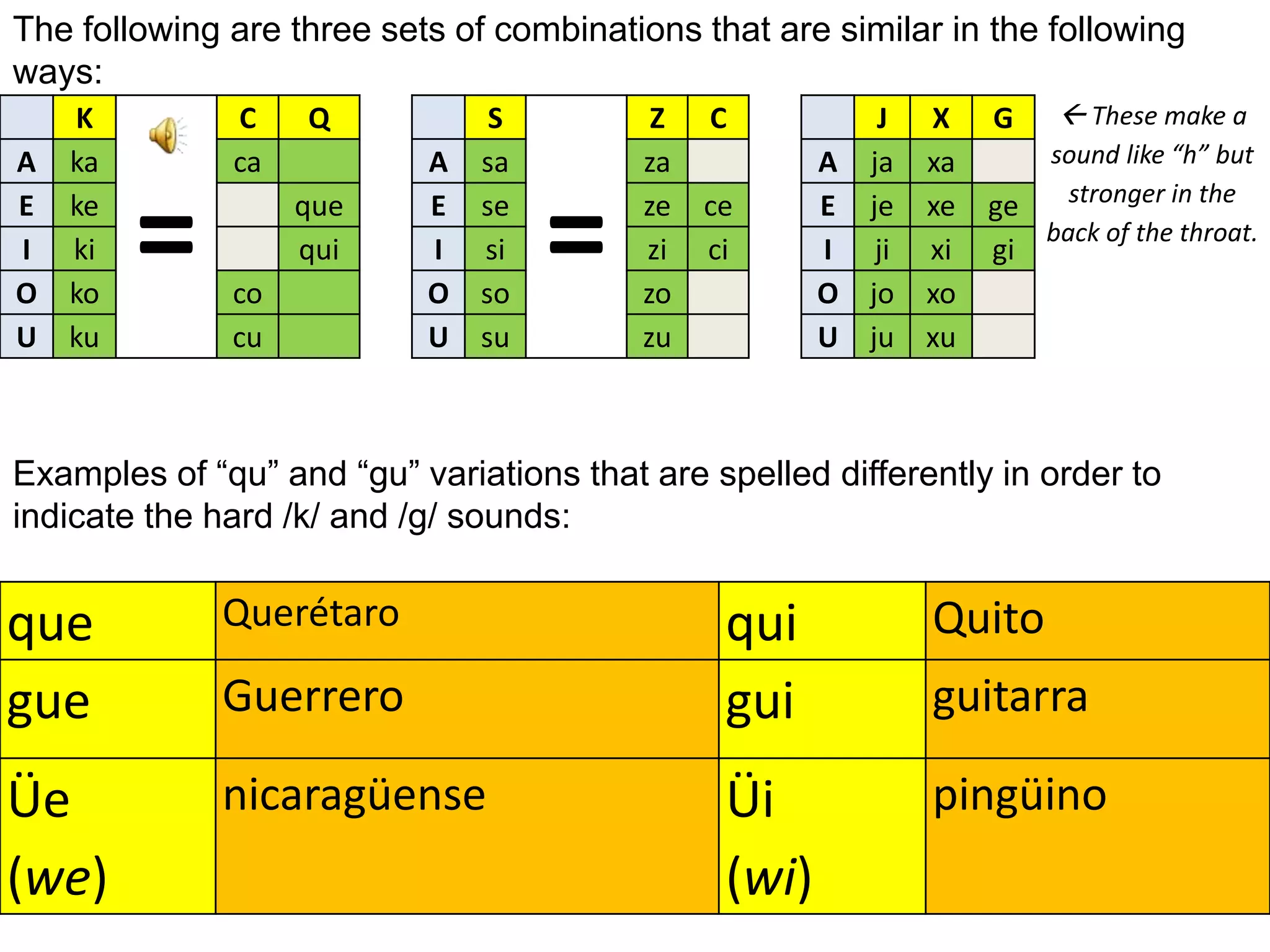
The following are three sets of combinations that are similar in the following ways:Examples of “qu” and “gu” variations that are spelled differently in order to indicate the hard /k/ and /g/ sounds:
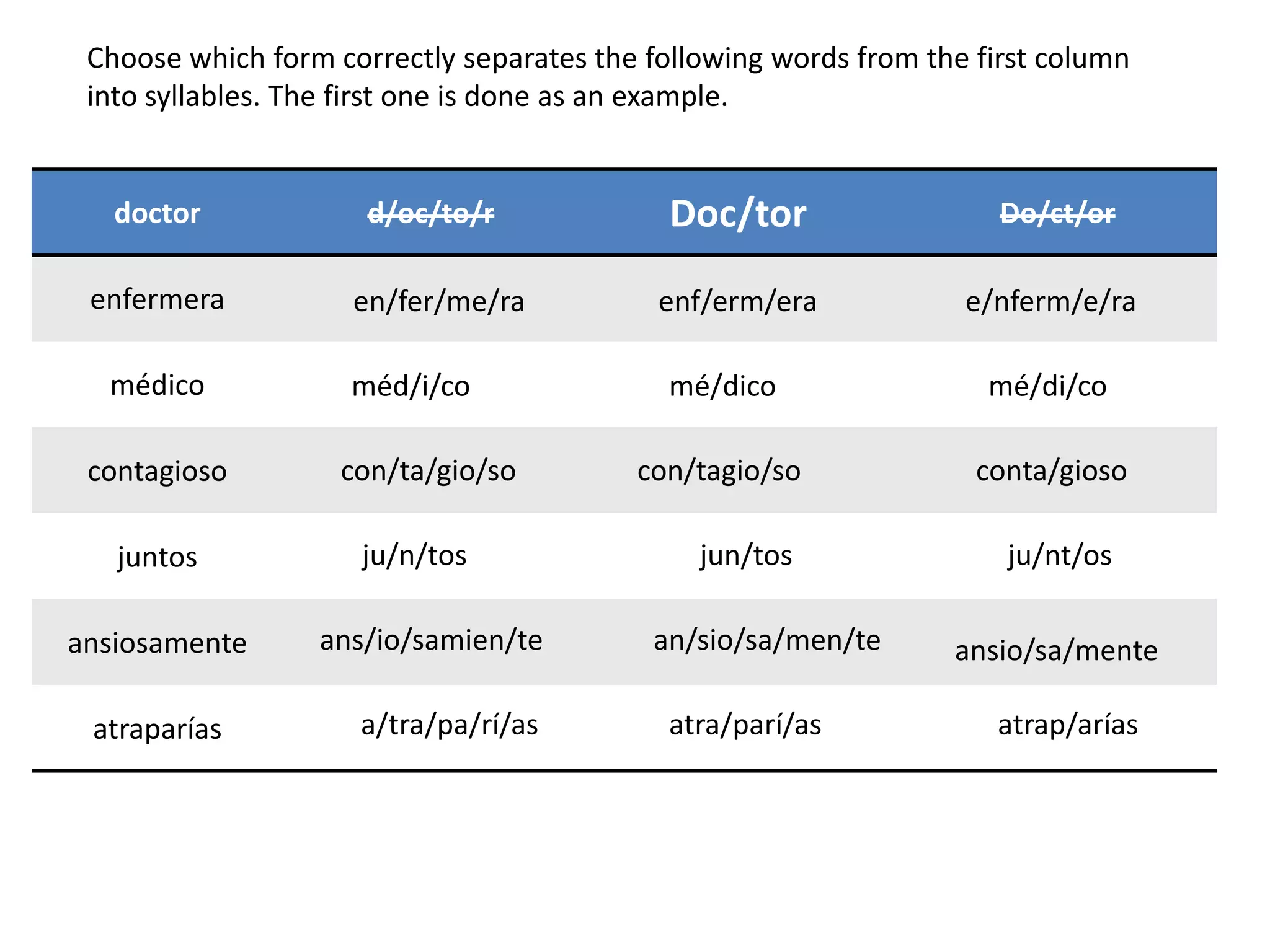
Choose which form correctly separates the following words from the first column into syllables. The first one is done as an example.en/fer/me/raenf/erm/erae/nferm/e/raméd/i/comé/dicomé/di/cocon/ta/gio/socon/tagio/soconta/giosoju/n/tosjun/tosju/nt/osans/io/samien/tean/sio/sa/men/teansio/sa/mentea/tra/pa/rí/asatra/parí/asatrap/arías
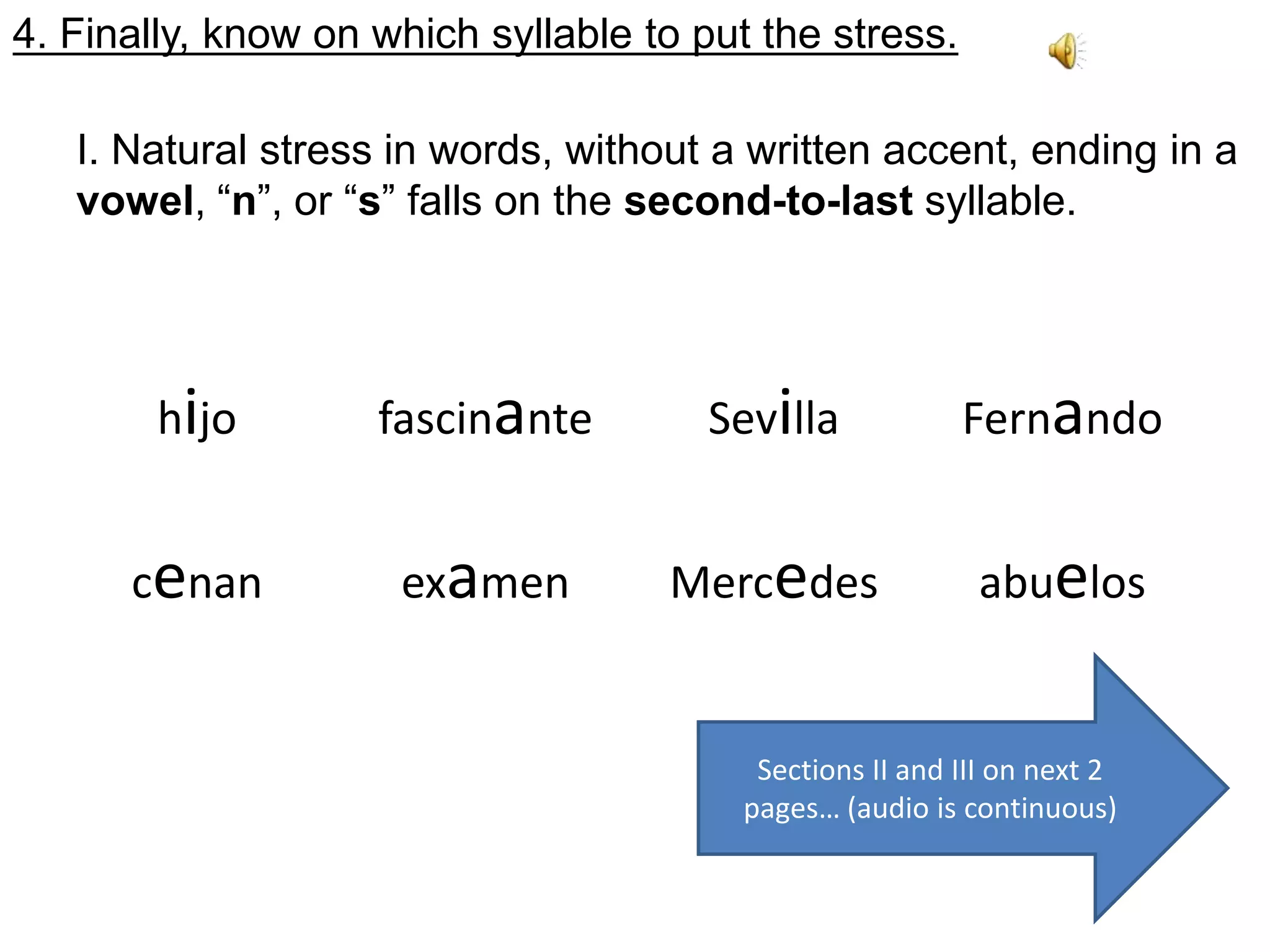
4. Finally, know on which syllable to put the stress.I. Natural stress in words, without a written accent, ending in a vowel, “n”, or “s” falls on the second-to-last syllable.Sections II and III onnext 2 pages… (audio iscontinuous)
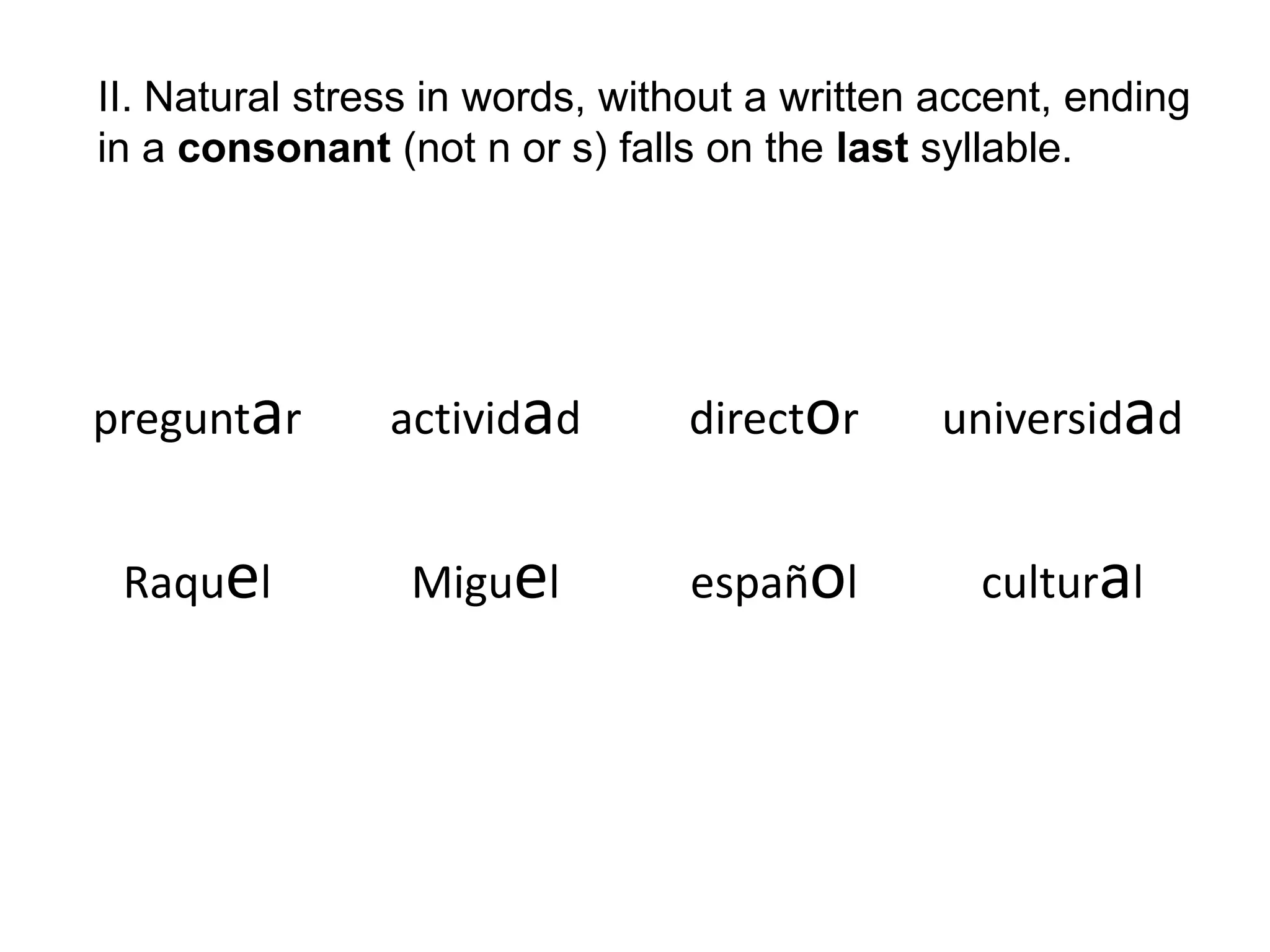
II. Natural stress in words, without a written accent, ending in a consonant (not n or s) falls on the last syllable.
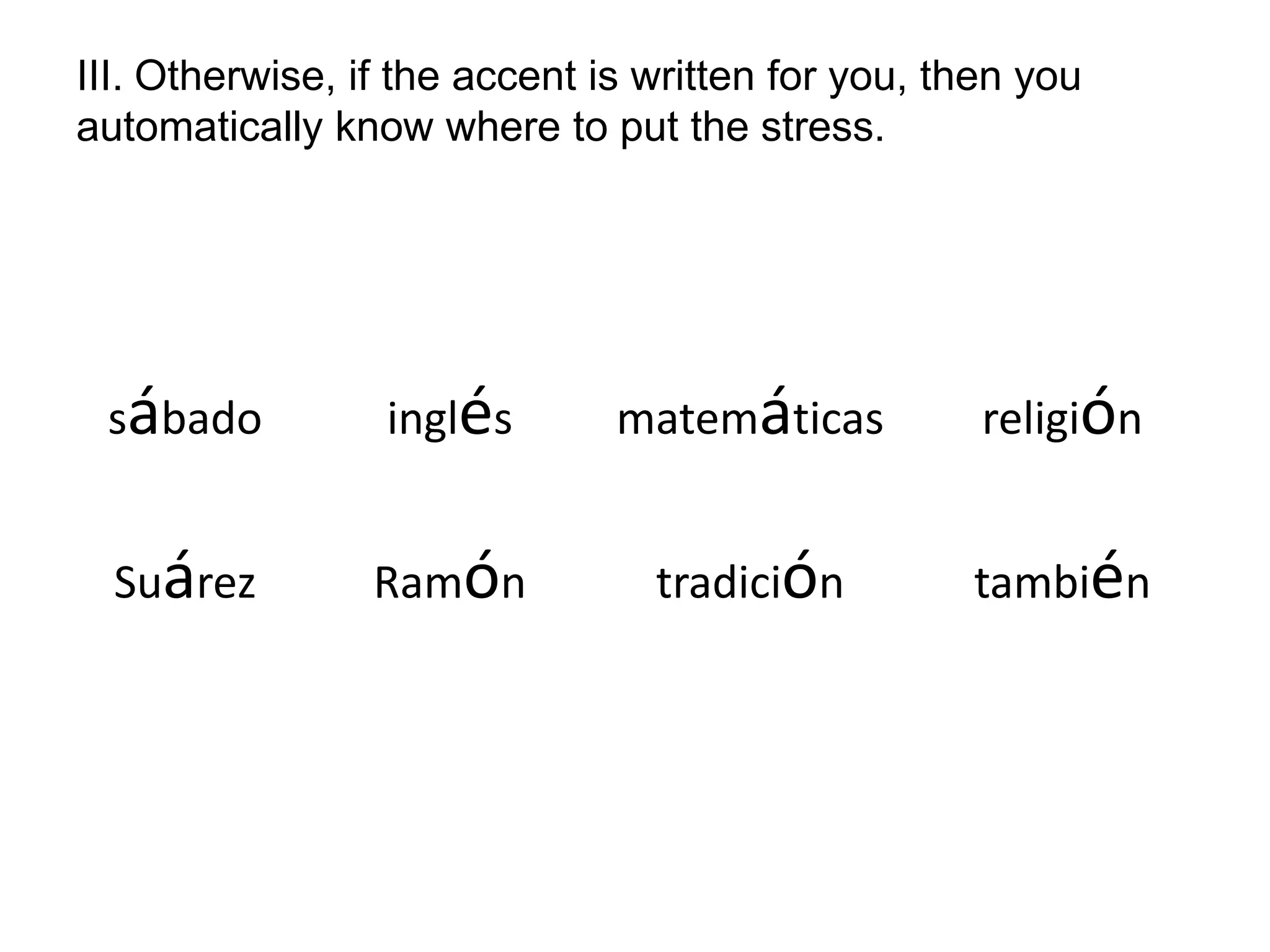
III. Otherwise, if the accent is written for you, then you automatically know where to put the stress.
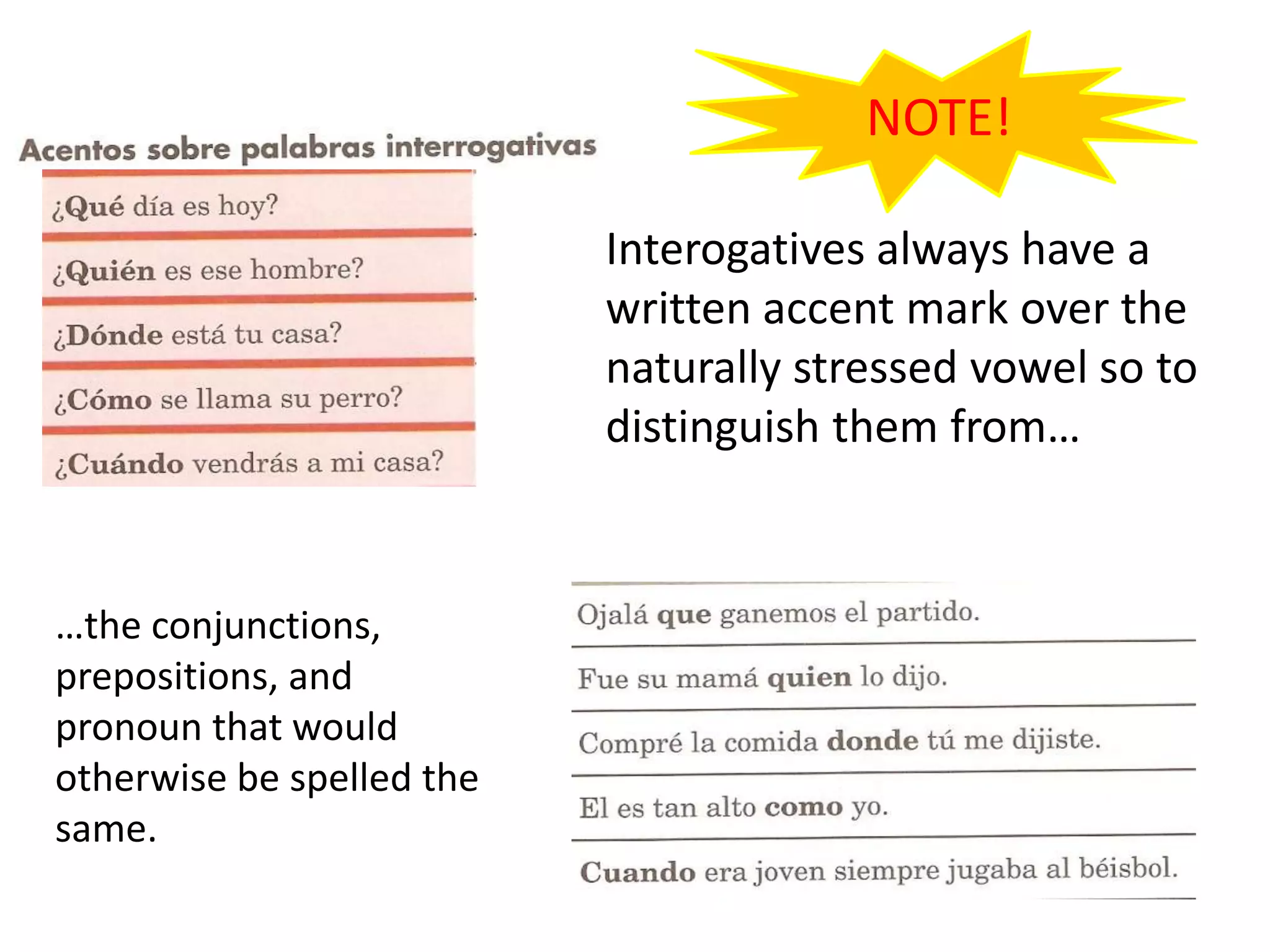
NOTE!Interogativesalwayshave a writtenaccentmarkoverthenaturallystressedvowel so todistinguishthemfrom… …theconjunctions, prepositions, and pronounthatwouldotherwisebespelledthesame.
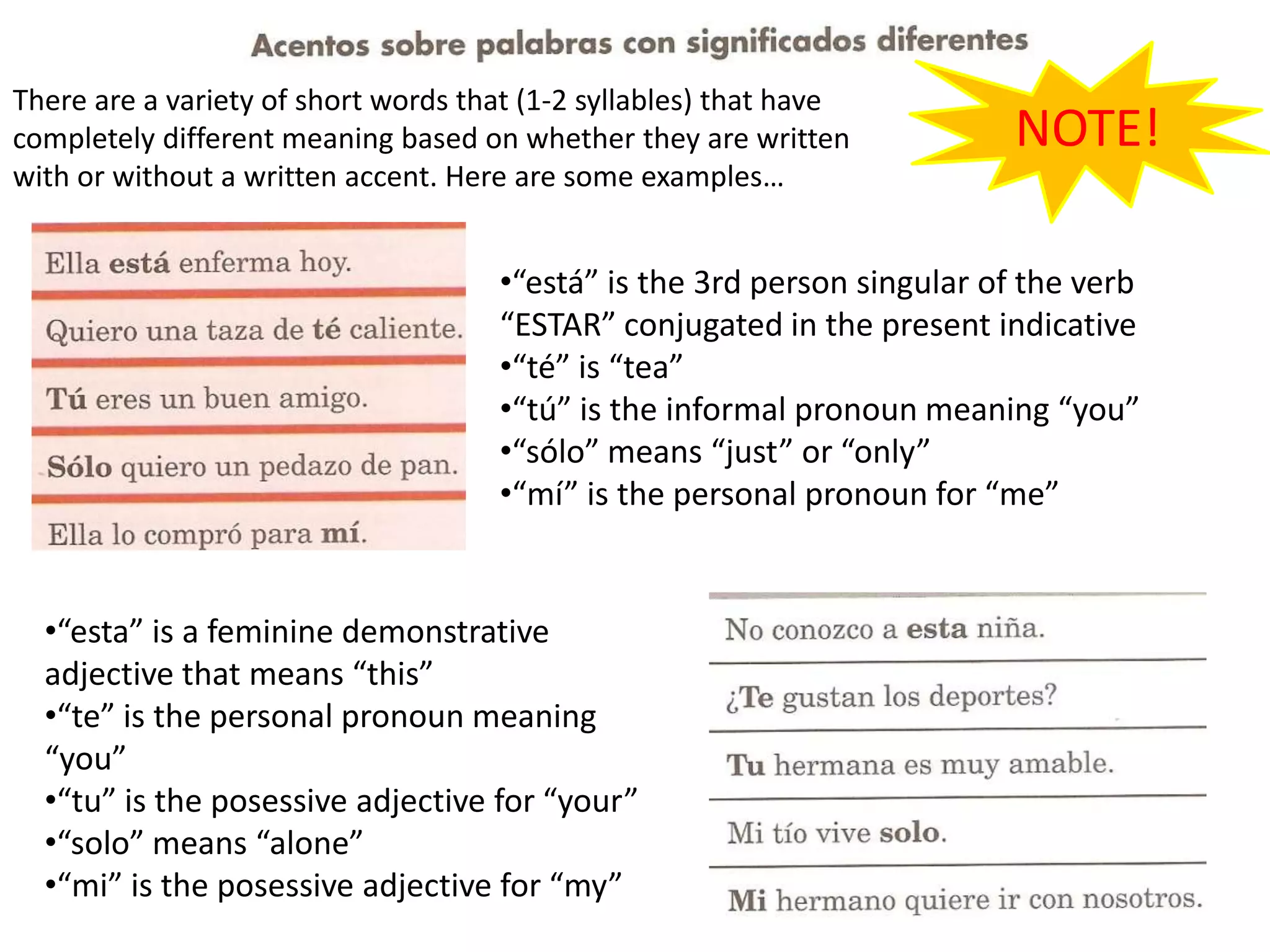
NOTE!There are a variety of short wordsthat (1-2 syllables) thathavecompletelydifferentmeaningbasedonwhetherthey are writtenwithorwithout a writtenaccent. Here are someexamples…“está” isthe 3rd person singular of theverb “ESTAR” conjugated in thepresentindicative
“té” is “tea”

Pronunciation tips

  • 1.
    ¡Pronunciaressencillo!Perhaps the mostimportant component in learning a second language is being able to read that language effectively. Follow these steps and you should have no problem reading new Spanish words thereafter. Spanish is a very easy language to decode (you are lucky you already know how to read English, which is a very difficult language to decode).
  • 2.
    Know what soundeach letter makes.
  • 3.
    El abecedario español/The Spanish alphabet
  • 4.
    The vowels onlymake one sound each: A, E, I, O, U (Y= I when it is a vowel)“H” doesn’t make any sound other than the vowel that it accompanies.2. Know how to pronounce dipthongs. “a, e, o” are open (strong) and they are given the stress in pronunciation.“i, u” are closed (weak) and are less pronounced when accompanied by open vowels.dipthong = strong/weak vowel+ weak vowel since “w” is not native to Spanish if it were added to a vowel it would act just like the dipthongs that begin with “u”.
  • 6.
    3. Consonant –vowel/dipthongcombinations (or strong vowels alone) =1 syllable.For the following combinations simply add the consonant sound to the vowel sound:These consonants are pronounced the same so their combinations sound the same (but in Argentina the “ll” is pronounced like the 2nd “g” in “garage”):
  • 7.
    The following arethree sets of combinations that are similar in the following ways:Examples of “qu” and “gu” variations that are spelled differently in order to indicate the hard /k/ and /g/ sounds:
  • 8.
    Choose which formcorrectly separates the following words from the first column into syllables. The first one is done as an example.en/fer/me/raenf/erm/erae/nferm/e/raméd/i/comé/dicomé/di/cocon/ta/gio/socon/tagio/soconta/giosoju/n/tosjun/tosju/nt/osans/io/samien/tean/sio/sa/men/teansio/sa/mentea/tra/pa/rí/asatra/parí/asatrap/arías
  • 9.
    4. Finally, knowon which syllable to put the stress.I. Natural stress in words, without a written accent, ending in a vowel, “n”, or “s” falls on the second-to-last syllable.Sections II and III onnext 2 pages… (audio iscontinuous)
  • 10.
    II. Natural stressin words, without a written accent, ending in a consonant (not n or s) falls on the last syllable.
  • 11.
    III. Otherwise, ifthe accent is written for you, then you automatically know where to put the stress.
  • 12.
    NOTE!Interogativesalwayshave a writtenaccentmarkoverthenaturallystressedvowelso todistinguishthemfrom… …theconjunctions, prepositions, and pronounthatwouldotherwisebespelledthesame.
  • 13.
    NOTE!There are avariety of short wordsthat (1-2 syllables) thathavecompletelydifferentmeaningbasedonwhetherthey are writtenwithorwithout a writtenaccent. Here are someexamples…“está” isthe 3rd person singular of theverb “ESTAR” conjugated in thepresentindicative
  • 14.
  • 15.
    “tú” isthe informalpronounmeaning “you”
  • 16.
  • 17.
    “mí” isthe personalpronounfor “me”
  • 18.
    “esta” is afemininedemonstrativeadjectivethatmeans “this”
  • 19.
    “te” isthe personalpronounmeaning “you”
  • 20.
  • 21.
  • 22.
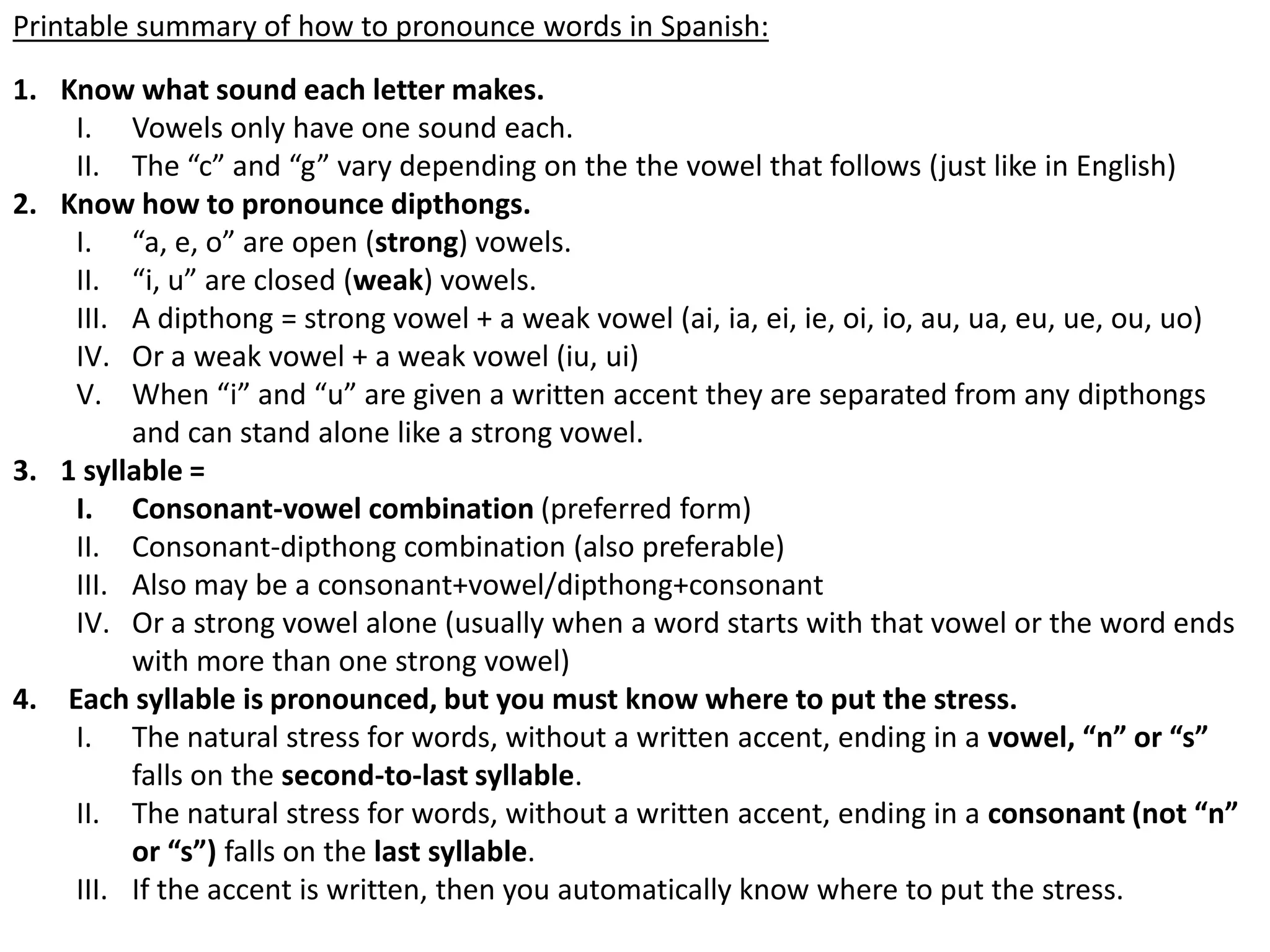
    “mi” istheposessiveadjectivefor“my”Printablesummary ofhowtopronouncewords in Spanish:Know what sound each letter makes.Vowels only have one sound each.The “c” and “g” vary depending on the the vowel that follows (just like in English)Know how to pronounce dipthongs.“a, e, o” are open (strong) vowels.“i, u” are closed (weak) vowels.A dipthong = strong vowel + a weak vowel (ai, ia, ei, ie, oi, io, au, ua, eu, ue, ou, uo)Or a weak vowel + a weak vowel (iu, ui)When “i” and “u” are given a written accent they are separated from any dipthongs and can stand alone like a strong vowel.1 syllable =Consonant-vowel combination (preferred form)Consonant-dipthong combination (also preferable)Also may be a consonant+vowel/dipthong+consonantOr a strong vowel alone (usually when a word starts with that vowel or the word ends with more than one strong vowel)Each syllable is pronounced, but you must know where to put the stress.The natural stress for words, without a written accent, ending in a vowel, “n” or “s” falls on the second-to-last syllable.The natural stress for words, without a written accent, ending in a consonant (not “n” or “s”) falls on the last syllable.If the accent is written, then you automatically know where to put the stress.