Grammar 101


Subject-Verb Agreement
 Rules and Exceptions
Learning Objectives

     Grasp the rules governing subjects and verbs in
    a sentence.

    Understand the exceptions.
Introduction

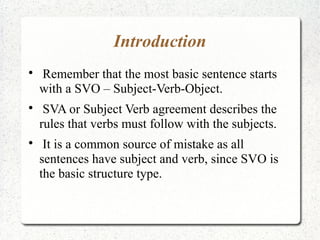
    Remember that the most basic sentence starts
    with a SVO – Subject-Verb-Object.

     SVA or Subject Verb agreement describes the
    rules that verbs must follow with the subjects.

     It is a common source of mistake as all
    sentences have subject and verb, since SVO is
    the basic structure type.
What must agree?

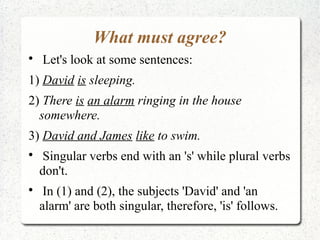
    Let's look at some sentences:
1) David is sleeping.
2) There is an alarm ringing in the house
  somewhere.
3) David and James like to swim.

     Singular verbs end with an 's' while plural verbs
    don't.

     In (1) and (2), the subjects 'David' and 'an
    alarm' are both singular, therefore, 'is' follows.
Subject-Verb Agreement (SVA)
One of the basic rules of grammar is that the subject
 and verb must agree:
Plural Noun (suffix 's') = Plural Verb (no 's')
Singular Noun (no 's') = Singular Verb (suffix 's')
The suffix 's' and 'es' are used to signal plural and
 singular nouns and verbs.
Note: If a noun or a verb ends with a 'y', 'es' is added:
Cry – cries / Fly – flies / worry – worries
SVA Advanced Rules
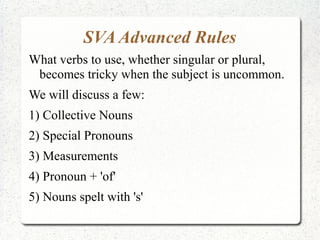
What verbs to use, whether singular or plural,
 becomes tricky when the subject is uncommon.
We will discuss a few:
1) Collective Nouns
2) Special Pronouns
3) Measurements
4) Pronoun + 'of'
5) Nouns spelt with 's'
1 - Collective Nouns
A collective noun groups people, animals or objects
  together such as:
    Army Furniture School Equipment Colony
So, whenever a collective noun is used, it is referred
  to as a single unit and hence, takes on singular
  verbs. For example,
1) An army approaches.
2) The school is impressive.
3) The equipment is not working.
2 - Special Pronouns
Special Pronouns include:
1) 'You' and 'I' and 2) 'All' and 'None'

    The first group takes on plural verbs, such as:
You are strong but I have my friend who is stronger.

    The second group takes on both S/P verbs.
When 'All' means everything: All is not lost.
 When it refer to many things: All are gone.
 When None refers to one: None of the pie was eaten.
 When None refers to many: None of the children
 were injured.
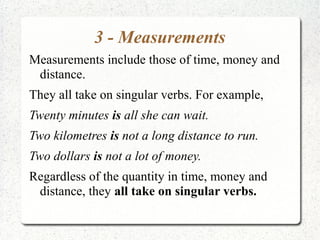
3 - Measurements
Measurements include those of time, money and
 distance.
They all take on singular verbs. For example,
Twenty minutes is all she can wait.
Two kilometres is not a long distance to run.
Two dollars is not a lot of money.
Regardless of the quantity in time, money and
 distance, they all take on singular verbs.
4 - Pronouns + 'of'
We are often tricked by the number and person of
 the noun following 'of', even if the singularity of
 the true subject is obvious.
In a moment of carelessness, for example,
A basket of apples were standing on the table. or
Each of us have finished our work.
These should be:
A basket of apples was standing on the table. and
Each of us has finished our work.
5 – Nouns with 's'
We are also tricked by nouns that are spelt with 's'.
 For example,
         News Banks Physics Mathematics
1) The good news is that we have been selected.
2) The river banks is overflowing.
3) Physics is not an easy subject for some.
4) Mathematics is easy once you have enough
  practice.
Learning Activity
For each of the question, use the correct verb to
  agree with the subject.
1) All of us ___ interested in the outing.
2) None of the children ___ absent from school.
3) The quality of these watches ___ good.
4) My favourite food ___ chicken rice.
5) Neither you nor he ___ to be rewarded.
6) The news ___ so sad.
Discussion
What do the SVA advanced rules teach us about
 certain subjects?
In Summary
SVA Advanced Rules teach us that we need to be
 careful with some subjects as they are tricky.

Upper pri exceptions to sva

  • 1.
  • 2.
    Learning Objectives  Grasp the rules governing subjects and verbs in a sentence.  Understand the exceptions.
  • 3.
    Introduction  Remember that the most basic sentence starts with a SVO – Subject-Verb-Object.  SVA or Subject Verb agreement describes the rules that verbs must follow with the subjects.  It is a common source of mistake as all sentences have subject and verb, since SVO is the basic structure type.
  • 4.
    What must agree?  Let's look at some sentences: 1) David is sleeping. 2) There is an alarm ringing in the house somewhere. 3) David and James like to swim.  Singular verbs end with an 's' while plural verbs don't.  In (1) and (2), the subjects 'David' and 'an alarm' are both singular, therefore, 'is' follows.
  • 5.
    Subject-Verb Agreement (SVA) Oneof the basic rules of grammar is that the subject and verb must agree: Plural Noun (suffix 's') = Plural Verb (no 's') Singular Noun (no 's') = Singular Verb (suffix 's') The suffix 's' and 'es' are used to signal plural and singular nouns and verbs. Note: If a noun or a verb ends with a 'y', 'es' is added: Cry – cries / Fly – flies / worry – worries
  • 6.
    SVA Advanced Rules Whatverbs to use, whether singular or plural, becomes tricky when the subject is uncommon. We will discuss a few: 1) Collective Nouns 2) Special Pronouns 3) Measurements 4) Pronoun + 'of' 5) Nouns spelt with 's'
  • 7.
    1 - CollectiveNouns A collective noun groups people, animals or objects together such as: Army Furniture School Equipment Colony So, whenever a collective noun is used, it is referred to as a single unit and hence, takes on singular verbs. For example, 1) An army approaches. 2) The school is impressive. 3) The equipment is not working.
  • 8.
    2 - SpecialPronouns Special Pronouns include: 1) 'You' and 'I' and 2) 'All' and 'None'  The first group takes on plural verbs, such as: You are strong but I have my friend who is stronger.  The second group takes on both S/P verbs. When 'All' means everything: All is not lost. When it refer to many things: All are gone. When None refers to one: None of the pie was eaten. When None refers to many: None of the children were injured.
  • 9.
    3 - Measurements Measurementsinclude those of time, money and distance. They all take on singular verbs. For example, Twenty minutes is all she can wait. Two kilometres is not a long distance to run. Two dollars is not a lot of money. Regardless of the quantity in time, money and distance, they all take on singular verbs.
  • 10.
    4 - Pronouns+ 'of' We are often tricked by the number and person of the noun following 'of', even if the singularity of the true subject is obvious. In a moment of carelessness, for example, A basket of apples were standing on the table. or Each of us have finished our work. These should be: A basket of apples was standing on the table. and Each of us has finished our work.
  • 11.
    5 – Nounswith 's' We are also tricked by nouns that are spelt with 's'. For example, News Banks Physics Mathematics 1) The good news is that we have been selected. 2) The river banks is overflowing. 3) Physics is not an easy subject for some. 4) Mathematics is easy once you have enough practice.
  • 12.
    Learning Activity For eachof the question, use the correct verb to agree with the subject. 1) All of us ___ interested in the outing. 2) None of the children ___ absent from school. 3) The quality of these watches ___ good. 4) My favourite food ___ chicken rice. 5) Neither you nor he ___ to be rewarded. 6) The news ___ so sad.
  • 13.
    Discussion What do theSVA advanced rules teach us about certain subjects?
  • 14.
    In Summary SVA AdvancedRules teach us that we need to be careful with some subjects as they are tricky.