1 
Phonics 
Panaga School
Programme 
• Introduction 
• Technical Language 
• Curriculum 
• How we teach phonics 
• Primary 1 
• Primary 2 
• Primary 3 
• Resources
Overview 
Panaga School
Background 
English 
• Difficult language to learn 
• Historically comes from various civilisations and 
languages 
• Made up of 44 sounds (phonemes) 
As a comparison: 
• Spanish - 24 sounds 
• Italian – 27 sounds 
• Finnish – 21 sounds
Technical Language 
• Alphabet (vowels and consonants) 
• Phonemes 
• Graphemes 
• Digraphs 
• Trigraphs 
• Vowel 
• Consonant 
• Blending (covered later in How We Teach) 
• Segmenting (covered later in How We Teach)
Technical Language 
Alphabet - 26 letters 
Vowels 
• a 
• e 
• i 
• o 
• u 
Consonants 
• b 
• c 
• d 
• f 
• g 
• h 
• j 
• k 
• l 
• m 
• n 
• p 
• q 
• r 
• s 
• t 
• v 
• w 
• x 
• y 
• z
Technical Language 
Alphabet 
However we are not interested in 
the letter names … 
only their phonemes!
Technical Language 
Phonemes 
• Spoken sounds 
• 44 in English 
• Split into 3 types 
• Single phonemes 
• Digraphs 
• Trigraphs
Technical Language 
Phonemes
Technical Language 
Graphemes 
• Written sounds 
• Far more than the 44 phonemes 
• Split into 4 types 
• Single graphemes 
• Digraphs (split digraphs) 
• Trigraphs 
• Quadgraphs
Technical Language 
Graphemes
Curriculum 
Split into 6 phases 
• Phase 1 - making sounds 
• Phase 2 - single phonemes 
• Phase 3 - phoneme diagraphs 
• Phase 4 - recapping Phase 2 and 3 with longer words 
• Phase 5 - phoneme trigraphs and all graphemes 
• Phase 6 - suffixes 
Before Primary 1 
Primary 1 
Primary 2 
Primary 3
Technical Language 
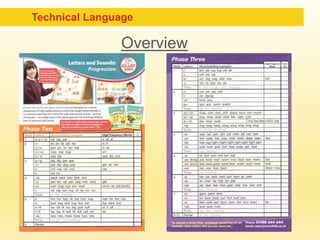
Overview
Technical Language 
Overview
Technical Language 
Overview
P1 Phonics 
Panaga School
Phonics in P1 
• An explanation of how phonics is taught 
in P1 and how you can support your 
child at home.
Phase 1 
Phase One of Letters and Sounds concentrates on developing 
children's speaking and listening skills and lays the foundations for the 
phonic work which starts in Phase 2. The emphasis during Phase 1 is to 
get children attuned to the sounds around them and ready to begin 
developing oral blending and segmenting skills. 
Phase 1 contains three strands: Tuning in to sounds (auditory 
discrimination), Listening and remembering sounds (auditory memory 
and sequencing) and Talking about sounds (developing vocabulary and 
language comprehension). 
Useful website for phase 1 games: 
http://www.letters-and-sounds.com/phase-1-games.html
Phase 2 
In Phase 2, letters and their phonemes are introduced one at a time. A 
set of letters is taught each week, in the following sequence: 
Set 1: s, a, t, p 
Set 2: i, n, m, d 
Set 3: g, o, c, k 
Set 4: ck, e, u, r 
Set 5: h, b, f, ff, l, ll, ss 
Hear it and say it, see it and say it, say it and write it
Teaching the sounds
Blending and Segmenting 
The children will begin to learn to blend and 
segment to begin reading and spelling. This will 
begin with simple words. 
Words using set 1 
at sat pat tap sap 
Words using set 1 and 2 
(+i) (+n) (+m) (+d) 
it an am dad 
is in man sad 
sit nip mat dim 
sat pan map din 
pit pin Pam did 
pip tan Tim Sid 
sip nap Sam and 
tip tin dip
Tricky Words 
Alongside this children are introduced to tricky words. 
These are the words that are irregular words. That 
means that phonics cannot be applied to the reading 
and spelling of these words. 
The tricky words introduced in phase 2 are: 
to the no go I
Blending for Reading
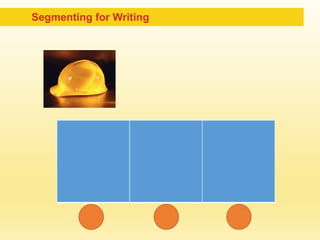
Segmenting for Writing
Applying to Reading or Writing 
The dog has a hat.
Phase 3 
By the time they reach Phase 3, children will already 
be able to blend and segment words containing the 
19 letters taught in Phase 2. 
Over the twelve weeks which Phase 3 is expected to 
last, twenty-five new graphemes are introduced (one 
at a time). 
Set 6: j, v, w, x 
Set 7: y, z, zz, qu 
Consonant digraphs: ch, sh, th, ng 
Vowel digraphs: ai, ee, igh, oa, oo, ar, or, ur, ow, oi, 
ear, air, ure, er
Phase 3 
• Tricky words: 
• we me be was no go 
• my you they her all are
P2 Phonics 
Panaga School
P2 Phonics Vocabulary 
 Phoneme – A unit of sound 
 Digraph – A phoneme made up of two letters 
 Trigraph – A phoneme made up of three letters 
 Quadgraph – A phoneme made up of four letters 
 Grapheme – The written phoneme 
 Blending – Strategy used to read (sound it out and 
say the word) 
 Segmenting – Strategy used to spell (say the word 
and sound it out)
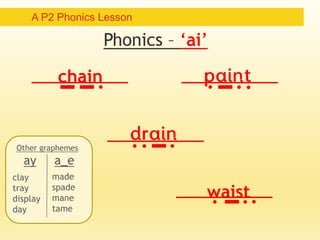
A P2 Phonics Lesson 
Phonics – ‘ai’ 
train rain chain grain 
drain paint Spain 
wait fail waist 
Other graphemes 
ay a_e 
clay 
made 
tray 
spade 
display 
mane 
day 
tame
A P2 Phonics Lesson 
Phonics – ‘ai’ 
train rain chain grain 
drain paint Spain 
wait fail waist 
Other graphemes 
ay a_e 
clay 
made 
tray 
spade 
display 
mane 
day 
tame
A P2 Phonics Lesson 
Phonics – ‘ai’ 
Other graphemes 
ay a_e 
clay 
made 
tray 
spade 
display 
mane 
day 
tame
A P2 Phonics Lesson 
Phonics – ‘ai’ 
chain 
Other graphemes 
ay a_e 
clay 
made 
tray 
spade 
display 
mane 
day 
tame 
waist
A P2 Phonics Lesson 
Graphemes we already know 
ar ch er 
sh ck th
A P2 Phonics Lesson 
High Frequency and Tricky Words 
said when that called was 
she we me my went 
her
P3 Phonics 
Panaga School
Coverage 
• Suffixes 
• Tenses 
• Polysyllabic Words 
• Apostrophes
Technical Language 
Word Types 
• Verb – action word 
• Noun – person, place or object 
• Adjective – describing word 
• Adverb – describes a verb
Suffixes 
Suffix 
• ed (jump – jumped) 
• ing (skip – skipping) 
• er (tall – taller) 
• est (small – smallest) 
• s/es (chair – chairs) 
• ly (slow – slowly) 
• y (rock – rocky) 
• ness (happy – happiness) 
• ment (enjoy – enjoyment) 
• ful (play – playful) 
• less (pain – painless) 
• en (flat – flatten) 
Word Type 
• verbs 
• verbs 
• adjectives 
• adjectives 
• nouns 
• adjective to an adverb 
• noun to a adjective 
• adjective to a noun 
• verb to a noun 
• verb to an adjective 
• noun to an adjective 
• noun to a verb
Tenses and Plurals 
Regular verbs 
• play - playing/played 
Irregular verbs 
• run - running/ran 
• go - going/went 
Regular verbs 
• shoe - shoes 
Irregular verbs 
• child - children 
• sheep - sheep
Polysyllabic Words 
Polysyllabic - more than one syllable 
• fishfinger 
• cupboard 
• clingfilm 
• Springboard 
• nightmare 
• enormous 
• homeless 
• fantastic
Apostrophes 
Possession 
• That pen is Mr Dave’s pen. 
• That iPad is your Dad’s iPad. 
• Please get in your Mum’s shiny car. 
Omission/Contraction 
• do not – don’t 
• we are – we’re 
• should not – shouldn’t
Resources 
Panaga School
Resources 
Key Words
Resources 
Websites for Downloading Resources 
• www.sparklebox.co.uk 
• www.twinkl.co.uk 
• http://www.communication4all.co.uk/http/PhonicsPlus.htm 
Websites for Interactive Stories 
• http://www.oxfordowl.co.uk/
Resources 
Websites for Interactive Games 
• http://www.bbc.co.uk/bitesize/ks1/literacy/ 
• http://www.letters-and-sounds.com/phase-2.html 
• http://www.nessy.com/ 
• http://www.bbc.co.uk/schools/wordsandpictures/ 
• http://www.bugclub.co.uk 
Useful App for Phase 2: 
• http://www.nessy.com/hairyletters/
Panaga School Phonics Presentation October 2014

Panaga School Phonics Presentation October 2014

  • 1.
  • 2.
    Programme • Introduction • Technical Language • Curriculum • How we teach phonics • Primary 1 • Primary 2 • Primary 3 • Resources
  • 3.
  • 4.
    Background English •Difficult language to learn • Historically comes from various civilisations and languages • Made up of 44 sounds (phonemes) As a comparison: • Spanish - 24 sounds • Italian – 27 sounds • Finnish – 21 sounds
  • 5.
    Technical Language •Alphabet (vowels and consonants) • Phonemes • Graphemes • Digraphs • Trigraphs • Vowel • Consonant • Blending (covered later in How We Teach) • Segmenting (covered later in How We Teach)
  • 6.
    Technical Language Alphabet- 26 letters Vowels • a • e • i • o • u Consonants • b • c • d • f • g • h • j • k • l • m • n • p • q • r • s • t • v • w • x • y • z
  • 7.
    Technical Language Alphabet However we are not interested in the letter names … only their phonemes!
  • 8.
    Technical Language Phonemes • Spoken sounds • 44 in English • Split into 3 types • Single phonemes • Digraphs • Trigraphs
  • 9.
  • 10.
    Technical Language Graphemes • Written sounds • Far more than the 44 phonemes • Split into 4 types • Single graphemes • Digraphs (split digraphs) • Trigraphs • Quadgraphs
  • 11.
  • 12.
    Curriculum Split into6 phases • Phase 1 - making sounds • Phase 2 - single phonemes • Phase 3 - phoneme diagraphs • Phase 4 - recapping Phase 2 and 3 with longer words • Phase 5 - phoneme trigraphs and all graphemes • Phase 6 - suffixes Before Primary 1 Primary 1 Primary 2 Primary 3
  • 13.
  • 14.
  • 15.
  • 16.
  • 17.
    Phonics in P1 • An explanation of how phonics is taught in P1 and how you can support your child at home.
  • 18.
    Phase 1 PhaseOne of Letters and Sounds concentrates on developing children's speaking and listening skills and lays the foundations for the phonic work which starts in Phase 2. The emphasis during Phase 1 is to get children attuned to the sounds around them and ready to begin developing oral blending and segmenting skills. Phase 1 contains three strands: Tuning in to sounds (auditory discrimination), Listening and remembering sounds (auditory memory and sequencing) and Talking about sounds (developing vocabulary and language comprehension). Useful website for phase 1 games: http://www.letters-and-sounds.com/phase-1-games.html
  • 19.
    Phase 2 InPhase 2, letters and their phonemes are introduced one at a time. A set of letters is taught each week, in the following sequence: Set 1: s, a, t, p Set 2: i, n, m, d Set 3: g, o, c, k Set 4: ck, e, u, r Set 5: h, b, f, ff, l, ll, ss Hear it and say it, see it and say it, say it and write it
  • 20.
  • 21.
    Blending and Segmenting The children will begin to learn to blend and segment to begin reading and spelling. This will begin with simple words. Words using set 1 at sat pat tap sap Words using set 1 and 2 (+i) (+n) (+m) (+d) it an am dad is in man sad sit nip mat dim sat pan map din pit pin Pam did pip tan Tim Sid sip nap Sam and tip tin dip
  • 22.
    Tricky Words Alongsidethis children are introduced to tricky words. These are the words that are irregular words. That means that phonics cannot be applied to the reading and spelling of these words. The tricky words introduced in phase 2 are: to the no go I
  • 23.
  • 24.
  • 25.
    Applying to Readingor Writing The dog has a hat.
  • 26.
    Phase 3 Bythe time they reach Phase 3, children will already be able to blend and segment words containing the 19 letters taught in Phase 2. Over the twelve weeks which Phase 3 is expected to last, twenty-five new graphemes are introduced (one at a time). Set 6: j, v, w, x Set 7: y, z, zz, qu Consonant digraphs: ch, sh, th, ng Vowel digraphs: ai, ee, igh, oa, oo, ar, or, ur, ow, oi, ear, air, ure, er
  • 27.
    Phase 3 •Tricky words: • we me be was no go • my you they her all are
  • 28.
  • 29.
    P2 Phonics Vocabulary  Phoneme – A unit of sound  Digraph – A phoneme made up of two letters  Trigraph – A phoneme made up of three letters  Quadgraph – A phoneme made up of four letters  Grapheme – The written phoneme  Blending – Strategy used to read (sound it out and say the word)  Segmenting – Strategy used to spell (say the word and sound it out)
  • 30.
    A P2 PhonicsLesson Phonics – ‘ai’ train rain chain grain drain paint Spain wait fail waist Other graphemes ay a_e clay made tray spade display mane day tame
  • 31.
    A P2 PhonicsLesson Phonics – ‘ai’ train rain chain grain drain paint Spain wait fail waist Other graphemes ay a_e clay made tray spade display mane day tame
  • 32.
    A P2 PhonicsLesson Phonics – ‘ai’ Other graphemes ay a_e clay made tray spade display mane day tame
  • 33.
    A P2 PhonicsLesson Phonics – ‘ai’ chain Other graphemes ay a_e clay made tray spade display mane day tame waist
  • 34.
    A P2 PhonicsLesson Graphemes we already know ar ch er sh ck th
  • 35.
    A P2 PhonicsLesson High Frequency and Tricky Words said when that called was she we me my went her
  • 36.
  • 37.
    Coverage • Suffixes • Tenses • Polysyllabic Words • Apostrophes
  • 38.
    Technical Language WordTypes • Verb – action word • Noun – person, place or object • Adjective – describing word • Adverb – describes a verb
  • 39.
    Suffixes Suffix •ed (jump – jumped) • ing (skip – skipping) • er (tall – taller) • est (small – smallest) • s/es (chair – chairs) • ly (slow – slowly) • y (rock – rocky) • ness (happy – happiness) • ment (enjoy – enjoyment) • ful (play – playful) • less (pain – painless) • en (flat – flatten) Word Type • verbs • verbs • adjectives • adjectives • nouns • adjective to an adverb • noun to a adjective • adjective to a noun • verb to a noun • verb to an adjective • noun to an adjective • noun to a verb
  • 40.
    Tenses and Plurals Regular verbs • play - playing/played Irregular verbs • run - running/ran • go - going/went Regular verbs • shoe - shoes Irregular verbs • child - children • sheep - sheep
  • 41.
    Polysyllabic Words Polysyllabic- more than one syllable • fishfinger • cupboard • clingfilm • Springboard • nightmare • enormous • homeless • fantastic
  • 42.
    Apostrophes Possession •That pen is Mr Dave’s pen. • That iPad is your Dad’s iPad. • Please get in your Mum’s shiny car. Omission/Contraction • do not – don’t • we are – we’re • should not – shouldn’t
  • 43.
  • 44.
  • 45.
    Resources Websites forDownloading Resources • www.sparklebox.co.uk • www.twinkl.co.uk • http://www.communication4all.co.uk/http/PhonicsPlus.htm Websites for Interactive Stories • http://www.oxfordowl.co.uk/
  • 46.
    Resources Websites forInteractive Games • http://www.bbc.co.uk/bitesize/ks1/literacy/ • http://www.letters-and-sounds.com/phase-2.html • http://www.nessy.com/ • http://www.bbc.co.uk/schools/wordsandpictures/ • http://www.bugclub.co.uk Useful App for Phase 2: • http://www.nessy.com/hairyletters/