PRODUCTION TECHNOLOGY OF 
Submitted by-GROUP NO- 7 
AMAN MISHRA-12BSCAG071 
12BSCAG072 
12BSCAG074 
12BSCAG075 
12BSCAG077 
12BSCAG079 
12BSCAG080
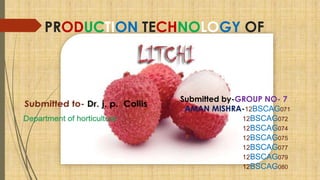
LITCHI
Plant Description: 
HEIGHT- less than 19 m (62 ft) 
The bark is grey-black, the branches a 
brownish-red 
ROOT- shallow rooted 
Leaves-compound with leaflets in 2-4 pairs 
flowers -small, yellowish-white 
Inflorescence- compound raceme 
Fruit type- nut, contain:- aril- 70-86% 
peel-8-15% 
seed-4-18% 
edible portion- fleshly aril 
Pollination system: cross pollinated crop
NUTRITIVE VALUE 
Energy 276 kJ (66 kcal) 
Carbohydrates 16.53 g 
Sugars 15.23 g 
Dietary fiber 1.3 g 
Dietary fiber 1.3 g 
Vitamin C 71.5 mg (86%)
AREA & PRODUCTION 
 `China` is the biggest producer of litchi in the world. 
India rank second in the the world(Area & Production). 
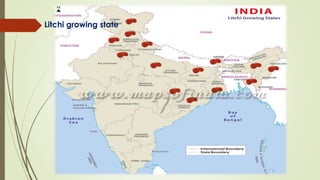
In india litchi is grown on large scale in Bihar. 
State rank – `Bihar`(area & production) 
`West Bengal`(productivity)
Litchi growing state
State-wise Area, Production & Productivity of 
State Area 
Litchi 
(‘000 Ha.) 
Production 
(‘000 MT) 
Productivity 
(MT/Ha.) 
Bihar 27.7 221.7 8.0 
West Bengal 5.9 61.4 10.5 
Assam 4.1 18.7 4.6 
Punjab 1.2 11.6 10.0 
Orissa 3.5 10.2 2.9 
Tripura 1.7 9.0 5.1 
Jharkhand 1.5 7.5 5.0 
Uttaranchal 7.8 7.5 1.0 
Nagaland 0.8 4.0 5.1 
Others 4.0 4.5 - 
TOTAL 58.2 356.2 6.1
ECOLOGICAL REQURIMENT 
 Litchi is subtropical fruit 
 Bearing tree are much affected by 
HOT WIND causing fruit cracking 
SOIL 
 Alluvial soil with good 
drainage is suitable for litchi 
orchard. 
 It can grow in wide range of 
soils from light sandy to heavy 
clay. 
TEMPERATURE 
 The temperature should not 
go beyond 40.5 0C in 
summer and below freezing 
point in winter
VARIETIES 
EARLY-dehradoon(fruit have an attractive colour), 
Early badam (seedless variety) , 
muzzafarpur, shahi 
MEDIUM- rose santed, Mclean 
LATE- seedless late(late bedana), calcttia, china
PROPOGATION 
 From Seed 
 Through vegetative. 
SEED 
Litchi seed loses its viability with in 4-5days of its extraction from the 
fruit. 
The trees raised from seeds are very slow to come into bearing and 
may take 10-12 years to come to bearing. 
VEGETATIVE 
 In vegetative propogation technique, litchi can be propagated 
through cutting, budding, layering and grafting. 
 AIR LAYERING(in the month jun-july) is the Commercial method of 
propogation.
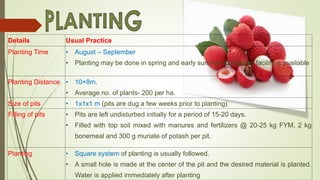
Details Usual Practice 
Planting Time • August – September 
• Planting may be done in spring and early summer if irrigation facility is available 
Planting Distance • 10×8m. 
• Average no. of plants- 200 per ha. 
Size of pits • 1x1x1 m (pits are dug a few weeks prior to planting) 
Filling of pits • Pits are left undisturbed initially for a period of 15-20 days. 
• Filled with top soil mixed with manures and fertilizers @ 20-25 kg FYM, 2 kg 
bonemeal and 300 g muriate of potash per pit. 
Planting • Square system of planting is usually followed. 
• A small hole is made at the center of the pit and the desired material is planted. 
Water is applied immediately after planting
Age of the plant 
(in years) 
Manure/Fertilizer applied (per plant/year in kg) 
FYM CAN (Calcium 
ammonium 
nitrate) 
Super phosphate Muriate of potash 
1-3 10 - 20 0.3-1.00 0.2-0.6 0.05-0.15 
4-6 25 - 40 1.0-2.0 0.75-1.25 0.20-0.30 
7-10 40 – 50 2.0-3.0 1.50-2.0 0.35-0.45 
Above 10 60 3.5 2.25 0.60
Irrigation 
Methods- Basin or ring system of irrigation is recommended. 
Two irrigations at an interval of 45 – 60 days during winter 
months is required for bearing litchi trees. 
The trees are irrigated from fl owering onwards until the 
completion of the post-harvest fl ush. However, the growers 
normally irrigate the tree at 7 to 10 day intervals from panicle 
emergence to fruit harvest or until the post-harvest fl ush 
appears
Intercultural Operations 
Mulching- The farmyard 
manure, compost or straw 
may be used for soil 
mulching. 
Cutting down of tall growing 
weeds in the orchard and 
spreading them over the soil 
is another method of 
mulching the soil. 
Training & Pruning- After 
planting, a certain amount of 
pruning is often necessary to 
give proper shape to the litchi 
plant 
Once the desired shape is 
achieved, no pruning is 
usually necessary, except the 
removal of dead or diseased 
branches
Weed control 
Weeds compete with the trees for water and nutrients. 
Mulches used include wheat, barley or rice straw, hay, 
sorghum stubble and similar materials. 
Reduce costs by growing mulch material between the 
rows for later slashing.
Plant Protection Measures 
Diseases 
Litchi is almost free from fungal diseases in India. 
Few diseases have been reported from any litchi-growing 
locally. 
1-Leaf spots 
2-Red rust
Phiological Disorder 
Fruit cracking 
Presence of optimum moisture level in the soil 
during fruit development is crucial for reducing fruit 
cracking and quality litchi production Early varieties are 
more susceptible to cracking than late ripening one. 
Flower and fruit drop 
Sunburn
Pest control 
1- Fruit flies 
They cause severe damage to litchi fruit, especially 
during fruit formation. 
2-Litchi moth 
This species also attacks macadamia nuts and is 
related to the false codling moth, Cryptophlebia leucotreta 
(Meyrick), although it has not been recorded on citrus yet, which 
is the main host of the latter pest. 
Control- 
The use of bait must be applied correctly and regularly to ensure 
good results – 5 g trichlorfon 95% wsp + 25 ml protein hydrolysate 
(or 800 g sugar) + 10 litres of water. Apply to each tree by using a 
knapsack sprayer. Apply twice a week.
Harvesting 
 Depending on the tree age there are four growth phases in litchi 
plants 
 young non-bearing stage (1-3 years), 
 young bearing stage (6-10 years), 
 junior adult bearing stage (11-20 years) 
 senior adult bearing stage (21 years and 
above). 
 Harvesting is usually done in May and June. 
 The fruits are harvested in bunches along with a portion of the 
branch and a few leaves.
Yield 
the litchi tree yields 40-100 kg. fruits annually depending on the variety, 
locality, season, nutrition and age 
Processing 
Processing of lychee is done in different forms. Canning of pulp, aseptic 
packing and ready to serve lychee juice are common. Dried lychee 
processing is not in practice. Pulp of lychee is aseptically packed and 
stored at 2-3°C for preparing lychee juice.
THANK YOU 
http://WWW.AMN.SITE90.NET

LITCHI

  • 1.
    PRODUCTION TECHNOLOGY OF Submitted by-GROUP NO- 7 AMAN MISHRA-12BSCAG071 12BSCAG072 12BSCAG074 12BSCAG075 12BSCAG077 12BSCAG079 12BSCAG080
  • 2.
  • 3.
    Plant Description: HEIGHT-less than 19 m (62 ft) The bark is grey-black, the branches a brownish-red ROOT- shallow rooted Leaves-compound with leaflets in 2-4 pairs flowers -small, yellowish-white Inflorescence- compound raceme Fruit type- nut, contain:- aril- 70-86% peel-8-15% seed-4-18% edible portion- fleshly aril Pollination system: cross pollinated crop
  • 4.
    NUTRITIVE VALUE Energy276 kJ (66 kcal) Carbohydrates 16.53 g Sugars 15.23 g Dietary fiber 1.3 g Dietary fiber 1.3 g Vitamin C 71.5 mg (86%)
  • 5.
    AREA & PRODUCTION  `China` is the biggest producer of litchi in the world. India rank second in the the world(Area & Production). In india litchi is grown on large scale in Bihar. State rank – `Bihar`(area & production) `West Bengal`(productivity)
  • 6.
  • 7.
    State-wise Area, Production& Productivity of State Area Litchi (‘000 Ha.) Production (‘000 MT) Productivity (MT/Ha.) Bihar 27.7 221.7 8.0 West Bengal 5.9 61.4 10.5 Assam 4.1 18.7 4.6 Punjab 1.2 11.6 10.0 Orissa 3.5 10.2 2.9 Tripura 1.7 9.0 5.1 Jharkhand 1.5 7.5 5.0 Uttaranchal 7.8 7.5 1.0 Nagaland 0.8 4.0 5.1 Others 4.0 4.5 - TOTAL 58.2 356.2 6.1
  • 8.
    ECOLOGICAL REQURIMENT Litchi is subtropical fruit  Bearing tree are much affected by HOT WIND causing fruit cracking SOIL  Alluvial soil with good drainage is suitable for litchi orchard.  It can grow in wide range of soils from light sandy to heavy clay. TEMPERATURE  The temperature should not go beyond 40.5 0C in summer and below freezing point in winter
  • 9.
    VARIETIES EARLY-dehradoon(fruit havean attractive colour), Early badam (seedless variety) , muzzafarpur, shahi MEDIUM- rose santed, Mclean LATE- seedless late(late bedana), calcttia, china
  • 10.
    PROPOGATION  FromSeed  Through vegetative. SEED Litchi seed loses its viability with in 4-5days of its extraction from the fruit. The trees raised from seeds are very slow to come into bearing and may take 10-12 years to come to bearing. VEGETATIVE  In vegetative propogation technique, litchi can be propagated through cutting, budding, layering and grafting.  AIR LAYERING(in the month jun-july) is the Commercial method of propogation.
  • 11.
    Details Usual Practice Planting Time • August – September • Planting may be done in spring and early summer if irrigation facility is available Planting Distance • 10×8m. • Average no. of plants- 200 per ha. Size of pits • 1x1x1 m (pits are dug a few weeks prior to planting) Filling of pits • Pits are left undisturbed initially for a period of 15-20 days. • Filled with top soil mixed with manures and fertilizers @ 20-25 kg FYM, 2 kg bonemeal and 300 g muriate of potash per pit. Planting • Square system of planting is usually followed. • A small hole is made at the center of the pit and the desired material is planted. Water is applied immediately after planting
  • 12.
    Age of theplant (in years) Manure/Fertilizer applied (per plant/year in kg) FYM CAN (Calcium ammonium nitrate) Super phosphate Muriate of potash 1-3 10 - 20 0.3-1.00 0.2-0.6 0.05-0.15 4-6 25 - 40 1.0-2.0 0.75-1.25 0.20-0.30 7-10 40 – 50 2.0-3.0 1.50-2.0 0.35-0.45 Above 10 60 3.5 2.25 0.60
  • 13.
    Irrigation Methods- Basinor ring system of irrigation is recommended. Two irrigations at an interval of 45 – 60 days during winter months is required for bearing litchi trees. The trees are irrigated from fl owering onwards until the completion of the post-harvest fl ush. However, the growers normally irrigate the tree at 7 to 10 day intervals from panicle emergence to fruit harvest or until the post-harvest fl ush appears
  • 14.
    Intercultural Operations Mulching-The farmyard manure, compost or straw may be used for soil mulching. Cutting down of tall growing weeds in the orchard and spreading them over the soil is another method of mulching the soil. Training & Pruning- After planting, a certain amount of pruning is often necessary to give proper shape to the litchi plant Once the desired shape is achieved, no pruning is usually necessary, except the removal of dead or diseased branches
  • 15.
    Weed control Weedscompete with the trees for water and nutrients. Mulches used include wheat, barley or rice straw, hay, sorghum stubble and similar materials. Reduce costs by growing mulch material between the rows for later slashing.
  • 16.
    Plant Protection Measures Diseases Litchi is almost free from fungal diseases in India. Few diseases have been reported from any litchi-growing locally. 1-Leaf spots 2-Red rust
  • 17.
    Phiological Disorder Fruitcracking Presence of optimum moisture level in the soil during fruit development is crucial for reducing fruit cracking and quality litchi production Early varieties are more susceptible to cracking than late ripening one. Flower and fruit drop Sunburn
  • 18.
    Pest control 1-Fruit flies They cause severe damage to litchi fruit, especially during fruit formation. 2-Litchi moth This species also attacks macadamia nuts and is related to the false codling moth, Cryptophlebia leucotreta (Meyrick), although it has not been recorded on citrus yet, which is the main host of the latter pest. Control- The use of bait must be applied correctly and regularly to ensure good results – 5 g trichlorfon 95% wsp + 25 ml protein hydrolysate (or 800 g sugar) + 10 litres of water. Apply to each tree by using a knapsack sprayer. Apply twice a week.
  • 19.
    Harvesting  Dependingon the tree age there are four growth phases in litchi plants  young non-bearing stage (1-3 years),  young bearing stage (6-10 years),  junior adult bearing stage (11-20 years)  senior adult bearing stage (21 years and above).  Harvesting is usually done in May and June.  The fruits are harvested in bunches along with a portion of the branch and a few leaves.
  • 20.
    Yield the litchitree yields 40-100 kg. fruits annually depending on the variety, locality, season, nutrition and age Processing Processing of lychee is done in different forms. Canning of pulp, aseptic packing and ready to serve lychee juice are common. Dried lychee processing is not in practice. Pulp of lychee is aseptically packed and stored at 2-3°C for preparing lychee juice.
  • 21.