DOING A LITERATURE
REVIEW
Dr. Cut Dewi
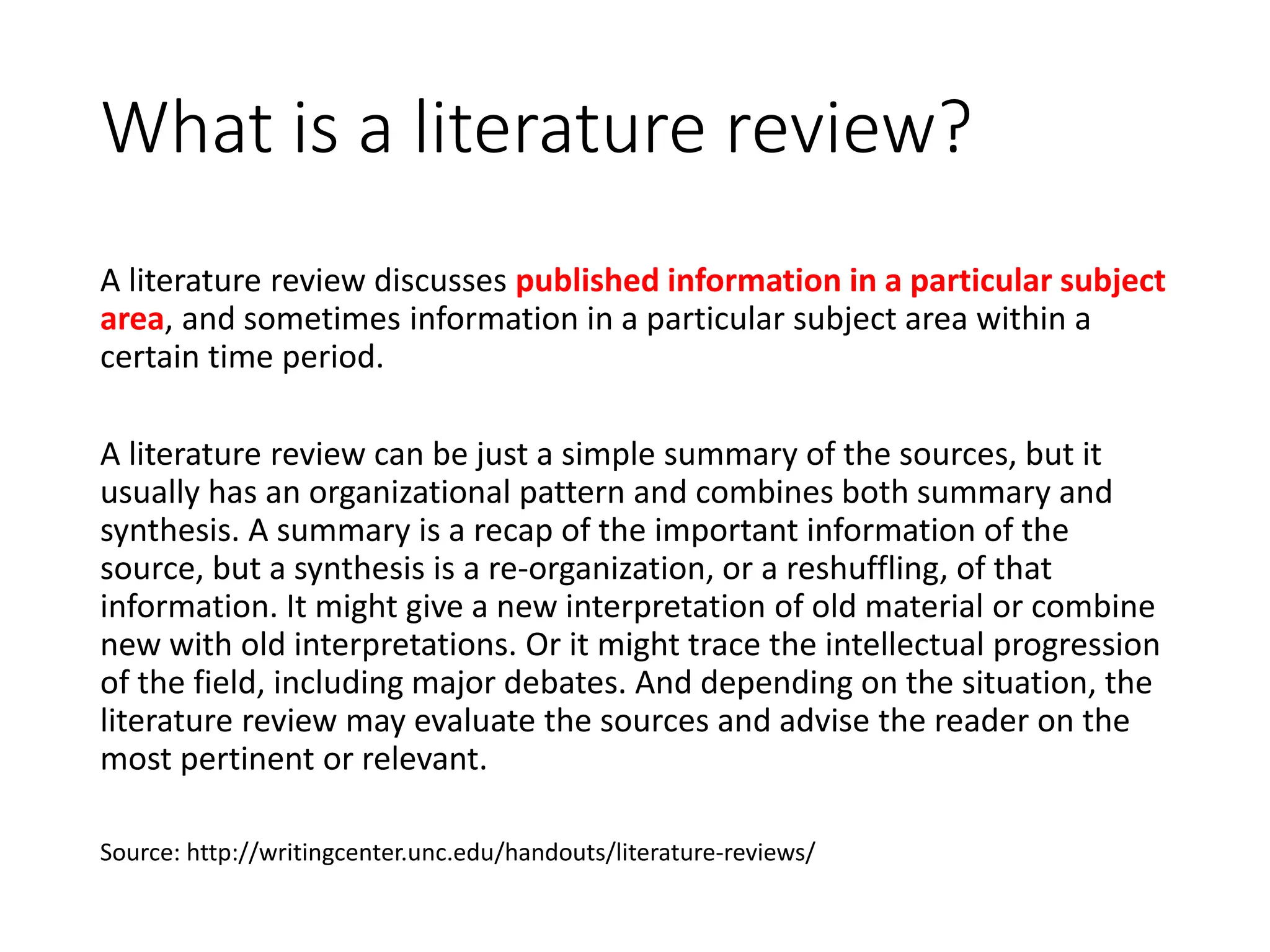
A literature review discusses published information in a particular subject
area, and sometimes information in a particular subject area within a
certain time period.
A literature review can be just a simple summary of the sources, but it
usually has an organizational pattern and combines both summary and
synthesis. A summary is a recap of the important information of the
source, but a synthesis is a re-organization, or a reshuffling, of that
information. It might give a new interpretation of old material or combine
new with old interpretations. Or it might trace the intellectual progression
of the field, including major debates. And depending on the situation, the
literature review may evaluate the sources and advise the reader on the
most pertinent or relevant.
Source: http://writingcenter.unc.edu/handouts/literature-reviews/
What is a literature review?
But how is a literature
review different from
an academic research
paper?
• The main focus of an
academic research paper is to
develop a new argument, and a
research paper is likely to
contain a literature review as
one of its parts. In a research
paper, you use the literature as
a foundation and as support for
a new insight that you
contribute. The focus of a
literature review, however, is to
summarize and synthesize the
arguments and ideas of others
without adding new
contributions.
Why do we write literature
reviews? (1)
•
• Literature reviews provide you with a handy
guide to a particular topic. If you have limited
time to conduct research, literature reviews can
give you an overview or act as a stepping stone.
For professionals, they are useful reports that
keep them up to date with what is current in the
field. For scholars, the depth and breadth of the
literature review emphasizes the credibility of
the writer in his or her field. Literature reviews
also provide a solid background for a research
paper’s investigation. Comprehensive
knowledge of the literature of the field is
essential to most research papers.
Show your understanding by analysing and then synthesising the
information to:
Determine what has already been written on a topic
Provide an overview of key concepts
Identify major relationships or patterns
Identify strengths and weaknesses
Identify any gaps in the research
Identify any conflicting evidence
Provide a solid background to a research paper’s investigation
Source: http://www.citewrite.qut.edu.au/write/litreview.jsp
Why do we write literature reviews? (2)
Literature reviews are written
occasionally in the humanities,
but mostly in the sciences and
social sciences; in experiment and
lab reports, they constitute a
section of the paper. Sometimes
a literature review is written as a
paper in itself.
Source:
http://writingcenter.unc.edu/handouts
/literature-reviews/
Who writes
these
things,
anyway?
How To
Write? (1)
• Note the bibliographical details of your sources
• Keep a note of the publication title, date,
authors’ names, page numbers and publishers.
These details will save you time later.
• Read the literature
• Critically read each source, look for the
arguments presented rather than for facts.
• Take notes as you read and start to organise
your review around themes and ideas.
• Consider using a table, matrix or concept map
to identify how the different sources relate to each
other.
Source: http://www.citewrite.qut.edu.au/write/litreview.jsp
How to
write? (2)
• Analyze the literature you have found
• In order for your writing to reflect strong critical
analysis, you need to evaluate the sources. For each
source you are reviewing ask yourself these questions:
• What are the key terms and concepts?
• How relevant is this article to my specific topic?
• What are the major relationships, trends and
patterns?
• How has the author structured the arguments?
• How authoritative and credible is this source?
• What are the differences and similarities between
the sources?
• Are there any gaps in the literature that require
further study?
Find a focus
A literature review, like a term paper, is usually
organized around ideas, not the sources themselves
as an annotated bibliography would be organized.
This means that you will not just simply list your
sources and go into detail about each one of them,
one at a time. No. As you read widely but selectively
in your topic area, consider instead what themes or
issues connect your sources together. Do they
present one or different solutions? Is there an
aspect of the field that is missing? How well do they
present the material and do they portray it
according to an appropriate theory? Do they reveal
a trend in the field? A raging debate? Pick one of
these themes to focus the organization of your
review.
Source: http://writingcenter.unc.edu/handouts/literature-reviews/
Strategies
for Writing
Literature
Review (1)
Strategies for
Writing
Literature Review
(2)
• Convey it to your reader
• A literature review may not have a traditional
thesis statement (one that makes an argument), but
you do need to tell readers what to expect. Try
writing a simple statement that lets the reader
know what is your main organizing principle. Here
are a couple of examples:
• The current trend in treatment for congestive
heart failure combines surgery and medicine.
• More and more cultural studies scholars are
accepting popular media as a subject worthy of
academic consideration.
Strategies
for
Writing
Literature
Review
(3)
• Consider organization
• You’ve got a focus, and you’ve stated
it clearly and directly. Now what is the
most effective way of presenting the
information? What are the most
important topics, subtopics, etc., that
your review needs to include? And in
what order should you present them?
Develop an organization for your
review at both a global and local level:
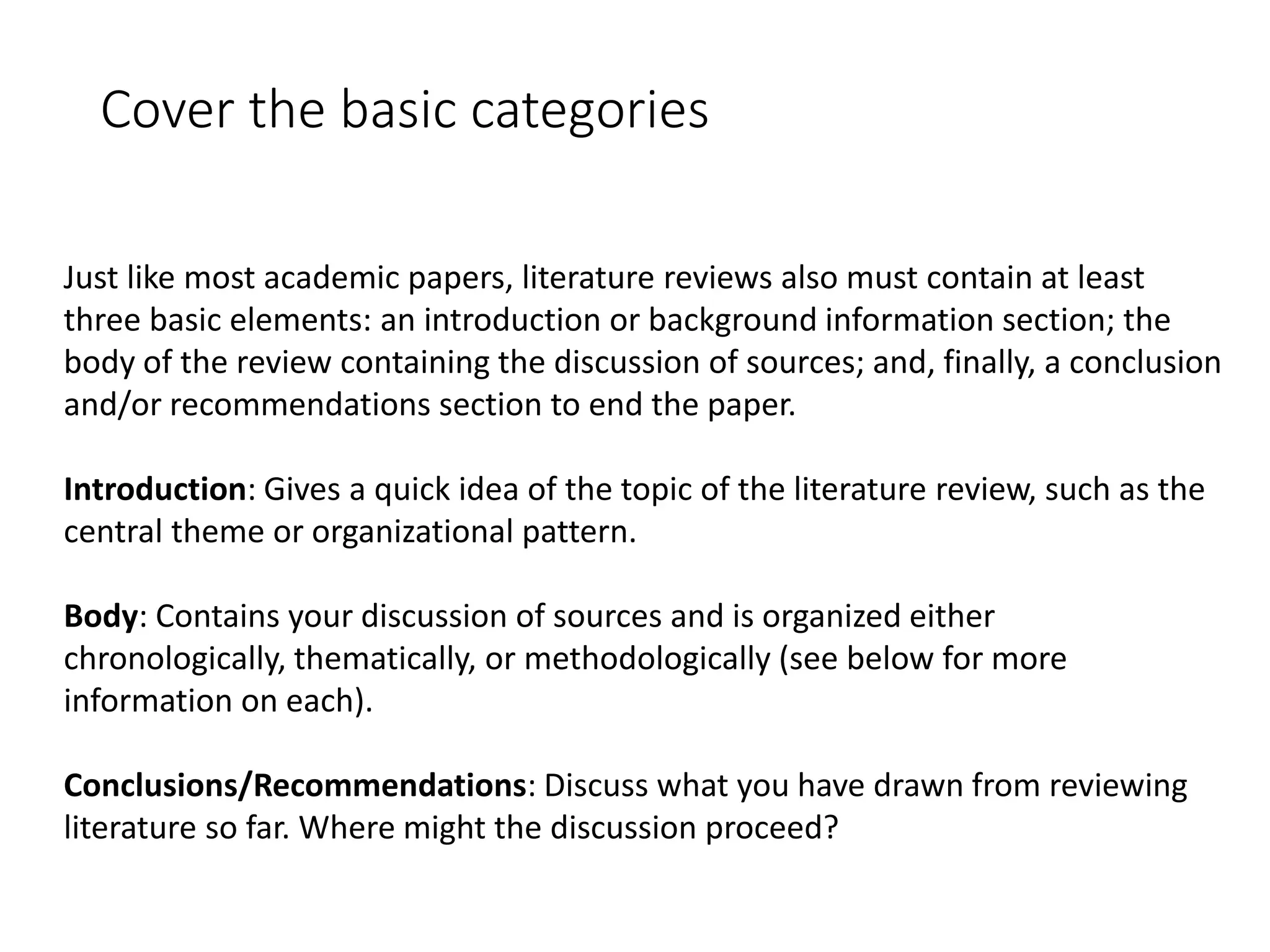
Cover the basic categories
Just like most academic papers, literature reviews also must contain at least
three basic elements: an introduction or background information section; the
body of the review containing the discussion of sources; and, finally, a conclusion
and/or recommendations section to end the paper.
Introduction: Gives a quick idea of the topic of the literature review, such as the
central theme or organizational pattern.
Body: Contains your discussion of sources and is organized either
chronologically, thematically, or methodologically (see below for more
information on each).
Conclusions/Recommendations: Discuss what you have drawn from reviewing
literature so far. Where might the discussion proceed?
EXAMPLE
Here is a sample paragraph from a literature review about sexism and language to
illuminate the following discussion:
However, other studies have shown that even gender-neutral antecedents are
more likely to produce masculine images than feminine ones (Gastil, 1990).
Hamilton (1988) asked students to complete sentences that required them to fill in
pronouns that agreed with gender-neutral antecedents such as “writer,”
“pedestrian,” and “persons.” The students were asked to describe any image they
had when writing the sentence. Hamilton found that people imagined 3.3 men to
each woman in the masculine “generic” condition and 1.5 men per woman in the
unbiased condition. Thus, while ambient sexism accounted for some of the
masculine bias, sexist language amplified the effect. (Source: Erika Falk and Jordan
Mills, “Why Sexist Language Affects Persuasion: The Role of Homophily, Intended
Audience, and Offense,” Women and Language19:2.
Lets do it…!
The research of health-related crisis management in
tourism has been divided into three main streams,
including evaluating impacts on the tourism industry
(e.g., Au, Ramasamy, & Yeung, 2005; Zeng, Carter,
& De Lacy, 2005), forecasting tourism demand (e.g.,
Kuo, Chen, Tseng, Ju, & Huang, 2008; Solarin, 2016;
Tang & Wong, 2009), and estimating impacts on
tourist behaviors (e.g., Cahyanto, Wiblishauser,
Pennington-Gray, & Schroeder, 2016; Wen, Huimin,
& Kavanaugh, 2005). Since 2000, a series of
epidemic diseases have been studied, such as foot
and mouth disease (e.g., Irvine & Anderson, 2006),
SARS (e.g., Kuo et al., 2008), H1N1 (e.g., Lee,
Song, Bendle, Kim, & Han, 2012) and Ebola (e.g.,

Literature Review Articel writing strategi

  • 1.
  • 2.
    A literature reviewdiscusses published information in a particular subject area, and sometimes information in a particular subject area within a certain time period. A literature review can be just a simple summary of the sources, but it usually has an organizational pattern and combines both summary and synthesis. A summary is a recap of the important information of the source, but a synthesis is a re-organization, or a reshuffling, of that information. It might give a new interpretation of old material or combine new with old interpretations. Or it might trace the intellectual progression of the field, including major debates. And depending on the situation, the literature review may evaluate the sources and advise the reader on the most pertinent or relevant. Source: http://writingcenter.unc.edu/handouts/literature-reviews/ What is a literature review?
  • 3.
    But how isa literature review different from an academic research paper? • The main focus of an academic research paper is to develop a new argument, and a research paper is likely to contain a literature review as one of its parts. In a research paper, you use the literature as a foundation and as support for a new insight that you contribute. The focus of a literature review, however, is to summarize and synthesize the arguments and ideas of others without adding new contributions.
  • 4.
    Why do wewrite literature reviews? (1) • • Literature reviews provide you with a handy guide to a particular topic. If you have limited time to conduct research, literature reviews can give you an overview or act as a stepping stone. For professionals, they are useful reports that keep them up to date with what is current in the field. For scholars, the depth and breadth of the literature review emphasizes the credibility of the writer in his or her field. Literature reviews also provide a solid background for a research paper’s investigation. Comprehensive knowledge of the literature of the field is essential to most research papers.
  • 5.
    Show your understandingby analysing and then synthesising the information to: Determine what has already been written on a topic Provide an overview of key concepts Identify major relationships or patterns Identify strengths and weaknesses Identify any gaps in the research Identify any conflicting evidence Provide a solid background to a research paper’s investigation Source: http://www.citewrite.qut.edu.au/write/litreview.jsp Why do we write literature reviews? (2)
  • 6.
    Literature reviews arewritten occasionally in the humanities, but mostly in the sciences and social sciences; in experiment and lab reports, they constitute a section of the paper. Sometimes a literature review is written as a paper in itself. Source: http://writingcenter.unc.edu/handouts /literature-reviews/ Who writes these things, anyway?
  • 7.
    How To Write? (1) •Note the bibliographical details of your sources • Keep a note of the publication title, date, authors’ names, page numbers and publishers. These details will save you time later. • Read the literature • Critically read each source, look for the arguments presented rather than for facts. • Take notes as you read and start to organise your review around themes and ideas. • Consider using a table, matrix or concept map to identify how the different sources relate to each other. Source: http://www.citewrite.qut.edu.au/write/litreview.jsp
  • 8.
    How to write? (2) •Analyze the literature you have found • In order for your writing to reflect strong critical analysis, you need to evaluate the sources. For each source you are reviewing ask yourself these questions: • What are the key terms and concepts? • How relevant is this article to my specific topic? • What are the major relationships, trends and patterns? • How has the author structured the arguments? • How authoritative and credible is this source? • What are the differences and similarities between the sources? • Are there any gaps in the literature that require further study?
  • 9.
    Find a focus Aliterature review, like a term paper, is usually organized around ideas, not the sources themselves as an annotated bibliography would be organized. This means that you will not just simply list your sources and go into detail about each one of them, one at a time. No. As you read widely but selectively in your topic area, consider instead what themes or issues connect your sources together. Do they present one or different solutions? Is there an aspect of the field that is missing? How well do they present the material and do they portray it according to an appropriate theory? Do they reveal a trend in the field? A raging debate? Pick one of these themes to focus the organization of your review. Source: http://writingcenter.unc.edu/handouts/literature-reviews/ Strategies for Writing Literature Review (1)
  • 10.
    Strategies for Writing Literature Review (2) •Convey it to your reader • A literature review may not have a traditional thesis statement (one that makes an argument), but you do need to tell readers what to expect. Try writing a simple statement that lets the reader know what is your main organizing principle. Here are a couple of examples: • The current trend in treatment for congestive heart failure combines surgery and medicine. • More and more cultural studies scholars are accepting popular media as a subject worthy of academic consideration.
  • 11.
    Strategies for Writing Literature Review (3) • Consider organization •You’ve got a focus, and you’ve stated it clearly and directly. Now what is the most effective way of presenting the information? What are the most important topics, subtopics, etc., that your review needs to include? And in what order should you present them? Develop an organization for your review at both a global and local level:
  • 12.
    Cover the basiccategories Just like most academic papers, literature reviews also must contain at least three basic elements: an introduction or background information section; the body of the review containing the discussion of sources; and, finally, a conclusion and/or recommendations section to end the paper. Introduction: Gives a quick idea of the topic of the literature review, such as the central theme or organizational pattern. Body: Contains your discussion of sources and is organized either chronologically, thematically, or methodologically (see below for more information on each). Conclusions/Recommendations: Discuss what you have drawn from reviewing literature so far. Where might the discussion proceed?
  • 13.
    EXAMPLE Here is asample paragraph from a literature review about sexism and language to illuminate the following discussion: However, other studies have shown that even gender-neutral antecedents are more likely to produce masculine images than feminine ones (Gastil, 1990). Hamilton (1988) asked students to complete sentences that required them to fill in pronouns that agreed with gender-neutral antecedents such as “writer,” “pedestrian,” and “persons.” The students were asked to describe any image they had when writing the sentence. Hamilton found that people imagined 3.3 men to each woman in the masculine “generic” condition and 1.5 men per woman in the unbiased condition. Thus, while ambient sexism accounted for some of the masculine bias, sexist language amplified the effect. (Source: Erika Falk and Jordan Mills, “Why Sexist Language Affects Persuasion: The Role of Homophily, Intended Audience, and Offense,” Women and Language19:2.
  • 14.
  • 17.
    The research ofhealth-related crisis management in tourism has been divided into three main streams, including evaluating impacts on the tourism industry (e.g., Au, Ramasamy, & Yeung, 2005; Zeng, Carter, & De Lacy, 2005), forecasting tourism demand (e.g., Kuo, Chen, Tseng, Ju, & Huang, 2008; Solarin, 2016; Tang & Wong, 2009), and estimating impacts on tourist behaviors (e.g., Cahyanto, Wiblishauser, Pennington-Gray, & Schroeder, 2016; Wen, Huimin, & Kavanaugh, 2005). Since 2000, a series of epidemic diseases have been studied, such as foot and mouth disease (e.g., Irvine & Anderson, 2006), SARS (e.g., Kuo et al., 2008), H1N1 (e.g., Lee, Song, Bendle, Kim, & Han, 2012) and Ebola (e.g.,