IAEA Workshop on NSDD, Trieste, November 2003
The nuclear shell model
P. Van Isacker, GANIL, France
Context and assumptions of the model
Symmetries of the shell model:
Racah’s SU(2) pairing model
Wigner’s SU(4) symmetry
Elliott’s SU(3) model of rotation
IAEA Workshop on NSDD, Trieste, November 2003
Overview of nuclear models
• Ab initio methods: Description of nuclei
starting from the bare nn & nnn interactions.
• Nuclear shell model: Nuclear average potential
+ (residual) interaction between nucleons.
• Mean-field methods: Nuclear average potential
with global parametrization (+ correlations).
• Phenomenological models: Specific nuclei or
properties with local parametrization.
IAEA Workshop on NSDD, Trieste, November 2003
Ab initio methods
• Faddeev-Yakubovsky: A≤4
• Coupled-rearrangement-channel Gaussian-
basis variational: A≤4 (higher with clusters)
• Stochastic variational: A≤7
• Hyperspherical harmonic variational:
• Green’s function Monte Carlo: A≤7
• No-core shell model: A≤12
• Effective interaction hyperspherical: A≤6
IAEA Workshop on NSDD, Trieste, November 2003
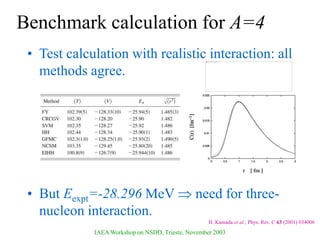
Benchmark calculation for A=4
• Test calculation with realistic interaction: all
methods agree.
• But Eexpt=-28.296 MeV  need for three-
nucleon interaction.
H. Kamada et al., Phys. Rev. C 63 (2001) 034006
IAEA Workshop on NSDD, Trieste, November 2003
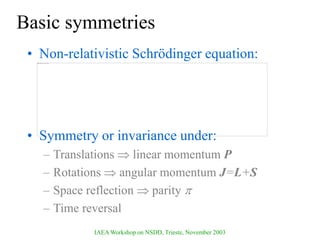
Basic symmetries
• Non-relativistic Schrödinger equation:
• Symmetry or invariance under:
– Translations  linear momentum P
– Rotations  angular momentum J=L+S
– Space reflection  parity 
– Time reversal
IAEA Workshop on NSDD, Trieste, November 2003
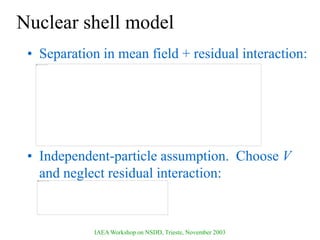
Nuclear shell model
• Separation in mean field + residual interaction:
• Independent-particle assumption. Choose V
and neglect residual interaction:
IAEA Workshop on NSDD, Trieste, November 2003
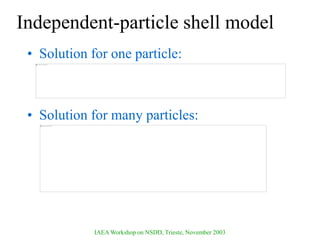
Independent-particle shell model
• Solution for one particle:
• Solution for many particles:
IAEA Workshop on NSDD, Trieste, November 2003
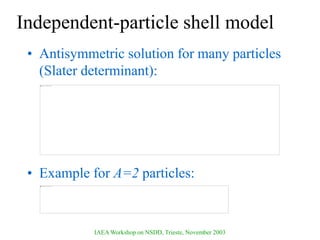
Independent-particle shell model
• Antisymmetric solution for many particles
(Slater determinant):
• Example for A=2 particles:
IAEA Workshop on NSDD, Trieste, November 2003
Hartree-Fock approximation
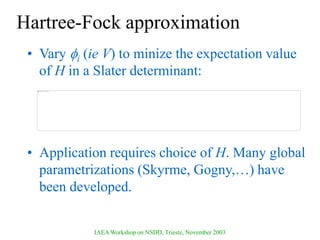
• Vary i (ie V) to minize the expectation value
of H in a Slater determinant:
• Application requires choice of H. Many global
parametrizations (Skyrme, Gogny,…) have
been developed.
IAEA Workshop on NSDD, Trieste, November 2003
Poor man’s Hartree-Fock
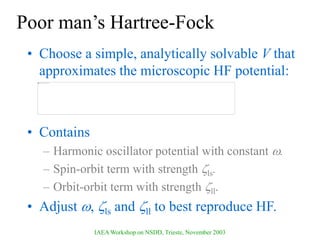
• Choose a simple, analytically solvable V that
approximates the microscopic HF potential:
• Contains
– Harmonic oscillator potential with constant .
– Spin-orbit term with strength ls.
– Orbit-orbit term with strength ll.
• Adjust , ls and ll to best reproduce HF.
IAEA Workshop on NSDD, Trieste, November 2003
Energy levels of harmonic oscillator
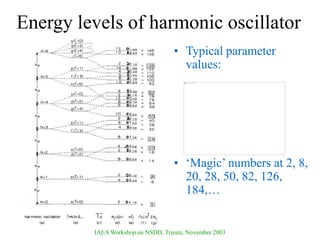
• Typical parameter
values:
• ‘Magic’ numbers at 2, 8,
20, 28, 50, 82, 126,
184,…
IAEA Workshop on NSDD, Trieste, November 2003
Evidence for shell structure
• Evidence for nuclear shell structure from
– Excitation energies in even-even nuclei
– Nucleon-separation energies
– Nuclear masses
– Nuclear level densities
– Reaction cross sections
• Is nuclear shell structure modified away from
the line of stability?
IAEA Workshop on NSDD, Trieste, November 2003
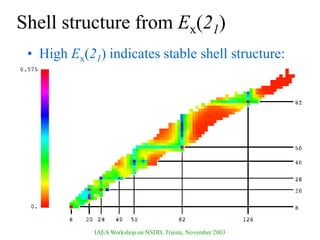
Shell structure from Ex(21)
• High Ex(21) indicates stable shell structure:
IAEA Workshop on NSDD, Trieste, November 2003
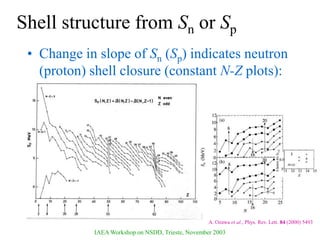
Shell structure from Sn or Sp
• Change in slope of Sn (Sp) indicates neutron
(proton) shell closure (constant N-Z plots):
A. Ozawa et al., Phys. Rev. Lett. 84 (2000) 5493
IAEA Workshop on NSDD, Trieste, November 2003
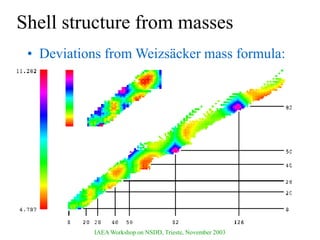
Shell structure from masses
• Deviations from Weizsäcker mass formula:
IAEA Workshop on NSDD, Trieste, November 2003
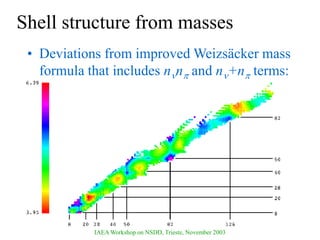
Shell structure from masses
• Deviations from improved Weizsäcker mass
formula that includes nn and n+n terms:
IAEA Workshop on NSDD, Trieste, November 2003
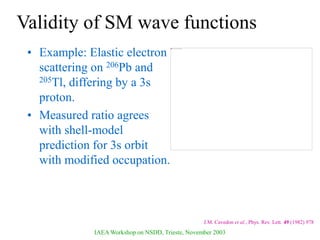
Validity of SM wave functions
• Example: Elastic electron
scattering on 206Pb and
205Tl, differing by a 3s
proton.
• Measured ratio agrees
with shell-model
prediction for 3s orbit
with modified occupation.
J.M. Cavedon et al., Phys. Rev. Lett. 49 (1982) 978
IAEA Workshop on NSDD, Trieste, November 2003
Nuclear shell model
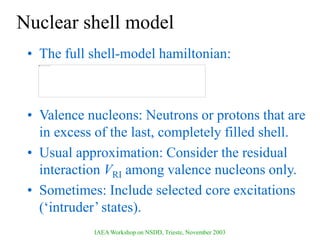
• The full shell-model hamiltonian:
• Valence nucleons: Neutrons or protons that are
in excess of the last, completely filled shell.
• Usual approximation: Consider the residual
interaction VRI among valence nucleons only.
• Sometimes: Include selected core excitations
(‘intruder’ states).
IAEA Workshop on NSDD, Trieste, November 2003
The shell-model problem
• Solve the eigenvalue problem associated with
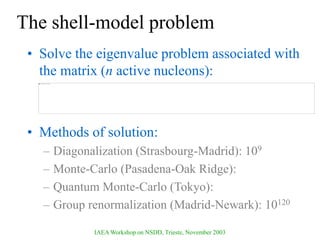
the matrix (n active nucleons):
• Methods of solution:
– Diagonalization (Strasbourg-Madrid): 109
– Monte-Carlo (Pasadena-Oak Ridge):
– Quantum Monte-Carlo (Tokyo):
– Group renormalization (Madrid-Newark): 10120
IAEA Workshop on NSDD, Trieste, November 2003
Residual shell-model interaction
• Four approaches:
– Effective: Derive from free nn interaction taking
account of the nuclear medium.
– Empirical: Adjust matrix elements of residual
interaction to data. Examples: p, sd and pf shells.
– Effective-empirical: Effective interaction with
some adjusted (monopole) matrix elements.
– Schematic: Assume a simple spatial form and
calculate its matrix elements in a harmonic-
oscillator basis. Example:  interaction.
IAEA Workshop on NSDD, Trieste, November 2003
Schematic short-range interaction
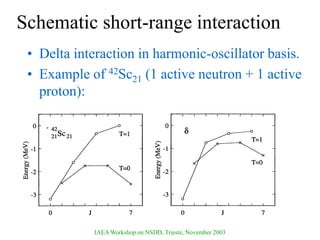
• Delta interaction in harmonic-oscillator basis.
• Example of 42Sc21 (1 active neutron + 1 active
proton):
IAEA Workshop on NSDD, Trieste, November 2003
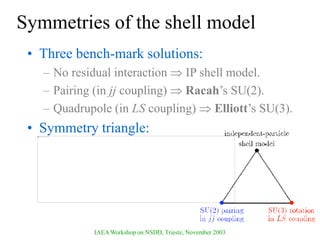
Symmetries of the shell model
• Three bench-mark solutions:
– No residual interaction  IP shell model.
– Pairing (in jj coupling)  Racah’s SU(2).
– Quadrupole (in LS coupling)  Elliott’s SU(3).
• Symmetry triangle:
IAEA Workshop on NSDD, Trieste, November 2003
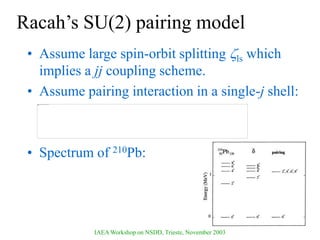
Racah’s SU(2) pairing model
• Assume large spin-orbit splitting ls which
implies a jj coupling scheme.
• Assume pairing interaction in a single-j shell:
• Spectrum of 210Pb:
IAEA Workshop on NSDD, Trieste, November 2003
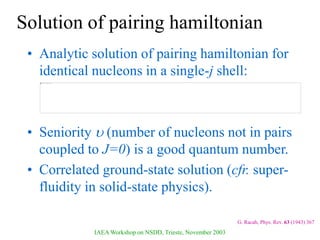
Solution of pairing hamiltonian
• Analytic solution of pairing hamiltonian for
identical nucleons in a single-j shell:
• Seniority  (number of nucleons not in pairs
coupled to J=0) is a good quantum number.
• Correlated ground-state solution (cfr. super-
fluidity in solid-state physics).
G. Racah, Phys. Rev. 63 (1943) 367
IAEA Workshop on NSDD, Trieste, November 2003
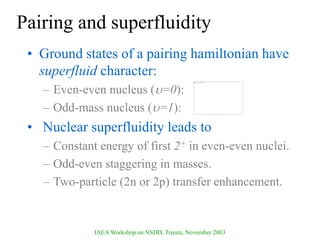
Pairing and superfluidity
• Ground states of a pairing hamiltonian have
superfluid character:
– Even-even nucleus (=0):
– Odd-mass nucleus (=1):
• Nuclear superfluidity leads to
– Constant energy of first 2+ in even-even nuclei.
– Odd-even staggering in masses.
– Two-particle (2n or 2p) transfer enhancement.
IAEA Workshop on NSDD, Trieste, November 2003
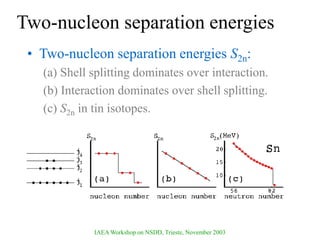
Superfluidity in semi-magic nuclei
• Even-even nuclei:
– Ground state has
=0.
– First-excited state has
=2.
– Pairing produces
constant energy gap:
• Example of Sn
nuclei:
IAEA Workshop on NSDD, Trieste, November 2003
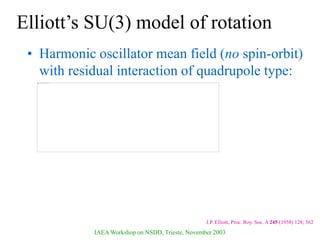
Two-nucleon separation energies
• Two-nucleon separation energies S2n:
(a) Shell splitting dominates over interaction.
(b) Interaction dominates over shell splitting.
(c) S2n in tin isotopes.
IAEA Workshop on NSDD, Trieste, November 2003
Generalized pairing models
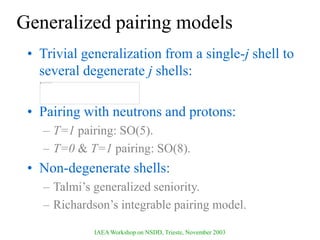
• Trivial generalization from a single-j shell to
several degenerate j shells:
• Pairing with neutrons and protons:
– T=1 pairing: SO(5).
– T=0 & T=1 pairing: SO(8).
• Non-degenerate shells:
– Talmi’s generalized seniority.
– Richardson’s integrable pairing model.
IAEA Workshop on NSDD, Trieste, November 2003
Pairing with neutrons and protons
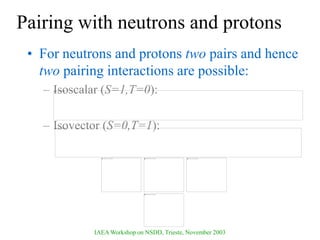
• For neutrons and protons two pairs and hence
two pairing interactions are possible:
– Isoscalar (S=1,T=0):
– Isovector (S=0,T=1):
IAEA Workshop on NSDD, Trieste, November 2003
Superfluidity of N=Z nuclei
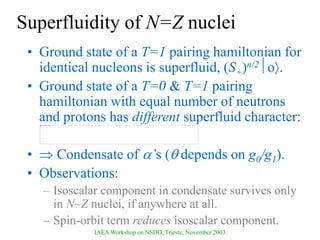
• Ground state of a T=1 pairing hamiltonian for
identical nucleons is superfluid, (S+)n/2o.
• Ground state of a T=0 & T=1 pairing
hamiltonian with equal number of neutrons
and protons has different superfluid character:
•  Condensate of ’s ( depends on g0/g1).
• Observations:
– Isoscalar component in condensate survives only
in N~Z nuclei, if anywhere at all.
– Spin-orbit term reduces isoscalar component.
IAEA Workshop on NSDD, Trieste, November 2003
Wigner’s SU(4) symmetry
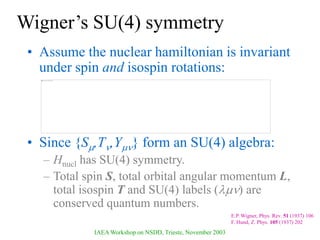
• Assume the nuclear hamiltonian is invariant
under spin and isospin rotations:
• Since {S,T,Y} form an SU(4) algebra:
– Hnucl has SU(4) symmetry.
– Total spin S, total orbital angular momentum L,
total isospin T and SU(4) labels () are
conserved quantum numbers.
E.P. Wigner, Phys. Rev. 51 (1937) 106
F. Hund, Z. Phys. 105 (1937) 202
IAEA Workshop on NSDD, Trieste, November 2003
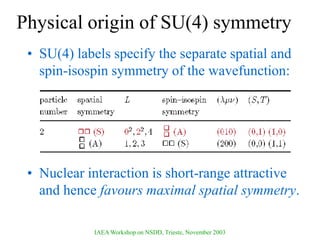
Physical origin of SU(4) symmetry
• SU(4) labels specify the separate spatial and
spin-isospin symmetry of the wavefunction:
• Nuclear interaction is short-range attractive
and hence favours maximal spatial symmetry.
IAEA Workshop on NSDD, Trieste, November 2003
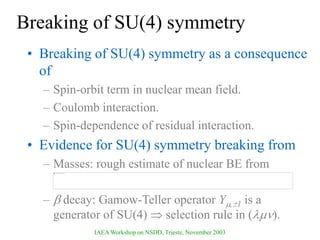
Breaking of SU(4) symmetry
• Breaking of SU(4) symmetry as a consequence
of
– Spin-orbit term in nuclear mean field.
– Coulomb interaction.
– Spin-dependence of residual interaction.
• Evidence for SU(4) symmetry breaking from
– Masses: rough estimate of nuclear BE from
–  decay: Gamow-Teller operator Y,1 is a
generator of SU(4)  selection rule in ().
IAEA Workshop on NSDD, Trieste, November 2003
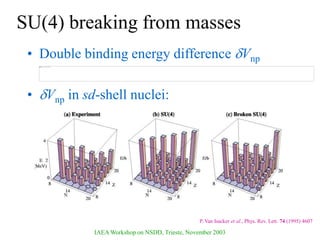
SU(4) breaking from masses
• Double binding energy difference Vnp
• Vnp in sd-shell nuclei:
P. Van Isacker et al., Phys. Rev. Lett. 74 (1995) 4607
IAEA Workshop on NSDD, Trieste, November 2003
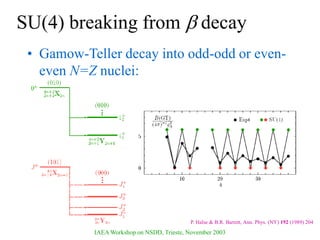
SU(4) breaking from  decay
• Gamow-Teller decay into odd-odd or even-
even N=Z nuclei:
P. Halse & B.R. Barrett, Ann. Phys. (NY) 192 (1989) 204
IAEA Workshop on NSDD, Trieste, November 2003
Elliott’s SU(3) model of rotation
• Harmonic oscillator mean field (no spin-orbit)
with residual interaction of quadrupole type:
J.P. Elliott, Proc. Roy. Soc. A 245 (1958) 128; 562
IAEA Workshop on NSDD, Trieste, November 2003
Importance and limitations of SU(3)
• Historical importance:
– Bridge between the spherical shell model and the
liquid droplet model through mixing of orbits.
– Spectrum generating algebra of Wigner’s SU(4)
supermultiplet.
• Limitations:
– LS (Russell-Saunders) coupling, not jj coupling
(zero spin-orbit splitting)  beginning of sd shell.
– Q is the algebraic quadrupole operator  no
major-shell mixing.
IAEA Workshop on NSDD, Trieste, November 2003
Generalized SU(3) models
• How to obtain rotational features in a jj-
coupling limit of the nuclear shell model?
• Several efforts since Elliott:
– Pseudo-spin symmetry.
– Quasi-SU(3) symmetry (Zuker).
– Effective symmetries (Rowe).
– FDSM: fermion dynamical symmetry model.
– ...

Nucleur shell model of atom by P. Van isacker

  • 1.
    IAEA Workshop onNSDD, Trieste, November 2003 The nuclear shell model P. Van Isacker, GANIL, France Context and assumptions of the model Symmetries of the shell model: Racah’s SU(2) pairing model Wigner’s SU(4) symmetry Elliott’s SU(3) model of rotation
  • 2.
    IAEA Workshop onNSDD, Trieste, November 2003 Overview of nuclear models • Ab initio methods: Description of nuclei starting from the bare nn & nnn interactions. • Nuclear shell model: Nuclear average potential + (residual) interaction between nucleons. • Mean-field methods: Nuclear average potential with global parametrization (+ correlations). • Phenomenological models: Specific nuclei or properties with local parametrization.
  • 3.
    IAEA Workshop onNSDD, Trieste, November 2003 Ab initio methods • Faddeev-Yakubovsky: A≤4 • Coupled-rearrangement-channel Gaussian- basis variational: A≤4 (higher with clusters) • Stochastic variational: A≤7 • Hyperspherical harmonic variational: • Green’s function Monte Carlo: A≤7 • No-core shell model: A≤12 • Effective interaction hyperspherical: A≤6
  • 4.
    IAEA Workshop onNSDD, Trieste, November 2003 Benchmark calculation for A=4 • Test calculation with realistic interaction: all methods agree. • But Eexpt=-28.296 MeV  need for three- nucleon interaction. H. Kamada et al., Phys. Rev. C 63 (2001) 034006
  • 5.
    IAEA Workshop onNSDD, Trieste, November 2003 Basic symmetries • Non-relativistic Schrödinger equation: • Symmetry or invariance under: – Translations  linear momentum P – Rotations  angular momentum J=L+S – Space reflection  parity  – Time reversal
  • 6.
    IAEA Workshop onNSDD, Trieste, November 2003 Nuclear shell model • Separation in mean field + residual interaction: • Independent-particle assumption. Choose V and neglect residual interaction:
  • 7.
    IAEA Workshop onNSDD, Trieste, November 2003 Independent-particle shell model • Solution for one particle: • Solution for many particles:
  • 8.
    IAEA Workshop onNSDD, Trieste, November 2003 Independent-particle shell model • Antisymmetric solution for many particles (Slater determinant): • Example for A=2 particles:
  • 9.
    IAEA Workshop onNSDD, Trieste, November 2003 Hartree-Fock approximation • Vary i (ie V) to minize the expectation value of H in a Slater determinant: • Application requires choice of H. Many global parametrizations (Skyrme, Gogny,…) have been developed.
  • 10.
    IAEA Workshop onNSDD, Trieste, November 2003 Poor man’s Hartree-Fock • Choose a simple, analytically solvable V that approximates the microscopic HF potential: • Contains – Harmonic oscillator potential with constant . – Spin-orbit term with strength ls. – Orbit-orbit term with strength ll. • Adjust , ls and ll to best reproduce HF.
  • 11.
    IAEA Workshop onNSDD, Trieste, November 2003 Energy levels of harmonic oscillator • Typical parameter values: • ‘Magic’ numbers at 2, 8, 20, 28, 50, 82, 126, 184,…
  • 12.
    IAEA Workshop onNSDD, Trieste, November 2003 Evidence for shell structure • Evidence for nuclear shell structure from – Excitation energies in even-even nuclei – Nucleon-separation energies – Nuclear masses – Nuclear level densities – Reaction cross sections • Is nuclear shell structure modified away from the line of stability?
  • 13.
    IAEA Workshop onNSDD, Trieste, November 2003 Shell structure from Ex(21) • High Ex(21) indicates stable shell structure:
  • 14.
    IAEA Workshop onNSDD, Trieste, November 2003 Shell structure from Sn or Sp • Change in slope of Sn (Sp) indicates neutron (proton) shell closure (constant N-Z plots): A. Ozawa et al., Phys. Rev. Lett. 84 (2000) 5493
  • 15.
    IAEA Workshop onNSDD, Trieste, November 2003 Shell structure from masses • Deviations from Weizsäcker mass formula:
  • 16.
    IAEA Workshop onNSDD, Trieste, November 2003 Shell structure from masses • Deviations from improved Weizsäcker mass formula that includes nn and n+n terms:
  • 17.
    IAEA Workshop onNSDD, Trieste, November 2003 Validity of SM wave functions • Example: Elastic electron scattering on 206Pb and 205Tl, differing by a 3s proton. • Measured ratio agrees with shell-model prediction for 3s orbit with modified occupation. J.M. Cavedon et al., Phys. Rev. Lett. 49 (1982) 978
  • 18.
    IAEA Workshop onNSDD, Trieste, November 2003 Nuclear shell model • The full shell-model hamiltonian: • Valence nucleons: Neutrons or protons that are in excess of the last, completely filled shell. • Usual approximation: Consider the residual interaction VRI among valence nucleons only. • Sometimes: Include selected core excitations (‘intruder’ states).
  • 19.
    IAEA Workshop onNSDD, Trieste, November 2003 The shell-model problem • Solve the eigenvalue problem associated with the matrix (n active nucleons): • Methods of solution: – Diagonalization (Strasbourg-Madrid): 109 – Monte-Carlo (Pasadena-Oak Ridge): – Quantum Monte-Carlo (Tokyo): – Group renormalization (Madrid-Newark): 10120
  • 20.
    IAEA Workshop onNSDD, Trieste, November 2003 Residual shell-model interaction • Four approaches: – Effective: Derive from free nn interaction taking account of the nuclear medium. – Empirical: Adjust matrix elements of residual interaction to data. Examples: p, sd and pf shells. – Effective-empirical: Effective interaction with some adjusted (monopole) matrix elements. – Schematic: Assume a simple spatial form and calculate its matrix elements in a harmonic- oscillator basis. Example:  interaction.
  • 21.
    IAEA Workshop onNSDD, Trieste, November 2003 Schematic short-range interaction • Delta interaction in harmonic-oscillator basis. • Example of 42Sc21 (1 active neutron + 1 active proton):
  • 22.
    IAEA Workshop onNSDD, Trieste, November 2003 Symmetries of the shell model • Three bench-mark solutions: – No residual interaction  IP shell model. – Pairing (in jj coupling)  Racah’s SU(2). – Quadrupole (in LS coupling)  Elliott’s SU(3). • Symmetry triangle:
  • 23.
    IAEA Workshop onNSDD, Trieste, November 2003 Racah’s SU(2) pairing model • Assume large spin-orbit splitting ls which implies a jj coupling scheme. • Assume pairing interaction in a single-j shell: • Spectrum of 210Pb:
  • 24.
    IAEA Workshop onNSDD, Trieste, November 2003 Solution of pairing hamiltonian • Analytic solution of pairing hamiltonian for identical nucleons in a single-j shell: • Seniority  (number of nucleons not in pairs coupled to J=0) is a good quantum number. • Correlated ground-state solution (cfr. super- fluidity in solid-state physics). G. Racah, Phys. Rev. 63 (1943) 367
  • 25.
    IAEA Workshop onNSDD, Trieste, November 2003 Pairing and superfluidity • Ground states of a pairing hamiltonian have superfluid character: – Even-even nucleus (=0): – Odd-mass nucleus (=1): • Nuclear superfluidity leads to – Constant energy of first 2+ in even-even nuclei. – Odd-even staggering in masses. – Two-particle (2n or 2p) transfer enhancement.
  • 26.
    IAEA Workshop onNSDD, Trieste, November 2003 Superfluidity in semi-magic nuclei • Even-even nuclei: – Ground state has =0. – First-excited state has =2. – Pairing produces constant energy gap: • Example of Sn nuclei:
  • 27.
    IAEA Workshop onNSDD, Trieste, November 2003 Two-nucleon separation energies • Two-nucleon separation energies S2n: (a) Shell splitting dominates over interaction. (b) Interaction dominates over shell splitting. (c) S2n in tin isotopes.
  • 28.
    IAEA Workshop onNSDD, Trieste, November 2003 Generalized pairing models • Trivial generalization from a single-j shell to several degenerate j shells: • Pairing with neutrons and protons: – T=1 pairing: SO(5). – T=0 & T=1 pairing: SO(8). • Non-degenerate shells: – Talmi’s generalized seniority. – Richardson’s integrable pairing model.
  • 29.
    IAEA Workshop onNSDD, Trieste, November 2003 Pairing with neutrons and protons • For neutrons and protons two pairs and hence two pairing interactions are possible: – Isoscalar (S=1,T=0): – Isovector (S=0,T=1):
  • 30.
    IAEA Workshop onNSDD, Trieste, November 2003 Superfluidity of N=Z nuclei • Ground state of a T=1 pairing hamiltonian for identical nucleons is superfluid, (S+)n/2o. • Ground state of a T=0 & T=1 pairing hamiltonian with equal number of neutrons and protons has different superfluid character: •  Condensate of ’s ( depends on g0/g1). • Observations: – Isoscalar component in condensate survives only in N~Z nuclei, if anywhere at all. – Spin-orbit term reduces isoscalar component.
  • 31.
    IAEA Workshop onNSDD, Trieste, November 2003 Wigner’s SU(4) symmetry • Assume the nuclear hamiltonian is invariant under spin and isospin rotations: • Since {S,T,Y} form an SU(4) algebra: – Hnucl has SU(4) symmetry. – Total spin S, total orbital angular momentum L, total isospin T and SU(4) labels () are conserved quantum numbers. E.P. Wigner, Phys. Rev. 51 (1937) 106 F. Hund, Z. Phys. 105 (1937) 202
  • 32.
    IAEA Workshop onNSDD, Trieste, November 2003 Physical origin of SU(4) symmetry • SU(4) labels specify the separate spatial and spin-isospin symmetry of the wavefunction: • Nuclear interaction is short-range attractive and hence favours maximal spatial symmetry.
  • 33.
    IAEA Workshop onNSDD, Trieste, November 2003 Breaking of SU(4) symmetry • Breaking of SU(4) symmetry as a consequence of – Spin-orbit term in nuclear mean field. – Coulomb interaction. – Spin-dependence of residual interaction. • Evidence for SU(4) symmetry breaking from – Masses: rough estimate of nuclear BE from –  decay: Gamow-Teller operator Y,1 is a generator of SU(4)  selection rule in ().
  • 34.
    IAEA Workshop onNSDD, Trieste, November 2003 SU(4) breaking from masses • Double binding energy difference Vnp • Vnp in sd-shell nuclei: P. Van Isacker et al., Phys. Rev. Lett. 74 (1995) 4607
  • 35.
    IAEA Workshop onNSDD, Trieste, November 2003 SU(4) breaking from  decay • Gamow-Teller decay into odd-odd or even- even N=Z nuclei: P. Halse & B.R. Barrett, Ann. Phys. (NY) 192 (1989) 204
  • 36.
    IAEA Workshop onNSDD, Trieste, November 2003 Elliott’s SU(3) model of rotation • Harmonic oscillator mean field (no spin-orbit) with residual interaction of quadrupole type: J.P. Elliott, Proc. Roy. Soc. A 245 (1958) 128; 562
  • 37.
    IAEA Workshop onNSDD, Trieste, November 2003 Importance and limitations of SU(3) • Historical importance: – Bridge between the spherical shell model and the liquid droplet model through mixing of orbits. – Spectrum generating algebra of Wigner’s SU(4) supermultiplet. • Limitations: – LS (Russell-Saunders) coupling, not jj coupling (zero spin-orbit splitting)  beginning of sd shell. – Q is the algebraic quadrupole operator  no major-shell mixing.
  • 38.
    IAEA Workshop onNSDD, Trieste, November 2003 Generalized SU(3) models • How to obtain rotational features in a jj- coupling limit of the nuclear shell model? • Several efforts since Elliott: – Pseudo-spin symmetry. – Quasi-SU(3) symmetry (Zuker). – Effective symmetries (Rowe). – FDSM: fermion dynamical symmetry model. – ...