Unit-II
Nuclear Models
• Nuclear models are proposed to understand
and explain the observed properties with
certain approximations . Some of the
important nuclear models are
Liquid drop model.
Fermi gas model.
Shell model
No single model explain all the properties of the
nucleus.
Liquid drop model
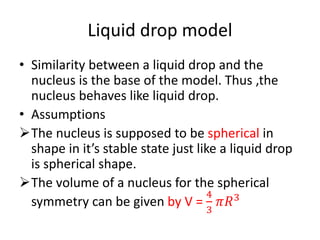
• Similarity between a liquid drop and the
nucleus is the base of the model. Thus ,the
nucleus behaves like liquid drop.
• Assumptions
The nucleus is supposed to be spherical in
shape in it’s stable state just like a liquid drop
is spherical shape.
The volume of a nucleus for the spherical
symmetry can be given by V =
4
3
𝜋𝑅3
The volume of a nucleus is proportional to total
number of nucleons A. Hence density is constant
and it is independent of volume. The liquid drop
has also a constant density for the liquid.
But density of nucleus is the same for the
nucleus of different element and density of
liquid is different for different liquids.
The short range nuclear forces in a nucleus are
identical to the strong cohesive forces in a
liquid drop .
Just as the latent heat of vaporization is
constant for a liquid , the binding energy per
nucleon is also constant for nucleus.
The formation of compound nucleus during
the nuclear reaction is similar to condensation
of vapor of liquid into drop .
When a small liquid drop is allowed to
oscillate, it breaks into two smaller drop of
equal size . The process of nuclear fission is
similar in which a heavy nucleus breaks up
into two almost equal fission fragments.
Different types of particles are emitted from
the nucleus during nuclear reactions . These
process is similar to emission of the molecules
from the liquid drop , during evaporation.
Justification
• From all above assumptions it is clear that the
properties of nucleus are very similar to the
properties of a liquid drop. Hence it is justified
to call this model of the nucleus as liquid drop
model.
Merits of liquid drop model
• The liquid drop model can explain the stability of
nucleus .
• It can explain the spontaneous disintegration of
radioactive element.
• It can explain the phenomenon of artificial
radioactivity.
• The liquid drop model also can explain the
phenomenon of nuclear fission.
• The liquid drop model explain the binding energy
of the nuclei.
limitations
• the liquid drop model fails to explain the high
stability of the nuclei with magic number.
• This model unable to calculate nuclear spin
and magnetic moments of the nuclei.
• This model can not explain excited state.
Nuclear Stability
• Nuclear stability means it does not emit any
kind of radiation
• Stable nucleus is not radioactive.
• Unstable nucleus is radioactive.
• The simplest way to predict the nuclear
stability is based on weather the nucleus
contains odd or even number of protons or
neutrons
• Nuclides containing even number of both
protons and neutrons are most stable means
less radioactive
• Nuclides containing odd number of both
protons and neutrons are unstable means
more radioactive.
• Nuclides containing odd number protons and
even number of neutrons are less stable than
nuclides containing even number of protons
and odd number of neutrons.
• Extra nuclear stability is associated with the
configuration having
Z = 2,8,20,50,82 and N = 2,8,20,50,82,126.
These are called magic numbers.
• For the light nuclei (A<40), Z and N are nearly
equal , so they are more stable.
• For the heavy nuclei more neutrons are added
to form a stable configuration and N/Z ratio
approaches to 1.5 for the heaviest nuclei.
• If a nucleus has too many neutrons , it is
unstable and it may spontaneously attain
stability via 𝛽 decay.
• All nuclei with Z > 83 and A< 209
spontaneously transform themselves into
lighter ones through the emission of
𝛼 particle.
Magic numbers
• The nuclei containing 2,8,20,28,50,82 and 126
nucleons of the same kind i.e. either protons
or neutrons are called as magic numbers .
Shell model
Evidences for nuclear shell structure.
the various experimentally determine facts
shows the nucleus has shell type structure.
Stability – the nucleons have tendency to form
pairs .It is easy to remove a single unpaired
nucleon from the nucleus . The helium
nucleus has 2 protons and 2 neutrons forms
very stable combination.
Natural abundance of elements found on
earth- it has been observed that the nuclei
contain Z or N magic number are most
abundant as compared to other nuclei in
nature.
End product of radioactive series
The stable end product of all three natural
radioactive series ( Uranium , Actinium and
Thorium series) is lead i.e. most stable because
it has Z=82 and N= 126 both are magic numbers.
Number of isotopes –
The nuclides whose proton number Z and
corresponding to magic number have
highest number of stable isotopes.
Number of isotones-
The nuclides whose neutron number N
and corresponding to magic number have
highest number of stable isotones.
Binding energy
The binding energy for the last neutron is
maximum for a magic neutron number . But
when the number of neutron exceeds the magic
number by one , the B.E. for the extra added
neutron drops sharply.
Electric quadrupole moment-
The electric quadrupole moment is zero for
magic number nuclei. This indicates that they
have zero deformation hence they are spherical,
while other nuclei are distorted in shape.
Low neutron capture cross-section-
For the magic number nuclei , the neutron
capture cross-section is low as compared to
their neighbors.
The energy of emitted 𝛽 –particle
The energy of emitted 𝛽 particle is very high
when the number of protons or neutrons in the
daughter nucleus is equal to magic number.
Assumptions of shell model
The electrons in the atom are grouped in the
shell and the subshell. And atoms with
2,10,18,36,54 and 86 electrons have their all
electrons shell completely filled . Such atoms
are stable and are chemical inert.
The nuclei having 2,8,20,28,50,82,and 126
neutrons or protons are most stable than the
other nuclei of similar mass number indicates
that their stable strucutre.These nuclei are
called as magic numbers.
Thus according to shell model, the nucleons
forms closed subshell within the nucleus just like
the electrons in the shells of an atom. Hence it is
named as shell model.
In shell model every nucleon is considered as
independent entity . Further it is assumed that
each nucleon moves in its orbit within the
nucleus independent of all other nucleons.
Each nucleon interact mainly within an average
force field produced by all the other nucleons.
Hence the shell model is also known as independent
particle model
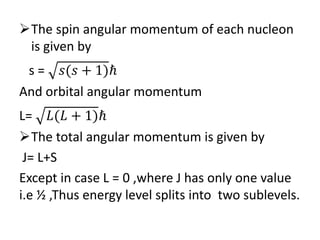
The spin angular momentum of each nucleon
is given by
s = 𝑠(𝑠 + 1)ℏ
And orbital angular momentum
L= 𝐿(𝐿 + 1)ℏ
The total angular momentum is given by
J= L+S
Except in case L = 0 ,where J has only one value
i.e ½ ,Thus energy level splits into two sublevels.

B.Sc. Sem VI ,Physics Paper - I ,Unit -II

  • 1.
  • 2.
    Nuclear Models • Nuclearmodels are proposed to understand and explain the observed properties with certain approximations . Some of the important nuclear models are Liquid drop model. Fermi gas model. Shell model No single model explain all the properties of the nucleus.
  • 3.
    Liquid drop model •Similarity between a liquid drop and the nucleus is the base of the model. Thus ,the nucleus behaves like liquid drop. • Assumptions The nucleus is supposed to be spherical in shape in it’s stable state just like a liquid drop is spherical shape. The volume of a nucleus for the spherical symmetry can be given by V = 4 3 𝜋𝑅3
  • 4.
    The volume ofa nucleus is proportional to total number of nucleons A. Hence density is constant and it is independent of volume. The liquid drop has also a constant density for the liquid. But density of nucleus is the same for the nucleus of different element and density of liquid is different for different liquids. The short range nuclear forces in a nucleus are identical to the strong cohesive forces in a liquid drop . Just as the latent heat of vaporization is constant for a liquid , the binding energy per nucleon is also constant for nucleus.
  • 5.
    The formation ofcompound nucleus during the nuclear reaction is similar to condensation of vapor of liquid into drop . When a small liquid drop is allowed to oscillate, it breaks into two smaller drop of equal size . The process of nuclear fission is similar in which a heavy nucleus breaks up into two almost equal fission fragments. Different types of particles are emitted from the nucleus during nuclear reactions . These process is similar to emission of the molecules from the liquid drop , during evaporation.
  • 6.
    Justification • From allabove assumptions it is clear that the properties of nucleus are very similar to the properties of a liquid drop. Hence it is justified to call this model of the nucleus as liquid drop model.
  • 7.
    Merits of liquiddrop model • The liquid drop model can explain the stability of nucleus . • It can explain the spontaneous disintegration of radioactive element. • It can explain the phenomenon of artificial radioactivity. • The liquid drop model also can explain the phenomenon of nuclear fission. • The liquid drop model explain the binding energy of the nuclei.
  • 8.
    limitations • the liquiddrop model fails to explain the high stability of the nuclei with magic number. • This model unable to calculate nuclear spin and magnetic moments of the nuclei. • This model can not explain excited state.
  • 9.
    Nuclear Stability • Nuclearstability means it does not emit any kind of radiation • Stable nucleus is not radioactive. • Unstable nucleus is radioactive. • The simplest way to predict the nuclear stability is based on weather the nucleus contains odd or even number of protons or neutrons
  • 10.
    • Nuclides containingeven number of both protons and neutrons are most stable means less radioactive • Nuclides containing odd number of both protons and neutrons are unstable means more radioactive. • Nuclides containing odd number protons and even number of neutrons are less stable than nuclides containing even number of protons and odd number of neutrons.
  • 11.
    • Extra nuclearstability is associated with the configuration having Z = 2,8,20,50,82 and N = 2,8,20,50,82,126. These are called magic numbers. • For the light nuclei (A<40), Z and N are nearly equal , so they are more stable. • For the heavy nuclei more neutrons are added to form a stable configuration and N/Z ratio approaches to 1.5 for the heaviest nuclei.
  • 12.
    • If anucleus has too many neutrons , it is unstable and it may spontaneously attain stability via 𝛽 decay. • All nuclei with Z > 83 and A< 209 spontaneously transform themselves into lighter ones through the emission of 𝛼 particle.
  • 13.
    Magic numbers • Thenuclei containing 2,8,20,28,50,82 and 126 nucleons of the same kind i.e. either protons or neutrons are called as magic numbers .
  • 14.
    Shell model Evidences fornuclear shell structure. the various experimentally determine facts shows the nucleus has shell type structure. Stability – the nucleons have tendency to form pairs .It is easy to remove a single unpaired nucleon from the nucleus . The helium nucleus has 2 protons and 2 neutrons forms very stable combination.
  • 15.
    Natural abundance ofelements found on earth- it has been observed that the nuclei contain Z or N magic number are most abundant as compared to other nuclei in nature. End product of radioactive series The stable end product of all three natural radioactive series ( Uranium , Actinium and Thorium series) is lead i.e. most stable because it has Z=82 and N= 126 both are magic numbers.
  • 16.
    Number of isotopes– The nuclides whose proton number Z and corresponding to magic number have highest number of stable isotopes. Number of isotones- The nuclides whose neutron number N and corresponding to magic number have highest number of stable isotones.
  • 17.
    Binding energy The bindingenergy for the last neutron is maximum for a magic neutron number . But when the number of neutron exceeds the magic number by one , the B.E. for the extra added neutron drops sharply. Electric quadrupole moment- The electric quadrupole moment is zero for magic number nuclei. This indicates that they have zero deformation hence they are spherical, while other nuclei are distorted in shape.
  • 18.
    Low neutron capturecross-section- For the magic number nuclei , the neutron capture cross-section is low as compared to their neighbors. The energy of emitted 𝛽 –particle The energy of emitted 𝛽 particle is very high when the number of protons or neutrons in the daughter nucleus is equal to magic number.
  • 19.
    Assumptions of shellmodel The electrons in the atom are grouped in the shell and the subshell. And atoms with 2,10,18,36,54 and 86 electrons have their all electrons shell completely filled . Such atoms are stable and are chemical inert. The nuclei having 2,8,20,28,50,82,and 126 neutrons or protons are most stable than the other nuclei of similar mass number indicates that their stable strucutre.These nuclei are called as magic numbers.
  • 20.
    Thus according toshell model, the nucleons forms closed subshell within the nucleus just like the electrons in the shells of an atom. Hence it is named as shell model. In shell model every nucleon is considered as independent entity . Further it is assumed that each nucleon moves in its orbit within the nucleus independent of all other nucleons. Each nucleon interact mainly within an average force field produced by all the other nucleons. Hence the shell model is also known as independent particle model
  • 21.
    The spin angularmomentum of each nucleon is given by s = 𝑠(𝑠 + 1)ℏ And orbital angular momentum L= 𝐿(𝐿 + 1)ℏ The total angular momentum is given by J= L+S Except in case L = 0 ,where J has only one value i.e ½ ,Thus energy level splits into two sublevels.