PRESENTED BY
Dr DEEPAK KAUSHIK
ASSISTANT PROFESSOR & IQAC OFFICER
DEPARTMENT OF PHARMACEUTICAL SCIENCES
M.D.UNIVERSITY, ROHTAK
LIPSTICKS AND SHAMPOOS
DEFINITION
 Lipstick is a cosmetic product containing
pigments, oils, waxes, and emollients which is
applied to the lips to provide color, moisturization,
and protection
Lipstick composition
 Emollients (also can help disperse pigments): 41-
79 percent
 Structuring agents: 15-28 percent (usually a
mixture of two to five ingredients)
 Pigments: 3-10 percent
 Pearls/luster agents: 0-10 percent
 Matting agents: 0-5 percent
 Wear ingredients: 0-5 percent
 Fragrance/flavor: 0-0.3 percent
 Preservatives/Antioxidants: 0.2-0.5 percent
Lipstick structuring agents
 The types of structuring agents used in lipstick
formulations include waxes, polymers, particles
(e.g. silica, organo clays) and fiber network
forming agents. The most common structuring
agents used include:
 Ozokerite
 Carnauba
 Candelilla
 Beeswax
 Polyethylene
 Microcrystalline
It’s critical to use a blend of crystalline and
amorphous waxes that provide a small crystal size
on cooling, which creates good oil
binding/compatibility and stick strength. Common
combinations include:
•Ozokerite/Microcrystalline
•Polyethylene/Microcrystalline
•Polyethylene/Ozokerite
•Beeswax/Candellila/Carnauba
Lipstick emollients
 Emollients are important lipstick
ingredients that impact product
application, color, spreading, and shine.
The best emollients are normally high
molecular weight, viscous ingredients
that don’t spread quickly on skin. This
can help prevent bleeding, and
feathering or wicking of product into the
skin creases around lips.
Emollients
 Emollients that provide shine normally are viscous to
provide cushion and have a refractive index over
1.49. Examples of commonly used emollients include:
 Lanolin
 Castor oil
 Bis-Diglyceryl Polyacyladipate-2 (synthetic Lanolin)
 Shea Butter
 Polybutene
 Hydrogenated Polyisobutene
 Triisostearyl Citrate
PIGMENTS & DYES
FORMULATION
CONSIDERATIONS
 Lipsticks are usually formulated in three stages: a
pigment grind, a wax base, and a dilution oil
blend.
 Use pigment grind premixes that have been high-
shear processed in a viscous emollient like castor
oil, via roller mill or Kady mill. Also include a good
dispersing agent.
 Use blends of crystalline and amorphous waxes
to get good oil binding. Most sticks contain three
to five structuring waxes.
 Slight variations in the formulation can sometimes
produce big differences in hardness, crystal size,
and appearance.
 Lipsticks should harden quickly and easily come
out of molds.
 Waxes that produce adequate shrinkage of the
lipstick on cooling must be incorporated for good
mold release. It is helpful to include a small
amount of wax which melts above the molding
temperature, to give faster nucleation during the
cooling process.
 It can sometimes be difficult to produce a
lipstick which is stable across a wide range of
temperatures. Materials which liquefy or
solidify within the stick under different
temperature conditions can alter the texture
and surface appearance of the stick over time.
Cocoa butter, which melts at body
temperature, is a good example of a material
which can produce this type of effect.
 Use fumed silica in the formulation to improve
payoff, reduce pigment settling and reduce oil
bleeding.
 The oils and waxes used should be close enough in
polarity to readily mix when the lipstick is melted,
before the stick is formed. Problems can occur if
excessively high levels of a microcrystalline wax are
used in a high castor oil containing lipstick, the
microcrystalline wax only having limited solubility in
polar castor oil.
 Use materials which produce a small crystal structure.
Larger crystals can reduce gloss characteristics of the
stick. Microcrystalline waxes can help form smaller
crystals.
SHAMPOOS
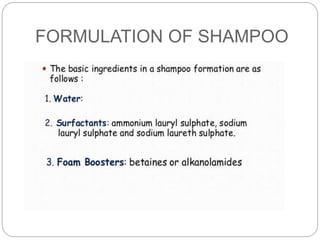
FORMULATION OF SHAMPOO
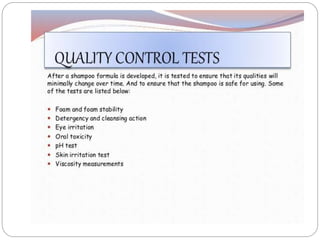
Foam and foam stability
 The Ross‐Miles foam column test is accepted.
200 ml of surfactant solution is dropped into a
glass column containing 50ml of the same
solution. The height of the foam generated is
measured immediately and again after a specified
time interval, and is considered proportional to
the volume. • Barnett and Powers developed a
latherometer to measure the effect of variables
such as water hardness, type of soil and quantity
of soil on foam speed, volume and stability. •
Fredell and Read titrated actual standard oiled
heads of hair with additive increments of
shampoo until a persistent lather end point
Detergency and cleaning action
 Cleansing power is evaluated by the method of
Barnet and Powers • 5gm sample of soiled
human hair is placed at 35°c in 200 cc of water
containing of 1 gm of shampoo. • The flask is
shaken 50 times a minute for 4 minutes. Then
washed once again with sufficient amount of
water, then after filter the hair dried and weighed.
• The amount of soil is removed under these
condition is calculated.
OTHER TESTS
 Wetting Action: Canvas disk sinking test: A mount
veron cotton duck # 6 canvas disk 1 inch in
diameter, is floated on the surface of a solution,
and the time required for it to sink is measured
accurately.
 Rinsing: • Skilled beauticians are employed to
make comparisons on the performance of several
shampoos.
 Conditioning Action: • Conditioning action is a
difficult property to assess. The degree of
conditioning given to hair is ultimately judged by
shampoo user who is making the evaluation on
the basis of past experience and present
Microbiological assay:
 PREPARATION OF PRE ‐INOCULUM
 Take the loopful culture of staphylococcus aureus
(ATCC6532) aseptically and transfer to sterilized
and cooled 100 ml SCDM (broth). • Mix well.
Incubate the broth at 37oC for 24 hrs. ‰
 PREPARATION OF MEDIA Soya bean casein
digests medium, soya bean casein digest agar
and nutrient agar.
 PREPARATION OF POUR PLATES :Sterilized
SCD agar (100 ml) is cooled to 40°C and mixed
with 5 ml of 24 hrs old pre inoculated culture. •
This is immediately poured in plates (340 ml
each) and allows to set.
 MAKING THE WELLS ON AGAR PLATES :The
wells are dig on agar plates with sterilised well
digger aseptically. • Take 100µml of each sample,
add to well aseptically. Incubate the plates at
37oC for 24 hrs to 48 hrs. • Observe the
effectiveness of sample on culture growing on the
agar plate and we can see the effectiveness of
sample in the form of zone of inhibition around
Evaluation of eye irritancy
 The test calls for dropping 0.1 ml of liquid shampoo in
the conjunctiva sac of one eye of the rabbit , the other
eye serving as control.
 In the case of the first three animals, the treated eye
remains unwashed. Since washing the eye may or
may not alleviate symptoms of injury.
 The six remaining animals are divided into two equal
groups.
 In the first of these groups eyes instilled with the
substances are washed with 20 ml of lukewarm water
two seconds after treatment and in the second group
after instillation. • Readings are then made at 24, 48
and 72 hr and again four and seven days after
treatment. • If the lesions have not cleared up in
Viscosity
Viscosity of the liquid shampoo is
determined using a Brookefield viscometer •
100 mL of the shampoo is taken in a beaker
and the spindle is dipped in it for about 5
min and then the reading is taken.

Lipsticks anf shampoos

  • 1.
    PRESENTED BY Dr DEEPAKKAUSHIK ASSISTANT PROFESSOR & IQAC OFFICER DEPARTMENT OF PHARMACEUTICAL SCIENCES M.D.UNIVERSITY, ROHTAK LIPSTICKS AND SHAMPOOS
  • 2.
    DEFINITION  Lipstick isa cosmetic product containing pigments, oils, waxes, and emollients which is applied to the lips to provide color, moisturization, and protection
  • 4.
    Lipstick composition  Emollients(also can help disperse pigments): 41- 79 percent  Structuring agents: 15-28 percent (usually a mixture of two to five ingredients)  Pigments: 3-10 percent  Pearls/luster agents: 0-10 percent  Matting agents: 0-5 percent  Wear ingredients: 0-5 percent  Fragrance/flavor: 0-0.3 percent  Preservatives/Antioxidants: 0.2-0.5 percent
  • 5.
    Lipstick structuring agents The types of structuring agents used in lipstick formulations include waxes, polymers, particles (e.g. silica, organo clays) and fiber network forming agents. The most common structuring agents used include:  Ozokerite  Carnauba  Candelilla  Beeswax  Polyethylene  Microcrystalline
  • 6.
    It’s critical touse a blend of crystalline and amorphous waxes that provide a small crystal size on cooling, which creates good oil binding/compatibility and stick strength. Common combinations include: •Ozokerite/Microcrystalline •Polyethylene/Microcrystalline •Polyethylene/Ozokerite •Beeswax/Candellila/Carnauba
  • 7.
    Lipstick emollients  Emollientsare important lipstick ingredients that impact product application, color, spreading, and shine. The best emollients are normally high molecular weight, viscous ingredients that don’t spread quickly on skin. This can help prevent bleeding, and feathering or wicking of product into the skin creases around lips.
  • 8.
    Emollients  Emollients thatprovide shine normally are viscous to provide cushion and have a refractive index over 1.49. Examples of commonly used emollients include:  Lanolin  Castor oil  Bis-Diglyceryl Polyacyladipate-2 (synthetic Lanolin)  Shea Butter  Polybutene  Hydrogenated Polyisobutene  Triisostearyl Citrate
  • 9.
  • 14.
    FORMULATION CONSIDERATIONS  Lipsticks areusually formulated in three stages: a pigment grind, a wax base, and a dilution oil blend.  Use pigment grind premixes that have been high- shear processed in a viscous emollient like castor oil, via roller mill or Kady mill. Also include a good dispersing agent.  Use blends of crystalline and amorphous waxes to get good oil binding. Most sticks contain three to five structuring waxes.
  • 15.
     Slight variationsin the formulation can sometimes produce big differences in hardness, crystal size, and appearance.  Lipsticks should harden quickly and easily come out of molds.  Waxes that produce adequate shrinkage of the lipstick on cooling must be incorporated for good mold release. It is helpful to include a small amount of wax which melts above the molding temperature, to give faster nucleation during the cooling process.
  • 16.
     It cansometimes be difficult to produce a lipstick which is stable across a wide range of temperatures. Materials which liquefy or solidify within the stick under different temperature conditions can alter the texture and surface appearance of the stick over time. Cocoa butter, which melts at body temperature, is a good example of a material which can produce this type of effect.  Use fumed silica in the formulation to improve payoff, reduce pigment settling and reduce oil bleeding.
  • 17.
     The oilsand waxes used should be close enough in polarity to readily mix when the lipstick is melted, before the stick is formed. Problems can occur if excessively high levels of a microcrystalline wax are used in a high castor oil containing lipstick, the microcrystalline wax only having limited solubility in polar castor oil.  Use materials which produce a small crystal structure. Larger crystals can reduce gloss characteristics of the stick. Microcrystalline waxes can help form smaller crystals.
  • 24.
  • 28.
  • 36.
    Foam and foamstability  The Ross‐Miles foam column test is accepted. 200 ml of surfactant solution is dropped into a glass column containing 50ml of the same solution. The height of the foam generated is measured immediately and again after a specified time interval, and is considered proportional to the volume. • Barnett and Powers developed a latherometer to measure the effect of variables such as water hardness, type of soil and quantity of soil on foam speed, volume and stability. • Fredell and Read titrated actual standard oiled heads of hair with additive increments of shampoo until a persistent lather end point
  • 37.
    Detergency and cleaningaction  Cleansing power is evaluated by the method of Barnet and Powers • 5gm sample of soiled human hair is placed at 35°c in 200 cc of water containing of 1 gm of shampoo. • The flask is shaken 50 times a minute for 4 minutes. Then washed once again with sufficient amount of water, then after filter the hair dried and weighed. • The amount of soil is removed under these condition is calculated.
  • 38.
    OTHER TESTS  WettingAction: Canvas disk sinking test: A mount veron cotton duck # 6 canvas disk 1 inch in diameter, is floated on the surface of a solution, and the time required for it to sink is measured accurately.  Rinsing: • Skilled beauticians are employed to make comparisons on the performance of several shampoos.  Conditioning Action: • Conditioning action is a difficult property to assess. The degree of conditioning given to hair is ultimately judged by shampoo user who is making the evaluation on the basis of past experience and present
  • 39.
    Microbiological assay:  PREPARATIONOF PRE ‐INOCULUM  Take the loopful culture of staphylococcus aureus (ATCC6532) aseptically and transfer to sterilized and cooled 100 ml SCDM (broth). • Mix well. Incubate the broth at 37oC for 24 hrs. ‰  PREPARATION OF MEDIA Soya bean casein digests medium, soya bean casein digest agar and nutrient agar.
  • 40.
     PREPARATION OFPOUR PLATES :Sterilized SCD agar (100 ml) is cooled to 40°C and mixed with 5 ml of 24 hrs old pre inoculated culture. • This is immediately poured in plates (340 ml each) and allows to set.  MAKING THE WELLS ON AGAR PLATES :The wells are dig on agar plates with sterilised well digger aseptically. • Take 100µml of each sample, add to well aseptically. Incubate the plates at 37oC for 24 hrs to 48 hrs. • Observe the effectiveness of sample on culture growing on the agar plate and we can see the effectiveness of sample in the form of zone of inhibition around
  • 41.
    Evaluation of eyeirritancy  The test calls for dropping 0.1 ml of liquid shampoo in the conjunctiva sac of one eye of the rabbit , the other eye serving as control.  In the case of the first three animals, the treated eye remains unwashed. Since washing the eye may or may not alleviate symptoms of injury.  The six remaining animals are divided into two equal groups.  In the first of these groups eyes instilled with the substances are washed with 20 ml of lukewarm water two seconds after treatment and in the second group after instillation. • Readings are then made at 24, 48 and 72 hr and again four and seven days after treatment. • If the lesions have not cleared up in
  • 42.
    Viscosity Viscosity of theliquid shampoo is determined using a Brookefield viscometer • 100 mL of the shampoo is taken in a beaker and the spindle is dipped in it for about 5 min and then the reading is taken.