PRESENTED BY
Dr DEEPAK KAUSHIK
ASSISTANT PROFESSOR & IQAC OFFICER
DEPARTMENT OF PHARMACEUTICAL SCIENCES
M.D.UNIVERSITY, ROHTAK
PHARMACEUTICAL AER0SOLS
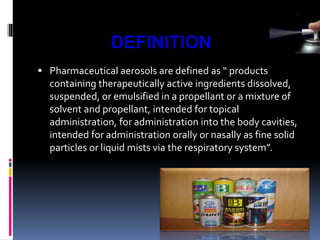
 Pharmaceutical aerosols are defined as “ products
containing therapeutically active ingredients dissolved,
suspended, or emulsified in a propellant or a mixture of
solvent and propellant, intended for topical
administration, for administration into the body cavities,
intended for administration orally or nasally as fine solid
particles or liquid mists via the respiratory system”.
DEFINITION
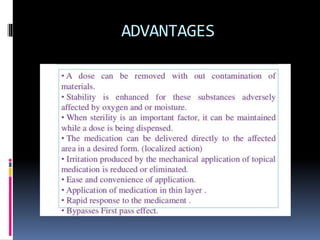
ADVANTAGES
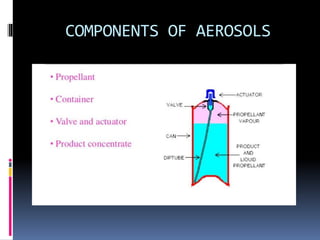
COMPONENTS OF AEROSOLS
PROPELLANTS
 The propellant is generally regarded as the heart of
the aerosol package. It is responsible for
development of pressure within the container,
supplying the necessary force to expel the product
when the valve is opened.
 The propellant also acts as a solvent and as a diluent
and has much to do with determing the
characteristics of the product as it leaves the
container.
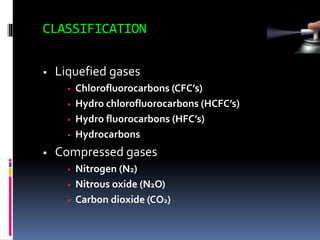
CLASSIFICATION
 Liquefied gases
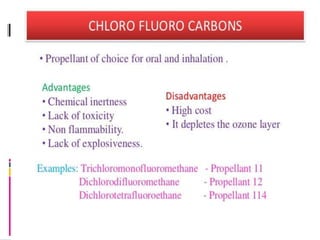
 Chlorofluorocarbons (CFC’s)
 Hydro chlorofluorocarbons (HCFC’s)
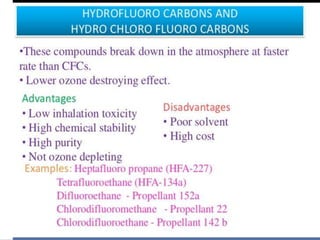
 Hydro fluorocarbons (HFC’s)
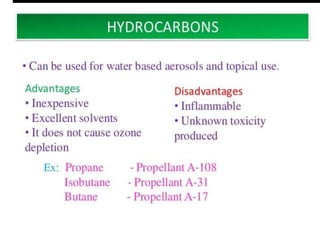
 Hydrocarbons
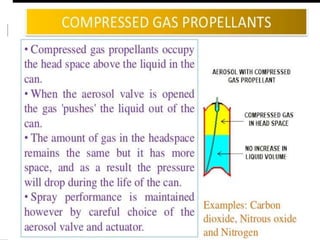
 Compressed gases
 Nitrogen (N2)
 Nitrous oxide (N2O)
 Carbon dioxide (CO2)
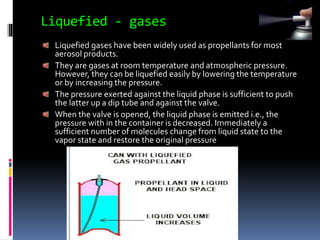
Liquefied - gases
Liquefied gases have been widely used as propellants for most
aerosol products.
They are gases at room temperature and atmospheric pressure.
However, they can be liquefied easily by lowering the temperature
or by increasing the pressure.
The pressure exerted against the liquid phase is sufficient to push
the latter up a dip tube and against the valve.
When the valve is opened, the liquid phase is emitted i.e., the
pressure with in the container is decreased. Immediately a
sufficient number of molecules change from liquid state to the
vapor state and restore the original pressure
Destruction of Ozone
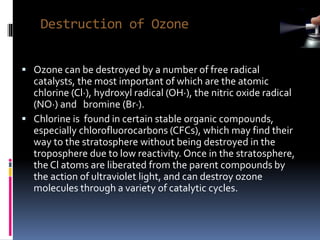
 Ozone can be destroyed by a number of free radical
catalysts, the most important of which are the atomic
chlorine (Cl·), hydroxyl radical (OH·), the nitric oxide radical
(NO·) and bromine (Br·).
 Chlorine is found in certain stable organic compounds,
especially chlorofluorocarbons (CFCs), which may find their
way to the stratosphere without being destroyed in the
troposphere due to low reactivity. Once in the stratosphere,
the Cl atoms are liberated from the parent compounds by
the action of ultraviolet light, and can destroy ozone
molecules through a variety of catalytic cycles.
Conti…
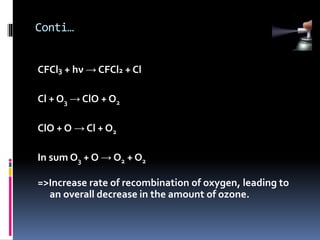
CFCl3 + hν → CFCl2 + Cl
Cl + O3 → ClO + O2
ClO + O → Cl + O2
In sum O3 + O → O2 + O2
=>Increase rate of recombination of oxygen, leading to
an overall decrease in the amount of ozone.
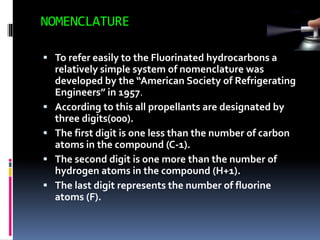
NOMENCLATURE
 To refer easily to the Fluorinated hydrocarbons a
relatively simple system of nomenclature was
developed by the “American Society of Refrigerating
Engineers” in 1957.
 According to this all propellants are designated by
three digits(000).
 The first digit is one less than the number of carbon
atoms in the compound (C-1).
 The second digit is one more than the number of
hydrogen atoms in the compound (H+1).
 The last digit represents the number of fluorine
atoms (F).
Conti….
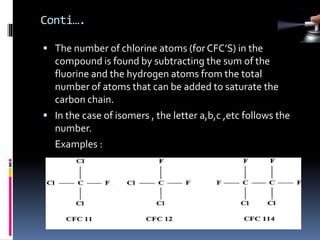
 The number of chlorine atoms (for CFC’S) in the
compound is found by subtracting the sum of the
fluorine and the hydrogen atoms from the total
number of atoms that can be added to saturate the
carbon chain.
 In the case of isomers , the letter a,b,c ,etc follows the
number.
Examples :
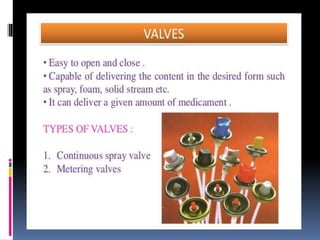
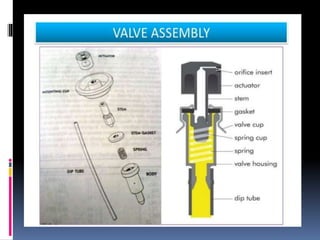
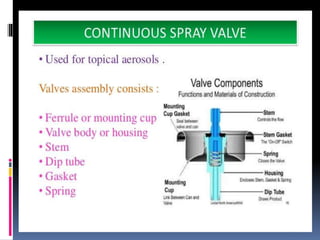
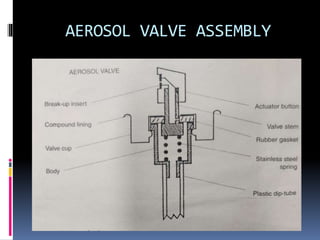
AEROSOL VALVE ASSEMBLY
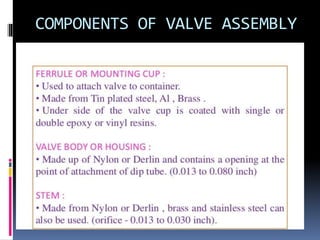
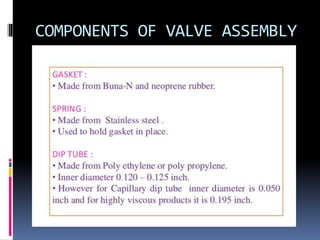
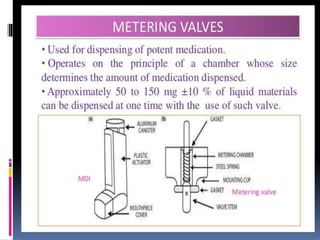
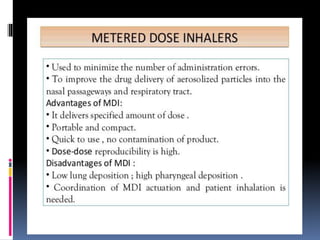
COMPONENTS OF VALVE ASSEMBLY
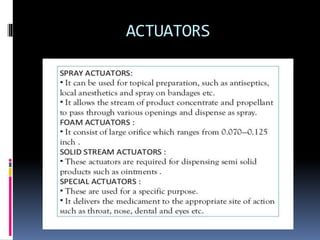
ACTUATORS
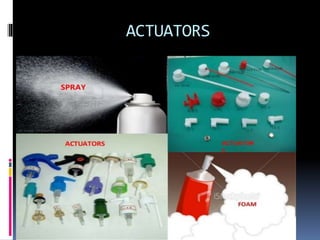
ACTUATORS
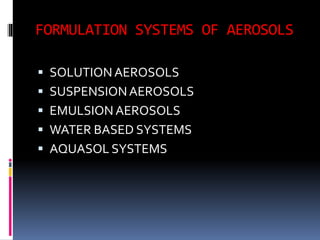
FORMULATION SYSTEMS OF AEROSOLS
 SOLUTIONAEROSOLS
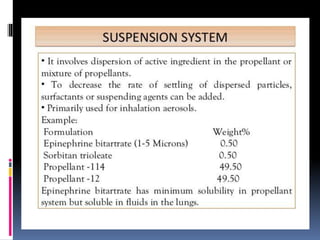
 SUSPENSIONAEROSOLS
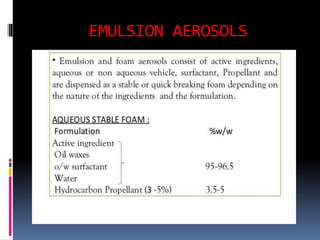
 EMULSION AEROSOLS
 WATER BASED SYSTEMS
 AQUASOL SYSTEMS
SOLUTION SYSTEMS
 The drug is soluble in propellants
 Easy to formulate
 Depending upon the concentration of
propellant two types of solution systems are
formulated:
 Space spray (85-95%), size less than 50µm or
less
 Surface spray (25-75%), size between 50-200
µm
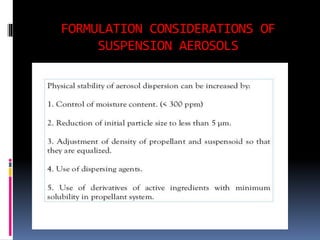
FORMULATION CONSIDERATIONS OF
SUSPENSION AEROSOLS
EMULSION AEROSOLS
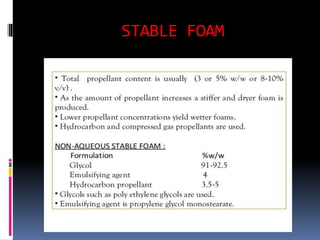
STABLE FOAM
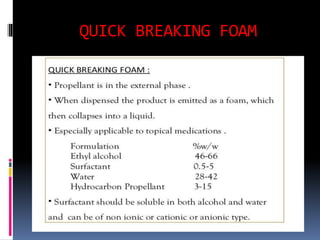
QUICK BREAKING FOAM
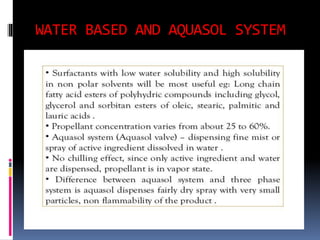
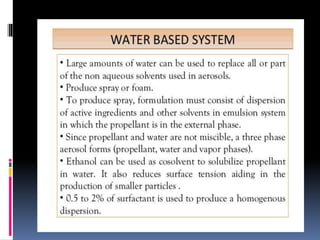
WATER BASED AND AQUASOL SYSTEM
Pharmaceutical aerosols

Pharmaceutical aerosols

  • 1.
    PRESENTED BY Dr DEEPAKKAUSHIK ASSISTANT PROFESSOR & IQAC OFFICER DEPARTMENT OF PHARMACEUTICAL SCIENCES M.D.UNIVERSITY, ROHTAK PHARMACEUTICAL AER0SOLS
  • 2.
     Pharmaceutical aerosolsare defined as “ products containing therapeutically active ingredients dissolved, suspended, or emulsified in a propellant or a mixture of solvent and propellant, intended for topical administration, for administration into the body cavities, intended for administration orally or nasally as fine solid particles or liquid mists via the respiratory system”. DEFINITION
  • 3.
  • 4.
  • 5.
    PROPELLANTS  The propellantis generally regarded as the heart of the aerosol package. It is responsible for development of pressure within the container, supplying the necessary force to expel the product when the valve is opened.  The propellant also acts as a solvent and as a diluent and has much to do with determing the characteristics of the product as it leaves the container.
  • 6.
    CLASSIFICATION  Liquefied gases Chlorofluorocarbons (CFC’s)  Hydro chlorofluorocarbons (HCFC’s)  Hydro fluorocarbons (HFC’s)  Hydrocarbons  Compressed gases  Nitrogen (N2)  Nitrous oxide (N2O)  Carbon dioxide (CO2)
  • 7.
    Liquefied - gases Liquefiedgases have been widely used as propellants for most aerosol products. They are gases at room temperature and atmospheric pressure. However, they can be liquefied easily by lowering the temperature or by increasing the pressure. The pressure exerted against the liquid phase is sufficient to push the latter up a dip tube and against the valve. When the valve is opened, the liquid phase is emitted i.e., the pressure with in the container is decreased. Immediately a sufficient number of molecules change from liquid state to the vapor state and restore the original pressure
  • 9.
    Destruction of Ozone Ozone can be destroyed by a number of free radical catalysts, the most important of which are the atomic chlorine (Cl·), hydroxyl radical (OH·), the nitric oxide radical (NO·) and bromine (Br·).  Chlorine is found in certain stable organic compounds, especially chlorofluorocarbons (CFCs), which may find their way to the stratosphere without being destroyed in the troposphere due to low reactivity. Once in the stratosphere, the Cl atoms are liberated from the parent compounds by the action of ultraviolet light, and can destroy ozone molecules through a variety of catalytic cycles.
  • 10.
    Conti… CFCl3 + hν→ CFCl2 + Cl Cl + O3 → ClO + O2 ClO + O → Cl + O2 In sum O3 + O → O2 + O2 =>Increase rate of recombination of oxygen, leading to an overall decrease in the amount of ozone.
  • 13.
    NOMENCLATURE  To refereasily to the Fluorinated hydrocarbons a relatively simple system of nomenclature was developed by the “American Society of Refrigerating Engineers” in 1957.  According to this all propellants are designated by three digits(000).  The first digit is one less than the number of carbon atoms in the compound (C-1).  The second digit is one more than the number of hydrogen atoms in the compound (H+1).  The last digit represents the number of fluorine atoms (F).
  • 14.
    Conti….  The numberof chlorine atoms (for CFC’S) in the compound is found by subtracting the sum of the fluorine and the hydrogen atoms from the total number of atoms that can be added to saturate the carbon chain.  In the case of isomers , the letter a,b,c ,etc follows the number. Examples :
  • 23.
  • 24.
  • 25.
  • 29.
  • 30.
  • 31.
    FORMULATION SYSTEMS OFAEROSOLS  SOLUTIONAEROSOLS  SUSPENSIONAEROSOLS  EMULSION AEROSOLS  WATER BASED SYSTEMS  AQUASOL SYSTEMS
  • 32.
    SOLUTION SYSTEMS  Thedrug is soluble in propellants  Easy to formulate  Depending upon the concentration of propellant two types of solution systems are formulated:  Space spray (85-95%), size less than 50µm or less  Surface spray (25-75%), size between 50-200 µm
  • 34.
  • 35.
  • 36.
  • 37.
  • 39.
    WATER BASED ANDAQUASOL SYSTEM