A Friendly Introduction to Linear Regression
Luis Serrano
Linear Regression Logistic Regression Support Vector Machines
Series of 3 videos
What is Linear Regression?
1 room 2 rooms 3 rooms 4 rooms 5 rooms
$150K $200K $300K $350K???
$250K
Housing Prices
House 1 House 2 House 3 House 4 House 5
$100
$200
$300
$400
1 2 3 4
Number of Rooms
Price
5
$150
$50
$250
$350
House 1
House 2
House 3
House 4
House 5
$100
$200
$300
$400
1 2 3 4
Number of Rooms
Price
5
$150
$50
$250
$350
House 1 House 2
House 3
House 4
House 5
Linear Regression
Linear Regression
Linear Regression
Come
closer!
Come
closer!
Come
closer!
Come
closer!
Come
closer!
Linear Regression
Come
closer!
How do we move a line closer to a point?
Come
closer!
Moving a line
Come
closer!
y-intercept
Slope
Changing the slope - Rotation
Slope
Bigger slope
Smaller slopePivot
Changing the y-intercept - Translation
y-intercept
Smaller y-intercept
Bigger y-intercept
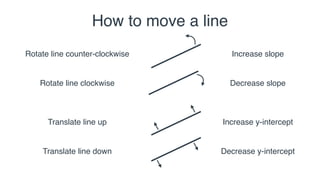
How to move a line
Rotate line counter-clockwise Increase slope
Rotate line clockwise Decrease slope
Translate line up Increase y-intercept
Translate line down Decrease y-intercept
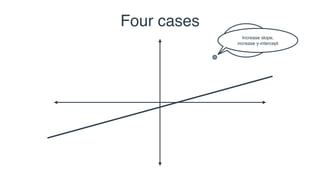
Four cases
Come
closer!
Rotate counter-clockwise
translate up
Increase slope,
increase y-intercept
Four cases
Come
closer!
Rotate clockwise
translate up
Decrease slope,
increase y-intercept
Four cases
Come
closer!
Rotate counter-clockwise
translate down
increase slope,
decrease y-intercept
Four cases
Come
closer!
Rotate clockwise
translate down
Decrease slope,
decrease y-intercept
Four cases
Decrease slope,
decrease y-intercept
Increase slope,
increase y-intercept
Increase slope,
decrease y-intercept
Decrease slope,
increase y-intercept
Moving a line
Come
closer!
y-intercept = 3
y = 2x + 3
Slope = 2
y = 2.01x + 3.01
Step 1: Pick a small number.
(learning rate)
Step 2:
- Add learning rate to slope
- Add learning rate to y-intercept
0.01
+0.01 +0.01
0.010.01
Linear regression
algorithm
Come
closer!
Step 3: Pick a small number.
(learning rate)
0.01
Step 4: (repeat 1000 times)
-Pick random point
-Move line towards point
Step 2: Pick a large number.
(number of repetitions, or epochs)
1000
-If point above line, and to the right of the y-axis:
rotate counter-clockwise and translate up
-If point above line, and to the left of the y-axis:
rotate clockwise and translate up
-If point below line, and to the right of the y-axis:
rotate clockwise and translate down
-If point below line, and to the left of the y-axis:
rotate counter-clockwise and translate down
-If point above line, and to the right of the y-axis:
add 0.01 to slope
add 0.01 to y-intercept
-If point above line, and to the left of the y-axis:
subtract 0.01 to slope
add 0.01 to y-intercept
-If point below line, and to the right of the y-axis:
subtract 0.01 to slope
subtract 0.01 to y-intercept
-If point below line, and to the left of the y-axis:
add 0.01 to slope
subtract 0.01 to y-intercept
Step 1: Start with a random line
Come
closer!
Step 5: Enjoy your fitted line!
Can we do better?
Yes!
Step 3: Pick a small number.
(learning rate)
0.01
Step 4: (repeat 1000 times)
-Pick random point
-Move line towards point
Step 2: Pick a large number.
(number of repetitions, or epochs)
1000
-If point above line, and to the right of the y-axis:
rotate counter-clockwise and translate up
-If point above line, and to the left of the y-axis:
rotate clockwise and translate up
-If point below line, and to the right of the y-axis:
rotate clockwise and translate down
-If point below line, and to the left of the y-axis:
rotate counter-clockwise and translate down
-If point above line, and to the right of the y-axis:
add 0.01 to slope
add 0.01 to y-intercept
-If point above line, and to the left of the y-axis:
subtract 0.01 to slope
add 0.01 to y-intercept
-If point below line, and to the right of the y-axis:
subtract 0.01 to slope
subtract 0.01 to y-intercept
-If point below line, and to the left of the y-axis:
add 0.01 to slope
subtract 0.01 to y-intercept
Step 1: Start with a random line
Step 5: Enjoy your fitted line!
4 cases!
1 case?
Linear regression
algorithm
Positive and negative distance
+-
Positive and negative distance
+
-
Positive and negative distance
+4-4
+3-3
(2,1) (6,1)
(6,4)
6-22-64-11-4
Four cases
Decrease slope,
decrease y-intercept
Increase slope,
increase y-intercept
Increase slope,
decrease y-intercept
Decrease slope,
increase y-intercept
Four cases
+
+
Four cases
+
-
Four cases
-
-
Four cases
-
+
Decrease slope,
decrease y-intercept
Increase slope,
increase y-intercept
Increase slope,
decrease y-intercept
Decrease slope,
increase y-intercept
+
+
+
-
-
-
-
+
Four cases
Decrease slope,
decrease y-intercept
Increase slope,
increase y-intercept
Increase slope,
decrease y-intercept
Decrease slope,
increase y-intercept
+
+
+
-
-
-
-
+
Four cases
One rule to rule them all
Decrease slope,
decrease y-intercept
Increase slope,
increase y-intercept
Increase slope,
decrease y-intercept
Decrease slope,
increase y-intercept
+
+
+
-
-
-
-
+
Rule
To rotate:
- Add (vertical distance) x (horizontal
distance) to slope
To translate:
- Add (vertical distance) to y-intercept
Square trickCome
closer!
y = 2x + 3
y = 2.15x + 3.03
Step 1:
Pick a small number (learning rate) 0.01
Step 2:
- Add (learning rate) x (vertical distance) x (horizontal distance) to slope
- Add (learning rate) x (vertical distance) to y-intercept
+
+5
3
+ 0.01 x 3 x 5 + 0.01 x 3
0.01
5
3
0.01
3
+0.15 +0.03
Square trick
Come
closer!
y = 2x + 3
y = 1.8x + 2.96
Step 1:
Pick a small number (learning rate) 0.01
Step 2:
- Add (learning rate) x (vertical distance) x (horizontal distance) to slope
- Add (learning rate) x (vertical distance) to y-intercept
-
+5
-4
+ 0.01 x (-4) x 5 + 0.01 x (-4)
-4 0.010.01
-0.2 -0.04
5
-4
Linear regression
algorithm Step 3: Pick a small number.
(learning rate)
0.01
Step 4: (repeat 1000 times)
-Pick random point
-Move line towards point
Step 2: Pick a large number.
(number of repetitions, or epochs)
1000
Step 1: Start with a random line
Come
closer!
Step 5: Enjoy your fitted line!
- Add (learning rate)x(vertical distance) x
(horizontal distance) to slope
- Add (learning rate)x(vertical distance)
to y-intercept
2 Challenges
Square error
Large square error Small square error
Minimize using calculus (gradient descent)
Same as the square trick!
Bad line Good line
Absolute error
Large absolute error Small absolute error
Minimize using calculus (gradient descent)
Develop an absolute trick!
Bad line Good line
Absolute trick
Step 1:
Pick a small number (learning rate)
Step 2:
- If point is above the line:
- Add (learning rate) x (horizontal distance) to slope
- Add (learning rate) to y-intercept
- If point is below the line:
- Subtract (learning rate) x (horizontal distance) to slope
- Subtract (learning rate) to y-intercept
Come
closer!
Linear Regression Logistic Regression Support Vector Machines
Series of 3 videos
Thank you!
@luis_likes_math
Subscribe, like,
share, comment!
youtube.com/c/LuisSerrano

Linear regression

  • 1.
    A Friendly Introductionto Linear Regression Luis Serrano
  • 2.
    Linear Regression LogisticRegression Support Vector Machines Series of 3 videos
  • 3.
    What is LinearRegression?
  • 4.
    1 room 2rooms 3 rooms 4 rooms 5 rooms $150K $200K $300K $350K??? $250K Housing Prices House 1 House 2 House 3 House 4 House 5
  • 5.
    $100 $200 $300 $400 1 2 34 Number of Rooms Price 5 $150 $50 $250 $350 House 1 House 2 House 3 House 4 House 5
  • 6.
    $100 $200 $300 $400 1 2 34 Number of Rooms Price 5 $150 $50 $250 $350 House 1 House 2 House 3 House 4 House 5
  • 7.
  • 8.
  • 9.
  • 10.
  • 11.
    How do wemove a line closer to a point? Come closer!
  • 12.
  • 13.
    Changing the slope- Rotation Slope Bigger slope Smaller slopePivot
  • 14.
    Changing the y-intercept- Translation y-intercept Smaller y-intercept Bigger y-intercept
  • 15.
    How to movea line Rotate line counter-clockwise Increase slope Rotate line clockwise Decrease slope Translate line up Increase y-intercept Translate line down Decrease y-intercept
  • 16.
    Four cases Come closer! Rotate counter-clockwise translateup Increase slope, increase y-intercept
  • 17.
    Four cases Come closer! Rotate clockwise translateup Decrease slope, increase y-intercept
  • 18.
    Four cases Come closer! Rotate counter-clockwise translatedown increase slope, decrease y-intercept
  • 19.
    Four cases Come closer! Rotate clockwise translatedown Decrease slope, decrease y-intercept
  • 20.
    Four cases Decrease slope, decreasey-intercept Increase slope, increase y-intercept Increase slope, decrease y-intercept Decrease slope, increase y-intercept
  • 21.
    Moving a line Come closer! y-intercept= 3 y = 2x + 3 Slope = 2 y = 2.01x + 3.01 Step 1: Pick a small number. (learning rate) Step 2: - Add learning rate to slope - Add learning rate to y-intercept 0.01 +0.01 +0.01 0.010.01
  • 22.
    Linear regression algorithm Come closer! Step 3:Pick a small number. (learning rate) 0.01 Step 4: (repeat 1000 times) -Pick random point -Move line towards point Step 2: Pick a large number. (number of repetitions, or epochs) 1000 -If point above line, and to the right of the y-axis: rotate counter-clockwise and translate up -If point above line, and to the left of the y-axis: rotate clockwise and translate up -If point below line, and to the right of the y-axis: rotate clockwise and translate down -If point below line, and to the left of the y-axis: rotate counter-clockwise and translate down -If point above line, and to the right of the y-axis: add 0.01 to slope add 0.01 to y-intercept -If point above line, and to the left of the y-axis: subtract 0.01 to slope add 0.01 to y-intercept -If point below line, and to the right of the y-axis: subtract 0.01 to slope subtract 0.01 to y-intercept -If point below line, and to the left of the y-axis: add 0.01 to slope subtract 0.01 to y-intercept Step 1: Start with a random line Come closer! Step 5: Enjoy your fitted line!
  • 23.
    Can we dobetter? Yes!
  • 24.
    Step 3: Picka small number. (learning rate) 0.01 Step 4: (repeat 1000 times) -Pick random point -Move line towards point Step 2: Pick a large number. (number of repetitions, or epochs) 1000 -If point above line, and to the right of the y-axis: rotate counter-clockwise and translate up -If point above line, and to the left of the y-axis: rotate clockwise and translate up -If point below line, and to the right of the y-axis: rotate clockwise and translate down -If point below line, and to the left of the y-axis: rotate counter-clockwise and translate down -If point above line, and to the right of the y-axis: add 0.01 to slope add 0.01 to y-intercept -If point above line, and to the left of the y-axis: subtract 0.01 to slope add 0.01 to y-intercept -If point below line, and to the right of the y-axis: subtract 0.01 to slope subtract 0.01 to y-intercept -If point below line, and to the left of the y-axis: add 0.01 to slope subtract 0.01 to y-intercept Step 1: Start with a random line Step 5: Enjoy your fitted line! 4 cases! 1 case? Linear regression algorithm
  • 25.
  • 26.
  • 27.
    Positive and negativedistance +4-4 +3-3 (2,1) (6,1) (6,4) 6-22-64-11-4
  • 28.
    Four cases Decrease slope, decreasey-intercept Increase slope, increase y-intercept Increase slope, decrease y-intercept Decrease slope, increase y-intercept
  • 29.
  • 30.
  • 31.
  • 32.
  • 33.
    Decrease slope, decrease y-intercept Increaseslope, increase y-intercept Increase slope, decrease y-intercept Decrease slope, increase y-intercept + + + - - - - + Four cases
  • 34.
    Decrease slope, decrease y-intercept Increaseslope, increase y-intercept Increase slope, decrease y-intercept Decrease slope, increase y-intercept + + + - - - - + Four cases
  • 35.
    One rule torule them all Decrease slope, decrease y-intercept Increase slope, increase y-intercept Increase slope, decrease y-intercept Decrease slope, increase y-intercept + + + - - - - + Rule To rotate: - Add (vertical distance) x (horizontal distance) to slope To translate: - Add (vertical distance) to y-intercept
  • 36.
    Square trickCome closer! y =2x + 3 y = 2.15x + 3.03 Step 1: Pick a small number (learning rate) 0.01 Step 2: - Add (learning rate) x (vertical distance) x (horizontal distance) to slope - Add (learning rate) x (vertical distance) to y-intercept + +5 3 + 0.01 x 3 x 5 + 0.01 x 3 0.01 5 3 0.01 3 +0.15 +0.03
  • 37.
    Square trick Come closer! y =2x + 3 y = 1.8x + 2.96 Step 1: Pick a small number (learning rate) 0.01 Step 2: - Add (learning rate) x (vertical distance) x (horizontal distance) to slope - Add (learning rate) x (vertical distance) to y-intercept - +5 -4 + 0.01 x (-4) x 5 + 0.01 x (-4) -4 0.010.01 -0.2 -0.04 5 -4
  • 38.
    Linear regression algorithm Step3: Pick a small number. (learning rate) 0.01 Step 4: (repeat 1000 times) -Pick random point -Move line towards point Step 2: Pick a large number. (number of repetitions, or epochs) 1000 Step 1: Start with a random line Come closer! Step 5: Enjoy your fitted line! - Add (learning rate)x(vertical distance) x (horizontal distance) to slope - Add (learning rate)x(vertical distance) to y-intercept
  • 39.
  • 40.
    Square error Large squareerror Small square error Minimize using calculus (gradient descent) Same as the square trick! Bad line Good line
  • 41.
    Absolute error Large absoluteerror Small absolute error Minimize using calculus (gradient descent) Develop an absolute trick! Bad line Good line
  • 42.
    Absolute trick Step 1: Picka small number (learning rate) Step 2: - If point is above the line: - Add (learning rate) x (horizontal distance) to slope - Add (learning rate) to y-intercept - If point is below the line: - Subtract (learning rate) x (horizontal distance) to slope - Subtract (learning rate) to y-intercept Come closer!
  • 43.
    Linear Regression LogisticRegression Support Vector Machines Series of 3 videos
  • 44.
    Thank you! @luis_likes_math Subscribe, like, share,comment! youtube.com/c/LuisSerrano