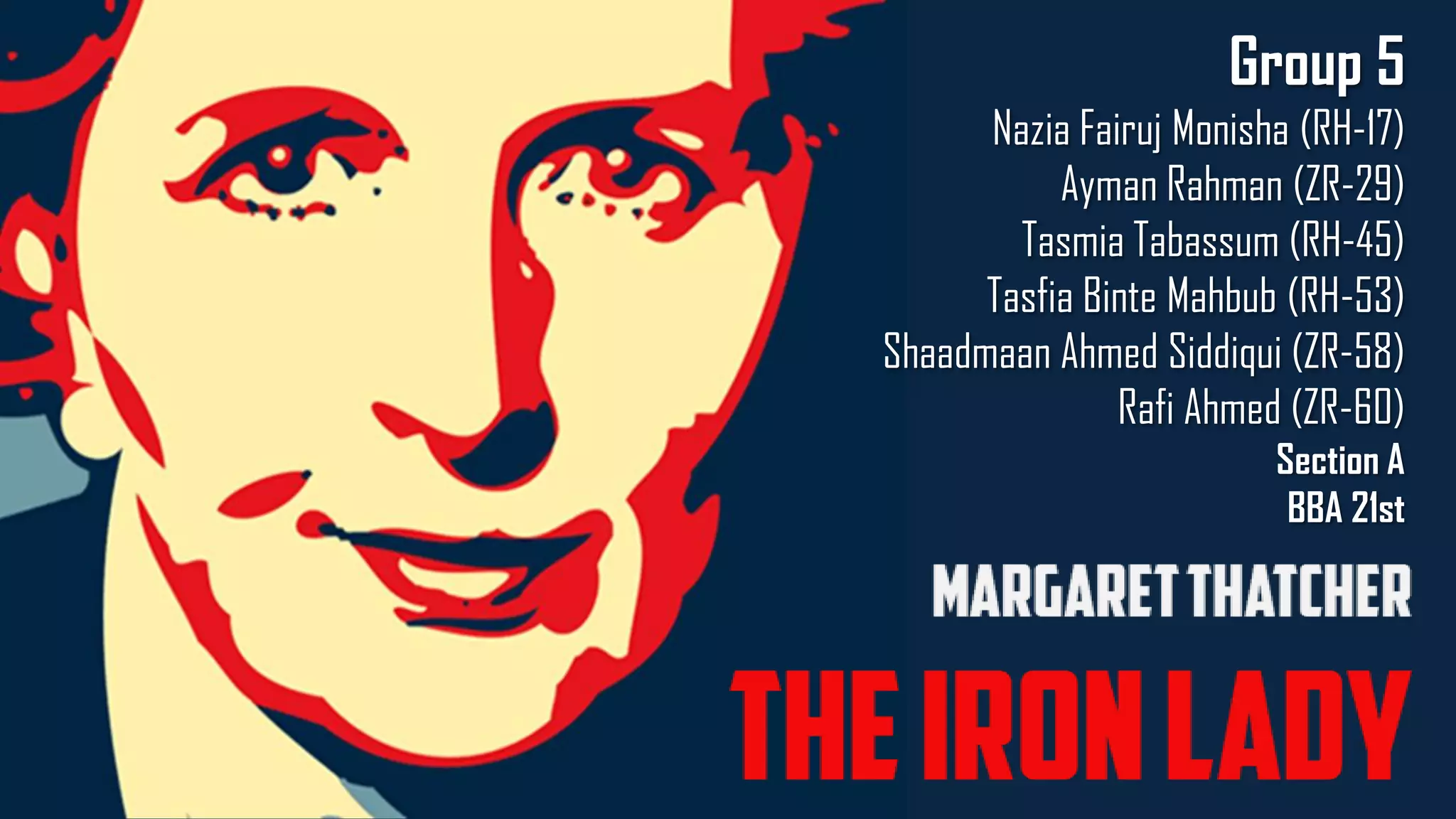
“ I don‟t mind how much my ministers talk,
as long as they do what I say ”
Group 5
Nazia Fairuj Monisha (RH-17)
Ayman Rahman (ZR-29)
Tasmia Tabassum (RH-45)
Tasfia Binte Mahbub (RH-53)
Shaadmaan Ahmed Siddiqui (ZR-58)
Rafi Ahmed (ZR-60)
Section A
BBA 21st
INTRODUCTION
First female to hold
the position of Prime
Minister of UK
Held office from
1979 to 1990
The longest
serving British
Prime Minister
of the 20th
century
Given the name
"Iron Lady”
for her
uncompromising
leadership style
Implemented
policies that have
come to be known
as Thatcherism
Died in London at
the age of 87 in
2013
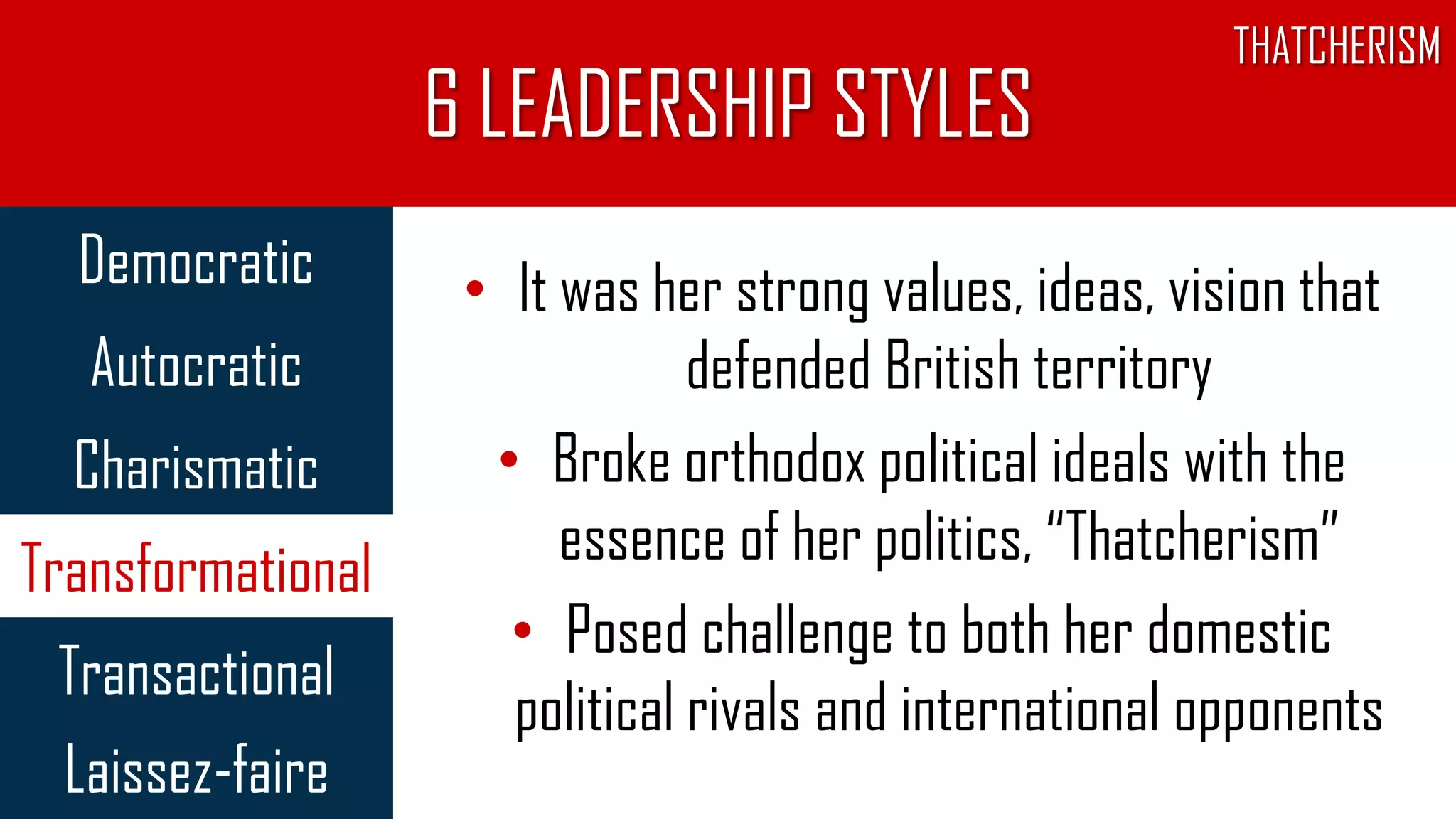
Democratic
Autocratic
Charismatic
Transformational
Transactional
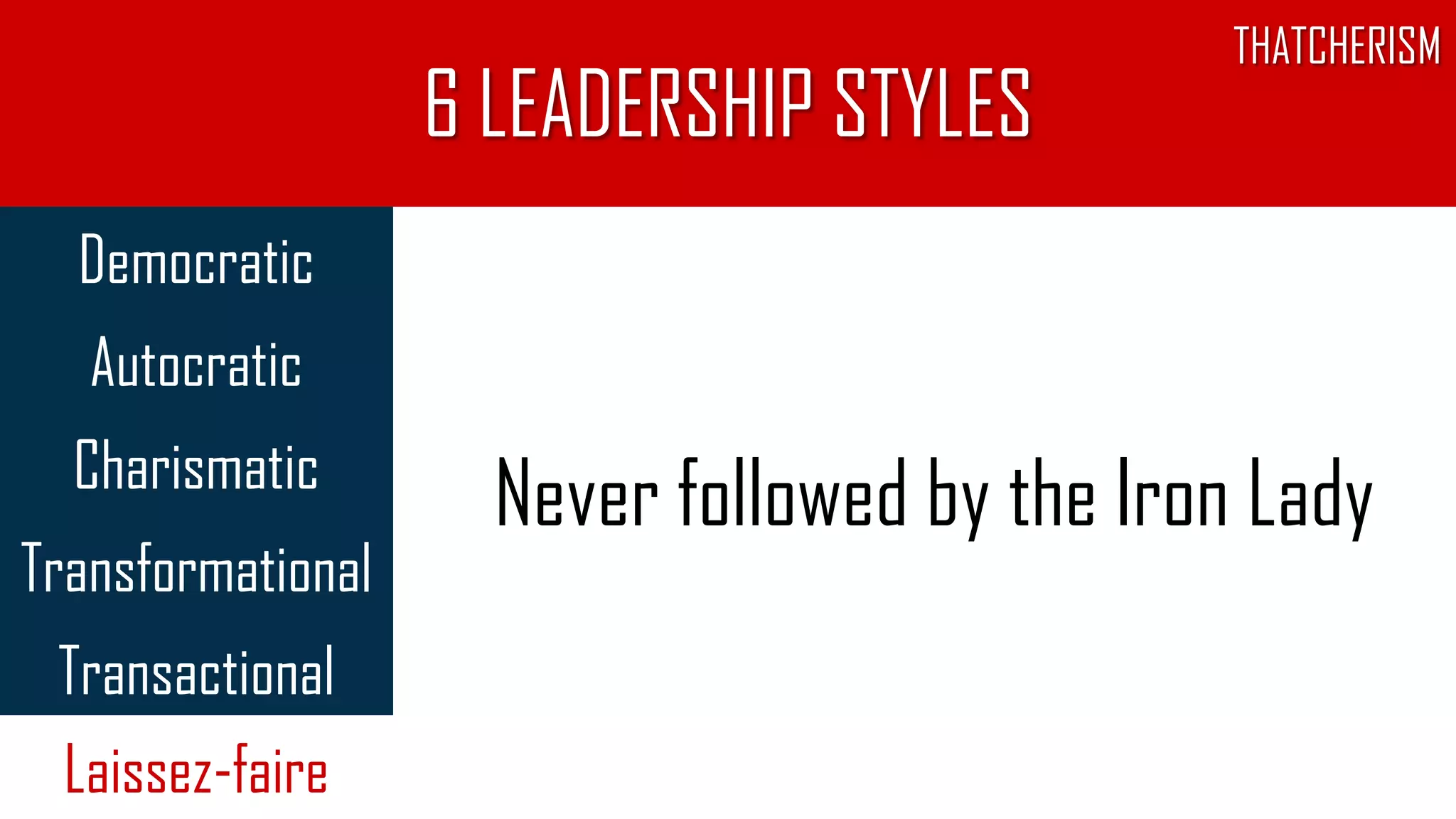
Laissez-faire
6 LEADERSHIP STYLES
THATCHERISM
•“I shan't be pulling the levers there but I
shall be a very good back-seat driver”
• Her actions didn‟t match her words
• Unwilling to compromise
• Not really her style
Democratic
Autocratic
Charismatic
Transformational
Transactional
Laissez-faire
6 LEADERSHIP STYLES
THATCHERISM
• „Do as I say‟ approach
• Complete intolerance of dissent
• Less emphasis on group discussion
• Feared by others
• Yet, admired for her ability to get things
done
Democratic
Autocratic
Charismatic
Transformational
Transactional
Laissez-faire
6 LEADERSHIP STYLES
THATCHERISM
• Robust self confidence
• Ability to articulate her strong vision
• Was able to impose her charismatic
personal authority
• Encourage, influence and communicate with
her followers
Democratic
Autocratic
Charismatic
Transformational
Transactional
Laissez-faire
6 LEADERSHIP STYLES
THATCHERISM
• It was her strong values, ideas, vision that
defended British territory
• Broke orthodox political ideals with the
essence of her politics, “Thatcherism”
• Posed challenge to both her domestic
political rivals and international opponents
Democratic
Autocratic
Charismatic
Transformational
Transactional
Laissez-faire
6 LEADERSHIP STYLES
THATCHERISM
• Put emphasis on “strong relationship building”
• Forged strong political alliances (e.g. Ronald
Reagan from USA)
• Formed relations based on reward-giving
approach
• When the relations became strained, reprimands
were issued
Democratic
Autocratic
Charismatic
Transformational
Transactional
Laissez-faire
6 LEADERSHIP STYLES
THATCHERISM
Never followed by the Iron Lady
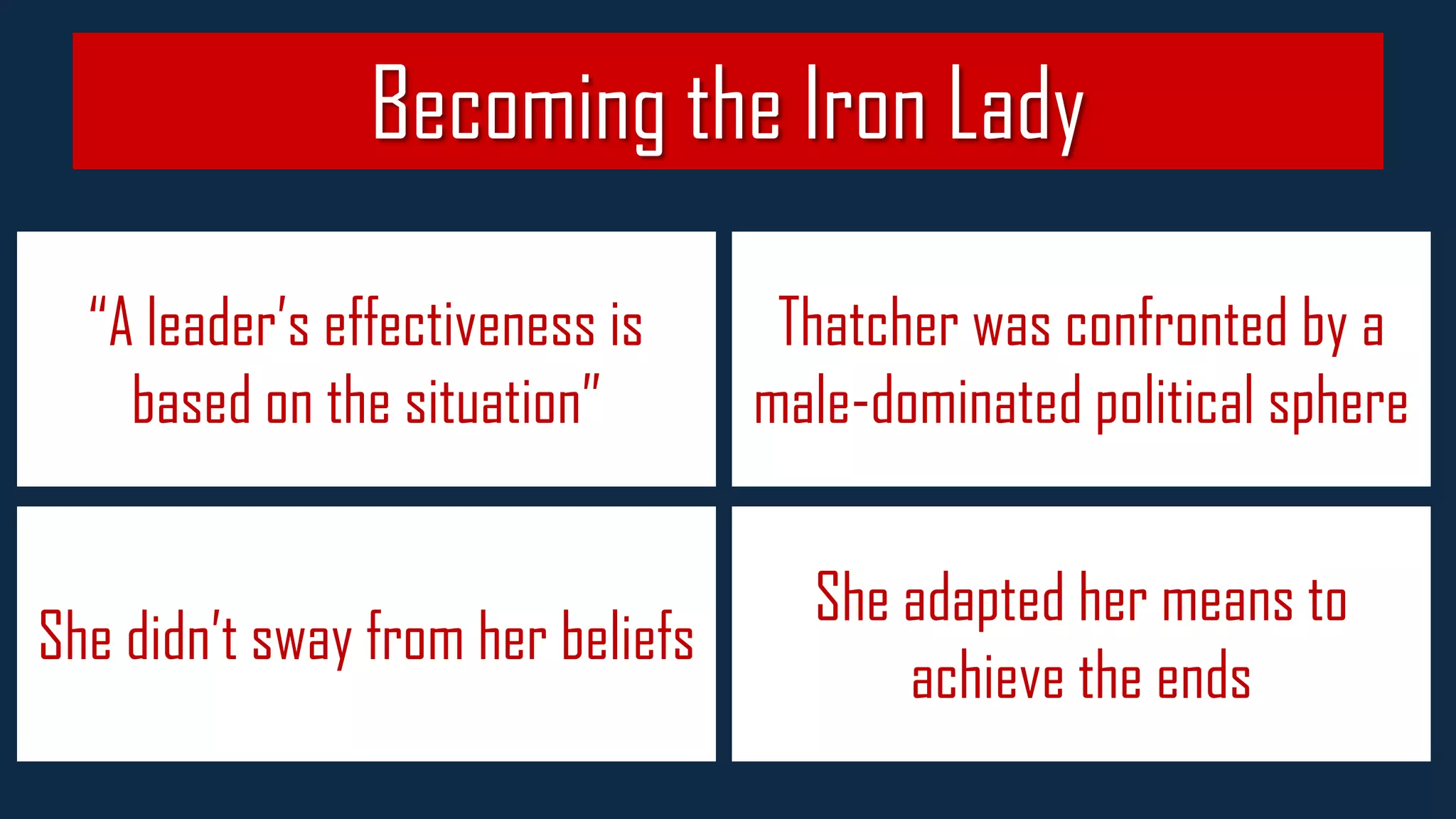
She didn‟t sway from her beliefs
Thatcher was confronted by a
male-dominated political sphere
“A leader‟s effectiveness is
based on the situation”
She adapted her means to
achieve the ends
Becoming the Iron Lady
Against
All Odds
But MOST importantly…
Revived the British tradition of individual initiative
and personal responsibility at a time of crisis
Defeated predatory trade-unionists
Sold off government owned property
Reduced tax rates
In Comparison With
One of Her
Contemporaries
Margaret Thatcher Ronald Reagan
Role Clear and communicated with passion An extroverted communicator to the people and followers
Results 1) Won the Falklands War
2) Increased flexibility of Labor Market
3) Increased prestige of the
British foreign policy
4) Empowered british women
1) Confined communism in latin america
2) Expanded the war on drugs.
3) Ended Cold War
Traits 1) Autocratic, directive
2) Strived for authority and power
3) Sometimes intolerant and impatient
1) Autocratic but in a paternalistic manner
2) Believed in individualism
3) Used his Hollywood popularity to publicize his
proposals
Thatcherism (Based on Leadership Trait Theory)
Integrity
Reputation
and morale
Commitment to
excellence
Thatcherism
Most Notable Achievements
The Falklands war
Right to buy scheme
Supply side reforms and entrepreneurship
Foreign investment
Defeat of the trade unions
Privatizations and share ownerships
End of the cold war
To achieve these ends, she had to
pose high interest rates
Which ultimately made the strong
corporations stronger
But ruined small mom-and-pop
enterprises
Pulled the british
economy through
high recession
and inflation
CRITICISM: Recovering from stagflation
She did not use her diplomatic clout to
negotiate Hong Kong‟s independence
She did not use her NATO‟s position to bring
sanctions against USSR when USSR invaded
Afghanistan
Did not use her influence to stop USA
invade Grenada to topple an elected
communist leader
Warm relations with
China
Strong diplomacy alleviated
Cold War politics
Made Britain‟s voice heard
to the world
CRITICISM: Underutilizing Strong diplomacy
Eventually cost her the premiership
CRITICISM: Lacking clear vision and direction
Indecisive prior to joining ERM
Not setting a clear goal confused many
stakeholders
Gradually got out of sync with her
electorates on how she dealt with them
Ignored polls showing her as least popular
prime minister
Rebutted questions aimed at her by referring
to her general election success rate
CRITICISM: Not learning from mistakes
Ruthlessly one sided policy making
Started losing the trust of people
Lost all her cabinet members from original
1979 cabinets through resignations
CRITICISM: Lacking interpersonal skills
Dominant trait: Autocratic leader
Exhibited other spectra of leadership
Success and failures attributed from
her leadership style
One of the most illustrated woman leaders
from the 20th century
TAKEAWAYS
1
2
3
4

Leadership Report on Margaret Thatcher- The Iron Lady

  • 1.
    “ I don‟tmind how much my ministers talk, as long as they do what I say ” Group 5 Nazia Fairuj Monisha (RH-17) Ayman Rahman (ZR-29) Tasmia Tabassum (RH-45) Tasfia Binte Mahbub (RH-53) Shaadmaan Ahmed Siddiqui (ZR-58) Rafi Ahmed (ZR-60) Section A BBA 21st
  • 2.
    INTRODUCTION First female tohold the position of Prime Minister of UK Held office from 1979 to 1990 The longest serving British Prime Minister of the 20th century Given the name "Iron Lady” for her uncompromising leadership style Implemented policies that have come to be known as Thatcherism Died in London at the age of 87 in 2013
  • 3.
    Democratic Autocratic Charismatic Transformational Transactional Laissez-faire 6 LEADERSHIP STYLES THATCHERISM •“Ishan't be pulling the levers there but I shall be a very good back-seat driver” • Her actions didn‟t match her words • Unwilling to compromise • Not really her style
  • 4.
    Democratic Autocratic Charismatic Transformational Transactional Laissez-faire 6 LEADERSHIP STYLES THATCHERISM •„Do as I say‟ approach • Complete intolerance of dissent • Less emphasis on group discussion • Feared by others • Yet, admired for her ability to get things done
  • 5.
    Democratic Autocratic Charismatic Transformational Transactional Laissez-faire 6 LEADERSHIP STYLES THATCHERISM •Robust self confidence • Ability to articulate her strong vision • Was able to impose her charismatic personal authority • Encourage, influence and communicate with her followers
  • 6.
    Democratic Autocratic Charismatic Transformational Transactional Laissez-faire 6 LEADERSHIP STYLES THATCHERISM •It was her strong values, ideas, vision that defended British territory • Broke orthodox political ideals with the essence of her politics, “Thatcherism” • Posed challenge to both her domestic political rivals and international opponents
  • 7.
    Democratic Autocratic Charismatic Transformational Transactional Laissez-faire 6 LEADERSHIP STYLES THATCHERISM •Put emphasis on “strong relationship building” • Forged strong political alliances (e.g. Ronald Reagan from USA) • Formed relations based on reward-giving approach • When the relations became strained, reprimands were issued
  • 8.
  • 9.
    She didn‟t swayfrom her beliefs Thatcher was confronted by a male-dominated political sphere “A leader‟s effectiveness is based on the situation” She adapted her means to achieve the ends Becoming the Iron Lady
  • 10.
    Against All Odds But MOSTimportantly… Revived the British tradition of individual initiative and personal responsibility at a time of crisis Defeated predatory trade-unionists Sold off government owned property Reduced tax rates
  • 11.
    In Comparison With Oneof Her Contemporaries
  • 12.
    Margaret Thatcher RonaldReagan Role Clear and communicated with passion An extroverted communicator to the people and followers Results 1) Won the Falklands War 2) Increased flexibility of Labor Market 3) Increased prestige of the British foreign policy 4) Empowered british women 1) Confined communism in latin america 2) Expanded the war on drugs. 3) Ended Cold War Traits 1) Autocratic, directive 2) Strived for authority and power 3) Sometimes intolerant and impatient 1) Autocratic but in a paternalistic manner 2) Believed in individualism 3) Used his Hollywood popularity to publicize his proposals
  • 13.
    Thatcherism (Based onLeadership Trait Theory) Integrity Reputation and morale Commitment to excellence Thatcherism
  • 14.
    Most Notable Achievements TheFalklands war Right to buy scheme Supply side reforms and entrepreneurship Foreign investment Defeat of the trade unions Privatizations and share ownerships End of the cold war
  • 15.
    To achieve theseends, she had to pose high interest rates Which ultimately made the strong corporations stronger But ruined small mom-and-pop enterprises Pulled the british economy through high recession and inflation CRITICISM: Recovering from stagflation
  • 16.
    She did notuse her diplomatic clout to negotiate Hong Kong‟s independence She did not use her NATO‟s position to bring sanctions against USSR when USSR invaded Afghanistan Did not use her influence to stop USA invade Grenada to topple an elected communist leader Warm relations with China Strong diplomacy alleviated Cold War politics Made Britain‟s voice heard to the world CRITICISM: Underutilizing Strong diplomacy
  • 17.
    Eventually cost herthe premiership CRITICISM: Lacking clear vision and direction Indecisive prior to joining ERM Not setting a clear goal confused many stakeholders
  • 18.
    Gradually got outof sync with her electorates on how she dealt with them Ignored polls showing her as least popular prime minister Rebutted questions aimed at her by referring to her general election success rate CRITICISM: Not learning from mistakes
  • 19.
    Ruthlessly one sidedpolicy making Started losing the trust of people Lost all her cabinet members from original 1979 cabinets through resignations CRITICISM: Lacking interpersonal skills
  • 20.
    Dominant trait: Autocraticleader Exhibited other spectra of leadership Success and failures attributed from her leadership style One of the most illustrated woman leaders from the 20th century TAKEAWAYS 1 2 3 4