Globalization
What is  the impact  of  globalization?
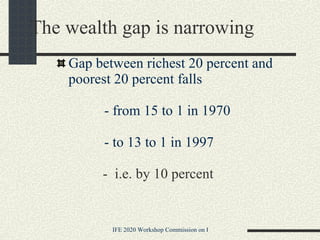
The wealth gap is narrowing Gap between richest 20 percent and poorest 20 percent falls   - from 15 to 1 in 1970   - to 13 to 1 in 1997   -  i.e. by 10 percent
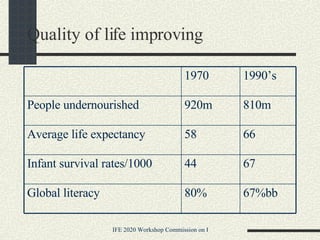
Quality of life improving 67%bb 80% Global literacy 67 44 Infant survival rates/1000 66 58 Average life expectancy 810m 920m People undernourished 1990’s 1970
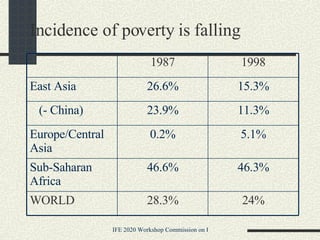
Incidence of poverty is falling 24% 28.3% WORLD 46.3% 46.6% Sub-Saharan Africa 5.1% 0.2% Europe/Central Asia 11.3% 23.9% (- China) 15.3% 26.6% East Asia 1998 1987
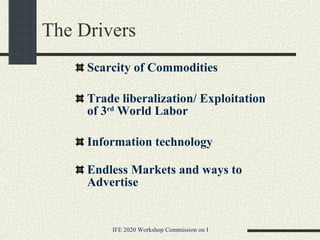
The Drivers  Scarcity of Commodities Trade liberalization/ Exploitation of 3 rd  World Labor Information technology Endless Markets and ways to Advertise
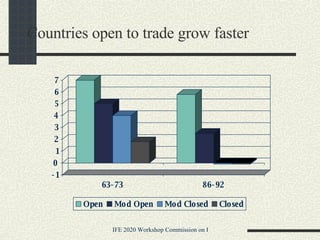
Countries open to trade grow faster


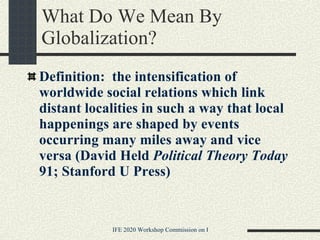
What Do We Mean By Globalization? Definition:  the intensification of worldwide social relations which link distant localities in such a way that local happenings are shaped by events occurring many miles away and vice versa (David Held  Political Theory Today  91; Stanford U Press)
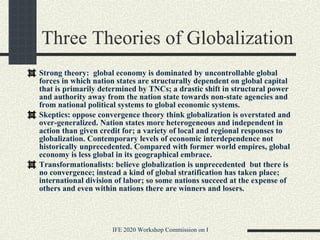
Three Theories of Globalization Strong theory:  global economy is dominated by uncontrollable global forces in which nation states are structurally dependent on global capital that is primarily determined by TNCs; a drastic shift in structural power and authority away from the nation state towards non-state agencies and from national political systems to global economic systems. Skeptics: oppose convergence theory think globalization is overstated and over-generalized. Nation states more heterogeneous and independent in action than given credit for; a variety of local and regional responses to globalization. Contemporary levels of economic interdependence not historically unprecedented. Compared with former world empires, global economy is less global in its geographical embrace. Transformationalists: believe globalization is unprecedented  but there is no convergence; instead a kind of global stratification has taken place; international division of labor; so some nations succeed at the expense of others and even within nations there are winners and losers.
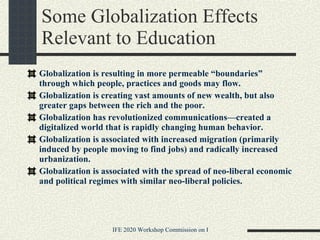
Some Globalization Effects Relevant to Education Globalization is resulting in more permeable “boundaries” through which people, practices and goods may flow.  Globalization is creating vast amounts of new wealth, but also greater gaps between the rich and the poor. Globalization has revolutionized communications—created a digitalized world that is rapidly changing human behavior. Globalization is associated with increased migration (primarily induced by people moving to find jobs) and radically increased urbanization. Globalization is associated with the spread of neo-liberal economic and political regimes with similar neo-liberal policies.
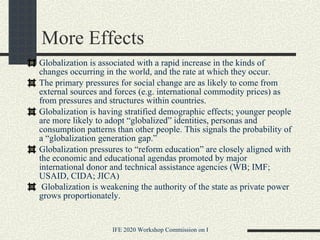
More Effects Globalization is associated with a rapid increase in the kinds of changes occurring in the world, and the rate at which they occur. The primary pressures for social change are as likely to come from external sources and forces (e.g. international commodity prices) as from pressures and structures within countries. Globalization is having stratified demographic effects; younger people are more likely to adopt “globalized” identities, personas and consumption patterns than other people. This signals the probability of a “globalization generation gap.” Globalization pressures to “reform education” are closely aligned with the economic and educational agendas promoted by major international donor and technical assistance agencies (WB; IMF; USAID, CIDA; JICA) Globalization is weakening the authority of the state as private power grows proportionately.

Globalization, Interdependence And Education

  • 1.
  • 2.
    What is the impact of globalization?
  • 3.
    The wealth gapis narrowing Gap between richest 20 percent and poorest 20 percent falls - from 15 to 1 in 1970 - to 13 to 1 in 1997 - i.e. by 10 percent
  • 4.
    Quality of lifeimproving 67%bb 80% Global literacy 67 44 Infant survival rates/1000 66 58 Average life expectancy 810m 920m People undernourished 1990’s 1970
  • 5.
    Incidence of povertyis falling 24% 28.3% WORLD 46.3% 46.6% Sub-Saharan Africa 5.1% 0.2% Europe/Central Asia 11.3% 23.9% (- China) 15.3% 26.6% East Asia 1998 1987
  • 6.
    The Drivers Scarcity of Commodities Trade liberalization/ Exploitation of 3 rd World Labor Information technology Endless Markets and ways to Advertise
  • 7.
    Countries open totrade grow faster
  • 8.
  • 9.
  • 10.
  • 11.
    What Do WeMean By Globalization? Definition: the intensification of worldwide social relations which link distant localities in such a way that local happenings are shaped by events occurring many miles away and vice versa (David Held Political Theory Today 91; Stanford U Press)
  • 12.
    Three Theories ofGlobalization Strong theory: global economy is dominated by uncontrollable global forces in which nation states are structurally dependent on global capital that is primarily determined by TNCs; a drastic shift in structural power and authority away from the nation state towards non-state agencies and from national political systems to global economic systems. Skeptics: oppose convergence theory think globalization is overstated and over-generalized. Nation states more heterogeneous and independent in action than given credit for; a variety of local and regional responses to globalization. Contemporary levels of economic interdependence not historically unprecedented. Compared with former world empires, global economy is less global in its geographical embrace. Transformationalists: believe globalization is unprecedented but there is no convergence; instead a kind of global stratification has taken place; international division of labor; so some nations succeed at the expense of others and even within nations there are winners and losers.
  • 13.
    Some Globalization EffectsRelevant to Education Globalization is resulting in more permeable “boundaries” through which people, practices and goods may flow. Globalization is creating vast amounts of new wealth, but also greater gaps between the rich and the poor. Globalization has revolutionized communications—created a digitalized world that is rapidly changing human behavior. Globalization is associated with increased migration (primarily induced by people moving to find jobs) and radically increased urbanization. Globalization is associated with the spread of neo-liberal economic and political regimes with similar neo-liberal policies.
  • 14.
    More Effects Globalizationis associated with a rapid increase in the kinds of changes occurring in the world, and the rate at which they occur. The primary pressures for social change are as likely to come from external sources and forces (e.g. international commodity prices) as from pressures and structures within countries. Globalization is having stratified demographic effects; younger people are more likely to adopt “globalized” identities, personas and consumption patterns than other people. This signals the probability of a “globalization generation gap.” Globalization pressures to “reform education” are closely aligned with the economic and educational agendas promoted by major international donor and technical assistance agencies (WB; IMF; USAID, CIDA; JICA) Globalization is weakening the authority of the state as private power grows proportionately.