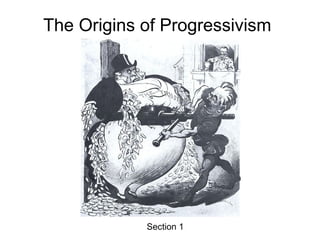
The Origins of Progressivism


            Section 1
What was the Progressive
            Movement?
• An early 20th Century reform movement
• Aimed at:
  – Returning the control of the government to the
    people
  – Restoring economic opportunities
  – Correcting injustices in American life
Four Goals of Progressivism
1.   Protecting social welfare
2.   Promoting moral improvement
3.   Creating economic reform
4.   Fostering efficiency
Protecting Social Welfare
• Review: What is Social Welfare?
• Social Gospel/ Settlement House Movement
  continued through Progressive Era
• What is the YMCA??
  –   Young Men’s Christian Association
  –   Opened Libraries
  –   Sponsored classes
  –   Built Swimming Pools & Handball Courts
• Salvation Army
  – Fed poor people in soup kitchens
• Many women followed the lead of Jane Addams
  and started taking action
• Slum brigades—teach immigrants
Early YMCA Ballers
Promoting Moral Improvement
• Some reformers felt that morality, not the
  workplace, held the key to improving the
  lives of poor people
• Thought people could better themselves
  by improving their behavior
• One of the strongest goals of reformers
  was to stop the production, sale, and
  consumption of alcoholic beverages
  – What was this known as?????
Prohibition
• Banning of alcoholic
  beverages
• Prohibitionists believed
  that alcohol was
  undermining American
  morals
  – What are
    morals?...examples of
    good morals?
Prohibition
     • Alcoholic beverages had
       been around for
       thousands of years
     • Certain immigrant groups
       used these beverages
       more than others
     • Hard to break old habits
     • Many individuals and
       groups of people were
       very upset by this
       movement
WCTU
• What does this stand for?
  – Woman’s Christian Temperance Union
• Spearheaded the crusade for prohibition
• What did these women do?
  – Entered saloons and protested
  – Would sing and pray in the saloons
  – Urged bartenders to quit selling liquor
• The WCTU grew from a small, Midwestern
  group to a national organization consisting
  of 245,000 members by 1911
Carry Nation
• Most famous member
  of the temperance
  movement
• Member of the WCTU
• 6 ft., 175lbs
• “Bulldog running along
  the feet of Jesus”
• Nation was known for
  attacking saloons with
  a hatchet
• Arrested 30 times in a
  10 year span
Creating Economic Reform
• Panic of 1893 caused many Americans to worry
  – What was the Panic of 1893?
  – Serious decline in the American economy due to lack of
    gold supply
• Many Americans questioned the Capitalist
  economic system due to poverty
• Some Americans, especially workers, embraced
  Socialism
• What is:
  – Capitalism?
  – Socialism?
Capitalism
• Economic System
• The means of production
  are privately owned
• $$ is invested in the
  production & distribution
  for a profit
• “Free Market”  What is
  this?
• Chance to go from poor to
  rich
• Laissez-Faire
   – Hands Off
Socialism
• Social or Economic system
• Property and distribution of
  wealth are determined by
  the Government
• State or Government
  ownership of everything
• Elimination of private
  property, everyone is
  equal
• Karl Marx 
   – Leading figure
   – Father of Communism
American Socialist Party

• Founded in 1901
• Its prominent leader
  was Eugene V. Debs
• In the early 1900’s,
  the party had
  numerous elected
  officials in office
• Debs ran for
  president 5 times
  unsuccessfully
• “Competition is natural enough at one time, but do
  you think you are competing today? Many of you
  think you are competing. Against whom? Against
  oil magnate John D. Rockefeller? About as I
  would if I had a wheelbarrow and competed with
  the Santa Fe Railroad from here to Kansas City!”
Muckrakers
• Muckrakers played a big role in bringing
  reform
• Investigative journalists
• Exposed the problems of society
• Upton Sinclair—The Jungle-meatpacking
• Ida Tarbell—Exposed the ruthless
  methods of the Standard Oil Company
• Lincoln Steffens-exposed corruption in
  gov’t
Fostering Efficiency
• Scientific management to increase
  efficiency was used in factories
• Frederick Taylor—Time Management
  studies
• Assembly line
• Henry Ford paid workers $5 a day!!
• Progressives also worked for better
  efficiency in all levels of government
Limiting Working Hours
• Many states enforced
  a 10 hour work day
  for both men and
  women
• Progressives also
  succeeded in winning
  workers’
  compensation for
  family members of
  hurt or killed workers
  – What is worker’s
    comp.?
  – Is it still around today?
Reforming Elections
• States adopt secret ballot
• Direct Primary
• Initiative-a bill originated by the people
  rather than lawmakers
• Referendum- when voters accept or reject
  the initiative (bill)
• Recall- enabled voters to remove public
  officials from elected positions
  – What did these five aim at doing????
A “Total” Recall?
Direct Election of Senators
•   17th Amendment
•   1913
•   Direct election of U.S. Senators
•   What does this mean?
•   Who are our Senators????
Charles Grassley
Tom Harkin
Women’s Role
• Many more women were getting an
  education
• Many became teachers
• Help push for the passing of the 18 th and
  19th Amendments to the US Constitution
      -Prohibition
      -Women’s Suffrage
Teddy Roosevelt-TR
• Born into a wealthy
  family-1858
• Had asthma as a child-
  sickly
• As a teen became a
  marksmen and learned
  to ride horses
• Went to Harvard
• Boxed and wrestled at
  Harvard
• Served in the New York
  State Assembly from
  1882-1884
• Served as US Civil
  Service Commissioner
  from 1889-1895
• Commissioner of the New
  York City Police from
  1895-1897
• Assistant Secretary of the
  Navy from 1897-1898
• Fought in the Spanish-
  American War in 1898 as
  leader of the “Rough
  Riders”
• Governor of New York
  1898-1900
• Vice-President of the US
  in 1901
• Served as President
  from 1901-1909
• Wrote many history
  books
• Owned and ran a ranch
  in the Dakota Territory
• Avid hunter-African
  Safaris
Teddy Bear
Accomplishments as President
• Used his personality, popularity and power
  of persuasion to get what he wanted
• Believed that the federal government was
  there to help common people
• Wanted to give everyone a “Square Deal”
• Used the “bully pulpit” to influence media
  and help pass laws
• TR was the “trustbuster”
• “good trusts” vs “bad trusts”
• Helped settle the 1902 Coal strike in which
  miners got better pay and a nine hour
  workday
• Passed the Elkins Act(1903-no rebates) and
  Hepburn Act(1906-ICC set max RR rates)
  which required railroads to be fair and just in
  their prices and practices
• Passed the Meat Inspection Act-1906
• Passed the Pure Food and Drug Act-1906
• Newlands Act-1902-sold western land and
  made dams which allowed for irrigation
• Conservation-map p. 323
• Did not do much for African-Americans
Conservation Measures
• Roosevelt condemned view that our “resources
  were endless”
• T.R. set aside 148 million acres of forest
  reserves
• 1.5 million acres of water-power sites
• Established 50 wildlife sanctuaries and several
  national parks
• Conservation- planned management of natural
  resources, involving the protection of some
  wilderness areas and the development of others
Theodore Roosevelt National Park—Badlands, N.D.
Willam Jennings Bryan vs William
    Howard Taft-1908 Election
1908 Election Taft v. Bryan
William Howard Taft
• Born September 15, 1857 in Cincinnati, OH
• Attended Yale College: New Haven, CT
• Lawyer then Secretary of War
• Never aimed at being president
• After his presidency he was a Professor at Yale
  Law School
• 1921, became Chief Justice of the Supreme
  Court, which was his career goal
• Only president to ever serve as Chief Justice
• Only president to hold public office after leaving
  the White House
• “When I am
  addressed as ‘Mr.
  President,’ I turn to
  see whether you are
  not at my elbow.” –
  W.H. Taft
• Taft never really felt
  like he was the
  president; always in
  Roosevelt’s shadow
Why was Taft Not Liked?
• Not as energetic and well liked as Roosevelt
• Not good at using the “Bully Pulpit”
• Promised to lower tariffs but actually increased
  many with the Payne-Aldrich Tariff upsetting
  progressives
• Appointed wealthy lawyer Richard Ballinger to
  Secretary of the Interior who removed land TR
  set aside for conservation
• Supported Speaker of the House Joe Cannon
  who was anti-progressive
Federal Income Tax
          • 16th Amendment passed
            2-3-13
          • Legalized a graduated
            federal income tax
          • Provided $$ to the
            GOV’T by taxing
            individual earnings and
            corporate profits
“Uncle” Joe Cannon
Republican Party Split
• Due to these problems with Taft, the
  Republicans split into old-guard
  republicans and progressive republicans
• TR did not get the Republican nomination
  so he decided to run as a third party
  candidate in the Progressive Party(Bull
  Moose Party)
• Why would this split guarantee a democrat
  win?
Teddy Roosevelt-Progressive
Bull-Moose Platform
• Direct Election of
  Senators
• Initiative, Referendum,
  Recall in all states
• Woman Suffrage
• Worker’s Compensation
• 8 hour workday
• Minimum wage for
  women
• Federal Law against child
  labor
William Howard Taft-Republicans
Woodrow Wilson-Democrats
Eugene V. Debs-Socialist
It Gets Nasty!!
• During the campaign before the election,
  both Roosevelt & Taft take shots at each
  other
• Taft called T.R. a “dangerous egotist”
• Roosevelt branded Taft as “Fat Head with
  the brain of a guinea pig”
• Wilson’s quote: “Don’t interfere when your
  enemy is destroying himself”
1912 Election
Election of 1912
• Election offered several choices:
  –   Wilson’s New Freedom
  –   Taft’s Conservatism
  –   Roosevelt’s Progressivism
  –   Debs’ Socialism
• Republican Split gives Wilson the presidency
• Republican voters split between Taft &
  Roosevelt
• Democrats voted for Wilson
• Wilson only received 42% of the popular vote,
  but won 435 electoral votes
• Roosevelt finished 2nd with 4.1 million votes
Woodrow Wilson’s New Freedom
Wilson’s Background
• Grew up in the South
  after the Civil War &
  Reconstruction
• Son, Grandson, and
  Nephew of Presbyterian
  Ministers—strict
  upbringing
• Before entering politics,
  Wilson worked as:
   – Lawyer
   – History Professor
   – President of Princeton
     University
   – Governor of N.J.
Wilson’s Accomplishments
• Passed Clayton Anti-Trust Act(1914)
  – Could break up monopolies
  -Labor Unions were given the right to exist
  -Strikes, boycotts, picketing etc became
        legal
• Federal Trade Commission was
  established in 1914
  – Investigated companies for monopolistic
    practices
• Underwood Tariff(1913) drastically cut
  tariff rates for the first time since the Civil
  War
Federal Reserve System
• America needed stronger banks
• Federal Reserve Act of 1913
• Divided the nation into 12 districts  regional
  central bank in each district
• “Bankers Bank”
• Federal Reserve banks could issue new paper
  money in emergency situations
• Also, helped with giving out loan $$
• Banks within the system helped others from
  closing due to lack of money
Federal Reserve System
• Controls the U.S. money supply and the
  availability of credit in the country
• One of President Wilson’s most enduring
  achievements
• We use this same system today as the basis of
  the nation’s banking system
•    17th, 18th and 19th Amendments were passed during
     his term
    –   Direct election of senators(1913)
    –   Prohibition(1919)
    –   Women’s Vote(1920)

    *Led US during Mexican Crisis and WWI

    **Developed Missionary Diplomacy

    *African-Americans were for the most part ignored by
        Roosevelt, Taft, Wilson and the Progressive Movement

    *Wilson reinstated segregation in Washington D.C. and
        also started segregation in the US military.
The Twilight of Progressivism
• Roosevelt, Taft, and the early part of
  Wilson’s presidencies marked the golden
  age of Progressivism within the United
  States
• Question: Do you think the progressives
  accomplished very much?
• World War I would dominate Wilson’s 2nd
  term and brought Progressivism to an end

Ch9new

  • 1.
    The Origins ofProgressivism Section 1
  • 2.
    What was theProgressive Movement? • An early 20th Century reform movement • Aimed at: – Returning the control of the government to the people – Restoring economic opportunities – Correcting injustices in American life
  • 3.
    Four Goals ofProgressivism 1. Protecting social welfare 2. Promoting moral improvement 3. Creating economic reform 4. Fostering efficiency
  • 4.
    Protecting Social Welfare •Review: What is Social Welfare? • Social Gospel/ Settlement House Movement continued through Progressive Era • What is the YMCA?? – Young Men’s Christian Association – Opened Libraries – Sponsored classes – Built Swimming Pools & Handball Courts • Salvation Army – Fed poor people in soup kitchens • Many women followed the lead of Jane Addams and started taking action • Slum brigades—teach immigrants
  • 5.
  • 7.
    Promoting Moral Improvement •Some reformers felt that morality, not the workplace, held the key to improving the lives of poor people • Thought people could better themselves by improving their behavior • One of the strongest goals of reformers was to stop the production, sale, and consumption of alcoholic beverages – What was this known as?????
  • 8.
    Prohibition • Banning ofalcoholic beverages • Prohibitionists believed that alcohol was undermining American morals – What are morals?...examples of good morals?
  • 9.
    Prohibition • Alcoholic beverages had been around for thousands of years • Certain immigrant groups used these beverages more than others • Hard to break old habits • Many individuals and groups of people were very upset by this movement
  • 11.
    WCTU • What doesthis stand for? – Woman’s Christian Temperance Union • Spearheaded the crusade for prohibition • What did these women do? – Entered saloons and protested – Would sing and pray in the saloons – Urged bartenders to quit selling liquor • The WCTU grew from a small, Midwestern group to a national organization consisting of 245,000 members by 1911
  • 13.
    Carry Nation • Mostfamous member of the temperance movement • Member of the WCTU • 6 ft., 175lbs • “Bulldog running along the feet of Jesus” • Nation was known for attacking saloons with a hatchet • Arrested 30 times in a 10 year span
  • 14.
    Creating Economic Reform •Panic of 1893 caused many Americans to worry – What was the Panic of 1893? – Serious decline in the American economy due to lack of gold supply • Many Americans questioned the Capitalist economic system due to poverty • Some Americans, especially workers, embraced Socialism • What is: – Capitalism? – Socialism?
  • 15.
    Capitalism • Economic System •The means of production are privately owned • $$ is invested in the production & distribution for a profit • “Free Market”  What is this? • Chance to go from poor to rich • Laissez-Faire – Hands Off
  • 16.
    Socialism • Social orEconomic system • Property and distribution of wealth are determined by the Government • State or Government ownership of everything • Elimination of private property, everyone is equal • Karl Marx  – Leading figure – Father of Communism
  • 17.
    American Socialist Party •Founded in 1901 • Its prominent leader was Eugene V. Debs • In the early 1900’s, the party had numerous elected officials in office • Debs ran for president 5 times unsuccessfully
  • 18.
    • “Competition isnatural enough at one time, but do you think you are competing today? Many of you think you are competing. Against whom? Against oil magnate John D. Rockefeller? About as I would if I had a wheelbarrow and competed with the Santa Fe Railroad from here to Kansas City!”
  • 20.
    Muckrakers • Muckrakers playeda big role in bringing reform • Investigative journalists • Exposed the problems of society • Upton Sinclair—The Jungle-meatpacking • Ida Tarbell—Exposed the ruthless methods of the Standard Oil Company • Lincoln Steffens-exposed corruption in gov’t
  • 21.
    Fostering Efficiency • Scientificmanagement to increase efficiency was used in factories • Frederick Taylor—Time Management studies • Assembly line • Henry Ford paid workers $5 a day!! • Progressives also worked for better efficiency in all levels of government
  • 26.
    Limiting Working Hours •Many states enforced a 10 hour work day for both men and women • Progressives also succeeded in winning workers’ compensation for family members of hurt or killed workers – What is worker’s comp.? – Is it still around today?
  • 27.
    Reforming Elections • Statesadopt secret ballot • Direct Primary • Initiative-a bill originated by the people rather than lawmakers • Referendum- when voters accept or reject the initiative (bill) • Recall- enabled voters to remove public officials from elected positions – What did these five aim at doing????
  • 28.
  • 30.
    Direct Election ofSenators • 17th Amendment • 1913 • Direct election of U.S. Senators • What does this mean? • Who are our Senators????
  • 31.
  • 32.
  • 33.
    Women’s Role • Manymore women were getting an education • Many became teachers • Help push for the passing of the 18 th and 19th Amendments to the US Constitution -Prohibition -Women’s Suffrage
  • 34.
    Teddy Roosevelt-TR • Borninto a wealthy family-1858 • Had asthma as a child- sickly • As a teen became a marksmen and learned to ride horses • Went to Harvard • Boxed and wrestled at Harvard • Served in the New York State Assembly from 1882-1884
  • 35.
    • Served asUS Civil Service Commissioner from 1889-1895 • Commissioner of the New York City Police from 1895-1897 • Assistant Secretary of the Navy from 1897-1898 • Fought in the Spanish- American War in 1898 as leader of the “Rough Riders”
  • 37.
    • Governor ofNew York 1898-1900 • Vice-President of the US in 1901 • Served as President from 1901-1909 • Wrote many history books • Owned and ran a ranch in the Dakota Territory • Avid hunter-African Safaris
  • 41.
  • 44.
    Accomplishments as President •Used his personality, popularity and power of persuasion to get what he wanted • Believed that the federal government was there to help common people • Wanted to give everyone a “Square Deal” • Used the “bully pulpit” to influence media and help pass laws
  • 45.
    • TR wasthe “trustbuster” • “good trusts” vs “bad trusts” • Helped settle the 1902 Coal strike in which miners got better pay and a nine hour workday • Passed the Elkins Act(1903-no rebates) and Hepburn Act(1906-ICC set max RR rates) which required railroads to be fair and just in their prices and practices • Passed the Meat Inspection Act-1906 • Passed the Pure Food and Drug Act-1906 • Newlands Act-1902-sold western land and made dams which allowed for irrigation • Conservation-map p. 323 • Did not do much for African-Americans
  • 47.
    Conservation Measures • Rooseveltcondemned view that our “resources were endless” • T.R. set aside 148 million acres of forest reserves • 1.5 million acres of water-power sites • Established 50 wildlife sanctuaries and several national parks • Conservation- planned management of natural resources, involving the protection of some wilderness areas and the development of others
  • 49.
    Theodore Roosevelt NationalPark—Badlands, N.D.
  • 51.
    Willam Jennings Bryanvs William Howard Taft-1908 Election
  • 52.
  • 53.
    William Howard Taft •Born September 15, 1857 in Cincinnati, OH • Attended Yale College: New Haven, CT • Lawyer then Secretary of War • Never aimed at being president • After his presidency he was a Professor at Yale Law School • 1921, became Chief Justice of the Supreme Court, which was his career goal • Only president to ever serve as Chief Justice • Only president to hold public office after leaving the White House
  • 55.
    • “When Iam addressed as ‘Mr. President,’ I turn to see whether you are not at my elbow.” – W.H. Taft • Taft never really felt like he was the president; always in Roosevelt’s shadow
  • 56.
    Why was TaftNot Liked? • Not as energetic and well liked as Roosevelt • Not good at using the “Bully Pulpit” • Promised to lower tariffs but actually increased many with the Payne-Aldrich Tariff upsetting progressives • Appointed wealthy lawyer Richard Ballinger to Secretary of the Interior who removed land TR set aside for conservation • Supported Speaker of the House Joe Cannon who was anti-progressive
  • 57.
    Federal Income Tax • 16th Amendment passed 2-3-13 • Legalized a graduated federal income tax • Provided $$ to the GOV’T by taxing individual earnings and corporate profits
  • 58.
  • 59.
    Republican Party Split •Due to these problems with Taft, the Republicans split into old-guard republicans and progressive republicans • TR did not get the Republican nomination so he decided to run as a third party candidate in the Progressive Party(Bull Moose Party) • Why would this split guarantee a democrat win?
  • 62.
  • 63.
    Bull-Moose Platform • DirectElection of Senators • Initiative, Referendum, Recall in all states • Woman Suffrage • Worker’s Compensation • 8 hour workday • Minimum wage for women • Federal Law against child labor
  • 64.
  • 65.
  • 66.
  • 67.
    It Gets Nasty!! •During the campaign before the election, both Roosevelt & Taft take shots at each other • Taft called T.R. a “dangerous egotist” • Roosevelt branded Taft as “Fat Head with the brain of a guinea pig” • Wilson’s quote: “Don’t interfere when your enemy is destroying himself”
  • 70.
  • 72.
    Election of 1912 •Election offered several choices: – Wilson’s New Freedom – Taft’s Conservatism – Roosevelt’s Progressivism – Debs’ Socialism • Republican Split gives Wilson the presidency • Republican voters split between Taft & Roosevelt • Democrats voted for Wilson • Wilson only received 42% of the popular vote, but won 435 electoral votes • Roosevelt finished 2nd with 4.1 million votes
  • 73.
  • 74.
    Wilson’s Background • Grewup in the South after the Civil War & Reconstruction • Son, Grandson, and Nephew of Presbyterian Ministers—strict upbringing • Before entering politics, Wilson worked as: – Lawyer – History Professor – President of Princeton University – Governor of N.J.
  • 75.
    Wilson’s Accomplishments • PassedClayton Anti-Trust Act(1914) – Could break up monopolies -Labor Unions were given the right to exist -Strikes, boycotts, picketing etc became legal • Federal Trade Commission was established in 1914 – Investigated companies for monopolistic practices
  • 76.
    • Underwood Tariff(1913)drastically cut tariff rates for the first time since the Civil War
  • 77.
    Federal Reserve System •America needed stronger banks • Federal Reserve Act of 1913 • Divided the nation into 12 districts  regional central bank in each district • “Bankers Bank” • Federal Reserve banks could issue new paper money in emergency situations • Also, helped with giving out loan $$ • Banks within the system helped others from closing due to lack of money
  • 79.
    Federal Reserve System •Controls the U.S. money supply and the availability of credit in the country • One of President Wilson’s most enduring achievements • We use this same system today as the basis of the nation’s banking system
  • 80.
    17th, 18th and 19th Amendments were passed during his term – Direct election of senators(1913) – Prohibition(1919) – Women’s Vote(1920) *Led US during Mexican Crisis and WWI **Developed Missionary Diplomacy *African-Americans were for the most part ignored by Roosevelt, Taft, Wilson and the Progressive Movement *Wilson reinstated segregation in Washington D.C. and also started segregation in the US military.
  • 82.
    The Twilight ofProgressivism • Roosevelt, Taft, and the early part of Wilson’s presidencies marked the golden age of Progressivism within the United States • Question: Do you think the progressives accomplished very much? • World War I would dominate Wilson’s 2nd term and brought Progressivism to an end