Hitler’s Economic Policy Leaving Cert History Revision Presentation
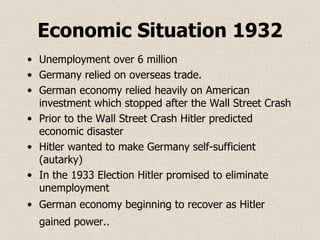
Economic Situation 1932 Unemployment over 6 million  Germany relied on overseas trade. German economy relied heavily on American investment which stopped after the Wall Street Crash Prior to the Wall Street Crash Hitler predicted economic disaster Hitler wanted to make Germany self-sufficient (autarky) In the 1933 Election Hitler promised to eliminate unemployment German economy beginning to recover as Hitler gained power. .
Nazi Economic Policies Hitler orders arrest of Germany's trade union leaders Trade unions replaced by the Nazi Labour Front (DAF) A pay freeze was introduced in 1933 Wages were now decided by the Labour Front The Labour Front issued work-books - no one could be employed without one  The government banned the introduction of some machinery. Employers had to get government permission before sacking workers
Economic Expansion The Nazis gave work contracts to companies that used manual labour– the autobahn (motorway) programme.  Investment in military re-armament - more jobs Conscription into the German army reduced the numbers of unemployed Young people planted forests, repaired river banks and helped reclaim wasteland. Women in certain professions such as doctors and civil servants were dismissed Labour Service (RAD). All men aged between the ages of nineteen and twenty-five had work for the government for six months.
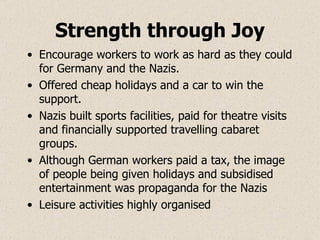
Strength through Joy Encourage workers to work as hard as they could for Germany and the Nazis. Offered cheap holidays and a car to win the support. Nazis built sports facilities, paid for theatre visits and financially supported travelling cabaret groups.  Although German workers paid a tax, the image of people being given holidays and subsidised entertainment was propaganda for the Nazis Leisure activities highly organised
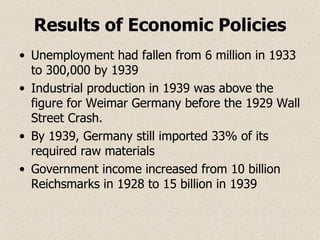
Results of Economic Policies Unemployment had fallen from 6 million in 1933 to 300,000 by 1939 Industrial production in 1939 was above the figure for Weimar Germany before the 1929 Wall Street Crash.  By 1939, Germany still imported 33% of its required raw materials  Government income increased from 10 billion Reichsmarks in 1928 to 15 billion in 1939
Government spending had increased from 12 billion in 1928 to over 30 billion in 1939 By 1939, government in massive debt Annual food consumption in 1937 had fallen compared to 1927 figures Real earnings in 1938 were about the same as in 1928 Results of Economic Policies
Presentation prepared by: Dominic Haugh St. Particks Comprehensive School Shannon Co. Clare Presentation can be used for educational purposes only – all rights remain with author