S E C T I O N  2 The Two-Party System Why does the United States have a two-party system? How do multiparty and one-party systems function and what are their influences on government? What membership characteristics do American parties have?
Why a Two-Party System? The Historical Basis.  The nation started out with two-parties: the Federalists and the Anti-Federalists. The Force of Tradition.   America has a  two-party system   because it always  has  had one.  Minor parties ,  lacking wide political support, have never made a successful showing, so people are reluctant to support them. The Electoral System.  Certain features of government, such as  single-member districts ,  are designed to favor two major parties.  Ideological Consensus.  Most Americans have a general agreement on fundamental matters.  Conditions that would spark several strong rival parties do not exist in the United States.
Multiparty Systems Advantages Provides broader representation of the people. More responsive to the will of the people. Give voters more choices at the polls. Disadvantages   Cause parties to form coalitions, which can dissolve easily. Failure of coalitions can cause instability in government.
One-Party Systems Types of One-Party Systems Example: Republican North and Democratic South until the 1950s. Modified One-Party Systems where one party regularly wins most elections One Party Systems where only one party is allowed. Example:  Dictatorships such as Stalinist Russia
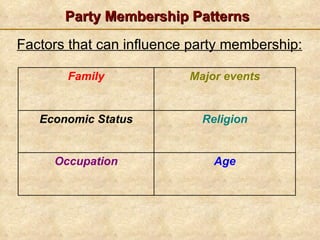
Factors that can influence party membership: Party Membership Patterns
The Two-Party System in American History How did the United States’ political parties originate? What are the three major periods of single-party domination? What characterizes the current era of government?
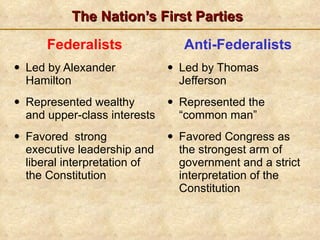
The Nation’s First Parties Federalists Led by Alexander Hamilton Represented wealthy and upper-class interests Favored  strong executive leadership and liberal interpretation of the Constitution Anti-Federalists Led by Thomas Jefferson Represented the “common man” Favored Congress as the strongest arm of government and a strict interpretation of the Constitution
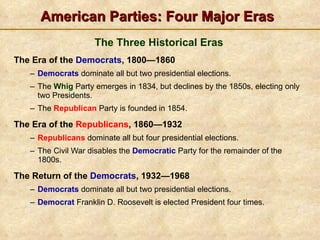
American Parties: Four Major Eras The Three Historical Eras   The Era of the  Democrats , 1800—1860 Democrats   dominate all but two presidential elections. The   Whig   Party emerges in 1834, but declines by the 1850s, electing only two Presidents. The  Republican  Party is founded in 1854. The Era of the  Republicans , 1860—1932 Republicans  dominate all but four presidential elections. The Civil War disables the  Democratic   Party for the remainder of the 1800s. The Return of the  Democrats , 1932—1968 Democrats  dominate all but two presidential elections. Democrat  Franklin D. Roosevelt is elected President four times.
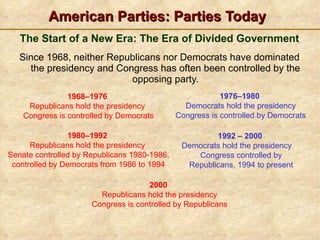
American Parties: Parties Today The Start of a New Era: The Era of Divided Government Since 1968, neither Republicans nor Democrats have dominated the presidency and Congress has often been controlled by the opposing party. 1968–1976   Republicans hold the presidency  Congress is controlled by Democrats 1976–1980   Democrats hold the presidency Congress is controlled by Democrats 1980–1992   Republicans hold the presidency  Senate controlled by Republicans 1980-1986, controlled by Democrats from 1986 to 1994 1992 – 2000   Democrats hold the presidency  Congress controlled by Republicans, 1994 to present 2000   Republicans hold the presidency Congress is controlled by Republicans
S E C T I O N  4 The Minor Parties What types of minor parties have been active in American politics? Why are minor parties important even though they seldom elect national candidates?
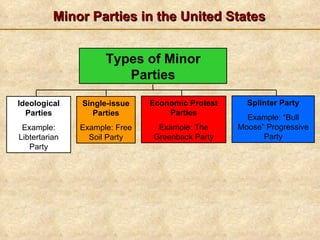
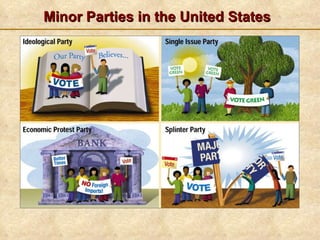
Minor Parties in the United States Splinter Party Example: “Bull Moose” Progressive Party Economic Protest Parties Example: The Greenback Party Ideological Parties Example: Libtertarian Party Single-issue Parties Example: Free Soil Party Types of Minor Parties
Minor Parties in the United States
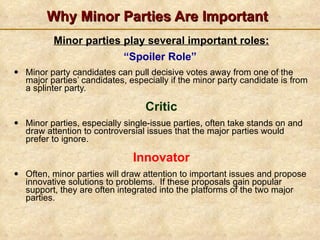
Why Minor Parties Are Important Minor parties play several important roles: “ Spoiler Role”   Minor party candidates can pull decisive votes away from one of the major parties’ candidates, especially if the minor party candidate is from a splinter party. Critic Minor parties, especially single-issue parties, often take stands on and draw attention to controversial issues that the major parties would prefer to ignore. Innovator Often, minor parties will draw attention to important issues and propose innovative solutions to problems.  If these proposals gain popular support, they are often integrated into the platforms of the two major parties.

2 party system

  • 1.
  • 2.
    S E CT I O N 2 The Two-Party System Why does the United States have a two-party system? How do multiparty and one-party systems function and what are their influences on government? What membership characteristics do American parties have?
  • 3.
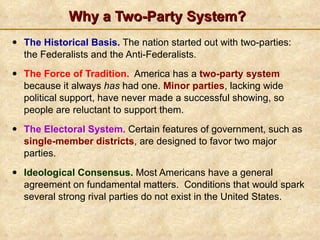
    Why a Two-PartySystem? The Historical Basis. The nation started out with two-parties: the Federalists and the Anti-Federalists. The Force of Tradition. America has a two-party system because it always has had one. Minor parties , lacking wide political support, have never made a successful showing, so people are reluctant to support them. The Electoral System. Certain features of government, such as single-member districts , are designed to favor two major parties. Ideological Consensus. Most Americans have a general agreement on fundamental matters. Conditions that would spark several strong rival parties do not exist in the United States.
  • 4.
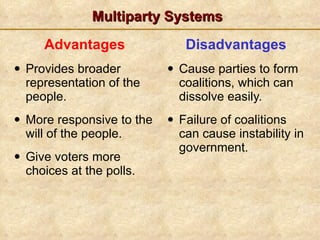
    Multiparty Systems AdvantagesProvides broader representation of the people. More responsive to the will of the people. Give voters more choices at the polls. Disadvantages Cause parties to form coalitions, which can dissolve easily. Failure of coalitions can cause instability in government.
  • 5.
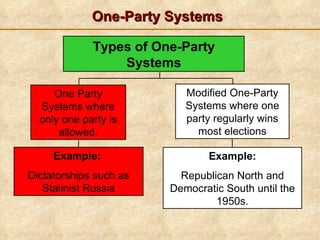
    One-Party Systems Typesof One-Party Systems Example: Republican North and Democratic South until the 1950s. Modified One-Party Systems where one party regularly wins most elections One Party Systems where only one party is allowed. Example: Dictatorships such as Stalinist Russia
  • 6.
    Factors that caninfluence party membership: Party Membership Patterns
  • 7.
    The Two-Party Systemin American History How did the United States’ political parties originate? What are the three major periods of single-party domination? What characterizes the current era of government?
  • 8.
    The Nation’s FirstParties Federalists Led by Alexander Hamilton Represented wealthy and upper-class interests Favored strong executive leadership and liberal interpretation of the Constitution Anti-Federalists Led by Thomas Jefferson Represented the “common man” Favored Congress as the strongest arm of government and a strict interpretation of the Constitution
  • 9.
    American Parties: FourMajor Eras The Three Historical Eras The Era of the Democrats , 1800—1860 Democrats dominate all but two presidential elections. The Whig Party emerges in 1834, but declines by the 1850s, electing only two Presidents. The Republican Party is founded in 1854. The Era of the Republicans , 1860—1932 Republicans dominate all but four presidential elections. The Civil War disables the Democratic Party for the remainder of the 1800s. The Return of the Democrats , 1932—1968 Democrats dominate all but two presidential elections. Democrat Franklin D. Roosevelt is elected President four times.
  • 10.
    American Parties: PartiesToday The Start of a New Era: The Era of Divided Government Since 1968, neither Republicans nor Democrats have dominated the presidency and Congress has often been controlled by the opposing party. 1968–1976 Republicans hold the presidency Congress is controlled by Democrats 1976–1980 Democrats hold the presidency Congress is controlled by Democrats 1980–1992 Republicans hold the presidency Senate controlled by Republicans 1980-1986, controlled by Democrats from 1986 to 1994 1992 – 2000 Democrats hold the presidency Congress controlled by Republicans, 1994 to present 2000 Republicans hold the presidency Congress is controlled by Republicans
  • 11.
    S E CT I O N 4 The Minor Parties What types of minor parties have been active in American politics? Why are minor parties important even though they seldom elect national candidates?
  • 12.
    Minor Parties inthe United States Splinter Party Example: “Bull Moose” Progressive Party Economic Protest Parties Example: The Greenback Party Ideological Parties Example: Libtertarian Party Single-issue Parties Example: Free Soil Party Types of Minor Parties
  • 13.
    Minor Parties inthe United States
  • 14.
    Why Minor PartiesAre Important Minor parties play several important roles: “ Spoiler Role” Minor party candidates can pull decisive votes away from one of the major parties’ candidates, especially if the minor party candidate is from a splinter party. Critic Minor parties, especially single-issue parties, often take stands on and draw attention to controversial issues that the major parties would prefer to ignore. Innovator Often, minor parties will draw attention to important issues and propose innovative solutions to problems. If these proposals gain popular support, they are often integrated into the platforms of the two major parties.