CH11 Communication
製作人:心碩二 吳瑞珊
1
Agenda
• Functions of Communication
• The Communication Process
• Direction of Communication
• Interpersonal Communication
• Organizational Communication
• Choice of Communication Channel
• Barriers to Effective Communication
• Current Issues in Communication
2
Communication
• No Group can exist without
communication: the transference of
meaning among its members.
• Communication must include both the
transference and the understanding of
meaning
3
Functions of Communication
• Control
– authority、formal guidelines、informal
communication
• Motivation
• Emotional Expression
• Information
4
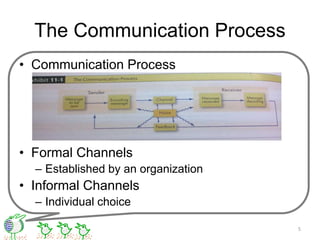
The Communication Process
• Communication Process
• Formal Channels
– Established by an organization
• Informal Channels
– Individual choice
5
Direction of Communication
• Downward
– High level→lower level
• Upward
– Lower level→high level
• Lateral
– Same level to communicate
6
Interpersonal Communication
• Oral Communication
– Speed and feedback
– Surfaces and passed
• Written Communication
– Tangible and verifiable
– Time-consuming and no feedback
• Nonverbal Communication
7
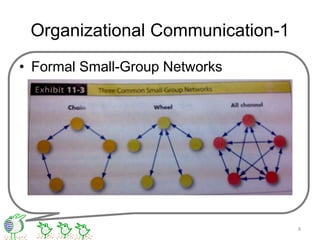
Organizational Communication-1
• Formal Small-Group Networks
8
Organizational Communication-2
• The Grapevine
– It is not controlled by management
– Perceived by most employee is more believable
than formal communiques
– Largely used to serve the self-interests of the
people within it
– Response grapevine situation
• Important to us
• Ambiguity
• anxiety
9
Organizational Communication-3
• Computer-Aided Communication
– E-Mail
– Instant Messaging
– Intranet and Extranet Links
– Videoconferencing
10
Organizational Communication-4
• Knowledge Management
– A process of organizing and distributing an
organization’s collective wisdom so the right
information gets to the right people at the right
time.
11
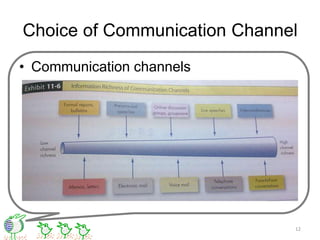
Choice of Communication Channel
• Communication channels
12
Barriers to Effective Communication
• Filtering
• Selective Perception
• Information Overload
• Emotions
• Language
• Communication Apprehension
13
Current Issues in Communication
• Communication Barriers Between Women
and Men
– Men use talk to emphasize status, and
women use it to create connection!
• Silence as Communication
• “Politically Correct” Communication
14
Current Issues in Communication
• Cross-Culture Communication
– Culture Barriers
• Semantics
• Word connotations
• Tone difference
• Different among perceptions
– Culture Context
• High/low-context cultureb
– A Culture Guide
15
Thank you for your listening !!
16

Ch11 communication

  • 1.
  • 2.
    Agenda • Functions ofCommunication • The Communication Process • Direction of Communication • Interpersonal Communication • Organizational Communication • Choice of Communication Channel • Barriers to Effective Communication • Current Issues in Communication 2
  • 3.
    Communication • No Groupcan exist without communication: the transference of meaning among its members. • Communication must include both the transference and the understanding of meaning 3
  • 4.
    Functions of Communication •Control – authority、formal guidelines、informal communication • Motivation • Emotional Expression • Information 4
  • 5.
    The Communication Process •Communication Process • Formal Channels – Established by an organization • Informal Channels – Individual choice 5
  • 6.
    Direction of Communication •Downward – High level→lower level • Upward – Lower level→high level • Lateral – Same level to communicate 6
  • 7.
    Interpersonal Communication • OralCommunication – Speed and feedback – Surfaces and passed • Written Communication – Tangible and verifiable – Time-consuming and no feedback • Nonverbal Communication 7
  • 8.
  • 9.
    Organizational Communication-2 • TheGrapevine – It is not controlled by management – Perceived by most employee is more believable than formal communiques – Largely used to serve the self-interests of the people within it – Response grapevine situation • Important to us • Ambiguity • anxiety 9
  • 10.
    Organizational Communication-3 • Computer-AidedCommunication – E-Mail – Instant Messaging – Intranet and Extranet Links – Videoconferencing 10
  • 11.
    Organizational Communication-4 • KnowledgeManagement – A process of organizing and distributing an organization’s collective wisdom so the right information gets to the right people at the right time. 11
  • 12.
    Choice of CommunicationChannel • Communication channels 12
  • 13.
    Barriers to EffectiveCommunication • Filtering • Selective Perception • Information Overload • Emotions • Language • Communication Apprehension 13
  • 14.
    Current Issues inCommunication • Communication Barriers Between Women and Men – Men use talk to emphasize status, and women use it to create connection! • Silence as Communication • “Politically Correct” Communication 14
  • 15.
    Current Issues inCommunication • Cross-Culture Communication – Culture Barriers • Semantics • Word connotations • Tone difference • Different among perceptions – Culture Context • High/low-context cultureb – A Culture Guide 15
  • 16.
    Thank you foryour listening !! 16