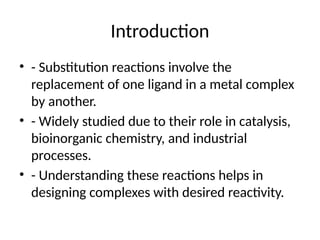
Introduction
• - Substitutionreactions involve the
replacement of one ligand in a metal complex
by another.
• - Widely studied due to their role in catalysis,
bioinorganic chemistry, and industrial
processes.
• - Understanding these reactions helps in
designing complexes with desired reactivity.
3.
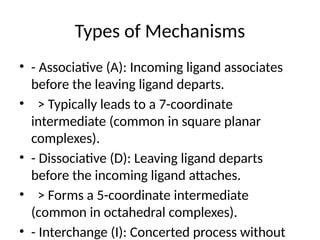
Types of Mechanisms
•- Associative (A): Incoming ligand associates
before the leaving ligand departs.
• > Typically leads to a 7-coordinate
intermediate (common in square planar
complexes).
• - Dissociative (D): Leaving ligand departs
before the incoming ligand attaches.
• > Forms a 5-coordinate intermediate
(common in octahedral complexes).
• - Interchange (I): Concerted process without
4.
Mechanism in Octahedral
Complexes
•- Octahedral complexes often undergo
substitution via the Dissociative (D) or Id
pathway.
• - Ligand departure forms a 5-coordinate
intermediate, usually trigonal bipyramidal.
• - Factors such as steric hindrance, solvation,
and ligand field stabilization affect the
mechanism.
• - Example: [Co(NH₃)₆]³⁺ losing one NH₃ before
water binds.
5.
Evidence for Dissociative
Mechanism
•- Rate law independent of entering ligand
concentration (Rate = k[ML₆]).
• - High activation entropy and enthalpy values
support bond cleavage.
• - Solvent exchange reactions and isotopic
labeling provide experimental evidence.
• - Inert complexes (e.g., Co(III), Cr(III)) often
follow the dissociative pathway.
6.
Mechanism in SquarePlanar
Complexes
• - Typically follow an Associative (A)
mechanism due to planar geometry.
• - Transition state involves a trigonal
bipyramidal or square pyramidal geometry.
• - Kinetics often show dependence on entering
ligand concentration.
• - Classic example: [PtCl₄]²⁻ substitution with
ammonia or water.
7.
Factors Affecting SquarePlanar
Mechanism
• - Electronic effects: Electron-rich ligands
accelerate substitution by stabilizing
intermediates.
• - Steric effects: Bulky ligands hinder approach
of nucleophile.
• - Trans effect: Ligands opposite to strong π-
acceptors (e.g., CN⁻, CO) are more labile.
• - Leaving group ability: Better leaving groups
(e.g., halides) increase reaction rate.
8.
Summary
• - Substitutionreactions are governed by three
principal mechanisms: A, D, and I.
• - Octahedral complexes often follow a
dissociative or interchange pathway.
• - Square planar complexes commonly proceed
via an associative mechanism.
• - Mechanism depends on coordination
number, geometry, ligand properties, and
electronic factors.

![Mechanism in Octahedral
Complexes
• - Octahedral complexes often undergo
substitution via the Dissociative (D) or Id
pathway.
• - Ligand departure forms a 5-coordinate
intermediate, usually trigonal bipyramidal.
• - Factors such as steric hindrance, solvation,
and ligand field stabilization affect the
mechanism.
• - Example: [Co(NH₃)₆]³⁺ losing one NH₃ before
water binds.](https://image.slidesharecdn.com/substitutionreactionsdetailedpresentation-250503060316-36cd1ddb/85/Substitution_Reactions_Detailed_Presentation-pptx-4-320.jpg)
![Evidence for Dissociative
Mechanism
• - Rate law independent of entering ligand
concentration (Rate = k[ML₆]).
• - High activation entropy and enthalpy values
support bond cleavage.
• - Solvent exchange reactions and isotopic
labeling provide experimental evidence.
• - Inert complexes (e.g., Co(III), Cr(III)) often
follow the dissociative pathway.](https://image.slidesharecdn.com/substitutionreactionsdetailedpresentation-250503060316-36cd1ddb/85/Substitution_Reactions_Detailed_Presentation-pptx-5-320.jpg)
![Mechanism in Square Planar
Complexes
• - Typically follow an Associative (A)
mechanism due to planar geometry.
• - Transition state involves a trigonal
bipyramidal or square pyramidal geometry.
• - Kinetics often show dependence on entering
ligand concentration.
• - Classic example: [PtCl₄]²⁻ substitution with
ammonia or water.](https://image.slidesharecdn.com/substitutionreactionsdetailedpresentation-250503060316-36cd1ddb/85/Substitution_Reactions_Detailed_Presentation-pptx-6-320.jpg)