Introduction
• - Substitutionreactions involve the
replacement of one ligand in a coordination
complex with another.
• - They are fundamental in coordination
chemistry and play crucial roles in catalysis,
synthesis, and biological systems.
• - Transition metals, due to their variable
oxidation states and coordination numbers,
exhibit diverse substitution behavior.
3.
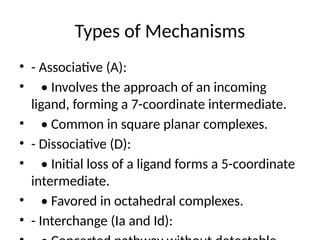
Types of Mechanisms
•- Associative (A):
• • Involves the approach of an incoming
ligand, forming a 7-coordinate intermediate.
• • Common in square planar complexes.
• - Dissociative (D):
• • Initial loss of a ligand forms a 5-coordinate
intermediate.
• • Favored in octahedral complexes.
• - Interchange (Ia and Id):
4.
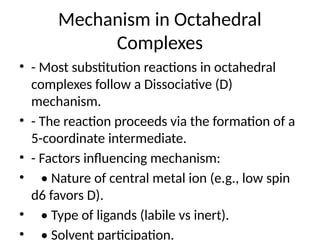
Mechanism in Octahedral
Complexes
•- Most substitution reactions in octahedral
complexes follow a Dissociative (D)
mechanism.
• - The reaction proceeds via the formation of a
5-coordinate intermediate.
• - Factors influencing mechanism:
• • Nature of central metal ion (e.g., low spin
d6 favors D).
• • Type of ligands (labile vs inert).
• • Solvent participation.
5.
Evidence for Dissociative
Mechanism
•- Kinetic Evidence:
• • Rate law: Rate = k[complex], independent
of entering ligand.
• - Activation Parameters:
• • Large positive entropy of activation (ΔS‡)
supports bond breaking.
• - Stereochemical Studies:
• • Retention or change in geometry suggests
intermediate formation.
6.
Mechanism in SquarePlanar
Complexes
• - Substitution generally follows an Associative
(A) or Interchange Associative (Ia) pathway.
• - Reaction pathway resembles SN2
mechanism.
• - Involves nucleophilic attack of entering
ligand on metal center.
• - Common in d8 metal centers (e.g., Pt(II),
Pd(II)).
• - Example:
• • [PtCl₄]²⁻ + NH₃ → [PtCl₃(NH₃)]⁻ + Cl⁻
7.
Factors Affecting Mechanismin
Square Planar Complexes
• - Electronic Effects:
• • Strong π-acceptor ligands stabilize
associative transition state.
• • Metal center with high electrophilicity
favors associative pathway.
• - Steric Effects:
• • Bulky ligands hinder approach of incoming
ligand.
• - Nature of Leaving Group:
8.
Summary
• - Transitionmetal complexes undergo
substitution via A, D, or I mechanisms.
• - Octahedral complexes often follow
Dissociative pathway.
• - Square planar complexes prefer Associative
or Interchange mechanisms.
• - The mechanism is influenced by electronic,
steric, and solvent factors.
9.
References
• - J.D.Lee, Inorganic Chemistry.
• - Shriver & Atkins, Inorganic Chemistry.
• - F. Basolo and R.G. Pearson, Mechanisms of
Inorganic Reactions.
• - Journal articles on substitution reactions in
coordination chemistry.
![Substitution Reactions in
Transition Metal Complexes
Presented by: Your Name
Course: [Course Name]
Institution: [Institution Name]
Date: [Date]](https://image.slidesharecdn.com/detailedsubstitutionreactionspresentation-250503060311-3d8cf7c2/85/Detailed_Substitution_Reactions_Presentation-pptx-1-320.jpg)
![Substitution Reactions in
Transition Metal Complexes
Presented by: Your Name
Course: [Course Name]
Institution: [Institution Name]
Date: [Date]](https://image.slidesharecdn.com/detailedsubstitutionreactionspresentation-250503060311-3d8cf7c2/75/Detailed_Substitution_Reactions_Presentation-pptx-1-2048.jpg)
![Evidence for Dissociative
Mechanism
• - Kinetic Evidence:
• • Rate law: Rate = k[complex], independent
of entering ligand.
• - Activation Parameters:
• • Large positive entropy of activation (ΔS‡)
supports bond breaking.
• - Stereochemical Studies:
• • Retention or change in geometry suggests
intermediate formation.](https://image.slidesharecdn.com/detailedsubstitutionreactionspresentation-250503060311-3d8cf7c2/85/Detailed_Substitution_Reactions_Presentation-pptx-5-320.jpg)
![Mechanism in Square Planar
Complexes
• - Substitution generally follows an Associative
(A) or Interchange Associative (Ia) pathway.
• - Reaction pathway resembles SN2
mechanism.
• - Involves nucleophilic attack of entering
ligand on metal center.
• - Common in d8 metal centers (e.g., Pt(II),
Pd(II)).
• - Example:
• • [PtCl₄]²⁻ + NH₃ → [PtCl₃(NH₃)]⁻ + Cl⁻](https://image.slidesharecdn.com/detailedsubstitutionreactionspresentation-250503060311-3d8cf7c2/85/Detailed_Substitution_Reactions_Presentation-pptx-6-320.jpg)