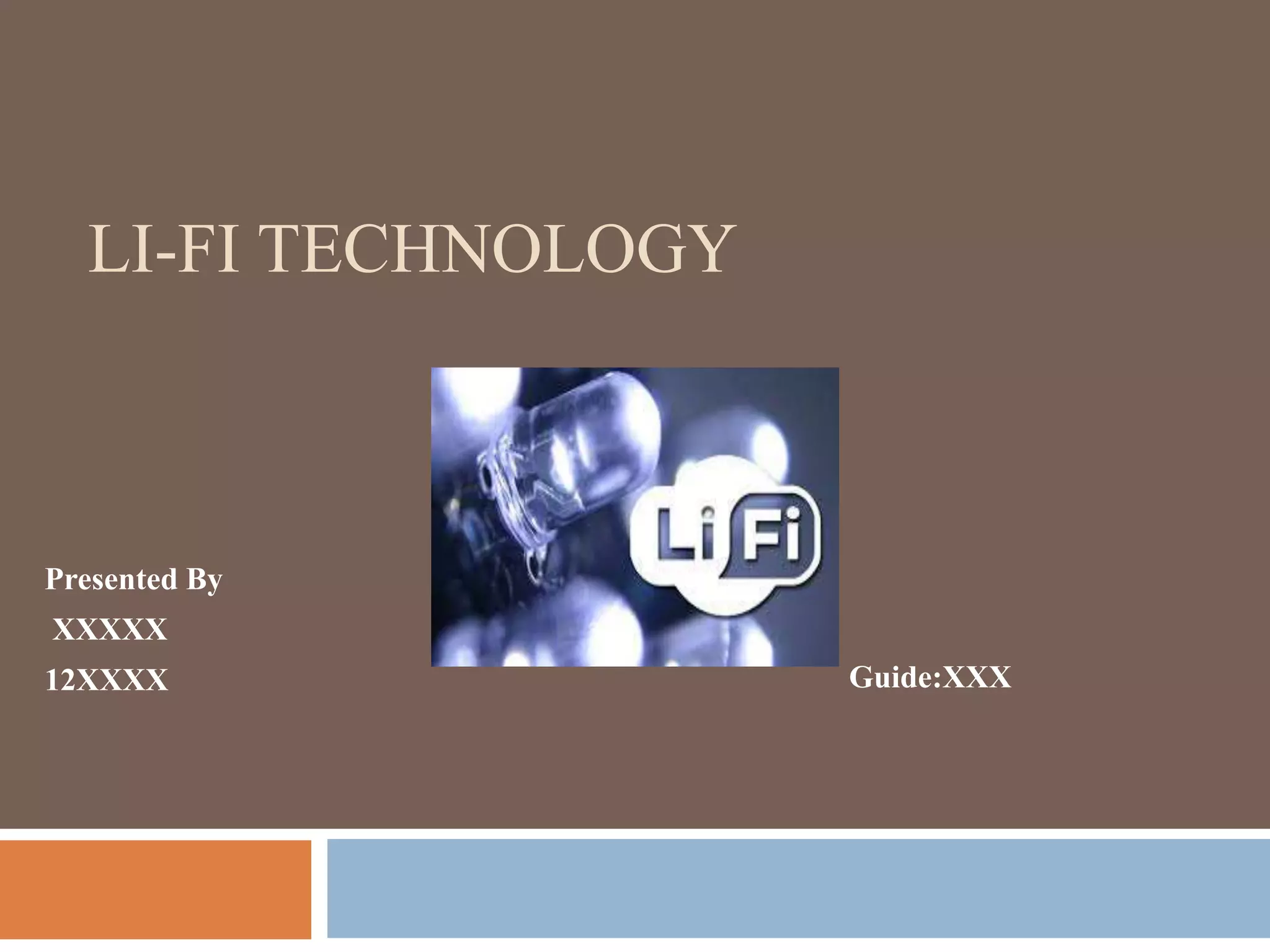
LI-FI TECHNOLOGY
Presented By
XXXXX
12XXXX Guide:XXX
ABSTRACT
Li- Fi (light-fidelity) refers to 5G visible light communication system.
using light emitting diode as a medium to hi-speed communication. in the similar
manner WI-FI as the internet as become a major demand people are in a search
of new life of data communication .These the concept of LI-FI is the data
communication on fast flickering of light which is not visible to human eyes.It
has gained huge popularity in the 2 years of invention such technology has
brought not only greener but also safer and cheaper future of communication
Contents
 Introduction
 What is Wi-fi ?
 Issues regarding Wi-Fi(Radio spectrum)
 What is Li-Fi?
 Principle of Li-Fi Technology
 Visible Light Communication
 Construction and Working of Li-Fi
 Comparison between Wi-Fi and Li-Fi
 Future Applications of Li-Fi
 Advantages and Disadvantages
 Conclusion
Introduction
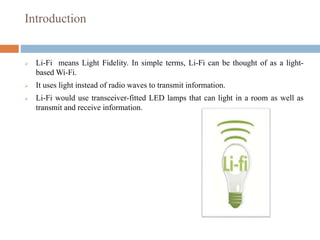
 Li-Fi means Light Fidelity. In simple terms, Li-Fi can be thought of as a light-
based Wi-Fi.
 It uses light instead of radio waves to transmit information.
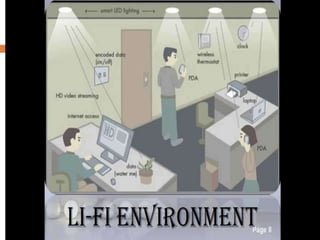
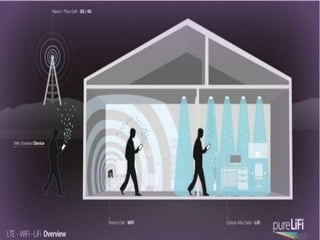
 Li-Fi would use transceiver-fitted LED lamps that can light in a room as well as
transmit and receive information.
Issues Regarding Wi-Fi
 Capacity
 Availability
 Efficiency
 Security
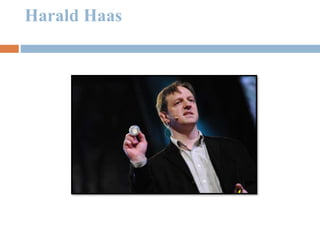
Harald Haas
HISTORY
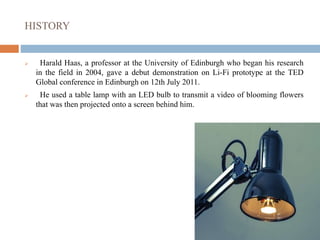
 Harald Haas, a professor at the University of Edinburgh who began his research
in the field in 2004, gave a debut demonstration on Li-Fi prototype at the TED
Global conference in Edinburgh on 12th July 2011.
 He used a table lamp with an LED bulb to transmit a video of blooming flowers
that was then projected onto a screen behind him.
Li-Fi(Light-Fidelity)
 Li-Fi can be tought as light based Wi-Fi.
 Li-Fi technology uses the visible spector.
 The term Li-Fi was first used by Harald haas in his Ted golbal talk on visible light
communication in 2011
 In oct 2011 num of companies & industrial group formed consturin for the LI-FI
promation to provide high speed optical WI-FI system
Principles of LI-FI
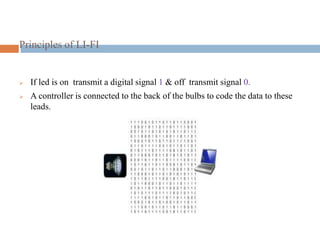
 If led is on transmit a digital signal 1 & off transmit signal 0.
 A controller is connected to the back of the bulbs to code the data to these
leads.
Visible light communication
 As the li-fi is based on the visible light communication it is Li-fi is a faster &
cheaper version of Wi-Fi (wireless fidelity).
 VLC is using 400thz to 800thz for an optimal carrier for data transaction.
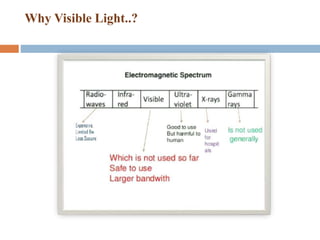
Why Visible Light..?
Why VLC….?
 As we know that the GAMA rays , X-rays, ULTRAVIOLOTE rays are
harm full to human body so we don’t use this rays.
 INFRAFER rays are also dangerous due to cyc regulation & this are used
with low power.
 RADIO waves are expensive & they are less secure.
 So we are only left with the visible light spectrum which are not harm full.
Construction & working of li-fi
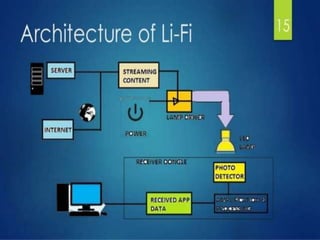
 LI-FI is implemented using a white LED light bulbs at downlink
transmitter.
 As the variation of current is fast the output’s can be made to vary at very
high speed.
 An overhead lamp is fitted with an LED with signal processing technology
streams data embedded in its beam at ultra high speed to photodiodes.
 A receiver dongle then converts the tiny change in amplitude into an
electrical signals which is the converted into data streams & transmitted
to mobiles or computers.
Comparison between LI-FI and WI-FI
 WI-FI stands for wireless fidelity.
 Transmits data using radio waves
with the help of WI-FI router.
 Interference issues form nearby
access point.
 Can’t pass through seawater as
interference is more.
 Can’t work in dense region.
 It can pass through the walls we
have to employ the security.
 WI-FI can be employed in open
environment.
 LI-FI stands for light fidelity.
 Transmits data light with the help of
LED bulbs.
 Don’t have any interference similar
to radio frequency waves.
 Can pass through salty sea water as
the interference is low.
 Works in dense region.
 Can’t penetrate through walls so
security is not needed to employ.
 LI-FI is effected by the sun light so
it should work in closed
environment.
WI-FI LI-FI
Future applications
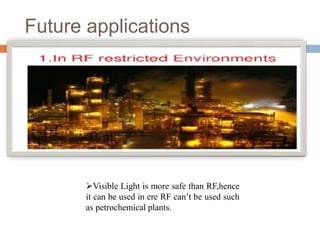
Visible Light is more safe than RF,hence
it can be used in ere RF can’t be used such
as petrochemical plants.
Traffic application
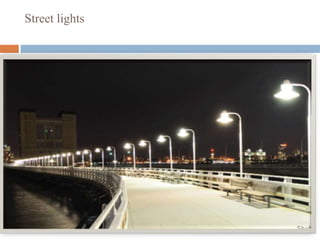
Street lights
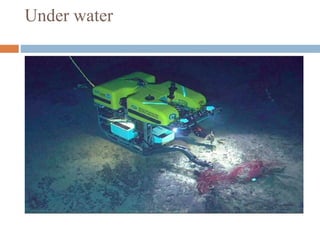
Under water
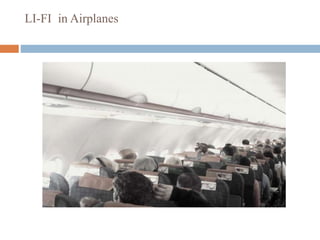
LI-FI in Airplanes
Advantages
 Availability
 Efficiency
 Harmless
 High security
 Ease of use
 Fast data transfer
 Low cost
Disadvantages
 Can’t transmit through wall.
 How the receiving device will transmit back to the transmitter.
 High initialization cost of VLC system.
 Interference from external light sources like sunlight ,normal bulbs &
opaque materials.
 Low range coverage.
 The security can’t be provided for the li-fi if the person is under the light.
Conclusion
 The possibilities are numerous & can be explored in future.
 In split of disadvantages if this technology can be put into use every bulb
can be used like WI-FI hotspot.
 By using LI-FI we can promote to the CLEANER,GREENER,SAFER&
BRIGHTER FUTURE.
Any Quries…?
Thank you

LI-FI TECHNOLOGY BY SAIKIRAN PANJALA

  • 1.
  • 2.
    ABSTRACT Li- Fi (light-fidelity)refers to 5G visible light communication system. using light emitting diode as a medium to hi-speed communication. in the similar manner WI-FI as the internet as become a major demand people are in a search of new life of data communication .These the concept of LI-FI is the data communication on fast flickering of light which is not visible to human eyes.It has gained huge popularity in the 2 years of invention such technology has brought not only greener but also safer and cheaper future of communication
  • 3.
    Contents  Introduction  Whatis Wi-fi ?  Issues regarding Wi-Fi(Radio spectrum)  What is Li-Fi?  Principle of Li-Fi Technology  Visible Light Communication  Construction and Working of Li-Fi  Comparison between Wi-Fi and Li-Fi  Future Applications of Li-Fi  Advantages and Disadvantages  Conclusion
  • 4.
    Introduction  Li-Fi meansLight Fidelity. In simple terms, Li-Fi can be thought of as a light- based Wi-Fi.  It uses light instead of radio waves to transmit information.  Li-Fi would use transceiver-fitted LED lamps that can light in a room as well as transmit and receive information.
  • 5.
    Issues Regarding Wi-Fi Capacity  Availability  Efficiency  Security
  • 7.
  • 8.
    HISTORY  Harald Haas,a professor at the University of Edinburgh who began his research in the field in 2004, gave a debut demonstration on Li-Fi prototype at the TED Global conference in Edinburgh on 12th July 2011.  He used a table lamp with an LED bulb to transmit a video of blooming flowers that was then projected onto a screen behind him.
  • 9.
    Li-Fi(Light-Fidelity)  Li-Fi canbe tought as light based Wi-Fi.  Li-Fi technology uses the visible spector.  The term Li-Fi was first used by Harald haas in his Ted golbal talk on visible light communication in 2011  In oct 2011 num of companies & industrial group formed consturin for the LI-FI promation to provide high speed optical WI-FI system
  • 10.
    Principles of LI-FI If led is on transmit a digital signal 1 & off transmit signal 0.  A controller is connected to the back of the bulbs to code the data to these leads.
  • 12.
    Visible light communication As the li-fi is based on the visible light communication it is Li-fi is a faster & cheaper version of Wi-Fi (wireless fidelity).  VLC is using 400thz to 800thz for an optimal carrier for data transaction.
  • 13.
  • 14.
    Why VLC….?  Aswe know that the GAMA rays , X-rays, ULTRAVIOLOTE rays are harm full to human body so we don’t use this rays.  INFRAFER rays are also dangerous due to cyc regulation & this are used with low power.  RADIO waves are expensive & they are less secure.  So we are only left with the visible light spectrum which are not harm full.
  • 15.
    Construction & workingof li-fi  LI-FI is implemented using a white LED light bulbs at downlink transmitter.  As the variation of current is fast the output’s can be made to vary at very high speed.  An overhead lamp is fitted with an LED with signal processing technology streams data embedded in its beam at ultra high speed to photodiodes.  A receiver dongle then converts the tiny change in amplitude into an electrical signals which is the converted into data streams & transmitted to mobiles or computers.
  • 17.
    Comparison between LI-FIand WI-FI  WI-FI stands for wireless fidelity.  Transmits data using radio waves with the help of WI-FI router.  Interference issues form nearby access point.  Can’t pass through seawater as interference is more.  Can’t work in dense region.  It can pass through the walls we have to employ the security.  WI-FI can be employed in open environment.  LI-FI stands for light fidelity.  Transmits data light with the help of LED bulbs.  Don’t have any interference similar to radio frequency waves.  Can pass through salty sea water as the interference is low.  Works in dense region.  Can’t penetrate through walls so security is not needed to employ.  LI-FI is effected by the sun light so it should work in closed environment. WI-FI LI-FI
  • 19.
    Future applications Visible Lightis more safe than RF,hence it can be used in ere RF can’t be used such as petrochemical plants.
  • 21.
  • 22.
  • 23.
  • 24.
  • 25.
    Advantages  Availability  Efficiency Harmless  High security  Ease of use  Fast data transfer  Low cost
  • 26.
    Disadvantages  Can’t transmitthrough wall.  How the receiving device will transmit back to the transmitter.  High initialization cost of VLC system.  Interference from external light sources like sunlight ,normal bulbs & opaque materials.  Low range coverage.  The security can’t be provided for the li-fi if the person is under the light.
  • 27.
    Conclusion  The possibilitiesare numerous & can be explored in future.  In split of disadvantages if this technology can be put into use every bulb can be used like WI-FI hotspot.  By using LI-FI we can promote to the CLEANER,GREENER,SAFER& BRIGHTER FUTURE.
  • 28.
  • 29.