FUAD SINEEN
RCSH
BSC CS
Introduction
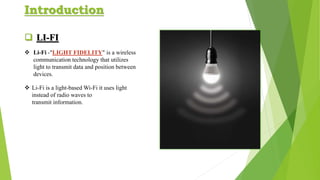
 Li-Fi -"LIGHT FIDELITY" is a wireless
communication technology that utilizes
light to transmit data and position between
devices.
 LI-FI
 Li-Fi is a light-based Wi-Fi it uses light
instead of radio waves to
transmit information.
HISTORY
 The term LI-FI was first introduced
by Harald Haas during a TED
Global talk in Edinburgh.
 He introduced this in the year 2011
IMPLEMENTATION OF LI-FI
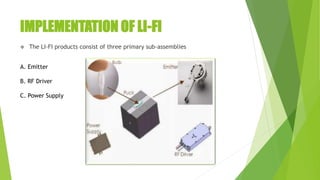
 The LI-FI products consist of three primary sub-assemblies
A. Emitter
B. RF Driver
C. Power Supply
HOW LI-FI WORKS
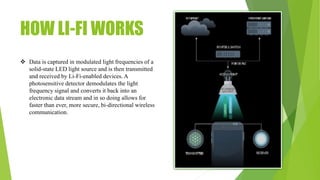
 Data is captured in modulated light frequencies of a
solid-state LED light source and is then transmitted
and received by Li-Fi-enabled devices. A
photosensitive detector demodulates the light
frequency signal and converts it back into an
electronic data stream and in so doing allows for
faster than ever, more secure, bi-directional wireless
communication.
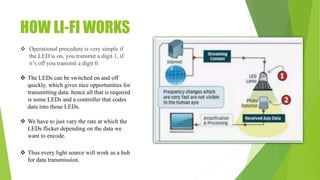
HOW LI-FI WORKS
 Operational procedure is very simple if
the LED is on, you transmit a digit 1, if
it’s off you transmit a digit 0.
 The LEDs can be switched on and off
quickly. which gives nice opportunities for
transmitting data. hence all that is required
is some LEDs and a controller that codes
data into those LEDs.
 We have to just vary the rate at which the
LEDs flicker depending on the data we
want to encode.
 Thus every light source will work as a hub
for data transmission.
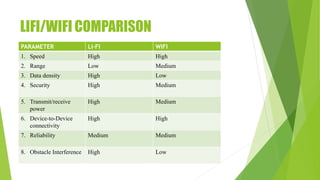
LIFI/WIFI COMPARISON
PARAMETER LI-FI WIFI
1. Speed High High
2. Range Low Medium
3. Data density High Low
4. Security High Medium
5. Transmit/receive
power
High Medium
6. Device-to-Device
connectivity
High High
7. Reliability Medium Medium
8. Obstacle Interference High Low
APPLICATIONS
 Used for modern medical instruments.
 In aircraft, it can be used for data
transmission.
 Used in petroleum or chemical plants
where other transmission or frequencies
can be hazardous.
 In traffic signals, LI-FI can be used
which will communicate with the LED
lights of the car and the number of
accidents can be decreased.
 Location-based services:-GPS
 Underwater communication.
 RF Spectrum relief
 Li-Fi can be used effectively in places where
it is difficult to lay the optical fiber cable
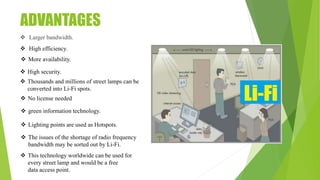
ADVANTAGES
 Larger bandwidth.
 High efficiency.
 More availability.
 High security.
 Thousands and millions of street lamps can be
converted into Li-Fi spots.
 No license needed
 green information technology.
 Lighting points are used as Hotspots.
 The issues of the shortage of radio frequency
bandwidth may be sorted out by Li-Fi.
 This technology worldwide can be used for
every street lamp and would be a free
data access point.
LIMITATIONS
 Li-Fi doesn’t work in dark.
 Li-Fi has a big drawback compared to
Wi-Fi, unlike Wi-Fi we cannot move
to other rooms unless there are wired
bulbs too.
 Light can't pass through the objects.
 Interference from external sources like sunlight,
normal bulbs, and opaque materials in the path of
transmission will course an interruption in
communication.
 High installation cost of the VLC systems
 A major challenge facing Li-Fi is how the receiving
device will transmit back to the transmitter
FUTURE DEVELOPMENTS
 Efficient alternative to radio-based wireless
 Li-Fi is an emerging technology that is quick and reliable
 Airwaves are clogged so let's use light waves.
 Hence, let's proceed to Li-Fi for a brighter cheaper, and greener future.
CONCLUTION
 Overcomes the limitations of the radio spectrum
 High speed of 10 Gbps can be achieved
 The possibilities are numerous and can be explored further.
 If this technology can be put into practical use, every bulb can be used as something like a
Wi-Fi hotspot
 we will proceed toward a cleaner, greener, safer and brighter future
 This may solve issues such as the shortage of radio-frequency bandwidth
 LI-FI is enabled by advanced digital transmission technologies
 Allows internet where traditional radio-based wireless isn't allowed such as aircraft or
hospitals
QUESTIONS ?
THANK YOU
LI - FI TECHNOLOGY.pptx

LI - FI TECHNOLOGY.pptx

  • 1.
  • 2.
    Introduction  Li-Fi -"LIGHTFIDELITY" is a wireless communication technology that utilizes light to transmit data and position between devices.  LI-FI  Li-Fi is a light-based Wi-Fi it uses light instead of radio waves to transmit information.
  • 3.
    HISTORY  The termLI-FI was first introduced by Harald Haas during a TED Global talk in Edinburgh.  He introduced this in the year 2011
  • 4.
    IMPLEMENTATION OF LI-FI The LI-FI products consist of three primary sub-assemblies A. Emitter B. RF Driver C. Power Supply
  • 5.
    HOW LI-FI WORKS Data is captured in modulated light frequencies of a solid-state LED light source and is then transmitted and received by Li-Fi-enabled devices. A photosensitive detector demodulates the light frequency signal and converts it back into an electronic data stream and in so doing allows for faster than ever, more secure, bi-directional wireless communication.
  • 6.
    HOW LI-FI WORKS Operational procedure is very simple if the LED is on, you transmit a digit 1, if it’s off you transmit a digit 0.  The LEDs can be switched on and off quickly. which gives nice opportunities for transmitting data. hence all that is required is some LEDs and a controller that codes data into those LEDs.  We have to just vary the rate at which the LEDs flicker depending on the data we want to encode.  Thus every light source will work as a hub for data transmission.
  • 7.
    LIFI/WIFI COMPARISON PARAMETER LI-FIWIFI 1. Speed High High 2. Range Low Medium 3. Data density High Low 4. Security High Medium 5. Transmit/receive power High Medium 6. Device-to-Device connectivity High High 7. Reliability Medium Medium 8. Obstacle Interference High Low
  • 8.
    APPLICATIONS  Used formodern medical instruments.  In aircraft, it can be used for data transmission.  Used in petroleum or chemical plants where other transmission or frequencies can be hazardous.  In traffic signals, LI-FI can be used which will communicate with the LED lights of the car and the number of accidents can be decreased.  Location-based services:-GPS  Underwater communication.  RF Spectrum relief  Li-Fi can be used effectively in places where it is difficult to lay the optical fiber cable
  • 9.
    ADVANTAGES  Larger bandwidth. High efficiency.  More availability.  High security.  Thousands and millions of street lamps can be converted into Li-Fi spots.  No license needed  green information technology.  Lighting points are used as Hotspots.  The issues of the shortage of radio frequency bandwidth may be sorted out by Li-Fi.  This technology worldwide can be used for every street lamp and would be a free data access point.
  • 10.
    LIMITATIONS  Li-Fi doesn’twork in dark.  Li-Fi has a big drawback compared to Wi-Fi, unlike Wi-Fi we cannot move to other rooms unless there are wired bulbs too.  Light can't pass through the objects.  Interference from external sources like sunlight, normal bulbs, and opaque materials in the path of transmission will course an interruption in communication.  High installation cost of the VLC systems  A major challenge facing Li-Fi is how the receiving device will transmit back to the transmitter
  • 11.
    FUTURE DEVELOPMENTS  Efficientalternative to radio-based wireless  Li-Fi is an emerging technology that is quick and reliable  Airwaves are clogged so let's use light waves.  Hence, let's proceed to Li-Fi for a brighter cheaper, and greener future.
  • 12.
    CONCLUTION  Overcomes thelimitations of the radio spectrum  High speed of 10 Gbps can be achieved  The possibilities are numerous and can be explored further.  If this technology can be put into practical use, every bulb can be used as something like a Wi-Fi hotspot  we will proceed toward a cleaner, greener, safer and brighter future  This may solve issues such as the shortage of radio-frequency bandwidth  LI-FI is enabled by advanced digital transmission technologies  Allows internet where traditional radio-based wireless isn't allowed such as aircraft or hospitals
  • 13.
  • 14.