A
Seminar Presentation on
LI-FI TECHNOLOGY
Presented By
Vishal
Contents
Introduction
History
Present Scenario
Working Process
Li-Fi vs Wi-Fi
Applications
Challenges for Li-Fi
Conclusion
Introduction
Li-Fi stands for Light-Fidelity
 Li-Fi is a Visible Light Communications (VLC)
system running wireless communications travelling
at very high speeds.
Li-Fi is transmission of data through illumination,
sending data through a LED light bulb that varies
intensity faster than human eye can follow.
The idea behind Li-Fi is to use a form of visible
light communication instead of radio waves like
conventional Wi-Fi routers.
History
The technology truly began during the
1990's in countries like Germany, Korea, and
Japan where they discovered LED's could be
retrofitted to send information.
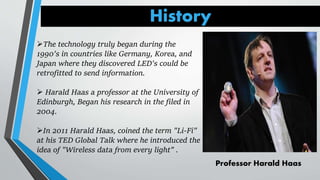
 Harald Haas a professor at the University of
Edinburgh, Began his research in the filed in
2004.
In 2011 Harald Haas, coined the term "Li-Fi"
at his TED Global Talk where he introduced the
idea of "Wireless data from every light” .
Professor Harald Haas
Present Scenario
In present scenario, Radio Waves are being used in Communication
Systems.
Radio Spectrum is congested but the demand for wireless data double each
year.
2 Million Base
Stations
7 Million Mobile
Phone Users
Radio Spectrum
ISSUES Regarding Radio Spectrum
o
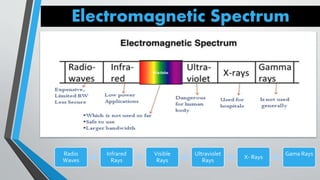
Electromagnetic Spectrum
Radio
Waves
Infrared
Rays
Visible
Rays
Ultraviolet
Rays
X- Rays
Gama Rays
WHO CAN REPLACE
RADIO WAVES FOR WIRELESS
COMMUNICATION ?
Working Of Li-Fi
LED i.e. Light emitting diode can be switched on
and off faster since operating speed of LED is less
than 1 μs, than the human eye can detect, causing
the light source to be appear continuously.
Operational procedure is very simple, if the led is
on, you transmit a digital 1, if its off you
transmit A 0. The LEDs can be switched on and
off very quickly, which gives nice opportunities
for transmitting data.
Thus every light source will works as a hub for
data transmission.
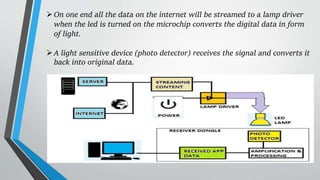
On one end all the data on the internet will be streamed to a lamp driver
when the led is turned on the microchip converts the digital data in form
of light.
A light sensitive device (photo detector) receives the signal and converts it
back into original data.
Li-Fi VS Wi-Fi
Li-Fi can be thought of as a light-based Wi-Fi. That is, it uses light instead of
radio waves to transmit information.
Instead of Wi-Fi modems, Li-Fi would use transceiver-fitted LED lamps that
can light a room as well as transmit and receive information.
Wi-Fi is great for general wireless coverage within buildings, and li-fi is ideal
for high density wireless data coverage in confined area and for relieving radio
interference issues.
Li-Fi VS Wi-Fi
Application Area
Li-Fi technology is still in its infancy. However some areas where it
seems perfectly applicable are:-
 Traffic Lights
 Intrinsically Safe Environment
 Hospitals(In Medical Equipment's )
 Airlines
 On Ocean Beds
 Street Lamps (As free Access Points)
Traffic Light
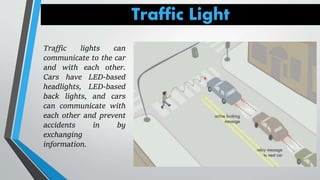
Traffic lights can
communicate to the car
and with each other.
Cars have LED-based
headlights, LED-based
back lights, and cars
can communicate with
each other and prevent
accidents in by
exchanging
information.
Intrinsically Safe Environment
Visible Light is more safe than RF, hence it can be used in places where
RF can't be used such as petrochemical plants and petrol pump.
Airlines
Whenever we travel through
airways we face the problem
in communication media ,
because the whole airways
communication are
performed on the basis of
radio waves.
To overcome this
drawback on radio wave, Li-
Fi is introduced.
Hospital
Patients could soon be less tied
down in hospitals, as
researchers work to develop
technology that transmits vital
signs by light instead of wires.
It could potentially be used for
electrooculography, a technique
used to record eye movement,
potentially opening the door for
quadriplegic users to implement
the technology to control
computers.
Under Water Communication
Li-Fi can even wok underwater were Wi-Fi fails completely, thereby
throwing open endless opportunities for military/navigation
operations.
Street Lamp
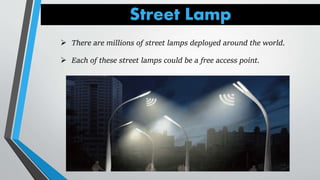
 There are millions of street lamps deployed around the world.
 Each of these street lamps could be a free access point.
Work Place
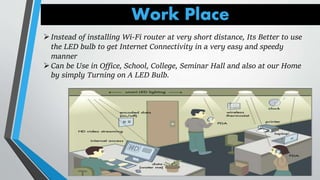
Instead of installing Wi-Fi router at very short distance, Its Better to use
the LED bulb to get Internet Connectivity in a very easy and speedy
manner
Can be Use in Office, School, College, Seminar Hall and also at our Home
by simply Turning on A LED Bulb.
Advantage’s
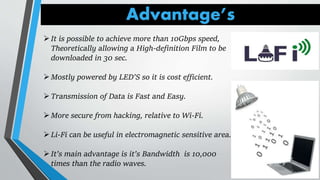
It is possible to achieve more than 10Gbps speed,
Theoretically allowing a High-definition Film to be
downloaded in 30 sec.
Mostly powered by LED’S so it is cost efficient.
Transmission of Data is Fast and Easy.
More secure from hacking, relative to Wi-Fi.
Li-Fi can be useful in electromagnetic sensitive area.
It’s main advantage is it’s Bandwidth is 10,000
times than the radio waves.
Limitations
 Light can't pass through objects.
 Interferences from external light sources like sun light, normal bulbs,
and opaque materials in the path of transmission will cause interruption
in the communication.
 Li-Fi requires line of sight.
 High installation cost of the VLC systems .
 A major challenge facing Li-Fi is how the receiving device will transmit
back to transmitter.
 You need LED and there will be Interference from other Light’s.
Current Status
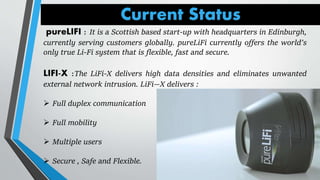
pureLIFI : It is a Scottish based start-up with headquarters in Edinburgh,
currently serving customers globally. pureLiFi currently offers the world’s
only true Li-Fi system that is flexible, fast and secure.
LIFI-X :The LiFi-X delivers high data densities and eliminates unwanted
external network intrusion. LiFi—X delivers :
 Full duplex communication
 Full mobility
 Multiple users
 Secure , Safe and Flexible.
Conclusion
 Currently Dubai is the first place where LiFi is being tested on a large scale
 The possibilities are numerous and can be explored further.
.
 If this technology can be put into
practical use , every bulb can be
used something like a Wi-Fi
hotspots to transmit wireless
data.
 With its Magic of Lights it can
make our world greener, safer,
cleaner and moreover a brighter
place to live.
Li fi ppt

Li fi ppt

  • 1.
    A Seminar Presentation on LI-FITECHNOLOGY Presented By Vishal
  • 2.
    Contents Introduction History Present Scenario Working Process Li-Fivs Wi-Fi Applications Challenges for Li-Fi Conclusion
  • 3.
    Introduction Li-Fi stands forLight-Fidelity  Li-Fi is a Visible Light Communications (VLC) system running wireless communications travelling at very high speeds. Li-Fi is transmission of data through illumination, sending data through a LED light bulb that varies intensity faster than human eye can follow. The idea behind Li-Fi is to use a form of visible light communication instead of radio waves like conventional Wi-Fi routers.
  • 4.
    History The technology trulybegan during the 1990's in countries like Germany, Korea, and Japan where they discovered LED's could be retrofitted to send information.  Harald Haas a professor at the University of Edinburgh, Began his research in the filed in 2004. In 2011 Harald Haas, coined the term "Li-Fi" at his TED Global Talk where he introduced the idea of "Wireless data from every light” . Professor Harald Haas
  • 5.
    Present Scenario In presentscenario, Radio Waves are being used in Communication Systems. Radio Spectrum is congested but the demand for wireless data double each year. 2 Million Base Stations 7 Million Mobile Phone Users
  • 6.
  • 7.
  • 8.
    WHO CAN REPLACE RADIOWAVES FOR WIRELESS COMMUNICATION ?
  • 9.
    Working Of Li-Fi LEDi.e. Light emitting diode can be switched on and off faster since operating speed of LED is less than 1 μs, than the human eye can detect, causing the light source to be appear continuously. Operational procedure is very simple, if the led is on, you transmit a digital 1, if its off you transmit A 0. The LEDs can be switched on and off very quickly, which gives nice opportunities for transmitting data. Thus every light source will works as a hub for data transmission.
  • 10.
    On one endall the data on the internet will be streamed to a lamp driver when the led is turned on the microchip converts the digital data in form of light. A light sensitive device (photo detector) receives the signal and converts it back into original data.
  • 11.
    Li-Fi VS Wi-Fi Li-Fican be thought of as a light-based Wi-Fi. That is, it uses light instead of radio waves to transmit information. Instead of Wi-Fi modems, Li-Fi would use transceiver-fitted LED lamps that can light a room as well as transmit and receive information. Wi-Fi is great for general wireless coverage within buildings, and li-fi is ideal for high density wireless data coverage in confined area and for relieving radio interference issues.
  • 12.
  • 13.
    Application Area Li-Fi technologyis still in its infancy. However some areas where it seems perfectly applicable are:-  Traffic Lights  Intrinsically Safe Environment  Hospitals(In Medical Equipment's )  Airlines  On Ocean Beds  Street Lamps (As free Access Points)
  • 14.
    Traffic Light Traffic lightscan communicate to the car and with each other. Cars have LED-based headlights, LED-based back lights, and cars can communicate with each other and prevent accidents in by exchanging information.
  • 15.
    Intrinsically Safe Environment VisibleLight is more safe than RF, hence it can be used in places where RF can't be used such as petrochemical plants and petrol pump.
  • 16.
    Airlines Whenever we travelthrough airways we face the problem in communication media , because the whole airways communication are performed on the basis of radio waves. To overcome this drawback on radio wave, Li- Fi is introduced.
  • 17.
    Hospital Patients could soonbe less tied down in hospitals, as researchers work to develop technology that transmits vital signs by light instead of wires. It could potentially be used for electrooculography, a technique used to record eye movement, potentially opening the door for quadriplegic users to implement the technology to control computers.
  • 18.
    Under Water Communication Li-Fican even wok underwater were Wi-Fi fails completely, thereby throwing open endless opportunities for military/navigation operations.
  • 19.
    Street Lamp  Thereare millions of street lamps deployed around the world.  Each of these street lamps could be a free access point.
  • 20.
    Work Place Instead ofinstalling Wi-Fi router at very short distance, Its Better to use the LED bulb to get Internet Connectivity in a very easy and speedy manner Can be Use in Office, School, College, Seminar Hall and also at our Home by simply Turning on A LED Bulb.
  • 21.
    Advantage’s It is possibleto achieve more than 10Gbps speed, Theoretically allowing a High-definition Film to be downloaded in 30 sec. Mostly powered by LED’S so it is cost efficient. Transmission of Data is Fast and Easy. More secure from hacking, relative to Wi-Fi. Li-Fi can be useful in electromagnetic sensitive area. It’s main advantage is it’s Bandwidth is 10,000 times than the radio waves.
  • 22.
    Limitations  Light can'tpass through objects.  Interferences from external light sources like sun light, normal bulbs, and opaque materials in the path of transmission will cause interruption in the communication.  Li-Fi requires line of sight.  High installation cost of the VLC systems .  A major challenge facing Li-Fi is how the receiving device will transmit back to transmitter.  You need LED and there will be Interference from other Light’s.
  • 23.
    Current Status pureLIFI :It is a Scottish based start-up with headquarters in Edinburgh, currently serving customers globally. pureLiFi currently offers the world’s only true Li-Fi system that is flexible, fast and secure. LIFI-X :The LiFi-X delivers high data densities and eliminates unwanted external network intrusion. LiFi—X delivers :  Full duplex communication  Full mobility  Multiple users  Secure , Safe and Flexible.
  • 24.
    Conclusion  Currently Dubaiis the first place where LiFi is being tested on a large scale  The possibilities are numerous and can be explored further. .  If this technology can be put into practical use , every bulb can be used something like a Wi-Fi hotspots to transmit wireless data.  With its Magic of Lights it can make our world greener, safer, cleaner and moreover a brighter place to live.