Presented By-
Umesh Manolkar
Contents
1.About LiFi
2.History
3.Architecture of LiFi
4.Security
5.Difference Between WiFi and LiFi
6.Advantages
7.Disadvantages
About LIFI
• The full form of LiFi is Light Fidelity.
• LiFi is cellular wireless networking (re)using lights.
Specifically, light emitting diodes (LEDs) are used in
LiFi as visible light transmitters.
History
Professor Harald Haas, coined the term "Li-Fi" at his 2011 TED Global Talk where
he introduced the idea of "Wireless data from every light". He is Chairman of Mobile
Communications at the University of Edinburgh and co-founder of pureLiFi.
Name- Harald Haas
Born- 1968
Birth Place-Neustadt an der Aisch, Germany
Security
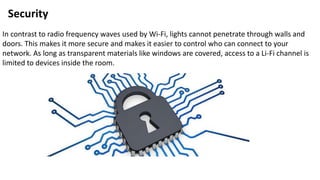
In contrast to radio frequency waves used by Wi-Fi, lights cannot penetrate through walls and
doors. This makes it more secure and makes it easier to control who can connect to your
network. As long as transparent materials like windows are covered, access to a Li-Fi channel is
limited to devices inside the room.
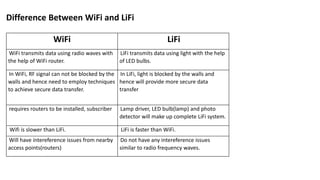
WiFi LiFi
WiFi transmits data using radio waves with
the help of WiFi router.
LiFi transmits data using light with the help
of LED bulbs.
In WiFi, RF signal can not be blocked by the
walls and hence need to employ techniques
to achieve secure data transfer.
In LiFi, light is blocked by the walls and
hence will provide more secure data
transfer
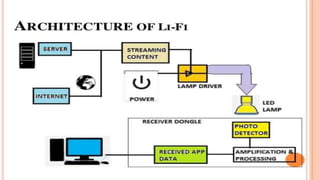
requires routers to be installed, subscriber Lamp driver, LED bulb(lamp) and photo
detector will make up complete LiFi system.
Wifi is slower than LiFi. LiFi is faster than WiFi.
Will have intereference issues from nearby
access points(routers)
Do not have any intereference issues
similar to radio frequency waves.
Difference Between WiFi and LiFi
Advantages-
• It is easy to install.
• It provides high amount of security.
• The data transfer rate for internet application is higher.
• The lifi devices consume low power for operation.
• There is no health concerns in LiFi based system.
• It provides high amount of security.
Disadvantages
• Internet can be used only where light of source device is
available.
• It can not be used in outdoor environment like RF signal.
• Though the installation is simple, Lifi system requires whole
new infrastructure.
Thank You

Lifi Technology

  • 1.
  • 2.
    Contents 1.About LiFi 2.History 3.Architecture ofLiFi 4.Security 5.Difference Between WiFi and LiFi 6.Advantages 7.Disadvantages
  • 3.
    About LIFI • Thefull form of LiFi is Light Fidelity. • LiFi is cellular wireless networking (re)using lights. Specifically, light emitting diodes (LEDs) are used in LiFi as visible light transmitters.
  • 4.
    History Professor Harald Haas,coined the term "Li-Fi" at his 2011 TED Global Talk where he introduced the idea of "Wireless data from every light". He is Chairman of Mobile Communications at the University of Edinburgh and co-founder of pureLiFi. Name- Harald Haas Born- 1968 Birth Place-Neustadt an der Aisch, Germany
  • 6.
    Security In contrast toradio frequency waves used by Wi-Fi, lights cannot penetrate through walls and doors. This makes it more secure and makes it easier to control who can connect to your network. As long as transparent materials like windows are covered, access to a Li-Fi channel is limited to devices inside the room.
  • 7.
    WiFi LiFi WiFi transmitsdata using radio waves with the help of WiFi router. LiFi transmits data using light with the help of LED bulbs. In WiFi, RF signal can not be blocked by the walls and hence need to employ techniques to achieve secure data transfer. In LiFi, light is blocked by the walls and hence will provide more secure data transfer requires routers to be installed, subscriber Lamp driver, LED bulb(lamp) and photo detector will make up complete LiFi system. Wifi is slower than LiFi. LiFi is faster than WiFi. Will have intereference issues from nearby access points(routers) Do not have any intereference issues similar to radio frequency waves. Difference Between WiFi and LiFi
  • 8.
    Advantages- • It iseasy to install. • It provides high amount of security. • The data transfer rate for internet application is higher. • The lifi devices consume low power for operation. • There is no health concerns in LiFi based system. • It provides high amount of security.
  • 9.
    Disadvantages • Internet canbe used only where light of source device is available. • It can not be used in outdoor environment like RF signal. • Though the installation is simple, Lifi system requires whole new infrastructure.
  • 10.