LIGHT FIDELITY (Li-Fi)
TECHNOLOGY
PRESENTED BY
AMBIKA R (1MV10CS008)
BHAGYASHREE (1MV10CS023)
CHAITRA CN (1MV10CS030)
SUPRIYA (1MV11CS417)
CONTENTS
History
Introduction
Why VLC?
Present Scenario
Working process
Advantages
Applications
Is this a proven technology?
Conclusion
References
History
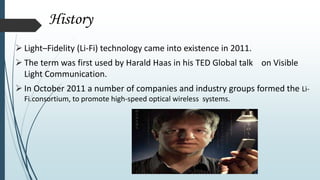
 Light–Fidelity (Li-Fi) technology came into existence in 2011.
 The term was first used by Harald Haas in his TED Global talk on Visible
Light Communication.
 In October 2011 a number of companies and industry groups formed the Li-
Fi.consortium, to promote high-speed optical wireless systems.
..
Introduction
 Li-Fi is transmission of data through illumination by taking the fiber
out of fiber optics by sending data through a LED light bulb that
varies in intensity faster than the human eye can follow.
 Li-Fi is fast and cheap optical version of wi - fi based on visible light
communication(VLC).
 At the heart of this technology is the high brightness light-emitting
diodes.
Introduction(contd…)
The on-off activity of LEDs enables a kind of data
transmission using binary codes. Switching on an LED is a
logical ‘1’;switching it off is a logical ‘0’.
It allows wireless communication without the use of radio
waves, which can be dangerous in places like oil platforms,
underwater and on planes Li-Fi can be thought of as a light-
based Wi-Fi.
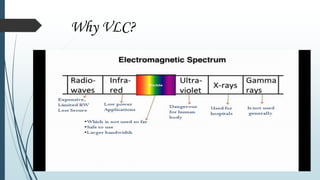
Why VLC?
Present Scenario
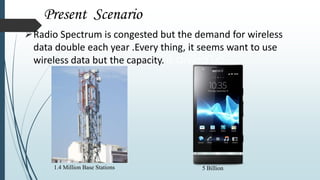
Radio Spectrum is congested but the demand for wireless
data double each year .Every thing, it seems want to use
wireless data but the capacity. is drying up.
5 Billion1.4 Million Base Stations
Li-Fi Construction
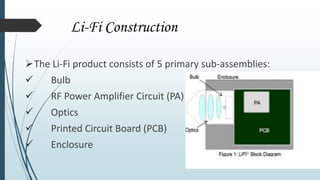
The Li-Fi product consists of 5 primary sub-assemblies:
 Bulb
 RF Power Amplifier Circuit (PA)
 Optics
 Printed Circuit Board (PCB)
 Enclosure
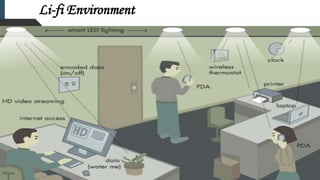
Li-fi Environment
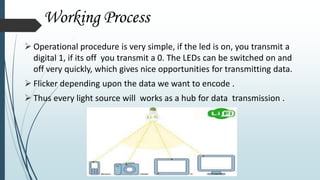
Working Process
 Operational procedure is very simple, if the led is on, you transmit a
digital 1, if its off you transmit a 0. The LEDs can be switched on and
off very quickly, which gives nice opportunities for transmitting data.
 Flicker depending upon the data we want to encode .
 Thus every light source will works as a hub for data transmission .
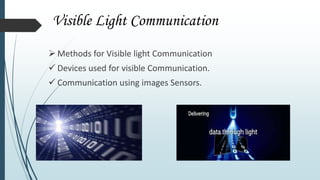
Visible Light Communication
 Methods for Visible light Communication
 Devices used for visible Communication.
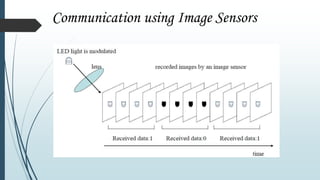
 Communication using images Sensors.
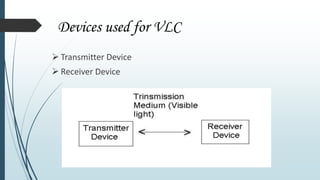
Devices used for VLC
 Transmitter Device
 Receiver Device
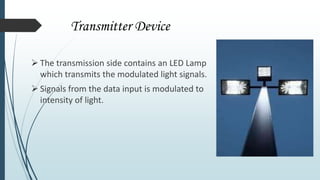
Transmitter Device
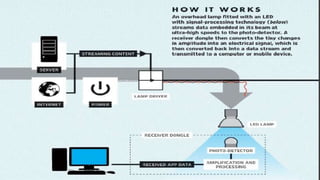
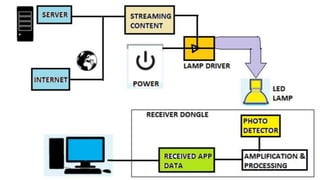
 The transmission side contains an LED Lamp
which transmits the modulated light signals.
 Signals from the data input is modulated to
intensity of light.
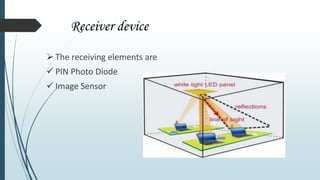
Receiver device
 The receiving elements are
 PIN Photo Diode
 Image Sensor
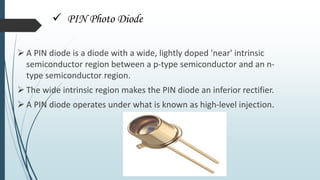
 PIN Photo Diode
 A PIN diode is a diode with a wide, lightly doped 'near' intrinsic
semiconductor region between a p-type semiconductor and an n-
type semiconductor region.
 The wide intrinsic region makes the PIN diode an inferior rectifier.
 A PIN diode operates under what is known as high-level injection.
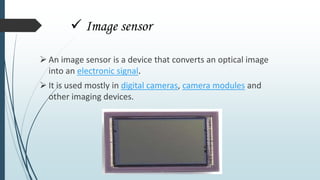
 Image sensor
 An image sensor is a device that converts an optical image
into an electronic signal.
 It is used mostly in digital cameras, camera modules and
other imaging devices.
Communication using Image Sensors
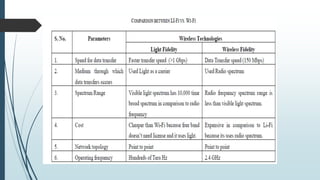
Comparision between Li-Fi and Wi-Fi
 LIGHT BASED Wi-Fi.
 Li-Fi would use transceiver-fitted LED lamps .
 Wi-Fi is great for general wireless coverage within buildings, and li-fi is
ideal for high density wireless data coverage in confined area.
 So the two technologies can be considered complimentary.
Advantages
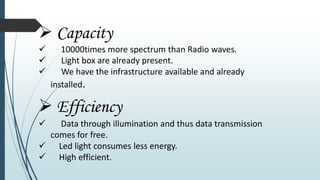
 Capacity
 10000times more spectrum than Radio waves.
 Light box are already present.
 We have the infrastructure available and already
installed.
 Efficiency
 Data through illumination and thus data transmission
comes for free.

 Led light consumes less energy.
 High efficient.
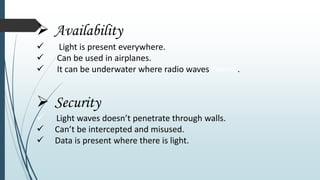
 Availability
 Light is present everywhere.
 Can be used in airplanes.
 It can be underwater where radio waves cannot.
 Security
 Light waves doesn’t penetrate through walls.
 Can’t be intercepted and misused.
 Data is present where there is light.
Application Areas
Li Fi technology is still in its infancy .However some areas
where it seems perfectly applicable are:-
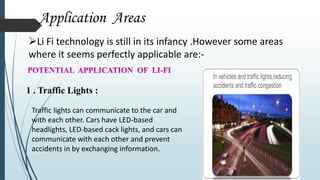
1 . Traffic Lights :
Traffic lights can communicate to the car and
with each other. Cars have LED-based
headlights, LED-based cack lights, and cars can
communicate with each other and prevent
accidents in by exchanging information.
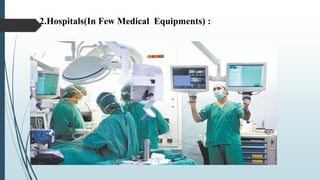
2.Hospitals(In Few Medical Equipments) :
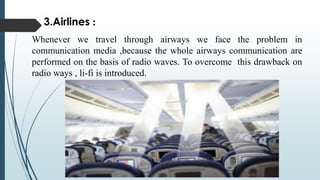
3.Airlines :
Whenever we travel through airways we face the problem in
communication media ,because the whole airways communication are
performed on the basis of radio waves. To overcome this drawback on
radio ways , li-fi is introduced.
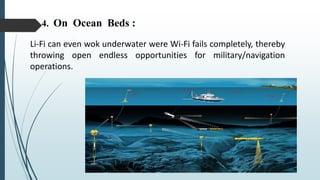
4. On Ocean Beds :
Li-Fi can even wok underwater were Wi-Fi fails completely, thereby
throwing open endless opportunities for military/navigation
operations.
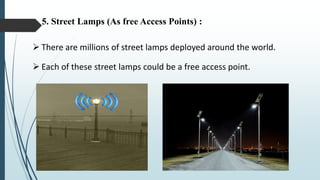
5. Street Lamps (As free Access Points) :
 There are millions of street lamps deployed around the world.
 Each of these street lamps could be a free access point.
Is it a proven technology????
 Yes, this is already proven.
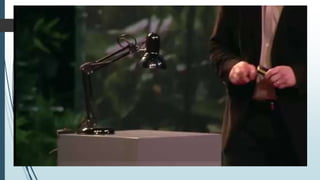
 Dr. Harald Hass demonstrated his invention using an ordinary
table lamp that successfully transmitted data at speeds
exceeding 10Mbps .
 To prove that the light bulb was the source of data stream, he
periodically blocked the beam of light, causing the connection
to drop.
Future scope
 Education system.
 Extends our life span.
 Reduction in accident number.
 Replacement for other technologies.
Challenges for LI-FI
 Light can't pass through objects .
 Interferences from external light sources like sun light.
 Li- Fi requires line of sight.
 A major challenge facing Li-Fi is how the receiving device
will transmit back to transmitter.
Conclusion
 The possibilities are numerous and can be explored further.
 Cheap and fast.
 If this technology can be put into practical use every bulb can be
used something like a Wi-Fi hotspots to transmit wireless data.
 As a growing number of people and their many devices access
wireless internet, the airwaves are becoming increasingly clogged,
making it more and more difficult to get a reliable, high-speed
signal.
 Li-Fi Technology which is for a cleaner, greener and brighter future
of planet.
References
 http://en.wikipedia.org/wiki/Li-Fi
 http://teleinfobd.blogspot.in/2012/01/what-is-lifi.html
 www.lificonsortium.org/
 Will Li-Fi be the new Wi-Fi?, New Scientist, by Jamie Condliffe, dated 28 July 2011
 http://www.digplanet.com/wiki/Li-Fi
 “Visible-light communication: Tripping the light fantastic: A fast and cheap optical
version of Wi-Fi iscoming”, Economist, dated 28 Jan 2012
THANK YOU

Li-Fi Technology presentation

  • 1.
    LIGHT FIDELITY (Li-Fi) TECHNOLOGY PRESENTEDBY AMBIKA R (1MV10CS008) BHAGYASHREE (1MV10CS023) CHAITRA CN (1MV10CS030) SUPRIYA (1MV11CS417)
  • 2.
    CONTENTS History Introduction Why VLC? Present Scenario Workingprocess Advantages Applications Is this a proven technology? Conclusion References
  • 3.
    History  Light–Fidelity (Li-Fi)technology came into existence in 2011.  The term was first used by Harald Haas in his TED Global talk on Visible Light Communication.  In October 2011 a number of companies and industry groups formed the Li- Fi.consortium, to promote high-speed optical wireless systems. ..
  • 4.
    Introduction  Li-Fi istransmission of data through illumination by taking the fiber out of fiber optics by sending data through a LED light bulb that varies in intensity faster than the human eye can follow.  Li-Fi is fast and cheap optical version of wi - fi based on visible light communication(VLC).  At the heart of this technology is the high brightness light-emitting diodes.
  • 5.
    Introduction(contd…) The on-off activityof LEDs enables a kind of data transmission using binary codes. Switching on an LED is a logical ‘1’;switching it off is a logical ‘0’. It allows wireless communication without the use of radio waves, which can be dangerous in places like oil platforms, underwater and on planes Li-Fi can be thought of as a light- based Wi-Fi.
  • 6.
  • 7.
    Present Scenario Radio Spectrumis congested but the demand for wireless data double each year .Every thing, it seems want to use wireless data but the capacity. is drying up. 5 Billion1.4 Million Base Stations
  • 8.
    Li-Fi Construction The Li-Fiproduct consists of 5 primary sub-assemblies:  Bulb  RF Power Amplifier Circuit (PA)  Optics  Printed Circuit Board (PCB)  Enclosure
  • 9.
  • 10.
    Working Process  Operationalprocedure is very simple, if the led is on, you transmit a digital 1, if its off you transmit a 0. The LEDs can be switched on and off very quickly, which gives nice opportunities for transmitting data.  Flicker depending upon the data we want to encode .  Thus every light source will works as a hub for data transmission .
  • 13.
    Visible Light Communication Methods for Visible light Communication  Devices used for visible Communication.  Communication using images Sensors.
  • 14.
    Devices used forVLC  Transmitter Device  Receiver Device
  • 15.
    Transmitter Device  Thetransmission side contains an LED Lamp which transmits the modulated light signals.  Signals from the data input is modulated to intensity of light.
  • 16.
    Receiver device  Thereceiving elements are  PIN Photo Diode  Image Sensor
  • 17.
     PIN PhotoDiode  A PIN diode is a diode with a wide, lightly doped 'near' intrinsic semiconductor region between a p-type semiconductor and an n- type semiconductor region.  The wide intrinsic region makes the PIN diode an inferior rectifier.  A PIN diode operates under what is known as high-level injection.
  • 18.
     Image sensor An image sensor is a device that converts an optical image into an electronic signal.  It is used mostly in digital cameras, camera modules and other imaging devices.
  • 19.
  • 20.
    Comparision between Li-Fiand Wi-Fi  LIGHT BASED Wi-Fi.  Li-Fi would use transceiver-fitted LED lamps .  Wi-Fi is great for general wireless coverage within buildings, and li-fi is ideal for high density wireless data coverage in confined area.  So the two technologies can be considered complimentary.
  • 22.
  • 23.
     Capacity  10000timesmore spectrum than Radio waves.  Light box are already present.  We have the infrastructure available and already installed.  Efficiency  Data through illumination and thus data transmission comes for free.  Led light consumes less energy.  High efficient.
  • 24.
     Availability  Lightis present everywhere.  Can be used in airplanes.  It can be underwater where radio waves cannot.  Security  Light waves doesn’t penetrate through walls.  Can’t be intercepted and misused.  Data is present where there is light.
  • 25.
    Application Areas Li Fitechnology is still in its infancy .However some areas where it seems perfectly applicable are:- 1 . Traffic Lights : Traffic lights can communicate to the car and with each other. Cars have LED-based headlights, LED-based cack lights, and cars can communicate with each other and prevent accidents in by exchanging information.
  • 26.
  • 27.
    3.Airlines : Whenever wetravel through airways we face the problem in communication media ,because the whole airways communication are performed on the basis of radio waves. To overcome this drawback on radio ways , li-fi is introduced.
  • 28.
    4. On OceanBeds : Li-Fi can even wok underwater were Wi-Fi fails completely, thereby throwing open endless opportunities for military/navigation operations.
  • 29.
    5. Street Lamps(As free Access Points) :  There are millions of street lamps deployed around the world.  Each of these street lamps could be a free access point.
  • 30.
    Is it aproven technology????  Yes, this is already proven.  Dr. Harald Hass demonstrated his invention using an ordinary table lamp that successfully transmitted data at speeds exceeding 10Mbps .  To prove that the light bulb was the source of data stream, he periodically blocked the beam of light, causing the connection to drop.
  • 32.
    Future scope  Educationsystem.  Extends our life span.  Reduction in accident number.  Replacement for other technologies.
  • 33.
    Challenges for LI-FI Light can't pass through objects .  Interferences from external light sources like sun light.  Li- Fi requires line of sight.  A major challenge facing Li-Fi is how the receiving device will transmit back to transmitter.
  • 34.
    Conclusion  The possibilitiesare numerous and can be explored further.  Cheap and fast.  If this technology can be put into practical use every bulb can be used something like a Wi-Fi hotspots to transmit wireless data.  As a growing number of people and their many devices access wireless internet, the airwaves are becoming increasingly clogged, making it more and more difficult to get a reliable, high-speed signal.  Li-Fi Technology which is for a cleaner, greener and brighter future of planet.
  • 35.
    References  http://en.wikipedia.org/wiki/Li-Fi  http://teleinfobd.blogspot.in/2012/01/what-is-lifi.html www.lificonsortium.org/  Will Li-Fi be the new Wi-Fi?, New Scientist, by Jamie Condliffe, dated 28 July 2011  http://www.digplanet.com/wiki/Li-Fi  “Visible-light communication: Tripping the light fantastic: A fast and cheap optical version of Wi-Fi iscoming”, Economist, dated 28 Jan 2012
  • 36.