Download the full version and explore a variety of test banks
or solution manuals at https://testbankmall.com
Life Span Development A Topical Approach 3rd
Edition Feldman Solutions Manual
_____ Follow the link below to get your download now _____
https://testbankmall.com/product/life-span-development-a-
topical-approach-3rd-edition-feldman-solutions-manual/
Access testbankmall.com now to download high-quality
test banks or solution manuals
Here are some recommended products for you. Click the link to
download, or explore more at testbankmall.com
Life Span Development A Topical Approach 3rd Edition
Feldman Test Bank
https://testbankmall.com/product/life-span-development-a-topical-
approach-3rd-edition-feldman-test-bank/
Life Span Development A Topical Approach Feldman 2nd
Edition Test Bank
https://testbankmall.com/product/life-span-development-a-topical-
approach-feldman-2nd-edition-test-bank/
A Topical Approach to Life-Span Development Santrock 7th
Edition Test Bank
https://testbankmall.com/product/a-topical-approach-to-life-span-
development-santrock-7th-edition-test-bank/
Business and Society Ethics, Sustainability, and
Stakeholder Management Carroll 8th Edition Test Bank
https://testbankmall.com/product/business-and-society-ethics-
sustainability-and-stakeholder-management-carroll-8th-edition-test-
bank/
Solution Manual for Concepts of Database Management, 9th
Edition, Joy L. Starks, Philip J. Pratt, Mary Z. Last
https://testbankmall.com/product/solution-manual-for-concepts-of-
database-management-9th-edition-joy-l-starks-philip-j-pratt-mary-z-
last/
Test Bank for Current Psychotherapies 11th by Wedding
https://testbankmall.com/product/test-bank-for-current-
psychotherapies-11th-by-wedding/
Solution Manual for Engineering Electromagnetics, 9th
Edition, William Hayt John Buck
https://testbankmall.com/product/solution-manual-for-engineering-
electromagnetics-9th-edition-william-hayt-john-buck/
Strategic Management Theory and Cases An Integrated
Approach 12th Edition Hill Solutions Manual
https://testbankmall.com/product/strategic-management-theory-and-
cases-an-integrated-approach-12th-edition-hill-solutions-manual/
Test Bank for Ethical Obligations and Decision Making in
Accounting: Text and Cases, 5th Edition, Steven M Mintz,
Roselyn E. Morris
https://testbankmall.com/product/test-bank-for-ethical-obligations-
and-decision-making-in-accounting-text-and-cases-5th-edition-steven-m-
mintz-roselyn-e-morris-i/
Test Bank for Comprehensive Medical Terminology 5th
Edition by Jones
https://testbankmall.com/product/test-bank-for-comprehensive-medical-
terminology-5th-edition-by-jones/
31
Copyright © 2017, 2014, 2011 Pearson Education, Inc. All rights reserved.
30
Handouts 54
32
Copyright © 2017, 2014, 2011 Pearson Education, Inc. All rights reserved.
31
CHAPTER-AT-A-GLANCE
Chapter Outline Instructor’s Resources Professor Notes
Module 2.1: Earliest Development and Learning Objectives 2.1, 2.2,
the Foundations of Genetics 2.3, 2.4, 2.5, 2.6, 2.7
Genes and Chromosomes: The Code of Lecture Launchers 2.1, 2.5
Life Student Activity 2.1
Multiple Births: Two—or More—for the MyDevelopmentLab Video:
Genetic Price of One Genetic Counseling
Boy or Girl? Establishing the Sex of the
Child
The Basics of Genetics: The Mixing and
Matching of Traits
The Human Genome and Behavioral
Genetics: Cracking the Genetic Code
Inherited and Genetic Disorders: When
Development Deviates From the Norm
Genetic Counseling: Predicting the
Future from the Genes of the Present
Module 2.2: The Interaction of Learning Objectives 2.8, 2.9,
Heredity and Environment 2.10, 2.11
The Role of the Environment in Lecture Launchers 2.2, 2.3, 2.4
Determining the Expression of Genes: Student Activities 2.2, 2.3
From Genotypes to Phenotypes MyDevelopmentLabVideo:
Studying Development: How Much Is Genetic Mechanisms and
Nature, How Much Is Nurture? Behavioral Genetics
Genetics and the Environment: Working
Together
Genetic and Environmental Influences
on Personality: Born to Be Outgoing?
Can Genes Influence the Environment?
Module 2.3: Prenatal Growth and Learning Objectives 2.12, 2.13,
Birth 2.14, 2.15, 2.16, 2.17, 2.18, 2.19,
Fertilization: The Moment of Conception 2.20
The Stages of the Prenatal Period: The Lecture Launchers 2.6, 2.7, 2.8
Onset of Development Student Activities 2.4, 2.5, 2.6
Pregnancy Problems
MyDevelopmentLabVideo:
The Prenatal Environment: Threats to Period of the Zygote
Development
MyDevelopmentLab Video:
Labor: The Process of Birth Begins
Labor
Approaches to Childbirth: Where
MyDevelopmentLab Video:
Medicine and Attitudes Meet
Premature Births and the
Birth Complications
Neonatal Intensive Care Unit
Caesarean Delivery: Intervening in the
Process of Birth
Stillbirth and Infant Mortality: The
Tragedy of Premature Death
< Return to Contents
33
Copyright © 2017, 2014, 2011 Pearson Education, Inc. All rights reserved.
32
LEARNING OBJECTIVES
LO 2.1: Describe how genes and chromosomes provide our basic genetic endowment.
LO 2.2: Compare monozygotic twins with dizygotic twins.
LO 2.3: Describe how the sex of a child is determined.
LO 2.4: Explain the mechanisms by which genes transmit information.
LO 2.5: Describe the field of behavioral genetics.
LO 2.6: Describe the major inherited disorders.
LO 2.7: Describe the role of genetic counselors and differentiate between different forms of prenatal
testing.
LO 2.8: Explain how the environment and genetics work together to determine human characteristics.
LO 2.9: Summarize the methods by which researchers study the interaction of genetic and environmental
factors in development.
LO 2.10: Examine how genetics and the environment jointly influence physical traits, intelligence, and
personality.
LO 2.11: Describe ways in which genes influence the environment.
LO 2.12: Describe the process of fertilization.
LO 2.13: Summarize the three stages of prenatal development.
LO 2.14: Describe major physical and ethical challenges that relate to pregnancy.
LO 2.15: Analyze threats to the fetal environment, and explain what can be done about them.
LO 2.16: Describe the normal process of labor.
LO 2.17: Describe the process of birth and analyze current approaches to childbirth.
LO 2.18: Recognize threats and complications that may accompany childbirth, and explain how they can
be addressed.
LO 2.19: Describe the process of Cesarean delivery and explain why its use is increasing.
LO 2.20: Describe infant mortality rates and explain factors that affect those rates.
< Return to Contents
34
Copyright © 2017, 2014, 2011 Pearson Education, Inc. All rights reserved.
33
CHAPTER OUTLINE
I. Module 2.1: Earliest Development and the Foundations of Genetics
Learning Objectives 2.1, 2.2, 2.3, 2.4, 2.5, 2.6, 2.7
Lecture Launchers 2.1, 2.5
Student Activity 2.1
MyDevelopmentLab Video: Genetic Counseling
A. Genes and Chromosomes: The Code of Life
1. Humans begin life as a single cell.
a. Our genetic code is stored and communicated in our GENES, the basic units
of genetic information.
b. Genes are composed of sequences of DNA (deoxyribonucleic acid), the
substance that determines the nature of every cell in the body and how it will
function.
c. Humans have over 25,000 genes.
d. Genes are arranged in specific locations and in a specific order along 46
CHROMOSOMES, rod-shaped portions of DNA that are organized in 23
pairs.
(1) At fertilization, one pair of chromosomes (via the gametes) is
provided by the mother and one is provided by the father.
(2) Sex cells contain half the number of chromosomes (not in pairs).
e. Gametes (sperm and ova) are formed by a process called meiosis.
f. A ZYGOTE is one cell formed by fusion of the two gametes.
g. All other cells replicate the genetic code by a process called mitosis.
h. There are tens of trillions of possible genetic combinations.
B. Multiple Births: Two—or More—for the Genetic Price of One
1. Less than 3 percent of all pregnancies produce twins; the odds are slimmer for 3 or
more children.
2. MONOZYGOTIC TWINS, who are genetically identical, form when a cluster of
cells in the ovum splits off within the first 2 weeks following fertilization.
3. DIZYGOTIC TWINS, who are produced when two separate ova are fertilized by 2
separate sperm, are no more genetically similar than any two siblings.
4. Other kinds of multiple births (triplets, quadruplets, etc.) can form from either
mechanism.
5. Using fertility drugs increases the chances of having a multiple birth.
a. One in ten are dizygotic.
b. Older women are more likely to have multiple births.
6. Racial and ethnic differences affect the rate of multiple births.
a. White American: 1 out of 86 dizygotic.
b. African American: 1 out of 70 dizygotic.
C. Boy or Girl? Establishing the Sex of the Child
1. The 23rd chromosome determines the sex of the child.
a. Females are XX.
b. Males are XY.
c. The father’s sperm determines the sex of the child.
D. The Basics of Genetics: The Mixing and Matching of Traits
1. An Austrian monk, Gregor Mendel (mid-1800s), discovered while working with peas
that when two competing traits are present, only one can be expressed.
a. The trait that is expressed when two competing traits are present is called the
DOMINANT TRAIT.
35
Copyright © 2017, 2014, 2011 Pearson Education, Inc. All rights reserved.
34
b. The trait that is present in the organism but not expressed is called the
RECESSIVE TRAIT.
c. GENOTYPE is the underlying combination of genetic material present (but
not outwardly visible) in an organism.
d. PHENOTYPE is an observable trait, the trait that is actually seen.
e. Alleles are genes for traits that may take alternate forms.
(1) HOMOZYGOUS is inheriting from parents similar genes for a
given trait.
(2) HETEROZYGOUS is inheriting from parents different forms of a
gene for a given trait.
f. If a child receives a recessive allele from each parent, it will display the
recessive characteristic.
2. Most traits are the result of POLYGENIC INHERITANCE, in which a
combination of multiple gene pairs is responsible for the production of a particular
trait.
a. Some genes (such as those for blood type AB) are neither dominant nor
recessive, but are a combination.
b. Some recessive genes are X-LINKED GENES, meaning they are located on
the X chromosome.
(1) Males have a higher risk for a variety of X-linked disorders because
they lack a second X chromosome to counteract the genetic
information that produces the disorder.
(2) Hemophilia is a blood disorder produced by X-linked genes.
(3) Red-green color blindness is another.
E. In 2001, molecular biologists succeeded in mapping the human genome—the specific
sequence of genes on each chromosome.
1. The number of human genes has been revised downward from 100,000 to 25,000.
2. Humans share 99.9 percent of the gene sequence.
3. The most recent approach to the study of the effects of heredity on behavior and
development is called BEHAVIORAL GENETICS.
a. This field merges psychology—the study of behavior—with genetics—the
study of transmission of characteristics through heredity.
b. These researchers are learning how behavioral difficulties (such as
schizophrenia) may have a genetic basis.
c. Researchers also seek to identify how genetic defects may be remedied.
F. Inherited and Genetic Disorders: When Development Deviates from the Norm
1. Some genetic disorders are inherited (e.g., PKU).
2. Some genetic disorders are the result of genes that become physically damaged.
a. Sometimes genes spontaneously change their form, a process called
spontaneous mutation.
b. Certain environmental factors, such as exposure to X-rays, can produce
malformed genetic material.
c. Some genetic disorders include:
(1) DOWN SYNDROME is a disorder produced by the presence of an
extra chromosome on the 21st chromosome pair, once referred to as
mongolism.
(2) SICKLE-CELL ANEMIA is a blood disorder that gets its name
from the shape of the red blood cells in those who have it.
(3) FRAGILE X SYNDROME is a disorder produced by injury to a
gene on the X chromosome, producing mild to moderate mental
retardation.
36
Copyright © 2017, 2014, 2011 Pearson Education, Inc. All rights reserved.
35
(4) TAY-SACHS DISEASE is an untreatable disorder that produces
blindness and muscle degeneration prior to death.
(5) One male out of every 400 is born with KLINEFELTER’S
SYNDROME, a disorder resulting from the presence of an extra X
chromosome that produces underdeveloped genitals, extreme
height, and enlarged breasts.
G. Genetic Counseling: Predicting the Future from the Genes of the Present
1. GENETIC COUNSELING is the discipline that focuses on helping people deal
with issues related to inherited disorders.
a. Genetic counselors use a variety of data.
b. They can take a thorough family history, seeking any familial incidence of
birth defects.
c. The ages of the mother and father will be taken into account.
d. Blood, skin, and urine may be used to isolate and examine specific
chromosomes.
e. Possible genetic defects can be identified by assembling a karyotype, a chart
containing enlarged photos of each of the chromosomes.
f. Other tests take place once the woman is already pregnant.
(1) ULTRASOUND SONOGRAPHY is a process in which high-
frequency sound waves scan the mother’s womb to produce an
image of the unborn baby whose size and shape can then be
assessed.
(2) CHORIONIC VILLUS SAMPLING (CVS) is a test used to find
genetic defects that involves taking samples of hair-like material
that surrounds the embryo.
(3) AMNIOCENTESIS is the process of identifying genetic defects by
examining a small sample of fetal cells drawn by a needle inserted
into the amniotic fluid surrounding the unborn fetus.
2. Screening for Future Problems
a. involves testing parents for the possibility that they will transmit diseases to
children
b. presents a range of possibilities, rather than a simple “yes” or “no” answer
c. Huntington’s disease and more than a thousand other disorders can be
predicted based on genetic testing.
d. Prediction is complicated, because environment as well as genes determine a
person’s actual likelihood of becoming ill.
e. Researchers as well as medical practitioners are actively working to change
flawed genes for intervention and manipulation.
II. Module 2.2: The Interaction of Heredity and Environment
Learning Objectives 2.8, 2.9, 2.10, 2.11
Lecture Launchers 2.2, 2.3, 2.4
Student Activities 2.2, 2.3
MyDevelopmentLabVideo: Genetic Mechanisms and Behavioral Genetics
A. The Role of the Environment in Determining the Expression of Genes: From Genotypes to
Phenotypes
1. An individual’s TEMPERAMENT, the patterns of arousal and emotionality that
represent consistent and enduring characteristics, may represent
MULTIFACTORIAL TRANSMISSION, traits that are determined by a
combination of both genetic and environmental factors in which a genotype provides
a range within which a phenotype may be expressed.
37
Copyright © 2017, 2014, 2011 Pearson Education, Inc. All rights reserved.
36
2. Some genotypes are not as sensitive to the environment as others.
B. Studying Development: How Much Is Nature? How Much Is Nurture?
1. The correct question is not whether behavior is caused by nature or nurture but how
much by nature and how much by nurture.
2. Nonhuman Studies: Controlling Both Genetics and Environment
a. Scientists put laboratory animals bred to share genetic backgrounds in
different environments to explore the effects of these environments.
b. Conversely, they use genetically different animals in similar environments to
determine the role of genetics.
3. Contrasting Relatedness and Behavior: Adoption, Twin, and Family Studies
a. Scientists use human twins to study the effects of genes and the environment.
b. Differences between monozygotic twins separated at birth are most likely—
but not always—due to different environments.
c. If monozygotic twins are more similar than dizygotic twins on a particular
trait, we can assume that genetics plays a role in the expression of that trait.
d. People who are unrelated but share the same environment also tell us about
environmental influences.
e. Researchers also study biological parents and their children versus adoptive
parents and their children to see the effects of heredity versus environment.
f. Bottom line: virtually all traits, characteristics, and behaviors are the joint result
of the combination and interaction of nature and nurture.
4. The more genetically similar two people are, the more likely they are to share
physical characteristics (e.g., height, weight).
C. Genetics play a significant role in intelligence; however, the environment is also a major
factor.
1. Increasing evidence supports the conclusion that at least some personality traits have
a genetic component.
a. Neuroticism refers to the degree of moodiness, touchiness, or sensitivity an
individual characteristically displays.
b. Extroversion is the degree to which a person seeks to be with others, to
behave in an outgoing manner, and generally to be sociable.
c. Certain traits reflect the contribution of genetics more than others.
(1) novelty-seeking tendencies
(2) social potency
(3) traditionalism
d. Political attitudes, religious interests and values, and even attitudes toward
human sexuality seem to have genetic components.
e. Environmental factors such as parental nurturance also impact traits.
(1) parents’ attitudes and encouragement of high/low activity levels
(2) Cultural contexts for parental attitudes shape differences in such
traits.
D. Can Genes Influence the Environment?
1. Children’s genetic predispositions might influence their environment (Scarr).
a. Children focus on aspects of their environment that connect with their
genetically determined abilities, and attend less to environmental features
that are less compatible with genetically determined traits.
b. The gene-environment influence can be more passive and less direct in other
cases.
c. The genetically determined temperament of a child can evoke certain
influences from the environment or parents.
38
Copyright © 2017, 2014, 2011 Pearson Education, Inc. All rights reserved.
37
2. The relative influence of genes and environmental factors can shift over the course of
the lifespan.
III. Module 2.3: Prenatal Growth and Birth
Learning Objectives 2.12, 2.13, 2.14, 2.15, 2.16, 2.17, 2.18, 2.19, 2.20
Lecture Launchers 2.6, 2.7, 2.8
Student Activities 2.4, 2.5, 2.6
MyDevelopmentLabVideo: Period of the Zygote
MyDevelopmentLab Video: Labor
MyDevelopmentLab Video: Premature Births and the Neonatal Intensive Care Unit
A. Fertilization: The Moment of Conception
1. FERTILIZATION is the process by which a sperm and an ovum—the male and
female gametes—join to form a single new cell.
B. The Stages of the Prenatal Period: The Onset of Development
1. The GERMINAL STAGE is the first and shortest stage of prenatal development,
which takes place during the first 2 weeks following conception.
a. It is characterized by methodical cell division and the attachment of the
organism (blastocyst) to the wall of the uterus.
b. The baby is called a zygote at this stage.
c. The cells become specialized with some forming a protective layer around
the zygote, while others create:
(1) PLACENTA, the conduit between the mother and fetus, providing
nourishment and oxygen via the umbilical cord.
2. The second stage is called the EMBRYONIC STAGE, the period from 2 to 8 weeks
following fertilization during which significant growth occurs in the major organs
and body systems.
a. At this point, the child is called an embryo.
b. By the end of this phase, the embryo is about an inch in length, with a tail-
like structure and the beginnings of eyes, lips, teeth, arms, and legs. The head
and brain begin rapid development.
c. The developing child is now composed of three layers.
(1) The ectoderm is the outer layer forming the skin, hair, teeth, sense
organs, brain, and spinal cord.
(2) The endoderm is the inner layer producing the digestive system,
liver, pancreas, and respiratory system.
(3) The mesoderm is sandwiched between the inner and outer layers and
forms the muscles, bones, blood, and circulatory system.
3. The FETAL STAGE begins about 8 weeks after conception and continues until
birth.
a. The developing child from 8 weeks after conception until birth is called a
FETUS.
b. The fetus dramatically increases in size and weight.
c. Organs become more differentiated and operational.
d. By three months, the fetus swallows and urinates.
e. By four months, the mother will be able to feel her fetus move.
f. Brain growth continues as the left and right hemispheres of the brain develop
and neurons become coated with an insulation called myelin.
g. Hormones begin to flow differently to male and female fetuses.
C. Pregnancy Problems: Giving Nature a Boost
1. Fifteen percent of couples suffer from INFERTILITY, the inability to conceive after
twelve to eighteen months of trying to become pregnant.
39
Copyright © 2017, 2014, 2011 Pearson Education, Inc. All rights reserved.
38
2. Infertility is produced by several causes.
a. the age of the parents
b. previous use of birth control pills, illicit drugs or cigarettes, or STDs
c. men who have an abnormally low sperm count
d. the woman’s mother taking certain drugs during pregnancy
e. The most common cause of infertility is failure to release an egg through
ovulation—possibly caused by hormonal imbalance, damage to the fallopian
tubes or uterus, or stress.
3. There are several approaches to conception in these cases.
a. ARTIFICIAL INSEMINATION is a process of fertilization in which a
man’s sperm is placed directly into a woman’s vagina by a physician.
b. IN VITRO FERTILIZATION (IVF) is a procedure in which a woman’s
ova are removed from her ovaries and a man’s sperm are used to fertilize the
ova in a laboratory.
c. A SURROGATE MOTHER is a woman who agrees to carry the child to
term; may be used in cases where the mother is unable to conceive.
4. Ethical Issues
a. Ethical and legal issues as well as emotional concerns are present, and may
result in the rights of the mother, the father, the surrogate mother, and
ultimately the child being in conflict.
b. Sex-selection techniques are even more troubling, and questions arise about
intervening in the reproductive process to obtain a favored sex or other
characteristics.
c. Evidence suggests that the quality of parenting in families who have used
artificial means to conception may even be superior to the parenting in
families with naturally conceived children.
d. The psychological adjustment of children conceived artificially is no
different than that of children conceived using natural techniques.
5. Miscarriage and Abortion
a. A miscarriage—known as spontaneous abortion—occurs when pregnancy
ends before the developing child is able to survive outside the womb.
(1) Fifteen to twenty percent of all pregnancies end in miscarriage.
(2) In many cases, the woman is not even aware that she was pregnant.
(3) Typically, miscarriages are attributable to some sort of genetic
abnormality.
b. Abortion is the voluntary termination of a pregnancy.
D. The Prenatal Environment: Threats to Development
1. Certain aspects of mothers’ and fathers’ behavior, both before and after conception,
can produce lifelong consequences for the child.
2. Some of the most profound consequences are brought about by a TERATOGEN, an
environmental agent such as a virus, chemical, or other factor that produces a birth
defect.
a. Timing and quantity of exposure to teratogens are crucial factors in assessing
risk.
b. At some phases of prenatal development, a teratogen may have minimal
impact; at other periods, consequences can be severe.
(1) A mother’s diet clearly plays an important role in bolstering the
development of the fetus.
(2) Research shows that mothers over 30 and adolescent mothers are at
greater risk for a variety of pregnancy and birth complications
including premature birth.
40
Copyright © 2017, 2014, 2011 Pearson Education, Inc. All rights reserved.
39
(3) About 90 percent of women’s eggs are no longer normal at age 42.
Older women (relative to younger women) are at risk for having
children with:
(a) premature birth
(b) low birth weight
(c) Down syndrome
(4) Rubella (German measles) prior to the eleventh week can cause
blindness, deafness, heart defects, or brain damage.
(5) Chicken pox and mumps may cause birth defects and miscarriage,
respectively.
(6) Syphilis and gonorrhea can be transmitted to the child.
(7) Babies may acquire AIDS (acquired immune deficiency syndrome)
from their mothers through the placenta.
c. A mother’s use of legal and illegal drugs poses serious risks to the unborn
child.
(1) Aspirin can lead to bleeding.
(2) DES (diethylstilbestrol) later caused cervical and vaginal cancer in
daughters.
(3) Exposure to birth control or fertility pills in utero can affect brain
structures in the fetus.
d. Both alcohol and cigarettes can disrupt the development of the fetus.
(1) FETAL ALCOHOL SPECTRUM DISORDER (FASD) is a
disorder caused by the pregnant mother consuming substantial
quantities of alcohol during pregnancy, potentially resulting in
mental retardation, delayed growth, and facial deformities.
(2) Even smaller amounts of alcohol can produce FETAL ALCOHOL
EFFECTS (FAE), a condition in which children display some,
although not all, of the problems of FAS due to their mothers’
consumption of alcohol during pregnancy.
(3) Just two drinks a day has been associated with lower intelligence.
(4) Smoking reduces the oxygen content and increase carbon monoxide.
(a) Babies can miscarry or are born with abnormally low birth
weight.
(b) Babies born to smokers are shorter and may be 50 percent
more likely to have mental retardation.
e. Fathers can affect the prenatal environment.
(1) Secondhand smoke can affect the mother’s health.
(2) Alcohol and illegal drugs can lead to chromosomal damage at
conception.
(3) Stress may produce an unhealthy environment for the mother.
(4) Sperm damage may result from a father’s exposure to
environmental toxins in the workplace.
E. The Process of Birth
1. About 266 days after conception, a protein called corticotropin-releasing hormone
(CRH) triggers the process of birth.
a. The hormone oxytocin is released from mother’s pituitary.
b. Braxton-Hicks contractions have been occurring since the fourth month.
c. Contractions force the head of the fetus against the cervix.
d. Labor proceeds in 3 stages.
(1) The first stage is the longest.
40
Copyright © 2017, 2014, 2011 Pearson Education, Inc. All rights reserved.
40
(a) Uterine contractions occur every 8–10 minutes and last
about 30 seconds.
(b) Contractions increase to their greatest intensity, a period
known as transition.
(c) The mother’s cervix fully opens.
(d) For first babies, this stage can last 16–24 hours (this varies
widely).
(e) Subsequent children involve shorter periods of labor.
(2) During the second stage of labor, the baby’s head moves through
the birth canal.
(a) This stage typically lasts 90 minutes.
(b) After each contraction, the baby’s head emerges more and
increases the vaginal opening.
(c) An EPISIOTOMY is an incision sometimes made to
increase the size of the opening of the vagina to allow the
baby to pass.
(d) This stage ends when the baby is born.
(3) The third stage of labor occurs when the child’s umbilical cord and
placenta are expelled.
(a) This is the shortest stage.
(b) It lasts only minutes.
(4) Cultural perspectives color the way that people in a given society
view the experience of childbirth.
F. Approaches to Childbirth: Where Medicine and Attitudes Meet
1. There are a variety of choices for how to give birth and no research proves that one
method is more effective than another.
2. There are several alternative birthing procedures.
a. Lamaze birthing techniques (Dr. Fernand Lamaze)
(1) The goal is to learn how to deal positively with pain and to relax at
the onset of a contraction.
(2) Low-income and minority groups may not take advantage of these
natural childbirth techniques.
b. Bradley Method
(1) known as “husband-coached childbirth”
(2) principle: childbirth should be as natural as possible
(3) involves no medication or medical interventions
c. Hypnobirthing
(1) involves a self-hypnosis during delivery
(2) produces peace and calm, thereby reducing pain
d. Water birthing
3. Childbirth Attendants: Who Delivers?
a. Birthing centers are homelike, and less foreboding or stressful than a
hospital.
b. The use of birthing centers is becoming increasingly common.
c. Some parents use a midwife, a nurse specializing in childbirth, instead of an
obstetrician, a physician who specializes in childbirth.
d. Although relatively rare in the U.S., midwives deliver some 80 percent of
babies in other parts of the world.
4. Use of Anesthesia and Pain-Reducing Drugs
a. The use of medication during childbirth has benefits and disadvantages.
41
Copyright © 2017, 2014, 2011 Pearson Education, Inc. All rights reserved.
41
b. Eighty percent of women receive some form of pain medication during
childbirth.
c. One-third of women receive an epidural anesthesia, which produces
numbness from the waist down.
(1) A newer form is known as walking epidural or dual spinal-epidural,
which use smaller needles and a system of delivering continuous
doses of anesthetic, allowing women to move about more freely
during labor.
G. Birth Complications
1. Preterm Infants: Too Soon, Too Small
2. PRETERM INFANTS, who are born prior to 37 weeks’ gestation (also known as
premature infants), are at high risk for illness and death.
a. The main factor in determining the extent of danger is the child’s weight at
birth.
(1) The average newborn weighs 3,400 grams (7 1/2 pounds).
(2) LOW-BIRTHWEIGHT INFANTS weigh less than 2,500 grams
(5 1/2 pounds).
(3) Although only 7 percent of all newborns in the U.S. are low-
birthweight, they account for the majority of newborn deaths.
(4) SMALL-FOR-GESTATIONAL-AGE INFANTS, because of
delayed fetal growth, weigh 90 percent or less of the average weight
of infants of the same gestational age.
b. Premature infants are susceptible to respiratory distress syndrome (RDS)
because of poorly developed lungs.
c. Low-birthweight infants are put in incubators, enclosures in which oxygen
and temperature are controlled.
(1) easily chilled, susceptible to infection, sensitive to environment
d. Preterm infants develop more slowly than infants born full-term.
(1) Sixty percent eventually develop normally.
(2) Thirty-eight percent have mild problems (learning disabilities, low
IQ).
3. VERY-LOW-BIRTHWEIGHT INFANTS weigh less than 1,250 grams (2 1/4
pounds) or, regardless of weight, have been in the womb less than 30 weeks and are
in grave danger because of the immaturity of their organ systems.
a. Medical advances have pushed the AGE OF VIABILITY, or point at which
an infant can survive a premature birth, to about 22 weeks.
b. A baby born earlier than 25 weeks has less than a 50/50 chance of survival.
c. Costs of keeping very-low-birthweight infants alive are enormous.
d. Research shows that children who receive more responsive, stimulating, and
organized care are apt to show more positive outcomes than children whose
care was not as good.
4. What Causes Preterm and Low-Birthweight Deliveries?
a. fifty percent are unknown causes
b. multiple births
c. young mothers (under age 15)
d. too closely spaced births
e. general health and nutrition of mother
f. African-American mothers have double the number of low-birthweight
babies that Caucasian mothers do.
5. Postmature Babies: Too Late, Too Large
42
Copyright © 2017, 2014, 2011 Pearson Education, Inc. All rights reserved.
42
a. POSTMATURE INFANTS, those still unborn 2 weeks after the mother’s
due date, face several risks.
(1) Blood supply to the baby’s brain may be decreased and cause brain
damage.
(2) Labor and delivery become more difficult.
H. Cesarean Delivery: Intervening in the Process of Birth
1. Over a million mothers in the U.S. today have a CESAREAN DELIVERY, where
the baby is surgically removed from the uterus, rather than traveling through the
birth canal.
2. Several types of difficulties can lead to Cesarean delivery.
a. Fetal distress is the most frequent reason for a Cesarean section.
b. used for breech position, where the baby is positioned feet first in the birth
canal
c. used for transverse position, in which the baby lies crosswise in the uterus
d. when the baby’s head is large
e. Mothers over age 40 are more likely to have Cesarean deliveries than
younger ones.
3. Routine use of FETAL MONITORS, devices that measure the baby’s heartbeat
during labor, have contributed to soaring rates of Cesarean deliveries—up 500
percent from 1970s. Their use has evoked several criticisms.
a. There is no association between Cesarean delivery and successful birth
consequences.
b. It involves major surgery and a long recovery for the mother.
c. There is a risk of infection to the mother.
d. Easy birth may deter release of certain stress hormones, such as
catecholamines, which help prepare the infant to deal with stress outside the
womb.
I. Mortality and Stillbirth: The Tragedy of Premature Death
1. STILLBIRTH is the delivery of a child who is not alive and occurs in less than 1
delivery in 100.
2. The rate of stillbirths has been declining since 1960s.
3. INFANT MORTALITY is defined as death within the first year of life.
a. The overall rate is 7.0 deaths per 1,000 live births.
b. Parents grieve in the same manner as if an older loved one had died.
c. Depression is a common aftermath.
< Return to Contents
43
Copyright © 2017, 2014, 2011 Pearson Education, Inc. All rights reserved.
43
LECTURE LAUNCHERS
Lecture Launcher 2.1: The Epidemic That Wasn’t—Crack Babies
The findings of Barry Lester’s longitudinal research on crack babies are discussed in this New York Times
article. Although there are significant differences in IQ between those exposed to crack prenatally and
their non-exposed counterparts, the differences are smaller than even Lester expected and likely not
clinically significant. Students can be divided into groups to do their own research on a particular
teratogen and then they can report out.
Okie, S. (2009). The epidemic that wasn’t. The New York Times.
http://www.nytimes.com/2009/01/27/health/27coca.html?pagewanted=all&_r=0
Lecture Launcher 2.2: Fertility
Traditionally, estimates of women’s fertility ranged anywhere from two days to ten days a month.
However, a study by the National Institute of Environmental Health Sciences in Research Park, NC,
published in the New England Journal of Medicine, found that women are fertile for five days before
ovulation as well as on the day of ovulation. Researchers were surprised to find that having sex just one
day after ovulation will not result in a pregnancy. Kits are available which tell when a woman is
ovulating. (For couples wanting to avoid pregnancy, these researchers suggest abstaining from sex, or using
birth control, during this six-day period.)
According to the study, the probability of conception ranges from 10% when intercourse occurs five days
before ovulation to 33% when it happens on the day of ovulation. Daily intercourse results in the highest
chance of pregnancy, 37%. The study had some other findings: There is no evidence that the timing of
intercourse influences whether the baby will be a boy or a girl. Also, there is no sign that aging sperm is
more likely to produce babies with defects, although the study was too small to support this conclusively.
On average, couples have a 20% chance of getting a viable pregnancy each month. However, according to
Dr. Allen Wilcox, who conducted the study, “even couples who are very fertile are not fertile in every cycle.
We don’t understand why that is.” Results from another study show that women who drink three or more
cups of coffee a day reduce their chances of conception by 26 percent. It is believed that caffeine disrupts
the menstrual cycle and may lead to early pregnancy loss.
Wilcox, A. J., Weinberg, C. R., & Baird, D. D. (December 7, 1995). Timing of sexual intercourse in relation to ovulation.
Effects on the probability of conception, survival of the pregnancy, and sex of the baby. New England Journal of Medicine,
333(23), 1517–1521.
Wilcox, A. J., Baird, D. D., Dunson, D. B., McConnaughey, D. R., Kesner, J. S., & Weinberg, C. R. (2004). On the frequency of
intercourse around ovulation: Evidence for biological influences. Human Reproduction, 19(7), 1539–1543.
Wilcox, A. J. (2010). Fertility and pregnancy: An epidemiologic perspective. Oxford University Press.
Lecture Launcher 2.3: Infertility
Contrary to popular opinion, infertility rates are not on the rise. In 1965, the U.S. infertility rate was
13.3%; in 1988 it was 13.7%. However, estimates are that one-sixth of all couples who try to conceive are
sterile or infertile. Jewelewicz (1989) cites several reasons for this:
The rise in sexually transmitted diseases, women entering the workforce and being exposed to
occupational hazards that affect their fertility, and the possibility of being exposed to more
environmental toxins, are all reasons hypothesized for increased infertility.
44
Copyright © 2017, 2014, 2011 Pearson Education, Inc. All rights reserved.
44
Women are delaying childbirth and increased age is related to decreased fertility.
Oral contraceptives and use of an IUD may account for some cases of infertility.
Because of second marriages, some couples seek to reverse previous surgical sterilizations.
More techniques are available and written about in the media so couples are more aware of help
for infertility.
The top five procedures for fertilization include:
• in vitro fertilization (IVF)
• gamete intrafallopian transfers (GIFT)
• intrauterine insemination (IUI)
• zygote intrafallopian transfer (ZIFT)
• intracytoplasmic sperm injection (ICSI)
There are some pros and cons about the new reproductive technologies. For example, before the 1970s, only
donor insemination—injection of sperm from an anonymous man into a woman—was available for infertile
women. Today, in vitro fertilization is a common choice where hormones are used to stimulate the
production of several ova, which are removed. The eggs are placed in a dish of nutrients, sperm are added,
and then the fertilized eggs are injected into the mother. Ova can be screened for genetic defects and
fertilized ova can also be frozen for use in the future. Sperm can also be frozen. Few states have legal
guidelines for these procedures. Consequently, problems that might arise include:
• genetic defects
• sexually transmitted diseases
• poor records of donor characteristics
• possibility that children from the same donor may grow up together and marry
• use of genetic selection for the “perfect child”
• use of “surrogate mothers”
Use Handout 2-1 to review some reasons for infertility and various solutions.
Ferin, M., Jewelewicz, R., & Warren, M. (1993). The menstrual cycle: Physiology, reproductive disorders, and infertility. New
York: Oxford University Press.
Jewelewicz, R. (1989). Sexual and reproductive health. In Tapley, D. F., Morris, T. Q., Rowland, L. P., Weiss, R. J, Subak- Sharpe,
G. J., & Goetz, D. M. (Eds.), The Columbia University College of Physicians and Surgeons complete home medical guide
(rev. ed.). New York: Crown.
Lecture Launcher 2.4: In Vitro Fertilization and Multiple Births
In 2009, a single mother named Nayda Suleman gained national attention when she gave birth to
octuplets. Dubbed the “Octomom” by the press, Suleman already had six children, with all of her
pregnancies being the result of in vitro fertilization, which can carry the consequence of multiple births.
Several popular reality television programs, such as “Kate Plus 8,” have also made celebrities out of parents
who have had multiple birth pregnancies using assisted reproduction technologies. All of this attention has
caused some people to ask whether children from multiple birth pregnancies are at risk for developmental
problems.
45
Copyright © 2017, 2014, 2011 Pearson Education, Inc. All rights reserved.
45
Concern over developmental problems with multiple births focuses on two distinct issues. First, multiple
birth pregnancies are associated with premature births, lower birth weights, and other complications from
having multiple fetuses in the womb at once. Because abnormal in utero development can have a long
lasting impact on brain development, multiple birth pregnancies have the potential to cause permanent
cognitive disabilities.
The other issue of concern regarding the development of children in multiple birth families is whether the
strain that so many children at the same age puts on a family interferes with the parents’ abilities to
provide a healthy environment. For example, parents may have little time and attention to devote to each
child. Furthermore, the financial burdens may cause children to go without toys and other items.
Introduce the concept of multiple births to students, along with their increased prevalence when in vitro
fertilization is used. Ask students to discuss whether they believe children from large, multiple birth
pregnancies are likely to have their development affected in a negative way. Should fertility doctors be
banned from implanting more than one or two embryos at a time? Do they feel that children in large families
from single births are also at risk? To extend the activity, ask students to respond to the writing prompt
below.
Lecture Launcher 2.5: My Mother, Myself
Many people feel that their mothers are “a part of them.” Recent findings suggest that there may be
considerable truth to that phrase.
Many adults apparently still have cells in their bodies that they picked up from their mothers during the
gestation period. Similarly, many mothers still have cells in their bodies that came from their own
children during pregnancy. Technically speaking, these “guest cells” are actually the product of stem cells
that got planted in the “host’s” body and started reproducing decades later. And, technically speaking,
there aren’t too many of them. Some estimates put the number of foreign cells at less than one in a
million, a comforting thought for anyone conjuring up images of parasitic offspring or alien-like entities
living happily rent-free.
The meaning of these microchimeras is less clear. There is some evidence that these cells might
contribute to autoimmune diseases, although there is also speculation that these cells might confer a
health benefit. Because this area of study is relatively young, there remain more questions than answers
(such as, what about women who have cells from both their mothers and their own offspring?). It’s
comforting to know, though, that in some small way a parent is always with us.
Ritter, M. (2003, May 9). Moms, you’ve got a little of your kids inside you. Austin American-Statesman, A1, A16.
Lecture Launcher 2.6: Childbirth Options
Methods of childbirth have changed dramatically during the past 50 years. Most current methods are
based on the pioneering work of Grantly Dick-Read in England and Ferdinand Lamaze in France. In
1944, Dick-Read proposed that fear is the major cause of most of the pain of childbirth. He proposed the
concept of natural childbirth and developed a method of teaching women about reproduction, pregnancy,
delivery, and exercises in breathing, relaxation, and fitness. Lamaze, in the 1950s, developed a method
called prepared childbirth where expectant mothers are taught to breathe and concentrate on sensations
other than contractions. This is facilitated by a “coach,” usually the father, who attends classes with her
and helps time her breathing. Fathers then became a part of the childbirth process, and by the 1970s hospitals
were beginning to allow them to go into the delivery room to assist. Now, most fathers elect to participate
in the birth of their children.
46
Copyright © 2017, 2014, 2011 Pearson Education, Inc. All rights reserved.
46
Although the vast majority of all babies born in the United States are born in hospitals, some women elect
to have their babies at home with the services of either a physician who specializes in home births or a
midwife, a specially trained nurse. These options should only be used by women whose pregnancies are
low risk. Hospitals responded to the home-birth movement by offering birthing centers, rooming-in facilities
so mothers and babies are together all day, and sibling visitations. Some women also enlist the services of
a doula, a non-medical professional who can provide support during labor (and sometimes afterwards,
during the baby’s first few days of life).
Lecture Launcher 2.7: Are There Too Many Cesarean Section Deliveries?
More Cesarean section deliveries (c-sections) are performed in the United States than in any other
industrialized nation. C-section rates have risen 50% since 1979. Reasons for Cesarean delivery include:
labor is progressing poorly; the mother has had a previous c-section (although many women can successfully
deliver vaginally after a previous c-section); the baby is in the breech or transverse position; the mother has
an active case of genital herpes; to avert potential malpractice suits. Some critics argue that the use of a
fetal monitor has increased the incidence of c-sections. Babies born by c-section miss out on the stress
hormones released during birth (catecholamines). These hormones are believed to help in the post-birth
breathing process. The effects on mothers are a result of the major abdominal surgery involved, which is
associated with a longer hospital stay, longer recovery, higher rates of postpartum depression, and a
greater risk of infection.
Lecture Launcher 2.8: Benefits of Massaging Preterm Babies
Post-maturity syndrome occurs when the placenta reaches its peak before term and calcifies to such an
extent that the fetus is not able to be adequately nourished. Babies delivered under these conditions may
have dry, peeling skin, appear emaciated, and often spend time in a neonatal intensive care unit (NICU).
This can be a traumatic experience…especially for a tiny person who’s just entered the world and doesn’t
know many people yet! Tiffany Field and her colleagues recognized that fetuses knew how to suck their
thumbs, so they gave pacifiers to newborns as they were being given heel-sticks (a way to draw blood for
testing). The researchers gave one group the pacifiers during this procedure and the other group (the
controls) did not receive them. Those in the pacifier groups cried less, showed slower breathing, and had a
slower heart rate. In another study they gave pacifiers to babies who were being tube fed. These babies were
weaned from tube feeding earlier, were easier to bottle feed, gained more weight per day, and were
discharged from the hospital sooner.
In her infant massage work, Field built on the technique of an abdomen massage that was being used by
nurses in another part of the country. Field and her colleagues gave whole body massages to preterm infants,
being careful that they were Swedish massages because they entailed deep pressure. (Light pressure is likely
to be perceived as an aversive tickle. This may explain why other research that had examined the effects of
infant massage yielded mixed results: Some studies found weight gain and others did not.) Field and
colleagues randomly assigned some babies to the experimental groups that received 45 minutes of massage
a day for a 10-day period in 15-minute sessions at the beginning of three consecutive hours. The others did
not receive the massages. Following the 10-day period, the massaged babies showed fewer stress responses
(they were less likely to clench their fists and less likely to show grimacing). They scored better on the
Brazelton Newborn Behavior Assessment Scale and most incredibly, they gained more weight (despite
being fed the same number of calories as those in the control group).
This is a great example of applied research that got a lot of attention—after all, think of the money that
was saved by being able to send these babies home sooner!
47
Copyright © 2017, 2014, 2011 Pearson Education, Inc. All rights reserved.
47
Field, T. (1993). The therapeutic effects of touch. In M. R. Merrens, & G. G. Brannigan (Eds.), The developmental psychologists:
Research adventures across the lifespan. New York: McGraw-Hill, Inc.
Field, T., Diego, M. A., Hernandez-Reif, O., Deeds, A., Ascencio, & Begert, G. (2007). Preterm infant massage elicits increases
in vagal activity and gastric motility that are associated with greater weight gain. Acta Paediatrica, 96,(11), 1588–1591.
Field, T., Diego, M. A., & Hernandez-Reif, M. (2010). Preterm infant massage therapy research: A review. Infant Behavior and
Development, 33(2), 115–124.
< Return to Contents
48
Copyright © 2017, 2014, 2011 Pearson Education, Inc. All rights reserved.
48
STUDENT ACTIVITIES
Student Activity 2.1: The Nature-Nurture Issue: Lessons from the Pillsbury Doughboy
David B. Miller uses a cooking metaphor to describe the intricate interactions between genetics/biology
(nature) and the environment/learning (nurture). In his metaphor, flour represents genes. He takes four
different food items, which represent four different developmental outcomes that all use flour as a base
but that have other ingredients that interact with the flour in unique ways.
1. FLOUR + SALT + WATER + FRIED IN SHORTENING = FLOUR TORTILLA
2. FLOUR + SALT + WATER + BAKED WITHOUT SHORTENING = MATZO
3. FLOUR + SALT + WATER + YEAST + BAKING = BREAD
4. FLOUR + SALT + BUTTER + COCOA + SUGAR + BAKING = BROWNIE
Depending on how adventuresome you feel, you can demonstrate this lesson in a variety of ways. You
can bring in an example of each ingredient (e.g., a bag of flour, a box of salt, some water, a can of shortening,
a packet of yeast, some butter, a can of cocoa, a bag of sugar, and perhaps a toy oven) and use them as props
to create the “developed” results (e.g., tortilla, matzo, bread, and brownie). You could actually mix some of
the ingredients and assign students to go home and finish them. Finally, you could assign small groups
ahead of time to make the various products and bring them to class; each group must explain how their
ingredients relate to real-world human development (i.e., flour = genes, salt = culture, water = health,
baking/frying = home environment). Each group must explain their results. Miller suggests that the
metaphor of tortilla versus matzo shows how similar ingredients (i.e., shared genes of identical twins) can
yield different developmental outcomes (i.e., different personalities, intelligence, etc.) due to different
environments (i.e., baking versus frying).
Miller, D. B. (1996). The nature-nurture issue: Lessons from the Pillsbury Doughboy. In Ware, M. E. and Johnson, D. E. (Eds.),
Handbook of demonstrations and activities in the teaching of psychology, Volume II: Physiological-comparative, perception,
learning, cognitive, and developmental. Mahwah, NJ: Lawrence Erlbaum Associates. pp. 201–203.
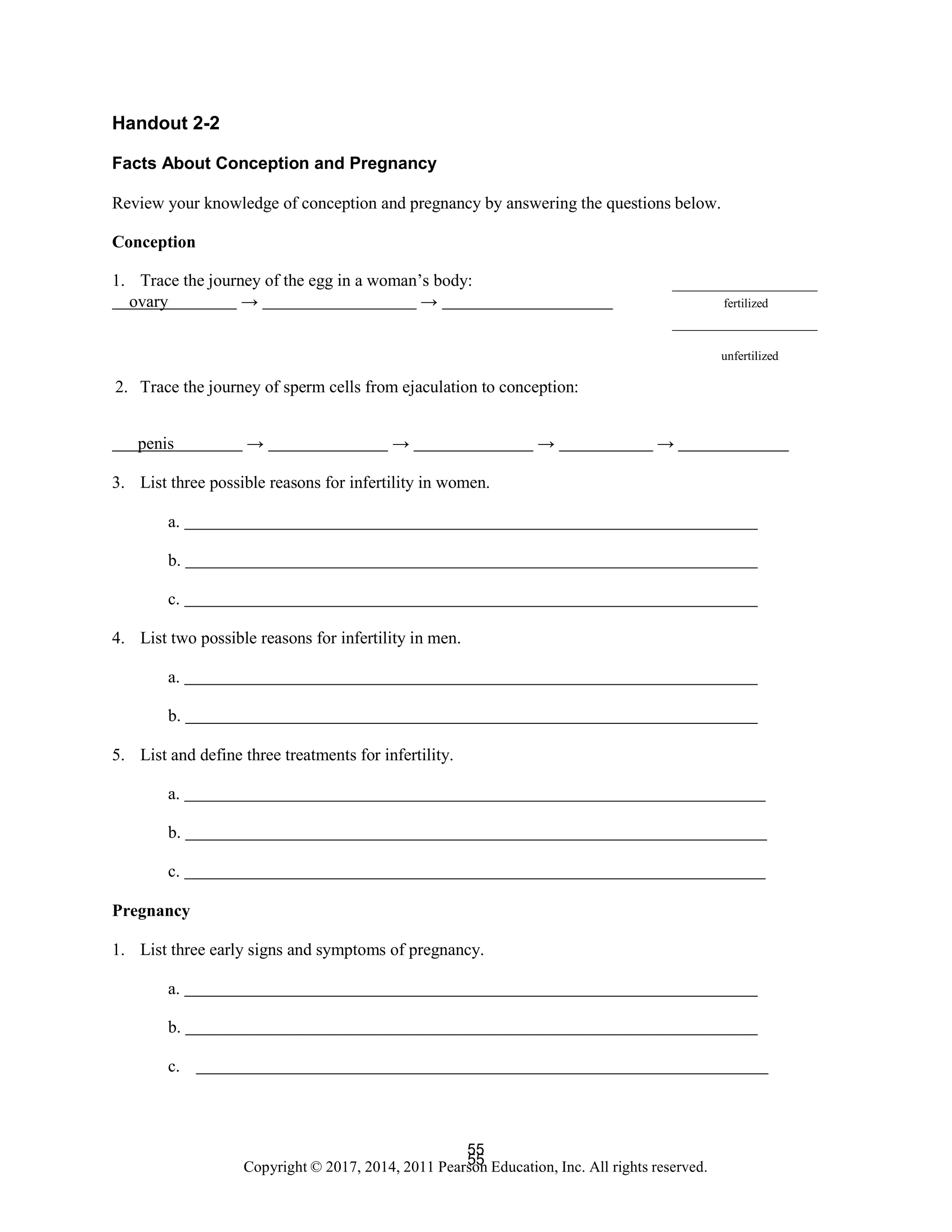
Student Activity 2.2: Conception and Pregnancy
Use Handout 2-2 for this assignment. Distribute the handout before you discuss conception and pregnancy.
Tell students that some of the answers are in Chapter 2 and some they will have to find on their own
using other sources.
This handout can be used as an assignment to be completed before your lectures on conception and
pregnancy or as a review. The answers are:
Conception
1. ovary → fallopian tube → uterus → uterine wall (fertilized) or vagina (unfertilized)
2. penis → vagina → uterus → fallopian tube → egg (ovum)
3. possible answers include blocked/damaged fallopian tubes, abnormal ovulation, pelvic inflammatory
disease (PID), endometriosis, damaged ovaries, hostile cervical mucus, fibroid tumor
4. possible answers include low sperm count, dilated veins around testicle, damaged sperm ducts,
hormone deficiency, sperm antibodies
5. possible answers include surgery, in vitro fertilization, hormone therapy, antibiotics, artificial
insemination
49
Copyright © 2017, 2014, 2011 Pearson Education, Inc. All rights reserved.
49
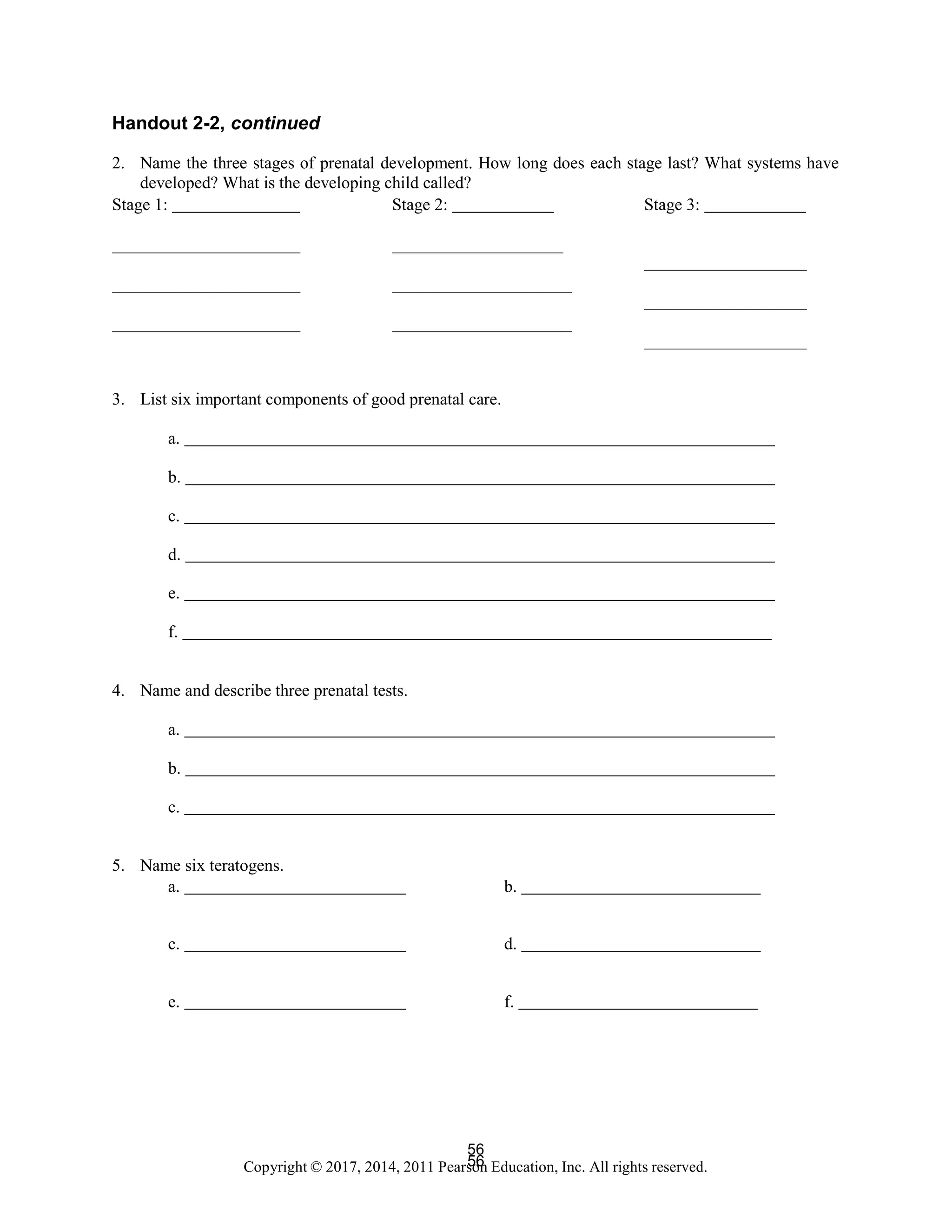
Pregnancy
1. possible answers include cessation of menses, breast tenderness, nausea
2. Stage 1: Germinal lasts two weeks (from conception till week 2), the cells divide and attach to the
uterine wall, the baby is called a “zygote”
Stage 2: Embryonic stage lasts 6 weeks (from week 2 until week 8), the cell layers (endoderm,
ectoderm, mesoderm) form, the baby is called an “embryo”
Stage 3: Fetal stage lasts 7 months (from week 8 until birth), all the child’s systems are developing
rapidly, the child is called a “fetus”
3. possible answers are see an obstetrician/midwife, eat a healthy diet including calcium and
multivitamin and mineral supplements, abstain from caffeine, alcohol, nicotine, and unnecessary
drugs, get plenty of rest, avoid X-rays, exercise moderately
4. amniocentesis—fetal cells are taken via a needle from amniotic fluid
chorionic villus sampling (CVS)—samples of hairlike material taken from embryo
ultrasound sonography—high frequency sound waves produce an image of baby
5. possible answers include alcohol, nicotine, X-rays, prescription drugs such as Thalidomide, illicit
drugs such as cocaine and marijuana, illnesses of the mother such as rubella, influenza, and AIDS
Student Activity 2.3: Buying Eggs or Finding a Sperm Donor or Surrogate on the Internet
Ask students to use the Internet to explore their options for becoming parents. Have them note the prices
paid for eggs, sperm, etc., by visiting several sites that offer reproductive help or reproductive services.
Pose the following question: How far is too far to go? Ask students what they would do if they wanted to
have a child, but could not. (Consider the following possibilities: they found out that they are infertile;
they have a genetic condition that has a chance of being passed to their offspring.) You might also share
Handouts 2-3 and 2-4 in this context. Handout 2-3 lists some dominant and recessive characteristics that
sometimes influence people’s wishes for a “designer baby.” Handout 2-4 lists some common teratogens that
can affect prenatal development.
Student Activity 2.4: Infant Reflexes
If possible, invite several parents to bring in their babies to illustrate reflexes in the newborn. Distribute
copies of Handout 2-5, which lists both survival and primitive infant reflexes. Your students might try to
guess the survival value of each reflex.
Student Activity 2.5: Critical Thinking Exercises
1. Get copies of Darcy Frey’s article in the New York Times Magazine titled “Does Anyone Here Think
This Baby Can Live?” (see Supplemental Reading for the complete reference; the article is also
available here: http://www.nytimes.com/1995/07/09/magazine/does-anyone-here-think-tnis-baby-can-
live.html?pagewanted=all ). Have your students read the article and write an essay considering the
following questions.
• What are some ethical considerations related to the provision of intensive medical care to very-
low-birthweight babies?
• Do you think such interventions should be routine practice? Why or why not?
50
Copyright © 2017, 2014, 2011 Pearson Education, Inc. All rights reserved.
50
2. Have students investigate the cost of childbirth in their city. These costs should include prenatal care,
the hospital/doctor or midwife charges, and costs of items for the baby, such as clothing, well-baby
checkups, and furniture.
Student Activity 2.6: Reflective Journal Exercises
Ask students to interview a woman about her pregnancy; ideally a family member, but any close friend,
colleague, or willing acquaintance will do. Distribute Handout 2-6 as a starting point for their task, and
emphasize that the interviewee’s responses should form the basis for the student’s own reflections.
Handout 2-7 offers some prompts to reflect on the process of childbirth and the first few days of life. Ask
students to use these questions to construct a Reflective Journal entry.
< Return to Contents
51
Copyright © 2017, 2014, 2011 Pearson Education, Inc. All rights reserved.
51
SUPPLEMENTAL READING
American Baby, Parenting, Parent and Child, Family Fun, Kiwi, Working Mother
These magazines, although designed for a lay audience, can often be a source of lecture topics, current
events, or even information to be clarified from a scientific perspective. Consider subscribing to one or
more of these titles if you teach this class on a regular basis.
Bean, C. (1990). Methods of childbirth (rev. ed.). New York: Quill.
Brazelton, T. B., & Nugent, J. K. (2011). Neonatal Behavioral Assessment Scale (4th
ed.). New York:
Wiley.
Dorris, M. (1990). The broken cord. New York: HarperCollins.
This is a moving account of the difficulty an adoptive father has raising his son born with fetal alcohol
syndrome.
Frey, D. (July 9, 1995). Does anyone here think this baby can live? The New York Times Magazine.
22–47.
This article presents a true story of a 24-week-old fetus who is born prematurely and discusses the
decisions involved in whether to use medical technology to keep the baby alive.
Leboyer, F. (2009). Birth without violence (rev. ed.). New York: Knopf.
Murkoff, H. E., & Mazel, S. (2008). What to expect when you’re expecting (4th
ed.). New York:
Workman.
This is an excellent and comprehensive guide that covers conception, pregnancy month by month, and
childbirth.
Murkoff, H. E., & Mazel, S. (2008). What to expect in the first year (2nd
ed.). New York: Workman.
Nilsson, L., Ingelman-Sundberg, A., & Wirsen, C. (2004). A child is born (4th
ed.). New York: Delta
Press.
Lennart Nilsson is justly famous for his amazing photographs of babies in utero, first published in 1965.
Share these with your class. The film The Miracle of Life also uses some of his microphotography.
< Return to Contents
52
Copyright © 2017, 2014, 2011 Pearson Education, Inc. All rights reserved.
52
MULTIMEDIA IDEAS
MyDevelopmentLab Video Series + Discussion Questions
The MyDevelopmentLab Video Series engages students and brings to life a wide range of topics spanning
prenatal development through the end of the lifespan. New international videos shot on location allow
students to observe similarities and differences in human development across various cultures.
Video: Genetic Counseling
Discussion Questions
1. What are your thoughts on genetic counseling after viewing this clip? Did viewing this video change
your opinion on the topic?
2. Would you, or did you, seek genetic counseling during your pregnancy? Why or why not? Would you
recommend it to others?
3. The professional interviewed lists several reasons why individuals might consider genetic counseling.
List and describe at least three.
Video: Period of the Zygote
Discussion Questions
1. Explain the steps involved in the process of fertilization.
2. What is the correct sequence of stages that take place during the zygotic period, and what is the
timeframe for each?
3. Sketch the location of the female reproductive organs, noting key areas involved in zygotic
development.
Video: Genetic Mechanisms and Behavioral Genetics
Discussion Questions
1. Review the process of genetic transmission, focusing on how parental chromosomes contribute to the
formation of a new life.
2. Explain how family studies, adoption studies, and twin studies provide key information to researchers
studying behavioral genetics.
3. Comment on the specific findings of the studies described by the researcher interviewed in the video.
Which outcomes did you find most interesting, unusual, or unexpected?
Video: Labor
Discussion Questions
1. Although the narrator tells us that the trigger for labor is still a mystery, he provides a few
possibilities. Explain those possibilities.
2. List at least three signals a woman may experience to let her know she is about to begin labor.
3. Describe the three stages of labor.
53
Copyright © 2017, 2014, 2011 Pearson Education, Inc. All rights reserved.
53
Video: Premature Births and the Neonatal Intensive Care Unit
Discussion Questions
1. What are some advances in care that technology has provided to the NICU?
2. The speaker discusses several reasons why babies might end up in the NICU. List some of the causes
and highlight those that can be controlled by the mother as well as those that cannot be controlled by
the mother.
3. What are some short-term and long-term complications that premature babies might encounter?
Video: Habituation
Discussion Questions
1. What evidence suggests that even young infants can grasp fundamental concepts related to numbers?
How does this change our thinking about perceptual and cognitive skills?
2. What does “habituation” refer to? How can habituation be used to study an infant’s understanding of
configuration, number, or surface area?
3. What practical applications can you think of that would result from studying young infants’
understanding of quantity?
< Return to Contents
54
Copyright © 2017, 2014, 2011 Pearson Education, Inc. All rights reserved.
54
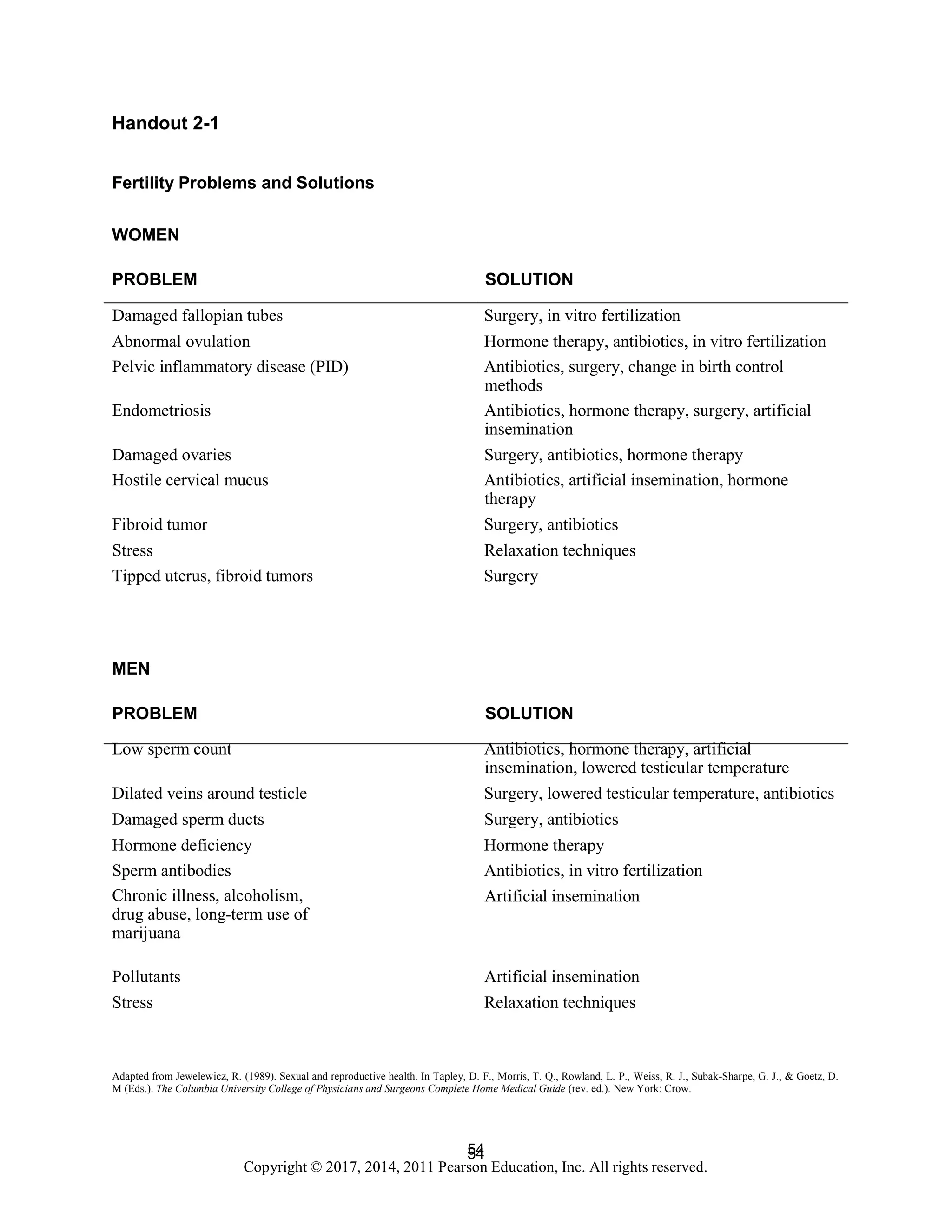
Handout 2-1
Fertility Problems and Solutions
WOMEN
PROBLEM SOLUTION
Damaged fallopian tubes Surgery, in vitro fertilization
Abnormal ovulation Hormone therapy, antibiotics, in vitro fertilization
Pelvic inflammatory disease (PID) Antibiotics, surgery, change in birth control
methods
Endometriosis Antibiotics, hormone therapy, surgery, artificial
insemination
Damaged ovaries Surgery, antibiotics, hormone therapy
Hostile cervical mucus Antibiotics, artificial insemination, hormone
therapy
Fibroid tumor Surgery, antibiotics
Stress Relaxation techniques
Tipped uterus, fibroid tumors Surgery
MEN
PROBLEM SOLUTION
Low sperm count Antibiotics, hormone therapy, artificial
insemination, lowered testicular temperature
Dilated veins around testicle Surgery, lowered testicular temperature, antibiotics
Damaged sperm ducts Surgery, antibiotics
Hormone deficiency Hormone therapy
Sperm antibodies Antibiotics, in vitro fertilization
Chronic illness, alcoholism,
drug abuse, long-term use of
marijuana
Artificial insemination
Pollutants Artificial insemination
Stress Relaxation techniques
Adapted from Jewelewicz, R. (1989). Sexual and reproductive health. In Tapley, D. F., Morris, T. Q., Rowland, L. P., Weiss, R. J., Subak-Sharpe, G. J., & Goetz, D.
M (Eds.). The Columbia University College of Physicians and Surgeons Complete Home Medical Guide (rev. ed.). New York: Crow.
55
Copyright © 2017, 2014, 2011 Pearson Education, Inc. All rights reserved.
55
Handout 2-2
Facts About Conception and Pregnancy
Review your knowledge of conception and pregnancy by answering the questions below.
Conception
1. Trace the journey of the egg in a woman’s body:
ovary → → fertilized
2. Trace the journey of sperm cells from ejaculation to conception:
unfertilized
penis → → → →
3. List three possible reasons for infertility in women.
a.
b.
c.
4. List two possible reasons for infertility in men.
a.
b.
5. List and define three treatments for infertility.
a.
b.
c.
Pregnancy
1. List three early signs and symptoms of pregnancy.
a.
b.
c.
56
Copyright © 2017, 2014, 2011 Pearson Education, Inc. All rights reserved.
56
Handout 2-2, continued
2. Name the three stages of prenatal development. How long does each stage last? What systems have
developed? What is the developing child called?
Stage 1: Stage 2: Stage 3:
3. List six important components of good prenatal care.
a.
b.
c.
d.
e.
f.
4. Name and describe three prenatal tests.
a.
b.
c.
5. Name six teratogens.
a. b.
c. d.
e. f.
57
Copyright © 2017, 2014, 2011 Pearson Education, Inc. All rights reserved.
57
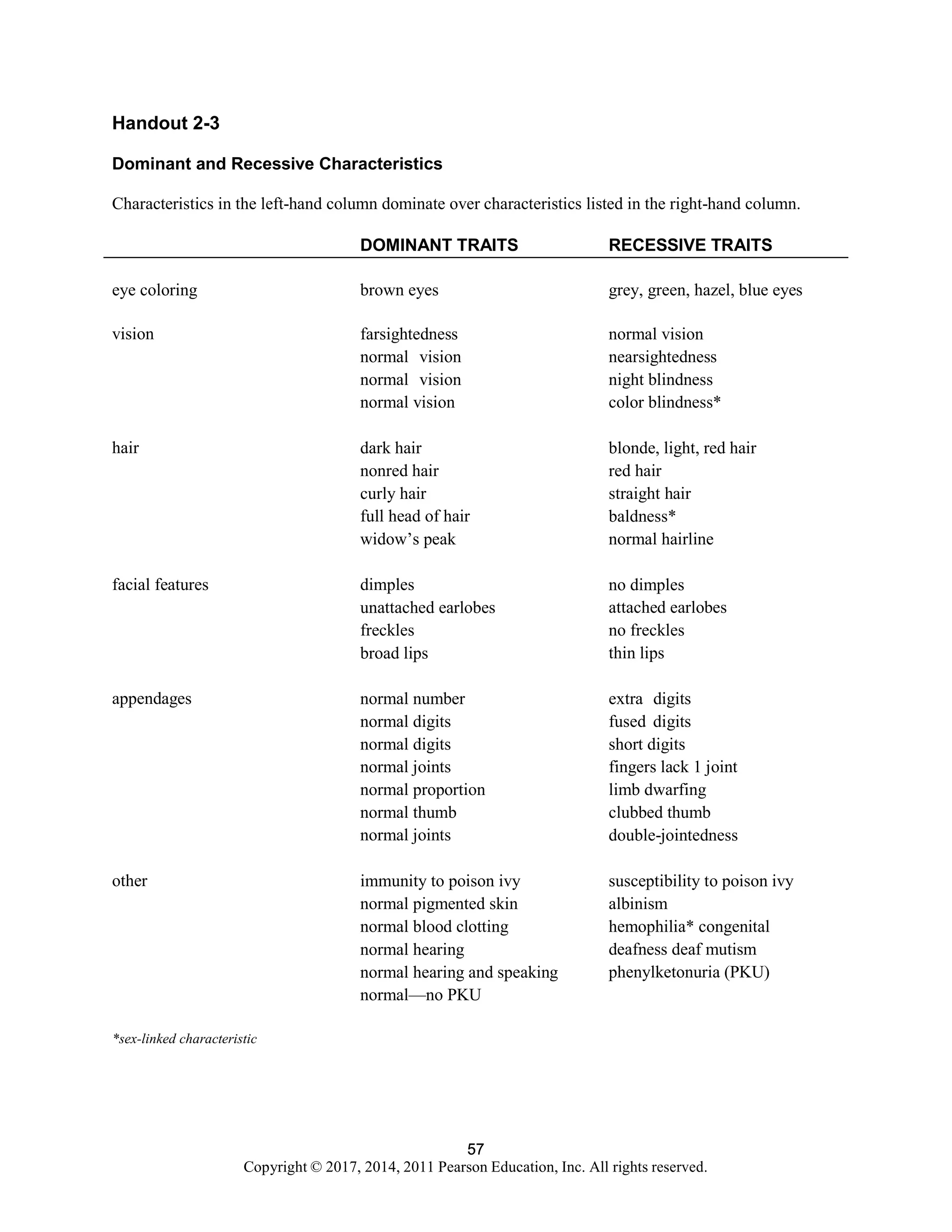
Handout 2-3
Dominant and Recessive Characteristics
Characteristics in the left-hand column dominate over characteristics listed in the right-hand column.
DOMINANT TRAITS RECESSIVE TRAITS
eye coloring brown eyes grey, green, hazel, blue eyes
vision farsightedness
normal vision
normal vision
normal vision
normal vision
nearsightedness
night blindness
color blindness*
hair dark hair
nonred hair
curly hair
full head of hair
widow’s peak
blonde, light, red hair
red hair
straight hair
baldness*
normal hairline
facial features dimples
unattached earlobes
freckles
broad lips
no dimples
attached earlobes
no freckles
thin lips
appendages normal number
normal digits
normal digits
normal joints
normal proportion
normal thumb
normal joints
extra digits
fused digits
short digits
fingers lack 1 joint
limb dwarfing
clubbed thumb
double-jointedness
other immunity to poison ivy
normal pigmented skin
normal blood clotting
normal hearing
normal hearing and speaking
normal—no PKU
susceptibility to poison ivy
albinism
hemophilia* congenital
deafness deaf mutism
phenylketonuria (PKU)
*sex-linked characteristic
58
Copyright © 2017, 2014, 2011 Pearson Education, Inc. All rights reserved.
58
DISEASES
Chlamydia
Rubella (German Measles)
HIV
Toxoplasmosis
Pneumonia
Herpes
Syphilis
Tuberculosis
Gonorrhea
Scarlet Fever
Mumps
Influenza
DRUGS
Accutane
Iodides
Antibiotics
Opiates
Aspirin
Smallpox vaccination
Nicotine
Vitamins in excess
Hexachlorophene
Amphetamines
LSD
Anticoagulant drugs
Sedatives
Caffeine
Tranquilizers
Diethylstilbestrol (DES)
Alcohol
Lithium
Anti-cancer drugs
Quinine
Barbiturates
Thalidomide
Cocaine
Marijuana
ENVIRONMENTAL FACTORS
Cadmium
Nickel
Insecticides
Manganese
Mercury
Fumes from paints, solvents,
glues, dry-cleaning fluids
Radiation (X-rays, video display
Cat feces
Pesticides
Herbicides
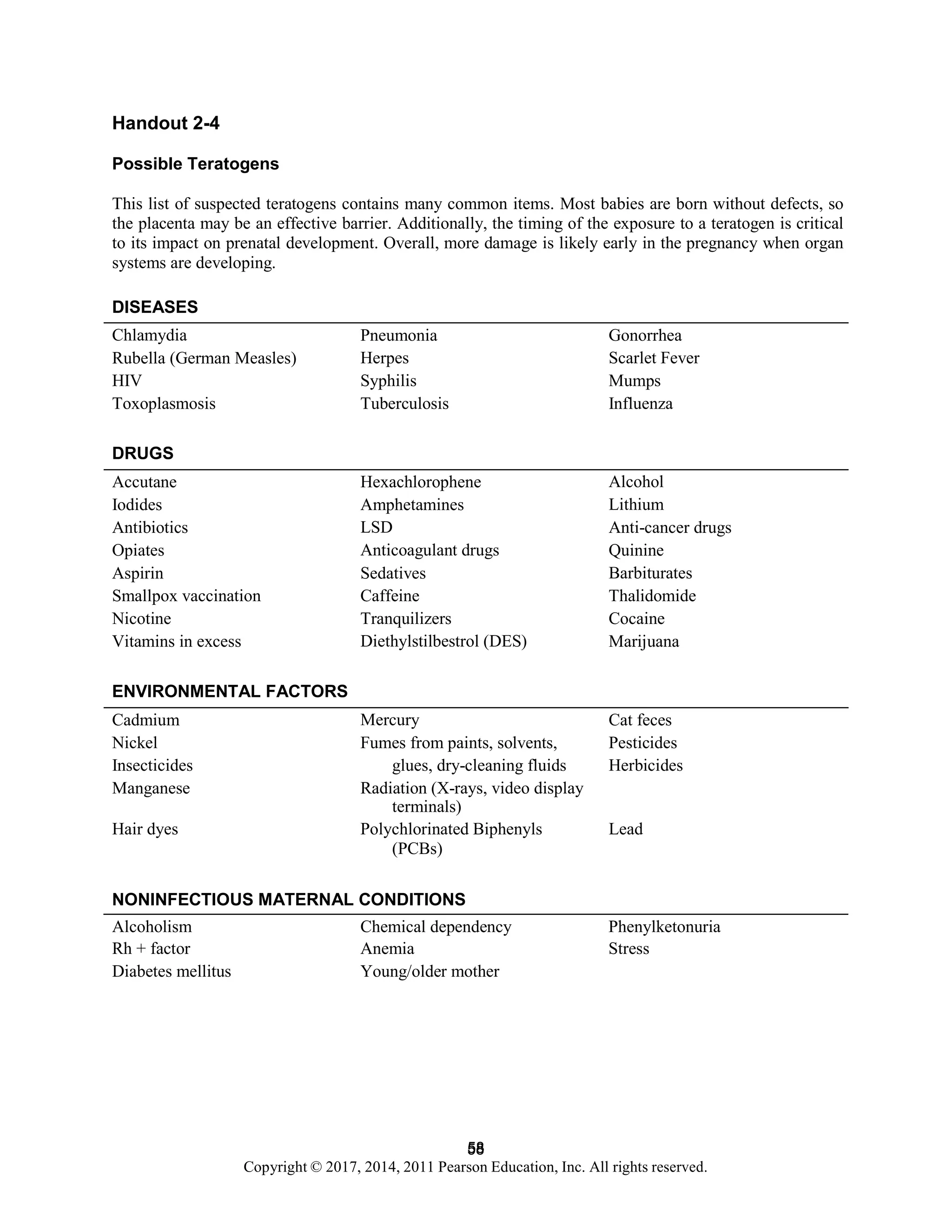
Hair dyes Polychlorinated Biphenyls Lead
Handout 2-4
Possible Teratogens
This list of suspected teratogens contains many common items. Most babies are born without defects, so
the placenta may be an effective barrier. Additionally, the timing of the exposure to a teratogen is critical
to its impact on prenatal development. Overall, more damage is likely early in the pregnancy when organ
systems are developing.
terminals)
(PCBs)
NONINFECTIOUS MATERNAL CONDITIONS
Alcoholism Chemical dependency Phenylketonuria
Rh + factor Anemia Stress
Diabetes mellitus Young/older mother
59
Copyright © 2017, 2014, 2011 Pearson Education, Inc. All rights reserved.
59
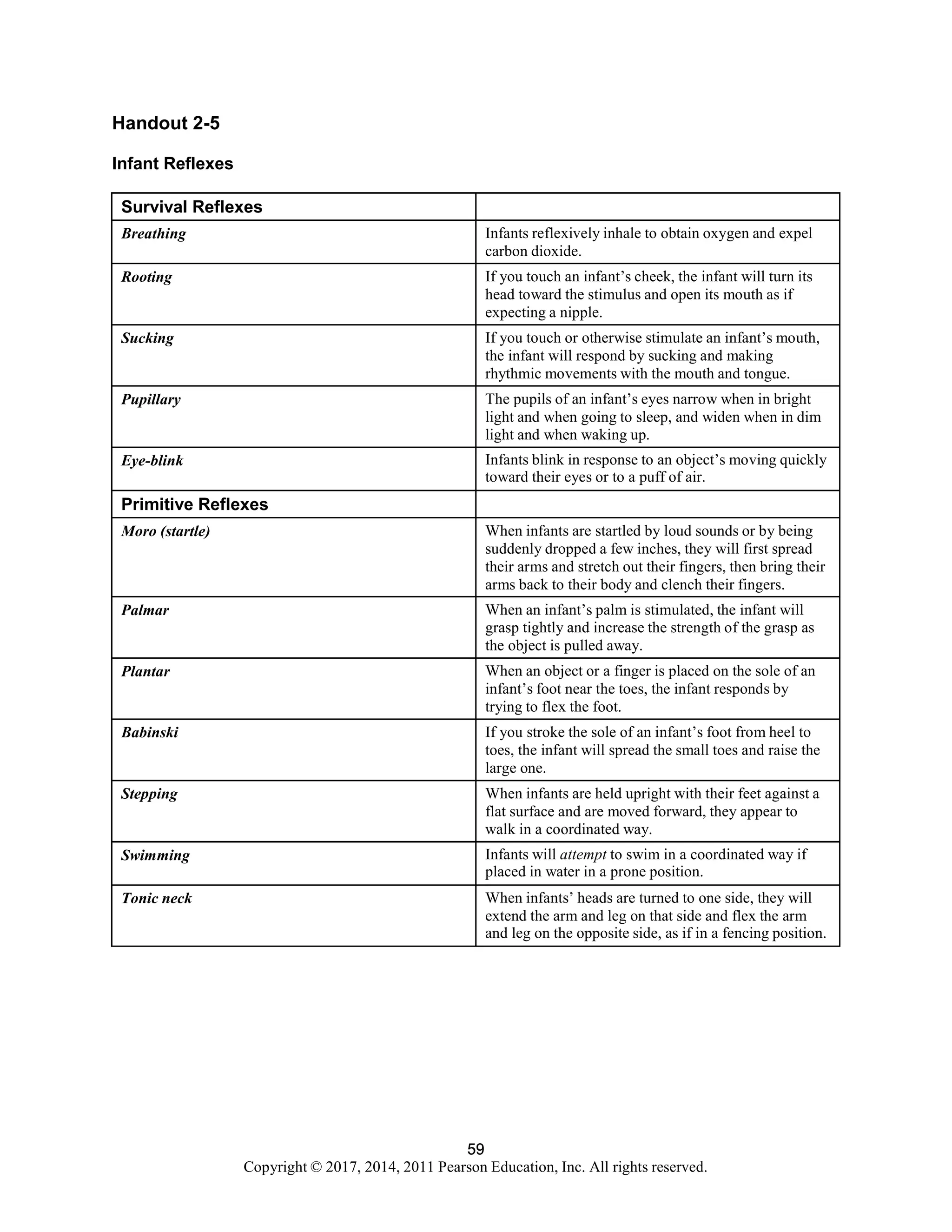
Handout 2-5
Infant Reflexes
Survival Reflexes
Breathing Infants reflexively inhale to obtain oxygen and expel
carbon dioxide.
Rooting If you touch an infant’s cheek, the infant will turn its
head toward the stimulus and open its mouth as if
expecting a nipple.
Sucking If you touch or otherwise stimulate an infant’s mouth,
the infant will respond by sucking and making
rhythmic movements with the mouth and tongue.
Pupillary The pupils of an infant’s eyes narrow when in bright
light and when going to sleep, and widen when in dim
light and when waking up.
Eye-blink Infants blink in response to an object’s moving quickly
toward their eyes or to a puff of air.
Primitive Reflexes
Moro (startle) When infants are startled by loud sounds or by being
suddenly dropped a few inches, they will first spread
their arms and stretch out their fingers, then bring their
arms back to their body and clench their fingers.
Palmar When an infant’s palm is stimulated, the infant will
grasp tightly and increase the strength of the grasp as
the object is pulled away.
Plantar When an object or a finger is placed on the sole of an
infant’s foot near the toes, the infant responds by
trying to flex the foot.
Babinski If you stroke the sole of an infant’s foot from heel to
toes, the infant will spread the small toes and raise the
large one.
Stepping When infants are held upright with their feet against a
flat surface and are moved forward, they appear to
walk in a coordinated way.
Swimming Infants will attempt to swim in a coordinated way if
placed in water in a prone position.
Tonic neck When infants’ heads are turned to one side, they will
extend the arm and leg on that side and flex the arm
and leg on the opposite side, as if in a fencing position.
Other documents randomly have
different content
A
XIX The Affable Man
(Ἀρέσκεια)
ffability is a sort of demeanor that gives pleasure at the
sacrifice of what is best. The affable man is the kind of person
who hails a friend at a distance, and after he has told him what
a fine fellow he is, and has lavished brimming admiration on
him, seizes both his hands, and is unwilling to let him go. He
escorts the friend a step on his way, and as he asks “When shall
we meet again?” tears himself away with praises still falling
from his lips.
When summoned to court he wishes to please not merely the man
in whose interest he appears, but his adversary too, that he
may seem to be non-partisan; and of strangers he says that
they pronounce juster judgment than his townsmen. If he’s
invited out to dinner he asks his host to call in the children, and
when they come, he declares they’re as like their father as one
fig is like another, and he draws them toward him, kisses them,
and sets them by his side. Sometimes he joins in their sports,
shouting “Strike!” and “Foul!”; and sometimes he lets them go
to sleep in his lap in spite of the burden.[28]
[28] The remainder of the Greek text of this character has been
thought to belong more properly with “The Exquisite,” No.
XV.
I
XX The Impudent Man
(Βδελυρία)
mpudence is easy to define; it is conduct that is obtrusively
offensive. The impudent man is one who, on meeting
respectable women in the street, insults them as he passes. At a
play, he claps his hands after all the rest have stopped, and
hisses the players when others wish to watch in silence. When
the theatre is still, he suddenly stands up and disgorges, to
make the audience look around. When the market-place is
crowded, he steps up to the stalls where nuts, myrtle-berries, or
fruits are for sale, and begins to pick at them as he talks to the
merchant; he calls by name people whom he doesn’t know, and
stops those intent upon some errand. When a man has just lost
an important case and is now leaving the court, he runs up and
tenders his congratulations.
He buys his own provisions,[29] too, and hires his own musicians,
showing his purchases to every man he meets and inviting him
to come and share the feast. Again, he takes his stand before a
barber’s booth or a perfumer’s stall, and proclaims unblushingly
his intention of getting drunk.
[29] To do one’s own marketing was considered a sign of
niggardliness; hence such business was ordinarily delegated
to slaves.
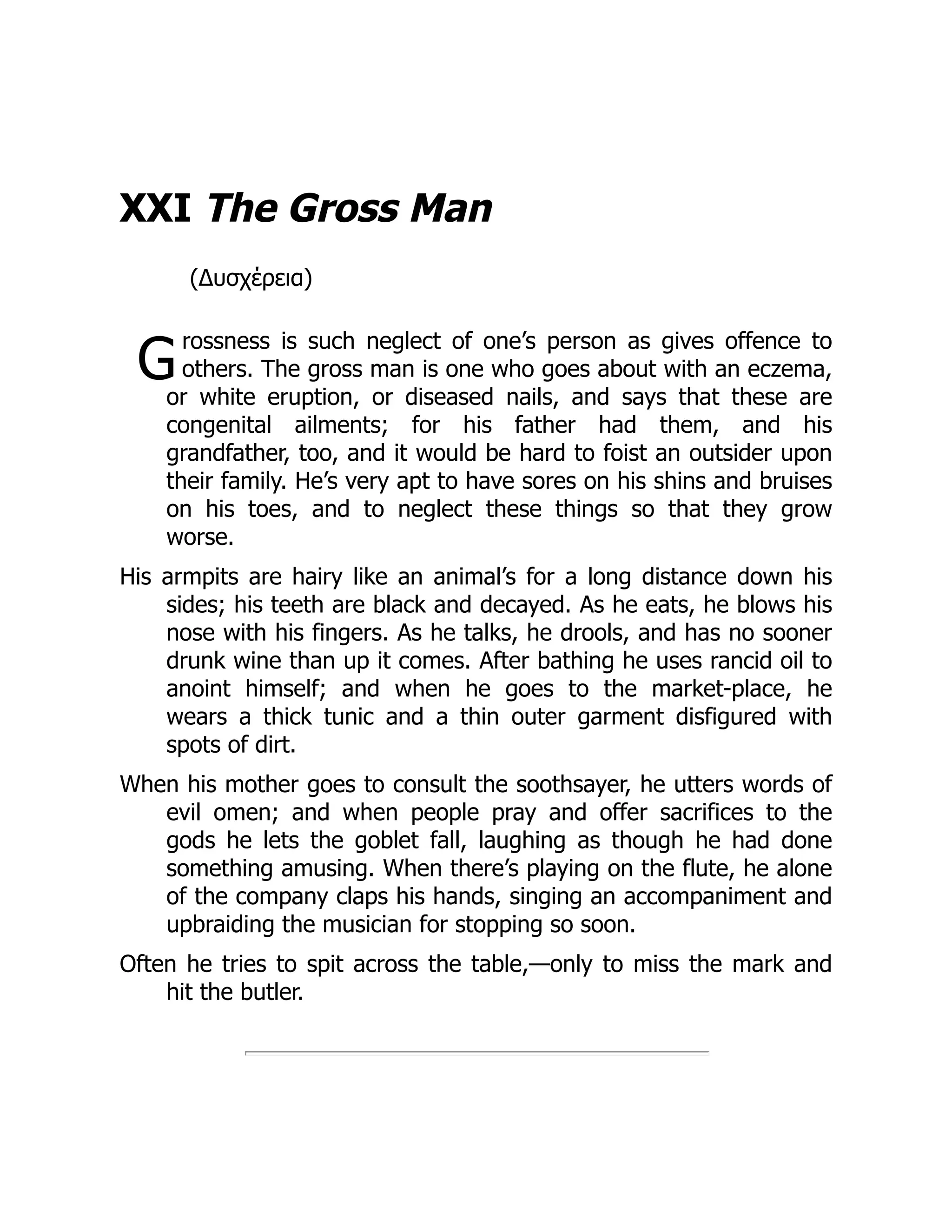
G
XXI The Gross Man
(Δυσχέρεια)
rossness is such neglect of one’s person as gives offence to
others. The gross man is one who goes about with an eczema,
or white eruption, or diseased nails, and says that these are
congenital ailments; for his father had them, and his
grandfather, too, and it would be hard to foist an outsider upon
their family. He’s very apt to have sores on his shins and bruises
on his toes, and to neglect these things so that they grow
worse.
His armpits are hairy like an animal’s for a long distance down his
sides; his teeth are black and decayed. As he eats, he blows his
nose with his fingers. As he talks, he drools, and has no sooner
drunk wine than up it comes. After bathing he uses rancid oil to
anoint himself; and when he goes to the market-place, he
wears a thick tunic and a thin outer garment disfigured with
spots of dirt.
When his mother goes to consult the soothsayer, he utters words of
evil omen; and when people pray and offer sacrifices to the
gods he lets the goblet fall, laughing as though he had done
something amusing. When there’s playing on the flute, he alone
of the company claps his hands, singing an accompaniment and
upbraiding the musician for stopping so soon.
Often he tries to spit across the table,—only to miss the mark and
hit the butler.
B
XXII The Boor
(Ἀγροικία)
oorishness is ignorance of good form. The boor is the sort of
man who takes a strong drink and then goes to the Assembly.
He insists that myrrh has not a whit sweeter smell than onions.
His boots are too big for his feet and he talks in a loud voice.
He distrusts even friends and kinsmen, while his most important
secrets are shared with his domestics, and he tells all the news
of the Assembly to his farm hands. Nothing awakens his
admiration or startles him on the streets so much as the sight of
an ox, an ass, or a goat, and then he stands agape in
contemplation.[30] He is the sort of man who snatches a bite
from the pantry and drinks his liquor straight.
He has clandestine talks with the cook and helps her grind the meal
for his household. At breakfast he throws bits to the animals
about the table. He answers the knock at the door himself and
then whistles for his dog, takes him by the nose, and says:
“Here’s the keeper of my house and grounds!” When a man
offers him a coin he declines it, saying it is too worn, and takes
another piece in its stead.
After loaning a plough, basket, sickle, or sack, he goes after it,
unable to sleep for thinking of it. When he goes to town he
inquires of any chance passer-by: “What are hides selling for?
What’s the price of bacon? Does the celebration of New Moon
come to-day?” Then he remarks he must go down street and
have his hair cut, and while in town must also run into the shop
of Archias and buy the bacon. He sings in the public baths and
wears hob-nailed boots.
[30] “Hee is sensible of no calamitie but the burning of a stacke
of corne or the overflowing of a medow, and thinks Noah’s
flood the greatest plague that ever was, not because it
drowned the world, but spoyl’d the grasse.” Earle’s Micro-
cosmographie, “A Plaine Country Fellow.”
P
XXIII The Penurious Man
(Ἀνελευθερία)
enuriousness is the grudging of expense and is due to great
love of money and little love of honor. The penurious man,
after a victory on the tragic stage, sets up a wooden chaplet to
Dionysus, on which he inscribes his own name. If contributions
from the public are asked for, he is silent or rises and quits the
company. When he gives his daughter in marriage, he sells the
sacrificial offerings, excepting the parts that belong by law to
the priests. At the wedding, he employs only servants who will
eat at home.
As trierarch[31] he takes the pilot’s blankets and spreads them on
deck for himself, while he puts his own away. He is the sort of
man who keeps his children from school when a festival comes,
and makes excuses for them on the plea of ill-health, that he
may avoid the fee for tuition.
When he goes to market, he brings the meat home with him,
carrying the vegetables in the folds of his cloak. He stays
indoors when he sends his tunic to the cleaner. If he catches
sight of a friend coming towards him and soliciting
contributions, he sneaks off through a by-street and goes home
by a roundabout way. He employs no maid for his wife,
although she brought him a dowry, but hires a child from the
woman’s market to accompany her on her errands.
He keeps his patched shoes until they are twice worn out, saying
they are still good, and tough as horn. When he gets up, he
dusts the house and makes the beds, and when he sits down he
lays aside the coat he is wearing in order to spare it.
[31] Commander of a galley.
P
XXIV The Pompous Man
(Ὑπερηφανία)
ompousness is contempt for everybody save one’s self. If you
have urgent business, the pompous man will tell you that he
will meet you after dinner on his walk. If he has done you a
favor, he reminds you of it. When elected to office he declines,
saying under oath he has no leisure. He is not disposed to make
the first call on anybody. Tradesmen and hired men he orders to
come to him by daybreak.
As he passes along the street, he does not greet the men he meets;
he lowers his eyes and when it suits him raises them again. If
he entertains friends he does not dine with them, but instructs
some of his underlings to attend to the duties of entertainment.
He sends a messenger ahead when he makes a call, to say that he
approaches. He allows no one to enter while he is at his oil-rub,
his bath, or his dinner. When he is casting an account, he
instructs a slave to set down the items, foot up the total, and
arrange it in a statement for him. He does not write in a letter:
“You would do me a favor,” but “I want this done,” and “I have
sent for this and wish to have it,” and “See to it that my orders
are followed precisely,” and “Have this done immediately.”
B
XXV The Braggart
(Ἀλαζονεία)
ragging is pretending to have excellences that one does not
really possess. The braggart is the man who stands on the
wharf and tells the bystanders how much capital he has
invested in ships at sea, and tells how extensive is his business
of loaning money, and how much he has made and lost by
different ventures. As he talks thus magnificently, he sends his
slave to his banker, where he has—exactly one shilling to his
credit. On a journey he imposes on his travelling companion by
telling him that he once served with Alexander, and how
intimate were their relations, and how many jewelled cups he
brought back from his campaigns.
As regards the Asiatic artists, he counts them better than those in
Europe. And all this he tells you without having once set foot
outside his native city. He claims further to have three letters
from Antipater[32] bidding him come to Macedonia; but he
declares that, though he has been guaranteed the privilege of
exporting wood free of duty, he has refused to go, simply to
avoid being suspected by his fellow-citizens of foreign leanings.
The Macedonians, he says, in urging him so to come, ought to
have considered this point.
In time of famine, he says, his expenditures for the poor amounted
to over five talents; for he hadn’t the heart to refuse. When he’s
with strangers, he often bids some one place the reckoning
counters on the table, and computing by six hundreds and by
minae, glibly mentioning the names of his pretended debtors,
he makes a total of twenty-four talents, saying that the whole
sum had gone for voluntary contributions, and that, too, without
including subscriptions for the navy or for other public objects.
At times he goes to the horse-market where blooded stock is for
sale, and makes pretence of wanting to buy; and stepping up to
the block, he hunts his clothes for two talents, upbraiding his
servant for coming along without any money. Though he lives in
a rented house, he represents it to those who do not know as
the family homestead; yet adds that he thinks of selling it as
being too small for the proper entertainment of his friends.
[32] A general of Alexander. Upon Alexander’s death he became
king of Macedonia.
O
XXVI The Oligarch
(Ὀλιγαρχία)
ligarchy is a love of power that clings tightly to personal
advantage. The oligarch rises in the people’s councils, when
assistants to the archon are elected for the management of a
fête, and says: “These men must have absolute control.” And
although others have suggested ten, he insists that one is
enough, but he must be a man. The only line of Homer that
stays in his memory is: “A crowd’s rule is bad; let there be one
ruler.” He knows no other verse. He is, however, an adept at
such phrases as this: “We must hold a caucus and make our
plans; we must cut loose from mob and market; we must throw
aside the annoyance of petty office and of insult or honor at the
masses’ whim; we or they must rule the state.”
At midday he goes out with his mantle thrown about him, his hair
dressed in the mode and his nails fashionably trimmed; he
promenades down Odeon Way ejaculating: “Sycophants have
made the city no longer habitable. What outrages we endure in
court from our persecutors! Why men nowadays go into office,
is a marvel to me. How ungrateful the mob is! although one is
always giving, giving.”
If, at the Assembly, a naked, hungry vagabond sits next to him, he
complains of the outrage. “When,” he asks, “is a stop to be put
to this ruin of our property by taxation for fêtes and navy? How
odious is this crew of demagogues! Theseus,” he says, “was the
forefront of all this offending, for out of twelve cities, he
brought the masses into one, to overthrow the monarchies. He
met his just reward,—he was the first to fall a victim at their
hands.” This is the way he talks to foreigners and to citizens of
his own temper and party.
B
XXVII The Backbiter
(Κακολογία)
ackbiting is a disposition[33] to vilify others. When the
backbiter is asked “Who is so and so?” he begins, like the
genealogists, with the man’s ancestry. “His father’s name was
originally Sosias,[34] but amongst the soldiers it became
Sosistratus, and upon registration in the deme, it was again
changed to Sosidemus. His mother was a Thracian,—gentle
blood! you see. At any rate this jewel’s name was Krinokoraka.
Women of that name are of gentle blood in Thrace, so people
say! The man himself, with an ancestry like that, is a foul fellow
fit for the whipping-post.” In a company where his companions
are maligning a man, he of course takes up the attack and says:
“For my part I hate him of all men. He is a bad character, as one
may see from his face, and as for his meanness, it has no
parallel and here is a proof: His wife brought him a dowry of
talents of money and yet after the birth of their first child, he
gave her but three pence a day for household expenses and
forced her to bathe in cold water on the festival of Poseidon in
midwinter.” When he is seated with a group, he loves to talk
about an acquaintance who has just risen and gone, and his
biting tongue does not spare even the man’s kinsfolk. Of his
own relatives and friends, he says the vilest things and even
maligns the dead. Backbiting is what he calls frankness of
speech, democracy, and freedom; and there is nothing he
enjoys so much.
[33] “Scandal, like other virtues, is in part its own reward, as it
gives us the satisfaction of making ourselves appear better
than others, or others no better than ourselves.” Benj.
Franklin, Works, ed. Sparks, II., p. 540.
[34] Apparently a slave’s name.
A
XXVIII The Avaricious Man
(Αἰσχροκέρδεια)
varice is greedy love of gain. When the avaricious man gives a
dinner, he puts scant allowance of bread on the table. He
borrows money of a stranger who is lodging with him. When he
distributes the portions at table, he says it is fair for the laborer
to receive double and straightway loads his own plate. He
engages in wine traffic, and sells adulterated liquors even to his
friend. He goes to the show and takes his children with him, on
the days when spectators are admitted to the galleries free.
When he is the people’s delegate, he leaves at home the money
provided by the city, and borrows from his fellow
commissioners.
He loads more luggage on his porter than the man can carry, and
provides him with the smallest rations of any man in the party.
When presents are given the delegates by foreign courts, he
demands his share at once, and sells it. At the bath he says the
oil brought him is bad, and shouts: “Boy, the oil is rancid;” and
in its stead takes what belongs to another. If his servants find
money on the highway, he demands a share of it, saying:
“Luck’s gifts are common property.” When he sends his cloak to
be cleaned, he borrows another from an acquaintance and
keeps it until it is asked for. He also does this sort of thing: he
uses King Frugal’s measure with the bottom dented in, for
doling out supplies to his household and then secretly brushes
off the top. He sells underweight even to his friend, who thinks
he is buying according to market standard.
When he pays a debt of thirty pounds, he does so with a discount of
four shillings. When, owing to sickness, his children are not at
school the entire month, he deducts a proportionate amount
from the teacher’s pay; and during the month of Anthesterion
he does not send them to their studies at all, on account of the
frequent shows, and so he avoids tuition fees. If he receives
coppers from a slave who has been serving out, he demands in
addition the exchange value of silver. When he gets a statement
from the deme’s[35] administrator, he demands provision for his
slaves at public cost.
He makes note of the half-radishes left on the table, to keep the
servants from taking them. If he goes abroad with friends, he
uses their servants and hires his own out; yet he does not
contribute to the common fund the money thus received. When
others combine with him to give a banquet at his house, he
secretly includes in his account the wood, figs, vinegar, salt, and
lamp-oil,—trifles furnished from his supplies. If a marriage is
announced in a friend’s family, he goes away a little beforehand,
to avoid sending a wedding present. He borrows of friends such
articles as they would not ask to have returned, or such as, if
returned, they would not readily accept.
[35] The deme was a local division.
T
XXIX The Late Learner
(Ὀψιμαθία)
he late learner has a fondness for study late in life. He commits
whole passages of poetry to memory when sixty years of age;
but when he essays to quote them at a banquet his memory
trips. From his son, he learns “Forward march!” “Shoulder
arms!” “’Bout face!” At the feast of heroes he pits himself
against the boys in the torch-race; and of course when he is
invited to the temple of Hercules, he throws aside his mantle,
and makes ready to lift the steer, that he may bend back its
neck. He goes to the wrestling-grounds and joins in the
matches.
At the shows he stays one performance after another until he has
learned the songs by heart. If he is dedicated to Sabazius, he is
eager to be declared the fairest; if he falls in love with some
damsel, he makes an onset on her door, only to be assaulted by
a rival and hauled before the court. He makes a trip to the
country on a mare he has never before ridden, and, essaying
feats of horsemanship on the road, he falls and breaks his head.
He joins a boys’ club too, and entertains the members at his house;
he plays “ducks and drakes” with his servant, and competes at
archery and javelin-throwing with his children’s tutor, and he
expects the tutor, as though ignorant of these sports, to learn
them from him. He wrestles at the baths, turning a bench
nimbly about to create the impression that he has been well
trained in the art; and if women happen to be standing near, he
trips a dance, whistling his own music.
V
XXX The Vicious Man
(Φιλοπονηρία)
iciousness is love of what is bad. The vicious man is one who
associates with men convicted in public suits, and who
assumes that, if he makes friends of these fellows, he will gain
in knowledge of the world, and so will be more feared.
Of upright men, he declares that no one is by nature upright, but
that all men are alike, and he even reproaches the man who is
honorable. The bad man, he asserts, is free from prejudice, if
one will but make the trial, and, while in some respects he
admits that men speak truly of such a man, in others he refuses
to allow it. “For,” says he, “the fellow is clever, companionable,
and a gentleman;” in fact, he maintains that he never met so
talented a person. He supports him, therefore, when he speaks
in the assembly or is defendant in court, and to those sitting in
judgment he’s apt to say that one must judge not the man, but
the facts; and he declares that his friend is the very watch-dog
of the people, “for he watches out for evil-doers”; and he adds:
“We shall no longer have men to burden themselves with a care
for the common weal, if we abandon men like him.”
It’s the vicious man’s way to constitute himself the patron of all
worthless scamps and to support them before the court in
desperate cases; and, when he passes judgment, he puts the
worst construction on the arguments of the opposing counsel.
*** END OF THE PROJECT GUTENBERG EBOOK THE CHARACTERS
OF THEOPHRASTUS ***
Updated editions will replace the previous one—the old editions
will be renamed.
Creating the works from print editions not protected by U.S.
copyright law means that no one owns a United States
copyright in these works, so the Foundation (and you!) can copy
and distribute it in the United States without permission and
without paying copyright royalties. Special rules, set forth in the
General Terms of Use part of this license, apply to copying and
distributing Project Gutenberg™ electronic works to protect the
PROJECT GUTENBERG™ concept and trademark. Project
Gutenberg is a registered trademark, and may not be used if
you charge for an eBook, except by following the terms of the
trademark license, including paying royalties for use of the
Project Gutenberg trademark. If you do not charge anything for
copies of this eBook, complying with the trademark license is
very easy. You may use this eBook for nearly any purpose such
as creation of derivative works, reports, performances and
research. Project Gutenberg eBooks may be modified and
printed and given away—you may do practically ANYTHING in
the United States with eBooks not protected by U.S. copyright
law. Redistribution is subject to the trademark license, especially
commercial redistribution.
START: FULL LICENSE
THE FULL PROJECT GUTENBERG LICENSE
PLEASE READ THIS BEFORE YOU DISTRIBUTE OR USE THIS WORK
To protect the Project Gutenberg™ mission of promoting the
free distribution of electronic works, by using or distributing this
work (or any other work associated in any way with the phrase
“Project Gutenberg”), you agree to comply with all the terms of
the Full Project Gutenberg™ License available with this file or
online at www.gutenberg.org/license.
Section 1. General Terms of Use and
Redistributing Project Gutenberg™
electronic works
1.A. By reading or using any part of this Project Gutenberg™
electronic work, you indicate that you have read, understand,
agree to and accept all the terms of this license and intellectual
property (trademark/copyright) agreement. If you do not agree
to abide by all the terms of this agreement, you must cease
using and return or destroy all copies of Project Gutenberg™
electronic works in your possession. If you paid a fee for
obtaining a copy of or access to a Project Gutenberg™
electronic work and you do not agree to be bound by the terms
of this agreement, you may obtain a refund from the person or
entity to whom you paid the fee as set forth in paragraph 1.E.8.
1.B. “Project Gutenberg” is a registered trademark. It may only
be used on or associated in any way with an electronic work by
people who agree to be bound by the terms of this agreement.
There are a few things that you can do with most Project
Gutenberg™ electronic works even without complying with the
full terms of this agreement. See paragraph 1.C below. There
are a lot of things you can do with Project Gutenberg™
electronic works if you follow the terms of this agreement and
help preserve free future access to Project Gutenberg™
electronic works. See paragraph 1.E below.
1.C. The Project Gutenberg Literary Archive Foundation (“the
Foundation” or PGLAF), owns a compilation copyright in the
collection of Project Gutenberg™ electronic works. Nearly all the
individual works in the collection are in the public domain in the
United States. If an individual work is unprotected by copyright
law in the United States and you are located in the United
States, we do not claim a right to prevent you from copying,
distributing, performing, displaying or creating derivative works
based on the work as long as all references to Project
Gutenberg are removed. Of course, we hope that you will
support the Project Gutenberg™ mission of promoting free
access to electronic works by freely sharing Project Gutenberg™
works in compliance with the terms of this agreement for
keeping the Project Gutenberg™ name associated with the
work. You can easily comply with the terms of this agreement
by keeping this work in the same format with its attached full
Project Gutenberg™ License when you share it without charge
with others.
1.D. The copyright laws of the place where you are located also
govern what you can do with this work. Copyright laws in most
countries are in a constant state of change. If you are outside
the United States, check the laws of your country in addition to
the terms of this agreement before downloading, copying,
displaying, performing, distributing or creating derivative works
based on this work or any other Project Gutenberg™ work. The
Foundation makes no representations concerning the copyright
status of any work in any country other than the United States.
1.E. Unless you have removed all references to Project
Gutenberg:
1.E.1. The following sentence, with active links to, or other
immediate access to, the full Project Gutenberg™ License must
appear prominently whenever any copy of a Project
Gutenberg™ work (any work on which the phrase “Project
Gutenberg” appears, or with which the phrase “Project
Gutenberg” is associated) is accessed, displayed, performed,
viewed, copied or distributed:
This eBook is for the use of anyone anywhere in the United
States and most other parts of the world at no cost and
with almost no restrictions whatsoever. You may copy it,
give it away or re-use it under the terms of the Project
Gutenberg License included with this eBook or online at
www.gutenberg.org. If you are not located in the United
States, you will have to check the laws of the country
where you are located before using this eBook.
1.E.2. If an individual Project Gutenberg™ electronic work is
derived from texts not protected by U.S. copyright law (does not
contain a notice indicating that it is posted with permission of
the copyright holder), the work can be copied and distributed to
anyone in the United States without paying any fees or charges.
If you are redistributing or providing access to a work with the
phrase “Project Gutenberg” associated with or appearing on the
work, you must comply either with the requirements of
paragraphs 1.E.1 through 1.E.7 or obtain permission for the use
of the work and the Project Gutenberg™ trademark as set forth
in paragraphs 1.E.8 or 1.E.9.
1.E.3. If an individual Project Gutenberg™ electronic work is
posted with the permission of the copyright holder, your use and
distribution must comply with both paragraphs 1.E.1 through
1.E.7 and any additional terms imposed by the copyright holder.
Additional terms will be linked to the Project Gutenberg™
License for all works posted with the permission of the copyright
holder found at the beginning of this work.
1.E.4. Do not unlink or detach or remove the full Project
Gutenberg™ License terms from this work, or any files
containing a part of this work or any other work associated with
Project Gutenberg™.
1.E.5. Do not copy, display, perform, distribute or redistribute
this electronic work, or any part of this electronic work, without
prominently displaying the sentence set forth in paragraph 1.E.1
with active links or immediate access to the full terms of the
Project Gutenberg™ License.
1.E.6. You may convert to and distribute this work in any binary,
compressed, marked up, nonproprietary or proprietary form,
including any word processing or hypertext form. However, if
you provide access to or distribute copies of a Project
Gutenberg™ work in a format other than “Plain Vanilla ASCII” or
other format used in the official version posted on the official
Project Gutenberg™ website (www.gutenberg.org), you must,
at no additional cost, fee or expense to the user, provide a copy,
a means of exporting a copy, or a means of obtaining a copy
upon request, of the work in its original “Plain Vanilla ASCII” or
other form. Any alternate format must include the full Project
Gutenberg™ License as specified in paragraph 1.E.1.
1.E.7. Do not charge a fee for access to, viewing, displaying,
performing, copying or distributing any Project Gutenberg™
works unless you comply with paragraph 1.E.8 or 1.E.9.
1.E.8. You may charge a reasonable fee for copies of or
providing access to or distributing Project Gutenberg™
electronic works provided that:
• You pay a royalty fee of 20% of the gross profits you derive
from the use of Project Gutenberg™ works calculated using the
method you already use to calculate your applicable taxes. The
fee is owed to the owner of the Project Gutenberg™ trademark,
but he has agreed to donate royalties under this paragraph to
the Project Gutenberg Literary Archive Foundation. Royalty
payments must be paid within 60 days following each date on
which you prepare (or are legally required to prepare) your
periodic tax returns. Royalty payments should be clearly marked
as such and sent to the Project Gutenberg Literary Archive
Foundation at the address specified in Section 4, “Information
about donations to the Project Gutenberg Literary Archive
Foundation.”
• You provide a full refund of any money paid by a user who
notifies you in writing (or by e-mail) within 30 days of receipt
that s/he does not agree to the terms of the full Project
Gutenberg™ License. You must require such a user to return or
destroy all copies of the works possessed in a physical medium
and discontinue all use of and all access to other copies of
Project Gutenberg™ works.
• You provide, in accordance with paragraph 1.F.3, a full refund of
any money paid for a work or a replacement copy, if a defect in
the electronic work is discovered and reported to you within 90
days of receipt of the work.
• You comply with all other terms of this agreement for free
distribution of Project Gutenberg™ works.
1.E.9. If you wish to charge a fee or distribute a Project
Gutenberg™ electronic work or group of works on different
terms than are set forth in this agreement, you must obtain
permission in writing from the Project Gutenberg Literary
Archive Foundation, the manager of the Project Gutenberg™
trademark. Contact the Foundation as set forth in Section 3
below.
1.F.
1.F.1. Project Gutenberg volunteers and employees expend
considerable effort to identify, do copyright research on,
transcribe and proofread works not protected by U.S. copyright
law in creating the Project Gutenberg™ collection. Despite these
efforts, Project Gutenberg™ electronic works, and the medium
on which they may be stored, may contain “Defects,” such as,
but not limited to, incomplete, inaccurate or corrupt data,
transcription errors, a copyright or other intellectual property
infringement, a defective or damaged disk or other medium, a
computer virus, or computer codes that damage or cannot be
read by your equipment.
1.F.2. LIMITED WARRANTY, DISCLAIMER OF DAMAGES - Except
for the “Right of Replacement or Refund” described in
paragraph 1.F.3, the Project Gutenberg Literary Archive
Foundation, the owner of the Project Gutenberg™ trademark,
and any other party distributing a Project Gutenberg™ electronic
work under this agreement, disclaim all liability to you for
damages, costs and expenses, including legal fees. YOU AGREE
THAT YOU HAVE NO REMEDIES FOR NEGLIGENCE, STRICT
LIABILITY, BREACH OF WARRANTY OR BREACH OF CONTRACT
EXCEPT THOSE PROVIDED IN PARAGRAPH 1.F.3. YOU AGREE
THAT THE FOUNDATION, THE TRADEMARK OWNER, AND ANY
DISTRIBUTOR UNDER THIS AGREEMENT WILL NOT BE LIABLE
TO YOU FOR ACTUAL, DIRECT, INDIRECT, CONSEQUENTIAL,
PUNITIVE OR INCIDENTAL DAMAGES EVEN IF YOU GIVE
NOTICE OF THE POSSIBILITY OF SUCH DAMAGE.
1.F.3. LIMITED RIGHT OF REPLACEMENT OR REFUND - If you
discover a defect in this electronic work within 90 days of
receiving it, you can receive a refund of the money (if any) you
paid for it by sending a written explanation to the person you
received the work from. If you received the work on a physical
medium, you must return the medium with your written
explanation. The person or entity that provided you with the
defective work may elect to provide a replacement copy in lieu
of a refund. If you received the work electronically, the person
or entity providing it to you may choose to give you a second
opportunity to receive the work electronically in lieu of a refund.
If the second copy is also defective, you may demand a refund
in writing without further opportunities to fix the problem.
1.F.4. Except for the limited right of replacement or refund set
forth in paragraph 1.F.3, this work is provided to you ‘AS-IS’,
WITH NO OTHER WARRANTIES OF ANY KIND, EXPRESS OR
IMPLIED, INCLUDING BUT NOT LIMITED TO WARRANTIES OF
MERCHANTABILITY OR FITNESS FOR ANY PURPOSE.
1.F.5. Some states do not allow disclaimers of certain implied
warranties or the exclusion or limitation of certain types of
damages. If any disclaimer or limitation set forth in this
agreement violates the law of the state applicable to this
agreement, the agreement shall be interpreted to make the
maximum disclaimer or limitation permitted by the applicable
state law. The invalidity or unenforceability of any provision of
this agreement shall not void the remaining provisions.
1.F.6. INDEMNITY - You agree to indemnify and hold the
Foundation, the trademark owner, any agent or employee of the
Foundation, anyone providing copies of Project Gutenberg™
electronic works in accordance with this agreement, and any
volunteers associated with the production, promotion and
distribution of Project Gutenberg™ electronic works, harmless
from all liability, costs and expenses, including legal fees, that
arise directly or indirectly from any of the following which you
do or cause to occur: (a) distribution of this or any Project
Gutenberg™ work, (b) alteration, modification, or additions or
deletions to any Project Gutenberg™ work, and (c) any Defect
you cause.
Section 2. Information about the Mission
of Project Gutenberg™
Project Gutenberg™ is synonymous with the free distribution of
electronic works in formats readable by the widest variety of
computers including obsolete, old, middle-aged and new
computers. It exists because of the efforts of hundreds of
volunteers and donations from people in all walks of life.
Volunteers and financial support to provide volunteers with the
assistance they need are critical to reaching Project
Gutenberg™’s goals and ensuring that the Project Gutenberg™
collection will remain freely available for generations to come. In
2001, the Project Gutenberg Literary Archive Foundation was
created to provide a secure and permanent future for Project
Gutenberg™ and future generations. To learn more about the
Project Gutenberg Literary Archive Foundation and how your
efforts and donations can help, see Sections 3 and 4 and the
Foundation information page at www.gutenberg.org.
Section 3. Information about the Project
Gutenberg Literary Archive Foundation
The Project Gutenberg Literary Archive Foundation is a non-
profit 501(c)(3) educational corporation organized under the
laws of the state of Mississippi and granted tax exempt status
by the Internal Revenue Service. The Foundation’s EIN or
federal tax identification number is 64-6221541. Contributions
to the Project Gutenberg Literary Archive Foundation are tax
deductible to the full extent permitted by U.S. federal laws and
your state’s laws.
The Foundation’s business office is located at 809 North 1500
West, Salt Lake City, UT 84116, (801) 596-1887. Email contact
links and up to date contact information can be found at the
Foundation’s website and official page at
www.gutenberg.org/contact
Section 4. Information about Donations to
the Project Gutenberg Literary Archive
Foundation
Project Gutenberg™ depends upon and cannot survive without
widespread public support and donations to carry out its mission
of increasing the number of public domain and licensed works
that can be freely distributed in machine-readable form
accessible by the widest array of equipment including outdated
equipment. Many small donations ($1 to $5,000) are particularly
important to maintaining tax exempt status with the IRS.
The Foundation is committed to complying with the laws
regulating charities and charitable donations in all 50 states of
the United States. Compliance requirements are not uniform
and it takes a considerable effort, much paperwork and many
fees to meet and keep up with these requirements. We do not
solicit donations in locations where we have not received written
confirmation of compliance. To SEND DONATIONS or determine
the status of compliance for any particular state visit
www.gutenberg.org/donate.
While we cannot and do not solicit contributions from states
where we have not met the solicitation requirements, we know
of no prohibition against accepting unsolicited donations from
donors in such states who approach us with offers to donate.
International donations are gratefully accepted, but we cannot
make any statements concerning tax treatment of donations
received from outside the United States. U.S. laws alone swamp
our small staff.
Please check the Project Gutenberg web pages for current
donation methods and addresses. Donations are accepted in a
number of other ways including checks, online payments and
credit card donations. To donate, please visit:
www.gutenberg.org/donate.
Section 5. General Information About
Project Gutenberg™ electronic works
Professor Michael S. Hart was the originator of the Project
Gutenberg™ concept of a library of electronic works that could
be freely shared with anyone. For forty years, he produced and
distributed Project Gutenberg™ eBooks with only a loose
network of volunteer support.
Project Gutenberg™ eBooks are often created from several
printed editions, all of which are confirmed as not protected by
copyright in the U.S. unless a copyright notice is included. Thus,
we do not necessarily keep eBooks in compliance with any
particular paper edition.
Most people start at our website which has the main PG search
facility: www.gutenberg.org.
This website includes information about Project Gutenberg™,
including how to make donations to the Project Gutenberg
Literary Archive Foundation, how to help produce our new
eBooks, and how to subscribe to our email newsletter to hear
about new eBooks.
Welcome to our website – the perfect destination for book lovers and
knowledge seekers. We believe that every book holds a new world,
offering opportunities for learning, discovery, and personal growth.
That’s why we are dedicated to bringing you a diverse collection of
books, ranging from classic literature and specialized publications to
self-development guides and children's books.
More than just a book-buying platform, we strive to be a bridge
connecting you with timeless cultural and intellectual values. With an
elegant, user-friendly interface and a smart search system, you can
quickly find the books that best suit your interests. Additionally,
our special promotions and home delivery services help you save time
and fully enjoy the joy of reading.
Join us on a journey of knowledge exploration, passion nurturing, and
personal growth every day!
testbankmall.com

Life Span Development A Topical Approach 3rd Edition Feldman Solutions Manual

  • 1.
    Download the fullversion and explore a variety of test banks or solution manuals at https://testbankmall.com Life Span Development A Topical Approach 3rd Edition Feldman Solutions Manual _____ Follow the link below to get your download now _____ https://testbankmall.com/product/life-span-development-a- topical-approach-3rd-edition-feldman-solutions-manual/ Access testbankmall.com now to download high-quality test banks or solution manuals
  • 2.
    Here are somerecommended products for you. Click the link to download, or explore more at testbankmall.com Life Span Development A Topical Approach 3rd Edition Feldman Test Bank https://testbankmall.com/product/life-span-development-a-topical- approach-3rd-edition-feldman-test-bank/ Life Span Development A Topical Approach Feldman 2nd Edition Test Bank https://testbankmall.com/product/life-span-development-a-topical- approach-feldman-2nd-edition-test-bank/ A Topical Approach to Life-Span Development Santrock 7th Edition Test Bank https://testbankmall.com/product/a-topical-approach-to-life-span- development-santrock-7th-edition-test-bank/ Business and Society Ethics, Sustainability, and Stakeholder Management Carroll 8th Edition Test Bank https://testbankmall.com/product/business-and-society-ethics- sustainability-and-stakeholder-management-carroll-8th-edition-test- bank/
  • 3.
    Solution Manual forConcepts of Database Management, 9th Edition, Joy L. Starks, Philip J. Pratt, Mary Z. Last https://testbankmall.com/product/solution-manual-for-concepts-of- database-management-9th-edition-joy-l-starks-philip-j-pratt-mary-z- last/ Test Bank for Current Psychotherapies 11th by Wedding https://testbankmall.com/product/test-bank-for-current- psychotherapies-11th-by-wedding/ Solution Manual for Engineering Electromagnetics, 9th Edition, William Hayt John Buck https://testbankmall.com/product/solution-manual-for-engineering- electromagnetics-9th-edition-william-hayt-john-buck/ Strategic Management Theory and Cases An Integrated Approach 12th Edition Hill Solutions Manual https://testbankmall.com/product/strategic-management-theory-and- cases-an-integrated-approach-12th-edition-hill-solutions-manual/ Test Bank for Ethical Obligations and Decision Making in Accounting: Text and Cases, 5th Edition, Steven M Mintz, Roselyn E. Morris https://testbankmall.com/product/test-bank-for-ethical-obligations- and-decision-making-in-accounting-text-and-cases-5th-edition-steven-m- mintz-roselyn-e-morris-i/
  • 4.
    Test Bank forComprehensive Medical Terminology 5th Edition by Jones https://testbankmall.com/product/test-bank-for-comprehensive-medical- terminology-5th-edition-by-jones/
  • 5.
    31 Copyright © 2017,2014, 2011 Pearson Education, Inc. All rights reserved. 30 Handouts 54
  • 6.
    32 Copyright © 2017,2014, 2011 Pearson Education, Inc. All rights reserved. 31 CHAPTER-AT-A-GLANCE Chapter Outline Instructor’s Resources Professor Notes Module 2.1: Earliest Development and Learning Objectives 2.1, 2.2, the Foundations of Genetics 2.3, 2.4, 2.5, 2.6, 2.7 Genes and Chromosomes: The Code of Lecture Launchers 2.1, 2.5 Life Student Activity 2.1 Multiple Births: Two—or More—for the MyDevelopmentLab Video: Genetic Price of One Genetic Counseling Boy or Girl? Establishing the Sex of the Child The Basics of Genetics: The Mixing and Matching of Traits The Human Genome and Behavioral Genetics: Cracking the Genetic Code Inherited and Genetic Disorders: When Development Deviates From the Norm Genetic Counseling: Predicting the Future from the Genes of the Present Module 2.2: The Interaction of Learning Objectives 2.8, 2.9, Heredity and Environment 2.10, 2.11 The Role of the Environment in Lecture Launchers 2.2, 2.3, 2.4 Determining the Expression of Genes: Student Activities 2.2, 2.3 From Genotypes to Phenotypes MyDevelopmentLabVideo: Studying Development: How Much Is Genetic Mechanisms and Nature, How Much Is Nurture? Behavioral Genetics Genetics and the Environment: Working Together Genetic and Environmental Influences on Personality: Born to Be Outgoing? Can Genes Influence the Environment? Module 2.3: Prenatal Growth and Learning Objectives 2.12, 2.13, Birth 2.14, 2.15, 2.16, 2.17, 2.18, 2.19, Fertilization: The Moment of Conception 2.20 The Stages of the Prenatal Period: The Lecture Launchers 2.6, 2.7, 2.8 Onset of Development Student Activities 2.4, 2.5, 2.6 Pregnancy Problems MyDevelopmentLabVideo: The Prenatal Environment: Threats to Period of the Zygote Development MyDevelopmentLab Video: Labor: The Process of Birth Begins Labor Approaches to Childbirth: Where MyDevelopmentLab Video: Medicine and Attitudes Meet Premature Births and the Birth Complications Neonatal Intensive Care Unit Caesarean Delivery: Intervening in the Process of Birth Stillbirth and Infant Mortality: The Tragedy of Premature Death < Return to Contents
  • 7.
    33 Copyright © 2017,2014, 2011 Pearson Education, Inc. All rights reserved. 32 LEARNING OBJECTIVES LO 2.1: Describe how genes and chromosomes provide our basic genetic endowment. LO 2.2: Compare monozygotic twins with dizygotic twins. LO 2.3: Describe how the sex of a child is determined. LO 2.4: Explain the mechanisms by which genes transmit information. LO 2.5: Describe the field of behavioral genetics. LO 2.6: Describe the major inherited disorders. LO 2.7: Describe the role of genetic counselors and differentiate between different forms of prenatal testing. LO 2.8: Explain how the environment and genetics work together to determine human characteristics. LO 2.9: Summarize the methods by which researchers study the interaction of genetic and environmental factors in development. LO 2.10: Examine how genetics and the environment jointly influence physical traits, intelligence, and personality. LO 2.11: Describe ways in which genes influence the environment. LO 2.12: Describe the process of fertilization. LO 2.13: Summarize the three stages of prenatal development. LO 2.14: Describe major physical and ethical challenges that relate to pregnancy. LO 2.15: Analyze threats to the fetal environment, and explain what can be done about them. LO 2.16: Describe the normal process of labor. LO 2.17: Describe the process of birth and analyze current approaches to childbirth. LO 2.18: Recognize threats and complications that may accompany childbirth, and explain how they can be addressed. LO 2.19: Describe the process of Cesarean delivery and explain why its use is increasing. LO 2.20: Describe infant mortality rates and explain factors that affect those rates. < Return to Contents
  • 8.
    34 Copyright © 2017,2014, 2011 Pearson Education, Inc. All rights reserved. 33 CHAPTER OUTLINE I. Module 2.1: Earliest Development and the Foundations of Genetics Learning Objectives 2.1, 2.2, 2.3, 2.4, 2.5, 2.6, 2.7 Lecture Launchers 2.1, 2.5 Student Activity 2.1 MyDevelopmentLab Video: Genetic Counseling A. Genes and Chromosomes: The Code of Life 1. Humans begin life as a single cell. a. Our genetic code is stored and communicated in our GENES, the basic units of genetic information. b. Genes are composed of sequences of DNA (deoxyribonucleic acid), the substance that determines the nature of every cell in the body and how it will function. c. Humans have over 25,000 genes. d. Genes are arranged in specific locations and in a specific order along 46 CHROMOSOMES, rod-shaped portions of DNA that are organized in 23 pairs. (1) At fertilization, one pair of chromosomes (via the gametes) is provided by the mother and one is provided by the father. (2) Sex cells contain half the number of chromosomes (not in pairs). e. Gametes (sperm and ova) are formed by a process called meiosis. f. A ZYGOTE is one cell formed by fusion of the two gametes. g. All other cells replicate the genetic code by a process called mitosis. h. There are tens of trillions of possible genetic combinations. B. Multiple Births: Two—or More—for the Genetic Price of One 1. Less than 3 percent of all pregnancies produce twins; the odds are slimmer for 3 or more children. 2. MONOZYGOTIC TWINS, who are genetically identical, form when a cluster of cells in the ovum splits off within the first 2 weeks following fertilization. 3. DIZYGOTIC TWINS, who are produced when two separate ova are fertilized by 2 separate sperm, are no more genetically similar than any two siblings. 4. Other kinds of multiple births (triplets, quadruplets, etc.) can form from either mechanism. 5. Using fertility drugs increases the chances of having a multiple birth. a. One in ten are dizygotic. b. Older women are more likely to have multiple births. 6. Racial and ethnic differences affect the rate of multiple births. a. White American: 1 out of 86 dizygotic. b. African American: 1 out of 70 dizygotic. C. Boy or Girl? Establishing the Sex of the Child 1. The 23rd chromosome determines the sex of the child. a. Females are XX. b. Males are XY. c. The father’s sperm determines the sex of the child. D. The Basics of Genetics: The Mixing and Matching of Traits 1. An Austrian monk, Gregor Mendel (mid-1800s), discovered while working with peas that when two competing traits are present, only one can be expressed. a. The trait that is expressed when two competing traits are present is called the DOMINANT TRAIT.
  • 9.
    35 Copyright © 2017,2014, 2011 Pearson Education, Inc. All rights reserved. 34 b. The trait that is present in the organism but not expressed is called the RECESSIVE TRAIT. c. GENOTYPE is the underlying combination of genetic material present (but not outwardly visible) in an organism. d. PHENOTYPE is an observable trait, the trait that is actually seen. e. Alleles are genes for traits that may take alternate forms. (1) HOMOZYGOUS is inheriting from parents similar genes for a given trait. (2) HETEROZYGOUS is inheriting from parents different forms of a gene for a given trait. f. If a child receives a recessive allele from each parent, it will display the recessive characteristic. 2. Most traits are the result of POLYGENIC INHERITANCE, in which a combination of multiple gene pairs is responsible for the production of a particular trait. a. Some genes (such as those for blood type AB) are neither dominant nor recessive, but are a combination. b. Some recessive genes are X-LINKED GENES, meaning they are located on the X chromosome. (1) Males have a higher risk for a variety of X-linked disorders because they lack a second X chromosome to counteract the genetic information that produces the disorder. (2) Hemophilia is a blood disorder produced by X-linked genes. (3) Red-green color blindness is another. E. In 2001, molecular biologists succeeded in mapping the human genome—the specific sequence of genes on each chromosome. 1. The number of human genes has been revised downward from 100,000 to 25,000. 2. Humans share 99.9 percent of the gene sequence. 3. The most recent approach to the study of the effects of heredity on behavior and development is called BEHAVIORAL GENETICS. a. This field merges psychology—the study of behavior—with genetics—the study of transmission of characteristics through heredity. b. These researchers are learning how behavioral difficulties (such as schizophrenia) may have a genetic basis. c. Researchers also seek to identify how genetic defects may be remedied. F. Inherited and Genetic Disorders: When Development Deviates from the Norm 1. Some genetic disorders are inherited (e.g., PKU). 2. Some genetic disorders are the result of genes that become physically damaged. a. Sometimes genes spontaneously change their form, a process called spontaneous mutation. b. Certain environmental factors, such as exposure to X-rays, can produce malformed genetic material. c. Some genetic disorders include: (1) DOWN SYNDROME is a disorder produced by the presence of an extra chromosome on the 21st chromosome pair, once referred to as mongolism. (2) SICKLE-CELL ANEMIA is a blood disorder that gets its name from the shape of the red blood cells in those who have it. (3) FRAGILE X SYNDROME is a disorder produced by injury to a gene on the X chromosome, producing mild to moderate mental retardation.
  • 10.
    36 Copyright © 2017,2014, 2011 Pearson Education, Inc. All rights reserved. 35 (4) TAY-SACHS DISEASE is an untreatable disorder that produces blindness and muscle degeneration prior to death. (5) One male out of every 400 is born with KLINEFELTER’S SYNDROME, a disorder resulting from the presence of an extra X chromosome that produces underdeveloped genitals, extreme height, and enlarged breasts. G. Genetic Counseling: Predicting the Future from the Genes of the Present 1. GENETIC COUNSELING is the discipline that focuses on helping people deal with issues related to inherited disorders. a. Genetic counselors use a variety of data. b. They can take a thorough family history, seeking any familial incidence of birth defects. c. The ages of the mother and father will be taken into account. d. Blood, skin, and urine may be used to isolate and examine specific chromosomes. e. Possible genetic defects can be identified by assembling a karyotype, a chart containing enlarged photos of each of the chromosomes. f. Other tests take place once the woman is already pregnant. (1) ULTRASOUND SONOGRAPHY is a process in which high- frequency sound waves scan the mother’s womb to produce an image of the unborn baby whose size and shape can then be assessed. (2) CHORIONIC VILLUS SAMPLING (CVS) is a test used to find genetic defects that involves taking samples of hair-like material that surrounds the embryo. (3) AMNIOCENTESIS is the process of identifying genetic defects by examining a small sample of fetal cells drawn by a needle inserted into the amniotic fluid surrounding the unborn fetus. 2. Screening for Future Problems a. involves testing parents for the possibility that they will transmit diseases to children b. presents a range of possibilities, rather than a simple “yes” or “no” answer c. Huntington’s disease and more than a thousand other disorders can be predicted based on genetic testing. d. Prediction is complicated, because environment as well as genes determine a person’s actual likelihood of becoming ill. e. Researchers as well as medical practitioners are actively working to change flawed genes for intervention and manipulation. II. Module 2.2: The Interaction of Heredity and Environment Learning Objectives 2.8, 2.9, 2.10, 2.11 Lecture Launchers 2.2, 2.3, 2.4 Student Activities 2.2, 2.3 MyDevelopmentLabVideo: Genetic Mechanisms and Behavioral Genetics A. The Role of the Environment in Determining the Expression of Genes: From Genotypes to Phenotypes 1. An individual’s TEMPERAMENT, the patterns of arousal and emotionality that represent consistent and enduring characteristics, may represent MULTIFACTORIAL TRANSMISSION, traits that are determined by a combination of both genetic and environmental factors in which a genotype provides a range within which a phenotype may be expressed.
  • 11.
    37 Copyright © 2017,2014, 2011 Pearson Education, Inc. All rights reserved. 36 2. Some genotypes are not as sensitive to the environment as others. B. Studying Development: How Much Is Nature? How Much Is Nurture? 1. The correct question is not whether behavior is caused by nature or nurture but how much by nature and how much by nurture. 2. Nonhuman Studies: Controlling Both Genetics and Environment a. Scientists put laboratory animals bred to share genetic backgrounds in different environments to explore the effects of these environments. b. Conversely, they use genetically different animals in similar environments to determine the role of genetics. 3. Contrasting Relatedness and Behavior: Adoption, Twin, and Family Studies a. Scientists use human twins to study the effects of genes and the environment. b. Differences between monozygotic twins separated at birth are most likely— but not always—due to different environments. c. If monozygotic twins are more similar than dizygotic twins on a particular trait, we can assume that genetics plays a role in the expression of that trait. d. People who are unrelated but share the same environment also tell us about environmental influences. e. Researchers also study biological parents and their children versus adoptive parents and their children to see the effects of heredity versus environment. f. Bottom line: virtually all traits, characteristics, and behaviors are the joint result of the combination and interaction of nature and nurture. 4. The more genetically similar two people are, the more likely they are to share physical characteristics (e.g., height, weight). C. Genetics play a significant role in intelligence; however, the environment is also a major factor. 1. Increasing evidence supports the conclusion that at least some personality traits have a genetic component. a. Neuroticism refers to the degree of moodiness, touchiness, or sensitivity an individual characteristically displays. b. Extroversion is the degree to which a person seeks to be with others, to behave in an outgoing manner, and generally to be sociable. c. Certain traits reflect the contribution of genetics more than others. (1) novelty-seeking tendencies (2) social potency (3) traditionalism d. Political attitudes, religious interests and values, and even attitudes toward human sexuality seem to have genetic components. e. Environmental factors such as parental nurturance also impact traits. (1) parents’ attitudes and encouragement of high/low activity levels (2) Cultural contexts for parental attitudes shape differences in such traits. D. Can Genes Influence the Environment? 1. Children’s genetic predispositions might influence their environment (Scarr). a. Children focus on aspects of their environment that connect with their genetically determined abilities, and attend less to environmental features that are less compatible with genetically determined traits. b. The gene-environment influence can be more passive and less direct in other cases. c. The genetically determined temperament of a child can evoke certain influences from the environment or parents.
  • 12.
    38 Copyright © 2017,2014, 2011 Pearson Education, Inc. All rights reserved. 37 2. The relative influence of genes and environmental factors can shift over the course of the lifespan. III. Module 2.3: Prenatal Growth and Birth Learning Objectives 2.12, 2.13, 2.14, 2.15, 2.16, 2.17, 2.18, 2.19, 2.20 Lecture Launchers 2.6, 2.7, 2.8 Student Activities 2.4, 2.5, 2.6 MyDevelopmentLabVideo: Period of the Zygote MyDevelopmentLab Video: Labor MyDevelopmentLab Video: Premature Births and the Neonatal Intensive Care Unit A. Fertilization: The Moment of Conception 1. FERTILIZATION is the process by which a sperm and an ovum—the male and female gametes—join to form a single new cell. B. The Stages of the Prenatal Period: The Onset of Development 1. The GERMINAL STAGE is the first and shortest stage of prenatal development, which takes place during the first 2 weeks following conception. a. It is characterized by methodical cell division and the attachment of the organism (blastocyst) to the wall of the uterus. b. The baby is called a zygote at this stage. c. The cells become specialized with some forming a protective layer around the zygote, while others create: (1) PLACENTA, the conduit between the mother and fetus, providing nourishment and oxygen via the umbilical cord. 2. The second stage is called the EMBRYONIC STAGE, the period from 2 to 8 weeks following fertilization during which significant growth occurs in the major organs and body systems. a. At this point, the child is called an embryo. b. By the end of this phase, the embryo is about an inch in length, with a tail- like structure and the beginnings of eyes, lips, teeth, arms, and legs. The head and brain begin rapid development. c. The developing child is now composed of three layers. (1) The ectoderm is the outer layer forming the skin, hair, teeth, sense organs, brain, and spinal cord. (2) The endoderm is the inner layer producing the digestive system, liver, pancreas, and respiratory system. (3) The mesoderm is sandwiched between the inner and outer layers and forms the muscles, bones, blood, and circulatory system. 3. The FETAL STAGE begins about 8 weeks after conception and continues until birth. a. The developing child from 8 weeks after conception until birth is called a FETUS. b. The fetus dramatically increases in size and weight. c. Organs become more differentiated and operational. d. By three months, the fetus swallows and urinates. e. By four months, the mother will be able to feel her fetus move. f. Brain growth continues as the left and right hemispheres of the brain develop and neurons become coated with an insulation called myelin. g. Hormones begin to flow differently to male and female fetuses. C. Pregnancy Problems: Giving Nature a Boost 1. Fifteen percent of couples suffer from INFERTILITY, the inability to conceive after twelve to eighteen months of trying to become pregnant.
  • 13.
    39 Copyright © 2017,2014, 2011 Pearson Education, Inc. All rights reserved. 38 2. Infertility is produced by several causes. a. the age of the parents b. previous use of birth control pills, illicit drugs or cigarettes, or STDs c. men who have an abnormally low sperm count d. the woman’s mother taking certain drugs during pregnancy e. The most common cause of infertility is failure to release an egg through ovulation—possibly caused by hormonal imbalance, damage to the fallopian tubes or uterus, or stress. 3. There are several approaches to conception in these cases. a. ARTIFICIAL INSEMINATION is a process of fertilization in which a man’s sperm is placed directly into a woman’s vagina by a physician. b. IN VITRO FERTILIZATION (IVF) is a procedure in which a woman’s ova are removed from her ovaries and a man’s sperm are used to fertilize the ova in a laboratory. c. A SURROGATE MOTHER is a woman who agrees to carry the child to term; may be used in cases where the mother is unable to conceive. 4. Ethical Issues a. Ethical and legal issues as well as emotional concerns are present, and may result in the rights of the mother, the father, the surrogate mother, and ultimately the child being in conflict. b. Sex-selection techniques are even more troubling, and questions arise about intervening in the reproductive process to obtain a favored sex or other characteristics. c. Evidence suggests that the quality of parenting in families who have used artificial means to conception may even be superior to the parenting in families with naturally conceived children. d. The psychological adjustment of children conceived artificially is no different than that of children conceived using natural techniques. 5. Miscarriage and Abortion a. A miscarriage—known as spontaneous abortion—occurs when pregnancy ends before the developing child is able to survive outside the womb. (1) Fifteen to twenty percent of all pregnancies end in miscarriage. (2) In many cases, the woman is not even aware that she was pregnant. (3) Typically, miscarriages are attributable to some sort of genetic abnormality. b. Abortion is the voluntary termination of a pregnancy. D. The Prenatal Environment: Threats to Development 1. Certain aspects of mothers’ and fathers’ behavior, both before and after conception, can produce lifelong consequences for the child. 2. Some of the most profound consequences are brought about by a TERATOGEN, an environmental agent such as a virus, chemical, or other factor that produces a birth defect. a. Timing and quantity of exposure to teratogens are crucial factors in assessing risk. b. At some phases of prenatal development, a teratogen may have minimal impact; at other periods, consequences can be severe. (1) A mother’s diet clearly plays an important role in bolstering the development of the fetus. (2) Research shows that mothers over 30 and adolescent mothers are at greater risk for a variety of pregnancy and birth complications including premature birth.
  • 14.
    40 Copyright © 2017,2014, 2011 Pearson Education, Inc. All rights reserved. 39 (3) About 90 percent of women’s eggs are no longer normal at age 42. Older women (relative to younger women) are at risk for having children with: (a) premature birth (b) low birth weight (c) Down syndrome (4) Rubella (German measles) prior to the eleventh week can cause blindness, deafness, heart defects, or brain damage. (5) Chicken pox and mumps may cause birth defects and miscarriage, respectively. (6) Syphilis and gonorrhea can be transmitted to the child. (7) Babies may acquire AIDS (acquired immune deficiency syndrome) from their mothers through the placenta. c. A mother’s use of legal and illegal drugs poses serious risks to the unborn child. (1) Aspirin can lead to bleeding. (2) DES (diethylstilbestrol) later caused cervical and vaginal cancer in daughters. (3) Exposure to birth control or fertility pills in utero can affect brain structures in the fetus. d. Both alcohol and cigarettes can disrupt the development of the fetus. (1) FETAL ALCOHOL SPECTRUM DISORDER (FASD) is a disorder caused by the pregnant mother consuming substantial quantities of alcohol during pregnancy, potentially resulting in mental retardation, delayed growth, and facial deformities. (2) Even smaller amounts of alcohol can produce FETAL ALCOHOL EFFECTS (FAE), a condition in which children display some, although not all, of the problems of FAS due to their mothers’ consumption of alcohol during pregnancy. (3) Just two drinks a day has been associated with lower intelligence. (4) Smoking reduces the oxygen content and increase carbon monoxide. (a) Babies can miscarry or are born with abnormally low birth weight. (b) Babies born to smokers are shorter and may be 50 percent more likely to have mental retardation. e. Fathers can affect the prenatal environment. (1) Secondhand smoke can affect the mother’s health. (2) Alcohol and illegal drugs can lead to chromosomal damage at conception. (3) Stress may produce an unhealthy environment for the mother. (4) Sperm damage may result from a father’s exposure to environmental toxins in the workplace. E. The Process of Birth 1. About 266 days after conception, a protein called corticotropin-releasing hormone (CRH) triggers the process of birth. a. The hormone oxytocin is released from mother’s pituitary. b. Braxton-Hicks contractions have been occurring since the fourth month. c. Contractions force the head of the fetus against the cervix. d. Labor proceeds in 3 stages. (1) The first stage is the longest.
  • 15.
    40 Copyright © 2017,2014, 2011 Pearson Education, Inc. All rights reserved. 40 (a) Uterine contractions occur every 8–10 minutes and last about 30 seconds. (b) Contractions increase to their greatest intensity, a period known as transition. (c) The mother’s cervix fully opens. (d) For first babies, this stage can last 16–24 hours (this varies widely). (e) Subsequent children involve shorter periods of labor. (2) During the second stage of labor, the baby’s head moves through the birth canal. (a) This stage typically lasts 90 minutes. (b) After each contraction, the baby’s head emerges more and increases the vaginal opening. (c) An EPISIOTOMY is an incision sometimes made to increase the size of the opening of the vagina to allow the baby to pass. (d) This stage ends when the baby is born. (3) The third stage of labor occurs when the child’s umbilical cord and placenta are expelled. (a) This is the shortest stage. (b) It lasts only minutes. (4) Cultural perspectives color the way that people in a given society view the experience of childbirth. F. Approaches to Childbirth: Where Medicine and Attitudes Meet 1. There are a variety of choices for how to give birth and no research proves that one method is more effective than another. 2. There are several alternative birthing procedures. a. Lamaze birthing techniques (Dr. Fernand Lamaze) (1) The goal is to learn how to deal positively with pain and to relax at the onset of a contraction. (2) Low-income and minority groups may not take advantage of these natural childbirth techniques. b. Bradley Method (1) known as “husband-coached childbirth” (2) principle: childbirth should be as natural as possible (3) involves no medication or medical interventions c. Hypnobirthing (1) involves a self-hypnosis during delivery (2) produces peace and calm, thereby reducing pain d. Water birthing 3. Childbirth Attendants: Who Delivers? a. Birthing centers are homelike, and less foreboding or stressful than a hospital. b. The use of birthing centers is becoming increasingly common. c. Some parents use a midwife, a nurse specializing in childbirth, instead of an obstetrician, a physician who specializes in childbirth. d. Although relatively rare in the U.S., midwives deliver some 80 percent of babies in other parts of the world. 4. Use of Anesthesia and Pain-Reducing Drugs a. The use of medication during childbirth has benefits and disadvantages.
  • 16.
    41 Copyright © 2017,2014, 2011 Pearson Education, Inc. All rights reserved. 41 b. Eighty percent of women receive some form of pain medication during childbirth. c. One-third of women receive an epidural anesthesia, which produces numbness from the waist down. (1) A newer form is known as walking epidural or dual spinal-epidural, which use smaller needles and a system of delivering continuous doses of anesthetic, allowing women to move about more freely during labor. G. Birth Complications 1. Preterm Infants: Too Soon, Too Small 2. PRETERM INFANTS, who are born prior to 37 weeks’ gestation (also known as premature infants), are at high risk for illness and death. a. The main factor in determining the extent of danger is the child’s weight at birth. (1) The average newborn weighs 3,400 grams (7 1/2 pounds). (2) LOW-BIRTHWEIGHT INFANTS weigh less than 2,500 grams (5 1/2 pounds). (3) Although only 7 percent of all newborns in the U.S. are low- birthweight, they account for the majority of newborn deaths. (4) SMALL-FOR-GESTATIONAL-AGE INFANTS, because of delayed fetal growth, weigh 90 percent or less of the average weight of infants of the same gestational age. b. Premature infants are susceptible to respiratory distress syndrome (RDS) because of poorly developed lungs. c. Low-birthweight infants are put in incubators, enclosures in which oxygen and temperature are controlled. (1) easily chilled, susceptible to infection, sensitive to environment d. Preterm infants develop more slowly than infants born full-term. (1) Sixty percent eventually develop normally. (2) Thirty-eight percent have mild problems (learning disabilities, low IQ). 3. VERY-LOW-BIRTHWEIGHT INFANTS weigh less than 1,250 grams (2 1/4 pounds) or, regardless of weight, have been in the womb less than 30 weeks and are in grave danger because of the immaturity of their organ systems. a. Medical advances have pushed the AGE OF VIABILITY, or point at which an infant can survive a premature birth, to about 22 weeks. b. A baby born earlier than 25 weeks has less than a 50/50 chance of survival. c. Costs of keeping very-low-birthweight infants alive are enormous. d. Research shows that children who receive more responsive, stimulating, and organized care are apt to show more positive outcomes than children whose care was not as good. 4. What Causes Preterm and Low-Birthweight Deliveries? a. fifty percent are unknown causes b. multiple births c. young mothers (under age 15) d. too closely spaced births e. general health and nutrition of mother f. African-American mothers have double the number of low-birthweight babies that Caucasian mothers do. 5. Postmature Babies: Too Late, Too Large
  • 17.
    42 Copyright © 2017,2014, 2011 Pearson Education, Inc. All rights reserved. 42 a. POSTMATURE INFANTS, those still unborn 2 weeks after the mother’s due date, face several risks. (1) Blood supply to the baby’s brain may be decreased and cause brain damage. (2) Labor and delivery become more difficult. H. Cesarean Delivery: Intervening in the Process of Birth 1. Over a million mothers in the U.S. today have a CESAREAN DELIVERY, where the baby is surgically removed from the uterus, rather than traveling through the birth canal. 2. Several types of difficulties can lead to Cesarean delivery. a. Fetal distress is the most frequent reason for a Cesarean section. b. used for breech position, where the baby is positioned feet first in the birth canal c. used for transverse position, in which the baby lies crosswise in the uterus d. when the baby’s head is large e. Mothers over age 40 are more likely to have Cesarean deliveries than younger ones. 3. Routine use of FETAL MONITORS, devices that measure the baby’s heartbeat during labor, have contributed to soaring rates of Cesarean deliveries—up 500 percent from 1970s. Their use has evoked several criticisms. a. There is no association between Cesarean delivery and successful birth consequences. b. It involves major surgery and a long recovery for the mother. c. There is a risk of infection to the mother. d. Easy birth may deter release of certain stress hormones, such as catecholamines, which help prepare the infant to deal with stress outside the womb. I. Mortality and Stillbirth: The Tragedy of Premature Death 1. STILLBIRTH is the delivery of a child who is not alive and occurs in less than 1 delivery in 100. 2. The rate of stillbirths has been declining since 1960s. 3. INFANT MORTALITY is defined as death within the first year of life. a. The overall rate is 7.0 deaths per 1,000 live births. b. Parents grieve in the same manner as if an older loved one had died. c. Depression is a common aftermath. < Return to Contents
  • 18.
    43 Copyright © 2017,2014, 2011 Pearson Education, Inc. All rights reserved. 43 LECTURE LAUNCHERS Lecture Launcher 2.1: The Epidemic That Wasn’t—Crack Babies The findings of Barry Lester’s longitudinal research on crack babies are discussed in this New York Times article. Although there are significant differences in IQ between those exposed to crack prenatally and their non-exposed counterparts, the differences are smaller than even Lester expected and likely not clinically significant. Students can be divided into groups to do their own research on a particular teratogen and then they can report out. Okie, S. (2009). The epidemic that wasn’t. The New York Times. http://www.nytimes.com/2009/01/27/health/27coca.html?pagewanted=all&_r=0 Lecture Launcher 2.2: Fertility Traditionally, estimates of women’s fertility ranged anywhere from two days to ten days a month. However, a study by the National Institute of Environmental Health Sciences in Research Park, NC, published in the New England Journal of Medicine, found that women are fertile for five days before ovulation as well as on the day of ovulation. Researchers were surprised to find that having sex just one day after ovulation will not result in a pregnancy. Kits are available which tell when a woman is ovulating. (For couples wanting to avoid pregnancy, these researchers suggest abstaining from sex, or using birth control, during this six-day period.) According to the study, the probability of conception ranges from 10% when intercourse occurs five days before ovulation to 33% when it happens on the day of ovulation. Daily intercourse results in the highest chance of pregnancy, 37%. The study had some other findings: There is no evidence that the timing of intercourse influences whether the baby will be a boy or a girl. Also, there is no sign that aging sperm is more likely to produce babies with defects, although the study was too small to support this conclusively. On average, couples have a 20% chance of getting a viable pregnancy each month. However, according to Dr. Allen Wilcox, who conducted the study, “even couples who are very fertile are not fertile in every cycle. We don’t understand why that is.” Results from another study show that women who drink three or more cups of coffee a day reduce their chances of conception by 26 percent. It is believed that caffeine disrupts the menstrual cycle and may lead to early pregnancy loss. Wilcox, A. J., Weinberg, C. R., & Baird, D. D. (December 7, 1995). Timing of sexual intercourse in relation to ovulation. Effects on the probability of conception, survival of the pregnancy, and sex of the baby. New England Journal of Medicine, 333(23), 1517–1521. Wilcox, A. J., Baird, D. D., Dunson, D. B., McConnaughey, D. R., Kesner, J. S., & Weinberg, C. R. (2004). On the frequency of intercourse around ovulation: Evidence for biological influences. Human Reproduction, 19(7), 1539–1543. Wilcox, A. J. (2010). Fertility and pregnancy: An epidemiologic perspective. Oxford University Press. Lecture Launcher 2.3: Infertility Contrary to popular opinion, infertility rates are not on the rise. In 1965, the U.S. infertility rate was 13.3%; in 1988 it was 13.7%. However, estimates are that one-sixth of all couples who try to conceive are sterile or infertile. Jewelewicz (1989) cites several reasons for this: The rise in sexually transmitted diseases, women entering the workforce and being exposed to occupational hazards that affect their fertility, and the possibility of being exposed to more environmental toxins, are all reasons hypothesized for increased infertility.
  • 19.
    44 Copyright © 2017,2014, 2011 Pearson Education, Inc. All rights reserved. 44 Women are delaying childbirth and increased age is related to decreased fertility. Oral contraceptives and use of an IUD may account for some cases of infertility. Because of second marriages, some couples seek to reverse previous surgical sterilizations. More techniques are available and written about in the media so couples are more aware of help for infertility. The top five procedures for fertilization include: • in vitro fertilization (IVF) • gamete intrafallopian transfers (GIFT) • intrauterine insemination (IUI) • zygote intrafallopian transfer (ZIFT) • intracytoplasmic sperm injection (ICSI) There are some pros and cons about the new reproductive technologies. For example, before the 1970s, only donor insemination—injection of sperm from an anonymous man into a woman—was available for infertile women. Today, in vitro fertilization is a common choice where hormones are used to stimulate the production of several ova, which are removed. The eggs are placed in a dish of nutrients, sperm are added, and then the fertilized eggs are injected into the mother. Ova can be screened for genetic defects and fertilized ova can also be frozen for use in the future. Sperm can also be frozen. Few states have legal guidelines for these procedures. Consequently, problems that might arise include: • genetic defects • sexually transmitted diseases • poor records of donor characteristics • possibility that children from the same donor may grow up together and marry • use of genetic selection for the “perfect child” • use of “surrogate mothers” Use Handout 2-1 to review some reasons for infertility and various solutions. Ferin, M., Jewelewicz, R., & Warren, M. (1993). The menstrual cycle: Physiology, reproductive disorders, and infertility. New York: Oxford University Press. Jewelewicz, R. (1989). Sexual and reproductive health. In Tapley, D. F., Morris, T. Q., Rowland, L. P., Weiss, R. J, Subak- Sharpe, G. J., & Goetz, D. M. (Eds.), The Columbia University College of Physicians and Surgeons complete home medical guide (rev. ed.). New York: Crown. Lecture Launcher 2.4: In Vitro Fertilization and Multiple Births In 2009, a single mother named Nayda Suleman gained national attention when she gave birth to octuplets. Dubbed the “Octomom” by the press, Suleman already had six children, with all of her pregnancies being the result of in vitro fertilization, which can carry the consequence of multiple births. Several popular reality television programs, such as “Kate Plus 8,” have also made celebrities out of parents who have had multiple birth pregnancies using assisted reproduction technologies. All of this attention has caused some people to ask whether children from multiple birth pregnancies are at risk for developmental problems.
  • 20.
    45 Copyright © 2017,2014, 2011 Pearson Education, Inc. All rights reserved. 45 Concern over developmental problems with multiple births focuses on two distinct issues. First, multiple birth pregnancies are associated with premature births, lower birth weights, and other complications from having multiple fetuses in the womb at once. Because abnormal in utero development can have a long lasting impact on brain development, multiple birth pregnancies have the potential to cause permanent cognitive disabilities. The other issue of concern regarding the development of children in multiple birth families is whether the strain that so many children at the same age puts on a family interferes with the parents’ abilities to provide a healthy environment. For example, parents may have little time and attention to devote to each child. Furthermore, the financial burdens may cause children to go without toys and other items. Introduce the concept of multiple births to students, along with their increased prevalence when in vitro fertilization is used. Ask students to discuss whether they believe children from large, multiple birth pregnancies are likely to have their development affected in a negative way. Should fertility doctors be banned from implanting more than one or two embryos at a time? Do they feel that children in large families from single births are also at risk? To extend the activity, ask students to respond to the writing prompt below. Lecture Launcher 2.5: My Mother, Myself Many people feel that their mothers are “a part of them.” Recent findings suggest that there may be considerable truth to that phrase. Many adults apparently still have cells in their bodies that they picked up from their mothers during the gestation period. Similarly, many mothers still have cells in their bodies that came from their own children during pregnancy. Technically speaking, these “guest cells” are actually the product of stem cells that got planted in the “host’s” body and started reproducing decades later. And, technically speaking, there aren’t too many of them. Some estimates put the number of foreign cells at less than one in a million, a comforting thought for anyone conjuring up images of parasitic offspring or alien-like entities living happily rent-free. The meaning of these microchimeras is less clear. There is some evidence that these cells might contribute to autoimmune diseases, although there is also speculation that these cells might confer a health benefit. Because this area of study is relatively young, there remain more questions than answers (such as, what about women who have cells from both their mothers and their own offspring?). It’s comforting to know, though, that in some small way a parent is always with us. Ritter, M. (2003, May 9). Moms, you’ve got a little of your kids inside you. Austin American-Statesman, A1, A16. Lecture Launcher 2.6: Childbirth Options Methods of childbirth have changed dramatically during the past 50 years. Most current methods are based on the pioneering work of Grantly Dick-Read in England and Ferdinand Lamaze in France. In 1944, Dick-Read proposed that fear is the major cause of most of the pain of childbirth. He proposed the concept of natural childbirth and developed a method of teaching women about reproduction, pregnancy, delivery, and exercises in breathing, relaxation, and fitness. Lamaze, in the 1950s, developed a method called prepared childbirth where expectant mothers are taught to breathe and concentrate on sensations other than contractions. This is facilitated by a “coach,” usually the father, who attends classes with her and helps time her breathing. Fathers then became a part of the childbirth process, and by the 1970s hospitals were beginning to allow them to go into the delivery room to assist. Now, most fathers elect to participate in the birth of their children.
  • 21.
    46 Copyright © 2017,2014, 2011 Pearson Education, Inc. All rights reserved. 46 Although the vast majority of all babies born in the United States are born in hospitals, some women elect to have their babies at home with the services of either a physician who specializes in home births or a midwife, a specially trained nurse. These options should only be used by women whose pregnancies are low risk. Hospitals responded to the home-birth movement by offering birthing centers, rooming-in facilities so mothers and babies are together all day, and sibling visitations. Some women also enlist the services of a doula, a non-medical professional who can provide support during labor (and sometimes afterwards, during the baby’s first few days of life). Lecture Launcher 2.7: Are There Too Many Cesarean Section Deliveries? More Cesarean section deliveries (c-sections) are performed in the United States than in any other industrialized nation. C-section rates have risen 50% since 1979. Reasons for Cesarean delivery include: labor is progressing poorly; the mother has had a previous c-section (although many women can successfully deliver vaginally after a previous c-section); the baby is in the breech or transverse position; the mother has an active case of genital herpes; to avert potential malpractice suits. Some critics argue that the use of a fetal monitor has increased the incidence of c-sections. Babies born by c-section miss out on the stress hormones released during birth (catecholamines). These hormones are believed to help in the post-birth breathing process. The effects on mothers are a result of the major abdominal surgery involved, which is associated with a longer hospital stay, longer recovery, higher rates of postpartum depression, and a greater risk of infection. Lecture Launcher 2.8: Benefits of Massaging Preterm Babies Post-maturity syndrome occurs when the placenta reaches its peak before term and calcifies to such an extent that the fetus is not able to be adequately nourished. Babies delivered under these conditions may have dry, peeling skin, appear emaciated, and often spend time in a neonatal intensive care unit (NICU). This can be a traumatic experience…especially for a tiny person who’s just entered the world and doesn’t know many people yet! Tiffany Field and her colleagues recognized that fetuses knew how to suck their thumbs, so they gave pacifiers to newborns as they were being given heel-sticks (a way to draw blood for testing). The researchers gave one group the pacifiers during this procedure and the other group (the controls) did not receive them. Those in the pacifier groups cried less, showed slower breathing, and had a slower heart rate. In another study they gave pacifiers to babies who were being tube fed. These babies were weaned from tube feeding earlier, were easier to bottle feed, gained more weight per day, and were discharged from the hospital sooner. In her infant massage work, Field built on the technique of an abdomen massage that was being used by nurses in another part of the country. Field and her colleagues gave whole body massages to preterm infants, being careful that they were Swedish massages because they entailed deep pressure. (Light pressure is likely to be perceived as an aversive tickle. This may explain why other research that had examined the effects of infant massage yielded mixed results: Some studies found weight gain and others did not.) Field and colleagues randomly assigned some babies to the experimental groups that received 45 minutes of massage a day for a 10-day period in 15-minute sessions at the beginning of three consecutive hours. The others did not receive the massages. Following the 10-day period, the massaged babies showed fewer stress responses (they were less likely to clench their fists and less likely to show grimacing). They scored better on the Brazelton Newborn Behavior Assessment Scale and most incredibly, they gained more weight (despite being fed the same number of calories as those in the control group). This is a great example of applied research that got a lot of attention—after all, think of the money that was saved by being able to send these babies home sooner!
  • 22.
    47 Copyright © 2017,2014, 2011 Pearson Education, Inc. All rights reserved. 47 Field, T. (1993). The therapeutic effects of touch. In M. R. Merrens, & G. G. Brannigan (Eds.), The developmental psychologists: Research adventures across the lifespan. New York: McGraw-Hill, Inc. Field, T., Diego, M. A., Hernandez-Reif, O., Deeds, A., Ascencio, & Begert, G. (2007). Preterm infant massage elicits increases in vagal activity and gastric motility that are associated with greater weight gain. Acta Paediatrica, 96,(11), 1588–1591. Field, T., Diego, M. A., & Hernandez-Reif, M. (2010). Preterm infant massage therapy research: A review. Infant Behavior and Development, 33(2), 115–124. < Return to Contents
  • 23.
    48 Copyright © 2017,2014, 2011 Pearson Education, Inc. All rights reserved. 48 STUDENT ACTIVITIES Student Activity 2.1: The Nature-Nurture Issue: Lessons from the Pillsbury Doughboy David B. Miller uses a cooking metaphor to describe the intricate interactions between genetics/biology (nature) and the environment/learning (nurture). In his metaphor, flour represents genes. He takes four different food items, which represent four different developmental outcomes that all use flour as a base but that have other ingredients that interact with the flour in unique ways. 1. FLOUR + SALT + WATER + FRIED IN SHORTENING = FLOUR TORTILLA 2. FLOUR + SALT + WATER + BAKED WITHOUT SHORTENING = MATZO 3. FLOUR + SALT + WATER + YEAST + BAKING = BREAD 4. FLOUR + SALT + BUTTER + COCOA + SUGAR + BAKING = BROWNIE Depending on how adventuresome you feel, you can demonstrate this lesson in a variety of ways. You can bring in an example of each ingredient (e.g., a bag of flour, a box of salt, some water, a can of shortening, a packet of yeast, some butter, a can of cocoa, a bag of sugar, and perhaps a toy oven) and use them as props to create the “developed” results (e.g., tortilla, matzo, bread, and brownie). You could actually mix some of the ingredients and assign students to go home and finish them. Finally, you could assign small groups ahead of time to make the various products and bring them to class; each group must explain how their ingredients relate to real-world human development (i.e., flour = genes, salt = culture, water = health, baking/frying = home environment). Each group must explain their results. Miller suggests that the metaphor of tortilla versus matzo shows how similar ingredients (i.e., shared genes of identical twins) can yield different developmental outcomes (i.e., different personalities, intelligence, etc.) due to different environments (i.e., baking versus frying). Miller, D. B. (1996). The nature-nurture issue: Lessons from the Pillsbury Doughboy. In Ware, M. E. and Johnson, D. E. (Eds.), Handbook of demonstrations and activities in the teaching of psychology, Volume II: Physiological-comparative, perception, learning, cognitive, and developmental. Mahwah, NJ: Lawrence Erlbaum Associates. pp. 201–203. Student Activity 2.2: Conception and Pregnancy Use Handout 2-2 for this assignment. Distribute the handout before you discuss conception and pregnancy. Tell students that some of the answers are in Chapter 2 and some they will have to find on their own using other sources. This handout can be used as an assignment to be completed before your lectures on conception and pregnancy or as a review. The answers are: Conception 1. ovary → fallopian tube → uterus → uterine wall (fertilized) or vagina (unfertilized) 2. penis → vagina → uterus → fallopian tube → egg (ovum) 3. possible answers include blocked/damaged fallopian tubes, abnormal ovulation, pelvic inflammatory disease (PID), endometriosis, damaged ovaries, hostile cervical mucus, fibroid tumor 4. possible answers include low sperm count, dilated veins around testicle, damaged sperm ducts, hormone deficiency, sperm antibodies 5. possible answers include surgery, in vitro fertilization, hormone therapy, antibiotics, artificial insemination
  • 24.
    49 Copyright © 2017,2014, 2011 Pearson Education, Inc. All rights reserved. 49 Pregnancy 1. possible answers include cessation of menses, breast tenderness, nausea 2. Stage 1: Germinal lasts two weeks (from conception till week 2), the cells divide and attach to the uterine wall, the baby is called a “zygote” Stage 2: Embryonic stage lasts 6 weeks (from week 2 until week 8), the cell layers (endoderm, ectoderm, mesoderm) form, the baby is called an “embryo” Stage 3: Fetal stage lasts 7 months (from week 8 until birth), all the child’s systems are developing rapidly, the child is called a “fetus” 3. possible answers are see an obstetrician/midwife, eat a healthy diet including calcium and multivitamin and mineral supplements, abstain from caffeine, alcohol, nicotine, and unnecessary drugs, get plenty of rest, avoid X-rays, exercise moderately 4. amniocentesis—fetal cells are taken via a needle from amniotic fluid chorionic villus sampling (CVS)—samples of hairlike material taken from embryo ultrasound sonography—high frequency sound waves produce an image of baby 5. possible answers include alcohol, nicotine, X-rays, prescription drugs such as Thalidomide, illicit drugs such as cocaine and marijuana, illnesses of the mother such as rubella, influenza, and AIDS Student Activity 2.3: Buying Eggs or Finding a Sperm Donor or Surrogate on the Internet Ask students to use the Internet to explore their options for becoming parents. Have them note the prices paid for eggs, sperm, etc., by visiting several sites that offer reproductive help or reproductive services. Pose the following question: How far is too far to go? Ask students what they would do if they wanted to have a child, but could not. (Consider the following possibilities: they found out that they are infertile; they have a genetic condition that has a chance of being passed to their offspring.) You might also share Handouts 2-3 and 2-4 in this context. Handout 2-3 lists some dominant and recessive characteristics that sometimes influence people’s wishes for a “designer baby.” Handout 2-4 lists some common teratogens that can affect prenatal development. Student Activity 2.4: Infant Reflexes If possible, invite several parents to bring in their babies to illustrate reflexes in the newborn. Distribute copies of Handout 2-5, which lists both survival and primitive infant reflexes. Your students might try to guess the survival value of each reflex. Student Activity 2.5: Critical Thinking Exercises 1. Get copies of Darcy Frey’s article in the New York Times Magazine titled “Does Anyone Here Think This Baby Can Live?” (see Supplemental Reading for the complete reference; the article is also available here: http://www.nytimes.com/1995/07/09/magazine/does-anyone-here-think-tnis-baby-can- live.html?pagewanted=all ). Have your students read the article and write an essay considering the following questions. • What are some ethical considerations related to the provision of intensive medical care to very- low-birthweight babies? • Do you think such interventions should be routine practice? Why or why not?
  • 25.
    50 Copyright © 2017,2014, 2011 Pearson Education, Inc. All rights reserved. 50 2. Have students investigate the cost of childbirth in their city. These costs should include prenatal care, the hospital/doctor or midwife charges, and costs of items for the baby, such as clothing, well-baby checkups, and furniture. Student Activity 2.6: Reflective Journal Exercises Ask students to interview a woman about her pregnancy; ideally a family member, but any close friend, colleague, or willing acquaintance will do. Distribute Handout 2-6 as a starting point for their task, and emphasize that the interviewee’s responses should form the basis for the student’s own reflections. Handout 2-7 offers some prompts to reflect on the process of childbirth and the first few days of life. Ask students to use these questions to construct a Reflective Journal entry. < Return to Contents
  • 26.
    51 Copyright © 2017,2014, 2011 Pearson Education, Inc. All rights reserved. 51 SUPPLEMENTAL READING American Baby, Parenting, Parent and Child, Family Fun, Kiwi, Working Mother These magazines, although designed for a lay audience, can often be a source of lecture topics, current events, or even information to be clarified from a scientific perspective. Consider subscribing to one or more of these titles if you teach this class on a regular basis. Bean, C. (1990). Methods of childbirth (rev. ed.). New York: Quill. Brazelton, T. B., & Nugent, J. K. (2011). Neonatal Behavioral Assessment Scale (4th ed.). New York: Wiley. Dorris, M. (1990). The broken cord. New York: HarperCollins. This is a moving account of the difficulty an adoptive father has raising his son born with fetal alcohol syndrome. Frey, D. (July 9, 1995). Does anyone here think this baby can live? The New York Times Magazine. 22–47. This article presents a true story of a 24-week-old fetus who is born prematurely and discusses the decisions involved in whether to use medical technology to keep the baby alive. Leboyer, F. (2009). Birth without violence (rev. ed.). New York: Knopf. Murkoff, H. E., & Mazel, S. (2008). What to expect when you’re expecting (4th ed.). New York: Workman. This is an excellent and comprehensive guide that covers conception, pregnancy month by month, and childbirth. Murkoff, H. E., & Mazel, S. (2008). What to expect in the first year (2nd ed.). New York: Workman. Nilsson, L., Ingelman-Sundberg, A., & Wirsen, C. (2004). A child is born (4th ed.). New York: Delta Press. Lennart Nilsson is justly famous for his amazing photographs of babies in utero, first published in 1965. Share these with your class. The film The Miracle of Life also uses some of his microphotography. < Return to Contents
  • 27.
    52 Copyright © 2017,2014, 2011 Pearson Education, Inc. All rights reserved. 52 MULTIMEDIA IDEAS MyDevelopmentLab Video Series + Discussion Questions The MyDevelopmentLab Video Series engages students and brings to life a wide range of topics spanning prenatal development through the end of the lifespan. New international videos shot on location allow students to observe similarities and differences in human development across various cultures. Video: Genetic Counseling Discussion Questions 1. What are your thoughts on genetic counseling after viewing this clip? Did viewing this video change your opinion on the topic? 2. Would you, or did you, seek genetic counseling during your pregnancy? Why or why not? Would you recommend it to others? 3. The professional interviewed lists several reasons why individuals might consider genetic counseling. List and describe at least three. Video: Period of the Zygote Discussion Questions 1. Explain the steps involved in the process of fertilization. 2. What is the correct sequence of stages that take place during the zygotic period, and what is the timeframe for each? 3. Sketch the location of the female reproductive organs, noting key areas involved in zygotic development. Video: Genetic Mechanisms and Behavioral Genetics Discussion Questions 1. Review the process of genetic transmission, focusing on how parental chromosomes contribute to the formation of a new life. 2. Explain how family studies, adoption studies, and twin studies provide key information to researchers studying behavioral genetics. 3. Comment on the specific findings of the studies described by the researcher interviewed in the video. Which outcomes did you find most interesting, unusual, or unexpected? Video: Labor Discussion Questions 1. Although the narrator tells us that the trigger for labor is still a mystery, he provides a few possibilities. Explain those possibilities. 2. List at least three signals a woman may experience to let her know she is about to begin labor. 3. Describe the three stages of labor.
  • 28.
    53 Copyright © 2017,2014, 2011 Pearson Education, Inc. All rights reserved. 53 Video: Premature Births and the Neonatal Intensive Care Unit Discussion Questions 1. What are some advances in care that technology has provided to the NICU? 2. The speaker discusses several reasons why babies might end up in the NICU. List some of the causes and highlight those that can be controlled by the mother as well as those that cannot be controlled by the mother. 3. What are some short-term and long-term complications that premature babies might encounter? Video: Habituation Discussion Questions 1. What evidence suggests that even young infants can grasp fundamental concepts related to numbers? How does this change our thinking about perceptual and cognitive skills? 2. What does “habituation” refer to? How can habituation be used to study an infant’s understanding of configuration, number, or surface area? 3. What practical applications can you think of that would result from studying young infants’ understanding of quantity? < Return to Contents
  • 29.
    54 Copyright © 2017,2014, 2011 Pearson Education, Inc. All rights reserved. 54 Handout 2-1 Fertility Problems and Solutions WOMEN PROBLEM SOLUTION Damaged fallopian tubes Surgery, in vitro fertilization Abnormal ovulation Hormone therapy, antibiotics, in vitro fertilization Pelvic inflammatory disease (PID) Antibiotics, surgery, change in birth control methods Endometriosis Antibiotics, hormone therapy, surgery, artificial insemination Damaged ovaries Surgery, antibiotics, hormone therapy Hostile cervical mucus Antibiotics, artificial insemination, hormone therapy Fibroid tumor Surgery, antibiotics Stress Relaxation techniques Tipped uterus, fibroid tumors Surgery MEN PROBLEM SOLUTION Low sperm count Antibiotics, hormone therapy, artificial insemination, lowered testicular temperature Dilated veins around testicle Surgery, lowered testicular temperature, antibiotics Damaged sperm ducts Surgery, antibiotics Hormone deficiency Hormone therapy Sperm antibodies Antibiotics, in vitro fertilization Chronic illness, alcoholism, drug abuse, long-term use of marijuana Artificial insemination Pollutants Artificial insemination Stress Relaxation techniques Adapted from Jewelewicz, R. (1989). Sexual and reproductive health. In Tapley, D. F., Morris, T. Q., Rowland, L. P., Weiss, R. J., Subak-Sharpe, G. J., & Goetz, D. M (Eds.). The Columbia University College of Physicians and Surgeons Complete Home Medical Guide (rev. ed.). New York: Crow.
  • 30.
    55 Copyright © 2017,2014, 2011 Pearson Education, Inc. All rights reserved. 55 Handout 2-2 Facts About Conception and Pregnancy Review your knowledge of conception and pregnancy by answering the questions below. Conception 1. Trace the journey of the egg in a woman’s body: ovary → → fertilized 2. Trace the journey of sperm cells from ejaculation to conception: unfertilized penis → → → → 3. List three possible reasons for infertility in women. a. b. c. 4. List two possible reasons for infertility in men. a. b. 5. List and define three treatments for infertility. a. b. c. Pregnancy 1. List three early signs and symptoms of pregnancy. a. b. c.
  • 31.
    56 Copyright © 2017,2014, 2011 Pearson Education, Inc. All rights reserved. 56 Handout 2-2, continued 2. Name the three stages of prenatal development. How long does each stage last? What systems have developed? What is the developing child called? Stage 1: Stage 2: Stage 3: 3. List six important components of good prenatal care. a. b. c. d. e. f. 4. Name and describe three prenatal tests. a. b. c. 5. Name six teratogens. a. b. c. d. e. f.
  • 32.
    57 Copyright © 2017,2014, 2011 Pearson Education, Inc. All rights reserved. 57 Handout 2-3 Dominant and Recessive Characteristics Characteristics in the left-hand column dominate over characteristics listed in the right-hand column. DOMINANT TRAITS RECESSIVE TRAITS eye coloring brown eyes grey, green, hazel, blue eyes vision farsightedness normal vision normal vision normal vision normal vision nearsightedness night blindness color blindness* hair dark hair nonred hair curly hair full head of hair widow’s peak blonde, light, red hair red hair straight hair baldness* normal hairline facial features dimples unattached earlobes freckles broad lips no dimples attached earlobes no freckles thin lips appendages normal number normal digits normal digits normal joints normal proportion normal thumb normal joints extra digits fused digits short digits fingers lack 1 joint limb dwarfing clubbed thumb double-jointedness other immunity to poison ivy normal pigmented skin normal blood clotting normal hearing normal hearing and speaking normal—no PKU susceptibility to poison ivy albinism hemophilia* congenital deafness deaf mutism phenylketonuria (PKU) *sex-linked characteristic
  • 33.
    58 Copyright © 2017,2014, 2011 Pearson Education, Inc. All rights reserved. 58 DISEASES Chlamydia Rubella (German Measles) HIV Toxoplasmosis Pneumonia Herpes Syphilis Tuberculosis Gonorrhea Scarlet Fever Mumps Influenza DRUGS Accutane Iodides Antibiotics Opiates Aspirin Smallpox vaccination Nicotine Vitamins in excess Hexachlorophene Amphetamines LSD Anticoagulant drugs Sedatives Caffeine Tranquilizers Diethylstilbestrol (DES) Alcohol Lithium Anti-cancer drugs Quinine Barbiturates Thalidomide Cocaine Marijuana ENVIRONMENTAL FACTORS Cadmium Nickel Insecticides Manganese Mercury Fumes from paints, solvents, glues, dry-cleaning fluids Radiation (X-rays, video display Cat feces Pesticides Herbicides Hair dyes Polychlorinated Biphenyls Lead Handout 2-4 Possible Teratogens This list of suspected teratogens contains many common items. Most babies are born without defects, so the placenta may be an effective barrier. Additionally, the timing of the exposure to a teratogen is critical to its impact on prenatal development. Overall, more damage is likely early in the pregnancy when organ systems are developing. terminals) (PCBs) NONINFECTIOUS MATERNAL CONDITIONS Alcoholism Chemical dependency Phenylketonuria Rh + factor Anemia Stress Diabetes mellitus Young/older mother
  • 34.
    59 Copyright © 2017,2014, 2011 Pearson Education, Inc. All rights reserved. 59 Handout 2-5 Infant Reflexes Survival Reflexes Breathing Infants reflexively inhale to obtain oxygen and expel carbon dioxide. Rooting If you touch an infant’s cheek, the infant will turn its head toward the stimulus and open its mouth as if expecting a nipple. Sucking If you touch or otherwise stimulate an infant’s mouth, the infant will respond by sucking and making rhythmic movements with the mouth and tongue. Pupillary The pupils of an infant’s eyes narrow when in bright light and when going to sleep, and widen when in dim light and when waking up. Eye-blink Infants blink in response to an object’s moving quickly toward their eyes or to a puff of air. Primitive Reflexes Moro (startle) When infants are startled by loud sounds or by being suddenly dropped a few inches, they will first spread their arms and stretch out their fingers, then bring their arms back to their body and clench their fingers. Palmar When an infant’s palm is stimulated, the infant will grasp tightly and increase the strength of the grasp as the object is pulled away. Plantar When an object or a finger is placed on the sole of an infant’s foot near the toes, the infant responds by trying to flex the foot. Babinski If you stroke the sole of an infant’s foot from heel to toes, the infant will spread the small toes and raise the large one. Stepping When infants are held upright with their feet against a flat surface and are moved forward, they appear to walk in a coordinated way. Swimming Infants will attempt to swim in a coordinated way if placed in water in a prone position. Tonic neck When infants’ heads are turned to one side, they will extend the arm and leg on that side and flex the arm and leg on the opposite side, as if in a fencing position.
  • 35.
    Other documents randomlyhave different content
  • 36.
    A XIX The AffableMan (Ἀρέσκεια) ffability is a sort of demeanor that gives pleasure at the sacrifice of what is best. The affable man is the kind of person who hails a friend at a distance, and after he has told him what a fine fellow he is, and has lavished brimming admiration on him, seizes both his hands, and is unwilling to let him go. He escorts the friend a step on his way, and as he asks “When shall we meet again?” tears himself away with praises still falling from his lips. When summoned to court he wishes to please not merely the man in whose interest he appears, but his adversary too, that he may seem to be non-partisan; and of strangers he says that they pronounce juster judgment than his townsmen. If he’s invited out to dinner he asks his host to call in the children, and when they come, he declares they’re as like their father as one fig is like another, and he draws them toward him, kisses them, and sets them by his side. Sometimes he joins in their sports, shouting “Strike!” and “Foul!”; and sometimes he lets them go to sleep in his lap in spite of the burden.[28] [28] The remainder of the Greek text of this character has been thought to belong more properly with “The Exquisite,” No. XV.
  • 37.
    I XX The ImpudentMan (Βδελυρία) mpudence is easy to define; it is conduct that is obtrusively offensive. The impudent man is one who, on meeting respectable women in the street, insults them as he passes. At a play, he claps his hands after all the rest have stopped, and hisses the players when others wish to watch in silence. When the theatre is still, he suddenly stands up and disgorges, to make the audience look around. When the market-place is crowded, he steps up to the stalls where nuts, myrtle-berries, or fruits are for sale, and begins to pick at them as he talks to the merchant; he calls by name people whom he doesn’t know, and stops those intent upon some errand. When a man has just lost an important case and is now leaving the court, he runs up and tenders his congratulations. He buys his own provisions,[29] too, and hires his own musicians, showing his purchases to every man he meets and inviting him to come and share the feast. Again, he takes his stand before a barber’s booth or a perfumer’s stall, and proclaims unblushingly his intention of getting drunk. [29] To do one’s own marketing was considered a sign of niggardliness; hence such business was ordinarily delegated to slaves.
  • 38.
    G XXI The GrossMan (Δυσχέρεια) rossness is such neglect of one’s person as gives offence to others. The gross man is one who goes about with an eczema, or white eruption, or diseased nails, and says that these are congenital ailments; for his father had them, and his grandfather, too, and it would be hard to foist an outsider upon their family. He’s very apt to have sores on his shins and bruises on his toes, and to neglect these things so that they grow worse. His armpits are hairy like an animal’s for a long distance down his sides; his teeth are black and decayed. As he eats, he blows his nose with his fingers. As he talks, he drools, and has no sooner drunk wine than up it comes. After bathing he uses rancid oil to anoint himself; and when he goes to the market-place, he wears a thick tunic and a thin outer garment disfigured with spots of dirt. When his mother goes to consult the soothsayer, he utters words of evil omen; and when people pray and offer sacrifices to the gods he lets the goblet fall, laughing as though he had done something amusing. When there’s playing on the flute, he alone of the company claps his hands, singing an accompaniment and upbraiding the musician for stopping so soon. Often he tries to spit across the table,—only to miss the mark and hit the butler.
  • 39.
    B XXII The Boor (Ἀγροικία) oorishnessis ignorance of good form. The boor is the sort of man who takes a strong drink and then goes to the Assembly. He insists that myrrh has not a whit sweeter smell than onions. His boots are too big for his feet and he talks in a loud voice. He distrusts even friends and kinsmen, while his most important secrets are shared with his domestics, and he tells all the news of the Assembly to his farm hands. Nothing awakens his admiration or startles him on the streets so much as the sight of an ox, an ass, or a goat, and then he stands agape in contemplation.[30] He is the sort of man who snatches a bite from the pantry and drinks his liquor straight. He has clandestine talks with the cook and helps her grind the meal for his household. At breakfast he throws bits to the animals about the table. He answers the knock at the door himself and then whistles for his dog, takes him by the nose, and says: “Here’s the keeper of my house and grounds!” When a man offers him a coin he declines it, saying it is too worn, and takes another piece in its stead. After loaning a plough, basket, sickle, or sack, he goes after it, unable to sleep for thinking of it. When he goes to town he inquires of any chance passer-by: “What are hides selling for? What’s the price of bacon? Does the celebration of New Moon come to-day?” Then he remarks he must go down street and have his hair cut, and while in town must also run into the shop of Archias and buy the bacon. He sings in the public baths and wears hob-nailed boots.
  • 40.
    [30] “Hee issensible of no calamitie but the burning of a stacke of corne or the overflowing of a medow, and thinks Noah’s flood the greatest plague that ever was, not because it drowned the world, but spoyl’d the grasse.” Earle’s Micro- cosmographie, “A Plaine Country Fellow.”
  • 41.
    P XXIII The PenuriousMan (Ἀνελευθερία) enuriousness is the grudging of expense and is due to great love of money and little love of honor. The penurious man, after a victory on the tragic stage, sets up a wooden chaplet to Dionysus, on which he inscribes his own name. If contributions from the public are asked for, he is silent or rises and quits the company. When he gives his daughter in marriage, he sells the sacrificial offerings, excepting the parts that belong by law to the priests. At the wedding, he employs only servants who will eat at home. As trierarch[31] he takes the pilot’s blankets and spreads them on deck for himself, while he puts his own away. He is the sort of man who keeps his children from school when a festival comes, and makes excuses for them on the plea of ill-health, that he may avoid the fee for tuition. When he goes to market, he brings the meat home with him, carrying the vegetables in the folds of his cloak. He stays indoors when he sends his tunic to the cleaner. If he catches sight of a friend coming towards him and soliciting contributions, he sneaks off through a by-street and goes home by a roundabout way. He employs no maid for his wife, although she brought him a dowry, but hires a child from the woman’s market to accompany her on her errands. He keeps his patched shoes until they are twice worn out, saying they are still good, and tough as horn. When he gets up, he dusts the house and makes the beds, and when he sits down he lays aside the coat he is wearing in order to spare it.
  • 42.
  • 43.
    P XXIV The PompousMan (Ὑπερηφανία) ompousness is contempt for everybody save one’s self. If you have urgent business, the pompous man will tell you that he will meet you after dinner on his walk. If he has done you a favor, he reminds you of it. When elected to office he declines, saying under oath he has no leisure. He is not disposed to make the first call on anybody. Tradesmen and hired men he orders to come to him by daybreak. As he passes along the street, he does not greet the men he meets; he lowers his eyes and when it suits him raises them again. If he entertains friends he does not dine with them, but instructs some of his underlings to attend to the duties of entertainment. He sends a messenger ahead when he makes a call, to say that he approaches. He allows no one to enter while he is at his oil-rub, his bath, or his dinner. When he is casting an account, he instructs a slave to set down the items, foot up the total, and arrange it in a statement for him. He does not write in a letter: “You would do me a favor,” but “I want this done,” and “I have sent for this and wish to have it,” and “See to it that my orders are followed precisely,” and “Have this done immediately.”
  • 44.
    B XXV The Braggart (Ἀλαζονεία) raggingis pretending to have excellences that one does not really possess. The braggart is the man who stands on the wharf and tells the bystanders how much capital he has invested in ships at sea, and tells how extensive is his business of loaning money, and how much he has made and lost by different ventures. As he talks thus magnificently, he sends his slave to his banker, where he has—exactly one shilling to his credit. On a journey he imposes on his travelling companion by telling him that he once served with Alexander, and how intimate were their relations, and how many jewelled cups he brought back from his campaigns. As regards the Asiatic artists, he counts them better than those in Europe. And all this he tells you without having once set foot outside his native city. He claims further to have three letters from Antipater[32] bidding him come to Macedonia; but he declares that, though he has been guaranteed the privilege of exporting wood free of duty, he has refused to go, simply to avoid being suspected by his fellow-citizens of foreign leanings. The Macedonians, he says, in urging him so to come, ought to have considered this point. In time of famine, he says, his expenditures for the poor amounted to over five talents; for he hadn’t the heart to refuse. When he’s with strangers, he often bids some one place the reckoning counters on the table, and computing by six hundreds and by minae, glibly mentioning the names of his pretended debtors, he makes a total of twenty-four talents, saying that the whole
  • 45.
    sum had gonefor voluntary contributions, and that, too, without including subscriptions for the navy or for other public objects. At times he goes to the horse-market where blooded stock is for sale, and makes pretence of wanting to buy; and stepping up to the block, he hunts his clothes for two talents, upbraiding his servant for coming along without any money. Though he lives in a rented house, he represents it to those who do not know as the family homestead; yet adds that he thinks of selling it as being too small for the proper entertainment of his friends. [32] A general of Alexander. Upon Alexander’s death he became king of Macedonia.
  • 46.
    O XXVI The Oligarch (Ὀλιγαρχία) ligarchyis a love of power that clings tightly to personal advantage. The oligarch rises in the people’s councils, when assistants to the archon are elected for the management of a fête, and says: “These men must have absolute control.” And although others have suggested ten, he insists that one is enough, but he must be a man. The only line of Homer that stays in his memory is: “A crowd’s rule is bad; let there be one ruler.” He knows no other verse. He is, however, an adept at such phrases as this: “We must hold a caucus and make our plans; we must cut loose from mob and market; we must throw aside the annoyance of petty office and of insult or honor at the masses’ whim; we or they must rule the state.” At midday he goes out with his mantle thrown about him, his hair dressed in the mode and his nails fashionably trimmed; he promenades down Odeon Way ejaculating: “Sycophants have made the city no longer habitable. What outrages we endure in court from our persecutors! Why men nowadays go into office, is a marvel to me. How ungrateful the mob is! although one is always giving, giving.” If, at the Assembly, a naked, hungry vagabond sits next to him, he complains of the outrage. “When,” he asks, “is a stop to be put to this ruin of our property by taxation for fêtes and navy? How odious is this crew of demagogues! Theseus,” he says, “was the forefront of all this offending, for out of twelve cities, he brought the masses into one, to overthrow the monarchies. He met his just reward,—he was the first to fall a victim at their
  • 47.
    hands.” This isthe way he talks to foreigners and to citizens of his own temper and party.
  • 48.
    B XXVII The Backbiter (Κακολογία) ackbitingis a disposition[33] to vilify others. When the backbiter is asked “Who is so and so?” he begins, like the genealogists, with the man’s ancestry. “His father’s name was originally Sosias,[34] but amongst the soldiers it became Sosistratus, and upon registration in the deme, it was again changed to Sosidemus. His mother was a Thracian,—gentle blood! you see. At any rate this jewel’s name was Krinokoraka. Women of that name are of gentle blood in Thrace, so people say! The man himself, with an ancestry like that, is a foul fellow fit for the whipping-post.” In a company where his companions are maligning a man, he of course takes up the attack and says: “For my part I hate him of all men. He is a bad character, as one may see from his face, and as for his meanness, it has no parallel and here is a proof: His wife brought him a dowry of talents of money and yet after the birth of their first child, he gave her but three pence a day for household expenses and forced her to bathe in cold water on the festival of Poseidon in midwinter.” When he is seated with a group, he loves to talk about an acquaintance who has just risen and gone, and his biting tongue does not spare even the man’s kinsfolk. Of his own relatives and friends, he says the vilest things and even maligns the dead. Backbiting is what he calls frankness of speech, democracy, and freedom; and there is nothing he enjoys so much. [33] “Scandal, like other virtues, is in part its own reward, as it gives us the satisfaction of making ourselves appear better
  • 49.
    than others, orothers no better than ourselves.” Benj. Franklin, Works, ed. Sparks, II., p. 540. [34] Apparently a slave’s name.
  • 50.
    A XXVIII The AvariciousMan (Αἰσχροκέρδεια) varice is greedy love of gain. When the avaricious man gives a dinner, he puts scant allowance of bread on the table. He borrows money of a stranger who is lodging with him. When he distributes the portions at table, he says it is fair for the laborer to receive double and straightway loads his own plate. He engages in wine traffic, and sells adulterated liquors even to his friend. He goes to the show and takes his children with him, on the days when spectators are admitted to the galleries free. When he is the people’s delegate, he leaves at home the money provided by the city, and borrows from his fellow commissioners. He loads more luggage on his porter than the man can carry, and provides him with the smallest rations of any man in the party. When presents are given the delegates by foreign courts, he demands his share at once, and sells it. At the bath he says the oil brought him is bad, and shouts: “Boy, the oil is rancid;” and in its stead takes what belongs to another. If his servants find money on the highway, he demands a share of it, saying: “Luck’s gifts are common property.” When he sends his cloak to be cleaned, he borrows another from an acquaintance and keeps it until it is asked for. He also does this sort of thing: he uses King Frugal’s measure with the bottom dented in, for doling out supplies to his household and then secretly brushes off the top. He sells underweight even to his friend, who thinks he is buying according to market standard. When he pays a debt of thirty pounds, he does so with a discount of four shillings. When, owing to sickness, his children are not at
  • 51.
    school the entiremonth, he deducts a proportionate amount from the teacher’s pay; and during the month of Anthesterion he does not send them to their studies at all, on account of the frequent shows, and so he avoids tuition fees. If he receives coppers from a slave who has been serving out, he demands in addition the exchange value of silver. When he gets a statement from the deme’s[35] administrator, he demands provision for his slaves at public cost. He makes note of the half-radishes left on the table, to keep the servants from taking them. If he goes abroad with friends, he uses their servants and hires his own out; yet he does not contribute to the common fund the money thus received. When others combine with him to give a banquet at his house, he secretly includes in his account the wood, figs, vinegar, salt, and lamp-oil,—trifles furnished from his supplies. If a marriage is announced in a friend’s family, he goes away a little beforehand, to avoid sending a wedding present. He borrows of friends such articles as they would not ask to have returned, or such as, if returned, they would not readily accept. [35] The deme was a local division.
  • 52.
    T XXIX The LateLearner (Ὀψιμαθία) he late learner has a fondness for study late in life. He commits whole passages of poetry to memory when sixty years of age; but when he essays to quote them at a banquet his memory trips. From his son, he learns “Forward march!” “Shoulder arms!” “’Bout face!” At the feast of heroes he pits himself against the boys in the torch-race; and of course when he is invited to the temple of Hercules, he throws aside his mantle, and makes ready to lift the steer, that he may bend back its neck. He goes to the wrestling-grounds and joins in the matches. At the shows he stays one performance after another until he has learned the songs by heart. If he is dedicated to Sabazius, he is eager to be declared the fairest; if he falls in love with some damsel, he makes an onset on her door, only to be assaulted by a rival and hauled before the court. He makes a trip to the country on a mare he has never before ridden, and, essaying feats of horsemanship on the road, he falls and breaks his head. He joins a boys’ club too, and entertains the members at his house; he plays “ducks and drakes” with his servant, and competes at archery and javelin-throwing with his children’s tutor, and he expects the tutor, as though ignorant of these sports, to learn them from him. He wrestles at the baths, turning a bench nimbly about to create the impression that he has been well trained in the art; and if women happen to be standing near, he trips a dance, whistling his own music.
  • 54.
    V XXX The ViciousMan (Φιλοπονηρία) iciousness is love of what is bad. The vicious man is one who associates with men convicted in public suits, and who assumes that, if he makes friends of these fellows, he will gain in knowledge of the world, and so will be more feared. Of upright men, he declares that no one is by nature upright, but that all men are alike, and he even reproaches the man who is honorable. The bad man, he asserts, is free from prejudice, if one will but make the trial, and, while in some respects he admits that men speak truly of such a man, in others he refuses to allow it. “For,” says he, “the fellow is clever, companionable, and a gentleman;” in fact, he maintains that he never met so talented a person. He supports him, therefore, when he speaks in the assembly or is defendant in court, and to those sitting in judgment he’s apt to say that one must judge not the man, but the facts; and he declares that his friend is the very watch-dog of the people, “for he watches out for evil-doers”; and he adds: “We shall no longer have men to burden themselves with a care for the common weal, if we abandon men like him.” It’s the vicious man’s way to constitute himself the patron of all worthless scamps and to support them before the court in desperate cases; and, when he passes judgment, he puts the worst construction on the arguments of the opposing counsel.
  • 56.
    *** END OFTHE PROJECT GUTENBERG EBOOK THE CHARACTERS OF THEOPHRASTUS *** Updated editions will replace the previous one—the old editions will be renamed. Creating the works from print editions not protected by U.S. copyright law means that no one owns a United States copyright in these works, so the Foundation (and you!) can copy and distribute it in the United States without permission and without paying copyright royalties. Special rules, set forth in the General Terms of Use part of this license, apply to copying and distributing Project Gutenberg™ electronic works to protect the PROJECT GUTENBERG™ concept and trademark. Project Gutenberg is a registered trademark, and may not be used if you charge for an eBook, except by following the terms of the trademark license, including paying royalties for use of the Project Gutenberg trademark. If you do not charge anything for copies of this eBook, complying with the trademark license is very easy. You may use this eBook for nearly any purpose such as creation of derivative works, reports, performances and research. Project Gutenberg eBooks may be modified and printed and given away—you may do practically ANYTHING in the United States with eBooks not protected by U.S. copyright law. Redistribution is subject to the trademark license, especially commercial redistribution. START: FULL LICENSE
  • 57.
    THE FULL PROJECTGUTENBERG LICENSE
  • 58.
    PLEASE READ THISBEFORE YOU DISTRIBUTE OR USE THIS WORK To protect the Project Gutenberg™ mission of promoting the free distribution of electronic works, by using or distributing this work (or any other work associated in any way with the phrase “Project Gutenberg”), you agree to comply with all the terms of the Full Project Gutenberg™ License available with this file or online at www.gutenberg.org/license. Section 1. General Terms of Use and Redistributing Project Gutenberg™ electronic works 1.A. By reading or using any part of this Project Gutenberg™ electronic work, you indicate that you have read, understand, agree to and accept all the terms of this license and intellectual property (trademark/copyright) agreement. If you do not agree to abide by all the terms of this agreement, you must cease using and return or destroy all copies of Project Gutenberg™ electronic works in your possession. If you paid a fee for obtaining a copy of or access to a Project Gutenberg™ electronic work and you do not agree to be bound by the terms of this agreement, you may obtain a refund from the person or entity to whom you paid the fee as set forth in paragraph 1.E.8. 1.B. “Project Gutenberg” is a registered trademark. It may only be used on or associated in any way with an electronic work by people who agree to be bound by the terms of this agreement. There are a few things that you can do with most Project Gutenberg™ electronic works even without complying with the full terms of this agreement. See paragraph 1.C below. There are a lot of things you can do with Project Gutenberg™ electronic works if you follow the terms of this agreement and help preserve free future access to Project Gutenberg™ electronic works. See paragraph 1.E below.
  • 59.
    1.C. The ProjectGutenberg Literary Archive Foundation (“the Foundation” or PGLAF), owns a compilation copyright in the collection of Project Gutenberg™ electronic works. Nearly all the individual works in the collection are in the public domain in the United States. If an individual work is unprotected by copyright law in the United States and you are located in the United States, we do not claim a right to prevent you from copying, distributing, performing, displaying or creating derivative works based on the work as long as all references to Project Gutenberg are removed. Of course, we hope that you will support the Project Gutenberg™ mission of promoting free access to electronic works by freely sharing Project Gutenberg™ works in compliance with the terms of this agreement for keeping the Project Gutenberg™ name associated with the work. You can easily comply with the terms of this agreement by keeping this work in the same format with its attached full Project Gutenberg™ License when you share it without charge with others. 1.D. The copyright laws of the place where you are located also govern what you can do with this work. Copyright laws in most countries are in a constant state of change. If you are outside the United States, check the laws of your country in addition to the terms of this agreement before downloading, copying, displaying, performing, distributing or creating derivative works based on this work or any other Project Gutenberg™ work. The Foundation makes no representations concerning the copyright status of any work in any country other than the United States. 1.E. Unless you have removed all references to Project Gutenberg: 1.E.1. The following sentence, with active links to, or other immediate access to, the full Project Gutenberg™ License must appear prominently whenever any copy of a Project Gutenberg™ work (any work on which the phrase “Project
  • 60.
    Gutenberg” appears, orwith which the phrase “Project Gutenberg” is associated) is accessed, displayed, performed, viewed, copied or distributed: This eBook is for the use of anyone anywhere in the United States and most other parts of the world at no cost and with almost no restrictions whatsoever. You may copy it, give it away or re-use it under the terms of the Project Gutenberg License included with this eBook or online at www.gutenberg.org. If you are not located in the United States, you will have to check the laws of the country where you are located before using this eBook. 1.E.2. If an individual Project Gutenberg™ electronic work is derived from texts not protected by U.S. copyright law (does not contain a notice indicating that it is posted with permission of the copyright holder), the work can be copied and distributed to anyone in the United States without paying any fees or charges. If you are redistributing or providing access to a work with the phrase “Project Gutenberg” associated with or appearing on the work, you must comply either with the requirements of paragraphs 1.E.1 through 1.E.7 or obtain permission for the use of the work and the Project Gutenberg™ trademark as set forth in paragraphs 1.E.8 or 1.E.9. 1.E.3. If an individual Project Gutenberg™ electronic work is posted with the permission of the copyright holder, your use and distribution must comply with both paragraphs 1.E.1 through 1.E.7 and any additional terms imposed by the copyright holder. Additional terms will be linked to the Project Gutenberg™ License for all works posted with the permission of the copyright holder found at the beginning of this work. 1.E.4. Do not unlink or detach or remove the full Project Gutenberg™ License terms from this work, or any files
  • 61.
    containing a partof this work or any other work associated with Project Gutenberg™. 1.E.5. Do not copy, display, perform, distribute or redistribute this electronic work, or any part of this electronic work, without prominently displaying the sentence set forth in paragraph 1.E.1 with active links or immediate access to the full terms of the Project Gutenberg™ License. 1.E.6. You may convert to and distribute this work in any binary, compressed, marked up, nonproprietary or proprietary form, including any word processing or hypertext form. However, if you provide access to or distribute copies of a Project Gutenberg™ work in a format other than “Plain Vanilla ASCII” or other format used in the official version posted on the official Project Gutenberg™ website (www.gutenberg.org), you must, at no additional cost, fee or expense to the user, provide a copy, a means of exporting a copy, or a means of obtaining a copy upon request, of the work in its original “Plain Vanilla ASCII” or other form. Any alternate format must include the full Project Gutenberg™ License as specified in paragraph 1.E.1. 1.E.7. Do not charge a fee for access to, viewing, displaying, performing, copying or distributing any Project Gutenberg™ works unless you comply with paragraph 1.E.8 or 1.E.9. 1.E.8. You may charge a reasonable fee for copies of or providing access to or distributing Project Gutenberg™ electronic works provided that: • You pay a royalty fee of 20% of the gross profits you derive from the use of Project Gutenberg™ works calculated using the method you already use to calculate your applicable taxes. The fee is owed to the owner of the Project Gutenberg™ trademark, but he has agreed to donate royalties under this paragraph to the Project Gutenberg Literary Archive Foundation. Royalty
  • 62.
    payments must bepaid within 60 days following each date on which you prepare (or are legally required to prepare) your periodic tax returns. Royalty payments should be clearly marked as such and sent to the Project Gutenberg Literary Archive Foundation at the address specified in Section 4, “Information about donations to the Project Gutenberg Literary Archive Foundation.” • You provide a full refund of any money paid by a user who notifies you in writing (or by e-mail) within 30 days of receipt that s/he does not agree to the terms of the full Project Gutenberg™ License. You must require such a user to return or destroy all copies of the works possessed in a physical medium and discontinue all use of and all access to other copies of Project Gutenberg™ works. • You provide, in accordance with paragraph 1.F.3, a full refund of any money paid for a work or a replacement copy, if a defect in the electronic work is discovered and reported to you within 90 days of receipt of the work. • You comply with all other terms of this agreement for free distribution of Project Gutenberg™ works. 1.E.9. If you wish to charge a fee or distribute a Project Gutenberg™ electronic work or group of works on different terms than are set forth in this agreement, you must obtain permission in writing from the Project Gutenberg Literary Archive Foundation, the manager of the Project Gutenberg™ trademark. Contact the Foundation as set forth in Section 3 below. 1.F. 1.F.1. Project Gutenberg volunteers and employees expend considerable effort to identify, do copyright research on, transcribe and proofread works not protected by U.S. copyright
  • 63.
    law in creatingthe Project Gutenberg™ collection. Despite these efforts, Project Gutenberg™ electronic works, and the medium on which they may be stored, may contain “Defects,” such as, but not limited to, incomplete, inaccurate or corrupt data, transcription errors, a copyright or other intellectual property infringement, a defective or damaged disk or other medium, a computer virus, or computer codes that damage or cannot be read by your equipment. 1.F.2. LIMITED WARRANTY, DISCLAIMER OF DAMAGES - Except for the “Right of Replacement or Refund” described in paragraph 1.F.3, the Project Gutenberg Literary Archive Foundation, the owner of the Project Gutenberg™ trademark, and any other party distributing a Project Gutenberg™ electronic work under this agreement, disclaim all liability to you for damages, costs and expenses, including legal fees. YOU AGREE THAT YOU HAVE NO REMEDIES FOR NEGLIGENCE, STRICT LIABILITY, BREACH OF WARRANTY OR BREACH OF CONTRACT EXCEPT THOSE PROVIDED IN PARAGRAPH 1.F.3. YOU AGREE THAT THE FOUNDATION, THE TRADEMARK OWNER, AND ANY DISTRIBUTOR UNDER THIS AGREEMENT WILL NOT BE LIABLE TO YOU FOR ACTUAL, DIRECT, INDIRECT, CONSEQUENTIAL, PUNITIVE OR INCIDENTAL DAMAGES EVEN IF YOU GIVE NOTICE OF THE POSSIBILITY OF SUCH DAMAGE. 1.F.3. LIMITED RIGHT OF REPLACEMENT OR REFUND - If you discover a defect in this electronic work within 90 days of receiving it, you can receive a refund of the money (if any) you paid for it by sending a written explanation to the person you received the work from. If you received the work on a physical medium, you must return the medium with your written explanation. The person or entity that provided you with the defective work may elect to provide a replacement copy in lieu of a refund. If you received the work electronically, the person or entity providing it to you may choose to give you a second opportunity to receive the work electronically in lieu of a refund.
  • 64.
    If the secondcopy is also defective, you may demand a refund in writing without further opportunities to fix the problem. 1.F.4. Except for the limited right of replacement or refund set forth in paragraph 1.F.3, this work is provided to you ‘AS-IS’, WITH NO OTHER WARRANTIES OF ANY KIND, EXPRESS OR IMPLIED, INCLUDING BUT NOT LIMITED TO WARRANTIES OF MERCHANTABILITY OR FITNESS FOR ANY PURPOSE. 1.F.5. Some states do not allow disclaimers of certain implied warranties or the exclusion or limitation of certain types of damages. If any disclaimer or limitation set forth in this agreement violates the law of the state applicable to this agreement, the agreement shall be interpreted to make the maximum disclaimer or limitation permitted by the applicable state law. The invalidity or unenforceability of any provision of this agreement shall not void the remaining provisions. 1.F.6. INDEMNITY - You agree to indemnify and hold the Foundation, the trademark owner, any agent or employee of the Foundation, anyone providing copies of Project Gutenberg™ electronic works in accordance with this agreement, and any volunteers associated with the production, promotion and distribution of Project Gutenberg™ electronic works, harmless from all liability, costs and expenses, including legal fees, that arise directly or indirectly from any of the following which you do or cause to occur: (a) distribution of this or any Project Gutenberg™ work, (b) alteration, modification, or additions or deletions to any Project Gutenberg™ work, and (c) any Defect you cause. Section 2. Information about the Mission of Project Gutenberg™
  • 65.
    Project Gutenberg™ issynonymous with the free distribution of electronic works in formats readable by the widest variety of computers including obsolete, old, middle-aged and new computers. It exists because of the efforts of hundreds of volunteers and donations from people in all walks of life. Volunteers and financial support to provide volunteers with the assistance they need are critical to reaching Project Gutenberg™’s goals and ensuring that the Project Gutenberg™ collection will remain freely available for generations to come. In 2001, the Project Gutenberg Literary Archive Foundation was created to provide a secure and permanent future for Project Gutenberg™ and future generations. To learn more about the Project Gutenberg Literary Archive Foundation and how your efforts and donations can help, see Sections 3 and 4 and the Foundation information page at www.gutenberg.org. Section 3. Information about the Project Gutenberg Literary Archive Foundation The Project Gutenberg Literary Archive Foundation is a non- profit 501(c)(3) educational corporation organized under the laws of the state of Mississippi and granted tax exempt status by the Internal Revenue Service. The Foundation’s EIN or federal tax identification number is 64-6221541. Contributions to the Project Gutenberg Literary Archive Foundation are tax deductible to the full extent permitted by U.S. federal laws and your state’s laws. The Foundation’s business office is located at 809 North 1500 West, Salt Lake City, UT 84116, (801) 596-1887. Email contact links and up to date contact information can be found at the Foundation’s website and official page at www.gutenberg.org/contact
  • 66.
    Section 4. Informationabout Donations to the Project Gutenberg Literary Archive Foundation Project Gutenberg™ depends upon and cannot survive without widespread public support and donations to carry out its mission of increasing the number of public domain and licensed works that can be freely distributed in machine-readable form accessible by the widest array of equipment including outdated equipment. Many small donations ($1 to $5,000) are particularly important to maintaining tax exempt status with the IRS. The Foundation is committed to complying with the laws regulating charities and charitable donations in all 50 states of the United States. Compliance requirements are not uniform and it takes a considerable effort, much paperwork and many fees to meet and keep up with these requirements. We do not solicit donations in locations where we have not received written confirmation of compliance. To SEND DONATIONS or determine the status of compliance for any particular state visit www.gutenberg.org/donate. While we cannot and do not solicit contributions from states where we have not met the solicitation requirements, we know of no prohibition against accepting unsolicited donations from donors in such states who approach us with offers to donate. International donations are gratefully accepted, but we cannot make any statements concerning tax treatment of donations received from outside the United States. U.S. laws alone swamp our small staff. Please check the Project Gutenberg web pages for current donation methods and addresses. Donations are accepted in a number of other ways including checks, online payments and
  • 67.
    credit card donations.To donate, please visit: www.gutenberg.org/donate. Section 5. General Information About Project Gutenberg™ electronic works Professor Michael S. Hart was the originator of the Project Gutenberg™ concept of a library of electronic works that could be freely shared with anyone. For forty years, he produced and distributed Project Gutenberg™ eBooks with only a loose network of volunteer support. Project Gutenberg™ eBooks are often created from several printed editions, all of which are confirmed as not protected by copyright in the U.S. unless a copyright notice is included. Thus, we do not necessarily keep eBooks in compliance with any particular paper edition. Most people start at our website which has the main PG search facility: www.gutenberg.org. This website includes information about Project Gutenberg™, including how to make donations to the Project Gutenberg Literary Archive Foundation, how to help produce our new eBooks, and how to subscribe to our email newsletter to hear about new eBooks.
  • 68.
    Welcome to ourwebsite – the perfect destination for book lovers and knowledge seekers. We believe that every book holds a new world, offering opportunities for learning, discovery, and personal growth. That’s why we are dedicated to bringing you a diverse collection of books, ranging from classic literature and specialized publications to self-development guides and children's books. More than just a book-buying platform, we strive to be a bridge connecting you with timeless cultural and intellectual values. With an elegant, user-friendly interface and a smart search system, you can quickly find the books that best suit your interests. Additionally, our special promotions and home delivery services help you save time and fully enjoy the joy of reading. Join us on a journey of knowledge exploration, passion nurturing, and personal growth every day! testbankmall.com