A Topical Approach to   LIFE-SPAN DEVELOPMENT John W. Santrock Chapter Two: Biological Beginnings
The Evolutionary Perspective Natural selection   Evolutionary process where the best adapted individuals in a species survive and reproduce Natural selection and adaptive behavior Darwin:  On the Origin of Species  (1859) All organisms must adapt in life
The Evolutionary Perspective Evolutionary psychology Emphasizes adaptation, reproduction, and survival of the fittest in shaping behavior Evolution explains human physical features and behaviors
The Evolutionary Perspective Evolutionary developmental psychology Explaining humans and their behavior Larger brains and more complex societies Takes longest of all mammals to mature Some evolved mechanisms of adaptation not compatible with modern society
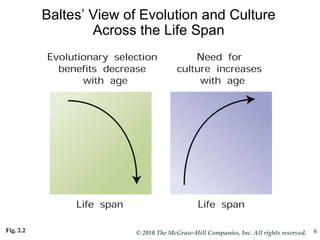
The Evolutionary Perspective Evolution and life-span development Natural selection  Benefits decrease with age Failures:  harmful conditions and non-adaptive characteristics As adults weaken biologically, culture-based needs increase Alternative:  bi-directional view
Fig. 2.2 Baltes’ View of Evolution and Culture Across the Life Span
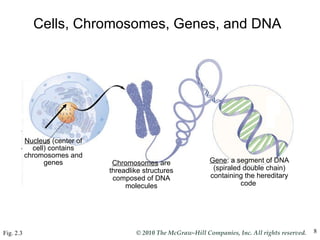
Genetic Foundations of Development The collaborative gene Nucleus of a human cell: Chromosomes  —  thread-like structures   DNA  —  double helix-shaped molecule Genes  —  units of hereditary information Human Genome Project 20,500 genes in humans Genetic expression  and inherited traits
Cells, Chromosomes, Genes, and DNA Fig. 2.3 Nucleus  (center of cell) contains chromosomes and genes Chromosomes  are threadlike structures composed of DNA molecules Gene : a segment of DNA (spiraled double chain) containing the hereditary code
Genetic Foundations of Development Genes and chromosomes Mitosis  — cell nucleus duplicates Meiosis  —  cell division forms gametes Fertilization  —  egg and sperm form zygote Genetic variability in the population X and Y chromosomes determine sex
Genetic Foundations of Development Genes and chromosomes Sources of variability Each zygote is unique Identical and fraternal twins Muted genes due to environmental agent Genotype: all of one’s genetic makeup Phenotype: observable characteristics
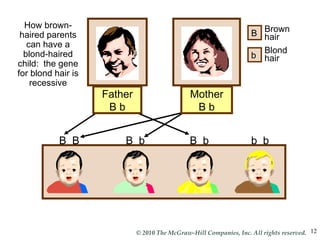
Genetic Foundations of Development Genetic principles Dominant and recessive genes Sex-linked genes X-linked inheritance for males and female Genetic imprinting Imprinted gene dominates Poly-genetically determined characteristics Many genes interact to influence a trait
b  b B  b B  b B  B b B Blond hair Brown hair How brown-haired parents can have a blond-haired child:  the gene for blond hair is recessive Mother B b Father B b
Genetic Foundations of Development Chromosomal and gene-linked abnormalities Down syndrome: 2 copies of chromosome 21 Sex-linked abnormalities Klinefelter syndrome: XXY instead of XY Fragile X syndrome: X in boys is fragile, breaks Turner syndrome: girl is XO instead of XX XYY syndrome: link to criminal males unproven
Genetic Foundations of Development Chromosomal and gene-linked abnormalities Gene-linked abnormalities Phenylketonuria (PKU) – treated by diet Sickle-cell anemia – red blood cells affected Cystic fibrosis, diabetes, hemophilia, spina bifida, Tay-sachs and Huntington diseases  Can sometimes be compensated for by other genes or events
Heredity and Environment Interaction: The Nature-Nurture Debate Behavior genetics  Studies genetic impact on traits and development Tests for genetic/environmental influences Twin studies Shared and nonshared factors  Adoption studies Effects of biological and adoptive parents
Heredity and Environment Interaction: The Nature-Nurture Debate Heredity-environment correlations Passive  genotype-environment  Parents provide/guide child’s interests Evocative  genotype-environment  Some traits elicit more adult responses Active  (niche-picking) genotype-environment Child seeks/selects favorable environments
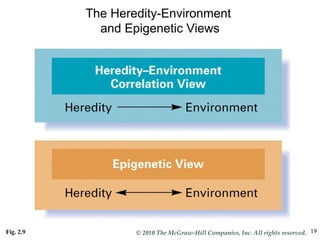
Heredity and Environment Interaction: The Nature-Nurture Debate Heredity-environment correlations Heredity directs environmental experiences In infancy, environment mostly parent-controlled As child ages, experiences extend beyond family Some environments can mute or strengthen genetic traits Critics: heredity gets too much credit
Heredity and Environment Interaction: The Nature-Nurture Debate Epigenetic view Development is ongoing Bi-directional interchange of heredity/environment Infancy Positive and negative environmental experiences can modify genetic activity
The Heredity-Environment  and Epigenetic Views Fig. 2.9
Prenatal Development Course of prenatal development Germinal period: creation of fertilized egg Embryonic period: cell differentiation of embryo Endoderm – digestive/respiratory systems Ectoderm – nervous system, sensory receptors Mesoderm – circulatory, bones, muscles, excretory and reproductive systems Organagenesis : organ formation
Prenatal Development Course of prenatal development Fetal period: lasts for 7 months, 3 trimesters Brain: 100 billion neurons (nerve cells) Neural tube  formed from ectoderm Birth defects can cause death, retardation Neurogenesis  – new cells formed  Neuronal migration  – cell specialization
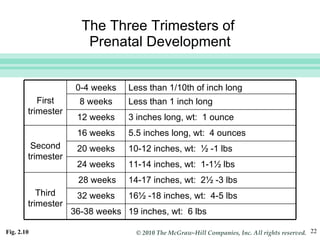
The Three Trimesters of  Prenatal Development Fig. 2.10   First trimester 0-4 weeks Less than 1/10th of inch long 8 weeks Less than 1 inch long 12 weeks 3 inches long, wt:  1 ounce Second trimester 16 weeks 5.5 inches long, wt:  4 ounces 20 weeks 10-12 inches, wt:  ½ -1 lbs 24 weeks 11-14 inches, wt:  1-1½ lbs Third trimester 28 weeks 14-17 inches, wt:  2½ -3 lbs 32 weeks 16½ -18 inches, wt:  4-5 lbs 36-38 weeks 19 inches, wt:  6 lbs
Prenatal Diagnostic Tests Tests for abnormality Ultrasound sonography Fetal MRI : better than ultrasound  Chorionic villus sampling : samples placenta Amniocentesis : samples amniotic fluid Maternal blood screening  (triple screen test) Noninvasive prenatal diagnosis (NIPD) : tests fetal cells (DNA) in mother’s blood
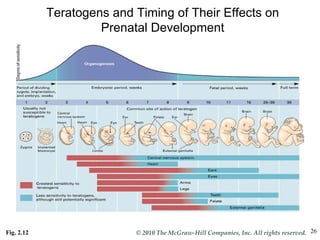
Hazards to Prenatal Development Teratogens Agents causing birth defects Severity of damage affected by Dose Genetic susceptibility Time of exposure Prescription, nonprescription drugs
Hazards to Prenatal Development Teratogens Psychoactive drugs Caffeine, cocaine, methamphetamines, marijuana, and heroin  Alcohol and fetal alcohol syndrome (FAS)  Nicotine’s link to SIDS, ADHD, low birth weight Paternal smoking during pregnancy
Fig. 2.12 Teratogens and Timing of Their Effects on Prenatal Development
Hazards to Prenatal Development Other prenatal factors Incompatible blood types ( Rh factor ) Maternal diseases STDs, HIV and AIDS; Rubella measles Diet and nutrition (vitamins, folic acid); weight Toxins in foods, mercury in fish Maternal age, emotional states, and stress Environmental hazards (toxins, waste)
Prenatal Care Prenatal care varies around the world Quality of medical care visits, education Low-birth weight and infant mortality rates Outside the United States: free/low cost prenatal care, liberal maternity leave Impact of cultural/ethnic beliefs about pregnancy
Birth Birth process Stages of birth Labor occurs in three stages:  Uterine contractions  Baby’s head begins to enter birth canal Afterbirth (shortest stage) Birth attendants vary across cultures Midwifery Doula
Birth Methods of childbirth Natural childbirth : reduce maternal pain through education (breathing, relaxation techniques) Prepared childbirth : Lamaze method Nonmedicated techniques to reduce pain Waterbirth Massage, acupuncture, hypnosis Music therapy
Birth Methods of childbirth Cesarean delivery (surgical procedure) Breech position  birth Benefits and risks continue being debated From fetus to newborn Vernix caseosa  (protective skin grease at birth) Baby must withstand stress of birth
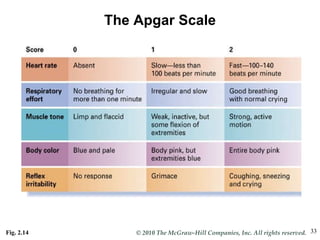
Birth Assessing the newborn Apgar Scale :  heart, reflexes, and color Brazelton Neonatal Behavioral Assessment Scale (BNBAS) A sensitive index of neurological competence Neonatal Intensive Care Unit Network Neurobehavioral Scale (NNNS) Analysis of behavior, neurological and stress responses, and regulatory capacities
Fig. 2.14  The Apgar Scale
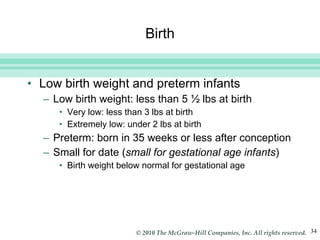
Birth Low birth weight and preterm infants Low birth weight: less than 5 ½ lbs at birth Very low: less than 3 lbs at birth Extremely low: under 2 lbs at birth Preterm: born in 35 weeks or less after conception Small for date ( small for gestational age infants ) Birth weight below normal for gestational age
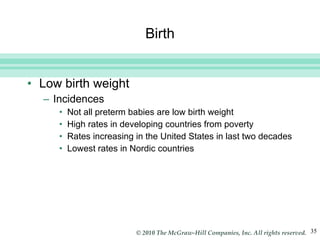
Birth Low birth weight  Incidences  Not all preterm babies are low birth weight High rates in developing countries from poverty Rates increasing in the United States in last two decades Lowest rates in Nordic countries
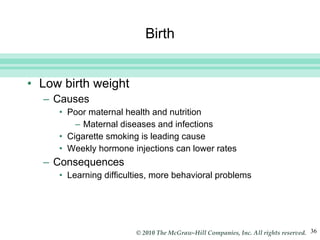
Birth Low birth weight Causes  Poor maternal health and nutrition Maternal diseases and infections Cigarette smoking is leading cause Weekly hormone injections can lower rates Consequences Learning difficulties, more behavioral problems
Birth Nurturing preterm infants Intensive enrichment (medical, educational) Neonatal Intensive Care Unit (NICU) interventions Kangaroo care: skin-to-skin contact Stabilizes bodily functions (ie: breathing)  Better sleep, weight gain, more alertness Massage therapy
Birth  Bonding  Special part of parent-infant relationship Needs to occur shortly after birth Early emotional attachments may create healthy interactions after leaving hospital Rooming-in  arrangements offered Massages and tactile stimulation for premature infants affect development
The End

Dev Psych.ch2.keynote

  • 1.
    A Topical Approachto LIFE-SPAN DEVELOPMENT John W. Santrock Chapter Two: Biological Beginnings
  • 2.
    The Evolutionary PerspectiveNatural selection Evolutionary process where the best adapted individuals in a species survive and reproduce Natural selection and adaptive behavior Darwin: On the Origin of Species (1859) All organisms must adapt in life
  • 3.
    The Evolutionary PerspectiveEvolutionary psychology Emphasizes adaptation, reproduction, and survival of the fittest in shaping behavior Evolution explains human physical features and behaviors
  • 4.
    The Evolutionary PerspectiveEvolutionary developmental psychology Explaining humans and their behavior Larger brains and more complex societies Takes longest of all mammals to mature Some evolved mechanisms of adaptation not compatible with modern society
  • 5.
    The Evolutionary PerspectiveEvolution and life-span development Natural selection Benefits decrease with age Failures: harmful conditions and non-adaptive characteristics As adults weaken biologically, culture-based needs increase Alternative: bi-directional view
  • 6.
    Fig. 2.2 Baltes’View of Evolution and Culture Across the Life Span
  • 7.
    Genetic Foundations ofDevelopment The collaborative gene Nucleus of a human cell: Chromosomes — thread-like structures DNA — double helix-shaped molecule Genes — units of hereditary information Human Genome Project 20,500 genes in humans Genetic expression and inherited traits
  • 8.
    Cells, Chromosomes, Genes,and DNA Fig. 2.3 Nucleus (center of cell) contains chromosomes and genes Chromosomes are threadlike structures composed of DNA molecules Gene : a segment of DNA (spiraled double chain) containing the hereditary code
  • 9.
    Genetic Foundations ofDevelopment Genes and chromosomes Mitosis — cell nucleus duplicates Meiosis — cell division forms gametes Fertilization — egg and sperm form zygote Genetic variability in the population X and Y chromosomes determine sex
  • 10.
    Genetic Foundations ofDevelopment Genes and chromosomes Sources of variability Each zygote is unique Identical and fraternal twins Muted genes due to environmental agent Genotype: all of one’s genetic makeup Phenotype: observable characteristics
  • 11.
    Genetic Foundations ofDevelopment Genetic principles Dominant and recessive genes Sex-linked genes X-linked inheritance for males and female Genetic imprinting Imprinted gene dominates Poly-genetically determined characteristics Many genes interact to influence a trait
  • 12.
    b bB b B b B B b B Blond hair Brown hair How brown-haired parents can have a blond-haired child: the gene for blond hair is recessive Mother B b Father B b
  • 13.
    Genetic Foundations ofDevelopment Chromosomal and gene-linked abnormalities Down syndrome: 2 copies of chromosome 21 Sex-linked abnormalities Klinefelter syndrome: XXY instead of XY Fragile X syndrome: X in boys is fragile, breaks Turner syndrome: girl is XO instead of XX XYY syndrome: link to criminal males unproven
  • 14.
    Genetic Foundations ofDevelopment Chromosomal and gene-linked abnormalities Gene-linked abnormalities Phenylketonuria (PKU) – treated by diet Sickle-cell anemia – red blood cells affected Cystic fibrosis, diabetes, hemophilia, spina bifida, Tay-sachs and Huntington diseases Can sometimes be compensated for by other genes or events
  • 15.
    Heredity and EnvironmentInteraction: The Nature-Nurture Debate Behavior genetics Studies genetic impact on traits and development Tests for genetic/environmental influences Twin studies Shared and nonshared factors Adoption studies Effects of biological and adoptive parents
  • 16.
    Heredity and EnvironmentInteraction: The Nature-Nurture Debate Heredity-environment correlations Passive genotype-environment Parents provide/guide child’s interests Evocative genotype-environment Some traits elicit more adult responses Active (niche-picking) genotype-environment Child seeks/selects favorable environments
  • 17.
    Heredity and EnvironmentInteraction: The Nature-Nurture Debate Heredity-environment correlations Heredity directs environmental experiences In infancy, environment mostly parent-controlled As child ages, experiences extend beyond family Some environments can mute or strengthen genetic traits Critics: heredity gets too much credit
  • 18.
    Heredity and EnvironmentInteraction: The Nature-Nurture Debate Epigenetic view Development is ongoing Bi-directional interchange of heredity/environment Infancy Positive and negative environmental experiences can modify genetic activity
  • 19.
    The Heredity-Environment and Epigenetic Views Fig. 2.9
  • 20.
    Prenatal Development Courseof prenatal development Germinal period: creation of fertilized egg Embryonic period: cell differentiation of embryo Endoderm – digestive/respiratory systems Ectoderm – nervous system, sensory receptors Mesoderm – circulatory, bones, muscles, excretory and reproductive systems Organagenesis : organ formation
  • 21.
    Prenatal Development Courseof prenatal development Fetal period: lasts for 7 months, 3 trimesters Brain: 100 billion neurons (nerve cells) Neural tube formed from ectoderm Birth defects can cause death, retardation Neurogenesis – new cells formed Neuronal migration – cell specialization
  • 22.
    The Three Trimestersof Prenatal Development Fig. 2.10 First trimester 0-4 weeks Less than 1/10th of inch long 8 weeks Less than 1 inch long 12 weeks 3 inches long, wt: 1 ounce Second trimester 16 weeks 5.5 inches long, wt: 4 ounces 20 weeks 10-12 inches, wt: ½ -1 lbs 24 weeks 11-14 inches, wt: 1-1½ lbs Third trimester 28 weeks 14-17 inches, wt: 2½ -3 lbs 32 weeks 16½ -18 inches, wt: 4-5 lbs 36-38 weeks 19 inches, wt: 6 lbs
  • 23.
    Prenatal Diagnostic TestsTests for abnormality Ultrasound sonography Fetal MRI : better than ultrasound Chorionic villus sampling : samples placenta Amniocentesis : samples amniotic fluid Maternal blood screening (triple screen test) Noninvasive prenatal diagnosis (NIPD) : tests fetal cells (DNA) in mother’s blood
  • 24.
    Hazards to PrenatalDevelopment Teratogens Agents causing birth defects Severity of damage affected by Dose Genetic susceptibility Time of exposure Prescription, nonprescription drugs
  • 25.
    Hazards to PrenatalDevelopment Teratogens Psychoactive drugs Caffeine, cocaine, methamphetamines, marijuana, and heroin Alcohol and fetal alcohol syndrome (FAS) Nicotine’s link to SIDS, ADHD, low birth weight Paternal smoking during pregnancy
  • 26.
    Fig. 2.12 Teratogensand Timing of Their Effects on Prenatal Development
  • 27.
    Hazards to PrenatalDevelopment Other prenatal factors Incompatible blood types ( Rh factor ) Maternal diseases STDs, HIV and AIDS; Rubella measles Diet and nutrition (vitamins, folic acid); weight Toxins in foods, mercury in fish Maternal age, emotional states, and stress Environmental hazards (toxins, waste)
  • 28.
    Prenatal Care Prenatalcare varies around the world Quality of medical care visits, education Low-birth weight and infant mortality rates Outside the United States: free/low cost prenatal care, liberal maternity leave Impact of cultural/ethnic beliefs about pregnancy
  • 29.
    Birth Birth processStages of birth Labor occurs in three stages: Uterine contractions Baby’s head begins to enter birth canal Afterbirth (shortest stage) Birth attendants vary across cultures Midwifery Doula
  • 30.
    Birth Methods ofchildbirth Natural childbirth : reduce maternal pain through education (breathing, relaxation techniques) Prepared childbirth : Lamaze method Nonmedicated techniques to reduce pain Waterbirth Massage, acupuncture, hypnosis Music therapy
  • 31.
    Birth Methods ofchildbirth Cesarean delivery (surgical procedure) Breech position birth Benefits and risks continue being debated From fetus to newborn Vernix caseosa (protective skin grease at birth) Baby must withstand stress of birth
  • 32.
    Birth Assessing thenewborn Apgar Scale : heart, reflexes, and color Brazelton Neonatal Behavioral Assessment Scale (BNBAS) A sensitive index of neurological competence Neonatal Intensive Care Unit Network Neurobehavioral Scale (NNNS) Analysis of behavior, neurological and stress responses, and regulatory capacities
  • 33.
    Fig. 2.14 The Apgar Scale
  • 34.
    Birth Low birthweight and preterm infants Low birth weight: less than 5 ½ lbs at birth Very low: less than 3 lbs at birth Extremely low: under 2 lbs at birth Preterm: born in 35 weeks or less after conception Small for date ( small for gestational age infants ) Birth weight below normal for gestational age
  • 35.
    Birth Low birthweight Incidences Not all preterm babies are low birth weight High rates in developing countries from poverty Rates increasing in the United States in last two decades Lowest rates in Nordic countries
  • 36.
    Birth Low birthweight Causes Poor maternal health and nutrition Maternal diseases and infections Cigarette smoking is leading cause Weekly hormone injections can lower rates Consequences Learning difficulties, more behavioral problems
  • 37.
    Birth Nurturing preterminfants Intensive enrichment (medical, educational) Neonatal Intensive Care Unit (NICU) interventions Kangaroo care: skin-to-skin contact Stabilizes bodily functions (ie: breathing) Better sleep, weight gain, more alertness Massage therapy
  • 38.
    Birth Bonding Special part of parent-infant relationship Needs to occur shortly after birth Early emotional attachments may create healthy interactions after leaving hospital Rooming-in arrangements offered Massages and tactile stimulation for premature infants affect development
  • 39.