 Logistic II “A”
 Date: January/18/2016
 GRADE: 10
• Laura Andrade
• David Cox
• David Coto
• Arianna Espinoza
• Nicole García
• Helanny Rendón
• Carolina Vélez
• Lecturer
Mr Max Galarza
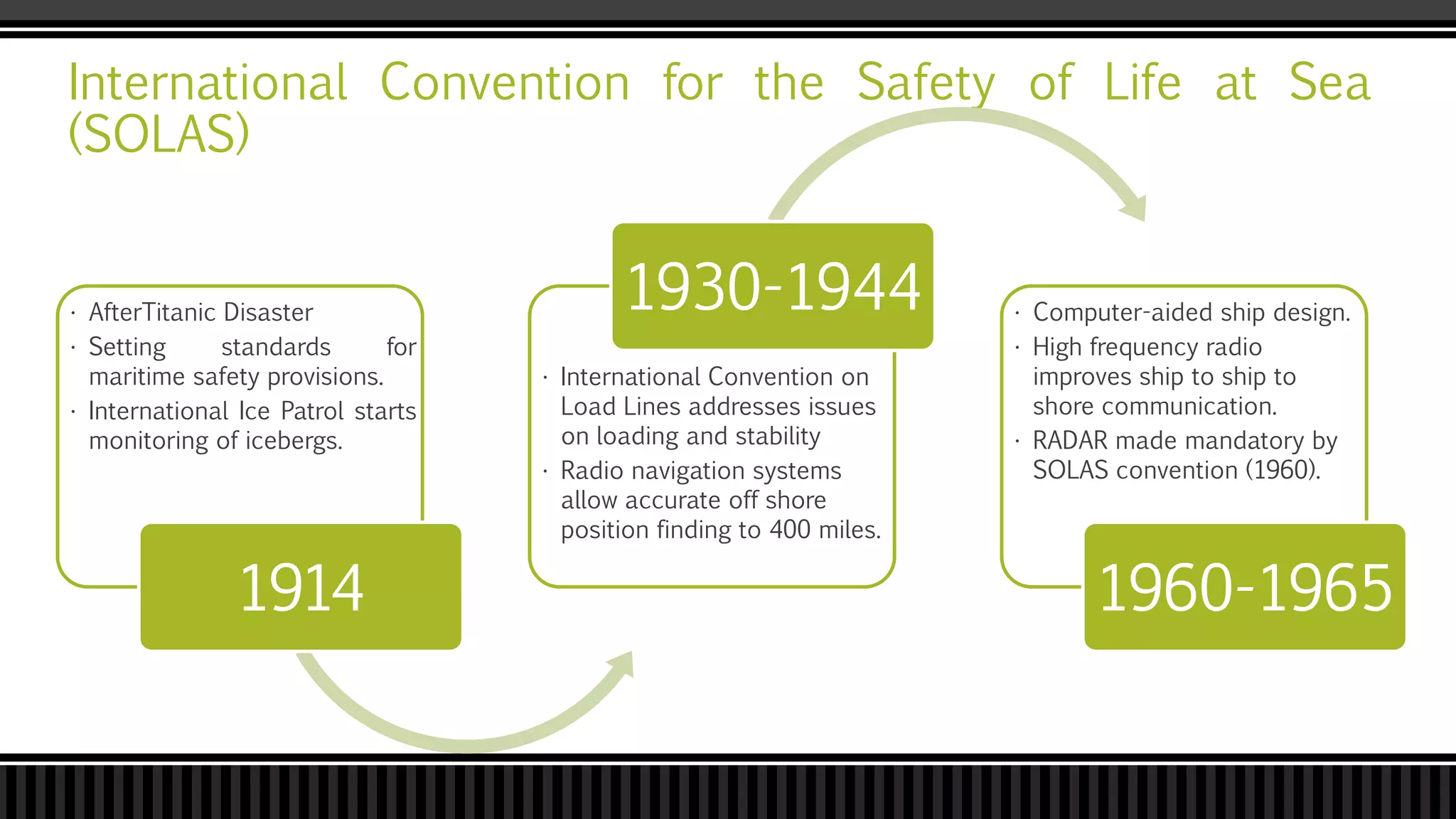
International Convention for the Safety of Life at Sea
(SOLAS)
• AfterTitanic Disaster
• Setting standards for
maritime safety provisions.
• International Ice Patrol starts
monitoring of icebergs.
1914
• International Convention on
Load Lines addresses issues
on loading and stability
• Radio navigation systems
allow accurate off shore
position finding to 400 miles.
1930-1944 • Computer-aided ship design.
• High frequency radio
improves ship to ship to
shore communication.
• RADAR made mandatory by
SOLAS convention (1960).
1960-1965
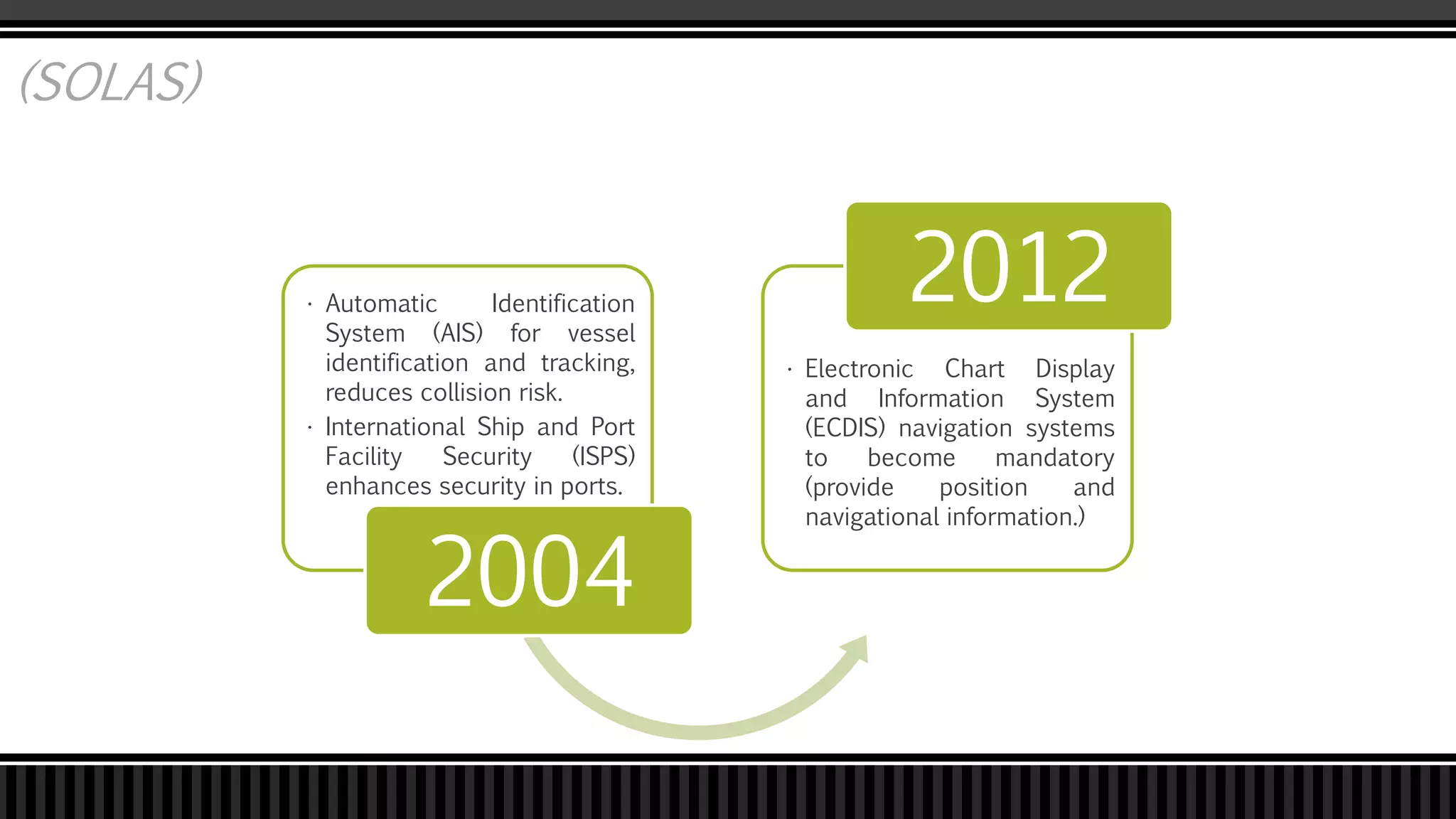
(SOLAS)
• “Transit”, first satellite-based
positioning system for
merchant ships.
1967
• International Convention on
Standards of Training and
Certification and
Watchkeeping for Seafarers
establishes basic training and
certification requirements.
1978 • International Safety
Management (ISM code)
established standards for
safe management and
operation of ships.
1993
(SOLAS)
• Automatic Identification
System (AIS) for vessel
identification and tracking,
reduces collision risk.
• International Ship and Port
Facility Security (ISPS)
enhances security in ports.
2004
• Electronic Chart Display
and Information System
(ECDIS) navigation systems
to become mandatory
(provide position and
navigational information.)
2012
A distress alert should be transmitted if, in the opinion of the Master, the ship
or a person is in distress and requires immediate assistance.
Distress alert should as far as possible include:
 The ship's last known position and the time (in UTC) when it was valid.
 The position and the time may be included automatically by the ship's
navigational equipment or may be inserted manually.
Life Saving Signals
Replies from maritime rescue units
to distress signals
Signals to be employed in
connection with the use of shore
lifesaving apparatus
Flares
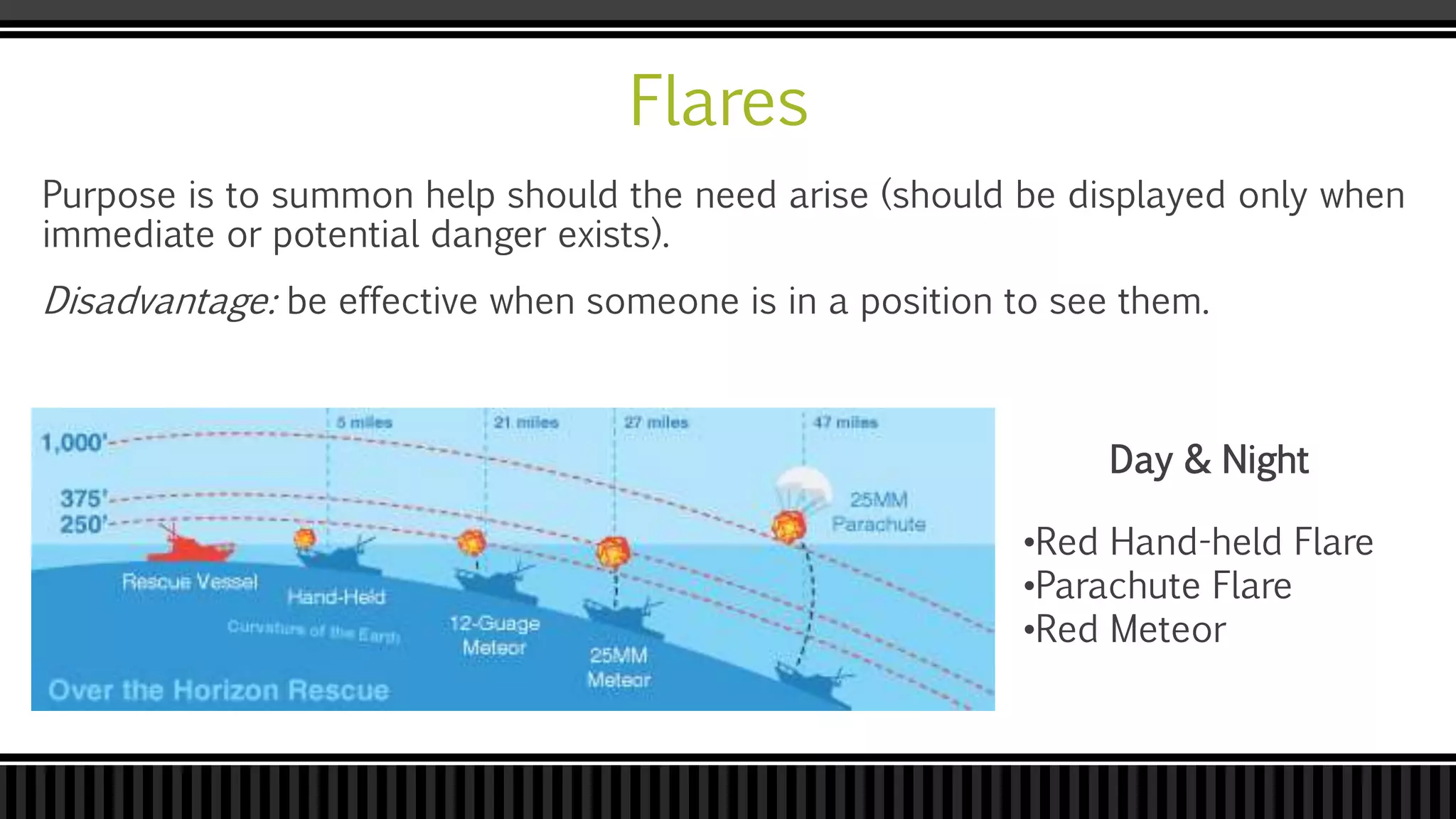
Purpose is to summon help should the need arise (should be displayed only when
immediate or potential danger exists).
Disadvantage: be effective when someone is in a position to see them.
•Red Hand-held Flare
•Parachute Flare
•Red Meteor
Day & Night
Code Flags
 Single-letter signals which are very urgent, important, or common.
Smoke Signals
Smoke signals are designed to help pinpoint
the location of a vessel in distress.
Emitting a thick, colored smoke rather than
light.
No use in the dark, but in daylight, a big
plume of colored smoke is often more
visible than the bright but relatively small
light emitted by a handheld flare.
Morse Code
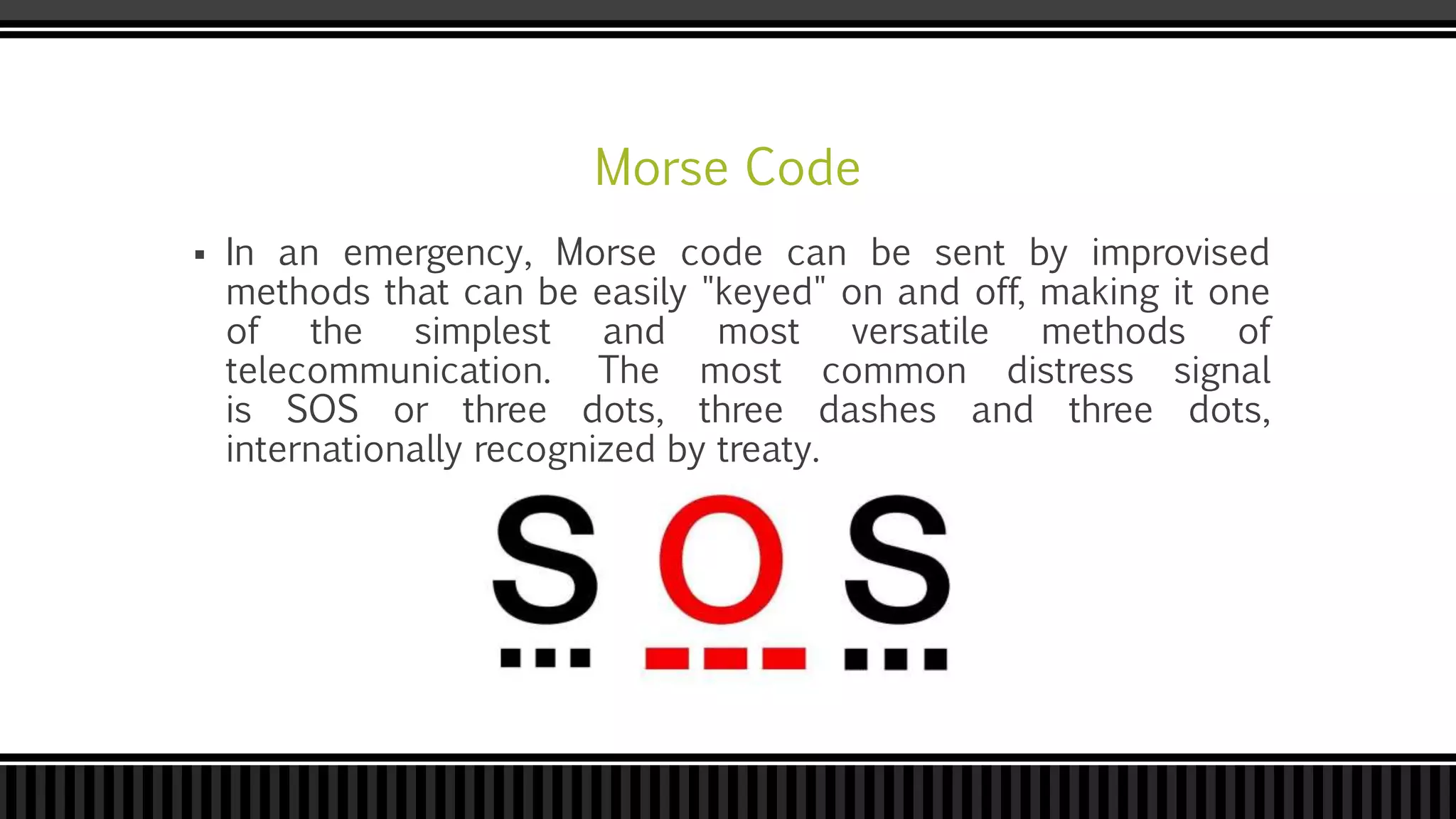
 In an emergency, Morse code can be sent by improvised
methods that can be easily "keyed" on and off, making it one
of the simplest and most versatile methods of
telecommunication. The most common distress signal
is SOS or three dots, three dashes and three dots,
internationally recognized by treaty.
Instruments
Alarms
 General Alarm: The general alarm on the ship is
recognized by 7 short ringing of bell followed by a long
ring or 7 short blasts on the ship’s horn followed by
one long blast. The general alarm is sounded to make
aware the crew on board that an emergency has
occurred.
 Fire Alarm: A fire alarm is sounded as continuous
ringing of ship’s electrical bell or continuous sounding
of ship’s horn.
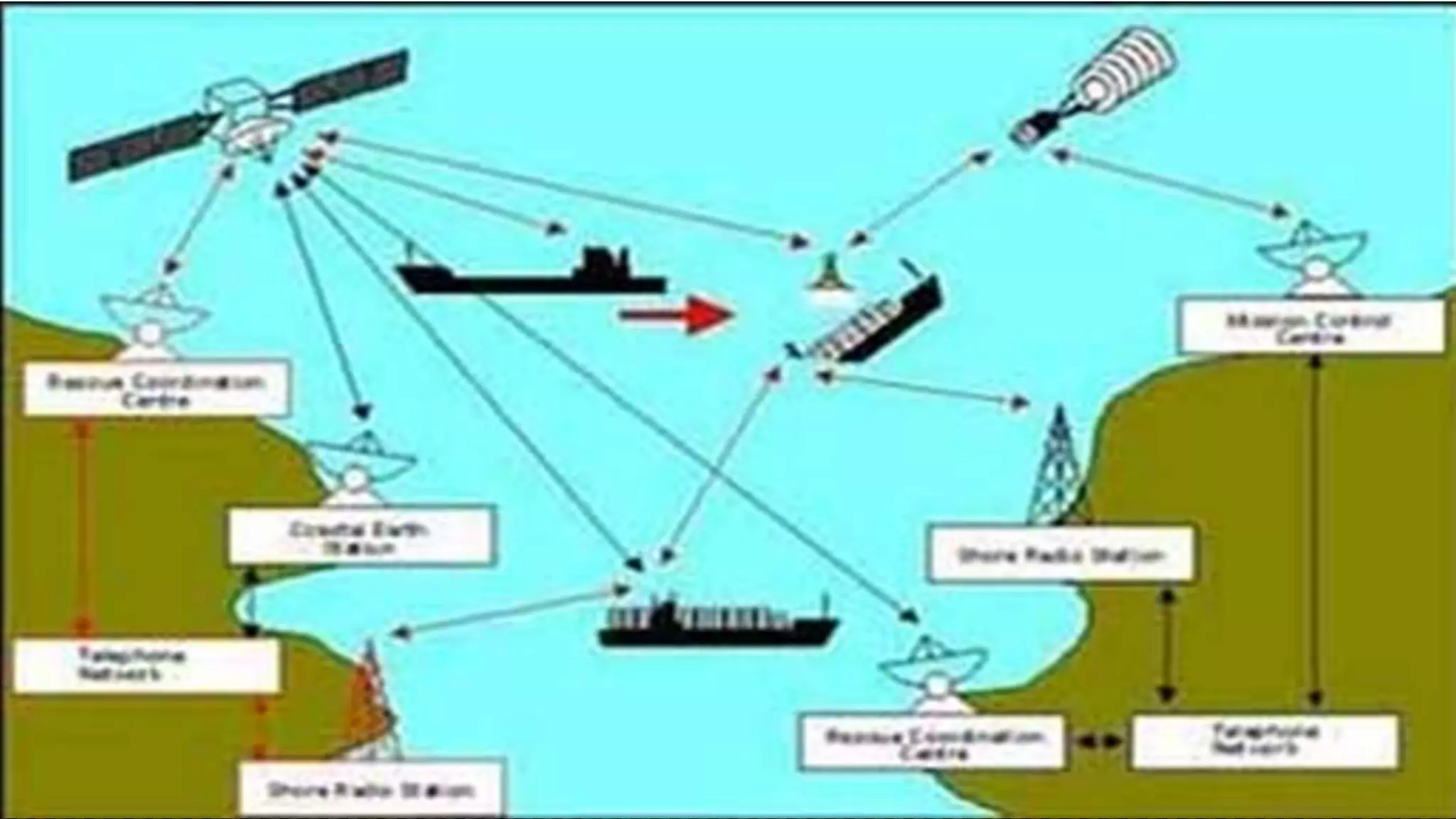
 Ship Security Alarm System: Most of the ocean going vessels
are fitted with security alert alarm system, which is a silent
alarm system sounded in a pirate attack emergency. This
signal is connected with different coastal authorities all over
the world via a global satellite system to inform about the
piracy.
 Navigational Alarm: In the navigation bridge, most of the
navigational equipments and navigation lights are fitted with
failure alarm. If any of these malfunctions, an alarm will be
sounded in an alarm panel displaying which system is
malfunctioning.
Parachute
 For use in day and night long range distress signal
situations.
 Ideally should be stored in the robust, specially
designed polybottle, or in a dry, easily accessed
location at ambient temperature.
 How to use:
Hold securely at arms length, vertically above head,
turn head away and pull toggle. Rocket is ejected
instantaneously with a loud report and slight recoil.
Ensure that rocket is not aimed at people or property
Gun for flares
 A flare is a tube packed with explosive chemicals that burn
very brightly or give off smoke.
 Main kinds are handheld flares (which operate on the
ground) and rocket flares (which are fired into the air).
 Colors:
Red and orange flares always indicate distress.
White flares work usually designed to illuminate an area at night (for
example, if someone falls overboard) or to prevent imminent
collisions at sea (by indicating a ship or boat's position to another
vessel); they don't normally indicate danger.
Flares: How are they used?
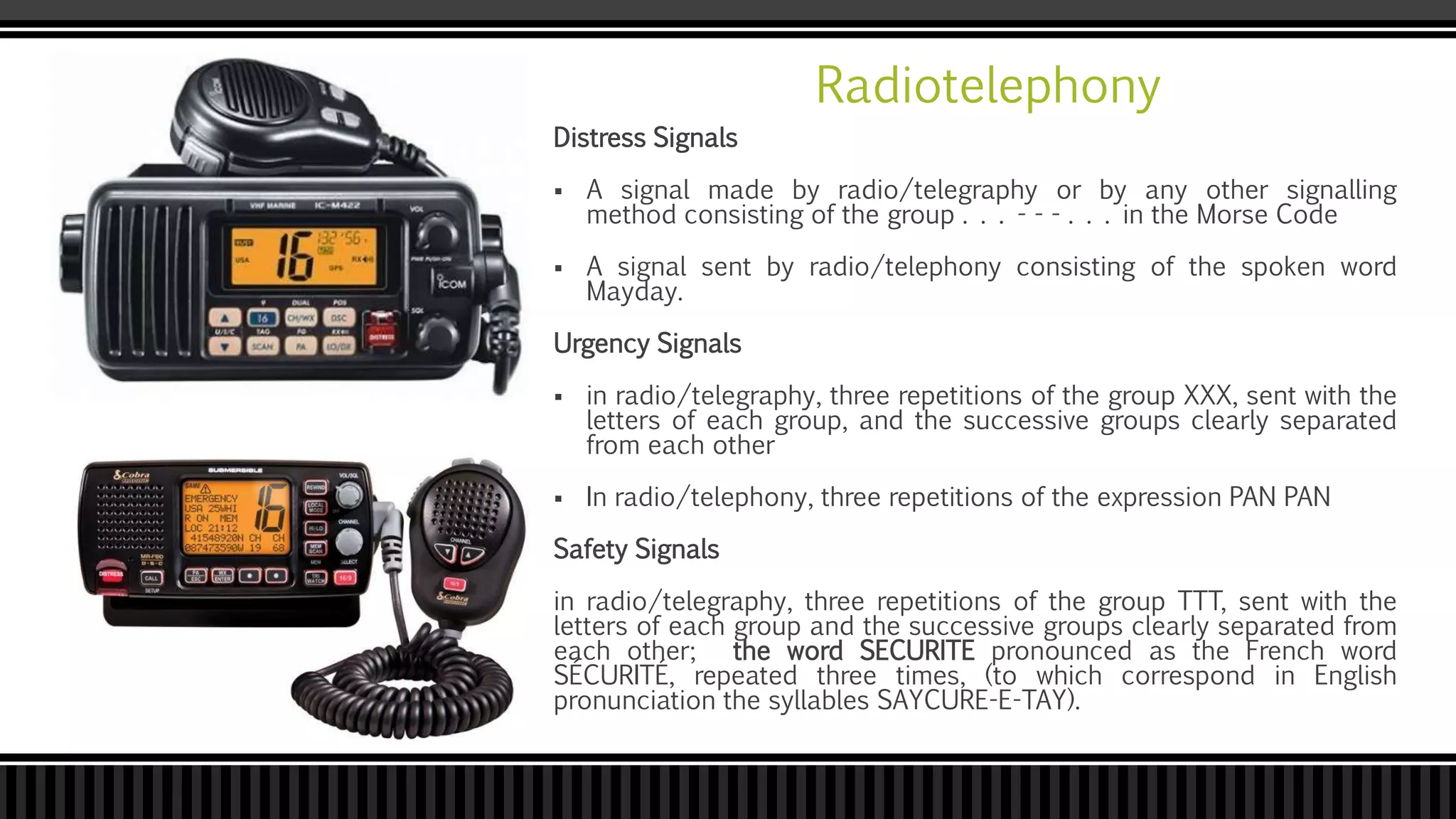
Radiotelephony
Distress Signals
 A signal made by radio/telegraphy or by any other signalling
method consisting of the group . . . - - - . . . in the Morse Code
 A signal sent by radio/telephony consisting of the spoken word
Mayday.
Urgency Signals
 in radio/telegraphy, three repetitions of the group XXX, sent with the
letters of each group, and the successive groups clearly separated
from each other
 In radio/telephony, three repetitions of the expression PAN PAN
Safety Signals
in radio/telegraphy, three repetitions of the group TTT, sent with the
letters of each group and the successive groups clearly separated from
each other; the word SECURITE pronounced as the French word
SÉCURITÉ, repeated three times, (to which correspond in English
pronunciation the syllables SAYCURE-E-TAY).
Marine Radios
The DSC distress alert is transmitted as follows:
 tune the transmitter to the DSC distress channel (2 187.5
kHz on MF, channel 70 on VHF)
 if time permits, key in or select on the DSC equipment
keyboard
– the nature of distress,
– the ship's last known position (latitude and longitude)
– the time (in UTC) the position was valid
– type of subsequent distress communication (telephony)
Marine Radio: Example
Ships receiving a DSC distress alert from another
ship shall:
 watch for the reception of a distress
acknowledgment on the distress channel
(2187.5 kHz on MF and channel 70 on VHF);
 acknowledge the receipt of the distress alert by
transmitting on channel 16 on VHF:
– "MAYDAY",
– the 9-digit identity of the ship in distress, repeated 3
times,
– "this is",
– the 9-digit identity or the call sign or other
identification of own ship, repeated 3 times,
– "RECEIVED MAYDAY".
Sea dye marker
 It is a lifesaving device used for sea rescue.
 Use on all military aircraft and vessels.
 Contain a fluorescent green dye that spreads
over the surface of the water so as to increase
visibility for a rescue pilot to see.
 Can be seen for a mile or more and lasts for 30
to 40 minutes.
 Wind and the choppiness of the water will affect
the shape of the pattern.
Sources
ALLIANZ. (2014). Safety and Shipping 1912-2012: From Titanic to Costa Concordia.
Retrieved January 26, 2016, from http://www.agcs.allianz.com/insights/white-
papers-and-case-studies/safety-and-shipping-report/
Boar US. (n.d.). Flares and Distress Signals. Retrieved from
http://www.boatus.org/distress-signals/
Boat Safe. (n.d.). Distress Signals. Retrieved from
http://www.boatsafe.com/nauticalknowhow/distress.htm
Navigation Center. (2010). DSC DISTRESS. Retrieved from
http://www.navcen.uscg.gov/?pageName=DSCDistressRúa, C. (2006). Los
puertos en el transporte marítimo. Retrieved from
https://upcommons.upc.edu/bitstream/handle/2117/289/8.%20Rua.pdf?seque
nce=1
Navigation Center. (2010). Distress Signals. Retrieved from
http://www.navcen.uscg.gov/pdf/navRules/Annexes/CGNAVRULES_20141118_A
nnex_4.pdf

Life saving signals

  • 1.
     Logistic II“A”  Date: January/18/2016  GRADE: 10 • Laura Andrade • David Cox • David Coto • Arianna Espinoza • Nicole García • Helanny Rendón • Carolina Vélez • Lecturer Mr Max Galarza
  • 2.
    International Convention forthe Safety of Life at Sea (SOLAS) • AfterTitanic Disaster • Setting standards for maritime safety provisions. • International Ice Patrol starts monitoring of icebergs. 1914 • International Convention on Load Lines addresses issues on loading and stability • Radio navigation systems allow accurate off shore position finding to 400 miles. 1930-1944 • Computer-aided ship design. • High frequency radio improves ship to ship to shore communication. • RADAR made mandatory by SOLAS convention (1960). 1960-1965
  • 3.
    (SOLAS) • “Transit”, firstsatellite-based positioning system for merchant ships. 1967 • International Convention on Standards of Training and Certification and Watchkeeping for Seafarers establishes basic training and certification requirements. 1978 • International Safety Management (ISM code) established standards for safe management and operation of ships. 1993
  • 4.
    (SOLAS) • Automatic Identification System(AIS) for vessel identification and tracking, reduces collision risk. • International Ship and Port Facility Security (ISPS) enhances security in ports. 2004 • Electronic Chart Display and Information System (ECDIS) navigation systems to become mandatory (provide position and navigational information.) 2012
  • 6.
    A distress alertshould be transmitted if, in the opinion of the Master, the ship or a person is in distress and requires immediate assistance. Distress alert should as far as possible include:  The ship's last known position and the time (in UTC) when it was valid.  The position and the time may be included automatically by the ship's navigational equipment or may be inserted manually.
  • 8.
    Life Saving Signals Repliesfrom maritime rescue units to distress signals Signals to be employed in connection with the use of shore lifesaving apparatus
  • 10.
    Flares Purpose is tosummon help should the need arise (should be displayed only when immediate or potential danger exists). Disadvantage: be effective when someone is in a position to see them. •Red Hand-held Flare •Parachute Flare •Red Meteor Day & Night
  • 11.
    Code Flags  Single-lettersignals which are very urgent, important, or common.
  • 15.
    Smoke Signals Smoke signalsare designed to help pinpoint the location of a vessel in distress. Emitting a thick, colored smoke rather than light. No use in the dark, but in daylight, a big plume of colored smoke is often more visible than the bright but relatively small light emitted by a handheld flare.
  • 16.
    Morse Code  Inan emergency, Morse code can be sent by improvised methods that can be easily "keyed" on and off, making it one of the simplest and most versatile methods of telecommunication. The most common distress signal is SOS or three dots, three dashes and three dots, internationally recognized by treaty.
  • 17.
  • 18.
    Alarms  General Alarm:The general alarm on the ship is recognized by 7 short ringing of bell followed by a long ring or 7 short blasts on the ship’s horn followed by one long blast. The general alarm is sounded to make aware the crew on board that an emergency has occurred.  Fire Alarm: A fire alarm is sounded as continuous ringing of ship’s electrical bell or continuous sounding of ship’s horn.
  • 19.
     Ship SecurityAlarm System: Most of the ocean going vessels are fitted with security alert alarm system, which is a silent alarm system sounded in a pirate attack emergency. This signal is connected with different coastal authorities all over the world via a global satellite system to inform about the piracy.  Navigational Alarm: In the navigation bridge, most of the navigational equipments and navigation lights are fitted with failure alarm. If any of these malfunctions, an alarm will be sounded in an alarm panel displaying which system is malfunctioning.
  • 20.
    Parachute  For usein day and night long range distress signal situations.  Ideally should be stored in the robust, specially designed polybottle, or in a dry, easily accessed location at ambient temperature.  How to use: Hold securely at arms length, vertically above head, turn head away and pull toggle. Rocket is ejected instantaneously with a loud report and slight recoil. Ensure that rocket is not aimed at people or property
  • 21.
    Gun for flares A flare is a tube packed with explosive chemicals that burn very brightly or give off smoke.  Main kinds are handheld flares (which operate on the ground) and rocket flares (which are fired into the air).  Colors: Red and orange flares always indicate distress. White flares work usually designed to illuminate an area at night (for example, if someone falls overboard) or to prevent imminent collisions at sea (by indicating a ship or boat's position to another vessel); they don't normally indicate danger.
  • 22.
    Flares: How arethey used?
  • 23.
    Radiotelephony Distress Signals  Asignal made by radio/telegraphy or by any other signalling method consisting of the group . . . - - - . . . in the Morse Code  A signal sent by radio/telephony consisting of the spoken word Mayday. Urgency Signals  in radio/telegraphy, three repetitions of the group XXX, sent with the letters of each group, and the successive groups clearly separated from each other  In radio/telephony, three repetitions of the expression PAN PAN Safety Signals in radio/telegraphy, three repetitions of the group TTT, sent with the letters of each group and the successive groups clearly separated from each other; the word SECURITE pronounced as the French word SÉCURITÉ, repeated three times, (to which correspond in English pronunciation the syllables SAYCURE-E-TAY).
  • 24.
    Marine Radios The DSCdistress alert is transmitted as follows:  tune the transmitter to the DSC distress channel (2 187.5 kHz on MF, channel 70 on VHF)  if time permits, key in or select on the DSC equipment keyboard – the nature of distress, – the ship's last known position (latitude and longitude) – the time (in UTC) the position was valid – type of subsequent distress communication (telephony)
  • 25.
    Marine Radio: Example Shipsreceiving a DSC distress alert from another ship shall:  watch for the reception of a distress acknowledgment on the distress channel (2187.5 kHz on MF and channel 70 on VHF);  acknowledge the receipt of the distress alert by transmitting on channel 16 on VHF: – "MAYDAY", – the 9-digit identity of the ship in distress, repeated 3 times, – "this is", – the 9-digit identity or the call sign or other identification of own ship, repeated 3 times, – "RECEIVED MAYDAY".
  • 26.
    Sea dye marker It is a lifesaving device used for sea rescue.  Use on all military aircraft and vessels.  Contain a fluorescent green dye that spreads over the surface of the water so as to increase visibility for a rescue pilot to see.  Can be seen for a mile or more and lasts for 30 to 40 minutes.  Wind and the choppiness of the water will affect the shape of the pattern.
  • 27.
  • 28.
    ALLIANZ. (2014). Safetyand Shipping 1912-2012: From Titanic to Costa Concordia. Retrieved January 26, 2016, from http://www.agcs.allianz.com/insights/white- papers-and-case-studies/safety-and-shipping-report/ Boar US. (n.d.). Flares and Distress Signals. Retrieved from http://www.boatus.org/distress-signals/ Boat Safe. (n.d.). Distress Signals. Retrieved from http://www.boatsafe.com/nauticalknowhow/distress.htm Navigation Center. (2010). DSC DISTRESS. Retrieved from http://www.navcen.uscg.gov/?pageName=DSCDistressRúa, C. (2006). Los puertos en el transporte marítimo. Retrieved from https://upcommons.upc.edu/bitstream/handle/2117/289/8.%20Rua.pdf?seque nce=1 Navigation Center. (2010). Distress Signals. Retrieved from http://www.navcen.uscg.gov/pdf/navRules/Annexes/CGNAVRULES_20141118_A nnex_4.pdf