LIFE SAVING APPLIANCES
Life-saving appliances are those appliances that protect human life at sea.
These devices are documented and mandated as part of the SOLAS Convention.
The number and type of life-saving appliances differ from vessel to vessel.
However, SOLAS code gives a minimum requirement to comply in order to make a
vessel seaworthy.
When faced with an emergency situation at sea, getting external help quickly is not
easy.
It becomes extremely necessary for one to aid to a safer place on their own. This is
where life-saving appliances come to rescue.
One needs to rescue oneself, move fast and be safe.
Life-saving appliances, in such circumstances, have saved numerous lives over the
course of their use. They are further classified as collective and personal life-saving
appliances.
In this presentation, we shall focus on PERSONAL LIFE SAVING APPLIANCES
(PLSA).
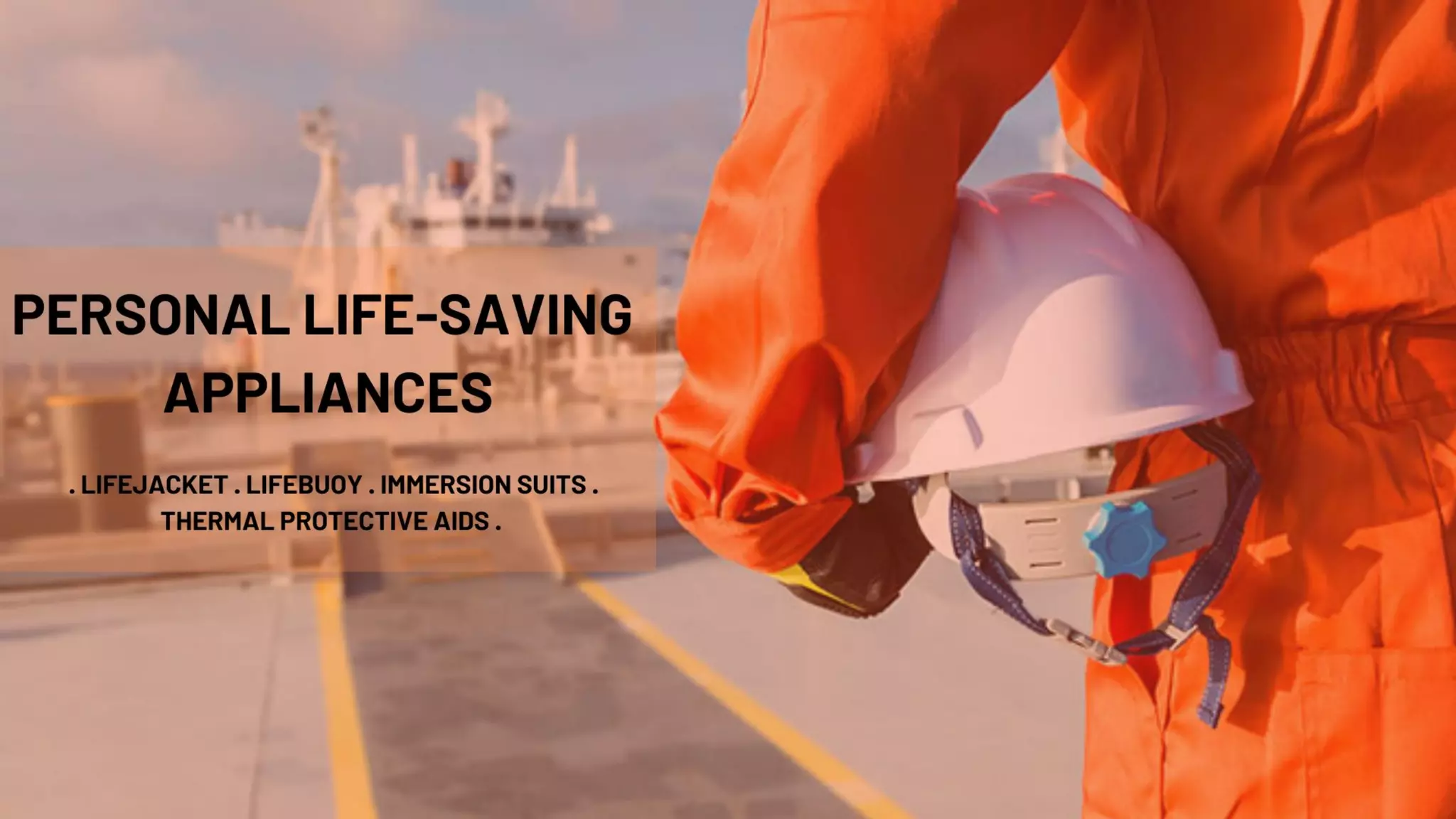
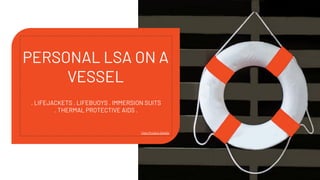
PERSONAL LSA ON A
VESSEL
. LIFEJACKETS . LIFEBUOYS . IMMERSION SUITS
. THERMAL PROTECTIVE AIDS .
View Product Details
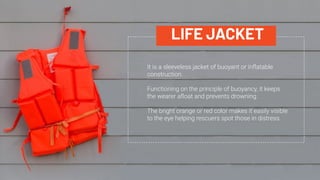
LIFE JACKET
It is a sleeveless jacket of buoyant or inflatable
construction.
Functioning on the principle of buoyancy, it keeps
the wearer afloat and prevents drowning.
The bright orange or red color makes it easily visible
to the eye helping rescuers spot those in distress.
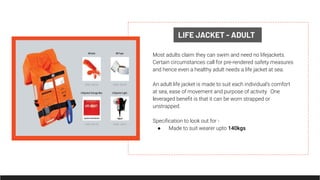
LIFE JACKET - ADULT
Most adults claim they can swim and need no lifejackets.
Certain circumstances call for pre-rendered safety measures
and hence even a healthy adult needs a life jacket at sea.
An adult life jacket is made to suit each individual's comfort
at sea, ease of movement and purpose of activity. One
leveraged benefit is that it can be worn strapped or
unstrapped.
Specification to look out for -
● Made to suit wearer upto 140kgs
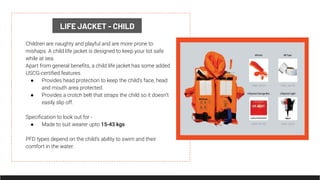
LIFE JACKET - CHILD
Children are naughty and playful and are more prone to
mishaps. A child life jacket is designed to keep your tot safe
while at sea.
Apart from general benefits, a child life jacket has some added
USCG-certified features.
● Provides head protection to keep the child’s face, head
and mouth area protected.
● Provides a crotch belt that straps the child so it doesn’t
easily slip off.
Specification to look out for -
● Made to suit wearer upto 15-43 kgs
PFD types depend on the child’s ability to swim and their
comfort in the water.
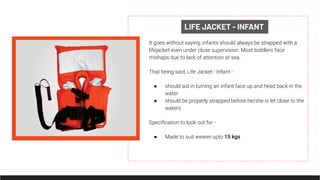
LIFE JACKET - INFANT
It goes without saying, infants should always be strapped with a
lifejacket even under close supervision. Most toddlers face
mishaps due to lack of attention at sea.
That being said, Life Jacket - Infant -
● should aid in turning an infant face up and head back in the
water
● should be properly strapped before he/she is let close to the
waters
Specification to look out for -
● Made to suit wearer upto 15 kgs
LIFE JACKET - LIGHT
A life jacket could be easily spotted in the daylight.
However, in the darkness, life jacket light helps to identify the
wearer in the waters.
● Increases visibility of seafarer at sea when in danger
● Luminous intensity of 0.75 cd in all directions of the
upper hemisphere
● Capable of providing luminous intensity for 8 hrs
● Could also be a flashing light, in which case, it is
provided with a manually operated switch with flash
rate of 50-70 flashes per min.
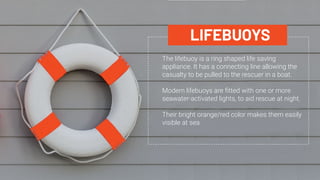
The lifebuoy is a ring shaped life saving
appliance. It has a connecting line allowing the
casualty to be pulled to the rescuer in a boat.
Modern lifebuoys are fitted with one or more
seawater-activated lights, to aid rescue at night.
Their bright orange/red color makes them easily
visible at sea.
LIFEBUOYS
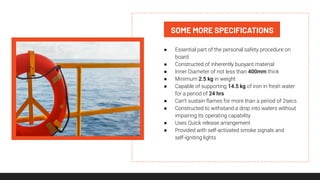
SOME MORE SPECIFICATIONS
● Essential part of the personal safety procedure on
board
● Constructed of inherently buoyant material
● Inner Diameter of not less than 400mm thick
● Minimum 2.5 kg in weight
● Capable of supporting 14.5 kg of iron in fresh water
for a period of 24 hrs
● Can’t sustain flames for more than a period of 2secs
● Constructed to withstand a drop into waters without
impairing its operating capability
● Uses Quick release arrangement
● Provided with self-activated smoke signals and
self-igniting lights
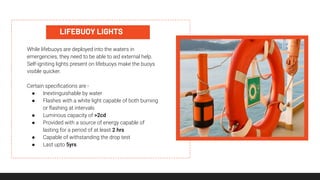
LIFEBUOY LIGHTS
While lifebuoys are deployed into the waters in
emergencies, they need to be able to aid external help.
Self-igniting lights present on lifebuoys make the buoys
visible quicker.
Certain specifications are -
● Inextinguishable by water
● Flashes with a white light capable of both burning
or flashing at intervals
● Luminous capacity of >2cd
● Provided with a source of energy capable of
lasting for a period of at least 2 hrs
● Capable of withstanding the drop test
● Last upto 5yrs
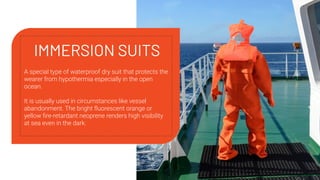
IMMERSION SUITS
A special type of waterproof dry suit that protects the
wearer from hypothermia especially in the open
ocean.
It is usually used in circumstances like vessel
abandonment. The bright fluorescent orange or
yellow fire-retardant neoprene renders high visibility
at sea even in the dark.
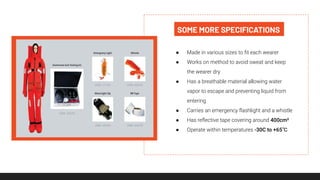
SOME MORE SPECIFICATIONS
● Made in various sizes to fit each wearer
● Works on method to avoid sweat and keep
the wearer dry
● Has a breathable material allowing water
vapor to escape and preventing liquid from
entering
● Carries an emergency flashlight and a whistle
● Has reflective tape covering around 400cm²
● Operate within temperatures -30C to +65℃
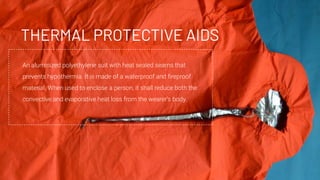
THERMAL PROTECTIVE AIDS
An aluminized polyethylene suit with heat sealed seams that
prevents hypothermia. It is made of a waterproof and fireproof
material. When used to enclose a person, it shall reduce both the
convective and evaporative heat loss from the wearer's body.
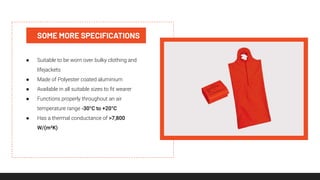
SOME MORE SPECIFICATIONS
● Suitable to be worn over bulky clothing and
lifejackets
● Made of Polyester coated aluminium
● Available in all suitable sizes to fit wearer
● Functions properly throughout an air
temperature range -30°C to +20°C
● Has a thermal conductance of >7,800
W/(m²K)
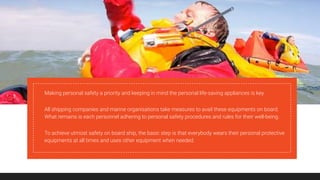
Making personal safety a priority and keeping in mind the personal life-saving appliances is key.
All shipping companies and marine organisations take measures to avail these equipments on board.
What remains is each personnel adhering to personal safety procedures and rules for their well-being.
To achieve utmost safety on board ship, the basic step is that everybody wears their personal protective
equipments at all times and uses other equipment when needed.
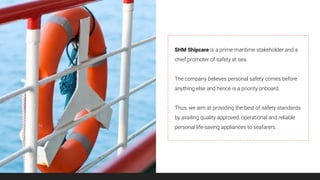
SHM Shipcare is a prime maritime stakeholder and a
chief promoter of safety at sea.
The company believes personal safety comes before
anything else and hence is a priority onboard.
Thus, we aim at providing the best of safety standards
by availing quality approved, operational and reliable
personal life-saving appliances to seafarers.
www.shmgroup.com
@SHMShipcare
Shm-Shipcare
SHMShipcare
Shmshipcare_official
91-222-378-6400

Personal Life Saving Appliances

  • 2.
    LIFE SAVING APPLIANCES Life-savingappliances are those appliances that protect human life at sea. These devices are documented and mandated as part of the SOLAS Convention. The number and type of life-saving appliances differ from vessel to vessel. However, SOLAS code gives a minimum requirement to comply in order to make a vessel seaworthy.
  • 3.
    When faced withan emergency situation at sea, getting external help quickly is not easy. It becomes extremely necessary for one to aid to a safer place on their own. This is where life-saving appliances come to rescue.
  • 4.
    One needs torescue oneself, move fast and be safe. Life-saving appliances, in such circumstances, have saved numerous lives over the course of their use. They are further classified as collective and personal life-saving appliances. In this presentation, we shall focus on PERSONAL LIFE SAVING APPLIANCES (PLSA).
  • 5.
    PERSONAL LSA ONA VESSEL . LIFEJACKETS . LIFEBUOYS . IMMERSION SUITS . THERMAL PROTECTIVE AIDS . View Product Details
  • 6.
    LIFE JACKET It isa sleeveless jacket of buoyant or inflatable construction. Functioning on the principle of buoyancy, it keeps the wearer afloat and prevents drowning. The bright orange or red color makes it easily visible to the eye helping rescuers spot those in distress.
  • 7.
    LIFE JACKET -ADULT Most adults claim they can swim and need no lifejackets. Certain circumstances call for pre-rendered safety measures and hence even a healthy adult needs a life jacket at sea. An adult life jacket is made to suit each individual's comfort at sea, ease of movement and purpose of activity. One leveraged benefit is that it can be worn strapped or unstrapped. Specification to look out for - ● Made to suit wearer upto 140kgs
  • 8.
    LIFE JACKET -CHILD Children are naughty and playful and are more prone to mishaps. A child life jacket is designed to keep your tot safe while at sea. Apart from general benefits, a child life jacket has some added USCG-certified features. ● Provides head protection to keep the child’s face, head and mouth area protected. ● Provides a crotch belt that straps the child so it doesn’t easily slip off. Specification to look out for - ● Made to suit wearer upto 15-43 kgs PFD types depend on the child’s ability to swim and their comfort in the water.
  • 9.
    LIFE JACKET -INFANT It goes without saying, infants should always be strapped with a lifejacket even under close supervision. Most toddlers face mishaps due to lack of attention at sea. That being said, Life Jacket - Infant - ● should aid in turning an infant face up and head back in the water ● should be properly strapped before he/she is let close to the waters Specification to look out for - ● Made to suit wearer upto 15 kgs
  • 10.
    LIFE JACKET -LIGHT A life jacket could be easily spotted in the daylight. However, in the darkness, life jacket light helps to identify the wearer in the waters. ● Increases visibility of seafarer at sea when in danger ● Luminous intensity of 0.75 cd in all directions of the upper hemisphere ● Capable of providing luminous intensity for 8 hrs ● Could also be a flashing light, in which case, it is provided with a manually operated switch with flash rate of 50-70 flashes per min.
  • 11.
    The lifebuoy isa ring shaped life saving appliance. It has a connecting line allowing the casualty to be pulled to the rescuer in a boat. Modern lifebuoys are fitted with one or more seawater-activated lights, to aid rescue at night. Their bright orange/red color makes them easily visible at sea. LIFEBUOYS
  • 12.
    SOME MORE SPECIFICATIONS ●Essential part of the personal safety procedure on board ● Constructed of inherently buoyant material ● Inner Diameter of not less than 400mm thick ● Minimum 2.5 kg in weight ● Capable of supporting 14.5 kg of iron in fresh water for a period of 24 hrs ● Can’t sustain flames for more than a period of 2secs ● Constructed to withstand a drop into waters without impairing its operating capability ● Uses Quick release arrangement ● Provided with self-activated smoke signals and self-igniting lights
  • 13.
    LIFEBUOY LIGHTS While lifebuoysare deployed into the waters in emergencies, they need to be able to aid external help. Self-igniting lights present on lifebuoys make the buoys visible quicker. Certain specifications are - ● Inextinguishable by water ● Flashes with a white light capable of both burning or flashing at intervals ● Luminous capacity of >2cd ● Provided with a source of energy capable of lasting for a period of at least 2 hrs ● Capable of withstanding the drop test ● Last upto 5yrs
  • 14.
    IMMERSION SUITS A specialtype of waterproof dry suit that protects the wearer from hypothermia especially in the open ocean. It is usually used in circumstances like vessel abandonment. The bright fluorescent orange or yellow fire-retardant neoprene renders high visibility at sea even in the dark.
  • 15.
    SOME MORE SPECIFICATIONS ●Made in various sizes to fit each wearer ● Works on method to avoid sweat and keep the wearer dry ● Has a breathable material allowing water vapor to escape and preventing liquid from entering ● Carries an emergency flashlight and a whistle ● Has reflective tape covering around 400cm² ● Operate within temperatures -30C to +65℃
  • 16.
    THERMAL PROTECTIVE AIDS Analuminized polyethylene suit with heat sealed seams that prevents hypothermia. It is made of a waterproof and fireproof material. When used to enclose a person, it shall reduce both the convective and evaporative heat loss from the wearer's body.
  • 17.
    SOME MORE SPECIFICATIONS ●Suitable to be worn over bulky clothing and lifejackets ● Made of Polyester coated aluminium ● Available in all suitable sizes to fit wearer ● Functions properly throughout an air temperature range -30°C to +20°C ● Has a thermal conductance of >7,800 W/(m²K)
  • 18.
    Making personal safetya priority and keeping in mind the personal life-saving appliances is key. All shipping companies and marine organisations take measures to avail these equipments on board. What remains is each personnel adhering to personal safety procedures and rules for their well-being. To achieve utmost safety on board ship, the basic step is that everybody wears their personal protective equipments at all times and uses other equipment when needed.
  • 19.
    SHM Shipcare isa prime maritime stakeholder and a chief promoter of safety at sea. The company believes personal safety comes before anything else and hence is a priority onboard. Thus, we aim at providing the best of safety standards by availing quality approved, operational and reliable personal life-saving appliances to seafarers.
  • 20.