Power Boat OperatorCourse
Syllabus:
Includes Sounds, Signals, Distress, Shipping Channels,
Navigation Markers, Navigation, Route Planning, Flares, Day
Shapes, Night Lights & flash patterns,
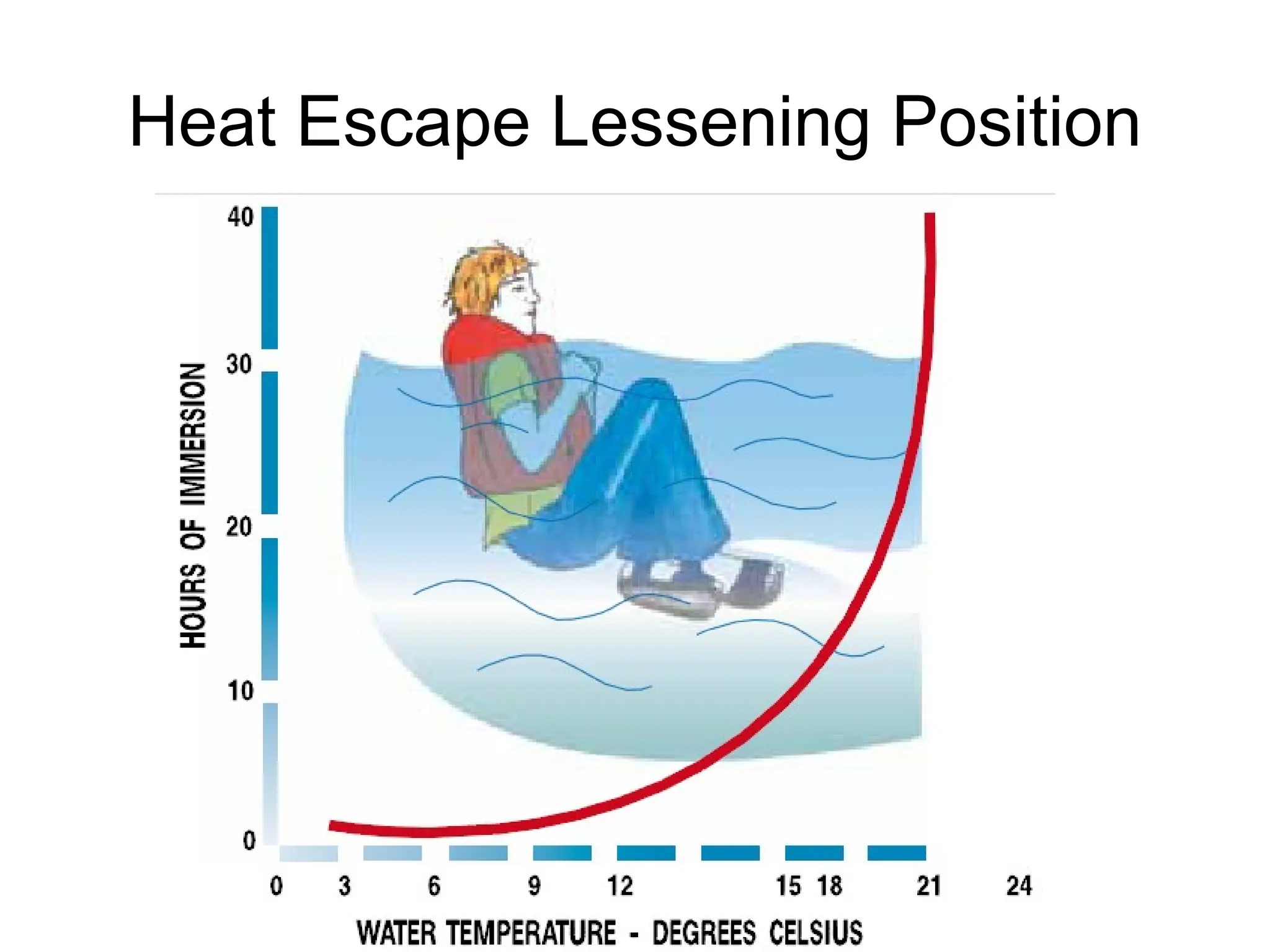
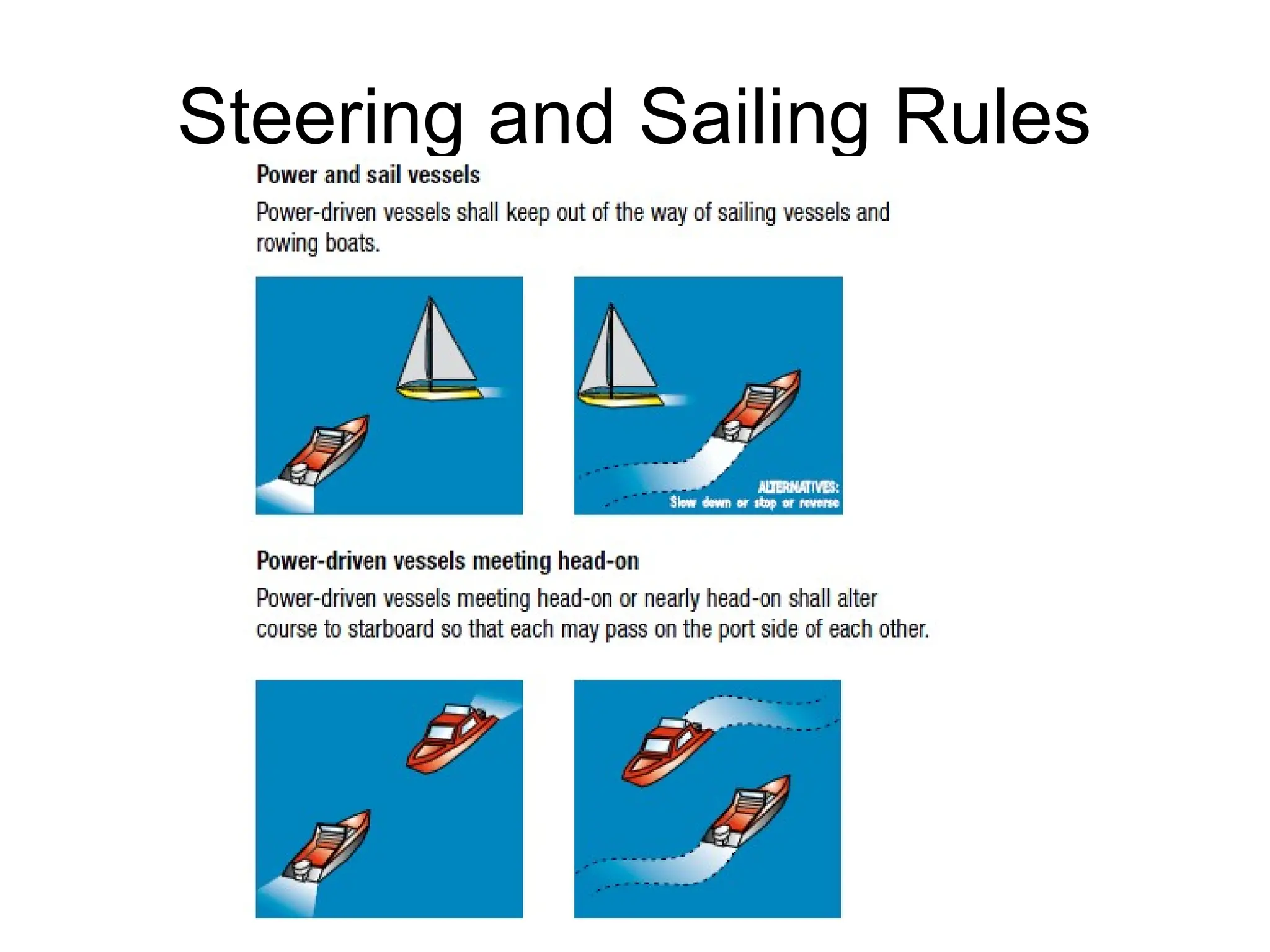
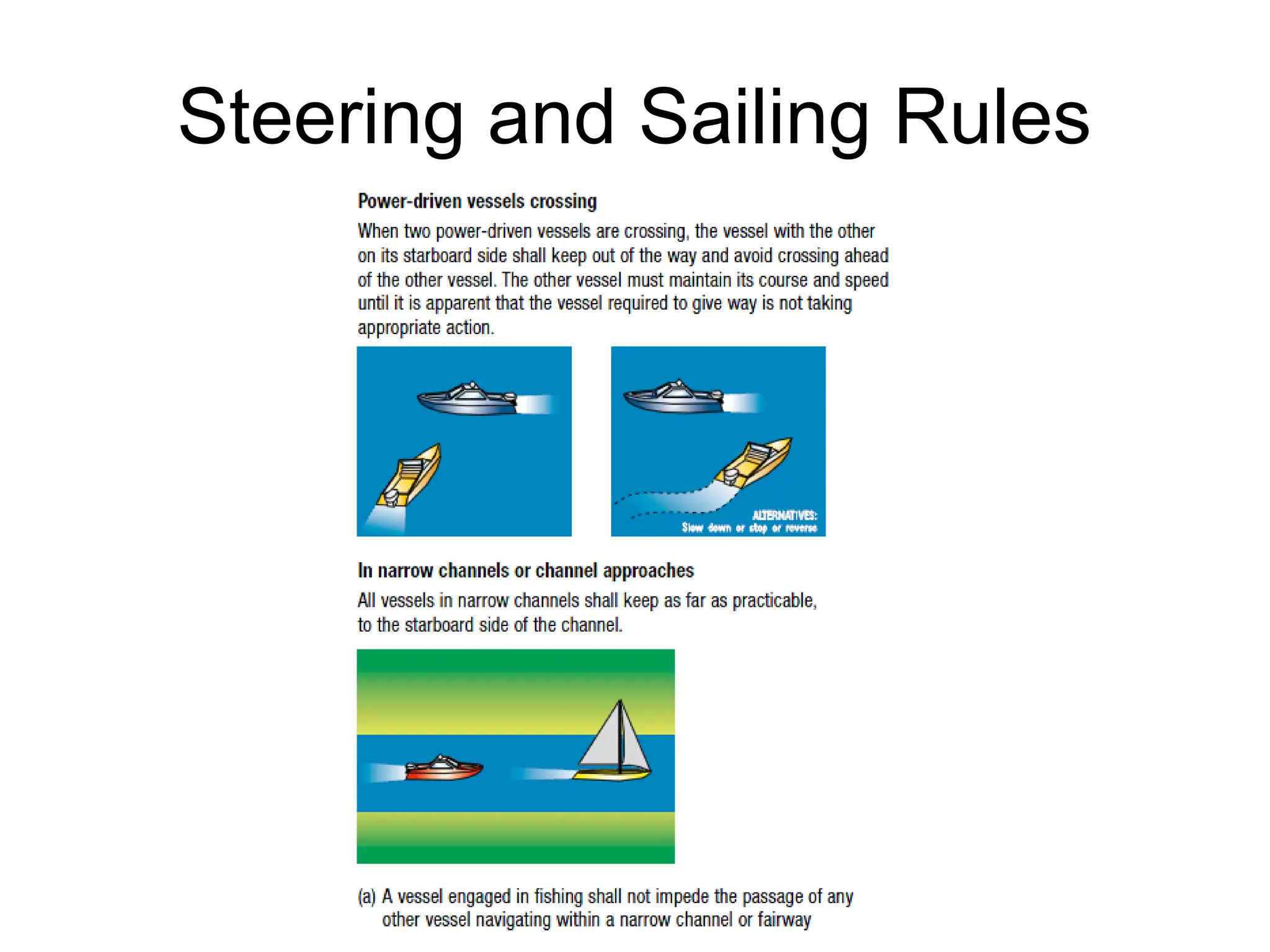
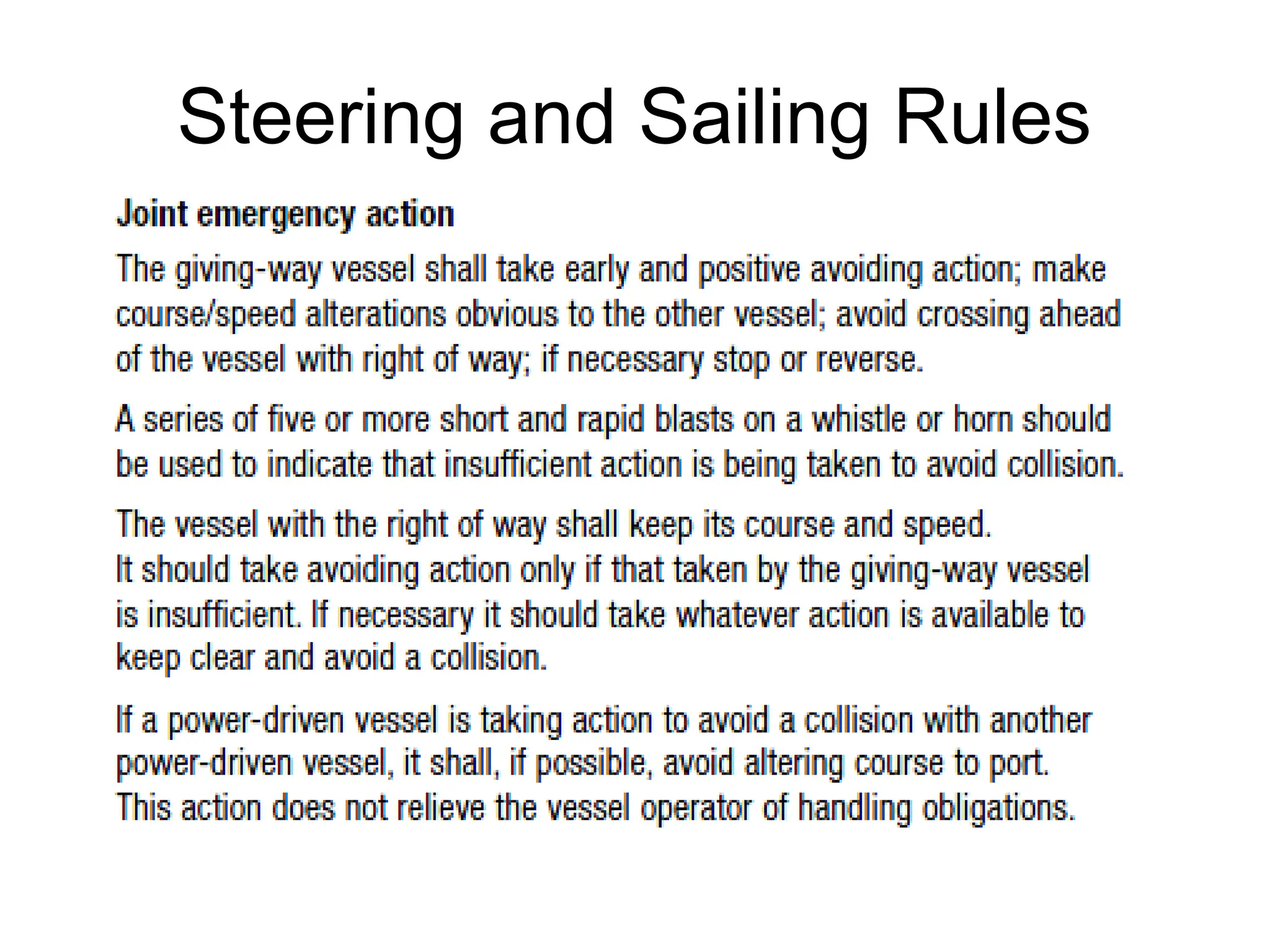
Fire extinguisher types, hypothermia, steering rules, fire
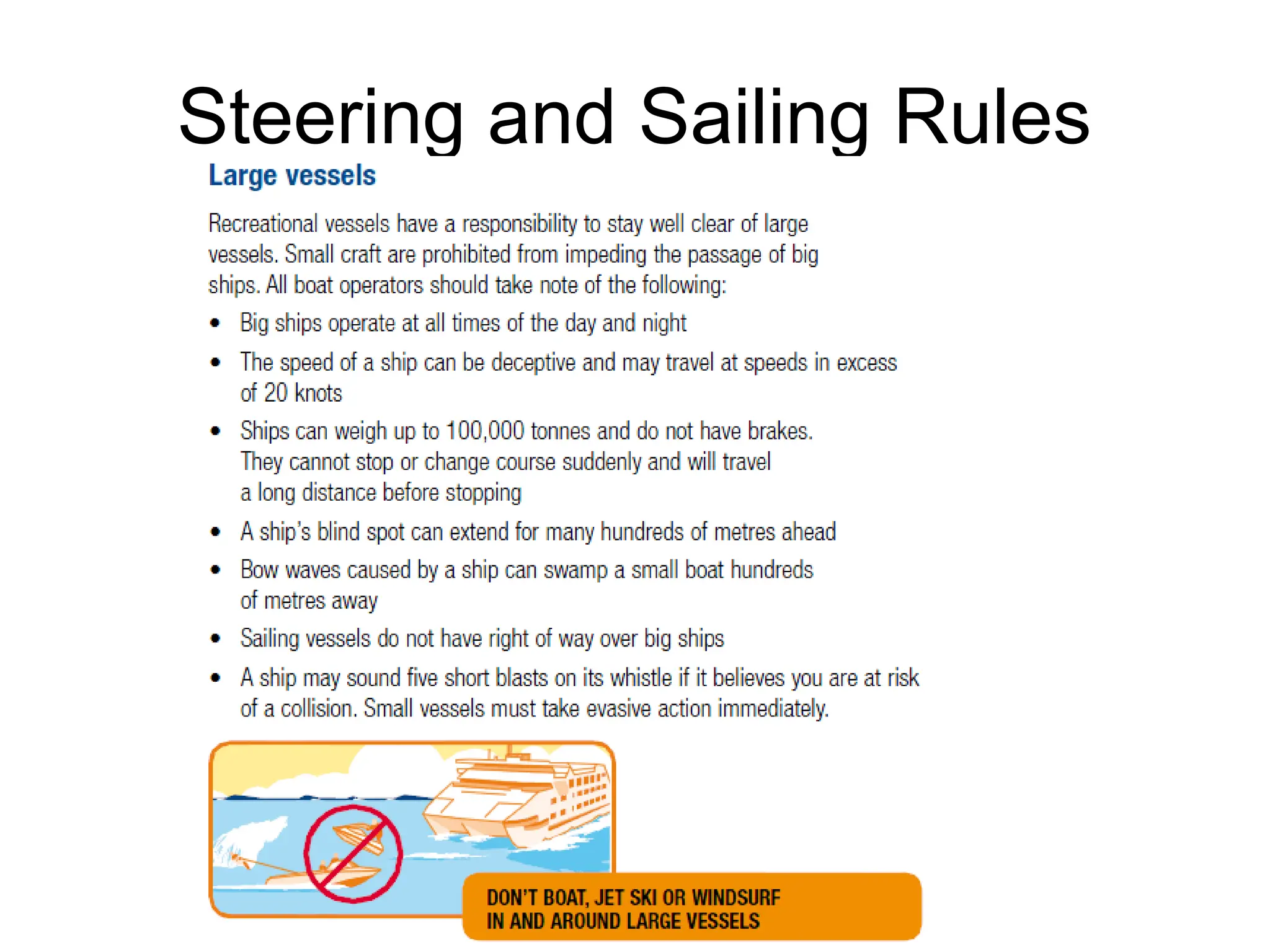
triangle, safe speed, navigation lights, speed restrictions,
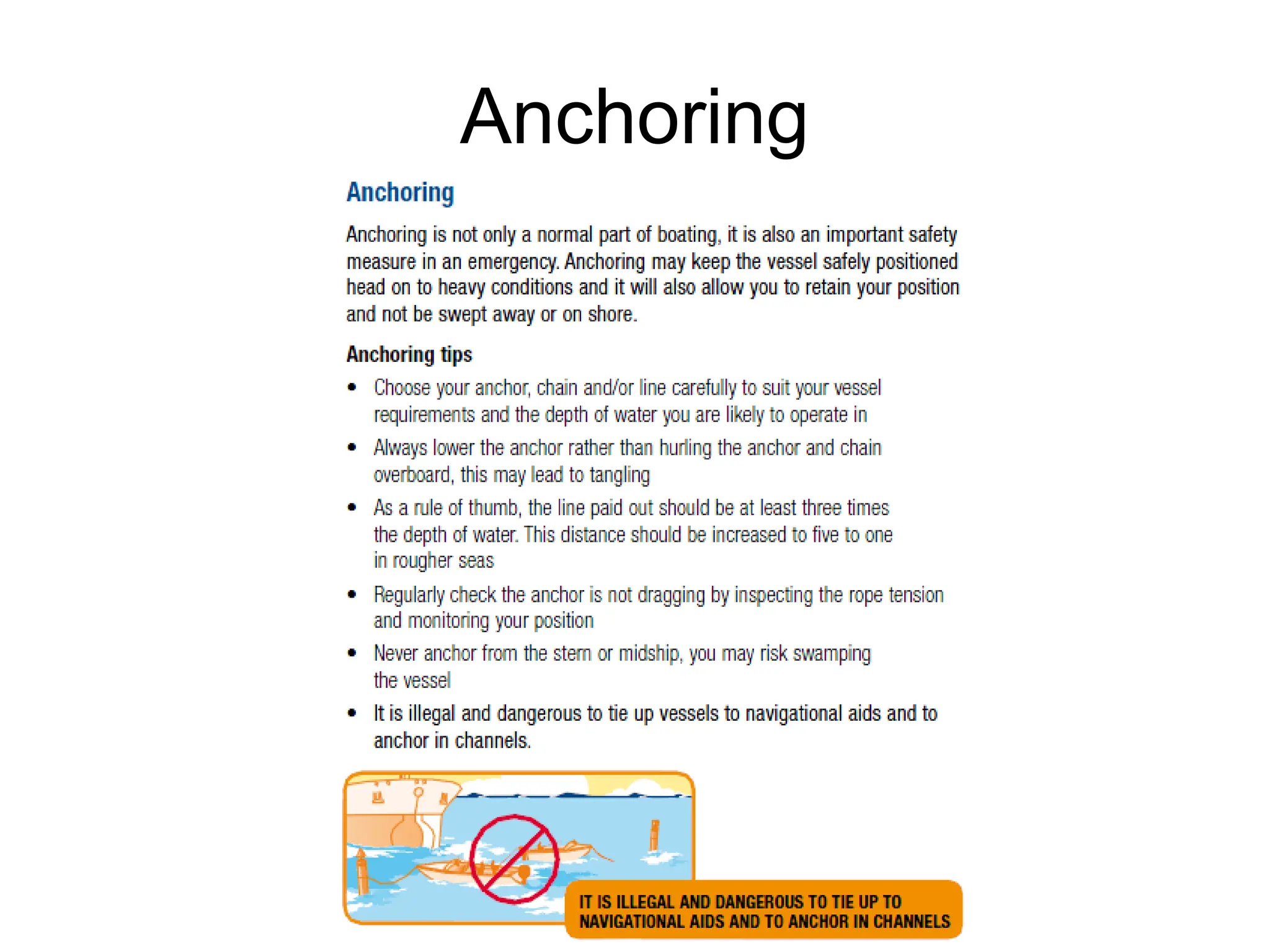
anchoring, wind strength, legal ages, safety equipment
No Brakes.
3.
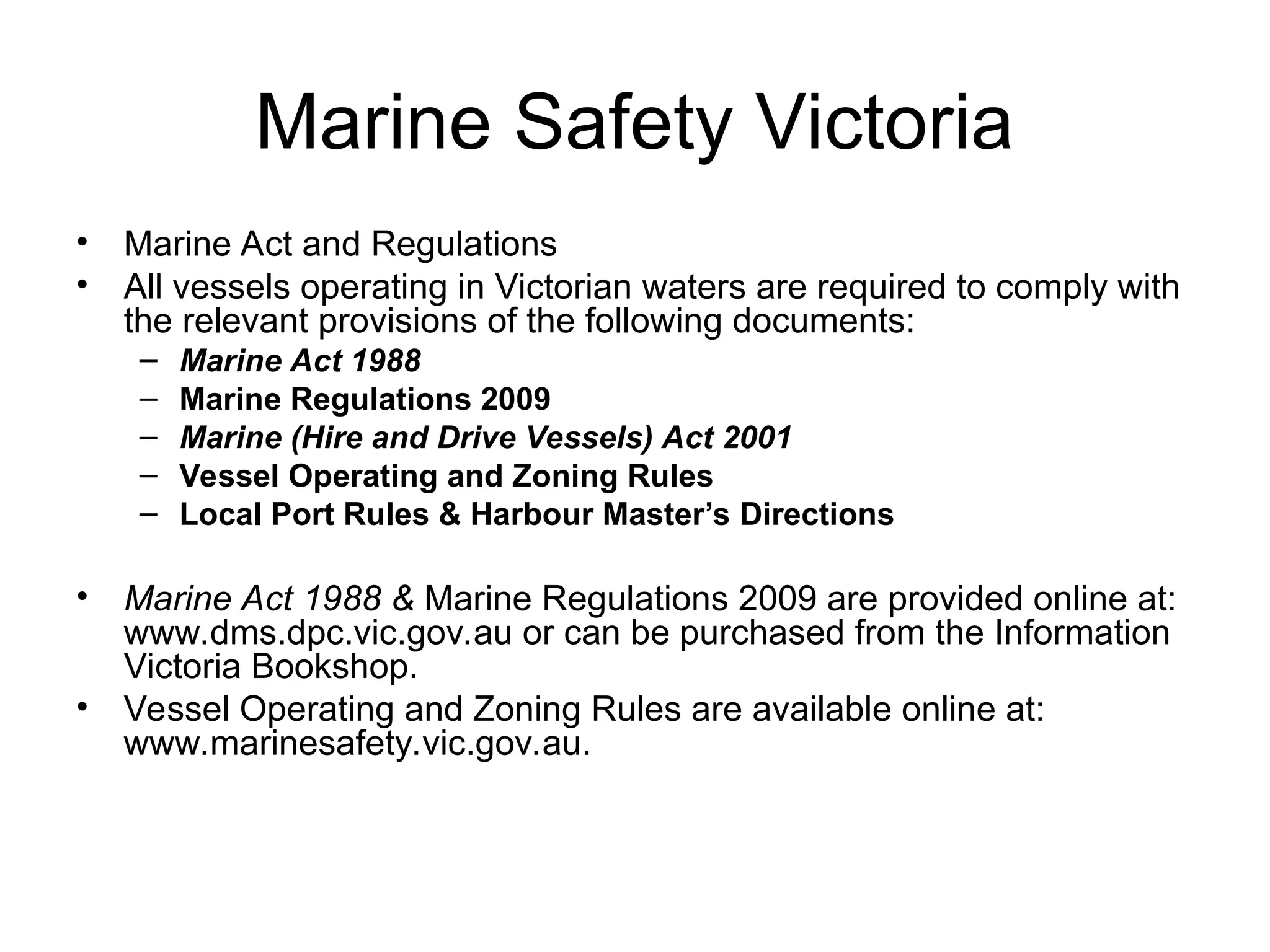
Marine Safety Victoria
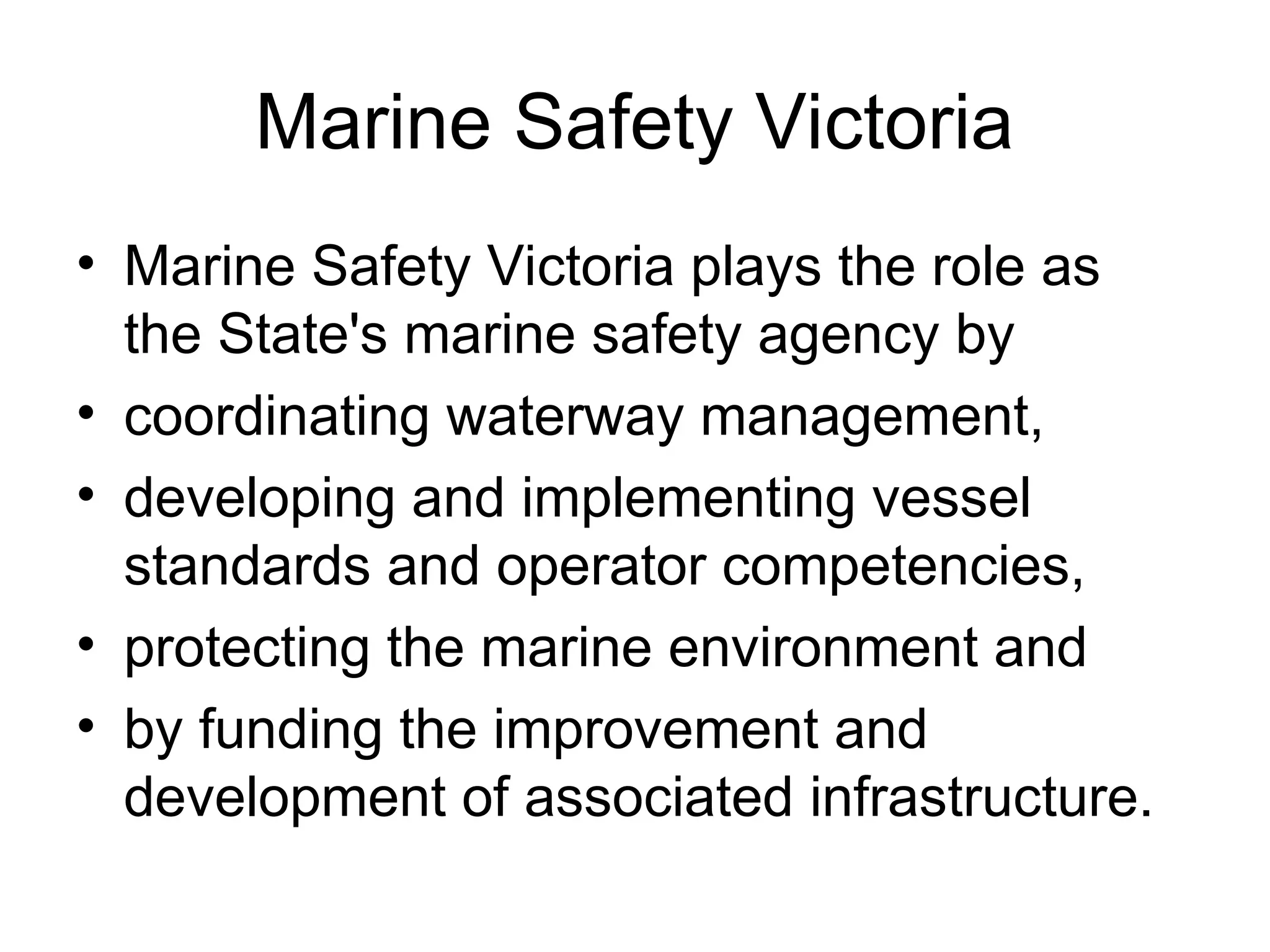
•Marine Safety Victoria plays the role as
the State's marine safety agency by
• coordinating waterway management,
• developing and implementing vessel
standards and operator competencies,
• protecting the marine environment and
• by funding the improvement and
development of associated infrastructure.
4.
Marine Safety Victoria
•Marine Act and Regulations
• All vessels operating in Victorian waters are required to comply with
the relevant provisions of the following documents:
– Marine Act 1988
– Marine Regulations 2009
– Marine (Hire and Drive Vessels) Act 2001
– Vessel Operating and Zoning Rules
– Local Port Rules & Harbour Master’s Directions
• Marine Act 1988 & Marine Regulations 2009 are provided online at:
www.dms.dpc.vic.gov.au or can be purchased from the Information
Victoria Bookshop.
• Vessel Operating and Zoning Rules are available online at:
www.marinesafety.vic.gov.au.
5.
Types of licence
•General Boat Operator Licence
– A general boat operator licence is required by
any person over the age of 16 who is
operating a powered recreational vessel.
• Restricted Operator Licence
– A restricted boat operator licence is required
by any person over the age of 12, but under
the age of 16, who is operating a powered
recreational vessel.
6.
Restricted Operator Licence
•Restricted Operator Licence conditions
– Holders of a restricted operator licence:
a. must operate at speeds of less than 10 knots
b. may operate at speeds of up to 20 knots if:
– i. accompanied by a person over the age of 16 years who is
licensed appropriately for the vessel being operated
– ii. operating between sunrise and sunset
c. must not operate a vessel that is towing.
For example, if a PWC is being operated, the licence of the
accompanying person must be endorsed for PWC operation
PWC – Personal Water Craft eg Jetski etc
to operate this you need an additional PWC endorsement.
7.
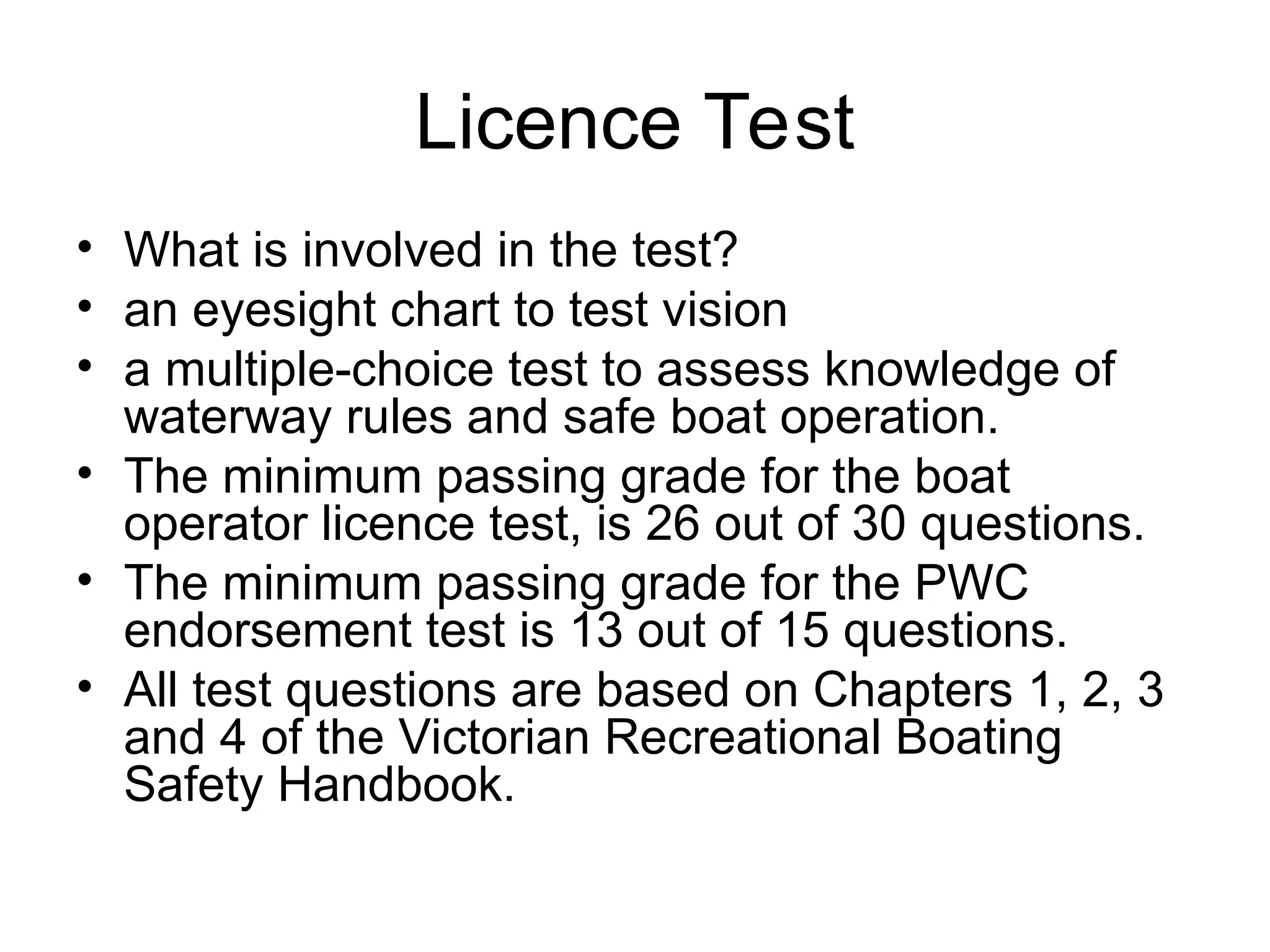
Licence Test
• Whatis involved in the test?
• an eyesight chart to test vision
• a multiple-choice test to assess knowledge of
waterway rules and safe boat operation.
• The minimum passing grade for the boat
operator licence test, is 26 out of 30 questions.
• The minimum passing grade for the PWC
endorsement test is 13 out of 15 questions.
• All test questions are based on Chapters 1, 2, 3
and 4 of the Victorian Recreational Boating
Safety Handbook.
8.
Powerboat Operator Licence
•You can complete a Marine Safety Victoria
approved training course by a Registered
Training Organisation (RTO) and present the
Marine Safety Victoria endorsed certificate,
within 6 months of completing the course, to
VicRoads to gain your licence.
• If you pass this course, you will not need to sit a
test at VicRoads, but you will need to pay your
one, three or five year licence fee.
$29.90, $89.70 or $149.50 respectively.
• PWC endorsement $5.10 pa.
SOLAS
• Safety OfLife At Sea
• An international maritime safety treaty.
• The SOLAS Convention in its successive forms
is generally regarded as the most important of all
international treaties concerning the safety of
merchant ships
• The first version of the treaty was passed in
1914 in response to the sinking of the RMS
Titanic. It prescribed numbers of lifeboats and
other emergency equipment along with safety
procedures, including continuous radio watches.
21.
• Sections ofthe treaty The International Convention for the Safety of
Life at Sea (SOLAS), 1974, requires flag States to ensure that their
ships comply with minimum safety standards in construction,
equipment and operation.
• It includes articles setting out general obligations, etcetera, followed
by an annex divided into twelve chapters.
• [1] Of these, chapter five (often called 'SOLAS V') is the only one
that applies to all vessels on the sea, including private yachts and
small craft on local trips as well as to commercial vessels on
international passages. Many countries have turned these
international requirements into national laws so that anybody on the
sea who is in breach of SOLAS V requirements may find
themselves subject to legal proceedings.
23.
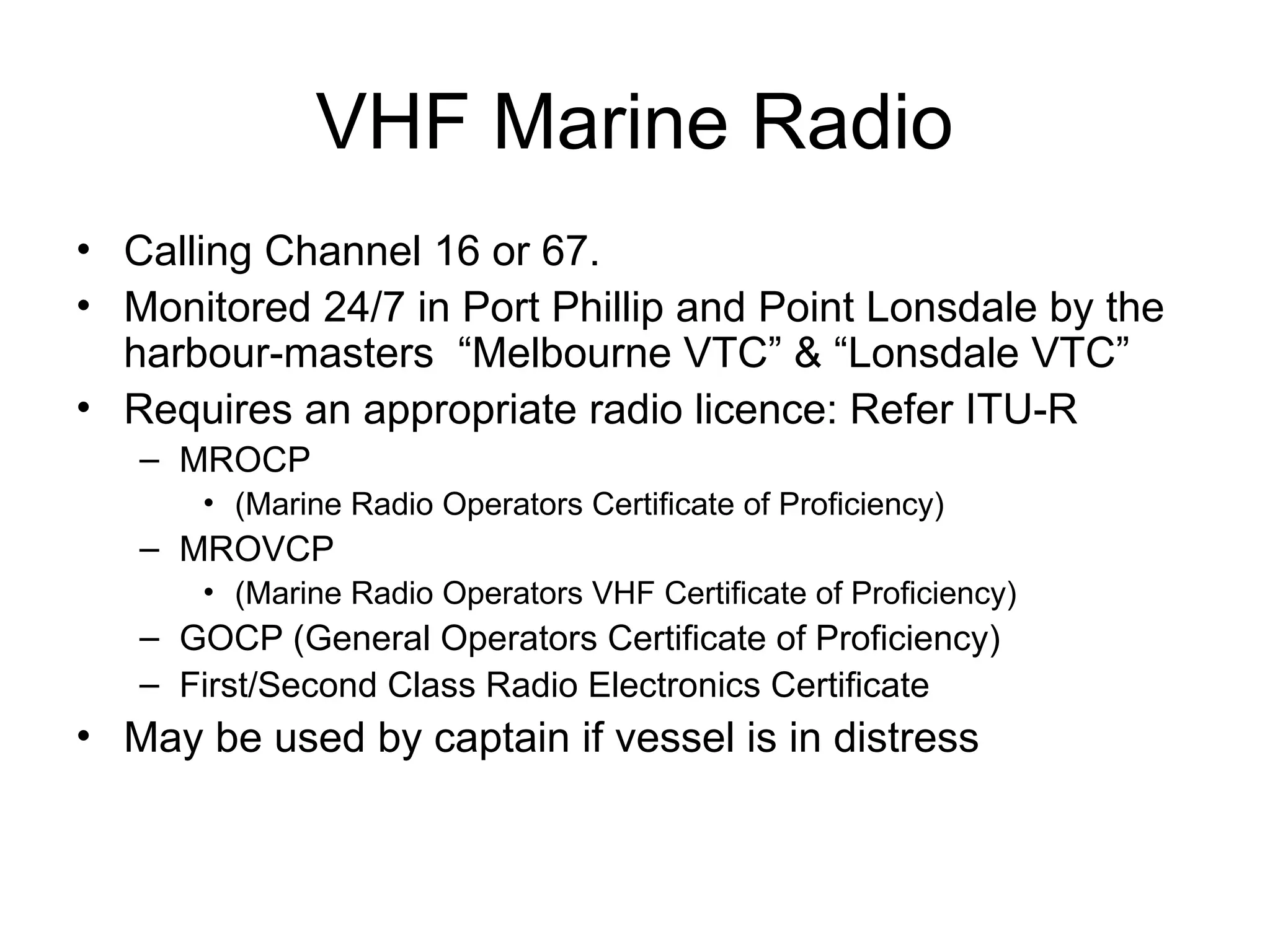
VHF Marine Radio
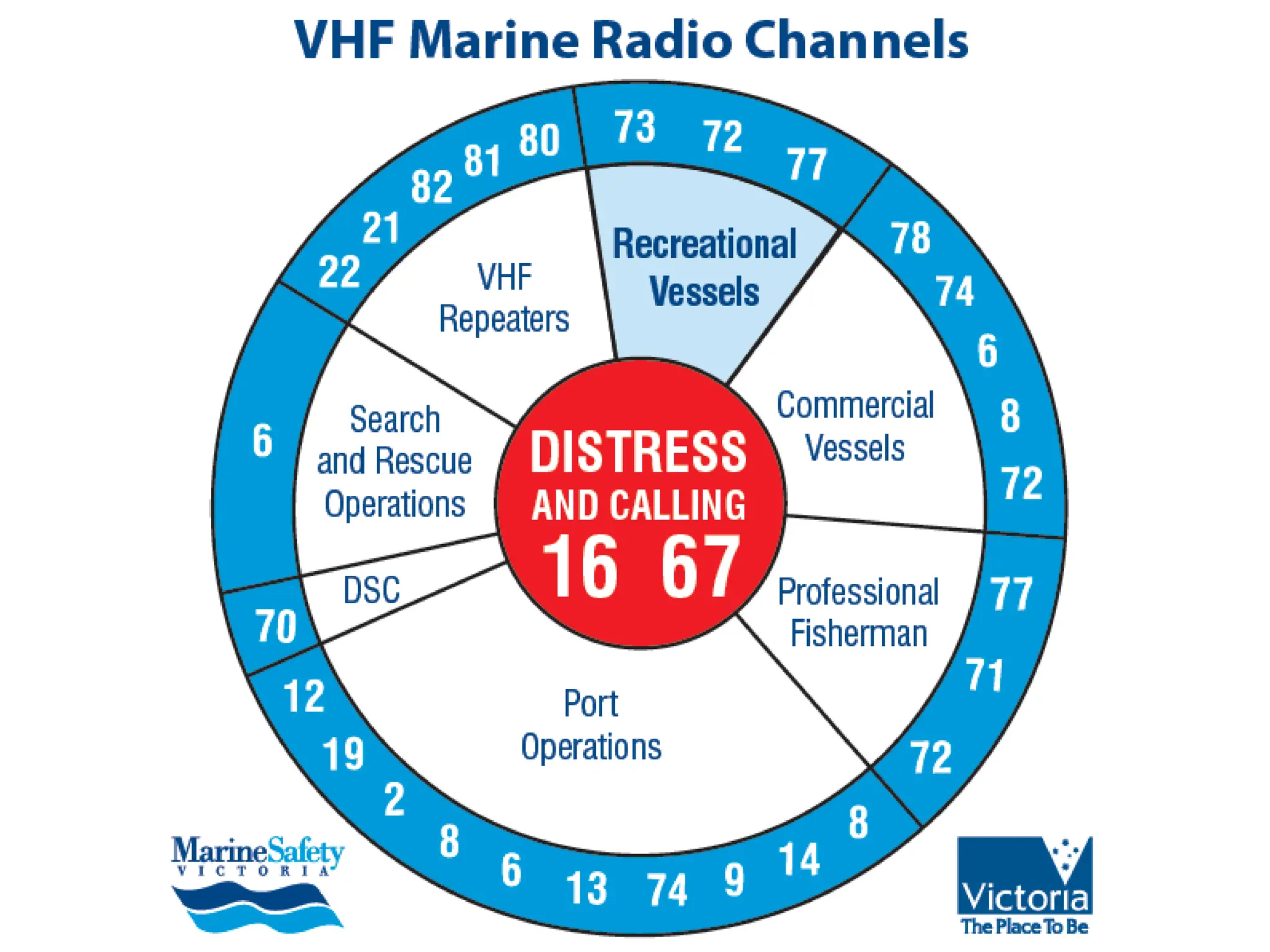
•Calling Channel 16 or 67.
• Monitored 24/7 in Port Phillip and Point Lonsdale by the
harbour-masters “Melbourne VTC” & “Lonsdale VTC”
• Requires an appropriate radio licence: Refer ITU-R
– MROCP
• (Marine Radio Operators Certificate of Proficiency)
– MROVCP
• (Marine Radio Operators VHF Certificate of Proficiency)
– GOCP (General Operators Certificate of Proficiency)
– First/Second Class Radio Electronics Certificate
• May be used by captain if vessel is in distress
24.
Distress Call
• “MaydayMayday Mayday THIS IS (name
of vessel and call sign)” (…) spoken three
times. From french: venez m'aider, meaning "come help me".
• A distress call has absolute priority over all
other transmissions and may only be
transmitted upon the authority of the
skipper or the person responsible for the
safety of your vessel.
25.
Distress Message
• “MaydayMayday Mayday THIS IS (name of
vessel and call sign) spoken three times.
• Particulars of your position in
– In relation to a well known geographical feature.
Example
• a charted feature, “20 metres North of Port Melbourne
Channel Starboard Marker Number 14”
• or a description ”half a nautical mile south west of
Breakwater Pier ” OR
– Degrees and Minutes Latitude & Longitude
• 37 Degrees 52 Minutes South, 144 Degrees 54 decimal 95
Minutes East
26.
Distress Message
• Thenature and kind of assistance required
– “Our hull has a large hole; Bilge pump not working; Cant bail fast
enough to keep up. Boat is listing at 30 degrees and rapidly
sinking. Will need a to be rescued from water.”
– “we are a 300 metre long super tanker with 210000 m3
of crude
oil on board. Struck Gelibrand shoal at 20 knots and are listing
20 degrees to port with a large hole along the port bow through
to midships.
• Any other useful information to facilitate rescue including
number of people on each vessel needing assistance.
– For example :
» “20 Persons On Board. All 20 on board are accounted for
and evacuating to life rafts. Fire is out of control, involves 44
gallons of spilled fuel, and involves a 20 by 20 metre area of
the top and middle decks.”
» “5 persons on board Total. 3 persons presently missing.
After explosion the Chimney caught fire – require Fire
Brigade liaison and assistance”
27.
Urgency Call &Message
• When the distress call is not justified.
• PAN PAN PAN PAN PAN PAN
• ALL STATIONS ALL STATIONS ALL STATIONS
• THIS IS
• ‘OCEAN RESCUE LAKES ENTRANCE’ x 3
• YACHT STANDFAST REPORTED OVERDUE ON VOYAGE
FROM PORT MAQUARIE TO HOBART. LAST RADIO
CONTACT 4 JUNE. POSITION 30 NAUTICAL MILES TO
SEAWARD FROM CAPE HOWE. FIFTEEN METRE
DESCRIPTION
– WHITE HULL
– BLUE SAILS
– THREE PERSONS ON BOARD
• ALL VESSELS KEEP A SHARP LOOKOUT AND REPORT
ANY SIGHTING
• OUT
28.
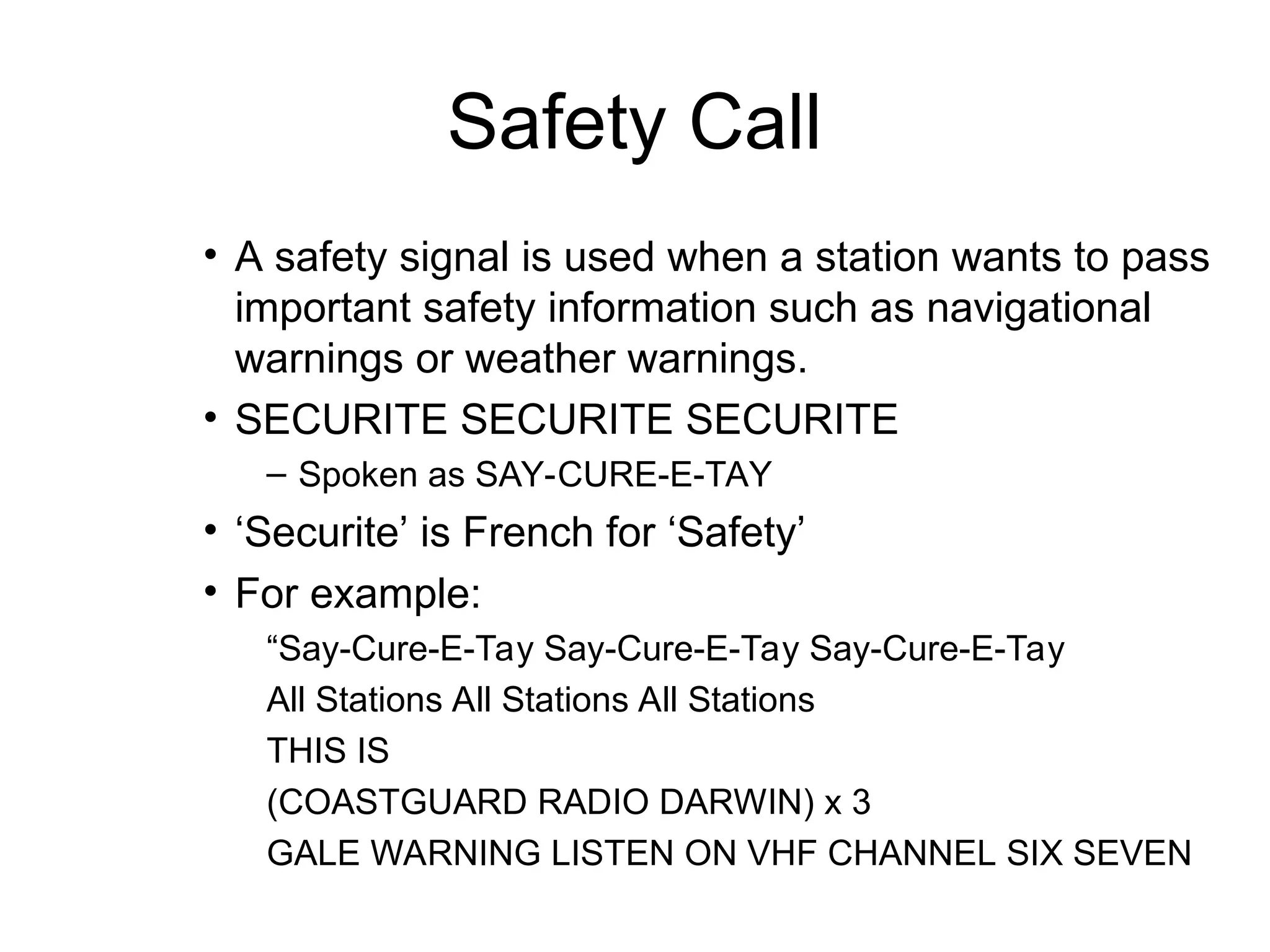
Safety Call
• Asafety signal is used when a station wants to pass
important safety information such as navigational
warnings or weather warnings.
• SECURITE SECURITE SECURITE
– Spoken as SAY-CURE-E-TAY
• ‘Securite’ is French for ‘Safety’
• For example:
“Say-Cure-E-Tay Say-Cure-E-Tay Say-Cure-E-Tay
All Stations All Stations All Stations
THIS IS
(COASTGUARD RADIO DARWIN) x 3
GALE WARNING LISTEN ON VHF CHANNEL SIX SEVEN
29.
Safety Message
• Changeto {nominated station eg} VHF Channel 67
• Safety Call is given again then -
• Safety message example:
“Say-Cure-E-Tay Say-Cure-E-Tay Say-Cure-E-Tay
All Stations All Stations All Stations
THIS IS
(COASTGUARD RADIO DARWIN) x 3
DALY RIVER TO TORRES STRAIGHT –
NORTHEASTERLY WINDS IN EXCESS OF 30 KNOTS
ARE EXPECTED TO PERSIST FOR NEXT TWENTY
FOUR HOURS
OUT”
This is a broadcast call – no responses are expected
directly.
30.
Radio Silence Periods:
Toincrease Safety of Life at Sea in Australia:
Two Silence Periods per hour on all Marine Bands:
27MHz, VHF, HF & MF
From the hour to three minutes past the hour AND
From the half-hour to three minutes past the half hour
With the exception of distress calls and messages all stations should
cease transmission during these periods
There is another Marine Radio band used for large distance ocean
traverses known as MF and HF radio.
Predominantly uses SSB. 4125, 6215, 8291 KHz – weather reports
available on
2056, 4149, 6230, 8113 12362 and 16528KHz from Willuna and
2201, 4426, 6507, 8176, 12365, 16356 from Charleville.
Also available on VHF channel 67.
For a broadcast schedule visit: www.bom.gov.au/marine
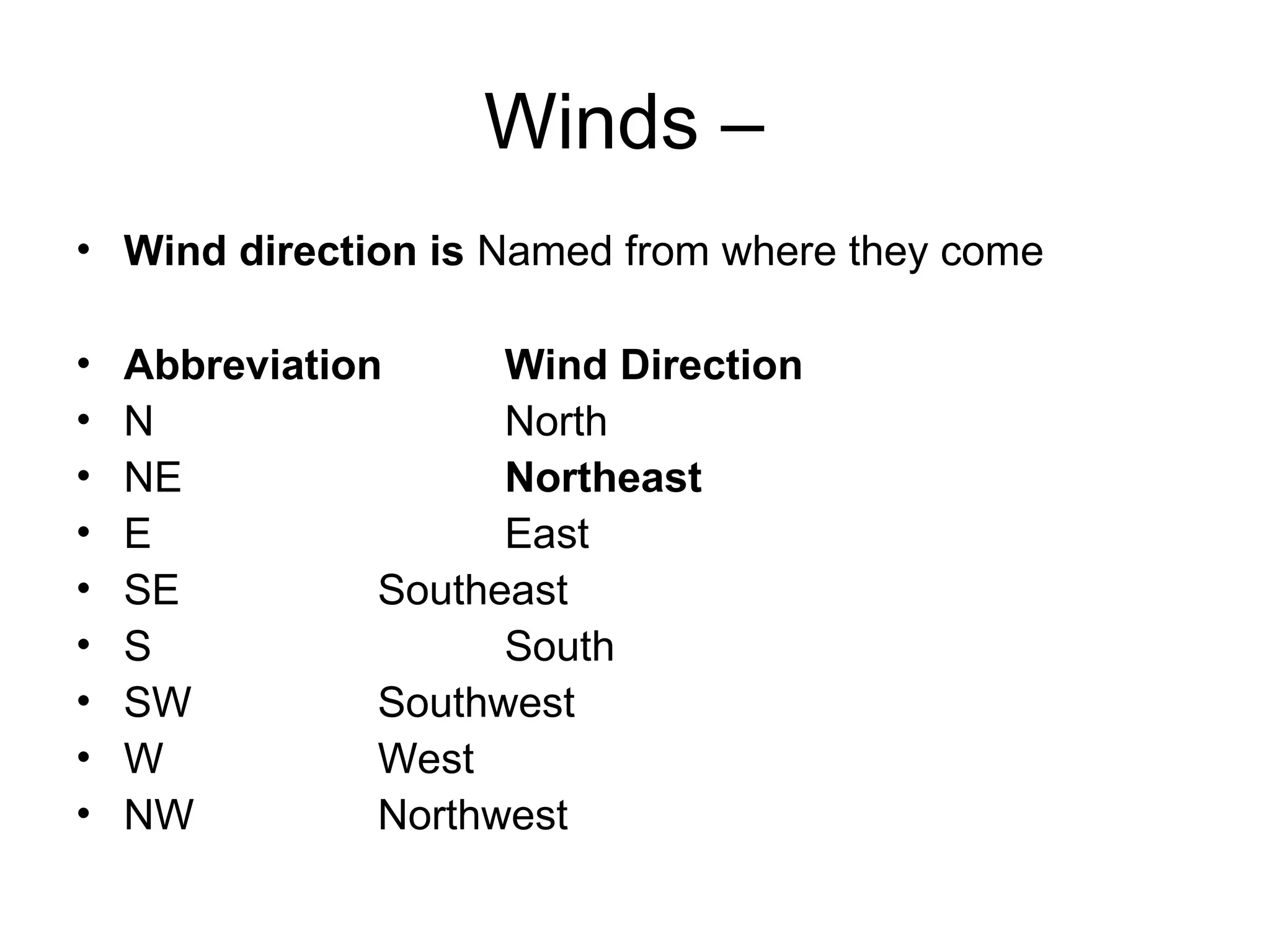
Winds –
• Winddirection is Named from where they come
• Abbreviation Wind Direction
• N North
• NE Northeast
• E East
• SE Southeast
• S South
• SW Southwest
• W West
• NW Northwest
Marine Pests
• Boatramp vessels
When leaving
• Dislodge all seaweed from your vessel
• Drain all harbour water from your vessel
• Wash down and dry your vessel and all equipment exposed to harbour water
• Do not re-launch in another location before taking these steps
• Moored vessels
Before leaving the harbour you must
• Maintain your anti-foul system - keep hull and wet areas free of marine growth
• Dislodge all seaweed from your vessel
• Pump out all water taken from the harbour (or pump out far away from inshore reefs)
• Divers
• No diving or swimming in harbour without a permit
• After diving wash and dry your dive suit and equipment before you re-enter the sea
• Anglers
After fishing at Apollo Bay Harbour
• Wash and dry fishing equipment used in the harbour before using elsewhere
• Do not discard harbour water or seaweed away from the harbour









![• Sections of the treaty The International Convention for the Safety of
Life at Sea (SOLAS), 1974, requires flag States to ensure that their
ships comply with minimum safety standards in construction,
equipment and operation.
• It includes articles setting out general obligations, etcetera, followed
by an annex divided into twelve chapters.
• [1] Of these, chapter five (often called 'SOLAS V') is the only one
that applies to all vessels on the sea, including private yachts and
small craft on local trips as well as to commercial vessels on
international passages. Many countries have turned these
international requirements into national laws so that anybody on the
sea who is in breach of SOLAS V requirements may find
themselves subject to legal proceedings.](https://image.slidesharecdn.com/boatoperatro-250315151136-7ebed435/75/safty-training-for-qualified-boat-operatror-21-2048.jpg)