FMO/JAN 15’
FUNDAMENTAL OF MARITIME OPERATIONS
CODE: LOB 10103
SESSION: JANUARY 2015
ASSIGNMENT 2
(GROUP)
TOPIC 8 : SAFETY & EMERGENCY
Subtopic;
1) Regulations
2) Compulsory documents carried onboard
3) Fire protection,detection &extinction
4) Lifesaving &live saving appliances
5) GMDSS
6) Onboard accidents
7) Job related problems for seafarers
8) Action by vesselin distress
9) Obligations of rescuing craft
10)Searching the sea
11)Aircraft in distress
12)Communication between surface craft & aircraft
13)Salvage & towage
FONTS STYLE Times New Roman / Arial Narrow
FONT SIZE
Title : 14
Others : 12
Spacing : 1.5
NUMBER OF PAGES Min 20-25 pages
SUBMISSION DATE 27th March 2015 (Friday before 5.00pm)
SUBMISSION METHOD
1) Send Full Reportin soft copy (in word)
2) Send softcopy ofslide presentation
3) Head/AssistantHead of class will submitvia a Pendrive
REMINDER
1) All must follow the actual format (APA Format)
e.g. Table ofcontent, introduction, page
numbers, conclusions & references
2) Please mention your class e.g L01 or L02
FMO/JAN 15’
Introduction
As the maritime industry is concerned, there are very emphasizing on the safety onboard
of the vessel. The safety during onboard of the vessel must be taken into account to avoid any
accident that can lead to injury and fatal. Commonly, accident that occurred onboard of the ship
is the result from the human error itself.
On a vessel, there should have a good ship with sufficient stability, water and weather
tight and properly equipped. These are as the preparation for facing the accident and as the
precaution during the accident.
A communication system also is vital to attract attention during in distress. This system
of communication also is equipped at the craft so that it will insure the craft in case of
emergency.
Based on the safety and precaution aspect above, it gives the ideal in self-sufficiency
towards the vessel or aircraft to allow it capable of the transport of cargo, livestock, troops,
passengers, gas fluid, minerals and others. The fact that the vessel provides a source of power
which can be coped with varying degrees of emergency and still be able to sustain itself says a
lot for the developed marine industry.
FMO/JAN 15’
11) Aircraft in distress
During the aircraft distress, there will be the signal issued by the aircraft itself to attract attention,
make known its position and get some help. This is vital to tell that the aircraft is having the
crucial moment for help or salvage.
The following signals used either together or separately, mean that grave and imminent danger
threatens, and immediate assistance is requested:
a) A signal made by radio/telegraphy or by any other signaling method consisting of the
group in the Morse Code
b) A signal sent by radio/telephony consisting of the spoken word Mayday,
c) Rockets or shells throwing red lights, fired one at a time at short intervals,
d) A parachute flare showing a red light,
e) The two-flag signal corresponding to the letters ‘NC’ of the International Code of Signals
f) A signal consisting of a square flag having above it or below it a ball or anything
resembling a ball,
g) A gun or other explosive signal fired at intervals of about a minute,
h) A smoke signal giving off a volume of orange-colored smoke.
The following signals are used mean that an aircraft is wishing to give notice of difficulties
which constrain it to land without requiring immediate assistance:
a) The repeated switching on and off of the landing lights,
b) The repeated switching on and off of the navigation lights,
c) A succession of white pyrotechnical lights.
FMO/JAN 15’
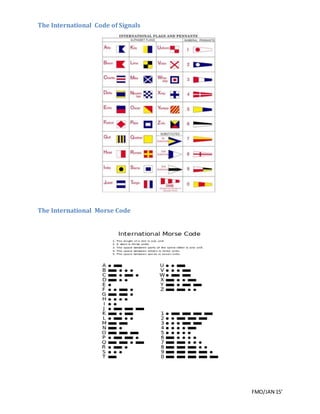
The International Code of Signals
The International Morse Code
FMO/JAN 15’
12) Communicationbetweensurface craft & aircraft
A communication device is a hardware device capable of transmitting an analog or digital
signal over the telephone, other communication wire, or wirelessly. Communication between
surface craft and aircraft must be taken into account. This is may be one way or two way
communication between the air and earth surface which includes the transmitter and responder.
The wave of communication then will be translated in term of signal to establish the
communication.
In maritime industry, merchant vessels engaged in SAR operations with military aircraft
should maintain a VHF watch on channel 16. In order to communicate with an aircraft, the
surface vessel should use their normal call sign.
In real situation, the call sign of the aircraft must be unknown. However, the term ‘Hawk’
may be used in place of the aircraft call sign. When the an aircraft is undergoing the process of
establishing communication with the surface craft without knowing the actual call sign of the
vessel, the aircraft will use the inquiry call ‘CQ’ in place of the vessel’s normal call sign.
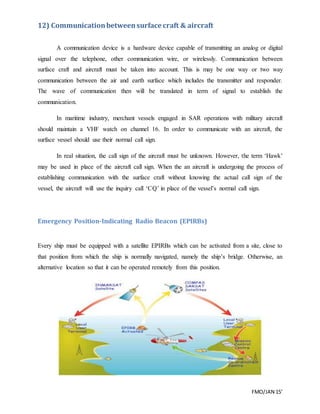
Emergency Position-Indicating Radio Beacon (EPIRBs)
Every ship must be equipped with a satellite EPIRBs which can be activated from a site, close to
that position from which the ship is normally navigated, namely the ship’s bridge. Otherwise, an
alternative location so that it can be operated remotely from this position.
FMO/JAN 15’
In order to EPIRBs fully functional, it must be capable of transmitting a distress alert
through the polar orbiting satellite service operating in the 406 MHz band.
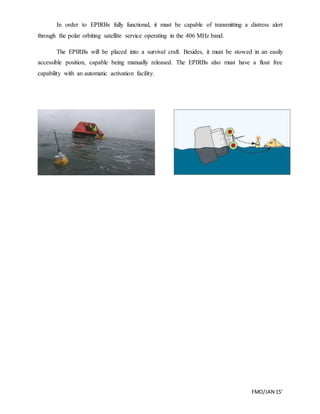
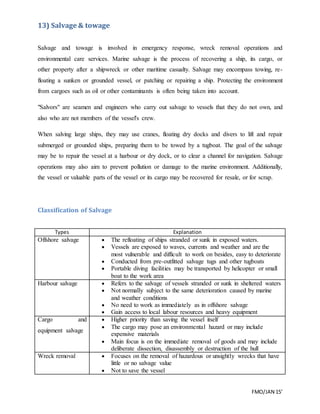
The EPIRBs will be placed into a survival craft. Besides, it must be stowed in an easily
accessible position, capable being manually released. The EPIRBs also must have a float free
capability with an automatic activation facility.
FMO/JAN 15’
13) Salvage & towage
Salvage and towage is involved in emergency response, wreck removal operations and
environmental care services. Marine salvage is the process of recovering a ship, its cargo, or
other property after a shipwreck or other maritime casualty. Salvage may encompass towing, re-
floating a sunken or grounded vessel, or patching or repairing a ship. Protecting the environment
from cargoes such as oil or other contaminants is often being taken into account.
"Salvors" are seamen and engineers who carry out salvage to vessels that they do not own, and
also who are not members of the vessel's crew.
When salving large ships, they may use cranes, floating dry docks and divers to lift and repair
submerged or grounded ships, preparing them to be towed by a tugboat. The goal of the salvage
may be to repair the vessel at a harbour or dry dock, or to clear a channel for navigation. Salvage
operations may also aim to prevent pollution or damage to the marine environment. Additionally,
the vessel or valuable parts of the vessel or its cargo may be recovered for resale, or for scrap.
Classification of Salvage
Types Explanation
Offshore salvage  The refloating of ships stranded or sunk in exposed waters.
 Vessels are exposed to waves, currents and weather and are the
most vulnerable and difficult to work on besides, easy to deteriorate
 Conducted from pre-outfitted salvage tugs and other tugboats
 Portable diving facilities may be transported by helicopter or small
boat to the work area
Harbour salvage  Refers to the salvage of vessels stranded or sunk in sheltered waters
 Not normally subject to the same deterioration caused by marine
and weather conditions
 No need to work as immediately as in offshore salvage
 Gain access to local labour resources and heavy equipment
Cargo and
equipment salvage
 Higher priority than saving the vessel itself
 The cargo may pose an environmental hazard or may include
expensive materials
 Main focus is on the immediate removal of goods and may include
deliberate dissection, disassembly or destruction of the hull
Wreck removal  Focuses on the removal of hazardous or unsightly wrecks that have
little or no salvage value
 Not to save the vessel
FMO/JAN 15’
 Wrecks are refloated or removed by the cheapest and most practical
method possible
 Hazardous materials must be removed before disposing of the
wreck
 Includes the process of cutting the hull into easily handled sections
or refloating the vessel and sinking it in deeper waters
Float salvage  The salvage of a vessel that is damaged but still afloat
 Involves primarily damage control work such as hull welding,
stabilization (rebalancing ballast tanks and shifting cargo) and
structural bracing
Clearance salvage  Clearance salvage is the coordinated removal or salvage of
numerous vessels in a harbor or waterway
 It typically follows a catastrophic event such as a tsunami,
hurricane or an act of war
 The clearance salvage due to the multiple vessel obstructions with
varying degrees of damage due to collision, fire or explosions
Tools used in marine salvage
 Floatation airbag
 Diving helmet
 Underwater cutting equipment
 Hydraulic salvage pump
 Air compressor
 Hydraulic winch
FMO/JAN 15’
Reference
 House,D. (2004). Seamanship techniquesforshipboard &maritimeoperations (3rd ed.).Oxford:
ElsevierButterworth-Heinemann.
 What isan EPIRB?(n.d.).RetrievedMarch26, 2015, from http://www.epirb.com/

maritime safety and emergency

  • 1.
    FMO/JAN 15’ FUNDAMENTAL OFMARITIME OPERATIONS CODE: LOB 10103 SESSION: JANUARY 2015 ASSIGNMENT 2 (GROUP) TOPIC 8 : SAFETY & EMERGENCY Subtopic; 1) Regulations 2) Compulsory documents carried onboard 3) Fire protection,detection &extinction 4) Lifesaving &live saving appliances 5) GMDSS 6) Onboard accidents 7) Job related problems for seafarers 8) Action by vesselin distress 9) Obligations of rescuing craft 10)Searching the sea 11)Aircraft in distress 12)Communication between surface craft & aircraft 13)Salvage & towage FONTS STYLE Times New Roman / Arial Narrow FONT SIZE Title : 14 Others : 12 Spacing : 1.5 NUMBER OF PAGES Min 20-25 pages SUBMISSION DATE 27th March 2015 (Friday before 5.00pm) SUBMISSION METHOD 1) Send Full Reportin soft copy (in word) 2) Send softcopy ofslide presentation 3) Head/AssistantHead of class will submitvia a Pendrive REMINDER 1) All must follow the actual format (APA Format) e.g. Table ofcontent, introduction, page numbers, conclusions & references 2) Please mention your class e.g L01 or L02
  • 2.
    FMO/JAN 15’ Introduction As themaritime industry is concerned, there are very emphasizing on the safety onboard of the vessel. The safety during onboard of the vessel must be taken into account to avoid any accident that can lead to injury and fatal. Commonly, accident that occurred onboard of the ship is the result from the human error itself. On a vessel, there should have a good ship with sufficient stability, water and weather tight and properly equipped. These are as the preparation for facing the accident and as the precaution during the accident. A communication system also is vital to attract attention during in distress. This system of communication also is equipped at the craft so that it will insure the craft in case of emergency. Based on the safety and precaution aspect above, it gives the ideal in self-sufficiency towards the vessel or aircraft to allow it capable of the transport of cargo, livestock, troops, passengers, gas fluid, minerals and others. The fact that the vessel provides a source of power which can be coped with varying degrees of emergency and still be able to sustain itself says a lot for the developed marine industry.
  • 3.
    FMO/JAN 15’ 11) Aircraftin distress During the aircraft distress, there will be the signal issued by the aircraft itself to attract attention, make known its position and get some help. This is vital to tell that the aircraft is having the crucial moment for help or salvage. The following signals used either together or separately, mean that grave and imminent danger threatens, and immediate assistance is requested: a) A signal made by radio/telegraphy or by any other signaling method consisting of the group in the Morse Code b) A signal sent by radio/telephony consisting of the spoken word Mayday, c) Rockets or shells throwing red lights, fired one at a time at short intervals, d) A parachute flare showing a red light, e) The two-flag signal corresponding to the letters ‘NC’ of the International Code of Signals f) A signal consisting of a square flag having above it or below it a ball or anything resembling a ball, g) A gun or other explosive signal fired at intervals of about a minute, h) A smoke signal giving off a volume of orange-colored smoke. The following signals are used mean that an aircraft is wishing to give notice of difficulties which constrain it to land without requiring immediate assistance: a) The repeated switching on and off of the landing lights, b) The repeated switching on and off of the navigation lights, c) A succession of white pyrotechnical lights.
  • 4.
    FMO/JAN 15’ The InternationalCode of Signals The International Morse Code
  • 5.
    FMO/JAN 15’ 12) Communicationbetweensurfacecraft & aircraft A communication device is a hardware device capable of transmitting an analog or digital signal over the telephone, other communication wire, or wirelessly. Communication between surface craft and aircraft must be taken into account. This is may be one way or two way communication between the air and earth surface which includes the transmitter and responder. The wave of communication then will be translated in term of signal to establish the communication. In maritime industry, merchant vessels engaged in SAR operations with military aircraft should maintain a VHF watch on channel 16. In order to communicate with an aircraft, the surface vessel should use their normal call sign. In real situation, the call sign of the aircraft must be unknown. However, the term ‘Hawk’ may be used in place of the aircraft call sign. When the an aircraft is undergoing the process of establishing communication with the surface craft without knowing the actual call sign of the vessel, the aircraft will use the inquiry call ‘CQ’ in place of the vessel’s normal call sign. Emergency Position-Indicating Radio Beacon (EPIRBs) Every ship must be equipped with a satellite EPIRBs which can be activated from a site, close to that position from which the ship is normally navigated, namely the ship’s bridge. Otherwise, an alternative location so that it can be operated remotely from this position.
  • 6.
    FMO/JAN 15’ In orderto EPIRBs fully functional, it must be capable of transmitting a distress alert through the polar orbiting satellite service operating in the 406 MHz band. The EPIRBs will be placed into a survival craft. Besides, it must be stowed in an easily accessible position, capable being manually released. The EPIRBs also must have a float free capability with an automatic activation facility.
  • 7.
    FMO/JAN 15’ 13) Salvage& towage Salvage and towage is involved in emergency response, wreck removal operations and environmental care services. Marine salvage is the process of recovering a ship, its cargo, or other property after a shipwreck or other maritime casualty. Salvage may encompass towing, re- floating a sunken or grounded vessel, or patching or repairing a ship. Protecting the environment from cargoes such as oil or other contaminants is often being taken into account. "Salvors" are seamen and engineers who carry out salvage to vessels that they do not own, and also who are not members of the vessel's crew. When salving large ships, they may use cranes, floating dry docks and divers to lift and repair submerged or grounded ships, preparing them to be towed by a tugboat. The goal of the salvage may be to repair the vessel at a harbour or dry dock, or to clear a channel for navigation. Salvage operations may also aim to prevent pollution or damage to the marine environment. Additionally, the vessel or valuable parts of the vessel or its cargo may be recovered for resale, or for scrap. Classification of Salvage Types Explanation Offshore salvage  The refloating of ships stranded or sunk in exposed waters.  Vessels are exposed to waves, currents and weather and are the most vulnerable and difficult to work on besides, easy to deteriorate  Conducted from pre-outfitted salvage tugs and other tugboats  Portable diving facilities may be transported by helicopter or small boat to the work area Harbour salvage  Refers to the salvage of vessels stranded or sunk in sheltered waters  Not normally subject to the same deterioration caused by marine and weather conditions  No need to work as immediately as in offshore salvage  Gain access to local labour resources and heavy equipment Cargo and equipment salvage  Higher priority than saving the vessel itself  The cargo may pose an environmental hazard or may include expensive materials  Main focus is on the immediate removal of goods and may include deliberate dissection, disassembly or destruction of the hull Wreck removal  Focuses on the removal of hazardous or unsightly wrecks that have little or no salvage value  Not to save the vessel
  • 8.
    FMO/JAN 15’  Wrecksare refloated or removed by the cheapest and most practical method possible  Hazardous materials must be removed before disposing of the wreck  Includes the process of cutting the hull into easily handled sections or refloating the vessel and sinking it in deeper waters Float salvage  The salvage of a vessel that is damaged but still afloat  Involves primarily damage control work such as hull welding, stabilization (rebalancing ballast tanks and shifting cargo) and structural bracing Clearance salvage  Clearance salvage is the coordinated removal or salvage of numerous vessels in a harbor or waterway  It typically follows a catastrophic event such as a tsunami, hurricane or an act of war  The clearance salvage due to the multiple vessel obstructions with varying degrees of damage due to collision, fire or explosions Tools used in marine salvage  Floatation airbag  Diving helmet  Underwater cutting equipment  Hydraulic salvage pump  Air compressor  Hydraulic winch
  • 9.
    FMO/JAN 15’ Reference  House,D.(2004). Seamanship techniquesforshipboard &maritimeoperations (3rd ed.).Oxford: ElsevierButterworth-Heinemann.  What isan EPIRB?(n.d.).RetrievedMarch26, 2015, from http://www.epirb.com/