Life Processes and Cells

Lo –to be able to learn all the features
of a plant cell.
- To be able to understand the seven life
processes.
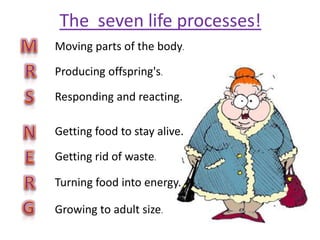
The seven life processes!
Moving parts of the body.

Producing offspring's.

Responding and reacting.

Getting food to stay alive.

Getting rid of waste.

Turning food into energy.

Growing to adult size.
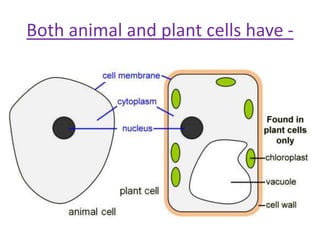
Both animal and plant cells have -
Animal and plant cell!
Nucleus – controls the cell and contains all
the genetic information.

Cell membrane – the lining of the cell and
it controls what goes in and out of the
cell.

Cytoplasm – where all the chemical
reaction take place.
Plant cell!
Cell wall – supports the cell.

Vacuole – a large space filled with cell
sap – a weak solution of salts and sugar.

Chloroplasts- contains chlorophyll that
is needed for photosynthesis.
Specialised cells

Lo - To identify each specialised cell.
   - To be able to learn the explanations
All cells are adapted
to do a particular
job. This is called
CELL SPECIALISM.
Sperm cell!
• The sperm cell is very small, it has a little tail to
  which provides movement so that it can find the
  egg to fertilise.
• Its head contains enzymes that are used to break
  through the egg membrane so that that two
  nuclei can join.
• It also contains chromosomes in the nucleus that
  holds genetic information from the father that
  will get passed down on to the offspring.
Ovum/egg cell!
• It has a large and bulky shape because there is
  no need for active movement .
• It has a yolk that provides a large food store
  for the young organism when fertilised.
• It also contains chromosomes in the nucleus
  that holds genetic information from the
  mother that will get passed down on to the
  offspring.
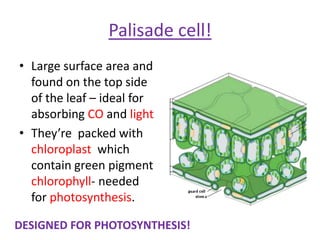
Palisade cell!
• Large surface area and
  found on the top side
  of the leaf – ideal for
  absorbing CO and light
• They’re packed with
  chloroplast which
  contain green pigment
  chlorophyll- needed
  for photosynthesis.

DESIGNED FOR PHOTOSYNTHESIS!
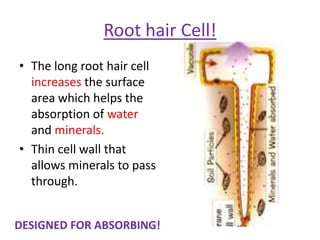
Root hair Cell!
• The long root hair cell
  increases the surface
  area which helps the
  absorption of water
  and minerals.
• Thin cell wall that
  allows minerals to pass
  through.


DESIGNED FOR ABSORBING!
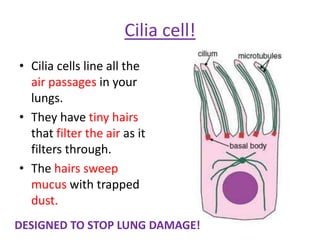
Cilia cell!
• Cilia cells line all the
  air passages in your
  lungs.
• They have tiny hairs
  that filter the air as it
  filters through.
• The hairs sweep
  mucus with trapped
  dust.
DESIGNED TO STOP LUNG DAMAGE!
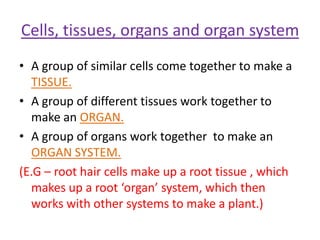
Cells, tissues, organs and organ system
• A group of similar cells come together to make a
  TISSUE.
• A group of different tissues work together to
  make an ORGAN.
• A group of organs work together to make an
  ORGAN SYSTEM.
(E.G – root hair cells make up a root tissue , which
  makes up a root ‘organ’ system, which then
  works with other systems to make a plant.)
Plant Organs!

LO -to identify key features of a plant
   -To learn what each one is for.
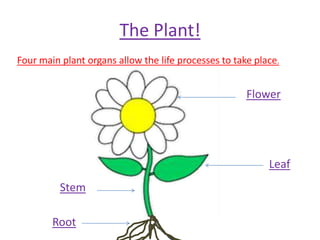
The Plant!
Four main plant organs allow the life processes to take place.


                                                      Flower


                                                           Leaf
          Stem

        Root
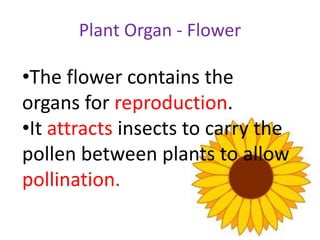
Plant Organ - Flower

•The flower contains the
organs for reproduction.
•It attracts insects to carry the
pollen between plants to allow
pollination.
Plant Organ - Stem
•The stem hold the leaves upright
and facing the light.
•It carries water and minerals to
the leaves, and food around the
plant.
•The stem is important for
nutrition, excretion and growth.
Plant Organ – Root
• The roots provide an anchorage for the
  plant – so that it doesn’t fall over or blow
  away.
• With its root hair it provide a big surface
  area to help take in water and minerals –
  these are both essential for
  photosynthesis.
• The roots are vital for nutrition.
Plant Organs – Leaves
• The leaves are important for
  photosynthesis, they make all the food for the
  plant.
• Leaves contain chloroplast that use light
  energy to change CO2 into glucose.
• They have tiny little pores that allow essential
  CO in and waste gases out – ( they have no
  lungs)
• They leaves are important for nutrition and
  excretion.
•Every cell in the
 plant will respire
 and change
 glucose into useful
 energy. jssssss
And that’s the
end of this topic!
  Welldone! 

Life processes and cell activity

  • 2.
    Life Processes andCells Lo –to be able to learn all the features of a plant cell. - To be able to understand the seven life processes.
  • 3.
    The seven lifeprocesses! Moving parts of the body. Producing offspring's. Responding and reacting. Getting food to stay alive. Getting rid of waste. Turning food into energy. Growing to adult size.
  • 4.
    Both animal andplant cells have -
  • 5.
    Animal and plantcell! Nucleus – controls the cell and contains all the genetic information. Cell membrane – the lining of the cell and it controls what goes in and out of the cell. Cytoplasm – where all the chemical reaction take place.
  • 6.
    Plant cell! Cell wall– supports the cell. Vacuole – a large space filled with cell sap – a weak solution of salts and sugar. Chloroplasts- contains chlorophyll that is needed for photosynthesis.
  • 7.
    Specialised cells Lo -To identify each specialised cell. - To be able to learn the explanations
  • 8.
    All cells areadapted to do a particular job. This is called CELL SPECIALISM.
  • 9.
    Sperm cell! • Thesperm cell is very small, it has a little tail to which provides movement so that it can find the egg to fertilise. • Its head contains enzymes that are used to break through the egg membrane so that that two nuclei can join. • It also contains chromosomes in the nucleus that holds genetic information from the father that will get passed down on to the offspring.
  • 10.
    Ovum/egg cell! • Ithas a large and bulky shape because there is no need for active movement . • It has a yolk that provides a large food store for the young organism when fertilised. • It also contains chromosomes in the nucleus that holds genetic information from the mother that will get passed down on to the offspring.
  • 11.
    Palisade cell! • Largesurface area and found on the top side of the leaf – ideal for absorbing CO and light • They’re packed with chloroplast which contain green pigment chlorophyll- needed for photosynthesis. DESIGNED FOR PHOTOSYNTHESIS!
  • 12.
    Root hair Cell! •The long root hair cell increases the surface area which helps the absorption of water and minerals. • Thin cell wall that allows minerals to pass through. DESIGNED FOR ABSORBING!
  • 13.
    Cilia cell! • Ciliacells line all the air passages in your lungs. • They have tiny hairs that filter the air as it filters through. • The hairs sweep mucus with trapped dust. DESIGNED TO STOP LUNG DAMAGE!
  • 14.
    Cells, tissues, organsand organ system • A group of similar cells come together to make a TISSUE. • A group of different tissues work together to make an ORGAN. • A group of organs work together to make an ORGAN SYSTEM. (E.G – root hair cells make up a root tissue , which makes up a root ‘organ’ system, which then works with other systems to make a plant.)
  • 15.
    Plant Organs! LO -toidentify key features of a plant -To learn what each one is for.
  • 16.
    The Plant! Four mainplant organs allow the life processes to take place. Flower Leaf Stem Root
  • 17.
    Plant Organ -Flower •The flower contains the organs for reproduction. •It attracts insects to carry the pollen between plants to allow pollination.
  • 18.
    Plant Organ -Stem •The stem hold the leaves upright and facing the light. •It carries water and minerals to the leaves, and food around the plant. •The stem is important for nutrition, excretion and growth.
  • 19.
    Plant Organ –Root • The roots provide an anchorage for the plant – so that it doesn’t fall over or blow away. • With its root hair it provide a big surface area to help take in water and minerals – these are both essential for photosynthesis. • The roots are vital for nutrition.
  • 20.
    Plant Organs –Leaves • The leaves are important for photosynthesis, they make all the food for the plant. • Leaves contain chloroplast that use light energy to change CO2 into glucose. • They have tiny little pores that allow essential CO in and waste gases out – ( they have no lungs) • They leaves are important for nutrition and excretion.
  • 21.
    •Every cell inthe plant will respire and change glucose into useful energy. jssssss
  • 22.
    And that’s the endof this topic! Welldone! 