Science (Biology)
Life Processes Mrs Gren Ovement to move your body. Espiration getting energy from food Ensitivity detecting changes in the surroundings. Rowth for your body to grow Eproduction making more living things of the same type Xcretion getting rid of waste Utrition taking in and using food
Nutrients There are 7 main nutrients needed for the body. Eating a moderate amount of every nutrient is a healthy balanced diet. The 7 nutrients are fat, fibre, minerals, vitamins, protein, carbohydrates, water.
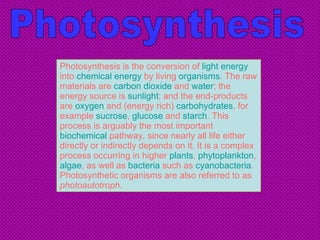
Photosynthesis is the conversion of  light   energy  into  chemical energy  by living  organisms . The raw materials are  carbon dioxide  and  water ; the energy source is  sunlight ; and the end-products are  oxygen  and (energy rich)  carbohydrates , for example  sucrose ,  glucose  and  starch . This process is arguably the most important  biochemical  pathway, since nearly all life either directly or indirectly depends on it. It is a complex process occurring in higher  plants ,  phytoplankton ,  algae , as well as  bacteria  such as  cyanobacteria . Photosynthetic organisms are also referred to as  photoautotroph . Photosynthesis
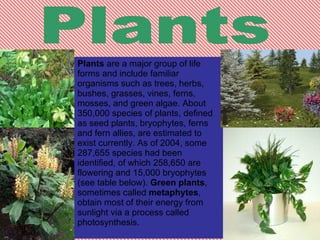
Plants Plants  are a major group of life forms and include familiar organisms such as trees, herbs, bushes, grasses, vines, ferns, mosses, and green algae. About 350,000 species of plants, defined as seed plants, bryophytes, ferns and fern allies, are estimated to exist currently. As of 2004, some 287,655 species had been identified, of which 258,650 are flowering and 15,000 bryophytes (see table below).  Green plants , sometimes called  metaphytes , obtain most of their energy from sunlight via a process called photosynthesis.
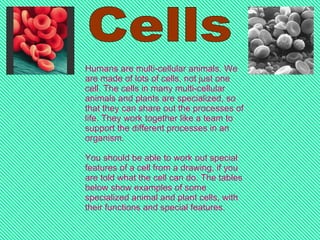
Cells Humans are multi-cellular animals. We are made of lots of cells, not just one cell. The cells in many multi-cellular animals and plants are specialized, so that they can share out the processes of life. They work together like a team to support the different processes in an organism.  You should be able to work out special features of a cell from a drawing, if you are told what the cell can do. The tables below show examples of some specialized animal and plant cells, with their functions and special features.
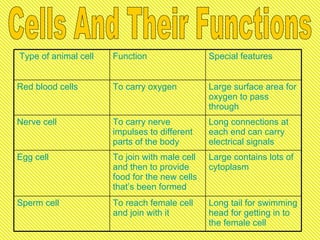
Cells And Their Functions Long tail for swimming head for getting in to the female cell To reach female cell and join with it Sperm cell Large contains lots of cytoplasm To join with male cell and then to provide food for the new cells that’s been formed Egg cell Long connections at each end can carry electrical signals To carry nerve impulses to different parts of the body Nerve cell Large surface area for oxygen to pass through To carry oxygen Red blood cells  Special features Function Type of animal cell
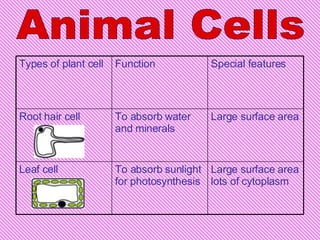
Animal Cells Large surface area lots of cytoplasm To absorb sunlight for photosynthesis Leaf cell Large surface area To absorb water and minerals Root hair cell Special features Function  Types of plant cell
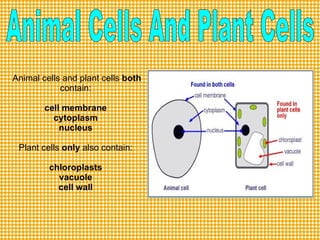
Animal Cells And Plant Cells Animal cells and plant cells  both  contain:  cell membrane  cytoplasm  nucleus  Plant cells  only  also contain:  chloroplasts  vacuole  cell wall
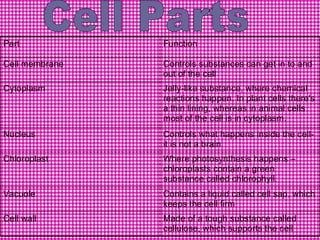
Cell Parts Made of a tough substance called cellulose, which supports the cell Cell wall Contains a liquid called cell sap, which keeps the cell firm Vacuole  Where photosynthesis happens – chloroplasts contain a green substance called chlorophyll.  Chloroplast Controls what happens inside the cell-it is not a brain Nucleus Jelly-like substance, where chemical reactions happen. In plant cells there's a thin lining, whereas in animal cells most of the cell is in cytoplasm. Cytoplasm Controls substances can get in to and out of the cell Cell membrane Function Part

Biology

  • 1.
  • 2.
    Life Processes MrsGren Ovement to move your body. Espiration getting energy from food Ensitivity detecting changes in the surroundings. Rowth for your body to grow Eproduction making more living things of the same type Xcretion getting rid of waste Utrition taking in and using food
  • 3.
    Nutrients There are7 main nutrients needed for the body. Eating a moderate amount of every nutrient is a healthy balanced diet. The 7 nutrients are fat, fibre, minerals, vitamins, protein, carbohydrates, water.
  • 4.
    Photosynthesis is theconversion of light energy into chemical energy by living organisms . The raw materials are carbon dioxide and water ; the energy source is sunlight ; and the end-products are oxygen and (energy rich) carbohydrates , for example sucrose , glucose and starch . This process is arguably the most important biochemical pathway, since nearly all life either directly or indirectly depends on it. It is a complex process occurring in higher plants , phytoplankton , algae , as well as bacteria such as cyanobacteria . Photosynthetic organisms are also referred to as photoautotroph . Photosynthesis
  • 5.
    Plants Plants are a major group of life forms and include familiar organisms such as trees, herbs, bushes, grasses, vines, ferns, mosses, and green algae. About 350,000 species of plants, defined as seed plants, bryophytes, ferns and fern allies, are estimated to exist currently. As of 2004, some 287,655 species had been identified, of which 258,650 are flowering and 15,000 bryophytes (see table below). Green plants , sometimes called metaphytes , obtain most of their energy from sunlight via a process called photosynthesis.
  • 6.
    Cells Humans aremulti-cellular animals. We are made of lots of cells, not just one cell. The cells in many multi-cellular animals and plants are specialized, so that they can share out the processes of life. They work together like a team to support the different processes in an organism. You should be able to work out special features of a cell from a drawing, if you are told what the cell can do. The tables below show examples of some specialized animal and plant cells, with their functions and special features.
  • 7.
    Cells And TheirFunctions Long tail for swimming head for getting in to the female cell To reach female cell and join with it Sperm cell Large contains lots of cytoplasm To join with male cell and then to provide food for the new cells that’s been formed Egg cell Long connections at each end can carry electrical signals To carry nerve impulses to different parts of the body Nerve cell Large surface area for oxygen to pass through To carry oxygen Red blood cells Special features Function Type of animal cell
  • 8.
    Animal Cells Largesurface area lots of cytoplasm To absorb sunlight for photosynthesis Leaf cell Large surface area To absorb water and minerals Root hair cell Special features Function Types of plant cell
  • 9.
    Animal Cells AndPlant Cells Animal cells and plant cells both contain: cell membrane cytoplasm nucleus Plant cells only also contain: chloroplasts vacuole cell wall
  • 10.
    Cell Parts Madeof a tough substance called cellulose, which supports the cell Cell wall Contains a liquid called cell sap, which keeps the cell firm Vacuole Where photosynthesis happens – chloroplasts contain a green substance called chlorophyll. Chloroplast Controls what happens inside the cell-it is not a brain Nucleus Jelly-like substance, where chemical reactions happen. In plant cells there's a thin lining, whereas in animal cells most of the cell is in cytoplasm. Cytoplasm Controls substances can get in to and out of the cell Cell membrane Function Part