LECTURE 8
LIABILITIES AND
OWNERS’ EQUITY
ARTHIK DAVIANTI, SE. MSI. AK. CA.
PERSPECTIVE OF THE FIRM
Proprietary theory is based on the idea that
the owner is the centre of attention
 accounting is done with the owners’
interests in mind
Entity theory focuses on the firm as the
centre of attention
2
PROPRIETARY THEORY
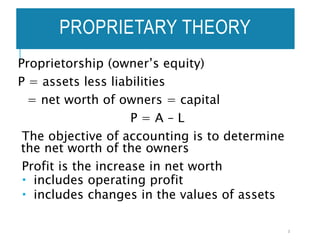
Proprietorship (owner’s equity)
P = assets less liabilities
= net worth of owners = capital
P = A – L
The objective of accounting is to determine
the net worth of the owners
Profit is the increase in net worth
 includes operating profit
 includes changes in the values of assets
3
Assets belong to the proprietor and
liabilities are obligations of the proprietor
The objective of accounting is to determine
the net worth of the owner.
Income is earned and expenses are incurred
– the decisions and actions of the owner.
Net income – the increase of the owner from
business during a given period.
Income – change in net worth derives from
income generating activities & changes in
value of assets.
4
PROPRIETARY THEORY
Present accounting is largely based on this
theory
 dividends – distribution of profit
 interest on debt & income tax - expense
 salaries to owners – not an expense
 equity method in long term investments –
ownership of the investor.
 consolidation financial statement - parent
Has a financial view of capital
 emphasis on the financial investment of the
owners and changes in owners’ wealth
5
PROPRIETARY THEORY
With the advent of the company the theory
has proved inadequate as a basis for
explaining company accounting
 developed when businesses were smaller
 a company is separate from its owners
 a company is a legal entity in its own right
 shareholders rely on managers for
information
 no longer so relevant
6
PROPRIETARY THEORY
Inadequacies in proprietary theory led to the
entity theory
Formulated to address separate legal status of
company
The company is viewed as a separate entity with
its own identity (Martin, 1978):
 separation of owners and the enterprise
 accounting procedures from the view of the
entity as an operating unit
 accounting principles and procedures not
formulated in terms of an ownership interest
 can also be applied in proprietorships,
partnerships and not-for-profit organisations
7
ENTITY THEORY
ENTITY THEORY
The objective of accounting may be either
stewardship or accountability
 entity seen as being in business for
itself
 interested in its own survival
 sees owners as outsiders
 reports to owners to meet legal
requirements and maintain good
relationships with them
8
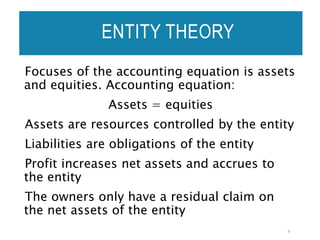
Focuses of the accounting equation is assets
and equities. Accounting equation:
Assets = equities
Assets are resources controlled by the entity
Liabilities are obligations of the entity
Profit increases net assets and accrues to
the entity
The owners only have a residual claim on
the net assets of the entity
9
ENTITY THEORY
ACCOUNTING PRACTICE
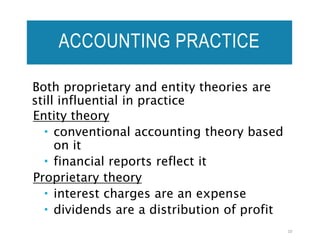
Both proprietary and entity theories are
still influential in practice
Entity theory
 conventional accounting theory based
on it
 financial reports reflect it
Proprietary theory
 interest charges are an expense
 dividends are a distribution of profit
10
LIABILITIES DEFINED
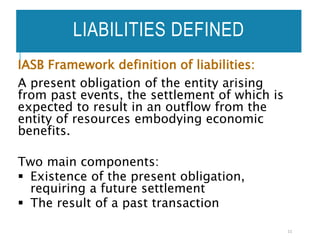
IASB Framework definition of liabilities:
A present obligation of the entity arising
from past events, the settlement of which is
expected to result in an outflow from the
entity of resources embodying economic
benefits.
Two main components:
 Existence of the present obligation,
requiring a future settlement
 The result of a past transaction
11
12
LIABILITAS
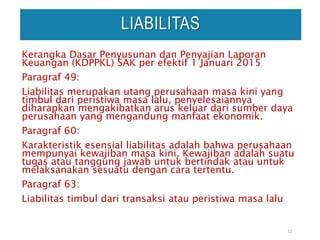
Kerangka Dasar Penyusunan dan Penyajian Laporan
Keuangan (KDPPKL) SAK per efektif 1 Januari 2015
Paragraf 49:
Liabilitas merupakan utang perusahaan masa kini yang
timbul dari peristiwa masa lalu, penyelesaiannya
diharapkan mengakibatkan arus keluar dari sumber daya
perusahaan yang mengandung manfaat ekonomik.
Paragraf 60:
Karakteristik esensial liabilitas adalah bahwa perusahaan
mempunyai kewajiban masa kini. Kewajiban adalah suatu
tugas atau tanggung jawab untuk bertindak atau untuk
melaksanakan sesuatu dengan cara tertentu.
Paragraf 63:
Liabilitas timbul dari transaksi atau peristiwa masa lalu
PRESENT OBLIGATION
Liabilities are expected to give rise to an
outflow of economic benefits.
 The actual sacrifices are yet to be made
 Obligation is already present
 Planned obligation included if to an
external party
 Legal enforceability
 Settlement of liability in various ways
 Equitable and constructive obligations
13
PAST TRANSACTION
A past transaction (or event) ensures that
only present liabilities are recorded and not
future ones
What kind of past transaction or event is
acceptable? Place an order – goods received.
 The case of wholly executory contracts
Signing a contract creates a liability?
Unconditional purchase obligation?
 Mine site restoration for an extractive
industry that commences mining.
14
LIABILITY RECOGNITION
Recognition criteria:
 Reliance on the law - legal enforceability
 Determination of the economic substance
of the event – ‘real’ obligation
15
LIABILITY RECOGNITION
Recognition criteria (continue):
 Ability to measure the value of the liability
 normally the nominal amount
 if period longer than 12-months, based
on the present value of expected future
cash flows
 Use of the conservatism principle
at what point is the entity too conservative
16
Kerangka Dasar Penyusunan dan Penyajian
Laporan Keuangan (KDPPKL)
SAK per efektif 1 Januari 2015
Paragraf 91:
Liabilitas diakui dalam neraca jika besar
kemungkinan bahwa pengeluaran sumber
daya yang mengandung manfaat ekonomik
akan dilakukan untuk menyelesaikan
kewajiban saat ini dan jumlah yang harus
diselesaikan dapat diukur dengan andal.
17
LIABILITAS
IASB FRAMEWORK
A liability should be recognised if (paragraph 82):
 it is probable that any future economic benefit
associated with the items will flow to or from
the entity; and
 the item has a cost or value that can be
measured with reliability
What does probable mean?
Vary - inconsistency
What is meant by reliable measurement?
‘free from material error & bias’
‘faithfully represents’ what it purports to
represent
18
LIABILITY MEASUREMENT
The Framework provides little guidance about how
to measure liabilities
A number of different measurement bases may be
used
Under IFRS, historical cost is the most common
Fair value measurement is more commonly being
used
 leases
 financial instruments
 share based payments
 business combinations
19
PROVISIONS AND CONTINGENCIES
Provisions and contingencies occur where there is a
blurring between present and future obligations
IAS 37 Provisions, Contingent Liabilities and
Contingent Assets
Paragraph 10, Contingent Liabilites:
a) A possible obligation that arises from past events and
whose existence will be confirmed only by the occurrence
or non-occurrence of one or more uncertain future events
not wholly within the control of the entity.
b) A present obligation that arises from past events but not
recognised.
20
PROVISIONS AND
CONTINGENCIES
Liabilities and provisions are recognised only
when there is a present obligation, it is
probable and it can be reliably measured
Contingent liabilities do not meet these
criteria
 Notes – future settlement may be required,
but the estimated probability is not high
enough to warrant recognition
21
PSAK 57 Provisi, Liabilitas Kontinjensi, dan Aset
Kontinjensi per efektif 1 Januari 2014
Paragraf 10
Liabilitas kontinjensi:
a) kewajiban potensial yang timbul dari peristiwa masa
lalu dan keberadaannya menjadi pasti dengan terjadi
atau tidak terjadinya satu atau lebih peristiwa di masa
depan yang tidak sepenuhnya berada dalam kendali
entitas
b) Kewajiban kini yang timbul sebagai akibat peristiwa
masa lalu, tetapi tidak diakui, karena (i) tidak terdapat
kemungkinan mengeluarkan sumber daya ekonomik
dan (ii) tidak dapat diukur secara andal.
22
LIABILITAS
Paragraf 10
Provisi adalah liabilitas yang waktu dan
jumlahnya belum pasti
Paragraf 14
Provisi diakui jika (a) entitas memiliki
kewajiban kini sebagai akibat peristiwa masa
lalu, (b) kemungkinan besar penyelesaian
kewajiban tersesut engakibatkan arus keluar
sumber daya yang mengandung manfaat
ekonomik, (c) estimasi yang andal mengenai
jumlah kewajiban tersebut dapat dibuat.
23
LIABILITAS
OWNERS’ EQUITY
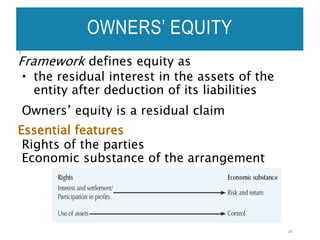
Framework defines equity as
 the residual interest in the assets of the
entity after deduction of its liabilities
Owners’ equity is a residual claim
Essential features
Rights of the parties
Economic substance of the arrangement
24
CLASSIFICATIONS WITHIN
OWNERS’ EQUITY
The distinction between contributed and
earned capital is useful
 retained earnings
 not all transactions fit nicely into categories
 share dividends
25
Kerangka Dasar Penyusunan dan Penyajian
Laporan Keuangan (KDPPKL)
SAK per efektif 1 Januari 2015
Paragraf 49:
Ekuitas adalah hak residual atas aset perusahaan
setelah dikurangi semua liabilitas.
Paragraf 65:
Ekuitas dapat disubklasifikasikan dalam neraca.
Contoh: setoran modal oleh pemegang saham,
saldo laba awal periode (retained earnings),
penyisihan saldo laba dan penyisihan
penyesuaian pemeliharaan modal.
26
EKUITAS
CONCEPT OF CAPITAL
Influenced by legal prescriptions
 capital maintenance
Financial capital
 invested money or invested purchasing
power
Physical capital
 the productive capacity of the entity
Capital can be measured on either a
nominal dollar or purchasing power (‘real’)
scale
27
Kerangka Dasar Penyusunan dan Penyajian
Laporan Keuangan (KDPPKL)
SAK per efektif 1 Januari 2015
Paragraf 104:
Konsep modal keuangan (paragraph 102)
menciptakan dua konsep pemeliharaan modal:
a) Pemeliharaan modal keuangan – laba
berdasar jumlah finansial
b) Pemeliharaan modal fisik – laba berdasar
kapasitas produktif fisik
28
KONSEP MODAL
CHALLENGES FOR
STANDARD SETTERS
IASB has several projects which will affect the
definition, recognition and measurement of
liabilities
 debt versus equity distinction – preference
share
 extinguishing debt with equity – ‘set-off
and extinguishment of debt’ or ‘in-
substance defeasance’
 employee shares (share-based payment) –
share or option
29
ISSUES FOR AUDITORS
The completeness of liabilities recognised
on the balance sheet and the note
disclosures about contingencies and other
obligations are major issues for auditors
 evidence, timing, cut off
 concealment and understatement
 going concern
 overstatement - provisions
 reasonableness of fair values
30
SOURCE:
GODFREY, HODGSON, HOLMES, AND TARCA (2012)
ACCOUNTING THEORY 7TH EDITION
IAI (2015) STANDAR AKUNTANSI KEUANGAN
PER EFEKTIV 1 JANUARI 2015

Liabilities and Owner's Equity

  • 1.
    LECTURE 8 LIABILITIES AND OWNERS’EQUITY ARTHIK DAVIANTI, SE. MSI. AK. CA.
  • 2.
    PERSPECTIVE OF THEFIRM Proprietary theory is based on the idea that the owner is the centre of attention  accounting is done with the owners’ interests in mind Entity theory focuses on the firm as the centre of attention 2
  • 3.
    PROPRIETARY THEORY Proprietorship (owner’sequity) P = assets less liabilities = net worth of owners = capital P = A – L The objective of accounting is to determine the net worth of the owners Profit is the increase in net worth  includes operating profit  includes changes in the values of assets 3
  • 4.
    Assets belong tothe proprietor and liabilities are obligations of the proprietor The objective of accounting is to determine the net worth of the owner. Income is earned and expenses are incurred – the decisions and actions of the owner. Net income – the increase of the owner from business during a given period. Income – change in net worth derives from income generating activities & changes in value of assets. 4 PROPRIETARY THEORY
  • 5.
    Present accounting islargely based on this theory  dividends – distribution of profit  interest on debt & income tax - expense  salaries to owners – not an expense  equity method in long term investments – ownership of the investor.  consolidation financial statement - parent Has a financial view of capital  emphasis on the financial investment of the owners and changes in owners’ wealth 5 PROPRIETARY THEORY
  • 6.
    With the adventof the company the theory has proved inadequate as a basis for explaining company accounting  developed when businesses were smaller  a company is separate from its owners  a company is a legal entity in its own right  shareholders rely on managers for information  no longer so relevant 6 PROPRIETARY THEORY
  • 7.
    Inadequacies in proprietarytheory led to the entity theory Formulated to address separate legal status of company The company is viewed as a separate entity with its own identity (Martin, 1978):  separation of owners and the enterprise  accounting procedures from the view of the entity as an operating unit  accounting principles and procedures not formulated in terms of an ownership interest  can also be applied in proprietorships, partnerships and not-for-profit organisations 7 ENTITY THEORY
  • 8.
    ENTITY THEORY The objectiveof accounting may be either stewardship or accountability  entity seen as being in business for itself  interested in its own survival  sees owners as outsiders  reports to owners to meet legal requirements and maintain good relationships with them 8
  • 9.
    Focuses of theaccounting equation is assets and equities. Accounting equation: Assets = equities Assets are resources controlled by the entity Liabilities are obligations of the entity Profit increases net assets and accrues to the entity The owners only have a residual claim on the net assets of the entity 9 ENTITY THEORY
  • 10.
    ACCOUNTING PRACTICE Both proprietaryand entity theories are still influential in practice Entity theory  conventional accounting theory based on it  financial reports reflect it Proprietary theory  interest charges are an expense  dividends are a distribution of profit 10
  • 11.
    LIABILITIES DEFINED IASB Frameworkdefinition of liabilities: A present obligation of the entity arising from past events, the settlement of which is expected to result in an outflow from the entity of resources embodying economic benefits. Two main components:  Existence of the present obligation, requiring a future settlement  The result of a past transaction 11
  • 12.
    12 LIABILITAS Kerangka Dasar Penyusunandan Penyajian Laporan Keuangan (KDPPKL) SAK per efektif 1 Januari 2015 Paragraf 49: Liabilitas merupakan utang perusahaan masa kini yang timbul dari peristiwa masa lalu, penyelesaiannya diharapkan mengakibatkan arus keluar dari sumber daya perusahaan yang mengandung manfaat ekonomik. Paragraf 60: Karakteristik esensial liabilitas adalah bahwa perusahaan mempunyai kewajiban masa kini. Kewajiban adalah suatu tugas atau tanggung jawab untuk bertindak atau untuk melaksanakan sesuatu dengan cara tertentu. Paragraf 63: Liabilitas timbul dari transaksi atau peristiwa masa lalu
  • 13.
    PRESENT OBLIGATION Liabilities areexpected to give rise to an outflow of economic benefits.  The actual sacrifices are yet to be made  Obligation is already present  Planned obligation included if to an external party  Legal enforceability  Settlement of liability in various ways  Equitable and constructive obligations 13
  • 14.
    PAST TRANSACTION A pasttransaction (or event) ensures that only present liabilities are recorded and not future ones What kind of past transaction or event is acceptable? Place an order – goods received.  The case of wholly executory contracts Signing a contract creates a liability? Unconditional purchase obligation?  Mine site restoration for an extractive industry that commences mining. 14
  • 15.
    LIABILITY RECOGNITION Recognition criteria: Reliance on the law - legal enforceability  Determination of the economic substance of the event – ‘real’ obligation 15
  • 16.
    LIABILITY RECOGNITION Recognition criteria(continue):  Ability to measure the value of the liability  normally the nominal amount  if period longer than 12-months, based on the present value of expected future cash flows  Use of the conservatism principle at what point is the entity too conservative 16
  • 17.
    Kerangka Dasar Penyusunandan Penyajian Laporan Keuangan (KDPPKL) SAK per efektif 1 Januari 2015 Paragraf 91: Liabilitas diakui dalam neraca jika besar kemungkinan bahwa pengeluaran sumber daya yang mengandung manfaat ekonomik akan dilakukan untuk menyelesaikan kewajiban saat ini dan jumlah yang harus diselesaikan dapat diukur dengan andal. 17 LIABILITAS
  • 18.
    IASB FRAMEWORK A liabilityshould be recognised if (paragraph 82):  it is probable that any future economic benefit associated with the items will flow to or from the entity; and  the item has a cost or value that can be measured with reliability What does probable mean? Vary - inconsistency What is meant by reliable measurement? ‘free from material error & bias’ ‘faithfully represents’ what it purports to represent 18
  • 19.
    LIABILITY MEASUREMENT The Frameworkprovides little guidance about how to measure liabilities A number of different measurement bases may be used Under IFRS, historical cost is the most common Fair value measurement is more commonly being used  leases  financial instruments  share based payments  business combinations 19
  • 20.
    PROVISIONS AND CONTINGENCIES Provisionsand contingencies occur where there is a blurring between present and future obligations IAS 37 Provisions, Contingent Liabilities and Contingent Assets Paragraph 10, Contingent Liabilites: a) A possible obligation that arises from past events and whose existence will be confirmed only by the occurrence or non-occurrence of one or more uncertain future events not wholly within the control of the entity. b) A present obligation that arises from past events but not recognised. 20
  • 21.
    PROVISIONS AND CONTINGENCIES Liabilities andprovisions are recognised only when there is a present obligation, it is probable and it can be reliably measured Contingent liabilities do not meet these criteria  Notes – future settlement may be required, but the estimated probability is not high enough to warrant recognition 21
  • 22.
    PSAK 57 Provisi,Liabilitas Kontinjensi, dan Aset Kontinjensi per efektif 1 Januari 2014 Paragraf 10 Liabilitas kontinjensi: a) kewajiban potensial yang timbul dari peristiwa masa lalu dan keberadaannya menjadi pasti dengan terjadi atau tidak terjadinya satu atau lebih peristiwa di masa depan yang tidak sepenuhnya berada dalam kendali entitas b) Kewajiban kini yang timbul sebagai akibat peristiwa masa lalu, tetapi tidak diakui, karena (i) tidak terdapat kemungkinan mengeluarkan sumber daya ekonomik dan (ii) tidak dapat diukur secara andal. 22 LIABILITAS
  • 23.
    Paragraf 10 Provisi adalahliabilitas yang waktu dan jumlahnya belum pasti Paragraf 14 Provisi diakui jika (a) entitas memiliki kewajiban kini sebagai akibat peristiwa masa lalu, (b) kemungkinan besar penyelesaian kewajiban tersesut engakibatkan arus keluar sumber daya yang mengandung manfaat ekonomik, (c) estimasi yang andal mengenai jumlah kewajiban tersebut dapat dibuat. 23 LIABILITAS
  • 24.
    OWNERS’ EQUITY Framework definesequity as  the residual interest in the assets of the entity after deduction of its liabilities Owners’ equity is a residual claim Essential features Rights of the parties Economic substance of the arrangement 24
  • 25.
    CLASSIFICATIONS WITHIN OWNERS’ EQUITY Thedistinction between contributed and earned capital is useful  retained earnings  not all transactions fit nicely into categories  share dividends 25
  • 26.
    Kerangka Dasar Penyusunandan Penyajian Laporan Keuangan (KDPPKL) SAK per efektif 1 Januari 2015 Paragraf 49: Ekuitas adalah hak residual atas aset perusahaan setelah dikurangi semua liabilitas. Paragraf 65: Ekuitas dapat disubklasifikasikan dalam neraca. Contoh: setoran modal oleh pemegang saham, saldo laba awal periode (retained earnings), penyisihan saldo laba dan penyisihan penyesuaian pemeliharaan modal. 26 EKUITAS
  • 27.
    CONCEPT OF CAPITAL Influencedby legal prescriptions  capital maintenance Financial capital  invested money or invested purchasing power Physical capital  the productive capacity of the entity Capital can be measured on either a nominal dollar or purchasing power (‘real’) scale 27
  • 28.
    Kerangka Dasar Penyusunandan Penyajian Laporan Keuangan (KDPPKL) SAK per efektif 1 Januari 2015 Paragraf 104: Konsep modal keuangan (paragraph 102) menciptakan dua konsep pemeliharaan modal: a) Pemeliharaan modal keuangan – laba berdasar jumlah finansial b) Pemeliharaan modal fisik – laba berdasar kapasitas produktif fisik 28 KONSEP MODAL
  • 29.
    CHALLENGES FOR STANDARD SETTERS IASBhas several projects which will affect the definition, recognition and measurement of liabilities  debt versus equity distinction – preference share  extinguishing debt with equity – ‘set-off and extinguishment of debt’ or ‘in- substance defeasance’  employee shares (share-based payment) – share or option 29
  • 30.
    ISSUES FOR AUDITORS Thecompleteness of liabilities recognised on the balance sheet and the note disclosures about contingencies and other obligations are major issues for auditors  evidence, timing, cut off  concealment and understatement  going concern  overstatement - provisions  reasonableness of fair values 30
  • 31.
    SOURCE: GODFREY, HODGSON, HOLMES,AND TARCA (2012) ACCOUNTING THEORY 7TH EDITION IAI (2015) STANDAR AKUNTANSI KEUANGAN PER EFEKTIV 1 JANUARI 2015