Page 1 of6
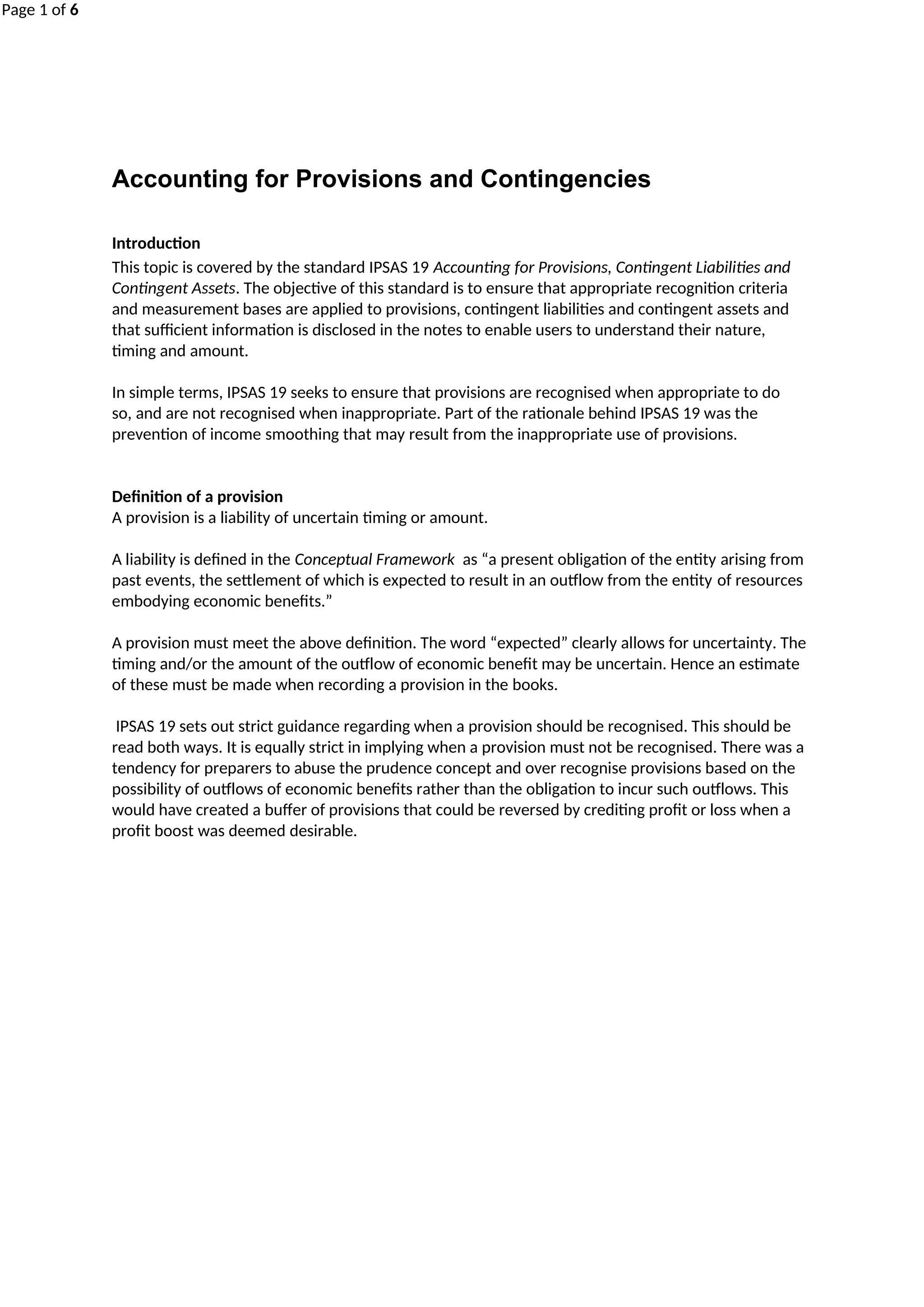
Accounting for Provisions and Contingencies
Introduction
This topic is covered by the standard IPSAS 19 Accounting for Provisions, Contingent Liabilities and
Contingent Assets. The objective of this standard is to ensure that appropriate recognition criteria
and measurement bases are applied to provisions, contingent liabilities and contingent assets and
that sufficient information is disclosed in the notes to enable users to understand their nature,
timing and amount.
In simple terms, IPSAS 19 seeks to ensure that provisions are recognised when appropriate to do
so, and are not recognised when inappropriate. Part of the rationale behind IPSAS 19 was the
prevention of income smoothing that may result from the inappropriate use of provisions.
Definition of a provision
A provision is a liability of uncertain timing or amount.
A liability is defined in the Conceptual Framework as “a present obligation of the entity arising from
past events, the settlement of which is expected to result in an outflow from the entity of resources
embodying economic benefits.”
A provision must meet the above definition. The word “expected” clearly allows for uncertainty. The
timing and/or the amount of the outflow of economic benefit may be uncertain. Hence an estimate
of these must be made when recording a provision in the books.
IPSAS 19 sets out strict guidance regarding when a provision should be recognised. This should be
read both ways. It is equally strict in implying when a provision must not be recognised. There was a
tendency for preparers to abuse the prudence concept and over recognise provisions based on the
possibility of outflows of economic benefits rather than the obligation to incur such outflows. This
would have created a buffer of provisions that could be reversed by crediting profit or loss when a
profit boost was deemed desirable.
2.
Page 2 of6
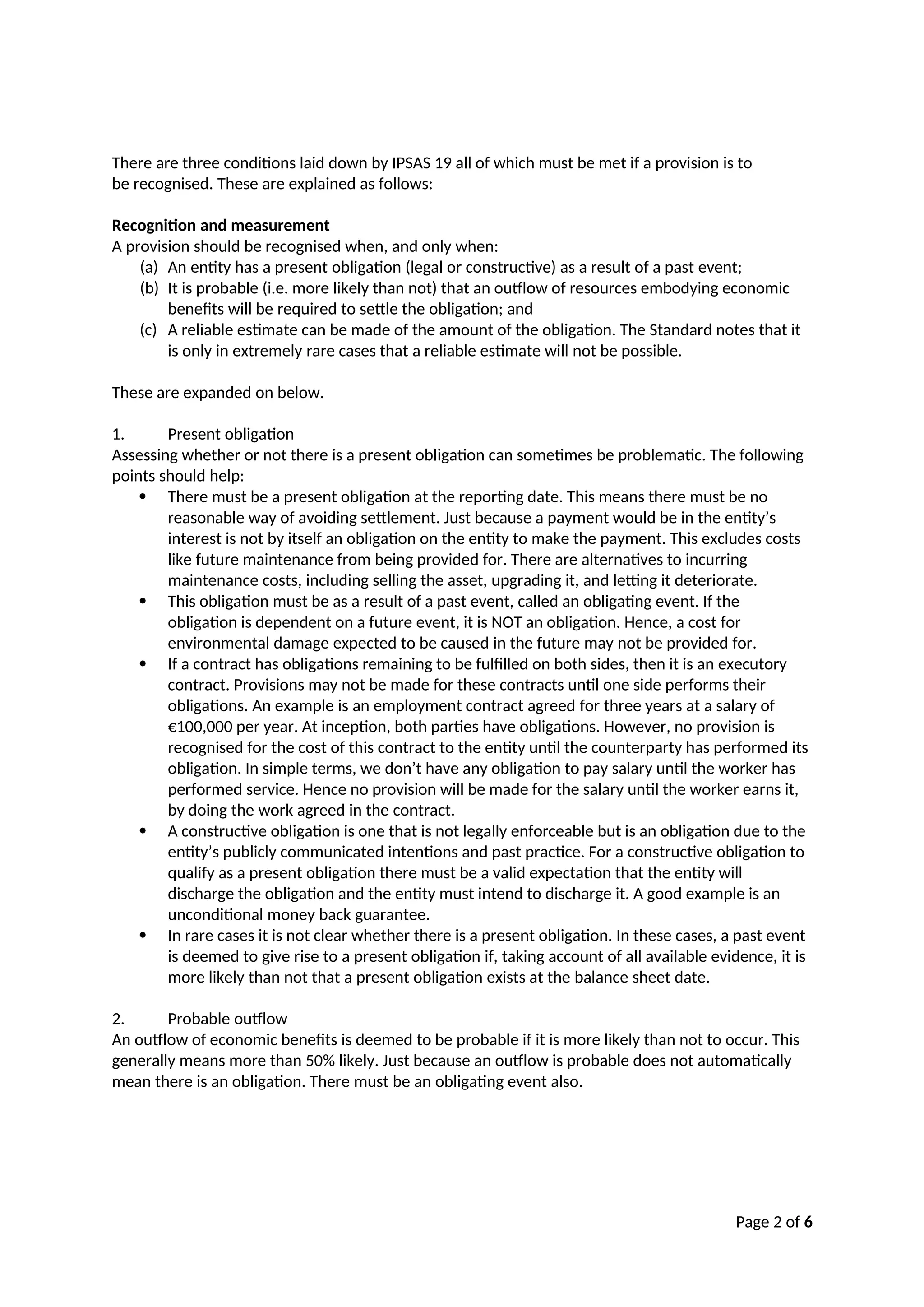
There are three conditions laid down by IPSAS 19 all of which must be met if a provision is to
be recognised. These are explained as follows:
Recognition and measurement
A provision should be recognised when, and only when:
(a) An entity has a present obligation (legal or constructive) as a result of a past event;
(b) It is probable (i.e. more likely than not) that an outflow of resources embodying economic
benefits will be required to settle the obligation; and
(c) A reliable estimate can be made of the amount of the obligation. The Standard notes that it
is only in extremely rare cases that a reliable estimate will not be possible.
These are expanded on below.
1. Present obligation
Assessing whether or not there is a present obligation can sometimes be problematic. The following
points should help:
There must be a present obligation at the reporting date. This means there must be no
reasonable way of avoiding settlement. Just because a payment would be in the entity’s
interest is not by itself an obligation on the entity to make the payment. This excludes costs
like future maintenance from being provided for. There are alternatives to incurring
maintenance costs, including selling the asset, upgrading it, and letting it deteriorate.
This obligation must be as a result of a past event, called an obligating event. If the
obligation is dependent on a future event, it is NOT an obligation. Hence, a cost for
environmental damage expected to be caused in the future may not be provided for.
If a contract has obligations remaining to be fulfilled on both sides, then it is an executory
contract. Provisions may not be made for these contracts until one side performs their
obligations. An example is an employment contract agreed for three years at a salary of
€100,000 per year. At inception, both parties have obligations. However, no provision is
recognised for the cost of this contract to the entity until the counterparty has performed its
obligation. In simple terms, we don’t have any obligation to pay salary until the worker has
performed service. Hence no provision will be made for the salary until the worker earns it,
by doing the work agreed in the contract.
A constructive obligation is one that is not legally enforceable but is an obligation due to the
entity’s publicly communicated intentions and past practice. For a constructive obligation to
qualify as a present obligation there must be a valid expectation that the entity will
discharge the obligation and the entity must intend to discharge it. A good example is an
unconditional money back guarantee.
In rare cases it is not clear whether there is a present obligation. In these cases, a past event
is deemed to give rise to a present obligation if, taking account of all available evidence, it is
more likely than not that a present obligation exists at the balance sheet date.
2. Probable outflow
An outflow of economic benefits is deemed to be probable if it is more likely than not to occur. This
generally means more than 50% likely. Just because an outflow is probable does not automatically
mean there is an obligation. There must be an obligating event also.
3.
Page 3 of6
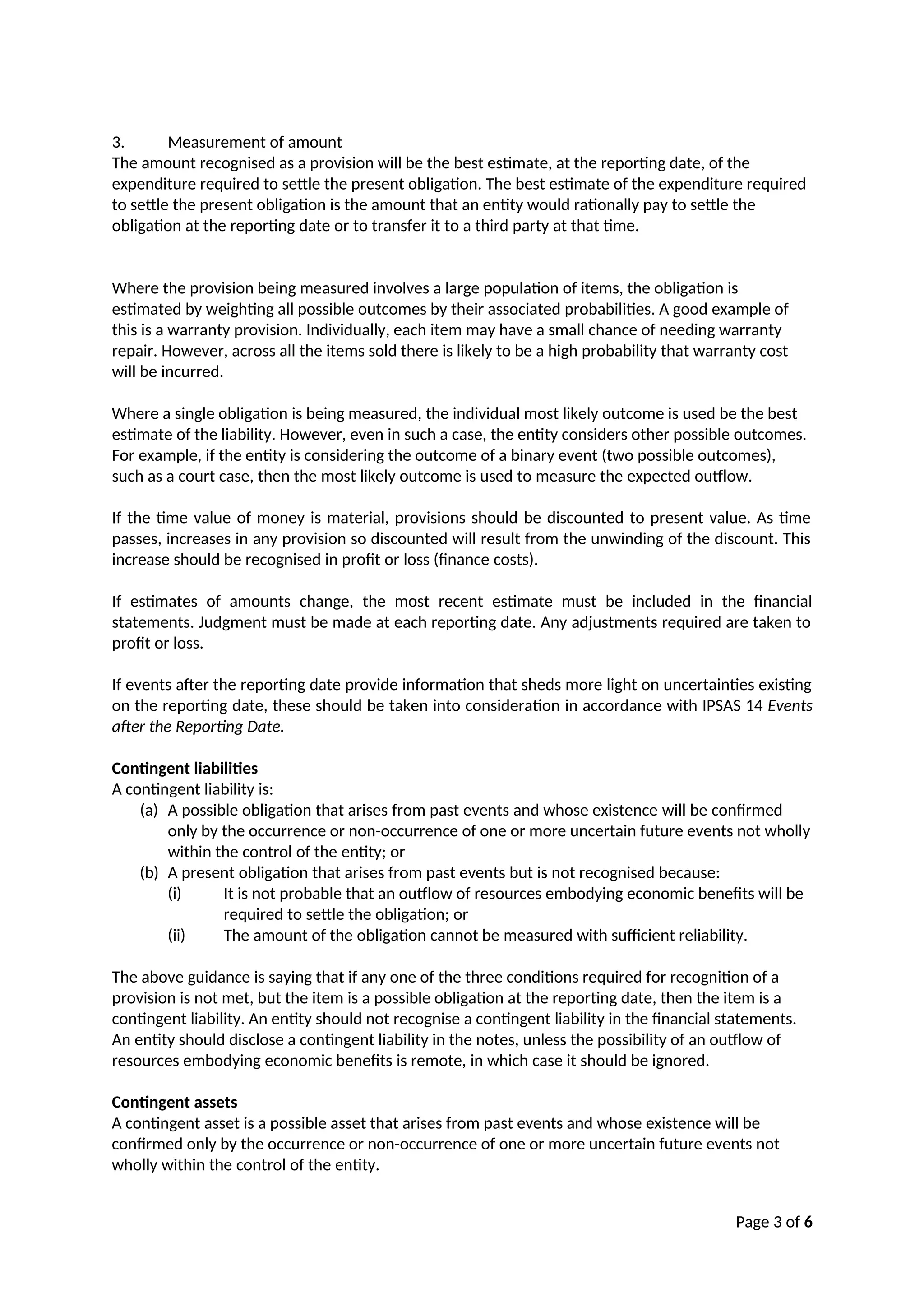
3. Measurement of amount
The amount recognised as a provision will be the best estimate, at the reporting date, of the
expenditure required to settle the present obligation. The best estimate of the expenditure required
to settle the present obligation is the amount that an entity would rationally pay to settle the
obligation at the reporting date or to transfer it to a third party at that time.
Where the provision being measured involves a large population of items, the obligation is
estimated by weighting all possible outcomes by their associated probabilities. A good example of
this is a warranty provision. Individually, each item may have a small chance of needing warranty
repair. However, across all the items sold there is likely to be a high probability that warranty cost
will be incurred.
Where a single obligation is being measured, the individual most likely outcome is used be the best
estimate of the liability. However, even in such a case, the entity considers other possible outcomes.
For example, if the entity is considering the outcome of a binary event (two possible outcomes),
such as a court case, then the most likely outcome is used to measure the expected outflow.
If the time value of money is material, provisions should be discounted to present value. As time
passes, increases in any provision so discounted will result from the unwinding of the discount. This
increase should be recognised in profit or loss (finance costs).
If estimates of amounts change, the most recent estimate must be included in the financial
statements. Judgment must be made at each reporting date. Any adjustments required are taken to
profit or loss.
If events after the reporting date provide information that sheds more light on uncertainties existing
on the reporting date, these should be taken into consideration in accordance with IPSAS 14 Events
after the Reporting Date.
Contingent liabilities
A contingent liability is:
(a) A possible obligation that arises from past events and whose existence will be confirmed
only by the occurrence or non-occurrence of one or more uncertain future events not wholly
within the control of the entity; or
(b) A present obligation that arises from past events but is not recognised because:
(i) It is not probable that an outflow of resources embodying economic benefits will be
required to settle the obligation; or
(ii) The amount of the obligation cannot be measured with sufficient reliability.
The above guidance is saying that if any one of the three conditions required for recognition of a
provision is not met, but the item is a possible obligation at the reporting date, then the item is a
contingent liability. An entity should not recognise a contingent liability in the financial statements.
An entity should disclose a contingent liability in the notes, unless the possibility of an outflow of
resources embodying economic benefits is remote, in which case it should be ignored.
Contingent assets
A contingent asset is a possible asset that arises from past events and whose existence will be
confirmed only by the occurrence or non-occurrence of one or more uncertain future events not
wholly within the control of the entity.
4.
Page 4 of6
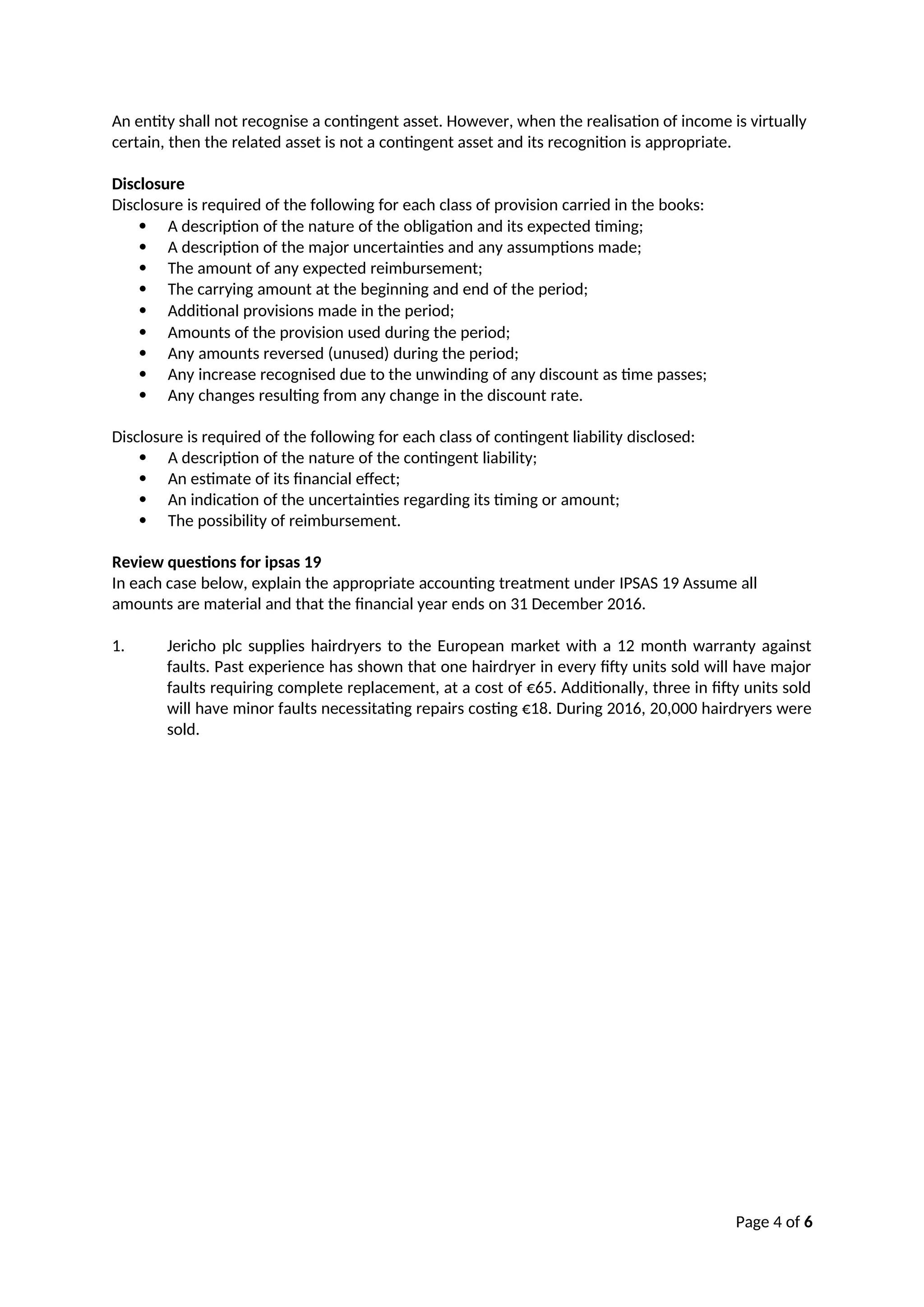
An entity shall not recognise a contingent asset. However, when the realisation of income is virtually
certain, then the related asset is not a contingent asset and its recognition is appropriate.
Disclosure
Disclosure is required of the following for each class of provision carried in the books:
A description of the nature of the obligation and its expected timing;
A description of the major uncertainties and any assumptions made;
The amount of any expected reimbursement;
The carrying amount at the beginning and end of the period;
Additional provisions made in the period;
Amounts of the provision used during the period;
Any amounts reversed (unused) during the period;
Any increase recognised due to the unwinding of any discount as time passes;
Any changes resulting from any change in the discount rate.
Disclosure is required of the following for each class of contingent liability disclosed:
A description of the nature of the contingent liability;
An estimate of its financial effect;
An indication of the uncertainties regarding its timing or amount;
The possibility of reimbursement.
Review questions for ipsas 19
In each case below, explain the appropriate accounting treatment under IPSAS 19 Assume all
amounts are material and that the financial year ends on 31 December 2016.
1. Jericho plc supplies hairdryers to the European market with a 12 month warranty against
faults. Past experience has shown that one hairdryer in every fifty units sold will have major
faults requiring complete replacement, at a cost of €65. Additionally, three in fifty units sold
will have minor faults necessitating repairs costing €18. During 2016, 20,000 hairdryers were
sold.
5.
Page 5 of6
2. Gamma plc operates as an oil exploration company in several countries. It often causes
environmental damage, but cleans up only when required to do so by law. In Murphyland,
where the company has been contaminating the environment for several years, a law has
been drafted requiring companies causing contamination to clean up. This law, which will
apply retrospectively to past damage, has passed through all stages of parliament before
Gamma’s year end of 31 December 2016, but has not been signed into law yet as the
president is on holidays. The president normally signs without question laws that are passed
by parliament. It has been estimated that the costs of cleaning up the damage already
caused will amount to €15m, and the damage expected to be caused in 2017 will cost €3.5m
to repair if the law is passed.
3. Hades Ltd operates offshore drilling rigs. As part of the terms of its drilling licence, Hades is
required to dismantle the rigs and clean up any contamination at the end of the rigs’ lives.
During 2016 a new rig was constructed at a cost of €30m. The present value of the expected
cost of dismantling this rig was estimated at €5m, and the present value of the cost of
decontamination due to oil passing through the rig was estimated at €2.4m. At 31 December
2016 the rig was completed, but no oil had yet passed through it.
4. Kelly plc operates several clothing stores throughout Ireland. It has a policy of allowing
refunds on all clothes returned within 4 weeks of purchase when accompanied by a valid
receipt. There is no legal obligation to allow refunds, but it has maintained this policy for
several years. Past experience has suggested that 10% of all clothes sold are returned for
refund within the 4 weeks. During the last 4 weeks of the financial year ended 31 December
2016, sales totalling €780,000 were made at a gross margin of 30%. Returned items can be
sold on at a discount of 50% of normal retail price.
5. On 12 December 2016 Llama Ltd decided to close down a division. Expected costs of closure
were estimated at €1.2m. No action was taken to communicate this to the affected parties
until 23 January 2017.
6. Legislation was passed on 30 September 2016 requiring the fitting of emissions filters to the
factories of Melvil plc immediately. This law has not been complied with by the year end.
The expected cost of fitting the filters is €375,000.
7. Sam Ltd is being sued for €100,000 by a customer who slipped on a wet floor whilst at Sam’s
premises. Legal advice at the reporting date is that Sam is likely to win the case, as no
negligence seems to be provable.
8. A fire occurred at the premises of Tim Ltd during December 2010. Total damage was
assessed at €350,000. It is a term of Tim’s insurance policy that fire alarms be fitted to all
premises. No fire alarms were fitted to the premises affected by the fire. It is hoped that
Tim’s insurers will cover this loss under the terms of the insurance policy. However the
assessor has not yet provided his report or recommendations.


![Contingencies and provisioning[1]](https://cdn.slidesharecdn.com/ss_thumbnails/contingenciesandprovisioning1-111024070333-phpapp01-thumbnail.jpg?width=640&height=640&fit=bounds)


