Assets and
Liabilities
By
Rashmi Gowda KM
Research Analyst – Risk Intelligence at
Supply Wisdom
Assets
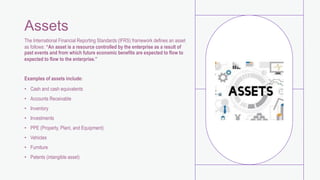
The International Financial Reporting Standards (IFRS) framework defines an asset
as follows: “An asset is a resource controlled by the enterprise as a result of
past events and from which future economic benefits are expected to flow to
expected to flow to the enterprise.”
Examples of assets include:
• Cash and cash equivalents
• Accounts Receivable
• Inventory
• Investments
• PPE (Property, Plant, and Equipment)
• Vehicles
• Furniture
• Patents (intangible asset)
Classification
of Assets
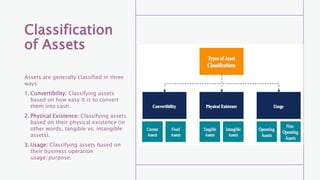
Assets are generally classified in three
ways:
1. Convertibility: Classifying assets
based on how easy it is to convert
them into cash.
2. Physical Existence: Classifying assets
based on their physical existence (in
other words, tangible vs. intangible
assets).
3. Usage: Classifying assets based on
their business operation
usage/purpose.
Classification of Assets: Convertibility
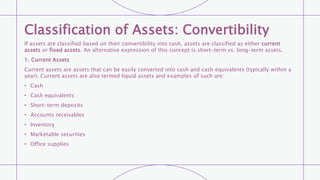
If assets are classified based on their convertibility into cash, assets are classified as either current
assets or fixed assets. An alternative expression of this concept is short-term vs. long-term assets.
1. Current Assets
Current assets are assets that can be easily converted into cash and cash equivalents (typically within a
year). Current assets are also termed liquid assets and examples of such are:
• Cash
• Cash equivalents
• Short-term deposits
• Accounts receivables
• Inventory
• Marketable securities
• Office supplies
2. Fixed or Non-Current Assets
Non-current assets are assets that cannot be easily and readily converted into cash and cash equivalents.
fixed assets, long-term assets, or hard assets. Examples of non-current or fixed assets include:
• Land
• Building
• Machinery
• Equipment
• Patents
• Trademarks
Classification of Assets: Physical Existence
If assets are classified based on their physical existence, assets are classified as either tangible
assets or intangible assets.
1. Tangible Assets
Tangible assets are assets with physical existence (we can touch, feel, and see them). Examples of
tangible assets include:
• Land
• Building
• Machinery
• Equipment
• Cash
• Office supplies
• Inventory
• Marketable securities
2. Intangible Assets
Intangible assets are assets that lack physical existence. Examples of intangible assets include:
• Goodwill
• Patents
• Brand
• Copyrights
• Trademarks
• Trade secrets
• Licenses and permits
• Corporate intellectual property
Classification of Assets: Usage
If assets are classified based on their usage or purpose, assets are classified as either operating
assets or non-operating assets.
1. Operating Assets
Operating assets are assets that are required in the daily operation of a business. In other words, operating
assets are used to generate revenue from a company’s core business activities. Examples of operating
assets include:
• Cash
• Accounts receivable
• Inventory
• Building
• Machinery
• Equipment
• Patents
• Copyrights
• Goodwill
2. Non-Operating Assets
Non-operating assets are assets that are not required for daily business operations but
Examples of non-operating assets include:
• Short-term investments
• Marketable securities
• Vacant land
• Interest income from a fixed deposit
Liabilities
• A liability is simply a debt or obligation. Most people have liabilities in their day-to-day
lives: car payments, rent, and credit card bills. In corporate finance, the liabilities are
similar, just on a much larger scale.
• Liabilities for a business may be long-term loans for funding operations, money a
company owes to vendors or suppliers, and leases on warehouse space. If a company
has an obligation to pay someone or for something, it is a liability.
• WHO DEALS WITH LIABILITIES -Liabilities are a core part of business and finance —
business owners and members of a company’s financial team are responsible for
understanding what liabilities their company has and how they affect the company as a
whole.
Types of Liabilities
Liabilities are typically categorized by expiration or due date: current liabilities are pressing debts and obligations,
while non-current liabilities are important but don’t require immediate action.
Current - Current liabilities are short-term debts and obligations due within one year. Some common
examples of current liabilities are:
• Accounts payable: Money the company owes to lenders, clients, customers, and suppliers
• Short-term loans: Loans with repayment periods of one year or less
• Payments on long-term debt: Payments due on larger loans with repayment periods of more than one year,
and the remainder of the loan owed is listed as a non-current liability
• Interest: Unpaid interest on loans
• Accrued liabilities: Any unpaid short-term debts from previous accounting periods
• Income taxes: Federal, state, and local income taxes that have not been paid yet
• Deferred revenue or unearned revenue: Money the company has received for goods or services it has not yet
provided to the customer
• Commercial paper: Unsecured promissory notes with fixed interest rates used by companies to fund very
pressing liabilities like payroll
Non-Current
Non-current or long-term liabilities are debts and obligations due in
the future but not in the next year. Some types of non-current
liabilities are:
Bonds: A type of marketable security that has a specified maturity
date (when payment is due in full) and interest rate
Deferred tax: Federal, state, and local taxes owed, though not due
immediately
Long-term debt: Loans and other debts that are not due within the
year, including remaining principal amounts on loans paid in
increments
Mortgages: Agreements with lenders that give the lender the right to
repossess the purchased property if the loan is not repaid
Leases: Payments for the use of another person’s property or
assets, such as machinery, office spaces, and vehicles
Pensions: Retirement funds for employees
Contingent Liabilities
• Contingent liabilities are a special type of debt or obligation that may or may not happen in the future. These are
contingent (or dependent on) certain events. The most common example of a contingent liability is legal costs
related to the outcome of a lawsuit. For example, if the company wins the case and doesn’t need to pay any
money, it does not need to cover the debt. However, if the company loses the lawsuit and needs to pay the other
party, the company does need to cover the obligation.
• Another example of a contingent liability is a warranty. If a company’s product requires repairs or replacement,
the company needs the funds available to honor the warranty agreement.
• Not every possible event can be planned for, though. So, when it comes to reporting a company’s finances, only
certain contingent obligations need to be reported. According to the generally accepted accounting principles
(GAAP), accountants only need to list probable liabilities on a company’s balance sheet. These are events that are
very likely to happen, and the cost can be reasonably estimated.
• The other two types of contingent liabilities — possible and remote — do not need to be stated in the balance
sheet because they are less likely to occur and much harder to estimate. Accountants should note possible
contingent liabilities in the footnotes of the company’s financial statements, though.
Liabilities
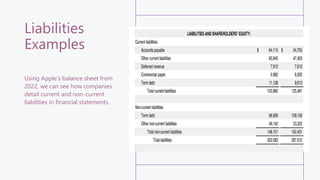
Examples
Using Apple’s balance sheet from
2022, we can see how companies
detail current and non-current
liabilities in financial statements.
Accounting Equation:
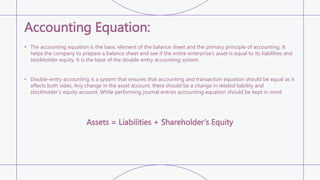
• The accounting equation is the basic element of the balance sheet and the primary principle of accounting. It
helps the company to prepare a balance sheet and see if the entire enterprise’s asset is equal to its liabilities and
stockholder equity. It is the base of the double-entry accounting system.
• Double-entry accounting is a system that ensures that accounting and transaction equation should be equal as it
affects both sides. Any change in the asset account, there should be a change in related liability and
stockholder’s equity account. While performing journal entries accounting equation should be kept in mind.
Assets = Liabilities + Shareholder’s Equity
Accounting Equation Examples
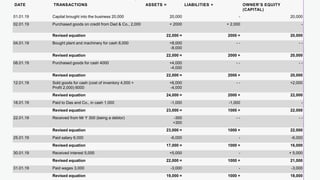
Let us understand the accounting equation with the help of an example.
• Mr Ram, a sole proprietor has the following transactions in his books of accounts for the year 2019.
• Jan 1 Invested Capital of 20,000 Indonesian Rupiah.
• Jan 2 Purchased goods on credit from Das & Co. for 2,000 Indonesian Rupiah.
• Jan 4 Bought plat and machinery for 8,000 Indonesian Rupiah on cash.
• Jan 8 Purchased goods for 4,000 Indonesian Rupiah on cash.
• Jan 12 Sold goods for (cost of inventory 4,000 + profit 2,000) 6,000 Indonesian Rupiah on cash
• Jan 18 Paid to Das & Co. in cash 1,000 Indonesian Rupiah
• Jan 22 Received 300 Indonesian Rupiah from Mr Y (being a debtor)
• Jan 25 Paid salary of 6,000 Indonesian Rupiah
• Jan 30 Received interest of 5,000 Indonesian Rupiah
• Jan 31 Paid wages of 3,000 Indonesian Rupiah
DATE TRANSACTIONS ASSETS = LIABILITIES + OWNER’S EQUITY
(CAPITAL)
01.01.19 Capital brought into the business 20,000 20,000 - 20,000
02.01.19 Purchased goods on credit from Dad & Co., 2,000 + 2000 + 2,000 -
Revised equation 22,000 = 2000 + 20,000
04.01.19 Bought plant and machinery for cash 8,000 +8,000
-8,000
- - - -
Revised equation 22,000 = 2000 + 20,000
08.01.19 Purchased goods for cash 4000 +4,000
-4,000
- - - -
Revised equation 22,000 = 2000 + 20,000
12.01.19 Sold goods for cash (cost of inventory 4,000 +
Profit 2,000) 6000
+6,000
-4,000
- - +2,000
Revised equation 24,000 = 2000 + 22,000
18.01.19 Paid to Das and Co., in cash 1,000 -1,000 -1,000 -
Revised equation 23,000 = 1000 + 22,000
22.01.19 Received from Mr Y 300 (being a debtor) -300
+300
- - - -
Revised equation 23,000 = 1000 + 22,000
25.01.19 Paid salary 6,000 -6,000 - -6,000
Revised equation 17,000 = 1000 + 16,000
30.01.19 Received interest 5,000 +5,000 - + 5,000
Revised equation 22,000 = 1000 + 21,000
31.01.19 Paid wages 3,000 -3,000 - -3,000
Revised equation 19,000 = 1000 + 18,000
RATIOS involving Assets and Liabilities
• https://rashmikm.blogspot.com/2020/11/
FINANCIAL STATEMENT of APPLE
(2022FY)
https://s2.q4cdn.com/470004039/files/doc_financials/2022/q4/_10-K-2022-(As-Filed).pdf
Assignment
Assets and Liabilities : Download any Financial Statement of a company of your choice
• List the Different types of Current Assets and Non Current Assets of the company
• List the different types of Current Liabilities and Non Current Liabilities of the company
• Calculate minimum of 8 Ratios to analyze the financial health of the company
THANK YOU
• “Money is defined as a two-way street: you are either
earning or spending. However, many in life are
accustomed to spending rather than earning.
Spending without earning defines a life of deficit
which builds an empire of liabilities to the detriment
of asset building.”
― Oscar Bimpong

Assets and Liabilities_Nov4th.pptx

  • 1.
    Assets and Liabilities By Rashmi GowdaKM Research Analyst – Risk Intelligence at Supply Wisdom
  • 2.
    Assets The International FinancialReporting Standards (IFRS) framework defines an asset as follows: “An asset is a resource controlled by the enterprise as a result of past events and from which future economic benefits are expected to flow to expected to flow to the enterprise.” Examples of assets include: • Cash and cash equivalents • Accounts Receivable • Inventory • Investments • PPE (Property, Plant, and Equipment) • Vehicles • Furniture • Patents (intangible asset)
  • 3.
    Classification of Assets Assets aregenerally classified in three ways: 1. Convertibility: Classifying assets based on how easy it is to convert them into cash. 2. Physical Existence: Classifying assets based on their physical existence (in other words, tangible vs. intangible assets). 3. Usage: Classifying assets based on their business operation usage/purpose.
  • 4.
    Classification of Assets:Convertibility If assets are classified based on their convertibility into cash, assets are classified as either current assets or fixed assets. An alternative expression of this concept is short-term vs. long-term assets. 1. Current Assets Current assets are assets that can be easily converted into cash and cash equivalents (typically within a year). Current assets are also termed liquid assets and examples of such are: • Cash • Cash equivalents • Short-term deposits • Accounts receivables • Inventory • Marketable securities • Office supplies
  • 5.
    2. Fixed orNon-Current Assets Non-current assets are assets that cannot be easily and readily converted into cash and cash equivalents. fixed assets, long-term assets, or hard assets. Examples of non-current or fixed assets include: • Land • Building • Machinery • Equipment • Patents • Trademarks
  • 6.
    Classification of Assets:Physical Existence If assets are classified based on their physical existence, assets are classified as either tangible assets or intangible assets. 1. Tangible Assets Tangible assets are assets with physical existence (we can touch, feel, and see them). Examples of tangible assets include: • Land • Building • Machinery • Equipment • Cash • Office supplies • Inventory • Marketable securities
  • 7.
    2. Intangible Assets Intangibleassets are assets that lack physical existence. Examples of intangible assets include: • Goodwill • Patents • Brand • Copyrights • Trademarks • Trade secrets • Licenses and permits • Corporate intellectual property
  • 8.
    Classification of Assets:Usage If assets are classified based on their usage or purpose, assets are classified as either operating assets or non-operating assets. 1. Operating Assets Operating assets are assets that are required in the daily operation of a business. In other words, operating assets are used to generate revenue from a company’s core business activities. Examples of operating assets include: • Cash • Accounts receivable • Inventory • Building • Machinery • Equipment • Patents • Copyrights • Goodwill
  • 9.
    2. Non-Operating Assets Non-operatingassets are assets that are not required for daily business operations but Examples of non-operating assets include: • Short-term investments • Marketable securities • Vacant land • Interest income from a fixed deposit
  • 10.
    Liabilities • A liabilityis simply a debt or obligation. Most people have liabilities in their day-to-day lives: car payments, rent, and credit card bills. In corporate finance, the liabilities are similar, just on a much larger scale. • Liabilities for a business may be long-term loans for funding operations, money a company owes to vendors or suppliers, and leases on warehouse space. If a company has an obligation to pay someone or for something, it is a liability. • WHO DEALS WITH LIABILITIES -Liabilities are a core part of business and finance — business owners and members of a company’s financial team are responsible for understanding what liabilities their company has and how they affect the company as a whole.
  • 11.
    Types of Liabilities Liabilitiesare typically categorized by expiration or due date: current liabilities are pressing debts and obligations, while non-current liabilities are important but don’t require immediate action. Current - Current liabilities are short-term debts and obligations due within one year. Some common examples of current liabilities are: • Accounts payable: Money the company owes to lenders, clients, customers, and suppliers • Short-term loans: Loans with repayment periods of one year or less • Payments on long-term debt: Payments due on larger loans with repayment periods of more than one year, and the remainder of the loan owed is listed as a non-current liability • Interest: Unpaid interest on loans • Accrued liabilities: Any unpaid short-term debts from previous accounting periods • Income taxes: Federal, state, and local income taxes that have not been paid yet • Deferred revenue or unearned revenue: Money the company has received for goods or services it has not yet provided to the customer • Commercial paper: Unsecured promissory notes with fixed interest rates used by companies to fund very pressing liabilities like payroll
  • 12.
    Non-Current Non-current or long-termliabilities are debts and obligations due in the future but not in the next year. Some types of non-current liabilities are: Bonds: A type of marketable security that has a specified maturity date (when payment is due in full) and interest rate Deferred tax: Federal, state, and local taxes owed, though not due immediately Long-term debt: Loans and other debts that are not due within the year, including remaining principal amounts on loans paid in increments Mortgages: Agreements with lenders that give the lender the right to repossess the purchased property if the loan is not repaid Leases: Payments for the use of another person’s property or assets, such as machinery, office spaces, and vehicles Pensions: Retirement funds for employees
  • 13.
    Contingent Liabilities • Contingentliabilities are a special type of debt or obligation that may or may not happen in the future. These are contingent (or dependent on) certain events. The most common example of a contingent liability is legal costs related to the outcome of a lawsuit. For example, if the company wins the case and doesn’t need to pay any money, it does not need to cover the debt. However, if the company loses the lawsuit and needs to pay the other party, the company does need to cover the obligation. • Another example of a contingent liability is a warranty. If a company’s product requires repairs or replacement, the company needs the funds available to honor the warranty agreement. • Not every possible event can be planned for, though. So, when it comes to reporting a company’s finances, only certain contingent obligations need to be reported. According to the generally accepted accounting principles (GAAP), accountants only need to list probable liabilities on a company’s balance sheet. These are events that are very likely to happen, and the cost can be reasonably estimated. • The other two types of contingent liabilities — possible and remote — do not need to be stated in the balance sheet because they are less likely to occur and much harder to estimate. Accountants should note possible contingent liabilities in the footnotes of the company’s financial statements, though.
  • 14.
    Liabilities Examples Using Apple’s balancesheet from 2022, we can see how companies detail current and non-current liabilities in financial statements.
  • 15.
    Accounting Equation: • Theaccounting equation is the basic element of the balance sheet and the primary principle of accounting. It helps the company to prepare a balance sheet and see if the entire enterprise’s asset is equal to its liabilities and stockholder equity. It is the base of the double-entry accounting system. • Double-entry accounting is a system that ensures that accounting and transaction equation should be equal as it affects both sides. Any change in the asset account, there should be a change in related liability and stockholder’s equity account. While performing journal entries accounting equation should be kept in mind. Assets = Liabilities + Shareholder’s Equity
  • 16.
    Accounting Equation Examples Letus understand the accounting equation with the help of an example. • Mr Ram, a sole proprietor has the following transactions in his books of accounts for the year 2019. • Jan 1 Invested Capital of 20,000 Indonesian Rupiah. • Jan 2 Purchased goods on credit from Das & Co. for 2,000 Indonesian Rupiah. • Jan 4 Bought plat and machinery for 8,000 Indonesian Rupiah on cash. • Jan 8 Purchased goods for 4,000 Indonesian Rupiah on cash. • Jan 12 Sold goods for (cost of inventory 4,000 + profit 2,000) 6,000 Indonesian Rupiah on cash • Jan 18 Paid to Das & Co. in cash 1,000 Indonesian Rupiah • Jan 22 Received 300 Indonesian Rupiah from Mr Y (being a debtor) • Jan 25 Paid salary of 6,000 Indonesian Rupiah • Jan 30 Received interest of 5,000 Indonesian Rupiah • Jan 31 Paid wages of 3,000 Indonesian Rupiah
  • 17.
    DATE TRANSACTIONS ASSETS= LIABILITIES + OWNER’S EQUITY (CAPITAL) 01.01.19 Capital brought into the business 20,000 20,000 - 20,000 02.01.19 Purchased goods on credit from Dad & Co., 2,000 + 2000 + 2,000 - Revised equation 22,000 = 2000 + 20,000 04.01.19 Bought plant and machinery for cash 8,000 +8,000 -8,000 - - - - Revised equation 22,000 = 2000 + 20,000 08.01.19 Purchased goods for cash 4000 +4,000 -4,000 - - - - Revised equation 22,000 = 2000 + 20,000 12.01.19 Sold goods for cash (cost of inventory 4,000 + Profit 2,000) 6000 +6,000 -4,000 - - +2,000 Revised equation 24,000 = 2000 + 22,000 18.01.19 Paid to Das and Co., in cash 1,000 -1,000 -1,000 - Revised equation 23,000 = 1000 + 22,000 22.01.19 Received from Mr Y 300 (being a debtor) -300 +300 - - - - Revised equation 23,000 = 1000 + 22,000 25.01.19 Paid salary 6,000 -6,000 - -6,000 Revised equation 17,000 = 1000 + 16,000 30.01.19 Received interest 5,000 +5,000 - + 5,000 Revised equation 22,000 = 1000 + 21,000 31.01.19 Paid wages 3,000 -3,000 - -3,000 Revised equation 19,000 = 1000 + 18,000
  • 18.
    RATIOS involving Assetsand Liabilities • https://rashmikm.blogspot.com/2020/11/ FINANCIAL STATEMENT of APPLE (2022FY) https://s2.q4cdn.com/470004039/files/doc_financials/2022/q4/_10-K-2022-(As-Filed).pdf
  • 19.
    Assignment Assets and Liabilities: Download any Financial Statement of a company of your choice • List the Different types of Current Assets and Non Current Assets of the company • List the different types of Current Liabilities and Non Current Liabilities of the company • Calculate minimum of 8 Ratios to analyze the financial health of the company
  • 20.
    THANK YOU • “Moneyis defined as a two-way street: you are either earning or spending. However, many in life are accustomed to spending rather than earning. Spending without earning defines a life of deficit which builds an empire of liabilities to the detriment of asset building.” ― Oscar Bimpong