Sustainability
and Integrated
Reporting
Arthik Davianti
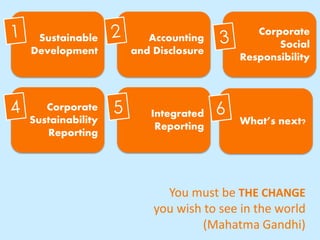
1. Sustainable Development
2. Accounting and Disclosure
3. Corporate Social Responsibility
4. Corporate Sustainability Reporting
5. Integrated Reporting
6. What’s next?
SUSTAINABLE
DEVELOPMENT
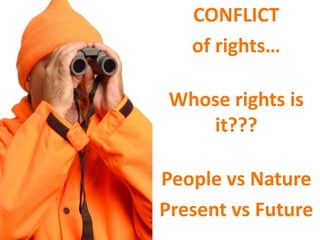
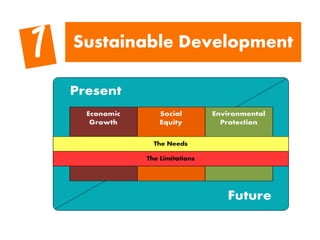
CONFLICT
of rights…
Whose rights is
it???
People vs Nature
Present vs Future
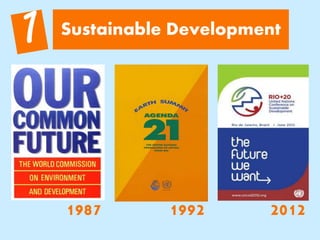
Sustainable Development
1987 1992 2012
Sustainable Development
Accounting
and Disclosure
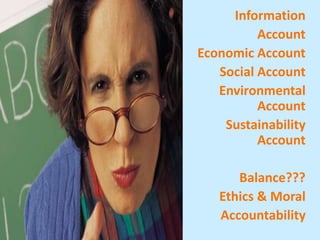
Information
Account
Economic Account
Social Account
Environmental
Account
Sustainability
Account
Balance???
Ethics & Moral
Accountability
Accounting and
Disclosure
Mandatory versus Voluntary
Law – Guidelines – Standards
Numbers versus Narratives
Financial measurements
Non-financial measurements
Corporate Social
Responsibility
Follow the
money??
Dimensions:
The stakeholder dimension
The social dimension
The economic dimension
The voluntariness dimension
The environmental dimension
(Carroll, 1999; Dahlsrud, 2008)
Corporate Social
Responsibility
Corporate
Sustainability
Reporting
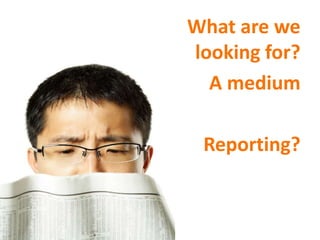
What are we
looking for?
A medium
Reporting?
The Future We Want Paragraph 47 – Rio+20
Engaging major group and other stakeholders
We acknowledge the importance of corporate
sustainability reporting, and encourage companies, where
appropriate, especially publicly listed and large companies,
to consider integrating sustainability information into their
reporting.
We encourage industry, interested government and
relevant stakeholders, with the support of the United
Nations system, as appropriate, to develop models for best
practice and facilitate action for the integration of
sustainability reporting into account experiences from
already existing frameworks and paying particular attention
to the needs of developing countries, including for capacity
building.
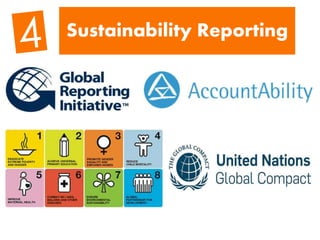
Sustainability Reporting
WHAT IS GRI?
​The Global Reporting Initiative (GRI) is a
leading organization in the sustainability field.
GRI promotes the use of sustainability
reporting as a way for organizations to
become more sustainable and contribute to
sustainable development.
AccountAbility is a leading global organisation providing
innovative solutions to the most critical challenges in
corporate responsibility and sustainable development.
The AA1000 Series of Standards based on the principles of:
Inclusivity - people should have a say in the decisions that
impact on them
Materiality - decision makers should identify and be clear
about the issues that matter
Responsiveness - organizations should be transparent
about their actions
AccountAbility works to:
• Help its clients and members improve business performance and
build sustainable competitive advantage
• Enable open, fair and effective approaches to stakeholder
engagement
• Develop and recognise responsible competitiveness in
companies, sectors, countries and regions
• Create effective collaborative governance strategies for
partnerships and multilateral organisations that are delivering
innovation and value
• Set and influence sustainability standards
• Help corporations, non-profits, and governments embed ethical,
environmental, social, and governance accountability into their
organisational DNA.
The Ten Principles
The UN Global Compact's ten principles in the areas of human
rights, labour, the environment and anti-corruption enjoy
universal consensus and are derived from:
• The Universal Declaration of Human Rights
• The International Labour Organization's Declaration on
Fundamental Principles and Rights at Work
• The Rio Declaration on Environment and Development
• The United Nations Convention Against Corruption
The UN Global Compact asks companies to embrace, support and
enact, within their sphere of influence, a set of core values in the
areas of human rights, labour standards, the environment and
anti-corruption:
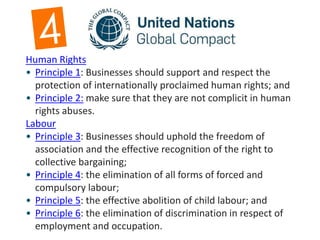
Human Rights
• Principle 1: Businesses should support and respect the
protection of internationally proclaimed human rights; and
• Principle 2: make sure that they are not complicit in human
rights abuses.
Labour
• Principle 3: Businesses should uphold the freedom of
association and the effective recognition of the right to
collective bargaining;
• Principle 4: the elimination of all forms of forced and
compulsory labour;
• Principle 5: the effective abolition of child labour; and
• Principle 6: the elimination of discrimination in respect of
employment and occupation.
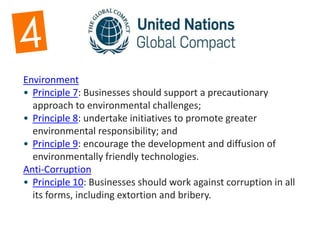
Environment
• Principle 7: Businesses should support a precautionary
approach to environmental challenges;
• Principle 8: undertake initiatives to promote greater
environmental responsibility; and
• Principle 9: encourage the development and diffusion of
environmentally friendly technologies.
Anti-Corruption
• Principle 10: Businesses should work against corruption in all
its forms, including extortion and bribery.
Integrated
Reporting
Integrated Reporting
The International Integrated Reporting Council (IIRC) was
established in 2010.
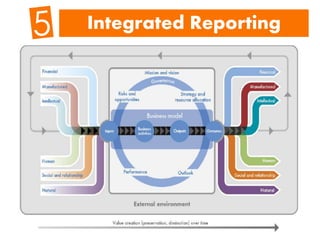
<IR> is a process founded on integrated thinking that results
in a periodic integrated report by an organization about
value creation over time and related communications
regarding aspects of value creation.
An integrated report is a concise communication about how
an organization’s strategy, governance, performance and
prospects, in the context of its external environment, lead to
the creation of value in the short, medium and long term.
Integrated Reporting
<IR> AIMS TO:
• Improve the quality of information available to providers
of financial capital to enable a more efficient and
productive allocation of capital
• Promote a more cohesive and efficient approach to
corporate reporting that draws on different reporting
strands and communicates the full range of factors that
materially affect the ability of an organization to create
value over time
Integrated Reporting
<IR> AIMS TO (CONTINUES):
• Enhance accountability and stewardship for the broad base
of capitals (financial, manufactured, intellectual, human,
social and relationship, and natural) and promote
understanding of their interdependencies
• Support integrated thinking, decision-making and actions
that focus on the creation of value over the short, medium
and long term.
Integrated Reporting
<IR> IN THE CORPORATE REPORTING LANDSCAPE:
• <IR> is about better reporting, not more reporting
• <IR> is consistent with numerous developments in
corporate reporting take place within national jurisdictions
across the world
• <IR> will provide the impetus for greater innovation in
corporate reporting globally
• <IR> has a combined emphasis on conciseness, strategic
focus and future orientation, the connectivity of
information, and the capitals and their interdependencies
• <IR> emphasizes the importance of integrated thinking
within the organization.
Integrated
Reporting
http://www.theiirc.org/international-ir-
framework/
Integrated Reporting
Integrated
Reporting
Integrated
Reporting
Organization overview
and external
environment:
Strategic focus and
future orientation
Connectivity of
information
Integrated
Reporting
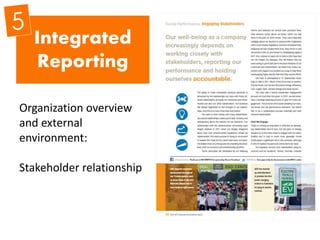
Organization overview
and external
environment:
Stakeholder relationship
Integrated
Reporting
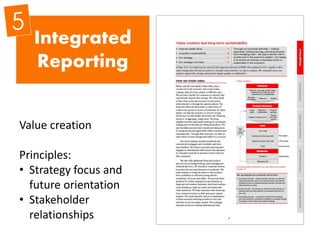
Value creation
Principles:
• Strategy focus and
future orientation
• Stakeholder
relationships
Integrated
Reporting
Integrated
Reporting
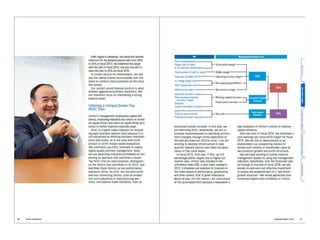
IR Guiding Principles
this extract
demonstrates:
• Connectivity
information
Integrated
Reporting
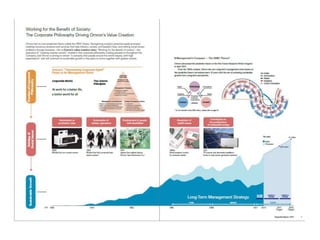
IR Guiding Principles
this extract
demonstrates:
• Strategic focus and
future orientation
• Stakeholder
relationships
Integrated
Reporting
What’s next?
Are we
under
pressure??
Corporate
Social
Responsibility
versus
Corporate
Sustainability
Reporting
Sustainability
Reporting
versus
Integrated
Reporting
Sustainable Reporting vs
Integrated Reporting
Why has IR become a trending topic?
An explanation rests on the increasingly complex
business environments and changing stakeholder needs
that have resulted in an evolution of business
information and annual reporting over the years (Eccles,
Krzus, and Ribot, 2014).
Integrated reporting is a failure (Flower, 2015, p. 15)
a. The single report: The Integrated Report is not to
become the firm’s primary report; it is an extra report
alongside conventional financial statements and
sustainability reports,
b. Sustainability: The Integrated Report is not to cover
sustainability,
c. Stakeholders: The Integrated Report is not to cover in
a comprehensive fashion the impact of the firm’s
activities on stakeholders
d. Lack of impact: The IIRC places very few specific
obligations on the preparer of an Integrated Report.
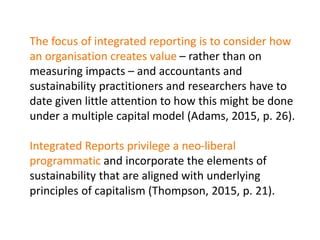
The focus of integrated reporting is to consider how
an organisation creates value – rather than on
measuring impacts – and accountants and
sustainability practitioners and researchers have to
date given little attention to how this might be done
under a multiple capital model (Adams, 2015, p. 26).
Integrated Reports privilege a neo-liberal
programmatic and incorporate the elements of
sustainability that are aligned with underlying
principles of capitalism (Thompson, 2015, p. 21).
A mandatory
‘comply or
explain’ regime
Mixed response
Opportunity
versus Challenge
What’s next?
What’s next?
Raise to
the challenge
Pursue
the knowledge
What’s next?
Propose
the perspective
of accounting
as discourse
You must be THE CHANGE
you wish to see in the world
(Mahatma Gandhi)
Sustainable
Development
Accounting
and Disclosure
Corporate
Social
Responsibility
Corporate
Sustainability
Reporting
Integrated
Reporting What’s next?
Images are
Microsoft Corporation’s
all rights reserved
Thank you
Terima kasih

Sustainability and integrated reporting

  • 1.
  • 2.
    1. Sustainable Development 2.Accounting and Disclosure 3. Corporate Social Responsibility 4. Corporate Sustainability Reporting 5. Integrated Reporting 6. What’s next?
  • 3.
  • 4.
    CONFLICT of rights… Whose rightsis it??? People vs Nature Present vs Future
  • 5.
  • 6.
  • 7.
  • 8.
  • 9.
    Accounting and Disclosure Mandatory versusVoluntary Law – Guidelines – Standards Numbers versus Narratives Financial measurements Non-financial measurements
  • 10.
  • 11.
  • 12.
    Dimensions: The stakeholder dimension Thesocial dimension The economic dimension The voluntariness dimension The environmental dimension (Carroll, 1999; Dahlsrud, 2008) Corporate Social Responsibility
  • 13.
  • 14.
    What are we lookingfor? A medium Reporting?
  • 15.
    The Future WeWant Paragraph 47 – Rio+20 Engaging major group and other stakeholders We acknowledge the importance of corporate sustainability reporting, and encourage companies, where appropriate, especially publicly listed and large companies, to consider integrating sustainability information into their reporting. We encourage industry, interested government and relevant stakeholders, with the support of the United Nations system, as appropriate, to develop models for best practice and facilitate action for the integration of sustainability reporting into account experiences from already existing frameworks and paying particular attention to the needs of developing countries, including for capacity building.
  • 16.
  • 17.
    WHAT IS GRI? ​TheGlobal Reporting Initiative (GRI) is a leading organization in the sustainability field. GRI promotes the use of sustainability reporting as a way for organizations to become more sustainable and contribute to sustainable development.
  • 22.
    AccountAbility is aleading global organisation providing innovative solutions to the most critical challenges in corporate responsibility and sustainable development. The AA1000 Series of Standards based on the principles of: Inclusivity - people should have a say in the decisions that impact on them Materiality - decision makers should identify and be clear about the issues that matter Responsiveness - organizations should be transparent about their actions
  • 23.
    AccountAbility works to: •Help its clients and members improve business performance and build sustainable competitive advantage • Enable open, fair and effective approaches to stakeholder engagement • Develop and recognise responsible competitiveness in companies, sectors, countries and regions • Create effective collaborative governance strategies for partnerships and multilateral organisations that are delivering innovation and value • Set and influence sustainability standards • Help corporations, non-profits, and governments embed ethical, environmental, social, and governance accountability into their organisational DNA.
  • 37.
    The Ten Principles TheUN Global Compact's ten principles in the areas of human rights, labour, the environment and anti-corruption enjoy universal consensus and are derived from: • The Universal Declaration of Human Rights • The International Labour Organization's Declaration on Fundamental Principles and Rights at Work • The Rio Declaration on Environment and Development • The United Nations Convention Against Corruption The UN Global Compact asks companies to embrace, support and enact, within their sphere of influence, a set of core values in the areas of human rights, labour standards, the environment and anti-corruption:
  • 38.
    Human Rights • Principle1: Businesses should support and respect the protection of internationally proclaimed human rights; and • Principle 2: make sure that they are not complicit in human rights abuses. Labour • Principle 3: Businesses should uphold the freedom of association and the effective recognition of the right to collective bargaining; • Principle 4: the elimination of all forms of forced and compulsory labour; • Principle 5: the effective abolition of child labour; and • Principle 6: the elimination of discrimination in respect of employment and occupation.
  • 39.
    Environment • Principle 7:Businesses should support a precautionary approach to environmental challenges; • Principle 8: undertake initiatives to promote greater environmental responsibility; and • Principle 9: encourage the development and diffusion of environmentally friendly technologies. Anti-Corruption • Principle 10: Businesses should work against corruption in all its forms, including extortion and bribery.
  • 40.
  • 41.
    Integrated Reporting The InternationalIntegrated Reporting Council (IIRC) was established in 2010. <IR> is a process founded on integrated thinking that results in a periodic integrated report by an organization about value creation over time and related communications regarding aspects of value creation. An integrated report is a concise communication about how an organization’s strategy, governance, performance and prospects, in the context of its external environment, lead to the creation of value in the short, medium and long term.
  • 42.
    Integrated Reporting <IR> AIMSTO: • Improve the quality of information available to providers of financial capital to enable a more efficient and productive allocation of capital • Promote a more cohesive and efficient approach to corporate reporting that draws on different reporting strands and communicates the full range of factors that materially affect the ability of an organization to create value over time
  • 43.
    Integrated Reporting <IR> AIMSTO (CONTINUES): • Enhance accountability and stewardship for the broad base of capitals (financial, manufactured, intellectual, human, social and relationship, and natural) and promote understanding of their interdependencies • Support integrated thinking, decision-making and actions that focus on the creation of value over the short, medium and long term.
  • 44.
    Integrated Reporting <IR> INTHE CORPORATE REPORTING LANDSCAPE: • <IR> is about better reporting, not more reporting • <IR> is consistent with numerous developments in corporate reporting take place within national jurisdictions across the world • <IR> will provide the impetus for greater innovation in corporate reporting globally • <IR> has a combined emphasis on conciseness, strategic focus and future orientation, the connectivity of information, and the capitals and their interdependencies • <IR> emphasizes the importance of integrated thinking within the organization.
  • 45.
  • 46.
  • 47.
  • 48.
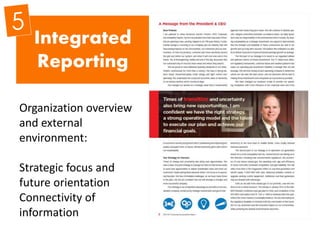
    Integrated Reporting Organization overview and external environment: Strategicfocus and future orientation Connectivity of information
  • 49.
  • 50.
  • 51.
    Value creation Principles: • Strategyfocus and future orientation • Stakeholder relationships Integrated Reporting
  • 52.
  • 53.
    IR Guiding Principles thisextract demonstrates: • Connectivity information Integrated Reporting
  • 55.
    IR Guiding Principles thisextract demonstrates: • Strategic focus and future orientation • Stakeholder relationships Integrated Reporting
  • 57.
  • 58.
  • 59.
  • 60.
  • 61.
    Sustainable Reporting vs IntegratedReporting Why has IR become a trending topic? An explanation rests on the increasingly complex business environments and changing stakeholder needs that have resulted in an evolution of business information and annual reporting over the years (Eccles, Krzus, and Ribot, 2014).
  • 62.
    Integrated reporting isa failure (Flower, 2015, p. 15) a. The single report: The Integrated Report is not to become the firm’s primary report; it is an extra report alongside conventional financial statements and sustainability reports, b. Sustainability: The Integrated Report is not to cover sustainability, c. Stakeholders: The Integrated Report is not to cover in a comprehensive fashion the impact of the firm’s activities on stakeholders d. Lack of impact: The IIRC places very few specific obligations on the preparer of an Integrated Report.
  • 63.
    The focus ofintegrated reporting is to consider how an organisation creates value – rather than on measuring impacts – and accountants and sustainability practitioners and researchers have to date given little attention to how this might be done under a multiple capital model (Adams, 2015, p. 26). Integrated Reports privilege a neo-liberal programmatic and incorporate the elements of sustainability that are aligned with underlying principles of capitalism (Thompson, 2015, p. 21).
  • 64.
    A mandatory ‘comply or explain’regime Mixed response Opportunity versus Challenge What’s next?
  • 65.
    What’s next? Raise to thechallenge Pursue the knowledge
  • 66.
  • 67.
    You must beTHE CHANGE you wish to see in the world (Mahatma Gandhi) Sustainable Development Accounting and Disclosure Corporate Social Responsibility Corporate Sustainability Reporting Integrated Reporting What’s next?
  • 68.
    Images are Microsoft Corporation’s allrights reserved Thank you Terima kasih

Editor's Notes

  • #3 Outline of presentation as a guideline to achieve the objective of this presentation (to discuss research progress).
  • #4 Introduction to my presentation, it is not just about research study. It is a passion that I have for sustainable development.
  • #6 Sustainable development in the past 40 years since the UN Conference on the Human Environment in 1972 in Stockholm.
  • #7 The most generally accepted and used terminology of sustainable development. . The concept of sustainable development has the ability to attract environmental and equity debate into business (Eden 1994, pp. 160, 165).