ACCOUNTING THEORY
TOPIC: ASSETS AND LIABILITIES

SUBMITTED BY:
Nandini R
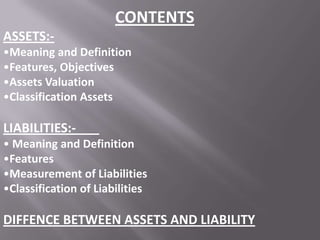
CONTENTS
ASSETS:•Meaning and Definition
•Features, Objectives
•Assets Valuation
•Classification Assets

LIABILITIES:• Meaning and Definition
•Features
•Measurement of Liabilities
•Classification of Liabilities

DIFFENCE BETWEEN ASSETS AND LIABILITY
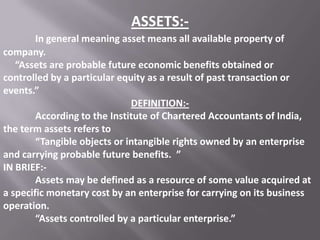
ASSETS:In general meaning asset means all available property of
company.
“Assets are probable future economic benefits obtained or
controlled by a particular equity as a result of past transaction or
events.”
DEFINITION:According to the Institute of Chartered Accountants of India,
the term assets refers to
“Tangible objects or intangible rights owned by an enterprise
and carrying probable future benefits. ”
IN BRIEF:Assets may be defined as a resource of some value acquired at
a specific monetary cost by an enterprise for carrying on its business
operation.
“Assets controlled by a particular enterprise.”
ASSETS USED FOR:
• Exchange
• To produce goods and services
• To settle liabilities
• Distribute it to owners

FEATURES OF AN ASSET
• Income Determination
• Determination of Financial Position
•Managerial Decisions

VALUATION OF ASSETS
Methods of measuring the elements of financial statements.
Assets valuation means. “Quantification of assets in term of
monetary units is known as valuation.”
The valuation is the process of assigning meaningful
quantitative monetary amounts.
ASSERTS VALUATION METHODS :
• Historical cost.
• Current entry price-Replacement cost.
•Current exit price- Net realizable value.
• Present value of expected cash flows.

1. HISTORICAL COST:• Traditional Methods of cost.
• Recorded at acquisition price.
• Main disadvantage is the value of assets may change over time.
• It fails to recognize again and losses in the periodic occurrence.
• Advantage, it is supporting record of all actual transaction in the
past.
• Without historical data, it is difficult to know that the property has
been utilized property or not.
2.CURRENT ENTRY PRICE – REPLACEMENT COST:• On the date of purchase current entry price and historical cost are
same.
• Current costs represent ten exchange prices for a given date.
• Important while presenting information regarding the effect of
inflation on an enterprise.

3.CURRENT EXIT PRICE:• It is called as net realizable cost
• Amount realizable by selling an assets
• Past price are irrelevant to future actions and future prices are
speculative
4.PRESENT VALUE OF EXPECTED CASH FLOWS: Present value of expected cash flows
3 basic factors are used
•Amount to be received
• Discount factor
•Time periods involved
When expected cash receipts require a waiting period, the present
value is less than the actual amount expected to be received.
Disadvantage is, it depends on probability distributions that are not
verifiable.
Discounted value of cash flows of all separate assets cannot
be added together
CLASSIFICATION OF ASSETS 4 MAJOR TYPES OF ASSETS
1.Fixed assets.
2. Investments
3.Intangible assets
4.Current assets

1.FIXED ASSETS:• It is also called as tangible assets.
• Asses are held with the intension of being used for the purpose of
producing goods and services.
• Assts, it has depreciation.
• Example for fixed assets plant & equipment, furniture& machinery
etc..,
2.INVESTMENTS:• Defined as a share & other legal or rights acquired by a firm through
the investment of its fund.
• Investment made by a long term or short term.

3.INTANGIBLE ASSETS:• Assets which have no physical existence.
• Intangible assets like good will, patents, copyright, trademarks,
franchises and licenses.

4.CURRENT ASSETS:• Defined as cash and other assets that are expected to be converted
into cash.
CLASSIFICATION
•
•
•
•
•

Cash
Receivable
Marketable securities
Inventories
Prepaid expenses

LIABILITIES:“In general meaning liabilities means debt.”
Liabilities may be defined as currently existing obligation which
a business enterprise intends to meet at some time in future. Such
obligations arise from legal or managerial consideration and impose
restrictions on the use of assets by the enterprise for its own purpose.
ICAI defines “Financial Obligation of an enterprise other than
owner’s fund.”
• Obligation of a particular enterprises

FEATURES OF LIABILITY
•Occurrence of a past transaction or events
• Required future sacrifice or assets
• Obligation of a particular enterprises
• Liabilities and proceeds
•Discontinuance of liability
• Capital and dividend
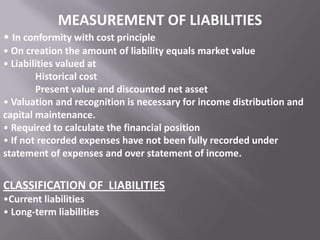
MEASUREMENT OF LIABILITIES
• In conformity with cost principle
• On creation the amount of liability equals market value
• Liabilities valued at
Historical cost
Present value and discounted net asset
• Valuation and recognition is necessary for income distribution and
capital maintenance.
• Required to calculate the financial position
• If not recorded expenses have not been fully recorded under
statement of expenses and over statement of income.

CLASSIFICATION OF LIABILITIES
•Current liabilities
• Long-term liabilities
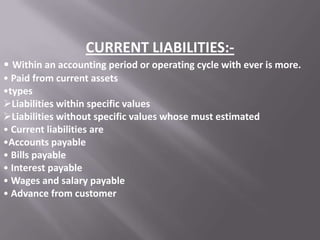
CURRENT LIABILITIES:• Within an accounting period or operating cycle with ever is more.
• Paid from current assets
•types
Liabilities within specific values
Liabilities without specific values whose must estimated
• Current liabilities are
•Accounts payable
• Bills payable
• Interest payable
• Wages and salary payable
• Advance from customer
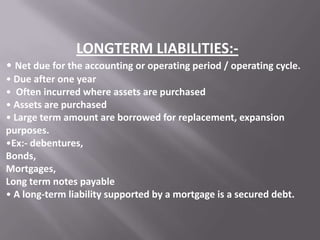
LONGTERM LIABILITIES:• Net due for the accounting or operating period / operating cycle.
• Due after one year
• Often incurred where assets are purchased
• Assets are purchased
• Large term amount are borrowed for replacement, expansion
purposes.
•Ex:- debentures,
Bonds,
Mortgages,
Long term notes payable
• A long-term liability supported by a mortgage is a secured debt.
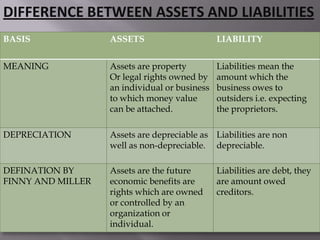
DIFFERENCE BETWEEN ASSETS AND LIABILITIES
BASIS

ASSETS

LIABILITY

MEANING

Assets are property
Or legal rights owned by
an individual or business
to which money value
can be attached.

Liabilities mean the
amount which the
business owes to
outsiders i.e. expecting
the proprietors.

DEPRECIATION

Assets are depreciable as Liabilities are non
well as non-depreciable. depreciable.

DEFINATION BY
FINNY AND MILLER

Assets are the future
economic benefits are
rights which are owned
or controlled by an
organization or
individual.

Liabilities are debt, they
are amount owed
creditors.
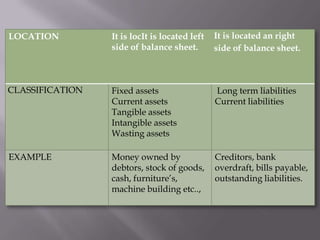
LOCATION

It is locIt is located left
side of balance sheet.

It is located an right
side of balance sheet.

CLASSIFICATION

Fixed assets
Current assets
Tangible assets
Intangible assets
Wasting assets

Long term liabilities
Current liabilities

EXAMPLE

Money owned by
debtors, stock of goods,
cash, furniture’s,
machine building etc..,

Creditors, bank
overdraft, bills payable,
outstanding liabilities.
CONCLUSION:Assets and liabilities are very essential for all type of
business, without assets and liabilities we cannot run
the business.

THANK YOU

Assets and liablity

  • 1.
    ACCOUNTING THEORY TOPIC: ASSETSAND LIABILITIES SUBMITTED BY: Nandini R
  • 2.
    CONTENTS ASSETS:•Meaning and Definition •Features,Objectives •Assets Valuation •Classification Assets LIABILITIES:• Meaning and Definition •Features •Measurement of Liabilities •Classification of Liabilities DIFFENCE BETWEEN ASSETS AND LIABILITY
  • 3.
    ASSETS:In general meaningasset means all available property of company. “Assets are probable future economic benefits obtained or controlled by a particular equity as a result of past transaction or events.” DEFINITION:According to the Institute of Chartered Accountants of India, the term assets refers to “Tangible objects or intangible rights owned by an enterprise and carrying probable future benefits. ” IN BRIEF:Assets may be defined as a resource of some value acquired at a specific monetary cost by an enterprise for carrying on its business operation. “Assets controlled by a particular enterprise.”
  • 4.
    ASSETS USED FOR: •Exchange • To produce goods and services • To settle liabilities • Distribute it to owners FEATURES OF AN ASSET • Income Determination • Determination of Financial Position •Managerial Decisions VALUATION OF ASSETS Methods of measuring the elements of financial statements. Assets valuation means. “Quantification of assets in term of monetary units is known as valuation.” The valuation is the process of assigning meaningful quantitative monetary amounts.
  • 5.
    ASSERTS VALUATION METHODS: • Historical cost. • Current entry price-Replacement cost. •Current exit price- Net realizable value. • Present value of expected cash flows. 1. HISTORICAL COST:• Traditional Methods of cost. • Recorded at acquisition price. • Main disadvantage is the value of assets may change over time. • It fails to recognize again and losses in the periodic occurrence. • Advantage, it is supporting record of all actual transaction in the past. • Without historical data, it is difficult to know that the property has been utilized property or not.
  • 6.
    2.CURRENT ENTRY PRICE– REPLACEMENT COST:• On the date of purchase current entry price and historical cost are same. • Current costs represent ten exchange prices for a given date. • Important while presenting information regarding the effect of inflation on an enterprise. 3.CURRENT EXIT PRICE:• It is called as net realizable cost • Amount realizable by selling an assets • Past price are irrelevant to future actions and future prices are speculative
  • 7.
    4.PRESENT VALUE OFEXPECTED CASH FLOWS: Present value of expected cash flows 3 basic factors are used •Amount to be received • Discount factor •Time periods involved When expected cash receipts require a waiting period, the present value is less than the actual amount expected to be received. Disadvantage is, it depends on probability distributions that are not verifiable. Discounted value of cash flows of all separate assets cannot be added together
  • 8.
    CLASSIFICATION OF ASSETS4 MAJOR TYPES OF ASSETS 1.Fixed assets. 2. Investments 3.Intangible assets 4.Current assets 1.FIXED ASSETS:• It is also called as tangible assets. • Asses are held with the intension of being used for the purpose of producing goods and services. • Assts, it has depreciation. • Example for fixed assets plant & equipment, furniture& machinery etc..,
  • 9.
    2.INVESTMENTS:• Defined asa share & other legal or rights acquired by a firm through the investment of its fund. • Investment made by a long term or short term. 3.INTANGIBLE ASSETS:• Assets which have no physical existence. • Intangible assets like good will, patents, copyright, trademarks, franchises and licenses. 4.CURRENT ASSETS:• Defined as cash and other assets that are expected to be converted into cash.
  • 10.
    CLASSIFICATION • • • • • Cash Receivable Marketable securities Inventories Prepaid expenses LIABILITIES:“Ingeneral meaning liabilities means debt.” Liabilities may be defined as currently existing obligation which a business enterprise intends to meet at some time in future. Such obligations arise from legal or managerial consideration and impose restrictions on the use of assets by the enterprise for its own purpose.
  • 11.
    ICAI defines “FinancialObligation of an enterprise other than owner’s fund.” • Obligation of a particular enterprises FEATURES OF LIABILITY •Occurrence of a past transaction or events • Required future sacrifice or assets • Obligation of a particular enterprises • Liabilities and proceeds •Discontinuance of liability • Capital and dividend
  • 12.
    MEASUREMENT OF LIABILITIES •In conformity with cost principle • On creation the amount of liability equals market value • Liabilities valued at Historical cost Present value and discounted net asset • Valuation and recognition is necessary for income distribution and capital maintenance. • Required to calculate the financial position • If not recorded expenses have not been fully recorded under statement of expenses and over statement of income. CLASSIFICATION OF LIABILITIES •Current liabilities • Long-term liabilities
  • 13.
    CURRENT LIABILITIES:• Withinan accounting period or operating cycle with ever is more. • Paid from current assets •types Liabilities within specific values Liabilities without specific values whose must estimated • Current liabilities are •Accounts payable • Bills payable • Interest payable • Wages and salary payable • Advance from customer
  • 14.
    LONGTERM LIABILITIES:• Netdue for the accounting or operating period / operating cycle. • Due after one year • Often incurred where assets are purchased • Assets are purchased • Large term amount are borrowed for replacement, expansion purposes. •Ex:- debentures, Bonds, Mortgages, Long term notes payable • A long-term liability supported by a mortgage is a secured debt.
  • 15.
    DIFFERENCE BETWEEN ASSETSAND LIABILITIES BASIS ASSETS LIABILITY MEANING Assets are property Or legal rights owned by an individual or business to which money value can be attached. Liabilities mean the amount which the business owes to outsiders i.e. expecting the proprietors. DEPRECIATION Assets are depreciable as Liabilities are non well as non-depreciable. depreciable. DEFINATION BY FINNY AND MILLER Assets are the future economic benefits are rights which are owned or controlled by an organization or individual. Liabilities are debt, they are amount owed creditors.
  • 16.
    LOCATION It is locItis located left side of balance sheet. It is located an right side of balance sheet. CLASSIFICATION Fixed assets Current assets Tangible assets Intangible assets Wasting assets Long term liabilities Current liabilities EXAMPLE Money owned by debtors, stock of goods, cash, furniture’s, machine building etc.., Creditors, bank overdraft, bills payable, outstanding liabilities.
  • 17.
    CONCLUSION:Assets and liabilitiesare very essential for all type of business, without assets and liabilities we cannot run the business. THANK YOU