8 - 1
Liabilities and Interest
8 - 2
Learning Objectives
After studying this chapter, you should be able to:
 Account for current liabilities.
 Design an internal control system for cash
disbursements.
 Explain simple long-term liabilities.
 Relate bond covenants to the riskiness of a bond.
 Interpret deferred tax liabilities.
 Locate and understand the contingent liabilities
information in a company’s financial statements.
 Use ratio analysis to assess a company’s debt levels.
8 - 3
Liabilities in Perspective
Liabilities are a company’s obligations to pay
cash or to provide goods and services to other
companies or individuals.
Accrual accounting recognizes expenses when
they occur rather than when they are paid.
• When an expense is recognized before it is paid, a
liability is created.
8 - 4
Liabilities in Perspective
Liabilities are important to investors, financial
analysts, management, and creditors.
• Excess liabilities often cause investors and creditors
to stay away from the company with the excess
liabilities.
8 - 5
Liabilities in Perspective
Liabilities are classified as either current or long
term to help readers interpret the immediacy of a
company’s obligations.
• Current liabilities - obligations that fall due within the
coming year or within the company’s normal
operating cycle
• Long-term liabilities - obligations that fall due beyond
one year from the balance sheet date
– If long-term liabilities are paid gradually, the portion that
comes due within the year becomes a current liability.
8 - 6
Liabilities in Perspective
In the general ledger, each liability (wages,
salaries, interest, etc.) is kept in a different
account.
However, in the financial statements, liabilities
may be combined and shown as a single amount.
• The terms “accrued” or “payable” may sometimes be
used to denote liabilities.
8 - 7
Liabilities in Perspective
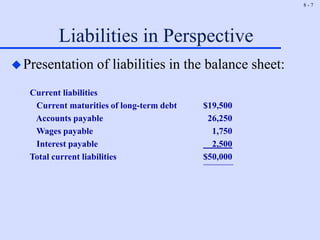
Presentation of liabilities in the balance sheet:
Current liabilities
Current maturities of long-term debt $19,500
Accounts payable 26,250
Wages payable 1,750
Interest payable 2,500
Total current liabilities $50,000
===============
8 - 8
Accounting for Current Liabilities
Not all current liabilities are recorded the same
way.
• Some are the result of a transaction with a third party,
such as a supplier or a lender.
• Some are the result of an adjusting
journal entry made to acknowledge
an obligation arising over time, such
as interest or wages.
8 - 9
Accounts Payable
Accounts payable (or trade accounts payable) are
amounts owed to suppliers.
Large sums of money flow through accounts
payable systems, so data-processing and internal
control systems are carefully designed for
accounts payable.
• The company must ensure that checks are written only
for legitimate obligations of the company.
8 - 10
Notes Payable
Promissory note (note payable) - a written
promise to repay principal plus interest at specific
future dates
• Notes payable can be classified as current or long
term depending on when they are payable.
8 - 11
Notes Payable
Rather than having to apply for many small loans
at different times, companies obtain lines of
credit with lenders.
• Line of credit - an agreement with a bank to
automatically provide short-term loans up to some
preestablished maximum
– The lender does not have to do extensive paperwork or
credit checks every time a borrower needs money.
– The borrower has a preset amount of borrowing available.
8 - 12
Notes Payable
Companies sometimes borrow directly from
investors in the form of commercial paper.
Commercial paper - a short-term debt contract
issued by prominent companies that borrow
directly from investors
• These liabilities usually fall due within 9 months,
often within 60 days.
8 - 13
Accrued Employee Compensation
Employers must withhold some employee
earnings and pay them to third parties, such as the
government, insurance companies, charitable
organizations, etc.
• Most companies have separate
current liability accounts for
such items.
8 - 14
Accrued Employee Compensation
Companies must pay payroll taxes and fringe
benefits in addition to salaries and wages.
• Payroll taxes are amounts paid to the government for
the employer’s portion of social security taxes, federal
and state unemployment taxes, and workers’
compensation taxes.
• Fringe benefits are extra benefits paid to employees in
lieu of cash, such as employee pensions, life and
health insurance, and vacation pay.
8 - 15
Accrued Employee Compensation
Assume a company pays its employees $100,000
and withholds $15,000 for income taxes and
$7,000 for social security taxes. The employer
pays its portion of social security taxes and puts
$10,000 into a retirement account.
How are these transactions recorded?
8 - 16
Accrued Employee Compensation
The transactions are recorded as follows:
Compensation expense 100,000
Salaries and wages payable 78,000
Income tax withholding payable 15,000
Social security withholding payable 7,000
Employee benefits expense 17,000
Employer social security payable 7,000
Pension liability payable 10,000
8 - 17
Income Taxes Payable
Corporations make periodic installment payments
based on their estimated tax for the year.
Therefore, the accrued tax liability at year end is
generally much smaller than the actual income
tax expense.
Corporations must adjust their periodic payments
to reflect changes in the estimates in earnings for
the year.
8 - 18
Current Portion of
Long-Term Debt
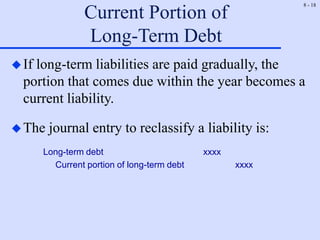
If long-term liabilities are paid gradually, the
portion that comes due within the year becomes a
current liability.
The journal entry to reclassify a liability is:
Long-term debt xxxx
Current portion of long-term debt xxxx
8 - 19
Sales Tax
When companies collect sales taxes, they are
collecting on behalf of a state or local
government.
Sales taxes do not affect
the income statement.
• They are recorded in a liability
account called Sales Tax Payable until they are
remitted to the governmental unit.
8 - 20
Product Warranties
A sales warranty creates a liability, but warranty
claims will arise in the future and cannot be
estimated precisely.
• If warranty obligations are
material, they must be accrued
when the products are sold.
• Warranty obligations are usually
based on past experience for
replacing or fixing defective
products.
8 - 21
Product Warranties
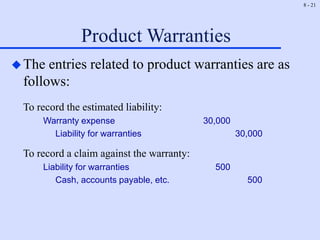
The entries related to product warranties are as
follows:
To record the estimated liability:
Warranty expense 30,000
Liability for warranties 30,000
To record a claim against the warranty:
Liability for warranties 500
Cash, accounts payable, etc. 500
8 - 22
Returnable Deposits
Customers must occasionally pay deposits that
will be returned, either with or without interest,
at some time in the future.
• Most apartment complexes require deposits
when a lease is signed.
• Companies that require deposits record them
as a type of payable because the amounts are
due back to the customer.
• Deposits are considered current liabilities.
8 - 23
Unearned Revenue
Revenues that are collected before services or
goods are delivered are called unearned revenues.
• Examples include lease rentals, magazine
subscriptions, insurance premiums, advance ticket
sales, etc.
• These amounts are recorded as current liabilities and
are converted to revenues as the services or goods are
delivered, i.e., when a month passes or when an issue
of a magazine is delivered to a subscriber.
8 - 24
Internal Controls Over Payables
Since huge sums of money flow through payables
systems, good internal control must be present to
ensure that all payments involve properly
approved and valid obligations of the company.
• Most disbursement systems require payments to be
made only by checks because the prenumbered checks
make record keeping easier.
All checks issued must be supported by source
documents.
8 - 25
Internal Control Over Payables
Before a check can be written, a series of source
documents must be completed to document the
obligation.
• Purchase order - a document that specifies the items
ordered and the price to be paid by the company
• Receiving report - a document that specifies the items
received by the company and their condition
• Invoice - a bill from the seller to a buyer indicating
the number of items shipped, their prices, any
additional costs such as shipping, and payment terms
8 - 26
Internal Control Over Payables
Checks in excess of a certain amount usually
require additional authorization or must be signed
by two people.
• This process leaves a paper trail in case anything goes
wrong.
• Because more than one person is involved in the
payment, errors should be avoided or detected
quickly.
8 - 27
Internal Control Over Payables
The more people within an organization that see a
transaction the better.
• Requiring different employees
to create the source documents,
keep purchase records, and prepare
the checks makes it harder for
one person to succeed with fraud.
8 - 28
Internal Control Over Payables
Computers allow the maintenance of an approved
vendor file.
• Checks for payables can be written only to approved
vendors, and high-level employees must approve
additions to the vendor list.
Even with the best control systems in place,
mistakes still occur.
• One common mistake is overpayment, usually
because of a company billing a customer twice.
8 - 29
Long-Term Liabilities
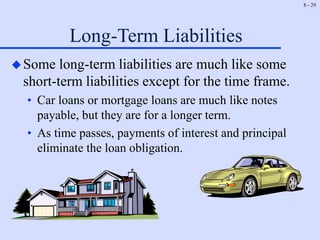
Some long-term liabilities are much like some
short-term liabilities except for the time frame.
• Car loans or mortgage loans are much like notes
payable, but they are for a longer term.
• As time passes, payments of interest and principal
eliminate the loan obligation.
8 - 30
Long-Term Liabilities
Illustration and analysis of a loan:
• Assume that $10,000 is borrowed at 10% interest.
The yearly payment is to be $3,154.71 for four years
on December 31 of each year.
• The total repayment amount is $12,618.83, which
consists of the $10,000 principal plus $2,618.83 in
interest.
8 - 31
Bonds and Notes
Both bonds and notes are legal contracts that
specify how much is to be borrowed and the dates
and amounts for repayment by the borrower.
• Notes and bonds are called negotiable financial
instruments because they can be transferred from one
lender to another.
• Some bonds and notes are private placements, which
means that only a few sources of borrowing are used
rather than the general public.
8 - 32
Bonds and Notes
Bond - a formal certificate of indebtedness that is
typically accompanied by (1) a promise to pay
interest in cash at a specified annual rate plus (2)
a promise to pay the principal at a specific
maturity date
• The interest rate is often called the nominal interest
rate, contractual rate, coupon rate, or stated rate.
• The principal amount is also known as the face
amount.
8 - 33
Bonds and Notes
Interest rate - the percentage applied to a
principal amount to calculate the amount of
interest that must be paid on the loan
• Interest represents the return the lender can earn for
loaning money.
• In general, riskier loans demand higher interest rates.
8 - 34
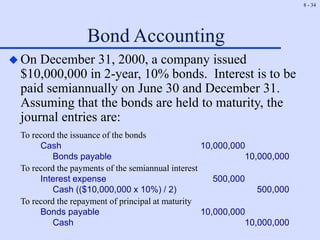
Bond Accounting
 On December 31, 2000, a company issued
$10,000,000 in 2-year, 10% bonds. Interest is to be
paid semiannually on June 30 and December 31.
Assuming that the bonds are held to maturity, the
journal entries are:
To record the issuance of the bonds
Cash 10,000,000
Bonds payable 10,000,000
To record the payments of the semiannual interest
Interest expense 500,000
Cash (($10,000,000 x 10%) / 2) 500,000
To record the repayment of principal at maturity
Bonds payable 10,000,000
Cash 10,000,000
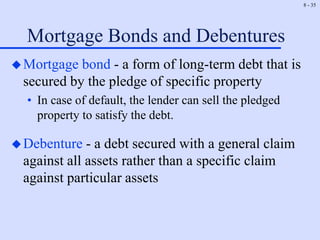
8 - 35
Mortgage Bonds and Debentures
Mortgage bond - a form of long-term debt that is
secured by the pledge of specific property
• In case of default, the lender can sell the pledged
property to satisfy the debt.
Debenture - a debt secured with a general claim
against all assets rather than a specific claim
against particular assets
8 - 36
Mortgage Bonds and Debentures
If a borrower defaults on a loan, the company
may be liquidated to satisfy the loan obligation.
• Liquidation - converting assets to cash and paying off
outside claims or obligations
If all claims were equal, each lender would
receive a proportional share of the cash remaining
after liquidation.
• Debentures have a lower priority claim than mortgage
bonds to recover the loan amount.
8 - 37
Mortgage Bonds and Debentures
Debentures can have different priorities also.
• Subordinated debentures - debt securities whose
holders have claims against only the assets that
remain after the claims of general creditors are
satisfied
– Generally have the lowest priority of recovery
– Also carry the highest interest rate
because they carry the most risk
8 - 38
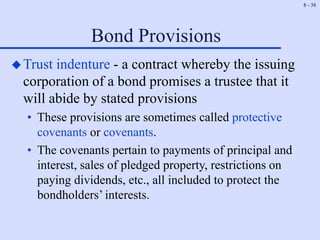
Bond Provisions
Trust indenture - a contract whereby the issuing
corporation of a bond promises a trustee that it
will abide by stated provisions
• These provisions are sometimes called protective
covenants or covenants.
• The covenants pertain to payments of principal and
interest, sales of pledged property, restrictions on
paying dividends, etc., all included to protect the
bondholders’ interests.
8 - 39
Callable, Sinking Fund, and
Convertible Bonds
Callable bonds - bonds subject to redemption
before maturity at the option of the issuer
• Usually, the bonds are callable at a call premium - the
redemption amount exceeds the par value of the bond.
• This feature is good for the issuer because the bonds
can be paid off early.
• However, this feature creates uncertainty for investors
and might cause interest rates to be higher.
8 - 40
Callable, Sinking Fund, and
Convertible Bonds
Sinking fund bonds - bonds with indentures that
require the issuer to make annual payments to a
sinking fund
• Sinking fund - a pool of cash or securities segregated
for meeting certain obligations
• The sinking fund assures investors that enough money
will be on hand to repay the bonds upon maturity.
– This increases attractiveness to investors and generally
lowers the interest rate on the borrowing.
8 - 41
Callable, Sinking Fund, and
Convertible Bonds
Convertible bonds - bonds that may be exchanged
for other securities at the holder’s option
• Conversion is usually for a preset number of shares of
the issuing corporation’s stock.
• This feature makes bondholders
more willing to accept a lower
interest rate.
8 - 42
Restructuring
Restructuring - a significant makeover of part of
the company typically involving the closing of
plants, firing of employees, and relocation of
activities
• Companies record restructuring
charges and some recognize
significant liabilities for future
costs.
8 - 43
Deferred Taxes
As discussed before, delays in payment of taxes
between the time that income is earned and taxes
are due leads to short-term taxes payable.
However, another reason for taxes payable arises
because of differences between U.S. income tax
rules and GAAP.
• Sometimes tax rules can cause income tax expense to
be recorded long before it is actually paid and creates
a deferred tax liability.
8 - 44
Deferred Taxes
Differences arise because GAAP is designed to
provide useful information to investors, while the
tax code is written to generate revenues for the
government.
• Managers try to pay the least amount of taxes at the
latest time possible.
• They try to delay reporting taxable revenue as long as
possible while deducting expenses as quickly as
possible.
8 - 45
Deferred Taxes
Rules under GAAP and tax rules differ on two
dimensions:
• Whether an item is recognized (permanent difference)
• When an item is recognized (temporary difference)
8 - 46
Deferred Taxes
Taxes are calculated as a percentage of taxable
income of a company.
• Taxable income results from subtracting deductible
expenses from taxable revenues.
• The percentage used to calculate
the tax is the tax rate.
8 - 47
Deferred Taxes
Differences may be created because:
• Rules for financial reporting and tax rules differ.
• Managers make different choices of accounting
treatment for financial reporting than for tax
reporting.
– Managers have an incentive to keep taxable income low, but
they have an incentive to make financial income high.
8 - 48
Permanent Differences
Permanent differences - revenue or expense items
that are recognized for tax purposes but not
recognized under GAAP, or vice versa
• An example of a permanent difference is municipal
bond interest.
– For GAAP purposes, this interest is reported on the income
statement.
– For tax purposes, this interest is not included in taxable
income.
8 - 49
Temporary Differences
Temporary differences (timing differences) -
differences between GAAP income and taxable
income that arise because some revenue and
expense items are recognized at different times
for tax purposes than for financial reporting
purposes
• An example of a temporary difference is using
straight-line depreciation for financial reporting
purposes and accelerated depreciation (MACRS) for
tax purposes.
8 - 50
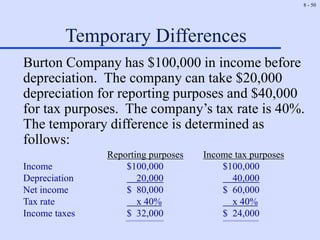
Temporary Differences
Burton Company has $100,000 in income before
depreciation. The company can take $20,000
depreciation for reporting purposes and $40,000
for tax purposes. The company’s tax rate is 40%.
The temporary difference is determined as
follows:
Reporting purposes Income tax purposes
Income $100,000 $100,000
Depreciation 20,000 40,000
Net income $ 80,000 $ 60,000
Tax rate x 40% x 40%
Income taxes $ 32,000 $ 24,000
=================== ==================
8 - 51
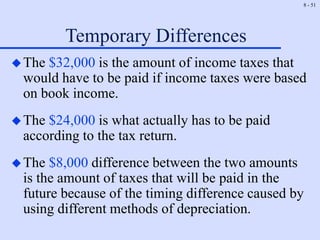
Temporary Differences
The $32,000 is the amount of income taxes that
would have to be paid if income taxes were based
on book income.
The $24,000 is what actually has to be paid
according to the tax return.
The $8,000 difference between the two amounts
is the amount of taxes that will be paid in the
future because of the timing difference caused by
using different methods of depreciation.
8 - 52
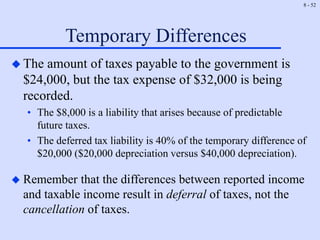
Temporary Differences
 The amount of taxes payable to the government is
$24,000, but the tax expense of $32,000 is being
recorded.
• The $8,000 is a liability that arises because of predictable
future taxes.
• The deferred tax liability is 40% of the temporary difference of
$20,000 ($20,000 depreciation versus $40,000 depreciation).
 Remember that the differences between reported income
and taxable income result in deferral of taxes, not the
cancellation of taxes.
8 - 53
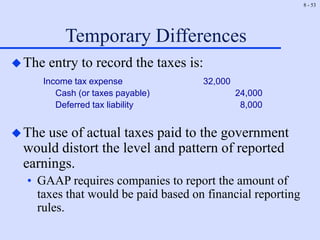
Temporary Differences
The entry to record the taxes is:
Income tax expense 32,000
Cash (or taxes payable) 24,000
Deferred tax liability 8,000
The use of actual taxes paid to the government
would distort the level and pattern of reported
earnings.
• GAAP requires companies to report the amount of
taxes that would be paid based on financial reporting
rules.
8 - 54
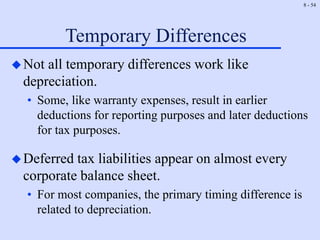
Temporary Differences
Not all temporary differences work like
depreciation.
• Some, like warranty expenses, result in earlier
deductions for reporting purposes and later deductions
for tax purposes.
Deferred tax liabilities appear on almost every
corporate balance sheet.
• For most companies, the primary timing difference is
related to depreciation.
8 - 55
Contingent Liabilities
Contingent liabilities - a potential liability that
depends on a future event arising out of a past
transaction
Some contingent liabilities are certain in amount.
• Smith Company may guarantee a loan for Parker
Company. Smith Company will pay if, and only if,
Parker Company does not pay.
– This is a liability of Parker Company and a contingent
liability of Smith Company.
8 - 56
Contingent Liabilities
More often, contingent liabilities
are of an indefinite amount.
• Lawsuits are common examples.
These are possible obligations of
uncertain amounts.
Some companies show contingent liabilities on
the balance sheet, but most disclose such amounts
in the footnotes to the financial statements.
8 - 57
Debt Ratios and
Interest-Coverage Ratios
Debt ratios are used to measure the extent to
which a company has used borrowing to finance
its activities.
• The more borrowing, and the less equity, the riskier it
is to lend money to a firm.
8 - 58
Debt Ratios and
Interest-Coverage Ratios
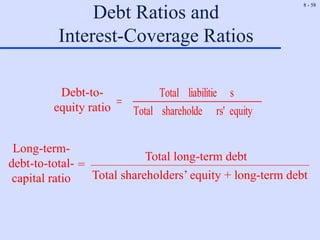
equity
rs'
shareholde
Total
s
liabilitie
Total

Debt-to-
equity ratio
Long-term-
debt-to-total-
capital ratio
=
Total long-term debt
Total shareholders’ equity + long-term debt
8 - 59
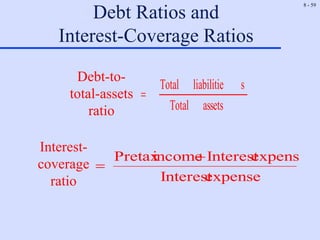
Debt Ratios and
Interest-Coverage Ratios
assets
Total
s
liabilitie
Total

Debt-to-
total-assets
ratio
expense
Interest
expense
Interest
income
Pretax 

Interest-
coverage
ratio
8 - 60
Debt Ratios and
Interest-Coverage Ratios
The first three ratios are alternative ways of
expressing what part of a firm’s resources is
obtained by borrowing and what part is invested
by owners.
The interest-coverage ratio measures the firm’s
ability to meet its interest obligations.
8 - 61
Introduction to Financial
Accounting
8th Edition
PowerPoint Presentation
Developed by:
Eddie Metrejean, MTAX, CPA
University of Mississippi
Images provided by New Vision Technology
1-800-387-0732
nvtech.com

Finance Accounting for Asset liability.ppt

  • 1.
    8 - 1 Liabilitiesand Interest
  • 2.
    8 - 2 LearningObjectives After studying this chapter, you should be able to:  Account for current liabilities.  Design an internal control system for cash disbursements.  Explain simple long-term liabilities.  Relate bond covenants to the riskiness of a bond.  Interpret deferred tax liabilities.  Locate and understand the contingent liabilities information in a company’s financial statements.  Use ratio analysis to assess a company’s debt levels.
  • 3.
    8 - 3 Liabilitiesin Perspective Liabilities are a company’s obligations to pay cash or to provide goods and services to other companies or individuals. Accrual accounting recognizes expenses when they occur rather than when they are paid. • When an expense is recognized before it is paid, a liability is created.
  • 4.
    8 - 4 Liabilitiesin Perspective Liabilities are important to investors, financial analysts, management, and creditors. • Excess liabilities often cause investors and creditors to stay away from the company with the excess liabilities.
  • 5.
    8 - 5 Liabilitiesin Perspective Liabilities are classified as either current or long term to help readers interpret the immediacy of a company’s obligations. • Current liabilities - obligations that fall due within the coming year or within the company’s normal operating cycle • Long-term liabilities - obligations that fall due beyond one year from the balance sheet date – If long-term liabilities are paid gradually, the portion that comes due within the year becomes a current liability.
  • 6.
    8 - 6 Liabilitiesin Perspective In the general ledger, each liability (wages, salaries, interest, etc.) is kept in a different account. However, in the financial statements, liabilities may be combined and shown as a single amount. • The terms “accrued” or “payable” may sometimes be used to denote liabilities.
  • 7.
    8 - 7 Liabilitiesin Perspective Presentation of liabilities in the balance sheet: Current liabilities Current maturities of long-term debt $19,500 Accounts payable 26,250 Wages payable 1,750 Interest payable 2,500 Total current liabilities $50,000 ===============
  • 8.
    8 - 8 Accountingfor Current Liabilities Not all current liabilities are recorded the same way. • Some are the result of a transaction with a third party, such as a supplier or a lender. • Some are the result of an adjusting journal entry made to acknowledge an obligation arising over time, such as interest or wages.
  • 9.
    8 - 9 AccountsPayable Accounts payable (or trade accounts payable) are amounts owed to suppliers. Large sums of money flow through accounts payable systems, so data-processing and internal control systems are carefully designed for accounts payable. • The company must ensure that checks are written only for legitimate obligations of the company.
  • 10.
    8 - 10 NotesPayable Promissory note (note payable) - a written promise to repay principal plus interest at specific future dates • Notes payable can be classified as current or long term depending on when they are payable.
  • 11.
    8 - 11 NotesPayable Rather than having to apply for many small loans at different times, companies obtain lines of credit with lenders. • Line of credit - an agreement with a bank to automatically provide short-term loans up to some preestablished maximum – The lender does not have to do extensive paperwork or credit checks every time a borrower needs money. – The borrower has a preset amount of borrowing available.
  • 12.
    8 - 12 NotesPayable Companies sometimes borrow directly from investors in the form of commercial paper. Commercial paper - a short-term debt contract issued by prominent companies that borrow directly from investors • These liabilities usually fall due within 9 months, often within 60 days.
  • 13.
    8 - 13 AccruedEmployee Compensation Employers must withhold some employee earnings and pay them to third parties, such as the government, insurance companies, charitable organizations, etc. • Most companies have separate current liability accounts for such items.
  • 14.
    8 - 14 AccruedEmployee Compensation Companies must pay payroll taxes and fringe benefits in addition to salaries and wages. • Payroll taxes are amounts paid to the government for the employer’s portion of social security taxes, federal and state unemployment taxes, and workers’ compensation taxes. • Fringe benefits are extra benefits paid to employees in lieu of cash, such as employee pensions, life and health insurance, and vacation pay.
  • 15.
    8 - 15 AccruedEmployee Compensation Assume a company pays its employees $100,000 and withholds $15,000 for income taxes and $7,000 for social security taxes. The employer pays its portion of social security taxes and puts $10,000 into a retirement account. How are these transactions recorded?
  • 16.
    8 - 16 AccruedEmployee Compensation The transactions are recorded as follows: Compensation expense 100,000 Salaries and wages payable 78,000 Income tax withholding payable 15,000 Social security withholding payable 7,000 Employee benefits expense 17,000 Employer social security payable 7,000 Pension liability payable 10,000
  • 17.
    8 - 17 IncomeTaxes Payable Corporations make periodic installment payments based on their estimated tax for the year. Therefore, the accrued tax liability at year end is generally much smaller than the actual income tax expense. Corporations must adjust their periodic payments to reflect changes in the estimates in earnings for the year.
  • 18.
    8 - 18 CurrentPortion of Long-Term Debt If long-term liabilities are paid gradually, the portion that comes due within the year becomes a current liability. The journal entry to reclassify a liability is: Long-term debt xxxx Current portion of long-term debt xxxx
  • 19.
    8 - 19 SalesTax When companies collect sales taxes, they are collecting on behalf of a state or local government. Sales taxes do not affect the income statement. • They are recorded in a liability account called Sales Tax Payable until they are remitted to the governmental unit.
  • 20.
    8 - 20 ProductWarranties A sales warranty creates a liability, but warranty claims will arise in the future and cannot be estimated precisely. • If warranty obligations are material, they must be accrued when the products are sold. • Warranty obligations are usually based on past experience for replacing or fixing defective products.
  • 21.
    8 - 21 ProductWarranties The entries related to product warranties are as follows: To record the estimated liability: Warranty expense 30,000 Liability for warranties 30,000 To record a claim against the warranty: Liability for warranties 500 Cash, accounts payable, etc. 500
  • 22.
    8 - 22 ReturnableDeposits Customers must occasionally pay deposits that will be returned, either with or without interest, at some time in the future. • Most apartment complexes require deposits when a lease is signed. • Companies that require deposits record them as a type of payable because the amounts are due back to the customer. • Deposits are considered current liabilities.
  • 23.
    8 - 23 UnearnedRevenue Revenues that are collected before services or goods are delivered are called unearned revenues. • Examples include lease rentals, magazine subscriptions, insurance premiums, advance ticket sales, etc. • These amounts are recorded as current liabilities and are converted to revenues as the services or goods are delivered, i.e., when a month passes or when an issue of a magazine is delivered to a subscriber.
  • 24.
    8 - 24 InternalControls Over Payables Since huge sums of money flow through payables systems, good internal control must be present to ensure that all payments involve properly approved and valid obligations of the company. • Most disbursement systems require payments to be made only by checks because the prenumbered checks make record keeping easier. All checks issued must be supported by source documents.
  • 25.
    8 - 25 InternalControl Over Payables Before a check can be written, a series of source documents must be completed to document the obligation. • Purchase order - a document that specifies the items ordered and the price to be paid by the company • Receiving report - a document that specifies the items received by the company and their condition • Invoice - a bill from the seller to a buyer indicating the number of items shipped, their prices, any additional costs such as shipping, and payment terms
  • 26.
    8 - 26 InternalControl Over Payables Checks in excess of a certain amount usually require additional authorization or must be signed by two people. • This process leaves a paper trail in case anything goes wrong. • Because more than one person is involved in the payment, errors should be avoided or detected quickly.
  • 27.
    8 - 27 InternalControl Over Payables The more people within an organization that see a transaction the better. • Requiring different employees to create the source documents, keep purchase records, and prepare the checks makes it harder for one person to succeed with fraud.
  • 28.
    8 - 28 InternalControl Over Payables Computers allow the maintenance of an approved vendor file. • Checks for payables can be written only to approved vendors, and high-level employees must approve additions to the vendor list. Even with the best control systems in place, mistakes still occur. • One common mistake is overpayment, usually because of a company billing a customer twice.
  • 29.
    8 - 29 Long-TermLiabilities Some long-term liabilities are much like some short-term liabilities except for the time frame. • Car loans or mortgage loans are much like notes payable, but they are for a longer term. • As time passes, payments of interest and principal eliminate the loan obligation.
  • 30.
    8 - 30 Long-TermLiabilities Illustration and analysis of a loan: • Assume that $10,000 is borrowed at 10% interest. The yearly payment is to be $3,154.71 for four years on December 31 of each year. • The total repayment amount is $12,618.83, which consists of the $10,000 principal plus $2,618.83 in interest.
  • 31.
    8 - 31 Bondsand Notes Both bonds and notes are legal contracts that specify how much is to be borrowed and the dates and amounts for repayment by the borrower. • Notes and bonds are called negotiable financial instruments because they can be transferred from one lender to another. • Some bonds and notes are private placements, which means that only a few sources of borrowing are used rather than the general public.
  • 32.
    8 - 32 Bondsand Notes Bond - a formal certificate of indebtedness that is typically accompanied by (1) a promise to pay interest in cash at a specified annual rate plus (2) a promise to pay the principal at a specific maturity date • The interest rate is often called the nominal interest rate, contractual rate, coupon rate, or stated rate. • The principal amount is also known as the face amount.
  • 33.
    8 - 33 Bondsand Notes Interest rate - the percentage applied to a principal amount to calculate the amount of interest that must be paid on the loan • Interest represents the return the lender can earn for loaning money. • In general, riskier loans demand higher interest rates.
  • 34.
    8 - 34 BondAccounting  On December 31, 2000, a company issued $10,000,000 in 2-year, 10% bonds. Interest is to be paid semiannually on June 30 and December 31. Assuming that the bonds are held to maturity, the journal entries are: To record the issuance of the bonds Cash 10,000,000 Bonds payable 10,000,000 To record the payments of the semiannual interest Interest expense 500,000 Cash (($10,000,000 x 10%) / 2) 500,000 To record the repayment of principal at maturity Bonds payable 10,000,000 Cash 10,000,000
  • 35.
    8 - 35 MortgageBonds and Debentures Mortgage bond - a form of long-term debt that is secured by the pledge of specific property • In case of default, the lender can sell the pledged property to satisfy the debt. Debenture - a debt secured with a general claim against all assets rather than a specific claim against particular assets
  • 36.
    8 - 36 MortgageBonds and Debentures If a borrower defaults on a loan, the company may be liquidated to satisfy the loan obligation. • Liquidation - converting assets to cash and paying off outside claims or obligations If all claims were equal, each lender would receive a proportional share of the cash remaining after liquidation. • Debentures have a lower priority claim than mortgage bonds to recover the loan amount.
  • 37.
    8 - 37 MortgageBonds and Debentures Debentures can have different priorities also. • Subordinated debentures - debt securities whose holders have claims against only the assets that remain after the claims of general creditors are satisfied – Generally have the lowest priority of recovery – Also carry the highest interest rate because they carry the most risk
  • 38.
    8 - 38 BondProvisions Trust indenture - a contract whereby the issuing corporation of a bond promises a trustee that it will abide by stated provisions • These provisions are sometimes called protective covenants or covenants. • The covenants pertain to payments of principal and interest, sales of pledged property, restrictions on paying dividends, etc., all included to protect the bondholders’ interests.
  • 39.
    8 - 39 Callable,Sinking Fund, and Convertible Bonds Callable bonds - bonds subject to redemption before maturity at the option of the issuer • Usually, the bonds are callable at a call premium - the redemption amount exceeds the par value of the bond. • This feature is good for the issuer because the bonds can be paid off early. • However, this feature creates uncertainty for investors and might cause interest rates to be higher.
  • 40.
    8 - 40 Callable,Sinking Fund, and Convertible Bonds Sinking fund bonds - bonds with indentures that require the issuer to make annual payments to a sinking fund • Sinking fund - a pool of cash or securities segregated for meeting certain obligations • The sinking fund assures investors that enough money will be on hand to repay the bonds upon maturity. – This increases attractiveness to investors and generally lowers the interest rate on the borrowing.
  • 41.
    8 - 41 Callable,Sinking Fund, and Convertible Bonds Convertible bonds - bonds that may be exchanged for other securities at the holder’s option • Conversion is usually for a preset number of shares of the issuing corporation’s stock. • This feature makes bondholders more willing to accept a lower interest rate.
  • 42.
    8 - 42 Restructuring Restructuring- a significant makeover of part of the company typically involving the closing of plants, firing of employees, and relocation of activities • Companies record restructuring charges and some recognize significant liabilities for future costs.
  • 43.
    8 - 43 DeferredTaxes As discussed before, delays in payment of taxes between the time that income is earned and taxes are due leads to short-term taxes payable. However, another reason for taxes payable arises because of differences between U.S. income tax rules and GAAP. • Sometimes tax rules can cause income tax expense to be recorded long before it is actually paid and creates a deferred tax liability.
  • 44.
    8 - 44 DeferredTaxes Differences arise because GAAP is designed to provide useful information to investors, while the tax code is written to generate revenues for the government. • Managers try to pay the least amount of taxes at the latest time possible. • They try to delay reporting taxable revenue as long as possible while deducting expenses as quickly as possible.
  • 45.
    8 - 45 DeferredTaxes Rules under GAAP and tax rules differ on two dimensions: • Whether an item is recognized (permanent difference) • When an item is recognized (temporary difference)
  • 46.
    8 - 46 DeferredTaxes Taxes are calculated as a percentage of taxable income of a company. • Taxable income results from subtracting deductible expenses from taxable revenues. • The percentage used to calculate the tax is the tax rate.
  • 47.
    8 - 47 DeferredTaxes Differences may be created because: • Rules for financial reporting and tax rules differ. • Managers make different choices of accounting treatment for financial reporting than for tax reporting. – Managers have an incentive to keep taxable income low, but they have an incentive to make financial income high.
  • 48.
    8 - 48 PermanentDifferences Permanent differences - revenue or expense items that are recognized for tax purposes but not recognized under GAAP, or vice versa • An example of a permanent difference is municipal bond interest. – For GAAP purposes, this interest is reported on the income statement. – For tax purposes, this interest is not included in taxable income.
  • 49.
    8 - 49 TemporaryDifferences Temporary differences (timing differences) - differences between GAAP income and taxable income that arise because some revenue and expense items are recognized at different times for tax purposes than for financial reporting purposes • An example of a temporary difference is using straight-line depreciation for financial reporting purposes and accelerated depreciation (MACRS) for tax purposes.
  • 50.
    8 - 50 TemporaryDifferences Burton Company has $100,000 in income before depreciation. The company can take $20,000 depreciation for reporting purposes and $40,000 for tax purposes. The company’s tax rate is 40%. The temporary difference is determined as follows: Reporting purposes Income tax purposes Income $100,000 $100,000 Depreciation 20,000 40,000 Net income $ 80,000 $ 60,000 Tax rate x 40% x 40% Income taxes $ 32,000 $ 24,000 =================== ==================
  • 51.
    8 - 51 TemporaryDifferences The $32,000 is the amount of income taxes that would have to be paid if income taxes were based on book income. The $24,000 is what actually has to be paid according to the tax return. The $8,000 difference between the two amounts is the amount of taxes that will be paid in the future because of the timing difference caused by using different methods of depreciation.
  • 52.
    8 - 52 TemporaryDifferences  The amount of taxes payable to the government is $24,000, but the tax expense of $32,000 is being recorded. • The $8,000 is a liability that arises because of predictable future taxes. • The deferred tax liability is 40% of the temporary difference of $20,000 ($20,000 depreciation versus $40,000 depreciation).  Remember that the differences between reported income and taxable income result in deferral of taxes, not the cancellation of taxes.
  • 53.
    8 - 53 TemporaryDifferences The entry to record the taxes is: Income tax expense 32,000 Cash (or taxes payable) 24,000 Deferred tax liability 8,000 The use of actual taxes paid to the government would distort the level and pattern of reported earnings. • GAAP requires companies to report the amount of taxes that would be paid based on financial reporting rules.
  • 54.
    8 - 54 TemporaryDifferences Not all temporary differences work like depreciation. • Some, like warranty expenses, result in earlier deductions for reporting purposes and later deductions for tax purposes. Deferred tax liabilities appear on almost every corporate balance sheet. • For most companies, the primary timing difference is related to depreciation.
  • 55.
    8 - 55 ContingentLiabilities Contingent liabilities - a potential liability that depends on a future event arising out of a past transaction Some contingent liabilities are certain in amount. • Smith Company may guarantee a loan for Parker Company. Smith Company will pay if, and only if, Parker Company does not pay. – This is a liability of Parker Company and a contingent liability of Smith Company.
  • 56.
    8 - 56 ContingentLiabilities More often, contingent liabilities are of an indefinite amount. • Lawsuits are common examples. These are possible obligations of uncertain amounts. Some companies show contingent liabilities on the balance sheet, but most disclose such amounts in the footnotes to the financial statements.
  • 57.
    8 - 57 DebtRatios and Interest-Coverage Ratios Debt ratios are used to measure the extent to which a company has used borrowing to finance its activities. • The more borrowing, and the less equity, the riskier it is to lend money to a firm.
  • 58.
    8 - 58 DebtRatios and Interest-Coverage Ratios equity rs' shareholde Total s liabilitie Total  Debt-to- equity ratio Long-term- debt-to-total- capital ratio = Total long-term debt Total shareholders’ equity + long-term debt
  • 59.
    8 - 59 DebtRatios and Interest-Coverage Ratios assets Total s liabilitie Total  Debt-to- total-assets ratio expense Interest expense Interest income Pretax   Interest- coverage ratio
  • 60.
    8 - 60 DebtRatios and Interest-Coverage Ratios The first three ratios are alternative ways of expressing what part of a firm’s resources is obtained by borrowing and what part is invested by owners. The interest-coverage ratio measures the firm’s ability to meet its interest obligations.
  • 61.
    8 - 61 Introductionto Financial Accounting 8th Edition PowerPoint Presentation Developed by: Eddie Metrejean, MTAX, CPA University of Mississippi Images provided by New Vision Technology 1-800-387-0732 nvtech.com