Social Sciences perspective for
Social Work
I
JFM Lohith Shetty
PGDPM, MSW(HRD), MBA(Hosp Mgt), NET
Asst Professor
Chief Facilitator – Vinetra Training Institute
Trainer – Junior Chamber International
President - 2014, JCI Mangalore
Lohith Shetty
Statutory Instructions:
This is not a study material & only a
teaching aid.
There is constant changes made to this
teaching material & those changes are
not updated in Slide Share.
This slide is prepared as teaching aid only,
so it can be understood & interpreted
rightly only after attending my classes.
Lohith Shetty
1a Sociology.pptx
1a Psychology.pptx
1a Economics.pptx
1a History.pptx
1a Political Science.pptx
Lohith Shetty
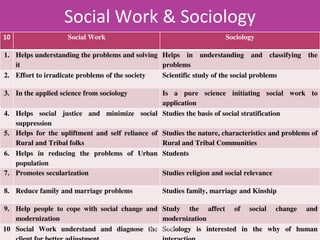
Social Work & Sociology
10 Social Work Sociology
1. Helps understanding the problems and solving
it
Helps in understanding and classifying the
problems
2. Effort to irradicate problems of the society Scientific study of the social problems
3. In the applied science from sociology Is a pure science initiating social work to
application
4. Helps social justice and minimize social
suppression
Studies the basis of social stratification
5. Helps for the upliftment and self reliance of
Rural and Tribal folks
Studies the nature, characteristics and problems of
Rural and Tribal Communities
6. Helps in reducing the problems of Urban
population
Students
7. Promotes secularization Studies religion and social relevance
8. Reduce family and marriage problems Studies family, marriage and Kinship
9. Help people to cope with social change and
modernization
Study the affect of social change and
modernization
10 Social Work understand and diagnose the Sociology is interested in the why of humanLohith Shetty
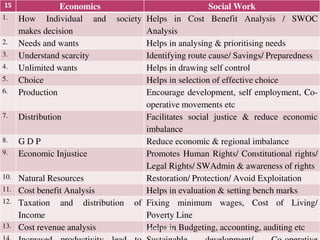
15 Economics Social Work
1. How Individual and society
makes decision
Helps in Cost Benefit Analysis / SWOC
Analysis
2. Needs and wants Helps in analysing & prioritising needs
3. Understand scarcity Identifying route cause/ Savings/ Preparedness
4. Unlimited wants Helps in drawing self control
5. Choice Helps in selection of effective choice
6. Production Encourage development, self employment, Co-
operative movements etc
7. Distribution Facilitates social justice & reduce economic
imbalance
8. G D P Reduce economic & regional imbalance
9. Economic Injustice Promotes Human Rights/ Constitutional rights/
Legal Rights/ SWAdmin & awareness of rights
10. Natural Resources Restoration/ Protection/ Avoid Exploitation
11. Cost benefit Analysis Helps in evaluation & setting bench marks
12. Taxation and distribution of
Income
Fixing minimum wages, Cost of Living/
Poverty Line
13. Cost revenue analysis Helps in Budgeting, accounting, auditing etcLohith Shetty
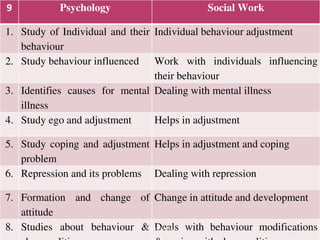
9 Psychology Social Work
1. Study of Individual and their
behaviour
Individual behaviour adjustment
2. Study behaviour influenced Work with individuals influencing
their behaviour
3. Identifies causes for mental
illness
Dealing with mental illness
4. Study ego and adjustment Helps in adjustment
5. Study coping and adjustment
problem
Helps in adjustment and coping
6. Repression and its problems Dealing with repression
7. Formation and change of
attitude
Change in attitude and development
8. Studies about behaviour & Deals with behaviour modificationsLohith Shetty
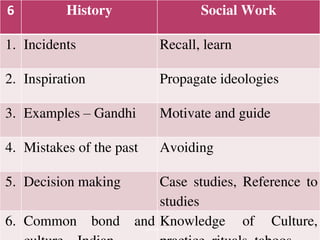
6 History Social Work
1. Incidents Recall, learn
2. Inspiration Propagate ideologies
3. Examples – Gandhi Motivate and guide
4. Mistakes of the past Avoiding
5. Decision making Case studies, Reference to
studies
6. Common bond and Knowledge of Culture,Lohith Shetty
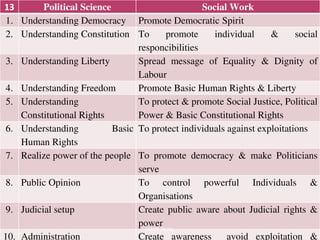
13 Political Science Social Work
1. Understanding Democracy Promote Democratic Spirit
2. Understanding Constitution To promote individual & social
responcibilities
3. Understanding Liberty Spread message of Equality & Dignity of
Labour
4. Understanding Freedom Promote Basic Human Rights & Liberty
5. Understanding
Constitutional Rights
To protect & promote Social Justice, Political
Power & Basic Constitutional Rights
6. Understanding Basic
Human Rights
To protect individuals against exploitations
7. Realize power of the people To promote democracy & make Politicians
serve
8. Public Opinion To control powerful Individuals &
Organisations
9. Judicial setup Create public aware about Judicial rights &
power
10. Administration Create awareness avoid exploitation &
Lohith Shetty
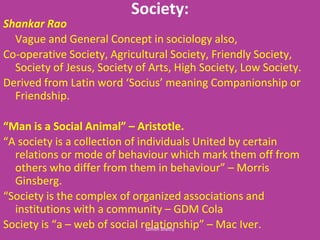
Society:
Shankar Rao
Vague and General Concept in sociology also,
Co-operative Society, Agricultural Society, Friendly Society,
Society of Jesus, Society of Arts, High Society, Low Society.
Deri ed fro Lati ord So ius ea i g Co pa io ship or
Friendship.
Ma is a So ial A i al – Aristotle.
A so iet is a olle tio of i di iduals U ited ertai
relations or mode of behaviour which mark them off from
others ho differ fro the i eha iour – Morris
Ginsberg.
So iet is the o ple of orga ized asso iatio s a d
institutions with a community – GDM Cola
So iet is a – e of so ial relatio ship – Mac Iver.Lohith Shetty
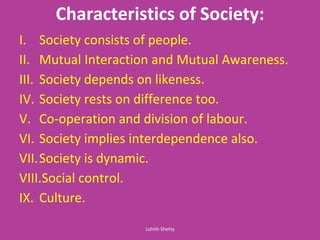
I. Society consists of people.
II. Mutual Interaction and Mutual Awareness.
III. Society depends on likeness.
IV. Society rests on difference too.
V. Co-operation and division of labour.
VI. Society implies interdependence also.
VII.Society is dynamic.
VIII.Social control.
IX. Culture.
Characteristics of Society:
Lohith Shetty
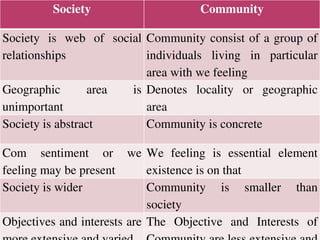
Society Community
Society is web of social
relationships
Community consist of a group of
individuals living in particular
area with we feeling
Geographic area is
unimportant
Denotes locality or geographic
area
Society is abstract Community is concrete
Com sentiment or we
feeling may be present
We feeling is essential element
existence is on that
Society is wider Community is smaller than
society
Objectives and interests are The Objective and Interests ofLohith Shetty
2 Socialization.pptx
Mans behaviour is learnt behaviour. The process of
moulding and shaping the personality of human
i fa t is alled So ializatio .
Bogardus: So ializatio is the pro ess of orki g
together, of developing group responsibility, or
ei g guided the elfare eeds of others .
W.F. Ogburn: So ializatio is the pro ess hi h the
individual learns to conform to the norms of the
group .
Peter Worsley e plai s so ializatio as the pro ess of
transmission of culture, the process whereby men
lear the rules a d pra ti es of so ial group .
Lohith Shetty
Types of Socialization:
Ia Ro ertso i his ook So iolog 1977
A. Primary Socialization – Childhood
B. Anticipatory Socialization – Different
place, culture
C. Developmental Socialization – marriage,
new job
D. Re-Socialization – Juvenile set up, new
prostitutes.
Lohith Shetty
Theories of Socialization:
C.H. Cooley s theory of Looki g Glass Self 3
elements
a) Imagination of our appearance to others
b) The imagination of his judgment of imagined
appearance
c) Some kind of self-feeling such as pride (praise
and blame)
George Her ert Mead s Theory of Self
Role playing: observed to act towards his doll as
parent.
Lohith Shetty
Process and Stages of Socialization:
1. The Oral Stage
2. The Anal Stage
3. The Oedipal or Electra stage
4. The stage of Adolescents
5. Adult Socialization
a) Change overt behaviour and not basic values
b) Informal nature of social positions
c) To gain special skills
d) To gain social positions.
Lohith Shetty
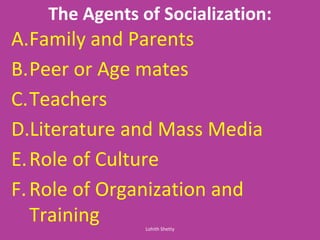
The Agents of Socialization:
A.Family and Parents
B.Peer or Age mates
C.Teachers
D.Literature and Mass Media
E.Role of Culture
F.Role of Organization and
Training Lohith Shetty
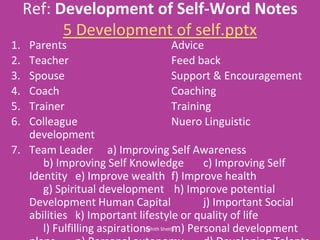
Ref: Development of Self-Word Notes
5 Development of self.pptx
1. Parents Advice
2. Teacher Feed back
3. Spouse Support & Encouragement
4. Coach Coaching
5. Trainer Training
6. Colleague Nuero Linguistic
development
7. Team Leader a) Improving Self Awareness
b) Improving Self Knowledge c) Improving Self
Identity e) Improve wealth f) Improve health
g) Spiritual development h) Improve potential
Development Human Capital j) Important Social
abilities k) Important lifestyle or quality of life
l) Fulfilling aspirations m) Personal developmentLohith Shetty
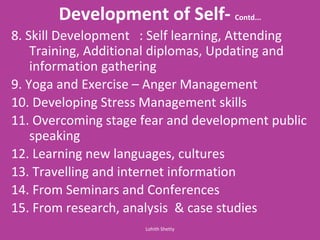
Development of Self- Contd...
8. Skill Development : Self learning, Attending
Training, Additional diplomas, Updating and
information gathering
9. Yoga and Exercise – Anger Management
10. Developing Stress Management skills
11. Overcoming stage fear and development public
speaking
12. Learning new languages, cultures
13. Travelling and internet information
14. From Seminars and Conferences
15. From research, analysis & case studies
Lohith Shetty

Social Sciences Perspective for Social Work I

  • 1.
    Social Sciences perspectivefor Social Work I JFM Lohith Shetty PGDPM, MSW(HRD), MBA(Hosp Mgt), NET Asst Professor Chief Facilitator – Vinetra Training Institute Trainer – Junior Chamber International President - 2014, JCI Mangalore Lohith Shetty
  • 2.
    Statutory Instructions: This isnot a study material & only a teaching aid. There is constant changes made to this teaching material & those changes are not updated in Slide Share. This slide is prepared as teaching aid only, so it can be understood & interpreted rightly only after attending my classes. Lohith Shetty
  • 3.
    1a Sociology.pptx 1a Psychology.pptx 1aEconomics.pptx 1a History.pptx 1a Political Science.pptx Lohith Shetty
  • 4.
    Social Work &Sociology 10 Social Work Sociology 1. Helps understanding the problems and solving it Helps in understanding and classifying the problems 2. Effort to irradicate problems of the society Scientific study of the social problems 3. In the applied science from sociology Is a pure science initiating social work to application 4. Helps social justice and minimize social suppression Studies the basis of social stratification 5. Helps for the upliftment and self reliance of Rural and Tribal folks Studies the nature, characteristics and problems of Rural and Tribal Communities 6. Helps in reducing the problems of Urban population Students 7. Promotes secularization Studies religion and social relevance 8. Reduce family and marriage problems Studies family, marriage and Kinship 9. Help people to cope with social change and modernization Study the affect of social change and modernization 10 Social Work understand and diagnose the Sociology is interested in the why of humanLohith Shetty
  • 5.
    15 Economics SocialWork 1. How Individual and society makes decision Helps in Cost Benefit Analysis / SWOC Analysis 2. Needs and wants Helps in analysing & prioritising needs 3. Understand scarcity Identifying route cause/ Savings/ Preparedness 4. Unlimited wants Helps in drawing self control 5. Choice Helps in selection of effective choice 6. Production Encourage development, self employment, Co- operative movements etc 7. Distribution Facilitates social justice & reduce economic imbalance 8. G D P Reduce economic & regional imbalance 9. Economic Injustice Promotes Human Rights/ Constitutional rights/ Legal Rights/ SWAdmin & awareness of rights 10. Natural Resources Restoration/ Protection/ Avoid Exploitation 11. Cost benefit Analysis Helps in evaluation & setting bench marks 12. Taxation and distribution of Income Fixing minimum wages, Cost of Living/ Poverty Line 13. Cost revenue analysis Helps in Budgeting, accounting, auditing etcLohith Shetty
  • 6.
    9 Psychology SocialWork 1. Study of Individual and their behaviour Individual behaviour adjustment 2. Study behaviour influenced Work with individuals influencing their behaviour 3. Identifies causes for mental illness Dealing with mental illness 4. Study ego and adjustment Helps in adjustment 5. Study coping and adjustment problem Helps in adjustment and coping 6. Repression and its problems Dealing with repression 7. Formation and change of attitude Change in attitude and development 8. Studies about behaviour & Deals with behaviour modificationsLohith Shetty
  • 7.
    6 History SocialWork 1. Incidents Recall, learn 2. Inspiration Propagate ideologies 3. Examples – Gandhi Motivate and guide 4. Mistakes of the past Avoiding 5. Decision making Case studies, Reference to studies 6. Common bond and Knowledge of Culture,Lohith Shetty
  • 8.
    13 Political ScienceSocial Work 1. Understanding Democracy Promote Democratic Spirit 2. Understanding Constitution To promote individual & social responcibilities 3. Understanding Liberty Spread message of Equality & Dignity of Labour 4. Understanding Freedom Promote Basic Human Rights & Liberty 5. Understanding Constitutional Rights To protect & promote Social Justice, Political Power & Basic Constitutional Rights 6. Understanding Basic Human Rights To protect individuals against exploitations 7. Realize power of the people To promote democracy & make Politicians serve 8. Public Opinion To control powerful Individuals & Organisations 9. Judicial setup Create public aware about Judicial rights & power 10. Administration Create awareness avoid exploitation & Lohith Shetty
  • 9.
    Society: Shankar Rao Vague andGeneral Concept in sociology also, Co-operative Society, Agricultural Society, Friendly Society, Society of Jesus, Society of Arts, High Society, Low Society. Deri ed fro Lati ord So ius ea i g Co pa io ship or Friendship. Ma is a So ial A i al – Aristotle. A so iet is a olle tio of i di iduals U ited ertai relations or mode of behaviour which mark them off from others ho differ fro the i eha iour – Morris Ginsberg. So iet is the o ple of orga ized asso iatio s a d institutions with a community – GDM Cola So iet is a – e of so ial relatio ship – Mac Iver.Lohith Shetty
  • 10.
    I. Society consistsof people. II. Mutual Interaction and Mutual Awareness. III. Society depends on likeness. IV. Society rests on difference too. V. Co-operation and division of labour. VI. Society implies interdependence also. VII.Society is dynamic. VIII.Social control. IX. Culture. Characteristics of Society: Lohith Shetty
  • 11.
    Society Community Society isweb of social relationships Community consist of a group of individuals living in particular area with we feeling Geographic area is unimportant Denotes locality or geographic area Society is abstract Community is concrete Com sentiment or we feeling may be present We feeling is essential element existence is on that Society is wider Community is smaller than society Objectives and interests are The Objective and Interests ofLohith Shetty
  • 12.
    2 Socialization.pptx Mans behaviouris learnt behaviour. The process of moulding and shaping the personality of human i fa t is alled So ializatio . Bogardus: So ializatio is the pro ess of orki g together, of developing group responsibility, or ei g guided the elfare eeds of others . W.F. Ogburn: So ializatio is the pro ess hi h the individual learns to conform to the norms of the group . Peter Worsley e plai s so ializatio as the pro ess of transmission of culture, the process whereby men lear the rules a d pra ti es of so ial group . Lohith Shetty
  • 13.
    Types of Socialization: IaRo ertso i his ook So iolog 1977 A. Primary Socialization – Childhood B. Anticipatory Socialization – Different place, culture C. Developmental Socialization – marriage, new job D. Re-Socialization – Juvenile set up, new prostitutes. Lohith Shetty
  • 14.
    Theories of Socialization: C.H.Cooley s theory of Looki g Glass Self 3 elements a) Imagination of our appearance to others b) The imagination of his judgment of imagined appearance c) Some kind of self-feeling such as pride (praise and blame) George Her ert Mead s Theory of Self Role playing: observed to act towards his doll as parent. Lohith Shetty
  • 15.
    Process and Stagesof Socialization: 1. The Oral Stage 2. The Anal Stage 3. The Oedipal or Electra stage 4. The stage of Adolescents 5. Adult Socialization a) Change overt behaviour and not basic values b) Informal nature of social positions c) To gain special skills d) To gain social positions. Lohith Shetty
  • 16.
    The Agents ofSocialization: A.Family and Parents B.Peer or Age mates C.Teachers D.Literature and Mass Media E.Role of Culture F.Role of Organization and Training Lohith Shetty
  • 17.
    Ref: Development ofSelf-Word Notes 5 Development of self.pptx 1. Parents Advice 2. Teacher Feed back 3. Spouse Support & Encouragement 4. Coach Coaching 5. Trainer Training 6. Colleague Nuero Linguistic development 7. Team Leader a) Improving Self Awareness b) Improving Self Knowledge c) Improving Self Identity e) Improve wealth f) Improve health g) Spiritual development h) Improve potential Development Human Capital j) Important Social abilities k) Important lifestyle or quality of life l) Fulfilling aspirations m) Personal developmentLohith Shetty
  • 18.
    Development of Self-Contd... 8. Skill Development : Self learning, Attending Training, Additional diplomas, Updating and information gathering 9. Yoga and Exercise – Anger Management 10. Developing Stress Management skills 11. Overcoming stage fear and development public speaking 12. Learning new languages, cultures 13. Travelling and internet information 14. From Seminars and Conferences 15. From research, analysis & case studies Lohith Shetty