ORGANISATIONAL BEHAVIOUR
& DEVELOPMENT
II
JFM Lohith Shetty
PGDPM, MSW(HRD), MBA(Hosp Mgt), NET
Chief Facilitator – Vinetra Training Institute
Trainer – Junior Chamber International
President - 2014, JCI Mangalore
Lohith Shetty
 Statutory Instructions:
 This is not a study material & only a teaching aid.
 There is constant changes made to this teaching
material & those changes are not updated in Slide
Share.
 This slide is prepared as teaching aid only, so it can
be understood & interpreted rightly only after
attending my classes.
Lohith Shetty
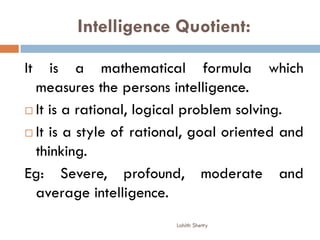
Intelligence Quotient:
It is a mathematical formula which
measures the persons intelligence.
 It is a rational, logical problem solving.
 It is a style of rational, goal oriented and
thinking.
Eg: Severe, profound, moderate and
average intelligence.
Lohith Shetty
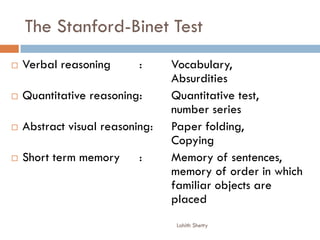
The Stanford-Binet Test
 Verbal reasoning : Vocabulary,
Absurdities
 Quantitative reasoning: Quantitative test,
number series
 Abstract visual reasoning: Paper folding,
Copying
 Short term memory : Memory of sentences,
memory of order in which
familiar objects are
placed
Lohith Shetty
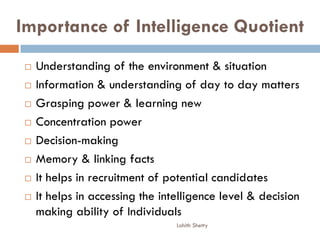
Importance of Intelligence Quotient
 Understanding of the environment & situation
 Information & understanding of day to day matters
 Grasping power & learning new
 Concentration power
 Decision-making
 Memory & linking facts
 It helps in recruitment of potential candidates
 It helps in accessing the intelligence level & decision
making ability of Individuals
Lohith Shetty
Emotional Quotient:
1919 concept was developed. Emotional
Intelligence is the ability to identify, assess and
control the emotion of ourselves.
 Self awareness and control and in the ability
to respond appropriately to the emotions of
others.
 The ability to assess and affect situations and
relationship with other people also plays a role
in Emotional Intelligence.
Lohith Shetty
Importance of Emotional Quotient:
 Maturity of personality is observed with Emotional
Stability
 Encourages right decision making
 It promotes healthy work environment
 It helps in reducing confusion & misunderstanding
 It reduce conflicts between colleagues
 Helps in providing emotional support
 Encourages Team Work
 Emotional stability reduce the health risk &
unhealthy habits. Lohith Shetty
Spiritual Quotient:
 It is an science of thinking out of the box.
 It is an access to higher meaning
 Higher spiritual truths are to be experienced.
Importance:
o Having direction in life
o Ability to lead ourselves
o Supervening higher reality
o Conscious afford to understand
Lohith Shetty
Principle of Spiritual Quotient:
 Self awareness
 Spontaneous thoughts
 Being Visionary
 Humility
 Humbleness
 Sense of Vocation
 Commitment to thought, ideology & belief
 Clarity of thought & action
 Independent opinion
 Self-rooted in spirituality Lohith Shetty
Personality:
Latin – Persona = means Actors
The human personality includes:
 External appearance and behaviour or social stimulus
value.
 Inner awareness of self as a permanent organizing
force.
Def: Gluck:
Personality is a pattern of stable states and
characteristics of a person that influence his or her
behaviour toward goal achievement.
Lohith Shetty
Determinants of Personality:
Heredity
Family
Culture
Social environment
Physical/ natural environment
Situation
Experience through lifeLohith Shetty
Types of Personality:
o Introvert personality: inward people,
No social contact
o Extrovert personalities: Simply speaking
o Mechanical personality
o Nurturing personality
o Artistic personality
o Protest personality
Lohith Shetty
Theories of Personality:
A. Sigmund Freud:
o Psychoanalytical theory
o Id, Ego, super ego
 The oral stage
 The anal stage
 The phallic stage
 The latency stage
 The genital stage
Lohith Shetty
B. Theories of Personality: Contd...
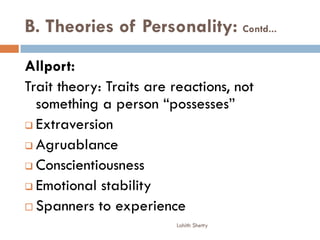
Allport:
Trait theory: Traits are reactions, not
something a person “possesses”
 Extraversion
 Agruablance
 Conscientiousness
 Emotional stability
 Spanners to experience
Lohith Shetty
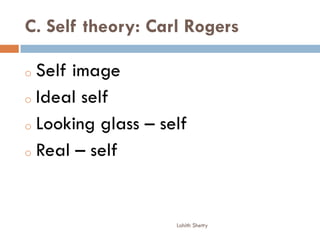
C. Self theory: Carl Rogers
o Self image
o Ideal self
o Looking glass – self
o Real – self
Lohith Shetty
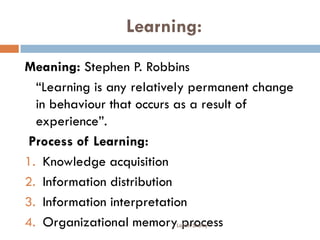
Learning:
Meaning: Stephen P. Robbins
“Learning is any relatively permanent change
in behaviour that occurs as a result of
experience”.
Process of Learning:
1. Knowledge acquisition
2. Information distribution
3. Information interpretation
4. Organizational memory processLohith Shetty
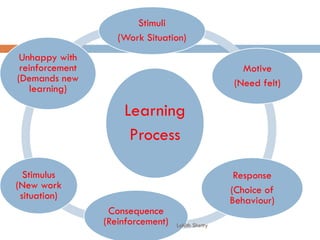
Learning
Process
Stimuli
(Work Situation)
Motive
(Need felt)
Response
(Choice of
Behaviour)
Consequence
(Reinforcement)
Stimulus
(New work
situation)
Unhappy with
reinforcement
(Demands new
learning)
Lohith Shetty
Theories of learning:
A. Classical conditioning theory: Ivan Povlov
a) Response is reactive
b) Responses are fixed to stimuli (no choice)
c) Stimulus such as sound, object, person are used
d) Reinforcement is not received by choice
B. Operant conditioning theory: By B.F. Skinner
Behaviour can be controlled by manipulating its
consequences.
The behaviour that result in positive rewards trend to be
repeated and behaviour with negative consequence
tender not to be repeated.
Based upon such consequences, the behaviour can be
predicted and controlled. Lohith Shetty
Factors influencing operant conditioning:
* Magnitude of reinforcement
* Imitation
* Motivation of the learner
C. Cognitive theory:
 Choice of behaviour based on perceived consequence
 1st imp, 2nd imp & so on
D. Social Learning Theory:
 Process of observational learning.
 Select model & learn by observing their behaviour.
OB modification: Changes brought in the behaviour
of the employees Lohith Shetty
Attitude: Attitude reflect how one feel about something.
Def: Munn: Attitude is learned predispositions towards aspects of our
environment
Characteristics:
1. Attitudes are learnt
2. Every individual hold attitude
3. Attitudes are organised & are core to an individual
4. Attitudes refers to feelings & beliefs of individual or
group
5. These feelings define one’s predisposition towards given
aspect
6. Attitude can be favourable or unfavourable feeling
7. Attitudes endure, unless something happensLohith Shetty
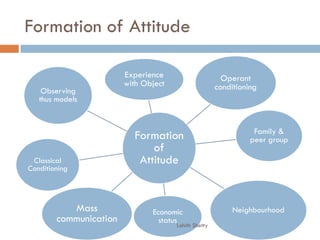
Formation of Attitude
Formation
of
Attitude
Experience
with Object
Operant
conditioning
Family &
peer group
NeighbourhoodEconomic
status
Mass
communication
Classical
Conditioning
Observing
thus models
Lohith Shetty
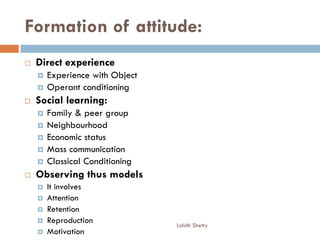
Formation of attitude:
 Direct experience
 Experience with Object
 Operant conditioning
 Social learning:
 Family & peer group
 Neighbourhood
 Economic status
 Mass communication
 Classical Conditioning
 Observing thus models
 It involves
 Attention
 Retention
 Reproduction
 Motivation
Lohith Shetty
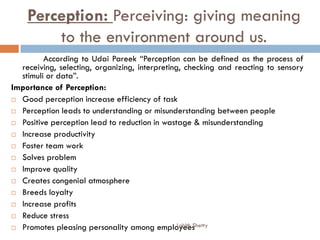
Perception: Perceiving: giving meaning
to the environment around us.
According to Udai Pareek “Perception can be defined as the process of
receiving, selecting, organizing, interpreting, checking and reacting to sensory
stimuli or data”.
Importance of Perception:
 Good perception increase efficiency of task
 Perception leads to understanding or misunderstanding between people
 Positive perception lead to reduction in wastage & misunderstanding
 Increase productivity
 Foster team work
 Solves problem
 Improve quality
 Creates congenial atmosphere
 Breeds loyalty
 Increase profits
 Reduce stress
 Promotes pleasing personality among employeesLohith Shetty
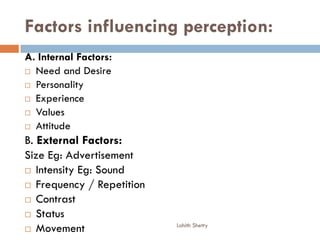
Factors influencing perception:
A. Internal Factors:
 Need and Desire
 Personality
 Experience
 Values
 Attitude
B. External Factors:
Size Eg: Advertisement
 Intensity Eg: Sound
 Frequency / Repetition
 Contrast
 Status
 Movement Lohith Shetty
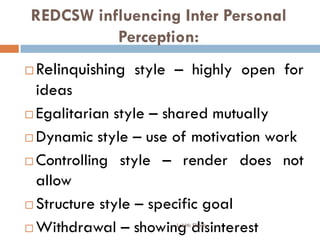
REDCSW influencing Inter Personal
Perception:
 Relinquishing style – highly open for
ideas
 Egalitarian style – shared mutually
 Dynamic style – use of motivation work
 Controlling style – render does not
allow
 Structure style – specific goal
 Withdrawal – showing disinterestLohith Shetty
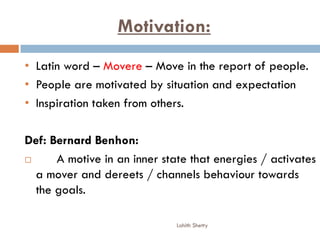
Motivation:
• Latin word – Movere – Move in the report of people.
• People are motivated by situation and expectation
• Inspiration taken from others.
Def: Bernard Benhon:
 A motive in an inner state that energies / activates
a mover and dereets / channels behaviour towards
the goals.
Lohith Shetty
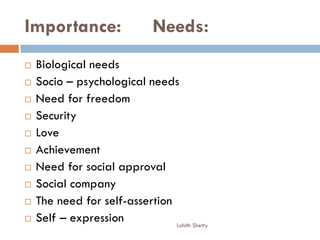
Importance: Needs:
 Biological needs
 Socio – psychological needs
 Need for freedom
 Security
 Love
 Achievement
 Need for social approval
 Social company
 The need for self-assertion
 Self – expression Lohith Shetty
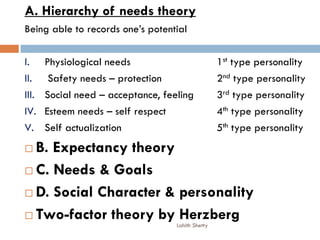
A. Hierarchy of needs theory
Being able to records one’s potential
I. Physiological needs 1st type personality
II. Safety needs – protection 2nd type personality
III. Social need – acceptance, feeling 3rd type personality
IV. Esteem needs – self respect 4th type personality
V. Self actualization 5th type personality
 B. Expectancy theory
 C. Needs & Goals
 D. Social Character & personality
 Two-factor theory by Herzberg
Lohith Shetty
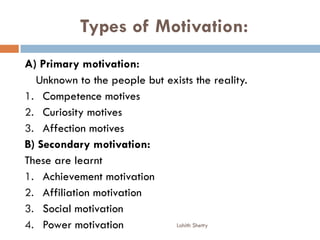
Types of Motivation:
A) Primary motivation:
Unknown to the people but exists the reality.
1. Competence motives
2. Curiosity motives
3. Affection motives
B) Secondary motivation:
These are learnt
1. Achievement motivation
2. Affiliation motivation
3. Social motivation
4. Power motivation Lohith Shetty
Effects of motivation on Work Behaviour:
Importance of Motivation:
 Motivations is observed with least employee turnover
 Motivated employees give better output
 Team Work is the result of motivation
 Motivated employees are open to suggestions & changes
 Learning new skills & development is observed
 Motivated employees give suggestions & participate with
management.
 Reduction in delays, damages & wastages will be
observed.
 De-motivated employees rebel with strikes & slowdownLohith Shetty

Organisational Behavior and Development

  • 1.
    ORGANISATIONAL BEHAVIOUR & DEVELOPMENT II JFMLohith Shetty PGDPM, MSW(HRD), MBA(Hosp Mgt), NET Chief Facilitator – Vinetra Training Institute Trainer – Junior Chamber International President - 2014, JCI Mangalore Lohith Shetty
  • 2.
     Statutory Instructions: This is not a study material & only a teaching aid.  There is constant changes made to this teaching material & those changes are not updated in Slide Share.  This slide is prepared as teaching aid only, so it can be understood & interpreted rightly only after attending my classes. Lohith Shetty
  • 3.
    Intelligence Quotient: It isa mathematical formula which measures the persons intelligence.  It is a rational, logical problem solving.  It is a style of rational, goal oriented and thinking. Eg: Severe, profound, moderate and average intelligence. Lohith Shetty
  • 4.
    The Stanford-Binet Test Verbal reasoning : Vocabulary, Absurdities  Quantitative reasoning: Quantitative test, number series  Abstract visual reasoning: Paper folding, Copying  Short term memory : Memory of sentences, memory of order in which familiar objects are placed Lohith Shetty
  • 5.
    Importance of IntelligenceQuotient  Understanding of the environment & situation  Information & understanding of day to day matters  Grasping power & learning new  Concentration power  Decision-making  Memory & linking facts  It helps in recruitment of potential candidates  It helps in accessing the intelligence level & decision making ability of Individuals Lohith Shetty
  • 6.
    Emotional Quotient: 1919 conceptwas developed. Emotional Intelligence is the ability to identify, assess and control the emotion of ourselves.  Self awareness and control and in the ability to respond appropriately to the emotions of others.  The ability to assess and affect situations and relationship with other people also plays a role in Emotional Intelligence. Lohith Shetty
  • 7.
    Importance of EmotionalQuotient:  Maturity of personality is observed with Emotional Stability  Encourages right decision making  It promotes healthy work environment  It helps in reducing confusion & misunderstanding  It reduce conflicts between colleagues  Helps in providing emotional support  Encourages Team Work  Emotional stability reduce the health risk & unhealthy habits. Lohith Shetty
  • 8.
    Spiritual Quotient:  Itis an science of thinking out of the box.  It is an access to higher meaning  Higher spiritual truths are to be experienced. Importance: o Having direction in life o Ability to lead ourselves o Supervening higher reality o Conscious afford to understand Lohith Shetty
  • 9.
    Principle of SpiritualQuotient:  Self awareness  Spontaneous thoughts  Being Visionary  Humility  Humbleness  Sense of Vocation  Commitment to thought, ideology & belief  Clarity of thought & action  Independent opinion  Self-rooted in spirituality Lohith Shetty
  • 10.
    Personality: Latin – Persona= means Actors The human personality includes:  External appearance and behaviour or social stimulus value.  Inner awareness of self as a permanent organizing force. Def: Gluck: Personality is a pattern of stable states and characteristics of a person that influence his or her behaviour toward goal achievement. Lohith Shetty
  • 11.
    Determinants of Personality: Heredity Family Culture Socialenvironment Physical/ natural environment Situation Experience through lifeLohith Shetty
  • 12.
    Types of Personality: oIntrovert personality: inward people, No social contact o Extrovert personalities: Simply speaking o Mechanical personality o Nurturing personality o Artistic personality o Protest personality Lohith Shetty
  • 13.
    Theories of Personality: A.Sigmund Freud: o Psychoanalytical theory o Id, Ego, super ego  The oral stage  The anal stage  The phallic stage  The latency stage  The genital stage Lohith Shetty
  • 14.
    B. Theories ofPersonality: Contd... Allport: Trait theory: Traits are reactions, not something a person “possesses”  Extraversion  Agruablance  Conscientiousness  Emotional stability  Spanners to experience Lohith Shetty
  • 15.
    C. Self theory:Carl Rogers o Self image o Ideal self o Looking glass – self o Real – self Lohith Shetty
  • 16.
    Learning: Meaning: Stephen P.Robbins “Learning is any relatively permanent change in behaviour that occurs as a result of experience”. Process of Learning: 1. Knowledge acquisition 2. Information distribution 3. Information interpretation 4. Organizational memory processLohith Shetty
  • 17.
    Learning Process Stimuli (Work Situation) Motive (Need felt) Response (Choiceof Behaviour) Consequence (Reinforcement) Stimulus (New work situation) Unhappy with reinforcement (Demands new learning) Lohith Shetty
  • 18.
    Theories of learning: A.Classical conditioning theory: Ivan Povlov a) Response is reactive b) Responses are fixed to stimuli (no choice) c) Stimulus such as sound, object, person are used d) Reinforcement is not received by choice B. Operant conditioning theory: By B.F. Skinner Behaviour can be controlled by manipulating its consequences. The behaviour that result in positive rewards trend to be repeated and behaviour with negative consequence tender not to be repeated. Based upon such consequences, the behaviour can be predicted and controlled. Lohith Shetty
  • 19.
    Factors influencing operantconditioning: * Magnitude of reinforcement * Imitation * Motivation of the learner C. Cognitive theory:  Choice of behaviour based on perceived consequence  1st imp, 2nd imp & so on D. Social Learning Theory:  Process of observational learning.  Select model & learn by observing their behaviour. OB modification: Changes brought in the behaviour of the employees Lohith Shetty
  • 20.
    Attitude: Attitude reflecthow one feel about something. Def: Munn: Attitude is learned predispositions towards aspects of our environment Characteristics: 1. Attitudes are learnt 2. Every individual hold attitude 3. Attitudes are organised & are core to an individual 4. Attitudes refers to feelings & beliefs of individual or group 5. These feelings define one’s predisposition towards given aspect 6. Attitude can be favourable or unfavourable feeling 7. Attitudes endure, unless something happensLohith Shetty
  • 21.
    Formation of Attitude Formation of Attitude Experience withObject Operant conditioning Family & peer group NeighbourhoodEconomic status Mass communication Classical Conditioning Observing thus models Lohith Shetty
  • 22.
    Formation of attitude: Direct experience  Experience with Object  Operant conditioning  Social learning:  Family & peer group  Neighbourhood  Economic status  Mass communication  Classical Conditioning  Observing thus models  It involves  Attention  Retention  Reproduction  Motivation Lohith Shetty
  • 23.
    Perception: Perceiving: givingmeaning to the environment around us. According to Udai Pareek “Perception can be defined as the process of receiving, selecting, organizing, interpreting, checking and reacting to sensory stimuli or data”. Importance of Perception:  Good perception increase efficiency of task  Perception leads to understanding or misunderstanding between people  Positive perception lead to reduction in wastage & misunderstanding  Increase productivity  Foster team work  Solves problem  Improve quality  Creates congenial atmosphere  Breeds loyalty  Increase profits  Reduce stress  Promotes pleasing personality among employeesLohith Shetty
  • 24.
    Factors influencing perception: A.Internal Factors:  Need and Desire  Personality  Experience  Values  Attitude B. External Factors: Size Eg: Advertisement  Intensity Eg: Sound  Frequency / Repetition  Contrast  Status  Movement Lohith Shetty
  • 25.
    REDCSW influencing InterPersonal Perception:  Relinquishing style – highly open for ideas  Egalitarian style – shared mutually  Dynamic style – use of motivation work  Controlling style – render does not allow  Structure style – specific goal  Withdrawal – showing disinterestLohith Shetty
  • 26.
    Motivation: • Latin word– Movere – Move in the report of people. • People are motivated by situation and expectation • Inspiration taken from others. Def: Bernard Benhon:  A motive in an inner state that energies / activates a mover and dereets / channels behaviour towards the goals. Lohith Shetty
  • 27.
    Importance: Needs:  Biologicalneeds  Socio – psychological needs  Need for freedom  Security  Love  Achievement  Need for social approval  Social company  The need for self-assertion  Self – expression Lohith Shetty
  • 28.
    A. Hierarchy ofneeds theory Being able to records one’s potential I. Physiological needs 1st type personality II. Safety needs – protection 2nd type personality III. Social need – acceptance, feeling 3rd type personality IV. Esteem needs – self respect 4th type personality V. Self actualization 5th type personality  B. Expectancy theory  C. Needs & Goals  D. Social Character & personality  Two-factor theory by Herzberg Lohith Shetty
  • 29.
    Types of Motivation: A)Primary motivation: Unknown to the people but exists the reality. 1. Competence motives 2. Curiosity motives 3. Affection motives B) Secondary motivation: These are learnt 1. Achievement motivation 2. Affiliation motivation 3. Social motivation 4. Power motivation Lohith Shetty
  • 30.
    Effects of motivationon Work Behaviour: Importance of Motivation:  Motivations is observed with least employee turnover  Motivated employees give better output  Team Work is the result of motivation  Motivated employees are open to suggestions & changes  Learning new skills & development is observed  Motivated employees give suggestions & participate with management.  Reduction in delays, damages & wastages will be observed.  De-motivated employees rebel with strikes & slowdownLohith Shetty