DR. SACHIN CHAUDHARY
PRINCIPAL CUM PROFESSOR
DATTA MEGHE COLLEGE OF PHYSIOTHERAPY
NAGPUR
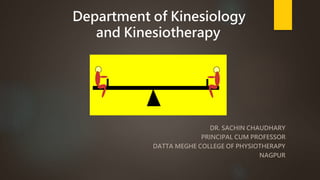
Department of Kinesiology
and Kinesiotherapy
LEVER
 A LEVER IS A RIGID BAR WHICH IS CAPABLE OF
MOVEMENT ABOUT A FIXED POINT CALLED A FULCRUM
(F)
 Work is done when a force or effort (E), applied at one point on the
lever, acts upon another force or weight (W), acting at the second point
on the lever.
 The perpendicular distance from the fulcrum to the effort (E) may be
called the effort's arm and that from the fulcrum to the weight (W) as
the weight's arm.
 In the body lever is represented by a bone, which is capable of
movement about a fulcrum formed at the articulating surfaces
of a joint;
 The effort which works the lever is supplied by the force of
muscular contraction, applied at the point of insertion to the
bone,
 While the weight may be either at the centre of gravity of the
part moved, or of the object to be lifted.
There are Three Orders or Classes of Levers, each of
which is characterised by the relative positions of the
fulcrum, effort and weight.
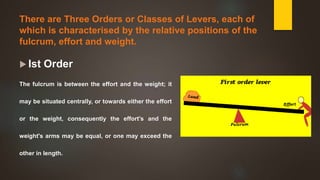
 Ist Order
The fulcrum is between the effort and the weight; it
may be situated centrally, or towards either the effort
or the weight, consequently the effort's and the
weight's arms may be equal, or one may exceed the
other in length.
2nd Order
The weight is between the fulcrum and the effort, and the
effort's arm must therefore always exceed the weight's arm.
3rd Order
The effort is between the fulcrum and the weight, and the weight's
arm must therefore exceed the effort's arm.
FEATURES OF LEVER
1ST ORDER – STABILITY
2ND ORDER – POWER
3RD ORDER – VELOCITY
MECHANICAL ADVANTAGE
 Mechanical advantage is the ratio of the weight to the effort
Mechanical Advantage = W/E
 When the two lengths are same, the MA is equal to 1
 When the MA is greater than 1 the machine is regarded as being efficient
and has a positive MA.
 This means that the effort required to shift a given resistance is less than
the value of the resistance. This is possible because the total force is equal
to F * d
 When the MA is less than 1, the machine is less efficient and exhibits
a mechanical disadvantage.
 This means that the effort required to shift a resistance is greater than
the value of the actual resistance
Two types of machines, based on principles of moments, are used by
physiotherapists
- LEVERS & PULLEYS
The efficacy of a force in relation to a lever is dependant on two factors, ie force
exerted (W) or (E), and its perpendicular distance from the fulcrum (weight’s
arm or effort’s arm)
The product of these two factors is known as the Moment of Force (or torque)
When the weight’s and effort’s arm are of equal length an effort of a magnitude
equal to that of the weight will be required to lift it.
No advantage is gained but the machine is useful for measuring weights as, for
eg – common balance
If the length of effort’s arm is more than the weight’s arm, less effort will be
required to achieve a similar result and an advantage will be gained by the use
of the lever ie MA
LEVERS IN HUMAN BODY
1ST ORDER – A state of equilibrium can be achieved either with or
without MA .
Eg – Nodding movement of head; the skull represents the lever, the atlanto-
occipital joint the fulcrum, the weight is situated anteriorly in the face, and
the effort is supplied by contraction of posterior neck muscles applied at
their attachment on the occipital bone.
Eg – Tilting movement of pelvis on the femoral heads
2ND ORDER
 There must always be a Mechanical Advantage.
 Eg - Heels raised to stand on toes
 The tarsal ans metatarsal bines are stabilised by muscular action to form the
lever, the fulcrum is at the MTP joint, and the weight of the body is transmitted
through the ankle joint to the talus. the effort is applied at the insertion of the
tendo-calcaneum by contraction of calf muscles.
 Eg - The action of Brachioradialis muscle in flexing the elbow joint
2nd Order
3RD ORDER
 In this type of lever there is always mechanical disadvantage.
 This is a lever of velocity, the loss of mechanical advantage being
outweighed by the advantage gained by speed and range of movement.
 Eg - Elbow flexion by Brachialis muscle
 Lever is the forearm, Fulcrum is the elbow joint, weight is some object held
in the hand, effort is supplied by contraction of the brachialus muscle at its
insertion.
 Eg - Knee flexion by Hamstring muscle
A system of levers is the means by which the human body achieves
movement and resilience.
A knowledge of lever principles is necessary for understanding of the method
of progression in strengthning muscles.
As the strength increases the resistance or weight which is to be overcomed
should also increased.
The insertions of muscles (E) are fixed in relation to the joints, thus the only
factors capable of variation are the weight and its perpendicular distance from
the fulcrum.
LEVERS IN PHYSIOTHERAPY
 Added resistance to the muscle action can therefore be applied, either by
increasing the weight to be overcome or by increasing the length of the
weight's arm ie increasing the leverage
 eg - In deltoid paresis, Abduction of arm at shoulder joint with flexed elbow
reduces the leverage, thus relatively weak muscles can perform the
movement; whereas when the elbow is straight and the leverage is increased
a more powerful contraction is required.
 eg - When patient is in supine lying while performing hip extension, resistance
applied at knee joint is more easily overcome by the extensors than the same
resistance applied at the foot when the knee is straight.
Ist Order
Ist Order
Bottle Opener
2nd Order
2nd Order
2nd Order
Ist Order
3rd Order
Ist Order
Wheel Barrow
3rd Order
Thank you

Levers.pptx

  • 1.
    DR. SACHIN CHAUDHARY PRINCIPALCUM PROFESSOR DATTA MEGHE COLLEGE OF PHYSIOTHERAPY NAGPUR Department of Kinesiology and Kinesiotherapy
  • 2.
    LEVER  A LEVERIS A RIGID BAR WHICH IS CAPABLE OF MOVEMENT ABOUT A FIXED POINT CALLED A FULCRUM (F)  Work is done when a force or effort (E), applied at one point on the lever, acts upon another force or weight (W), acting at the second point on the lever.  The perpendicular distance from the fulcrum to the effort (E) may be called the effort's arm and that from the fulcrum to the weight (W) as the weight's arm.
  • 3.
     In thebody lever is represented by a bone, which is capable of movement about a fulcrum formed at the articulating surfaces of a joint;  The effort which works the lever is supplied by the force of muscular contraction, applied at the point of insertion to the bone,  While the weight may be either at the centre of gravity of the part moved, or of the object to be lifted.
  • 4.
    There are ThreeOrders or Classes of Levers, each of which is characterised by the relative positions of the fulcrum, effort and weight.  Ist Order The fulcrum is between the effort and the weight; it may be situated centrally, or towards either the effort or the weight, consequently the effort's and the weight's arms may be equal, or one may exceed the other in length.
  • 5.
    2nd Order The weightis between the fulcrum and the effort, and the effort's arm must therefore always exceed the weight's arm.
  • 6.
    3rd Order The effortis between the fulcrum and the weight, and the weight's arm must therefore exceed the effort's arm.
  • 7.
    FEATURES OF LEVER 1STORDER – STABILITY 2ND ORDER – POWER 3RD ORDER – VELOCITY
  • 8.
    MECHANICAL ADVANTAGE  Mechanicaladvantage is the ratio of the weight to the effort Mechanical Advantage = W/E  When the two lengths are same, the MA is equal to 1  When the MA is greater than 1 the machine is regarded as being efficient and has a positive MA.  This means that the effort required to shift a given resistance is less than the value of the resistance. This is possible because the total force is equal to F * d
  • 9.
     When theMA is less than 1, the machine is less efficient and exhibits a mechanical disadvantage.  This means that the effort required to shift a resistance is greater than the value of the actual resistance Two types of machines, based on principles of moments, are used by physiotherapists - LEVERS & PULLEYS
  • 10.
    The efficacy ofa force in relation to a lever is dependant on two factors, ie force exerted (W) or (E), and its perpendicular distance from the fulcrum (weight’s arm or effort’s arm) The product of these two factors is known as the Moment of Force (or torque) When the weight’s and effort’s arm are of equal length an effort of a magnitude equal to that of the weight will be required to lift it. No advantage is gained but the machine is useful for measuring weights as, for eg – common balance If the length of effort’s arm is more than the weight’s arm, less effort will be required to achieve a similar result and an advantage will be gained by the use of the lever ie MA
  • 11.
    LEVERS IN HUMANBODY 1ST ORDER – A state of equilibrium can be achieved either with or without MA . Eg – Nodding movement of head; the skull represents the lever, the atlanto- occipital joint the fulcrum, the weight is situated anteriorly in the face, and the effort is supplied by contraction of posterior neck muscles applied at their attachment on the occipital bone. Eg – Tilting movement of pelvis on the femoral heads
  • 13.
    2ND ORDER  Theremust always be a Mechanical Advantage.  Eg - Heels raised to stand on toes  The tarsal ans metatarsal bines are stabilised by muscular action to form the lever, the fulcrum is at the MTP joint, and the weight of the body is transmitted through the ankle joint to the talus. the effort is applied at the insertion of the tendo-calcaneum by contraction of calf muscles.  Eg - The action of Brachioradialis muscle in flexing the elbow joint
  • 14.
  • 15.
    3RD ORDER  Inthis type of lever there is always mechanical disadvantage.  This is a lever of velocity, the loss of mechanical advantage being outweighed by the advantage gained by speed and range of movement.  Eg - Elbow flexion by Brachialis muscle  Lever is the forearm, Fulcrum is the elbow joint, weight is some object held in the hand, effort is supplied by contraction of the brachialus muscle at its insertion.  Eg - Knee flexion by Hamstring muscle
  • 17.
    A system oflevers is the means by which the human body achieves movement and resilience. A knowledge of lever principles is necessary for understanding of the method of progression in strengthning muscles. As the strength increases the resistance or weight which is to be overcomed should also increased. The insertions of muscles (E) are fixed in relation to the joints, thus the only factors capable of variation are the weight and its perpendicular distance from the fulcrum. LEVERS IN PHYSIOTHERAPY
  • 18.
     Added resistanceto the muscle action can therefore be applied, either by increasing the weight to be overcome or by increasing the length of the weight's arm ie increasing the leverage  eg - In deltoid paresis, Abduction of arm at shoulder joint with flexed elbow reduces the leverage, thus relatively weak muscles can perform the movement; whereas when the elbow is straight and the leverage is increased a more powerful contraction is required.  eg - When patient is in supine lying while performing hip extension, resistance applied at knee joint is more easily overcome by the extensors than the same resistance applied at the foot when the knee is straight.
  • 19.
  • 21.
  • 22.
  • 23.
  • 24.
  • 25.
  • 26.
  • 27.
  • 28.
  • 34.