Operating Leverage
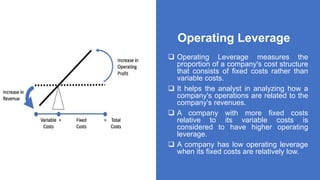
 Operating Leverage measures the
proportion of a company's cost structure
that consists of fixed costs rather than
variable costs.
 It helps the analyst in analyzing how a
company's operations are related to the
company's revenues.
 A company with more fixed costs
relative to its variable costs is
considered to have higher operating
leverage.
 A company has low operating leverage
when its fixed costs are relatively low.
Degree of Operating
Leverage (DOL)
The degree of operating
leverage measures how
much a company's
operating income changes
in response to a change in
sales.
Financial leverage is the use of
borrowed money (debt) for funding
the acquisition of assets with the
expectation that the income or
capital gain from the new asset will
exceed the cost of borrowing.
Financial Leverage
Degree of Financial
Leverage (DOL)
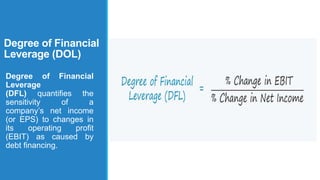
Degree of Financial
Leverage
(DFL) quantifies the
sensitivity of a
company’s net income
(or EPS) to changes in
its operating profit
(EBIT) as caused by
debt financing.
How Operating and Financial Leverage Is
Connected with EBIT and EPS
Operating leverage is determined by the relationship between the firm’s
sales revenues and its earnings before interest and taxes (EBIT). EBIT is
also called as Operating Profit.
Financial leverage represents the relationship between the firm’s earnings
before interest and taxes (EBIT) and the earnings available for ordinary
shareholders (EPS).
Thus EBIT is used as the pivotal point in defining operating and financial
leverage.
Operating Leverage Financial Leverage
Operating leverage is concerned with investment
activities of a firm.
Financial leverage is concerned with financing
activities of a firm.
It is the firm’s ability to use fixed operating costs to
magnify the effects of changes in sales on its EBIT.
It is the firm’s ability to use fixed financial charges to
magnify the effects of changes in EBIT on its EPS.
It establishes relationship between EBIT & Sales It establishes relationship between EBIT & EPS.
It is determined by cost structure of the firm. It is determined by the capital structure of the firm.
The higher the proportion of fixed operating costs in
the cost structure of a firm, the higher is the degree
of operating leverage.
The higher the proportion of fixed charges bearing
capital to total financial charges in the capital
structure of a firm, the higher is the degree of
financial leverage.
Degree of operating leverage measures the business
risk associated with the firm.
Degree of financial leverage measures the degree of
financial risk, associated with the firm.
Difference Between Operating Leverage & Financial Leverage

Operating & Financial Leverage

  • 1.
    Operating Leverage  OperatingLeverage measures the proportion of a company's cost structure that consists of fixed costs rather than variable costs.  It helps the analyst in analyzing how a company's operations are related to the company's revenues.  A company with more fixed costs relative to its variable costs is considered to have higher operating leverage.  A company has low operating leverage when its fixed costs are relatively low.
  • 2.
    Degree of Operating Leverage(DOL) The degree of operating leverage measures how much a company's operating income changes in response to a change in sales.
  • 3.
    Financial leverage isthe use of borrowed money (debt) for funding the acquisition of assets with the expectation that the income or capital gain from the new asset will exceed the cost of borrowing. Financial Leverage
  • 4.
    Degree of Financial Leverage(DOL) Degree of Financial Leverage (DFL) quantifies the sensitivity of a company’s net income (or EPS) to changes in its operating profit (EBIT) as caused by debt financing.
  • 5.
    How Operating andFinancial Leverage Is Connected with EBIT and EPS Operating leverage is determined by the relationship between the firm’s sales revenues and its earnings before interest and taxes (EBIT). EBIT is also called as Operating Profit. Financial leverage represents the relationship between the firm’s earnings before interest and taxes (EBIT) and the earnings available for ordinary shareholders (EPS). Thus EBIT is used as the pivotal point in defining operating and financial leverage.
  • 6.
    Operating Leverage FinancialLeverage Operating leverage is concerned with investment activities of a firm. Financial leverage is concerned with financing activities of a firm. It is the firm’s ability to use fixed operating costs to magnify the effects of changes in sales on its EBIT. It is the firm’s ability to use fixed financial charges to magnify the effects of changes in EBIT on its EPS. It establishes relationship between EBIT & Sales It establishes relationship between EBIT & EPS. It is determined by cost structure of the firm. It is determined by the capital structure of the firm. The higher the proportion of fixed operating costs in the cost structure of a firm, the higher is the degree of operating leverage. The higher the proportion of fixed charges bearing capital to total financial charges in the capital structure of a firm, the higher is the degree of financial leverage. Degree of operating leverage measures the business risk associated with the firm. Degree of financial leverage measures the degree of financial risk, associated with the firm. Difference Between Operating Leverage & Financial Leverage