Dr Umme Habiba
 Leucocyte cytochemistry encompasses the techniques used to identify
diagnostically useful enzymes or other substances in the cytoplasm of
haemopoietic cells.
 These techniques are particularly useful for the characterisation of immature cells
in AML and the identification of maturation abnormalities in MDS and
myeloproliferative neoplasms (MPN).
1. To characterise the blast cells in acute leukaemia as myeloid (leading to a diagnosis of AML unless
there is also evidence of lymphoid differentiation)
2. To demonstrate myeloperoxidase or nonspecific esterase activity and thus contribute to a diagnosis
of mixed-phenotype acute leukaemia, according to the criteria of the WHO Classification of
Tumours of Haematopoietic and Lymphoid Tissues
3. To identify granulocytic and monocytic components in AML
4. To identify unusual lineages occasionally involved in clonal myeloid disorders (e.g. basophils and
mast cells)
5. To detect cytoplasmic abnormalities and enzyme deficiencies in myeloid disorders (e.g.
myeloperoxidase- deficient neutrophils in MDS or acute leukaemia, neutrophil alkaline
phosphatase-deficient neutrophils in chronic myelogenous leukaemia, CML)
6. To identify Auer rods in MDS (and thus classify a case as refractory anaemia with excess of blasts II
in the WHO classification)
7. To confirm a diagnosis of hairy cell leukaemia.
 Myeloperoxidase
 Sudan Black B
 Neutrophil alkaline phosphatase
 Acid phosphatase reaction, including tartrate-resistant acid phosphatase reaction
 Periodic acid–Schiff reaction
 Toluidine blue stain
 Esterases
 Naphthol AS-D chloroacetate esterase
 α-naphthyl butyrate esterase
 α-naphthyl acetate esterase
 Sudan Black B (SBB) is a lipophilic dye that binds irreversibly to an undefined
granule component in granulocytes, eosinophils and some monocytes.
 It cannot be extracted from the stained granules by organic dye solvents and gives
comparable information to that of MPO staining.
 Fixative. Vapour from 40% formaldehyde solution
 Stain. SBB (Sigma S-2380) 0.3 g in 100 ml absolute ethanol
 Phenol buffer. Dissolve 16 g crystalline phenol in 30 ml absolute ethanol. Add to
100 ml distilled water in which 0.3 g Na2HPO4.12H2O has been dissolved
 Working stain solution. Add 40 ml buffer to 60 ml SBB solution
 Counterstain. May–Grünwald–Giemsa or Leishman stain
1. Fix air-dried smears in formalin vapour as follows. Place a small square of filter
paper in the bottom of a Coplin jar. Add 2 drops of 40% formalin, put on the lid
and leave for 15 min to allow vaporisation. Place the slides in the Coplin jar and
replace the lid. After 5–10 min, remove the slides and stand on end for 15 min to
‘air wash’.
2. Immerse the slides in the working stain solution for 1 h in a Coplin jar with a
lid on.
3. Transfer slides to a staining rack and immediately flood with 70% alcohol. After
30 s, tip the 70% alcohol off and flood again for 30 s. Repeat three times in total.
4. Rinse in gently running tap water and air dry.
5. Counterstain without further fixation with Leishman stain or May–Grünwald–
Giemsa.
 Buffered formal acetone fixation for 30 s is a satisfactory alternative to formalin
vapour.
 The working stain solution should be replaced after 4 weeks.
 Bone marrow films with fatty particles containing lipid-soluble SBB benefit from a
5 s swirl in xylene followed by rinsing in running tap water and air drying prior to
counterstaining.
 The Romanowsky counterstain gives excellent cytological detail of all cells
present.
 The reaction product is black and granular. The results are essentially similar to
those seen with MPO staining, both in normal and leukaemic cells
 MPO-negative neutrophils are also SBB negative. The only notable difference is in
eosinophil granules, which have a clear core when stained with SBB.
 Rare cases (1% to 2%) of acute lymphoblastic leukaemia (ALL) show nongranular
smudgy positivity not seen with MPO staining.
 Basophils are generally not positive but may show bright red/purple
metachromatic staining of the granules.
 IRON STAINING (PERL STAIN)
 Prussian blue (Perls’) reaction is a method for staining non-haem iron in
normoblasts (siderocytes), macrophages (haemosiderin), and other cells containing
particulate iron. The granules are formed of a water-insoluble complex of ferric
iron, lipid, protein and carbohydrate. The method allows assessment of both the
amount of iron in reticulo-endothelial stores and availability of iron to developing
erythroblasts.
 The granules (containing ferric iron) react with pottassium ferrocyanide
[K4Fe(CN)6] to form a blue compound ferriferrocynanide), Prussian blue reaction.
 2% Potassium Ferrocyanide ((K4Fe(CN)6.3H2O)
 2 N HCl
 1% aqueous safranin (counterstain)
 Air dried peripheral blood or bone marrow smear
1. Choose a suitable sample as a positive control and the stain together with a test
sample. Label the slides as control and patient name / registration number (R/N)
accordingly.
2. Fix the slides in absolute methanol for 10-20 minutes. Leave it to dry.
3. Prepare the working solution by adding 30 mL potassium ferrocyanide and 30 mL
HCl in a Coplin jar (v/v potassium ferrocyanide:HCl = 1:1).
4. Submerge the fixed and dried slides into the Coplin jar containing the working
solution.
5. Leave it at room temperature or incubate in a water bath at 50°C for 20 minutes.
6. Wash the slides in running tap water for 3-5 minutes.
7. Rinse thoroughly in distilled water, and then counterstain with safranin similar to
steps 4 – 6.
8. Airdry the slides.
 0 No stainable iron
 1+ Small iron particles just visible in reticulum cells using an oil objective
 2+ Small, sparse iron particles in reticulum cells, visible at lower power
 3+ Numerous small particles in reticulum cells
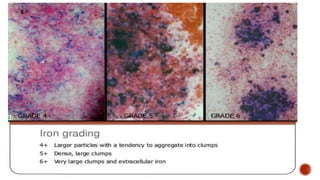
 4+ Larger particles with a tendency to aggregate into clumps
 5+ Dense, large clumps
 6+ Very large clumps and extracellular iron
Leucocyte Cytochemistry

Leucocyte Cytochemistry

  • 1.
  • 2.
     Leucocyte cytochemistryencompasses the techniques used to identify diagnostically useful enzymes or other substances in the cytoplasm of haemopoietic cells.  These techniques are particularly useful for the characterisation of immature cells in AML and the identification of maturation abnormalities in MDS and myeloproliferative neoplasms (MPN).
  • 3.
    1. To characterisethe blast cells in acute leukaemia as myeloid (leading to a diagnosis of AML unless there is also evidence of lymphoid differentiation) 2. To demonstrate myeloperoxidase or nonspecific esterase activity and thus contribute to a diagnosis of mixed-phenotype acute leukaemia, according to the criteria of the WHO Classification of Tumours of Haematopoietic and Lymphoid Tissues 3. To identify granulocytic and monocytic components in AML 4. To identify unusual lineages occasionally involved in clonal myeloid disorders (e.g. basophils and mast cells) 5. To detect cytoplasmic abnormalities and enzyme deficiencies in myeloid disorders (e.g. myeloperoxidase- deficient neutrophils in MDS or acute leukaemia, neutrophil alkaline phosphatase-deficient neutrophils in chronic myelogenous leukaemia, CML) 6. To identify Auer rods in MDS (and thus classify a case as refractory anaemia with excess of blasts II in the WHO classification) 7. To confirm a diagnosis of hairy cell leukaemia.
  • 4.
     Myeloperoxidase  SudanBlack B  Neutrophil alkaline phosphatase  Acid phosphatase reaction, including tartrate-resistant acid phosphatase reaction  Periodic acid–Schiff reaction  Toluidine blue stain  Esterases  Naphthol AS-D chloroacetate esterase  α-naphthyl butyrate esterase  α-naphthyl acetate esterase
  • 5.
     Sudan BlackB (SBB) is a lipophilic dye that binds irreversibly to an undefined granule component in granulocytes, eosinophils and some monocytes.  It cannot be extracted from the stained granules by organic dye solvents and gives comparable information to that of MPO staining.
  • 6.
     Fixative. Vapourfrom 40% formaldehyde solution  Stain. SBB (Sigma S-2380) 0.3 g in 100 ml absolute ethanol  Phenol buffer. Dissolve 16 g crystalline phenol in 30 ml absolute ethanol. Add to 100 ml distilled water in which 0.3 g Na2HPO4.12H2O has been dissolved  Working stain solution. Add 40 ml buffer to 60 ml SBB solution  Counterstain. May–Grünwald–Giemsa or Leishman stain
  • 7.
    1. Fix air-driedsmears in formalin vapour as follows. Place a small square of filter paper in the bottom of a Coplin jar. Add 2 drops of 40% formalin, put on the lid and leave for 15 min to allow vaporisation. Place the slides in the Coplin jar and replace the lid. After 5–10 min, remove the slides and stand on end for 15 min to ‘air wash’. 2. Immerse the slides in the working stain solution for 1 h in a Coplin jar with a lid on. 3. Transfer slides to a staining rack and immediately flood with 70% alcohol. After 30 s, tip the 70% alcohol off and flood again for 30 s. Repeat three times in total. 4. Rinse in gently running tap water and air dry. 5. Counterstain without further fixation with Leishman stain or May–Grünwald– Giemsa.
  • 8.
     Buffered formalacetone fixation for 30 s is a satisfactory alternative to formalin vapour.  The working stain solution should be replaced after 4 weeks.  Bone marrow films with fatty particles containing lipid-soluble SBB benefit from a 5 s swirl in xylene followed by rinsing in running tap water and air drying prior to counterstaining.  The Romanowsky counterstain gives excellent cytological detail of all cells present.
  • 11.
     The reactionproduct is black and granular. The results are essentially similar to those seen with MPO staining, both in normal and leukaemic cells  MPO-negative neutrophils are also SBB negative. The only notable difference is in eosinophil granules, which have a clear core when stained with SBB.  Rare cases (1% to 2%) of acute lymphoblastic leukaemia (ALL) show nongranular smudgy positivity not seen with MPO staining.  Basophils are generally not positive but may show bright red/purple metachromatic staining of the granules.
  • 13.
     IRON STAINING(PERL STAIN)
  • 14.
     Prussian blue(Perls’) reaction is a method for staining non-haem iron in normoblasts (siderocytes), macrophages (haemosiderin), and other cells containing particulate iron. The granules are formed of a water-insoluble complex of ferric iron, lipid, protein and carbohydrate. The method allows assessment of both the amount of iron in reticulo-endothelial stores and availability of iron to developing erythroblasts.
  • 15.
     The granules(containing ferric iron) react with pottassium ferrocyanide [K4Fe(CN)6] to form a blue compound ferriferrocynanide), Prussian blue reaction.
  • 16.
     2% PotassiumFerrocyanide ((K4Fe(CN)6.3H2O)  2 N HCl  1% aqueous safranin (counterstain)  Air dried peripheral blood or bone marrow smear
  • 17.
    1. Choose asuitable sample as a positive control and the stain together with a test sample. Label the slides as control and patient name / registration number (R/N) accordingly. 2. Fix the slides in absolute methanol for 10-20 minutes. Leave it to dry. 3. Prepare the working solution by adding 30 mL potassium ferrocyanide and 30 mL HCl in a Coplin jar (v/v potassium ferrocyanide:HCl = 1:1). 4. Submerge the fixed and dried slides into the Coplin jar containing the working solution. 5. Leave it at room temperature or incubate in a water bath at 50°C for 20 minutes. 6. Wash the slides in running tap water for 3-5 minutes. 7. Rinse thoroughly in distilled water, and then counterstain with safranin similar to steps 4 – 6. 8. Airdry the slides.
  • 19.
     0 Nostainable iron  1+ Small iron particles just visible in reticulum cells using an oil objective  2+ Small, sparse iron particles in reticulum cells, visible at lower power  3+ Numerous small particles in reticulum cells  4+ Larger particles with a tendency to aggregate into clumps  5+ Dense, large clumps  6+ Very large clumps and extracellular iron