LESSON PLAN
• Submitted by,
• PAVITHRA N,
• PINKI,
• Dept. of HDFS.
HECM 510 EDUCATIOAL TECHNOLOGY 24/11/2018
Answer the 4 questions. Discuss your answers
with your peer. Report to the group
24/11/2018HECM 510 EDUCATIOAL TECHNOLOGY
• Why is lesson planning important?
• How is lesson planning important for
the teacher? For the learners?
• What do you take into account when
you design a lesson plan?
• What constant components are
there in your lesson plan?
Why is lesson planning
important?
24/11/2018HECM 510 EDUCATIOAL TECHNOLOGY
• Being clear on what you want to teach.
• Being ready to cope with whatever
happens.
• Give your teaching a framework, an
overall shape.
• A reminder for the teacher when they get
distracted.
• It suggests a level of professionalism and
real commitment.
How is lesson planning important for the
teacher and the learners?
• For the teacher
They don’t have to think
on their feet.
They don’t lose face in
front of their learners.
They are clear on the
procedure to follow.
They build on previous
teaching and prepare
for coming lessons
• For the learner
They realize that the
teacher cares for their
learning.
They attend a structured
lesson: easier to
assimilate
They appreciate their
teacher’s work as a
model of well-organized
work to imitate.
HECM 510 EDUCATIOAL TECHNOLOGY 24/11/2018
What do you take into account when you
design a lesson plan?
HECM 510 EDUCATIOAL TECHNOLOGY 24/11/2018
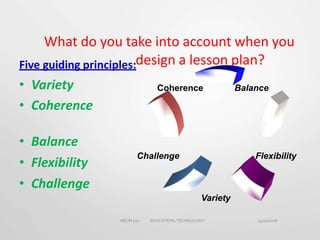
Five guiding principles:
• Variety
• Coherence
• Balance
• Flexibility
• Challenge
Flexibility
Variety
Challenge
Coherence Balance
Variety
24/11/2018HECM 510 EDUCATIOAL TECHNOLOGY
Why vary?
• a- to meet different learning styles: theorist –
Activist – Pragmatic – Reflector
• b- to consider different intelligence types.
• c- to keep them interested and avoid monotony.
What to vary?
• Contents – Activities – Interaction modes – Materials
– Aids …
How to vary?
• VAK Approach
Ways of Varying these
diffe rent components
24/11/2018HECM 510 EDUCATIOAL TECHNOLOGY
 Tempo/Pace : Activities may be brisk and fast-
moving, such as guessing games; or slow and
reflective, such as reading or responding in writing.
 Organization : The learners may work on their own
at individualized tasks, or in pairs or groups, or as a
full class in interaction with the teacher.
 Mode and Skill : Activities may be based on the
written or the spoken language; and within these,
they may vary as to whether the learners are asked to
produce (speak/ write) or receive (listen / read ).


Difficulty : Activities may be seen as easy and non demanding;
or difficult , requiring concentration and effort.
Mood : Activities vary also in mood: light and fun -based versus
serious and profound; happy versus sad; tense versus relaxed.
 Stir - Settle : Some activities enliven and excite learners ( such
as controversial discussions for advanced levels), or activities
which involve physical movement (such as the race dictation)
for the lower levels. Others, like dictation, have the effect of
calming them down
 Active - Passive : Learners may be activated in a way that
encourages their own initiative ; or they may only be required
to do as they are told
24/11/2018HECM 510 EDUCATIOAL TECHNOLOGY
Coherence
24/11/2018HECM 510 EDUCATIOAL TECHNOLOGY
• Observe a logical pattern to the lesson: there
has to be connection between the different
activities in the lesson.
• Smooth transition is one of the pillars that
ensures success of the lesson plan during
implementation in the classroom.
• An activity in a lesson builds on a previous one
and prepares for the next.
Challenge
24/11/2018HECM 510 EDUCATIOAL TECHNOLOGY
Learners are intelligent human beings and come
to class with knowledge previously acquired.
The new lesson should add to that knowledge
without excess.
The lesson that does not challenge is a lesson
that does not motivate.
No learning happens if the lesson doesn’t
present new items beyond students’ prior
knowledge.
Flexibility
24/11/2018HECM 510 EDUCATIOAL TECHNOLOGY
• Two dimensions:
a.ability to use a number of different
techniques and not be a slave to one
methodology – Principled eclecticism.
b.ability to change the plan if it shows
inappropriacy to the classroom real
situation for one reason or the other.
Balance
24/11/2018HECM 510 EDUCATIOAL TECHNOLOGY
The lesson is a mixture of a number of
ingredients: techniques, activities,
contents …. The successful teacher is the
one who is able to observe the right
dosage and makes the learners enjoy a
savoury lesson.
What do you take into account when
you design a lesson plan?
24/11/2018HECM 510 EDUCATIOAL TECHNOLOGY
• Objectives set out to be achieved.
• Prior knowledge of learners.
• Materials and didactic auxiliaries to be
used.
• Tasks and activities to select and
stts’grouping patterns.
• Interaction modes.
• Timing and time management
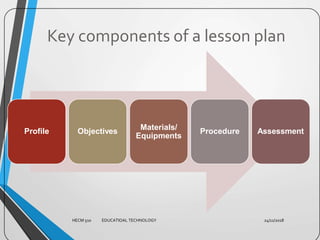
Key components of a lesson plan
24/11/2018HECM 510 EDUCATIOAL TECHNOLOGY
Profile Objectives Materials/
Equipments
Procedure Assessment
Key components of a lesson plan
24/11/2018HECM 510 EDUCATIOAL TECHNOLOGY
Profile
Objectives
Materials/
Equipment
s
Procedure
Assessmen
t
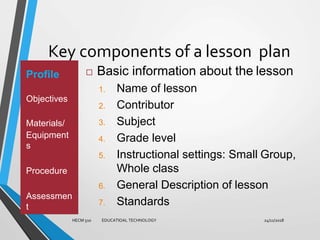
 Basic information about the lesson
1. Name of lesson
2. Contributor
3. Subject
4. Grade level
5. Instructional settings: Small Group,
Whole class
6. General Description of lesson
7. Standards
Key components of a lesson plan
24/11/2018HECM 510 EDUCATIOAL TECHNOLOGY
Profile
Objective s
Materials/
Equipments
Procedure
Assessment
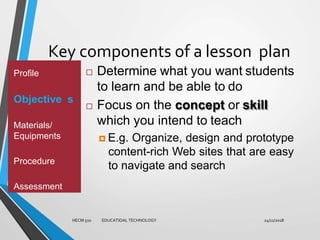
 Determine what you want students
to learn and be able to do
 Focus on the concept or skill
which you intend to teach
 E.g. Organize, design and prototype
content-rich Web sites that are easy
to navigate and search
Key components of a lesson plan
24/11/2018HECM 510 EDUCATIOAL TECHNOLOGY
Profile
Objectives
Materials/
Equipments
Procedure
Assessment
 Materials
 Power Point presentations (visual
aids)
 Text Books
 JournalArticles
 Multimedia materials: Instructional
video or audio
 Job-aid
 Rubric
 Checklist
Modified from sources: Designing Instructional Materials
Key components of a lesson plan
24/11/2018HECM 510 EDUCATIOAL TECHNOLOGY
Profile
Objectives
Materials/
Equipmen
ts
Procedure
Assessment
 Commonly used instructional
equipments
 Software applications
 PowerPoint
 Media Player
 Computer equipment
 Computer
 Internet connection
 Video equipment
 Projector
Modified from sources: Designing Instructional Materials
Key components of a lesson plan
24/11/2018HECM 510 EDUCATIOAL TECHNOLOGY
Profile
Objectives
Materials/
Equipments
Procedur
e
Assessment
 Outlining the STEPS of the teaching
process
 Useful Instructional Strategies
 Using the Appropriate Technique in
Your Lesson Plan
Key components of a lesson plan
24/11/2018HECM 510 EDUCATIOAL TECHNOLOGY
Profile
Objectives
Materials/
Equipments
Procedure
Assessme
nt
 Assess the outcome and to what
extent the objectives were achieved
 Ensure the assessment activity is
directly and explicitly tied to the
stated objectives.
 Take time to reflect upon the
result, and revise the lesson plan
accordingly
Key components of a lesson plan
24/11/2018HECM 510 EDUCATIOAL TECHNOLOGY
Profile
Objectives
Materials/
Equipments
Procedure
Assessme
nt
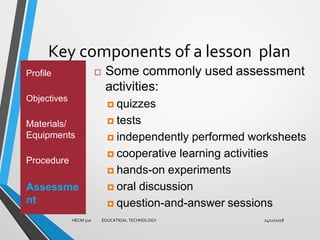
 Some commonly used assessment
activities:
 quizzes
 tests
 independently performed worksheets
 cooperative learning activities
 hands-on experiments
 oral discussion
 question-and-answer sessions
Gagne’s Nine Events of Instruction
Madeline Hunter's Seven Step Lesson
Plan Model
 The 5E’s Model
Check handouts for
detailed information
24/11/2018HECM 510 EDUCATIOAL TECHNOLOGY
Types of Lesson plan
24/11/2018HECM 510 EDUCATIOAL TECHNOLOGY
 There are several types of Lesson
plan the following:
 Detailed lesson plan
 Semi-detailed lesson plan
 Understanding by Design (UbD)
Detailed Lesson plan
•  It provides mastery of what to teach, and gives the teacher
the confidence whenteaching. In this plan, both teacher’s and
students’ activities are presented.
24/11/2018HECM 510 EDUCATIOAL TECHNOLOGY
Semi-detailed Lesson Plan
24/11/2018HECM 510 EDUCATIOAL TECHNOLOGY
 A semi-detailed lesson plan is less intricate
than the detailed lesson plan. It is having a
general game plan of what you wanted to
cover for that subject on that particular day.
Understanding by Design (UbD)•  It is a framework for improving student achievement
through standards-driven curriculum development,
instructional design, assessment and professional
development (Wiggins & McTighe,2006)
•  The emphasis of UbD is on "backward design", the
practice of looking at the outcomes in order to design
curriculum units, performance assessments, and
classroom instruction
24/11/2018HECM 510 EDUCATIOAL TECHNOLOGY
Suggested format of a lesson
plan
24/11/2018HECM 510 EDUCATIOAL TECHNOLOGY
 Goals: A unifying theme, an overall general purpose to
accomplish by the end of the lesson period.
 e.g. Students will increase their familiarity with the
conventions of telephone conversations
 Objectives : Explicitly state what you want students to gain
from the lesson.
What students will do:
a. Be sure you know what it is you want to accomplish
b. Preserve the unity of your lesson
c. Predetermine whether or not you are trying to accomplish
too much
d. Evaluate students' success at the end of, or after,
Reference
 Omrod, J.E. (2008) Human Learning (5th edition). Upper Saddle River, NJ:
Pearson Education, Inc.
 Madeline Hunter. (Year). Components of a Lesson Plan. Retrieved June
5, 2010 from:
http://www.uofaweb.ualberta.ca/fieldexperiences//pdfs/lessonplandirect.pdf
 Lewis, Beth (2010). Top 8 Components of a Well-Written Lesson Plan.
Retrieved June 5, 2010 from:
http://k6educators.about.com/od/lessonplanheadquarters/tp/8_steps_lp.htm
 CLRN. (2002). Lesson Plan Builder Worksheet. Retrieved June 5, 2010
from: http://www.lessonplanbuilder.org/lessons/help.cfm
 BCIT. (2003). Preparing Lesson Plan. BCIT Learning and Teaching Centre.
Retrieved July 9, 2010 from:
http://www.bcit.ca/files/idc/pdf/htlessonplans.pdf
 Gagne, R.M., Wager, W. W., Golas, K. C., & Kelle, J. M. (2005). Principle
of Instructional Design (5th Edition). Belmont, CA: Thomson Learning, Inc.
 Teachnology (2010) What to Consider When Writing a Lesson Plan.
Retrieved July 5, 2010 from: http://www.teach-
nology.com/tutorials/teaching/lesson_plan/
 Lemov, Doug (2010). Teach Like a Champion. Jossey-
Bass
 Wong, Harry (1998). The First Days of School. Harry K.
Wong Publications
 NYS Common Core Mathematics Curriculum (2013).
http://www.engageny.org/sites/default/files/resource/atta
chments/math-g3-m6-full-module.pdf
 Newman, Richard (2013). Teaching and Learning in the
21st Century: Connecting the Dots. Bridgepoint
Education, Inc.
24/11/2018HECM 510 EDUCATIOAL TECHNOLOGY

Lesson plan

  • 1.
    LESSON PLAN • Submittedby, • PAVITHRA N, • PINKI, • Dept. of HDFS. HECM 510 EDUCATIOAL TECHNOLOGY 24/11/2018
  • 2.
    Answer the 4questions. Discuss your answers with your peer. Report to the group 24/11/2018HECM 510 EDUCATIOAL TECHNOLOGY • Why is lesson planning important? • How is lesson planning important for the teacher? For the learners? • What do you take into account when you design a lesson plan? • What constant components are there in your lesson plan?
  • 3.
    Why is lessonplanning important? 24/11/2018HECM 510 EDUCATIOAL TECHNOLOGY • Being clear on what you want to teach. • Being ready to cope with whatever happens. • Give your teaching a framework, an overall shape. • A reminder for the teacher when they get distracted. • It suggests a level of professionalism and real commitment.
  • 4.
    How is lessonplanning important for the teacher and the learners? • For the teacher They don’t have to think on their feet. They don’t lose face in front of their learners. They are clear on the procedure to follow. They build on previous teaching and prepare for coming lessons • For the learner They realize that the teacher cares for their learning. They attend a structured lesson: easier to assimilate They appreciate their teacher’s work as a model of well-organized work to imitate. HECM 510 EDUCATIOAL TECHNOLOGY 24/11/2018
  • 5.
    What do youtake into account when you design a lesson plan? HECM 510 EDUCATIOAL TECHNOLOGY 24/11/2018 Five guiding principles: • Variety • Coherence • Balance • Flexibility • Challenge Flexibility Variety Challenge Coherence Balance
  • 6.
    Variety 24/11/2018HECM 510 EDUCATIOALTECHNOLOGY Why vary? • a- to meet different learning styles: theorist – Activist – Pragmatic – Reflector • b- to consider different intelligence types. • c- to keep them interested and avoid monotony. What to vary? • Contents – Activities – Interaction modes – Materials – Aids … How to vary? • VAK Approach
  • 7.
    Ways of Varyingthese diffe rent components 24/11/2018HECM 510 EDUCATIOAL TECHNOLOGY  Tempo/Pace : Activities may be brisk and fast- moving, such as guessing games; or slow and reflective, such as reading or responding in writing.  Organization : The learners may work on their own at individualized tasks, or in pairs or groups, or as a full class in interaction with the teacher.  Mode and Skill : Activities may be based on the written or the spoken language; and within these, they may vary as to whether the learners are asked to produce (speak/ write) or receive (listen / read ).
  • 8.
      Difficulty : Activitiesmay be seen as easy and non demanding; or difficult , requiring concentration and effort. Mood : Activities vary also in mood: light and fun -based versus serious and profound; happy versus sad; tense versus relaxed.  Stir - Settle : Some activities enliven and excite learners ( such as controversial discussions for advanced levels), or activities which involve physical movement (such as the race dictation) for the lower levels. Others, like dictation, have the effect of calming them down  Active - Passive : Learners may be activated in a way that encourages their own initiative ; or they may only be required to do as they are told 24/11/2018HECM 510 EDUCATIOAL TECHNOLOGY
  • 9.
    Coherence 24/11/2018HECM 510 EDUCATIOALTECHNOLOGY • Observe a logical pattern to the lesson: there has to be connection between the different activities in the lesson. • Smooth transition is one of the pillars that ensures success of the lesson plan during implementation in the classroom. • An activity in a lesson builds on a previous one and prepares for the next.
  • 10.
    Challenge 24/11/2018HECM 510 EDUCATIOALTECHNOLOGY Learners are intelligent human beings and come to class with knowledge previously acquired. The new lesson should add to that knowledge without excess. The lesson that does not challenge is a lesson that does not motivate. No learning happens if the lesson doesn’t present new items beyond students’ prior knowledge.
  • 11.
    Flexibility 24/11/2018HECM 510 EDUCATIOALTECHNOLOGY • Two dimensions: a.ability to use a number of different techniques and not be a slave to one methodology – Principled eclecticism. b.ability to change the plan if it shows inappropriacy to the classroom real situation for one reason or the other.
  • 12.
    Balance 24/11/2018HECM 510 EDUCATIOALTECHNOLOGY The lesson is a mixture of a number of ingredients: techniques, activities, contents …. The successful teacher is the one who is able to observe the right dosage and makes the learners enjoy a savoury lesson.
  • 13.
    What do youtake into account when you design a lesson plan? 24/11/2018HECM 510 EDUCATIOAL TECHNOLOGY • Objectives set out to be achieved. • Prior knowledge of learners. • Materials and didactic auxiliaries to be used. • Tasks and activities to select and stts’grouping patterns. • Interaction modes. • Timing and time management
  • 14.
    Key components ofa lesson plan 24/11/2018HECM 510 EDUCATIOAL TECHNOLOGY Profile Objectives Materials/ Equipments Procedure Assessment
  • 15.
    Key components ofa lesson plan 24/11/2018HECM 510 EDUCATIOAL TECHNOLOGY Profile Objectives Materials/ Equipment s Procedure Assessmen t  Basic information about the lesson 1. Name of lesson 2. Contributor 3. Subject 4. Grade level 5. Instructional settings: Small Group, Whole class 6. General Description of lesson 7. Standards
  • 16.
    Key components ofa lesson plan 24/11/2018HECM 510 EDUCATIOAL TECHNOLOGY Profile Objective s Materials/ Equipments Procedure Assessment  Determine what you want students to learn and be able to do  Focus on the concept or skill which you intend to teach  E.g. Organize, design and prototype content-rich Web sites that are easy to navigate and search
  • 17.
    Key components ofa lesson plan 24/11/2018HECM 510 EDUCATIOAL TECHNOLOGY Profile Objectives Materials/ Equipments Procedure Assessment  Materials  Power Point presentations (visual aids)  Text Books  JournalArticles  Multimedia materials: Instructional video or audio  Job-aid  Rubric  Checklist Modified from sources: Designing Instructional Materials
  • 18.
    Key components ofa lesson plan 24/11/2018HECM 510 EDUCATIOAL TECHNOLOGY Profile Objectives Materials/ Equipmen ts Procedure Assessment  Commonly used instructional equipments  Software applications  PowerPoint  Media Player  Computer equipment  Computer  Internet connection  Video equipment  Projector Modified from sources: Designing Instructional Materials
  • 19.
    Key components ofa lesson plan 24/11/2018HECM 510 EDUCATIOAL TECHNOLOGY Profile Objectives Materials/ Equipments Procedur e Assessment  Outlining the STEPS of the teaching process  Useful Instructional Strategies  Using the Appropriate Technique in Your Lesson Plan
  • 20.
    Key components ofa lesson plan 24/11/2018HECM 510 EDUCATIOAL TECHNOLOGY Profile Objectives Materials/ Equipments Procedure Assessme nt  Assess the outcome and to what extent the objectives were achieved  Ensure the assessment activity is directly and explicitly tied to the stated objectives.  Take time to reflect upon the result, and revise the lesson plan accordingly
  • 21.
    Key components ofa lesson plan 24/11/2018HECM 510 EDUCATIOAL TECHNOLOGY Profile Objectives Materials/ Equipments Procedure Assessme nt  Some commonly used assessment activities:  quizzes  tests  independently performed worksheets  cooperative learning activities  hands-on experiments  oral discussion  question-and-answer sessions
  • 22.
    Gagne’s Nine Eventsof Instruction Madeline Hunter's Seven Step Lesson Plan Model  The 5E’s Model Check handouts for detailed information 24/11/2018HECM 510 EDUCATIOAL TECHNOLOGY
  • 23.
  • 24.
  • 25.
  • 26.
    Types of Lessonplan 24/11/2018HECM 510 EDUCATIOAL TECHNOLOGY  There are several types of Lesson plan the following:  Detailed lesson plan  Semi-detailed lesson plan  Understanding by Design (UbD)
  • 27.
    Detailed Lesson plan • It provides mastery of what to teach, and gives the teacher the confidence whenteaching. In this plan, both teacher’s and students’ activities are presented. 24/11/2018HECM 510 EDUCATIOAL TECHNOLOGY
  • 28.
    Semi-detailed Lesson Plan 24/11/2018HECM510 EDUCATIOAL TECHNOLOGY  A semi-detailed lesson plan is less intricate than the detailed lesson plan. It is having a general game plan of what you wanted to cover for that subject on that particular day.
  • 29.
    Understanding by Design(UbD)•  It is a framework for improving student achievement through standards-driven curriculum development, instructional design, assessment and professional development (Wiggins & McTighe,2006) •  The emphasis of UbD is on "backward design", the practice of looking at the outcomes in order to design curriculum units, performance assessments, and classroom instruction 24/11/2018HECM 510 EDUCATIOAL TECHNOLOGY
  • 30.
    Suggested format ofa lesson plan 24/11/2018HECM 510 EDUCATIOAL TECHNOLOGY  Goals: A unifying theme, an overall general purpose to accomplish by the end of the lesson period.  e.g. Students will increase their familiarity with the conventions of telephone conversations  Objectives : Explicitly state what you want students to gain from the lesson. What students will do: a. Be sure you know what it is you want to accomplish b. Preserve the unity of your lesson c. Predetermine whether or not you are trying to accomplish too much d. Evaluate students' success at the end of, or after,
  • 31.
    Reference  Omrod, J.E.(2008) Human Learning (5th edition). Upper Saddle River, NJ: Pearson Education, Inc.  Madeline Hunter. (Year). Components of a Lesson Plan. Retrieved June 5, 2010 from: http://www.uofaweb.ualberta.ca/fieldexperiences//pdfs/lessonplandirect.pdf  Lewis, Beth (2010). Top 8 Components of a Well-Written Lesson Plan. Retrieved June 5, 2010 from: http://k6educators.about.com/od/lessonplanheadquarters/tp/8_steps_lp.htm  CLRN. (2002). Lesson Plan Builder Worksheet. Retrieved June 5, 2010 from: http://www.lessonplanbuilder.org/lessons/help.cfm  BCIT. (2003). Preparing Lesson Plan. BCIT Learning and Teaching Centre. Retrieved July 9, 2010 from: http://www.bcit.ca/files/idc/pdf/htlessonplans.pdf  Gagne, R.M., Wager, W. W., Golas, K. C., & Kelle, J. M. (2005). Principle of Instructional Design (5th Edition). Belmont, CA: Thomson Learning, Inc.  Teachnology (2010) What to Consider When Writing a Lesson Plan. Retrieved July 5, 2010 from: http://www.teach- nology.com/tutorials/teaching/lesson_plan/
  • 32.
     Lemov, Doug(2010). Teach Like a Champion. Jossey- Bass  Wong, Harry (1998). The First Days of School. Harry K. Wong Publications  NYS Common Core Mathematics Curriculum (2013). http://www.engageny.org/sites/default/files/resource/atta chments/math-g3-m6-full-module.pdf  Newman, Richard (2013). Teaching and Learning in the 21st Century: Connecting the Dots. Bridgepoint Education, Inc.
  • 33.