Concept of developmental
programmes; types of projects;
development of research projects
Submitted by,
Pavithra N.,
Dept. of HDFS,
I.C. COHS
DEVLOPMENTAL PROGRAMMES
 Extension programs are created through a process called
program development. Program development is defined as a
deliberate process through which Extension engages
representatives of the public in planning, implementing and
evaluating plans of action for addressing needs and issues
they have helped to identify.
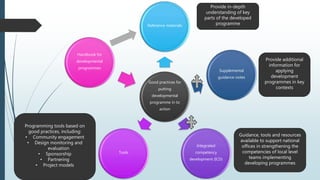
Good practices for
putting
developmental
programme in to
action
Reference materials
Supplemental
guidance notes
Integrated
competency
development (ICD)
Tools
Handbook for
developmental
programmes
Provide in-depth
understanding of key
parts of the developed
programme
Provide additional
information for
applying
development
programmes in key
contexts
Guidance, tools and resources
available to support national
offices in strengthening the
competencies of local level
teams implementing
developing programmes
Programming tools based on
good practices, including:
• Community engagement
• Design monitoring and
evaluation
• Sponsorship
• Partnering
• Project models
Developmental Programmes of Pre-
independence Era
 Sriniketan
 Marthandam
 Gurgaon experiment
 Gandhiyan constructive programme/ Sevagram
Developmental programmes after independence
 National health programmes
 Women empowerment programmes
 Rural development programmes
 Anti-poverty programmes
 Banking programmes and schemes
 Housing programmes
 Eradication of child labour programmes
 Employment generation programmes
 Child welfare programmes
 Agriculture development programmes
TOP 47 DEVELOPMENTAL PROGRAMMES
ADOPTED IN INDIA
 Pradhan Mantri Jan Dhan Yojana (PMJDY)
 Sukanya Samriddhi Yojana
 Pradhan Mantri Mudra Yojana (PMMY)
 Pradhan Mantri Suraksha Bima Yojana (PMSBY)
 Atal Pension Yojana (APY)
 Pradhan Mantri Awas Yojana (PMAY)
 Sansad Adarsh Gram Yojana (SAGY)
 Pradhan Mantri Fasal Bima Yojana (PMFBY)
 Pradhan Mantri Gram Sinchai Yojana (PMGSY)
 Pradhan Mantri Garib Kalyan Yojanaye (PMGKY)
 Pradhan Mantri Jan Aushadhi Yojana (PMJAY)
 Make in India
 Swachh Bharat Abhiyan
 Kisan Vikas Patra
 Soil Health Card Scheme
 Digital India
 Skill India
 Beti Bachao, Beti Padhao Yojana
 Mission Indradhanush
 Deen Dayal Upadhyaya Gram Jyoti Yojana (DDUGJY)
 Deen Dayal Upadhyaya Grameen Kaushalya Yojana (DDUGKY)
 Pandit Deendayal Upadhyay Shramev Jayate Yojana (PDUSJY)
 Atal Mission for Rejuvenation and Urban Transformation (AMRUT)
 Swadesh Darshan Yojana
 Pilgrimage Rejuvenation and Spiritual Augmentation Drive (PRASAD)
 National Heritage City Development and Augmentation Yojana (HRIDAY)
 Udaan Scheme
 National Bal Swachhta Mission
 One Rank One Pension (OROP) Scheme
 Smart City Mission
 Gold Monetisation Schemes
 Startup India, Standup India
 Digi Locker
 Shyama Prasad Mukherji Rurban Mission
 Sagarmala Project
 ‘Prakash Path’ – ‘Way to Light’ – The National LED Programme
 UJWAL Discom Assurance Yojana (UDAY)
 Vikalp Scheme
 National Sports Talent Search Scheme (NSTSS)
 Rashtriya Gokul Mission
 PAHAL-Direct Benefits Transfer for LPG (DBTL) Consumers Scheme
 The National Institution for Transforming India (NITI AAYOG)
 Pradhan Mantri Khanij Kshetra Kalyan Yojana (PMKKKY)
 Namami Gange Project
 Setu Bharatam Project
 Pradhan Mantri Ujjwala Yojana
 Rashtriya Gram Swaraj Abhiyan
Projects and its types
Project:
A project is temporary in that it has a defined
beginning and end in time, and therefore defined
scope and resources. And a project is unique in that it
is not a routine operation, but a specific set of
operations designed to accomplish a singular goal.
Types
 Construction projects produce artefacts.
 Research projects produce knowledge.
 Reengineering projects produce change.
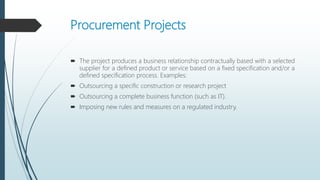
 Procurement projects produce business relationships.
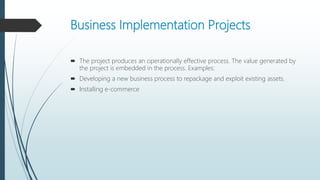
 Business implementation projects produce working processes.
Differences between project types
Where do we start?
How do we know when to stop?
When can (should) we evaluate the results?
Construction Projects
 The project produces an artefact. The value generated by the project is
embedded in the artefact. The artefact may be a complex system with human
and mechanical components. Examples:
 Warship
 Jubilee line extension
 Millennium dome
 Customer call center
 Method guidebook
 IT system
Research Projects
 The project produces knowledge. The knowledge may be formally represented
as models, patterns or patents. Or the knowledge may be embedded in a
working process or artefact. Examples:
 Business modelling
 Developing a model of the UK economy
 Developing a new species of wheat
 Developing novel approaches to project management.
 Military intelligence/ codebreaking.
 The analysis, testing, QA or evaluation portions of a larger project.
Reengineering Projects
 The project produces a desired change in some system or process. Examples:
 Taking sterling into the Euro
 Renumbering the UK telephone system
 Implementing PRINCE project management practices into a large organization.
 Designing and installing an Intranet.
Procurement Projects
 The project produces a business relationship contractually based with a selected
supplier for a defined product or service based on a fixed specification and/or a
defined specification process. Examples:
 Outsourcing a specific construction or research project
 Outsourcing a complete business function (such as IT).
 Imposing new rules and measures on a regulated industry.
Business Implementation Projects
 The project produces an operationally effective process. The value generated by
the project is embedded in the process. Examples:
 Developing a new business process to repackage and exploit existing assets.
 Installing e-commerce
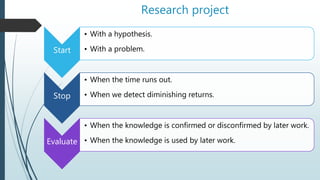
Research project
Start
• With a hypothesis.
• With a problem.
Stop
• When the time runs out.
• When we detect diminishing returns.
Evaluate
• When the knowledge is confirmed or disconfirmed by later work.
• When the knowledge is used by later work.
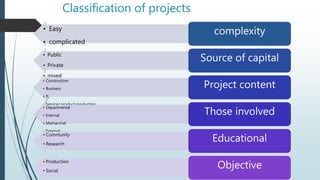
Classification of projects
• Easy
• complicated
complexity
• Public
• Private
• mixed
Source of capital
• Construction
• Business
• It
• Service/ product production
Project content
• Departmental
• Internal
• Matriarchal
• External
Those involved
• Community
• Research
Educational
• Production
• Social
Objective
DEVELOPMENT OF RESEARCH PROJECT
 A research project may also be an expansion on past work in
the field. Research projects can be used to develop further
knowledge on a topic, or in the example of a school research
project, they can be used to further a student's research
prowess to prepare them for future jobs or reports.
IMPORTANCE OF RESEARCH PROJECT
 A Tool for Building Knowledge and for Facilitating Learning
 Means to Understand Various Issues and Increase Public Awareness
 An Aid to Business Success
 A Way to Prove Lies and to Support Truths
 Means to Find, Gauge, and Seize Opportunities
 A Seed to Love Reading, Writing, Analyzing, and Sharing Valuable Information
 Nourishment and Exercise for the Mind
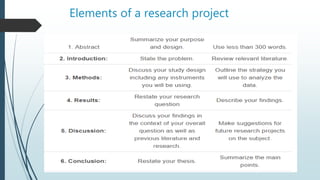
Elements of a research project
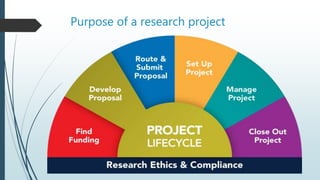
Purpose of a research project
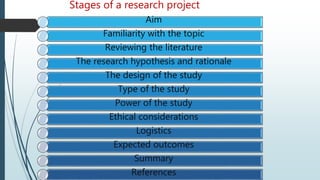
Stages of a research project
Aim
Familiarity with the topic
Reviewing the literature
The research hypothesis and rationale
The design of the study
Type of the study
Power of the study
Ethical considerations
Logistics
Expected outcomes
Summary
References

Developmental programmes and projects

  • 1.
    Concept of developmental programmes;types of projects; development of research projects Submitted by, Pavithra N., Dept. of HDFS, I.C. COHS
  • 2.
    DEVLOPMENTAL PROGRAMMES  Extensionprograms are created through a process called program development. Program development is defined as a deliberate process through which Extension engages representatives of the public in planning, implementing and evaluating plans of action for addressing needs and issues they have helped to identify.
  • 3.
    Good practices for putting developmental programmein to action Reference materials Supplemental guidance notes Integrated competency development (ICD) Tools Handbook for developmental programmes Provide in-depth understanding of key parts of the developed programme Provide additional information for applying development programmes in key contexts Guidance, tools and resources available to support national offices in strengthening the competencies of local level teams implementing developing programmes Programming tools based on good practices, including: • Community engagement • Design monitoring and evaluation • Sponsorship • Partnering • Project models
  • 5.
    Developmental Programmes ofPre- independence Era  Sriniketan  Marthandam  Gurgaon experiment  Gandhiyan constructive programme/ Sevagram
  • 6.
    Developmental programmes afterindependence  National health programmes  Women empowerment programmes  Rural development programmes  Anti-poverty programmes  Banking programmes and schemes  Housing programmes  Eradication of child labour programmes  Employment generation programmes  Child welfare programmes  Agriculture development programmes
  • 7.
    TOP 47 DEVELOPMENTALPROGRAMMES ADOPTED IN INDIA  Pradhan Mantri Jan Dhan Yojana (PMJDY)  Sukanya Samriddhi Yojana  Pradhan Mantri Mudra Yojana (PMMY)  Pradhan Mantri Suraksha Bima Yojana (PMSBY)  Atal Pension Yojana (APY)  Pradhan Mantri Awas Yojana (PMAY)  Sansad Adarsh Gram Yojana (SAGY)  Pradhan Mantri Fasal Bima Yojana (PMFBY)  Pradhan Mantri Gram Sinchai Yojana (PMGSY)  Pradhan Mantri Garib Kalyan Yojanaye (PMGKY)  Pradhan Mantri Jan Aushadhi Yojana (PMJAY)  Make in India  Swachh Bharat Abhiyan
  • 8.
     Kisan VikasPatra  Soil Health Card Scheme  Digital India  Skill India  Beti Bachao, Beti Padhao Yojana  Mission Indradhanush  Deen Dayal Upadhyaya Gram Jyoti Yojana (DDUGJY)  Deen Dayal Upadhyaya Grameen Kaushalya Yojana (DDUGKY)  Pandit Deendayal Upadhyay Shramev Jayate Yojana (PDUSJY)  Atal Mission for Rejuvenation and Urban Transformation (AMRUT)  Swadesh Darshan Yojana  Pilgrimage Rejuvenation and Spiritual Augmentation Drive (PRASAD)  National Heritage City Development and Augmentation Yojana (HRIDAY)  Udaan Scheme  National Bal Swachhta Mission
  • 9.
     One RankOne Pension (OROP) Scheme  Smart City Mission  Gold Monetisation Schemes  Startup India, Standup India  Digi Locker  Shyama Prasad Mukherji Rurban Mission  Sagarmala Project  ‘Prakash Path’ – ‘Way to Light’ – The National LED Programme  UJWAL Discom Assurance Yojana (UDAY)  Vikalp Scheme  National Sports Talent Search Scheme (NSTSS)  Rashtriya Gokul Mission  PAHAL-Direct Benefits Transfer for LPG (DBTL) Consumers Scheme  The National Institution for Transforming India (NITI AAYOG)  Pradhan Mantri Khanij Kshetra Kalyan Yojana (PMKKKY)
  • 10.
     Namami GangeProject  Setu Bharatam Project  Pradhan Mantri Ujjwala Yojana  Rashtriya Gram Swaraj Abhiyan
  • 11.
    Projects and itstypes Project: A project is temporary in that it has a defined beginning and end in time, and therefore defined scope and resources. And a project is unique in that it is not a routine operation, but a specific set of operations designed to accomplish a singular goal.
  • 12.
    Types  Construction projectsproduce artefacts.  Research projects produce knowledge.  Reengineering projects produce change.  Procurement projects produce business relationships.  Business implementation projects produce working processes.
  • 13.
    Differences between projecttypes Where do we start? How do we know when to stop? When can (should) we evaluate the results?
  • 14.
    Construction Projects  Theproject produces an artefact. The value generated by the project is embedded in the artefact. The artefact may be a complex system with human and mechanical components. Examples:  Warship  Jubilee line extension  Millennium dome  Customer call center  Method guidebook  IT system
  • 15.
    Research Projects  Theproject produces knowledge. The knowledge may be formally represented as models, patterns or patents. Or the knowledge may be embedded in a working process or artefact. Examples:  Business modelling  Developing a model of the UK economy  Developing a new species of wheat  Developing novel approaches to project management.  Military intelligence/ codebreaking.  The analysis, testing, QA or evaluation portions of a larger project.
  • 16.
    Reengineering Projects  Theproject produces a desired change in some system or process. Examples:  Taking sterling into the Euro  Renumbering the UK telephone system  Implementing PRINCE project management practices into a large organization.  Designing and installing an Intranet.
  • 17.
    Procurement Projects  Theproject produces a business relationship contractually based with a selected supplier for a defined product or service based on a fixed specification and/or a defined specification process. Examples:  Outsourcing a specific construction or research project  Outsourcing a complete business function (such as IT).  Imposing new rules and measures on a regulated industry.
  • 18.
    Business Implementation Projects The project produces an operationally effective process. The value generated by the project is embedded in the process. Examples:  Developing a new business process to repackage and exploit existing assets.  Installing e-commerce
  • 19.
    Research project Start • Witha hypothesis. • With a problem. Stop • When the time runs out. • When we detect diminishing returns. Evaluate • When the knowledge is confirmed or disconfirmed by later work. • When the knowledge is used by later work.
  • 20.
    Classification of projects •Easy • complicated complexity • Public • Private • mixed Source of capital • Construction • Business • It • Service/ product production Project content • Departmental • Internal • Matriarchal • External Those involved • Community • Research Educational • Production • Social Objective
  • 21.
    DEVELOPMENT OF RESEARCHPROJECT  A research project may also be an expansion on past work in the field. Research projects can be used to develop further knowledge on a topic, or in the example of a school research project, they can be used to further a student's research prowess to prepare them for future jobs or reports.
  • 22.
    IMPORTANCE OF RESEARCHPROJECT  A Tool for Building Knowledge and for Facilitating Learning  Means to Understand Various Issues and Increase Public Awareness  An Aid to Business Success  A Way to Prove Lies and to Support Truths  Means to Find, Gauge, and Seize Opportunities  A Seed to Love Reading, Writing, Analyzing, and Sharing Valuable Information  Nourishment and Exercise for the Mind
  • 23.
    Elements of aresearch project
  • 24.
    Purpose of aresearch project
  • 25.
    Stages of aresearch project Aim Familiarity with the topic Reviewing the literature The research hypothesis and rationale The design of the study Type of the study Power of the study Ethical considerations Logistics Expected outcomes Summary References