The Computer & Social Science Disciplines
The Computer Sciences The Social Sciences
Dr. L.T.M. Muungo, PhD
What is Sociology?
Introduction to
Sociology
Dr. L.T.M. Muungo
Theoretical Perspectives:
Functionalism
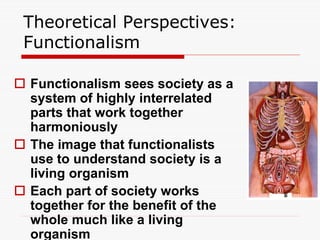
 Functionalism sees society as a
system of highly interrelated
parts that work together
harmoniously
 The image that functionalists
use to understand society is a
living organism
 Each part of society works
together for the benefit of the
whole much like a living
organism
Theoretical Perspectives:
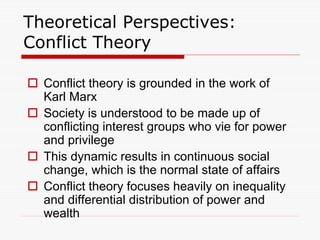
Conflict Theory
 Conflict theory is grounded in the work of
Karl Marx
 Society is understood to be made up of
conflicting interest groups who vie for power
and privilege
 This dynamic results in continuous social
change, which is the normal state of affairs
 Conflict theory focuses heavily on inequality
and differential distribution of power and
wealth
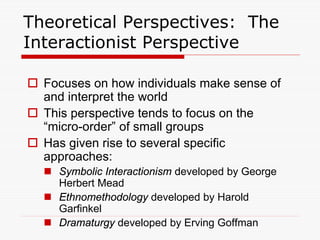
Theoretical Perspectives: The
Interactionist Perspective
 Focuses on how individuals make sense of
and interpret the world
 This perspective tends to focus on the
“micro-order” of small groups
 Has given rise to several specific
approaches:
 Symbolic Interactionism developed by George
Herbert Mead
 Ethnomethodology developed by Harold
Garfinkel
 Dramaturgy developed by Erving Goffman
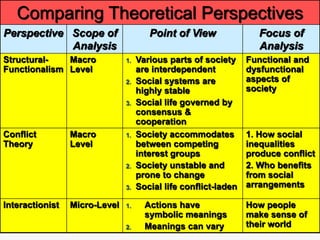
Comparing Theoretical Perspectives
Perspective Scope of
Analysis
Point of View Focus of
Analysis
Structural-
Functionalism
Macro
Level
1. Various parts of society
are interdependent
2. Social systems are
highly stable
3. Social life governed by
consensus &
cooperation
Functional and
dysfunctional
aspects of
society
Conflict
Theory
Macro
Level
1. Society accommodates
between competing
interest groups
2. Society unstable and
prone to change
3. Social life conflict-laden
1. How social
inequalities
produce conflict
2. Who benefits
from social
arrangements
Interactionist Micro-Level 1. Actions have
symbolic meanings
2. Meanings can vary
How people
make sense of
their world
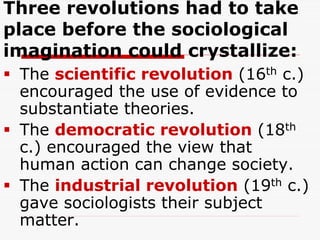
Three revolutions had to take
place before the sociological
imagination could crystallize:
 The scientific revolution (16th c.)
encouraged the use of evidence to
substantiate theories.
 The democratic revolution (18th
c.) encouraged the view that
human action can change society.
 The industrial revolution (19th c.)
gave sociologists their subject
matter.
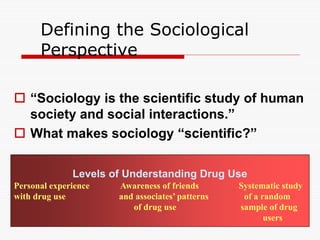
Personal experience Awareness of friends Systematic study
with drug use and associates’ patterns of a random
of drug use sample of drug
users
Defining the Sociological
Perspective
 “Sociology is the scientific study of human
society and social interactions.”
 What makes sociology “scientific?”
Levels of Understanding Drug Use
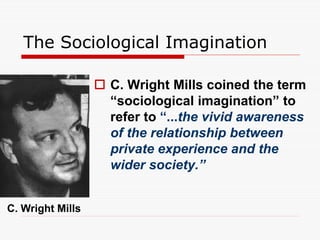
The Sociological Imagination
 C. Wright Mills coined the term
“sociological imagination” to
refer to “...the vivid awareness
of the relationship between
private experience and the
wider society.”
C. Wright Mills
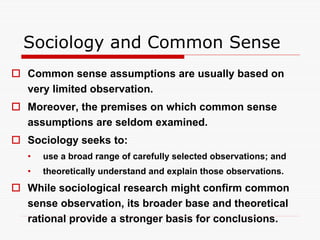
Sociology and Common Sense
 Common sense assumptions are usually based on
very limited observation.
 Moreover, the premises on which common sense
assumptions are seldom examined.
 Sociology seeks to:
• use a broad range of carefully selected observations; and
• theoretically understand and explain those observations.
 While sociological research might confirm common
sense observation, its broader base and theoretical
rational provide a stronger basis for conclusions.
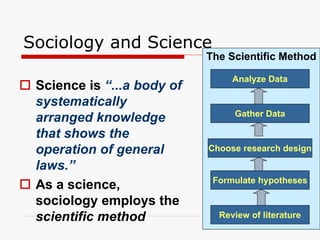
The Scientific Method
Sociology and Science
 Science is “...a body of
systematically
arranged knowledge
that shows the
operation of general
laws.”
 As a science,
sociology employs the
scientific method
Formulate hypotheses
Choose research design
Gather Data
Analyze Data
Review of literature
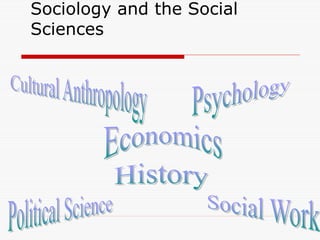
Sociology and the Social
Sciences
The Development of Sociology
 Sociology emerged as a separate
discipline in the nineteenth century
 This was a time of great social upheaval
due largely to the French and Industrial
Revolutions
 Several early sociologists shaped the
direction of the discipline
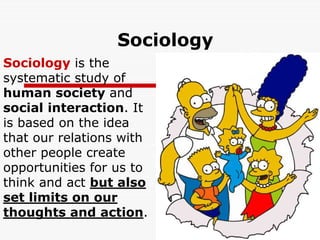
Sociology
Sociology is the
systematic study of
human society and
social interaction. It
is based on the idea
that our relations with
other people create
opportunities for us to
think and act but also
set limits on our
thoughts and action.
Introduction to Sociology: What is
Sociology?
15
What is Sociology?
Sociology is also the
study of reifications, or
social constructions.
Introduction to Sociology: What is
Sociology?
16
Sociology
Howard Becker defined
sociology as the study
of people “doing things
together.”
Introduction to Sociology: What is
Sociology?
17
Sociology
This reminds us that
society and the
individual are
inherently connected,
and each depends on
the other.
Introduction to Sociology: What is
Sociology?
18
Sociology
Sociologists study this
link: how society
affects the individual
and how the
individual affects
society.
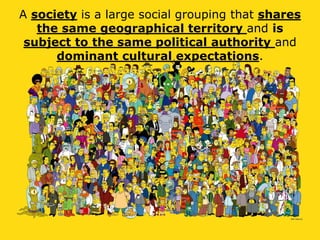
A society is a large social grouping that shares
the same geographical territory and is
subject to the same political authority and
dominant cultural expectations.
20
Society Is….
A society is a group of people who
share a culture and live more or less
together. They have a set of
institutions which provide what they
need to meet their physical, social,
and psychological needs and which
maintain order and the values of the
culture.
21
Social structures are the more or less
stable patterns of people’s interactions
and relationships.
22
Institutions are the principal social
structures that organize, direct, and
execute the essential tasks of
living.
23
Some institutions are:
Family,
Educational,
Economic,
Religion,
Law,
Political Systems
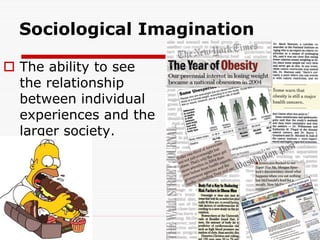
Sociological Imagination
 The ability to see
the relationship
between individual
experiences and the
larger society.
Introduction to Sociology: What is
Sociology?
25
Cool Insights from Sociology
Humans cannot be
understood apart from
social context (i.e.
society)
Introduction to Sociology: What is
Sociology?
26
Cool Insights from Sociology
Society makes us who
we are by structuring
out interactions and
laying out an orderly
world before us
Introduction to Sociology: What is
Sociology?
27
Cool Insights from Sociology
Society is a social
construction, that is an idea
created by humans (i.e. doesn’t
exist in the biological world but
only in the social world)
through social interaction
and given a reality through our
understanding of it and our
collective actions.
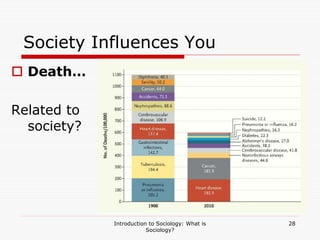
Society Influences You
 Death…
Related to
society?
Introduction to Sociology: What is
Sociology?
28
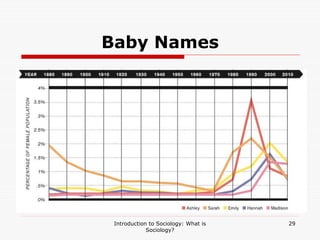
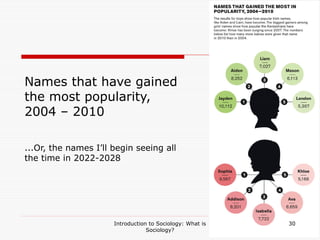
Baby Names
Introduction to Sociology: What is
Sociology?
29
Introduction to Sociology: What is
Sociology?
30
Names that have gained
the most popularity,
2004 – 2010
...Or, the names I’ll begin seeing all
the time in 2022-2028
Introduction to Sociology: What is
Sociology?
31
What Does Society Look
Like?
 While the idea of society is familiar,
describing it can be difficult.
Ultimately society is made up of
many different components, such
as culture, race, family, education,
social class, and people’s interactions.
 People who share a culture and
territory
Introduction to Sociology: What is
Sociology?
32
Meaning through Interaction
 People actively and collectively shape
their own lives, organizing their social
interactions and relationships into a
meaningful world.
 Sociologists study this social
behavior by seeking out its patterns.
 Patterns are crucial to our
understanding of society
Introduction to Sociology: What is
Sociology?
33
Society
Society is a group of people
who shape their lives in
aggregated and patterned
ways that distinguish
their group from other
groups.
Introduction to Sociology: What is
Sociology?
34
The Social Sciences
 Social Sciences are the disciplines
that use the scientific method to
examine the social world, in contrast
to the natural sciences, which
examine the physical world.
 Examples of social sciences include
….?
Introduction to Sociology: What is
Sociology?
35
How Sociology fits in
Introduction to Sociology: What is
Sociology?
36
Levels of Analysis
 We can study society from different levels:
 Microsociology is the level of analysis that
studies face-to-face and small-group
interactions in order to understand how
they affect the larger patterns and
institutions of society.
 Microsociology focuses on small-scale
issues.
 Ex: Symbolic Interactionism
Introduction to Sociology: What is
Sociology?
37
Levels of Analysis (cont)
 Macrosociology is the level of
analysis that studies large-scale
social structures in order to
determine how they affect the lives of
groups and individuals.
 Macrosociology focuses on large-scale
issues.
 Ex: Functionalism, Conflict Theory
Introduction to Sociology: What is
Sociology?
38
How We Use Levels of
Analysis
 Pam Fishman took a micro-level approach
to studying issues of power in male–female
relationships.
 She found that in conversation, women
ask nearly three times as many questions
as men do, perhaps because a speaker is
much more likely to ask a question if he or
she does not expect to get a response by
simply making a statement.
Introduction to Sociology: What is
Sociology?
39
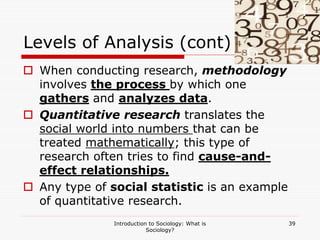
Levels of Analysis (cont)
 When conducting research, methodology
involves the process by which one
gathers and analyzes data.
 Quantitative research translates the
social world into numbers that can be
treated mathematically; this type of
research often tries to find cause-and-
effect relationships.
 Any type of social statistic is an example
of quantitative research.
Introduction to Sociology: What is
Sociology?
40
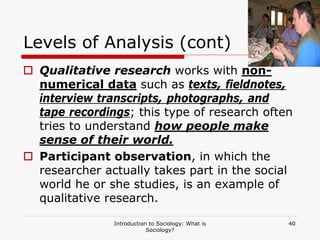
Levels of Analysis (cont)
 Qualitative research works with non-
numerical data such as texts, fieldnotes,
interview transcripts, photographs, and
tape recordings; this type of research often
tries to understand how people make
sense of their world.
 Participant observation, in which the
researcher actually takes part in the social
world he or she studies, is an example of
qualitative research.
Introduction to Sociology: What is
Sociology?
41
Take Away Points
Humans cannot be
understood apart from the
social context they live in
(society, culture and time +
place)
Introduction to Sociology: What is
Sociology?
42
Take Away Points
The world around us
profoundly shapes and
influences who we are, how
we behave and even
how/what we think.
Introduction to Sociology: What is
Sociology?
43
Take Away Points
It is the job of the
sociologist to understand
how this process works and
to what effect.
Introduction to Sociology: What is
Sociology?
44
Lesson Quiz
4. A sense of disorientation that occurs
when you enter a radically new social
or cultural environment is called:
a. cultural mind.
b. culture shakes.
c. cultural fear.
d. culture shock.
Thank You
Introduction to Sociology: What is
Sociology?
45
Define the following terms:
[society, micro-order, Sociology, Microsociology, Psychology, Macrosociology,
etc]
Respond to the following questions:
Define the term sociology with relevant examples
Give a detailed descriptive account of theoretical perspectives of sociology as
a factor in human life
Describe the social scientific aspects of the following: political science,
psychology, economics
Give detailed descriptive account of the difference between Microsociology and
Macrosociology
Give detailed descriptive account of the difference between sociology and
social science
Group work discussional questions:
Give a detailed descriptive account of functional classification of social life
institutes that are the principal social structures that organize, direct, and
execute the essential tasks of human living.
Give a detailed descriptive account of social perspectives in terms Levels of
Understanding the Drug rational use in a society
Describe a societal grouping with key elements of social living
Study Questions

4 1-introduction to sociology

  • 1.
    The Computer &Social Science Disciplines The Computer Sciences The Social Sciences Dr. L.T.M. Muungo, PhD
  • 2.
    What is Sociology? Introductionto Sociology Dr. L.T.M. Muungo
  • 3.
    Theoretical Perspectives: Functionalism  Functionalismsees society as a system of highly interrelated parts that work together harmoniously  The image that functionalists use to understand society is a living organism  Each part of society works together for the benefit of the whole much like a living organism
  • 4.
    Theoretical Perspectives: Conflict Theory Conflict theory is grounded in the work of Karl Marx  Society is understood to be made up of conflicting interest groups who vie for power and privilege  This dynamic results in continuous social change, which is the normal state of affairs  Conflict theory focuses heavily on inequality and differential distribution of power and wealth
  • 5.
    Theoretical Perspectives: The InteractionistPerspective  Focuses on how individuals make sense of and interpret the world  This perspective tends to focus on the “micro-order” of small groups  Has given rise to several specific approaches:  Symbolic Interactionism developed by George Herbert Mead  Ethnomethodology developed by Harold Garfinkel  Dramaturgy developed by Erving Goffman
  • 6.
    Comparing Theoretical Perspectives PerspectiveScope of Analysis Point of View Focus of Analysis Structural- Functionalism Macro Level 1. Various parts of society are interdependent 2. Social systems are highly stable 3. Social life governed by consensus & cooperation Functional and dysfunctional aspects of society Conflict Theory Macro Level 1. Society accommodates between competing interest groups 2. Society unstable and prone to change 3. Social life conflict-laden 1. How social inequalities produce conflict 2. Who benefits from social arrangements Interactionist Micro-Level 1. Actions have symbolic meanings 2. Meanings can vary How people make sense of their world
  • 7.
    Three revolutions hadto take place before the sociological imagination could crystallize:  The scientific revolution (16th c.) encouraged the use of evidence to substantiate theories.  The democratic revolution (18th c.) encouraged the view that human action can change society.  The industrial revolution (19th c.) gave sociologists their subject matter.
  • 8.
    Personal experience Awarenessof friends Systematic study with drug use and associates’ patterns of a random of drug use sample of drug users Defining the Sociological Perspective  “Sociology is the scientific study of human society and social interactions.”  What makes sociology “scientific?” Levels of Understanding Drug Use
  • 9.
    The Sociological Imagination C. Wright Mills coined the term “sociological imagination” to refer to “...the vivid awareness of the relationship between private experience and the wider society.” C. Wright Mills
  • 10.
    Sociology and CommonSense  Common sense assumptions are usually based on very limited observation.  Moreover, the premises on which common sense assumptions are seldom examined.  Sociology seeks to: • use a broad range of carefully selected observations; and • theoretically understand and explain those observations.  While sociological research might confirm common sense observation, its broader base and theoretical rational provide a stronger basis for conclusions.
  • 11.
    The Scientific Method Sociologyand Science  Science is “...a body of systematically arranged knowledge that shows the operation of general laws.”  As a science, sociology employs the scientific method Formulate hypotheses Choose research design Gather Data Analyze Data Review of literature
  • 12.
    Sociology and theSocial Sciences
  • 13.
    The Development ofSociology  Sociology emerged as a separate discipline in the nineteenth century  This was a time of great social upheaval due largely to the French and Industrial Revolutions  Several early sociologists shaped the direction of the discipline
  • 14.
    Sociology Sociology is the systematicstudy of human society and social interaction. It is based on the idea that our relations with other people create opportunities for us to think and act but also set limits on our thoughts and action.
  • 15.
    Introduction to Sociology:What is Sociology? 15 What is Sociology? Sociology is also the study of reifications, or social constructions.
  • 16.
    Introduction to Sociology:What is Sociology? 16 Sociology Howard Becker defined sociology as the study of people “doing things together.”
  • 17.
    Introduction to Sociology:What is Sociology? 17 Sociology This reminds us that society and the individual are inherently connected, and each depends on the other.
  • 18.
    Introduction to Sociology:What is Sociology? 18 Sociology Sociologists study this link: how society affects the individual and how the individual affects society.
  • 19.
    A society isa large social grouping that shares the same geographical territory and is subject to the same political authority and dominant cultural expectations.
  • 20.
    20 Society Is…. A societyis a group of people who share a culture and live more or less together. They have a set of institutions which provide what they need to meet their physical, social, and psychological needs and which maintain order and the values of the culture.
  • 21.
    21 Social structures arethe more or less stable patterns of people’s interactions and relationships.
  • 22.
    22 Institutions are theprincipal social structures that organize, direct, and execute the essential tasks of living.
  • 23.
  • 24.
    Sociological Imagination  Theability to see the relationship between individual experiences and the larger society.
  • 25.
    Introduction to Sociology:What is Sociology? 25 Cool Insights from Sociology Humans cannot be understood apart from social context (i.e. society)
  • 26.
    Introduction to Sociology:What is Sociology? 26 Cool Insights from Sociology Society makes us who we are by structuring out interactions and laying out an orderly world before us
  • 27.
    Introduction to Sociology:What is Sociology? 27 Cool Insights from Sociology Society is a social construction, that is an idea created by humans (i.e. doesn’t exist in the biological world but only in the social world) through social interaction and given a reality through our understanding of it and our collective actions.
  • 28.
    Society Influences You Death… Related to society? Introduction to Sociology: What is Sociology? 28
  • 29.
    Baby Names Introduction toSociology: What is Sociology? 29
  • 30.
    Introduction to Sociology:What is Sociology? 30 Names that have gained the most popularity, 2004 – 2010 ...Or, the names I’ll begin seeing all the time in 2022-2028
  • 31.
    Introduction to Sociology:What is Sociology? 31 What Does Society Look Like?  While the idea of society is familiar, describing it can be difficult. Ultimately society is made up of many different components, such as culture, race, family, education, social class, and people’s interactions.  People who share a culture and territory
  • 32.
    Introduction to Sociology:What is Sociology? 32 Meaning through Interaction  People actively and collectively shape their own lives, organizing their social interactions and relationships into a meaningful world.  Sociologists study this social behavior by seeking out its patterns.  Patterns are crucial to our understanding of society
  • 33.
    Introduction to Sociology:What is Sociology? 33 Society Society is a group of people who shape their lives in aggregated and patterned ways that distinguish their group from other groups.
  • 34.
    Introduction to Sociology:What is Sociology? 34 The Social Sciences  Social Sciences are the disciplines that use the scientific method to examine the social world, in contrast to the natural sciences, which examine the physical world.  Examples of social sciences include ….?
  • 35.
    Introduction to Sociology:What is Sociology? 35 How Sociology fits in
  • 36.
    Introduction to Sociology:What is Sociology? 36 Levels of Analysis  We can study society from different levels:  Microsociology is the level of analysis that studies face-to-face and small-group interactions in order to understand how they affect the larger patterns and institutions of society.  Microsociology focuses on small-scale issues.  Ex: Symbolic Interactionism
  • 37.
    Introduction to Sociology:What is Sociology? 37 Levels of Analysis (cont)  Macrosociology is the level of analysis that studies large-scale social structures in order to determine how they affect the lives of groups and individuals.  Macrosociology focuses on large-scale issues.  Ex: Functionalism, Conflict Theory
  • 38.
    Introduction to Sociology:What is Sociology? 38 How We Use Levels of Analysis  Pam Fishman took a micro-level approach to studying issues of power in male–female relationships.  She found that in conversation, women ask nearly three times as many questions as men do, perhaps because a speaker is much more likely to ask a question if he or she does not expect to get a response by simply making a statement.
  • 39.
    Introduction to Sociology:What is Sociology? 39 Levels of Analysis (cont)  When conducting research, methodology involves the process by which one gathers and analyzes data.  Quantitative research translates the social world into numbers that can be treated mathematically; this type of research often tries to find cause-and- effect relationships.  Any type of social statistic is an example of quantitative research.
  • 40.
    Introduction to Sociology:What is Sociology? 40 Levels of Analysis (cont)  Qualitative research works with non- numerical data such as texts, fieldnotes, interview transcripts, photographs, and tape recordings; this type of research often tries to understand how people make sense of their world.  Participant observation, in which the researcher actually takes part in the social world he or she studies, is an example of qualitative research.
  • 41.
    Introduction to Sociology:What is Sociology? 41 Take Away Points Humans cannot be understood apart from the social context they live in (society, culture and time + place)
  • 42.
    Introduction to Sociology:What is Sociology? 42 Take Away Points The world around us profoundly shapes and influences who we are, how we behave and even how/what we think.
  • 43.
    Introduction to Sociology:What is Sociology? 43 Take Away Points It is the job of the sociologist to understand how this process works and to what effect.
  • 44.
    Introduction to Sociology:What is Sociology? 44 Lesson Quiz 4. A sense of disorientation that occurs when you enter a radically new social or cultural environment is called: a. cultural mind. b. culture shakes. c. cultural fear. d. culture shock.
  • 45.
    Thank You Introduction toSociology: What is Sociology? 45
  • 46.
    Define the followingterms: [society, micro-order, Sociology, Microsociology, Psychology, Macrosociology, etc] Respond to the following questions: Define the term sociology with relevant examples Give a detailed descriptive account of theoretical perspectives of sociology as a factor in human life Describe the social scientific aspects of the following: political science, psychology, economics Give detailed descriptive account of the difference between Microsociology and Macrosociology Give detailed descriptive account of the difference between sociology and social science Group work discussional questions: Give a detailed descriptive account of functional classification of social life institutes that are the principal social structures that organize, direct, and execute the essential tasks of human living. Give a detailed descriptive account of social perspectives in terms Levels of Understanding the Drug rational use in a society Describe a societal grouping with key elements of social living Study Questions