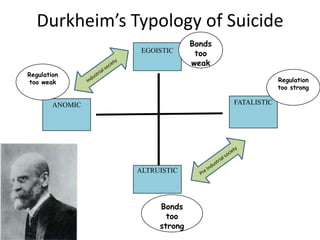
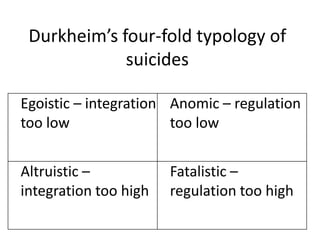
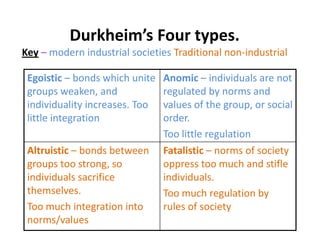
Durkheim's classic 1897 work on suicide was groundbreaking as it demonstrated suicide was a sociological phenomenon rather than solely an individual psychological matter. He showed suicide rates in societies remained remarkably stable, implying they were influenced by societal rather than individual factors. Durkheim developed a typology of suicide consisting of egoistic, altruistic, anomic, and fatalistic types, defined by the degree to which society integrated and regulated individuals. Later positivist critiques found Durkheim overemphasized religion's role and lacked operational definitions, while his reliance on incomplete 19th century statistics limited verification of results.