Albaha University
• Faculty of Applied Medical Sciences
Health sociology
• Dr. Abdalla Hasballa Elmanna
Dr.Abdalla Hasballa Elmanna 18/27/2019
LECTURE 1
• Concepts of Sociology
• OBJECTIVES
• By the end of this lecture the students should be
able to:
• Understand the concepts of sociology and
related terms.
• Define society
Dr.Abdalla Hasballa Elmanna 28/27/2019
Concepts of sociology
A society is a group of people who share a culture and live more or less together. They
have a set of institutions which provide what they need to meet their physical, social,
and psychological needs and which maintain order and the values of the culture.
Social structures are the more or less stable patterns of people’s interactions and
relationships.
Institutions are the principal social structures that organize, direct, and execute the
essential tasks of living. Societies represent the most comprehensive and complex type
of social structure in today’s world.
Some institutions are: Family, Medical, educational, economic, religious, legal
and political systems
4
Society Is Studied By…
 Using Scientific methods to Study
 Variations in social structures
 Variations in social Institutions
 How they are held together
 How they change
 How they effect the people who interact
in them
 This is what makes up sociology
8/27/2019 Dr.Abdalla Hasballa Elmanna
5
What Is Sociology?
• Sociology Focuses on:
– How social relationships influence people’s
attitudes and behavior
– How major social institutions affect us
– How we affect other individuals, groups, and
organizations
Dr.Abdalla Hasballa Elmanna8/27/2019
6
Sociology: The systematic study of
the relationship between the individual
and society and of the consequences
of different types of relationships.
What Is Sociology?
Dr.Abdalla Hasballa Elmanna8/27/2019
The Sociological Perspective
 The sociological perspective helps us to
see general social patterns in the behavior
of particular individuals.
 It allows or forces us to look beyond the
outer appearances of our social world and
discover new levels of reality
 It also encourages us to realize that society
guides our thoughts and deeds — to see
the strange in the familiar
 Sociology also encourages us to see
individuality in social context.
Dr.Abdalla Hasballa Elmanna
• The sociological imagination provides the ability to
see our private experiences and personal difficulties
as entwined with the structural arrangements of our
society and the times in which we live.
• Understand social marginality, the state of being
excluded from social activity as an “outsider.”
People at the margins of social life are aware of
social patterns that others rarely think about
• C. Wright Mills described sociological imagination as
“An awareness of the relationship between an
individual and the wider society, and …the ability to
view our society as an outsider might, rather than
relying only on our individual perspective, which is
shaped by our cultural biases”
The Sociological Imagination
88/27/2019
Dr.Abdalla Hasballa Elmanna 9
Benefits of the sociological
perspective
• The sociological perspective helps us assess the truth of
“common sense.” The sociological perspective helps us
assess both opportunities and constraints in our lives.
• The sociological perspective empowers us to be active
participants in our society.
• The sociological perspective helps us to live in a diverse
world. It also encourages us to realize that society
guides our thoughts and deeds — to see the strange in
the familiar
8/27/2019
Dr.Abdalla Hasballa Elmanna 10
The Origins of Sociology
Three major social changes during the seventeenth and
eighteenth centuries are important to the development of
sociology.
1. The rise of a factory-based industrial economy.
2. The emergence of great cities in Europe.
3. Political changes, including a rising concern with
individual liberty and rights.
8/27/2019
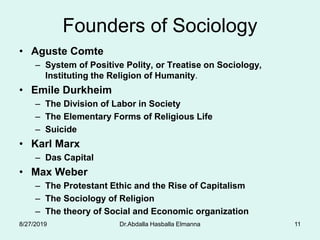
Founders of Sociology
• Aguste Comte
– System of Positive Polity, or Treatise on Sociology,
Instituting the Religion of Humanity.
• Emile Durkheim
– The Division of Labor in Society
– The Elementary Forms of Religious Life
– Suicide
• Karl Marx
– Das Capital
• Max Weber
– The Protestant Ethic and the Rise of Capitalism
– The Sociology of Religion
– The theory of Social and Economic organization
Dr.Abdalla Hasballa Elmanna 118/27/2019
Dr.Abdalla Hasballa Elmanna 12
Aguste Comte
Auguste Comte: Lived 1798-1857
Comte saw sociology as the product of a three-stage historical
development:
 The theological stage, in which thought was guided
by religion.
 The metaphysical stage, a transitional phase.
 The scientific stage
8/27/2019
Dr.Abdalla Hasballa Elmanna 13
Emile Durkheim
• Lived 1858-1917
• Influential French
sociologist, educator, and
public official
• Studied the ties that bind
society together
• Mechanical solidarity
– Traditional societies
are united by social
similarities
• Organic solidarity
– Modern societies are
united by
interdependence
• Anomie
– Rapid social change
leads to loss of social
norms and produces
many social problems
8/27/2019
Dr.Abdalla Hasballa Elmanna 14
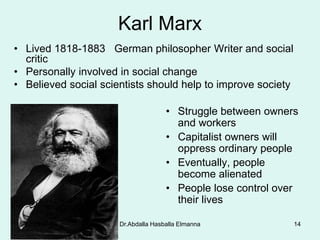
Karl Marx
• Lived 1818-1883 German philosopher Writer and social
critic
• Personally involved in social change
• Believed social scientists should help to improve society
• Struggle between owners
and workers
• Capitalist owners will
oppress ordinary people
• Eventually, people
become alienated
• People lose control over
their lives
8/27/2019
Dr.Abdalla Hasballa Elmanna
15
Max Weber
• Lived 1864-1920
• German scholar who
studied wide variety of
topics
• Like other peers, he
studied the impact of
industrialization on
peoples’ lives
• Support for value free
studies and objective
research
• Rationalization
– Traditional societies
emphasize emotion and
personal ties
– Modern societies
emphasize calculation,
efficiency, self control
– Personal ties decline and
people become
“disenchanted”
8/27/2019
Dr.Abdalla Hasballa Elmanna 16
Marx, Durkheim, and Weber Compared
• How is life treating you?
– Marx’s alienated person
• I really don’t care (because I’m detached from my work
and from other people).
– Durkheim’s anomic person
• I’m distressed by it (because there are no common rules
or norms to guide me).
– Weber’s rational person
• Let me think about it, and I’ll get back to you later
(because I need to make some calculations before I
know how to answer).
8/27/2019
Dr.Abdalla Hasballa Elmanna 17
Other Important Founders
2. Harriet Martineau: Feminist and Methodologist
Studied social life in Britain and US, translated
Comte. Studied the impact of inequality
3. Herbert Spencer and Social Darwinism
An evolutionary model of society, known for “social
Darwinism” but thought that attempts at social reform
were wrong.
8/27/2019
Lecture 2
• The sociological theories
• Define theory
Dr.Abdalla Hasballa Elmanna 188/27/2019
Dr.Abdalla Hasballa Elmanna 19
Sociological Theory
A theory is a statement of how and why specific facts are related. The
goal of sociological theory is to explain social behavior in the real
world.
 Theories are based on theoretical paradigms, sets of
assumptions that guide thinking and research.
Sociologists ask two basic questions:
 What issues should we study?
 How should we connect the facts?
I call this the plotting or outlining of how you want to tell the
story of society.
 In addition to the three perspectives today there are three ways
of using the perspectives to look at social issues.
8/27/2019
Dr.Abdalla Hasballa Elmanna 20
• Three general theoretical orientations
or perspectives for the study of society
Sociological Meta Theories
– Structural-Functionalism perspective
– Conflict perspective
– Interactionist perspective
8/27/2019
Dr.Abdalla Hasballa Elmanna 21
The Structural-Functionalist
Perspective
• Parts of a social system work together to
maintain a balance
– Functions are actions that have positive
consequences
– Dysfunctions are actions that have negative
consequences
– Manifest functions are intended
– Latent functions are unintended
8/27/2019
Dr.Abdalla Hasballa Elmanna 22
Structural Functionalism
● The structural-functional theory is a framework for building
theory that sees society as a complex system whose parts
work together to promote solidarity and stability.
- It asserts that our lives are guided by social structures
(relatively stable patterns of social behavior).
- Each social structure has social functions, or
consequences, for the operation of society as a whole.
- Key figures in the development of this paradigm include
Auguste Comte, Emile Durkheim, Herbert Spencer, and
Talcott Parsons and Robert Merton
8/27/2019
Dr.Abdalla Hasballa Elmanna 23
The Conflict Perspective
• Society is held together by who has power
at a moment in time
– Power allows some to dominate others
– Dominance leads to conflict
– Conflict and change are inevitable
– Conflict holds society together as new
alliances are formed and others fail
8/27/2019
Dr.Abdalla Hasballa Elmanna 24
Social Conflict
●The social-conflict paradigm is a framework for building theory that
sees society as an arena of inequality that generates conflict and
change.
-Most sociologists who favor the conflict paradigm attempt not
only to understand society but also to reduce social inequality
-Key figures in this tradition include Karl Marx, W. E. B. Du Bois,
and Wright Mills
●This paradigm has developed rapidly in recent years. It has several
weaknesses.
- It ignores social unity based on mutual interdependence and
shared values.
- Because it is explicitly political, it cannot claim scientific
objectivity.
- Like the structural-functional paradigm, it envisions society in
terms of broad abstractions.
8/27/2019
Dr.Abdalla Hasballa Elmanna 25
The Symbolic Interaction
Perspective
• Individuals construct the nature of their social
world through social interaction
– Social life is possible only because humans can
communicate through symbols
– All human communications take place through the
perception and interpretation of symbols
– How people define situations is important
– There is a general consensus on how situations are
defined
– We do not respond directly to reality but to the
symbolic meanings we attach to the real world
8/27/2019
Table 1.1 (p. 15)
Comparison of Three Theoretical Perspectives
Dr.Abdalla Hasballa Elmanna 27
Sociology’s Four
Realms(domains)
• Basic Science
– Expanding knowledge
• Critical Sociology
– Debate, argument, and controversy
• Applied Research
– Application of knowledge to real-world
problems
• Public Activism
– Working for social change
8/27/2019
Dr.Abdalla Hasballa Elmanna 28
• Applied sociology:
use of the discipline
of sociology with the
intent of yielding
practical
applications for
human behavior and
organizations
Practicing Sociology
• Clinical sociology:
dedicated to
facilitating change
by altering social
relationships or
restructuring social
institutions
8/27/2019
Lecture 3
• The process of socialization
Dr.Abdalla Hasballa Elmanna 298/27/2019
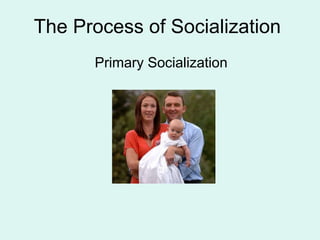
Primary Socialization
The Process of Socialization
The socialization process-
• Socialization is the process of learning how to
become human and behave in ways which are
acceptable to the expectations in others. As a
process it begins at birth and continues
throughout our lifespan. We never stop learning
how to behave due to the ever changing nature
of the society in which we live and due to new
situations we made find ourselves in. There are
two main types of socialization.
8/27/2019 Dr.Abdalla Hasballa Elmanna 31
Primary socialization-
• Primary socialization occurs between the
individual and those people in their life with
whom they have primary relationships. A primary
relationship can be categorised as one in which
the individual has close, personal, face-to-face
contact. The first primary relationship that the
vast majority of us form is with our parents or
guardians with whom our first primary
socialization will occur. As we develop and age
we form primary relationships with close friends,
and other adults through work, marriage etc
8/27/2019 Dr.Abdalla Hasballa Elmanna 32
Agents of socialization-
• We call the people responsible for socialisation,
agents of socialisation and by extension we can
talk about agencies of socialisation such as the
family, the education system, the workplace and
so on. In this way the first agency responsible for
primary socialisation is the family and the agents
of socialisation are a child’s parents. Through
primary socialisation a child learns things such as
talking and walking as well as values such as the
difference between right and wrong and how to act
appropriately with others such as adults and
authority figures.
8/27/2019 Dr.Abdalla Hasballa Elmanna 33
8/27/2019 Dr.Abdalla Hasballa Elmanna 34
• “Societies work or function because each individual
member of that society plays particular roles and each
role carries a status and norms which are informed by the
values and beliefs of the culture of that society. The
process of learning these roles and the norms and values
appropriate to them from those around us is called
socialisation.”
(Barnard and Burgess (1996) “Sociology Explained”)
8/27/2019 Dr.Abdalla Hasballa Elmanna 35
Agent 001- Parents?
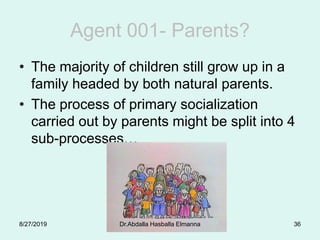
• The majority of children still grow up in a
family headed by both natural parents.
• The process of primary socialization
carried out by parents might be split into 4
sub-processes…
8/27/2019 Dr.Abdalla Hasballa Elmanna 36
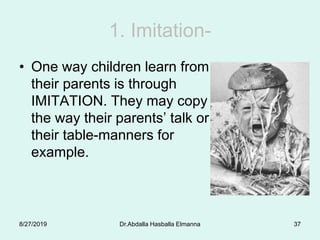
1. Imitation-
• One way children learn from
their parents is through
IMITATION. They may copy
the way their parents’ talk or
their table-manners for
example.
8/27/2019 Dr.Abdalla Hasballa Elmanna 37
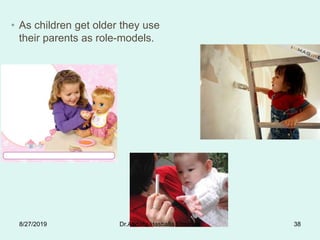
• As children get older they use
their parents as role-models.
8/27/2019 Dr.Abdalla Hasballa Elmanna 38
2. Manipulation
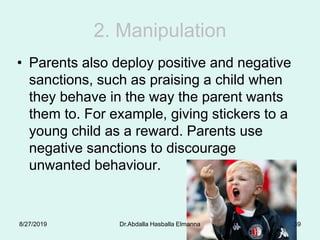
• Parents also deploy positive and negative
sanctions, such as praising a child when
they behave in the way the parent wants
them to. For example, giving stickers to a
young child as a reward. Parents use
negative sanctions to discourage
unwanted behaviour.
8/27/2019 Dr.Abdalla Hasballa Elmanna 39
3. Canalization
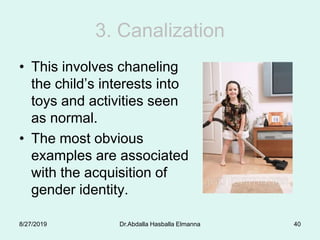
• This involves chaneling
the child’s interests into
toys and activities seen
as normal.
• The most obvious
examples are associated
with the acquisition of
gender identity.
8/27/2019 Dr.Abdalla Hasballa Elmanna 40
4. Verbal appellation
• This is a method of social control which
teaches children to identify the appropriate
behavior through the use of voice
inflection and the use of terms of
endearment.
8/27/2019 Dr.Abdalla Hasballa Elmanna 41
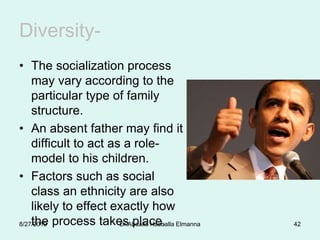
Diversity-
• The socialization process
may vary according to the
particular type of family
structure.
• An absent father may find it
difficult to act as a role-
model to his children.
• Factors such as social
class an ethnicity are also
likely to effect exactly how
the process takes place.8/27/2019 Dr.Abdalla Hasballa Elmanna 42
Lecture 4
The Social Model of Health
Discuss
How can we measure how healthy our
society is?
8/27/2019 Dr.Abdalla Hasballa Elmanna 44
Measuring Health & Illness
Two indicators are used: Morbidity and
Mortality.
It is impossible to measure morbidity with any
validity or reliability because definitions of
health and illness are so subjective.
Therefore, mortality rates are the most
commonly used to measure health/illness.
8/27/2019 Dr.Abdalla Hasballa Elmanna 45
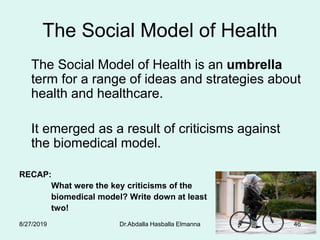
The Social Model of Health
The Social Model of Health is an umbrella
term for a range of ideas and strategies about
health and healthcare.
It emerged as a result of criticisms against
the biomedical model.
RECAP:
What were the key criticisms of the
biomedical model? Write down at least
two!
8/27/2019 Dr.Abdalla Hasballa Elmanna 46
The Social Model of Health
• The biomedical model looks for the causes
of illness within the individual.
• The social model looks for the causes of
illness within society.
8/27/2019 Dr.Abdalla Hasballa Elmanna 47
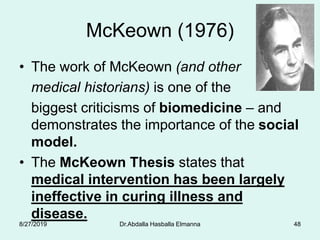
McKeown (1976)
• The work of McKeown (and other
medical historians) is one of the
biggest criticisms of biomedicine – and
demonstrates the importance of the social
model.
• The McKeown Thesis states that
medical intervention has been largely
ineffective in curing illness and
disease.
8/27/2019 Dr.Abdalla Hasballa Elmanna 48
Discuss
• If medical treatment was so irrelevant,
what were the social causes of
improvement?
8/27/2019 Dr.Abdalla Hasballa Elmanna 49
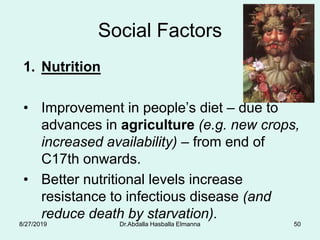
Social Factors
1. Nutrition
• Improvement in people’s diet – due to
advances in agriculture (e.g. new crops,
increased availability) – from end of
C17th onwards.
• Better nutritional levels increase
resistance to infectious disease (and
reduce death by starvation).
8/27/2019 Dr.Abdalla Hasballa Elmanna 50
Social Factors
2. Public Hygiene
E.g. Cleaner, piped water and better sewage
disposal.
• This reduces exposure to disease (esp.
water-borne diseases like cholera).
• Improved food hygiene from 1900 also
helped (e.g. Introduction of sterilisation
and bottling).8/27/2019 Dr.Abdalla Hasballa Elmanna 51
Social Factors
3. Birth Limitation
• Fall in birth-rate and family size in the
middle-classes from 1870s.
• Limits on population crucial for health of a
society.
• Drop in birth-rate also nearly eliminates
infanticide by reducing unwanted
pregnancy.8/27/2019 Dr.Abdalla Hasballa Elmanna 52
Criticisms of McKeown
• Not all diseases respond to an
improvement in the social environment.
• Medicine was the decisive factor in
curing/treating diseases like diphtheria and
polio.
8/27/2019 Dr.Abdalla Hasballa Elmanna 53
In Pairs...
List five other social or environmental
factors that might influence health.
8/27/2019 Dr.Abdalla Hasballa Elmanna 54
The Social Model
• Health and illness are not biological facts.
They are relative.
8/27/2019 Dr.Abdalla Hasballa Elmanna 55
Relative To…
• The society you live in
• Your gender
• Your Social Class
• Your ethnicity
• Your age
In pairs: Identify at least two ways in which
EACH ONE of the above could influence how
healthy/ill you feel (5 mins)
8/27/2019 Dr.Abdalla Hasballa Elmanna 56
Relative to…
• The society you live in (e.g. obesity)
• Your gender (e.g. men less likely to define
themselves as “ill”)
• Your social class (e.g. working class accept higher
levels of illness)
• Your ethnicity (Punjabis in Bradford suffer from a
‘sinking heart’)
• Your age (e.g. joint pains being accepted as normal)
8/27/2019 Dr.Abdalla Hasballa Elmanna 57
The Social Model
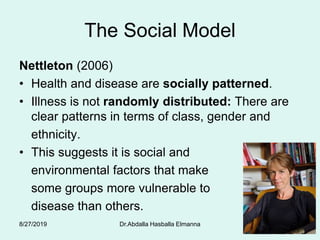
Nettleton (2006)
• Health and disease are socially patterned.
• Illness is not randomly distributed: There are
clear patterns in terms of class, gender and
ethnicity.
• This suggests it is social and
environmental factors that make
some groups more vulnerable to
disease than others.
8/27/2019 Dr.Abdalla Hasballa Elmanna 58
The Social Model
• Promotes the view that the definitions and
judgements of lay people are just as valid as
professional assessments.
• Much illness is diagnosed and treated within the
family.
• Illness is a personal experience, not a medical
one.
8/27/2019 Dr.Abdalla Hasballa Elmanna 59
The Social Model
• McKeown developed his work into a
critique of modern healthcare.
• He argues that we spend too much money
on treating disease and not enough on
prevention and health education.
8/27/2019 Dr.Abdalla Hasballa Elmanna 60
Criticisms of the Social Model
• Most of the time, illness exists. It’s not
relative or subjective: If you’re ill, you’re ill.
• The social model doesn’t ‘replace’ the
biomedical model: It puts it into
perspective.
8/27/2019 Dr.Abdalla Hasballa Elmanna 61
Health & Societal Development
• Most diseases can be classified as acute
or chronic diseases
• The most effective and least expensive
means of dealing with chronic disease is
preventive medicine.
• However, modern medicine is organized
around curative medicine.
8/27/2019 Dr.Abdalla Hasballa Elmanna 62
Classifying Countries
• Three categories according to economic status:
– Developed countries have relatively high gross
national income and have economies made up
of many different industries.
– Developing countries have relatively low gross
national income and their economies are much
simpler.
– Least developed countries are the poorest
countries of the world.8/27/2019 Dr.Abdalla Hasballa Elmanna 63
Life Expectancy
• Average number of years individuals born
in a given year can expect to live.
• Infant mortality - Number of deaths of live-
born infants under 1 year of age.
8/27/2019 Dr.Abdalla Hasballa Elmanna 64
Maternal Mortality Rates
• A measure of deaths that result from
complications associated with pregnancy,
childbirth, and unsafe abortion.
• Maternal mortality is the leading cause of death
and disability for women ages 15–49 in
developing countries.
• The most common causes of maternal death are
hemorrhage, infection, and complications related
to unsafe abortion.
8/27/2019 Dr.Abdalla Hasballa Elmanna 65
Social Factors in Health
and Illness
• Socioeconomic status
– Those who are lower in income, educational
attainment, and occupational attainment have
substantially higher disease rates and death
rates than their affluent counterparts.
• Gender
– Women appear to be healthier than men,
especially if life expectancy is considered. But
women have more acute, non-life-threatening
illnesses. So reality is complicated on this issue.
8/27/2019 Dr.Abdalla Hasballa Elmanna 66
Social Factors in Health
and Illness
• Race
–Some of the impact of race on health
has to do with discrimination.
• Lifestyle factors
–Industrialization has improved people’s
lives as well as created health hazards.
8/27/2019 Dr.Abdalla Hasballa Elmanna 67
Lecture 5
• Medicine and Health Care
Dr.Abdalla Hasballa Elmanna 688/27/2019
Dr.Abdalla Hasballa Elmanna 69
█ What does sociology contribute to something as
seemingly biological as health?
█ What is social epidemiology
A Look Ahead
8/27/2019
Dr.Abdalla Hasballa Elmanna 70
• Epidemic
– A widespread outbreak of a contagious disease
• Pandemic
– An outbreak of a contagious disease over a very
large area or worldwide
• Disease
– A pathology that disrupts the usual functions of the
body
• Health
– The capacity to satisfy role requirements
DEFINTION OF RELATED TERMS
8/27/2019
Dr.Abdalla Hasballa Elmanna 71
Illness and Social Order
• Illness is a threat to social order; if too many
people are sick at one time, it affects our
ability to perform tasks necessary for
continued operation of society
• Sick role: societal expectations about
attitudes and behavior of a person labeled as
ill
8/27/2019
Dr.Abdalla Hasballa Elmanna 72
Components of The KSA Health Care
Delivery System
• Do we have a health care or an illness treatment System?
• Hospitals
• Physicians
• The Doctor-Patient Relationship
• Nurses
• Medical Schools
• Public Health systems at various levels
• Nursing Homes
• Pharmaceutical / Drug Companies
• Medical Device makers
• Insurance Companies
8/27/2019
Dr.Abdalla Hasballa Elmanna 73
Health Care in the KSA
• Physicians, Nurses, and Patients
– Physicians (mostly male) have controlled
interactions with patients and nurses (mostly
female)
– Increasing numbers of physicians are men ; may
alter doctor–patient relationship
• Alternatives to Traditional Health Care
– Growing interest in holistic medicine
– According to WHO, 80 percent of people who live
in poorest countries use alternative medicine
8/27/2019
Dr.Abdalla Hasballa Elmanna 74
Medical Providers
Primary Roles
• Physicians
– Have the authority to
diagnose, prescribe
treatment
– Certify death or
competency
– Prestige results in
many privileges
– Most are specialists
today
• Nurses
– Assist in medical
settings under the
supervision of a
physician
– Have less education
than physician
– Most are women
8/27/2019
Dr.Abdalla Hasballa Elmanna 75
Social Epidemiology
• Social epidemiology: study of disease
distribution, impairment, and general health
status across a population
– Contemporary epidemiology concerned with
epidemics, and also nonepidemic diseases,
injuries, drug addiction and alcoholism,
suicide, and mental illness
• Incidence: number of new cases of a specific
disorder that occur within a given population
during a stated period, usually a year
8/27/2019
Dr.Abdalla Hasballa Elmanna 76
Social Epidemiology
• Prevalence: total number of cases of a specific
disorder that exist at a given time
• Morbidity rate: incidence of disease in a given
population
• Mortality rate: incidence of death in a given
population
8/27/2019
Dr.Abdalla Hasballa Elmanna 77
Social Class
• Studies show people in lower classes have
higher rates of mortality and disability
– Crowded living conditions
– Substandard housing
– Financial strain
– Poor diet
– Stress
– Inability to afford quality health care
8/27/2019
Lecture 6-8
• Beliefs and Values Norms and Culture
Dr.Abdalla Hasballa Elmanna 788/27/2019
Beliefs and Values and Culture
The unseen core of every human group
• Learning Outcome
• Identify and explain the difference between
values and beliefs
• students are able to identify their own
values and beliefs
• Students will be able to identify values and
beliefs of another country or culture
8/27/2019 Dr.Abdalla Hasballa Elmanna 80
Introduction
 Beliefs, values and norms within an group are a part of
what is commonly referred to as “culture.”
 Norms and beliefs are expressions of values.
 Every group develops distinct beliefs and patterns over
time. Many of these are subconscious or taken for
granted.
 They are demonstrated in the rituals, stories, ceremonies
and other symbolic forms.
List examples of ceremonies that show Saudi culture
8/27/2019 Dr.Abdalla Hasballa Elmanna 81
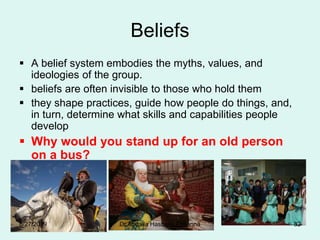
Beliefs
 A belief system embodies the myths, values, and
ideologies of the group.
 beliefs are often invisible to those who hold them
 they shape practices, guide how people do things, and,
in turn, determine what skills and capabilities people
develop
 Why would you stand up for an old person
on a bus?
8/27/2019 Dr.Abdalla Hasballa Elmanna 82
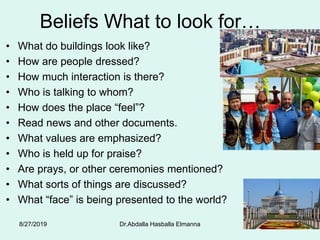
Beliefs What to look for…
• What do buildings look like?
• How are people dressed?
• How much interaction is there?
• Who is talking to whom?
• How does the place “feel”?
• Read news and other documents.
• What values are emphasized?
• Who is held up for praise?
• Are prays, or other ceremonies mentioned?
• What sorts of things are discussed?
• What “face” is being presented to the world?
8/27/2019 Dr.Abdalla Hasballa Elmanna 83
Review Statements
• When behaviors are in opposition with
values, internal conflicts arise.
• People can maintain their own values and
still show respect for the values of others.
• Respect yourself and others while you act
according to your values.
• The development of children’s values is
greatly influenced by their parents.
• Values are greatly revealed through
personal choice and decisions.
8/27/2019 Dr.Abdalla Hasballa Elmanna 84
Values
Journal
“There is something within us that gives
meaning to life, something that provides
the basis for ranking our various needs,
wants and goals.”
CONCEPTS OF VALUE
• Qualities, Characteristic or ideas about which we
feel very strongly.
• Value define what is of worth.
• Our values affect our decisions, goals and
behavior.
• A belief that someone or something is
worthwhile.
• Value help guide your actions and judgments.
Believe it or not our values even affect the
purchases we make.
8/27/2019 Dr.Abdalla Hasballa Elmanna 86
• You have been given a check for
$1000.00 to do whatever you like with it.
What would you do with it?
• Share with the class what you would do with it.
Conclusion:
• What you spend the money on has
everything to do with what you value
8/27/2019 Dr.Abdalla Hasballa Elmanna 87
Where do you get Values?
Home
Society
School
Friends
TV
Internet
You Tube
My Space
Church
Music
Books
Families
Culture
Employers
The Years you were raised
8/27/2019 Dr.Abdalla Hasballa Elmanna 88
Your age will influence your values
• Ages 1-7 -- Parents
• Ages 8-13 – Teacher, heroes (sports, rock, TV)
• Ages 14-20 – Friends (choose good ones!)
• Ages 21= Your values are established, but you
may test your values from time to time.
8/27/2019 Dr.Abdalla Hasballa Elmanna 89
Can you believe?
• By the time you are seven years old you
have already formed values from your
parents.
• Values need to be taught from the very
beginning.
8/27/2019 Dr.Abdalla Hasballa Elmanna 90
Characteristics of Values
• Values are personal
• Our actions point to what we really value
• Our values give us our perception of the
world
• Inconsistent behavior may indicate and
absence of values
• Values change as experiences change
8/27/2019 Dr.Abdalla Hasballa Elmanna 91
More Characteristics
• Respect others values
• When faced with adversity, our values
determine our choices
• Our values give us identity
• Values are subject to change!
• When Behaviors are in opposition
with values, internal conflict arises.
8/27/2019 Dr.Abdalla Hasballa Elmanna 92
Types of Values
8/27/2019 Dr.Abdalla Hasballa Elmanna 93
Moral Values
• What is right or wrong; codes by which to
live
• What is an example?
8/27/2019 Dr.Abdalla Hasballa Elmanna 94
Aesthetic Values
• What you feel has beauty in nature and life
• Do we all feel the same way about this?
8/27/2019 Dr.Abdalla Hasballa Elmanna 95
Material Values
• The things we want to spend our money
on
• How many of you only buy things on sale?
8/27/2019 Dr.Abdalla Hasballa Elmanna 96
Intrinsic Values
• Things that have value to us in their own
right
• Example: An antique car, a best friend, a
grandpa
8/27/2019 Dr.Abdalla Hasballa Elmanna 97
Extrinsic Values
• You value something because it helps you
get something you desire
• Example: You are friends with someone
because they are good at a sport and they
can help you get better
8/27/2019 Dr.Abdalla Hasballa Elmanna 98
Universal Values
• Values that most people agree. Equality,
world peace, respect.
• Does everyone feel this way?
• (i.e.: US: value time – in hurry; Europeans:
value people – take time to talk.)
• Saudi value in ………………………
8/27/2019 Dr.Abdalla Hasballa Elmanna 99
Group Specific Values
• Each region or groups values are specific
to them.
• Can you think of an example?
8/27/2019 Dr.Abdalla Hasballa Elmanna 100
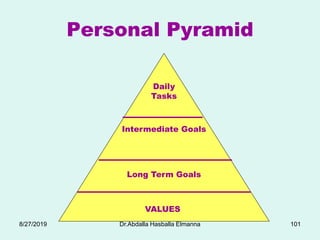
Personal Pyramid
VALUES
Long Term Goals
Intermediate Goals
Daily
Tasks
8/27/2019 Dr.Abdalla Hasballa Elmanna 101
Culture
What is culture?
• The shared products of human groups.
• Physical objects make up material
culture.
Ex: cars, books, buildings, clothes,
computers, cooking utensils
– Abstract human creations form a groups non-
material culture.
• Ex: , skills, family patterns, ideas, language,
political ideology, rules, ideas
8/27/2019 Dr.Abdalla Hasballa Elmanna 103
What is the difference between
society and culture?
• Society consists of people, and culture
consists of material and non-material
products that people make.
8/27/2019 Dr.Abdalla Hasballa Elmanna 104
Describe Saudi Culture
• 1.
• 2.
• 3.
• 4.
• 5.
• 6.
• 7.
8/27/2019 Dr.Abdalla Hasballa Elmanna 105
Components of Culture
1. Technology
2. Symbols
3. Language
4. Values
5. Norms
8/27/2019 Dr.Abdalla Hasballa Elmanna 106
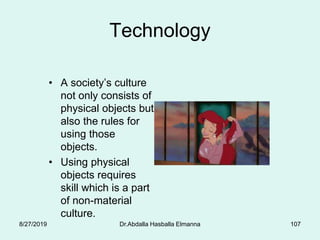
Technology
• A society’s culture
not only consists of
physical objects but
also the rules for
using those
objects.
• Using physical
objects requires
skill which is a part
of non-material
culture.
8/27/2019 Dr.Abdalla Hasballa Elmanna 107
Explain the previous clip
• 1. Using symbolic interactionist
perspective.
• 2. Using functionalist perspective.
• 3. Using conflict perspective.
8/27/2019 Dr.Abdalla Hasballa Elmanna 108
Symbols
• Symbols are the
basis of human
culture
• All humans use
symbols to
communicate
• A symbol is
anything that
represents
something else.8/27/2019 Dr.Abdalla Hasballa Elmanna 109
8/27/2019 Dr.Abdalla Hasballa Elmanna 110
The sociology of the hand shake
• Types: • Functionalist-
• Symbolic
Interaction
• Conflict
Theory
8/27/2019 Dr.Abdalla Hasballa Elmanna 111
Language
• One of the
obvious aspects
of any culture is
language.
• When organized
by accepted
rules of
grammar, words
can be used to
express any
idea.8/27/2019 Dr.Abdalla Hasballa Elmanna 112
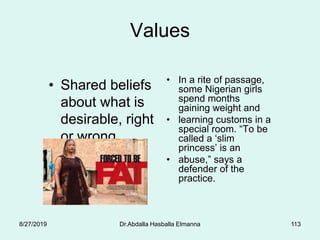
Values
• Shared beliefs
about what is
desirable, right
or wrong,
good or bad.
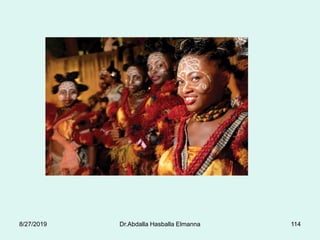
• In a rite of passage,
some Nigerian girls
spend months
gaining weight and
• learning customs in a
special room. “To be
called a ‘slim
princess’ is an
• abuse,” says a
defender of the
practice.
8/27/2019 Dr.Abdalla Hasballa Elmanna 113
8/27/2019 Dr.Abdalla Hasballa Elmanna 114
Norms
• Shared rules of conduct that reinforce
values.
• Some norms are formalized as written
rules.
• Others are taught through socialization at
school and home.
8/27/2019 Dr.Abdalla Hasballa Elmanna 115
Three types of Norms
1. Folkways- address acceptable behavior but
do not have moral significance.
Ex: Using the wrong fork
2. Mores- address acceptable behavior with great
moral consequence.
Ex: Killing someone.
3. Laws- address unacceptable behavior enforced
by government.
8/27/2019 Dr.Abdalla Hasballa Elmanna 116
How to break norms…
• – HAVE A ANIMATED CONVERSATION WITH YOURSELF IN PUBLIC
• – LOOK UP ALL THE TIME
• – SAY HELLO TO EVERYONE
• – WHEN PEOPLE ASK YOU HOW YOU ARE DOING, TELL THEM ABOUT YOUR
WHOLE DAY
• – WEAR YOUR CLOTHES BACKWARDS
• – DON’T TAKE YOUR HAT, COAT, & GLOVES OFF, EVEN INSIDE.
• – VIOLATE PEOPLE’S PERSONAL SPACE
• – WHISPER TO WHEN YOU TALK
• – YELL WHEN YOU TALK
• – ASK STRANGERS IF YOU CAN CUT IN LINE. IF THEY ASK WHY YOU NEED TO,
THEN SAY YOU DON’T REALLY FEEL LIKE WAITING FOR VERY LONG.
• – AT YOUR PARENTS HOME ASK FOR PERMISSION TO DO EVERYTHING (GET A
DRINK, USE THE BATHROOM, WATCH TV, ETC)
8/27/2019 Dr.Abdalla Hasballa Elmanna 117
Cultural Universals
• Features that are common to all human
cultures:
• 1. Arts and leisure
• 2. Basic needs
• 3. Beliefs
• 4. Communication and education
• 5. Family
• 6. Government and economy
• 7. Technology
8/27/2019 Dr.Abdalla Hasballa Elmanna 118
Cultural Variations
• Just as culture varies from place to place.
There are also variations with in cultures.
• Subculture- a group with its own unique
values, norms, and behaviors with in a
larger culture.
• Counterculture- a group that rejects the
values, norms and behaviors of the larger
society and replaces them with a new set
of cultural paterns.
8/27/2019 Dr.Abdalla Hasballa Elmanna 119
How does culture change?
• Cultural diffusion- spreading of cultural
ideas.
• Cultural lag- time between changes
• Cultural leveling- the process towards
global culture.
8/27/2019 Dr.Abdalla Hasballa Elmanna 120
Functionalist Perspective
• Culture enforces society’s central values.
• It encourages harmony and stability.
• Sub cultures diffuse discontent of sub
groups.
• Ethnocentrism encourages group
solidarity.
8/27/2019 Dr.Abdalla Hasballa Elmanna 121
Conflict Perspective
• Culture reflects and enforces the values of
those who hold power.
• It encourages and maintains social
inequality.
• Subcultures and Countercultures
challenge those in power.
• Ethnocentrism encourages discrimination
against the powerless.
8/27/2019 Dr.Abdalla Hasballa Elmanna 122
Lecture 9
• Health sociology & social medicine and
scope.
Dr.Abdalla Hasballa Elmanna 1238/27/2019
Domains in health Sociology:
Health Sociology study tow main parts:
A/ The relationships between human beings and how these
relations change or vary in different parts of the world and
times. The unit of the study is the small group.
B/ The human behavior. Human behavior is not only
determined by biological and physical environmental factors
but also by social factors. That means every kind of human
behavior has a social component. Sociologists are interested in
the study of the social determinants of human behavior, the
final analysis of the social determinants of human behavior
represent the aim of the sociology as a science.
8/27/2019 Dr.Abdalla Hasballa Elmanna 124
Scope of sociology
• In the field of knowledge
• In the field of profession
8/27/2019 Dr.Abdalla Hasballa Elmanna 125
Scope in the field of knowledge
• Society is the web of social institutions and all these
institutions are interrelated and interlinked with each
others.
• The basic and primary objective of Sociologist is to build
up knowledge about the society and social interaction.
• Sociologist are required to gain the know- how about the
social problems and their solutions.
• The specialized fields of sociology which give knowledge
to the students of sociology about different aspects of
human social life
8/27/2019 Dr.Abdalla Hasballa Elmanna 126
The Specialized fields of
sociology
• Rural Sociology
• Urban Sociology
• Medical Sociology
• Social Psychology
• Economic Sociology
• Sociology of Religion
• Industrial Sociology
• Sociology of Social Problems
• Sociology of Education
• Sociology of the Family
8/27/2019 Dr.Abdalla Hasballa Elmanna 127
• Teaching
• Research
• Administration
In the field of profession
8/27/2019 Dr.Abdalla Hasballa Elmanna 128
Social Problems
What is a Social Problem ?
Social problem is a condition that:
– Affect the quality of life of a large number of people
– Affect loved values.
Social problem could be a condition (e.g., poverty) or
a pattern of behaviour (e.g., violence).
8/27/2019 Dr.Abdalla Hasballa Elmanna 130
Reasons for studding Social
Problems?
• To understand social forces that shape our
lives on personal and societal levels
• To gain new insights into ourselves and
connections between our world and that of
other people, and
• To make more effective decisions about
these concerns
8/27/2019 Dr.Abdalla Hasballa Elmanna 131
How to measure Social
Health problem:
To measure “social problems we need “a single
quantitative measure of social well-being
resulted in the development of the Index of
Social Health (ISH) The Index focuses on
specific social problems, to determine if there an
improvement or a decline over time.
8/27/2019 Dr.Abdalla Hasballa Elmanna 132
The Index of Social Health problem
– Rate of Unemployment
– Percentage of children in poverty
– Average weekly earnings
– Levels of child abuse
– Health Insurance Coverage
8/27/2019 Dr.Abdalla Hasballa Elmanna 133
Common Social health related Problems:
• Poverty and Economic Inequality
• Crime and Violence
• Drugs and Alcohol Abuse
• Racial and Ethnic Relations
• Sexism and Gender Inequality
• Sexual Orientation and Homophobia
• Aging and Ageism
• Unemployment.
• Health and Health Care
• Population, Urbanization, and Environment
• War and Terrorism
• Obesity
8/27/2019 Dr.Abdalla Hasballa Elmanna 134
Types of Social Problems
1/ Acts and conditions that violate the norms
and values present in society.
2/ Societal-induced conditions that cause
psychic and material suffering for any
segment of the population.
8/27/2019 Dr.Abdalla Hasballa Elmanna 135
Reducing Social Problems through Social
Change
Social change: alteration, modification, or
transformation of public policy, culture, or
social institutions over time
Efforts can be:
• Short-term, middle-term, or long-term
• Micro-level, mid-range, or macro-level
For most problems, a combination of strategies
is required
8/27/2019 Dr.Abdalla Hasballa Elmanna 136
Types of Social Movements:
• Reform movements: Seek to change some
aspect of the social structure
• Revolutionary movements: Seek to bring
about a total change in society
• Religious movements: Seek to renovate
people through “inner change”
• Alternative movements: Seek limited change
in some aspects of behavior
• Resistance movements: Seek to prevent or
undo change8/27/2019 Dr.Abdalla Hasballa Elmanna 137
Research on Social Problems
• Ethnography (field studies) - the close observation
of interaction among people in a social group or
organization
»Provides in depth understanding of
the nature of a problem
• Demographic Studies - how social conditions are
distributed in human populations
»How many people are affected
»Characteristics of the people that are
affected
8/27/2019 Dr.Abdalla Hasballa Elmanna 138
Research (cont.)
• Survey Research – way of gathering information
from a large population
»Sample-representative part from the
population to be studied
»Cross-sectional data – data collected
at one point in time
»Longitudinal data – data collected at
different points in time
»Interviewing or administering a
questionnaire to a sample
8/27/2019 Dr.Abdalla Hasballa Elmanna 139
Research (cont.)
• Social Experiments – are studies that
are conducted in a controlled setting
• Random assignment of subjects to two
groups
»Experimental group
»Control group
• Test the effect of a treatment on the
experimental group
8/27/2019 Dr.Abdalla Hasballa Elmanna 140
LECTURE 10/11
• SOCIOLOGY AND GENDER
Dr.Abdalla Hasballa Elmanna 1418/27/2019
Topics to be Discussed
• Understanding Gender Concepts
• Differentiating Sex from Gender
• It’s implications on roles and identity
• Gender and Social Construction
• Gender Issues and how it affects men and
women
8/27/2019 Dr.Abdalla Hasballa Elmanna 142
Nature vs. Culture
• Women are weak and very emotional therefore unfit to
occupy leadership positions.
• Men are natural leaders because they are very rational
beings.
• Women are naturally nurturing which is why they
make good nurses and teachers.
• Men are really “bread winners” as they are good
economic providers
• All women want to be wives and mothers.
• Fathers remain to have the final say.
• Childcare is the mother’s primary responsibility.
• All men are good in sports.
8/27/2019 Dr.Abdalla Hasballa Elmanna 143
Defining SEX
 This about differences of people based on biological
characteristics, for example:
Physical Characteristics - characteristics that are present only
(exclusively) to men only or women only , for example:
• primary sex characteristics – example male or female genitalia
• secondary sex characteristics – facial and body hair
• Characteristics that are present from birth (genitalia)
• May be used as label or identification – male or female, man or
woman, babae o lalaki
8/27/2019 Dr.Abdalla Hasballa Elmanna 144
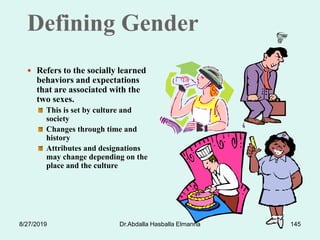
Defining Gender
 Refers to the socially learned
behaviors and expectations
that are associated with the
two sexes.
This is set by culture and
society
Changes through time and
history
Attributes and designations
may change depending on the
place and the culture
8/27/2019 Dr.Abdalla Hasballa Elmanna 145
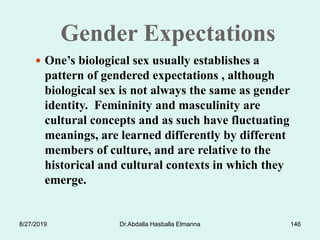
Gender Expectations
 One’s biological sex usually establishes a
pattern of gendered expectations , although
biological sex is not always the same as gender
identity. Femininity and masculinity are
cultural concepts and as such have fluctuating
meanings, are learned differently by different
members of culture, and are relative to the
historical and cultural contexts in which they
emerge.
8/27/2019 Dr.Abdalla Hasballa Elmanna 146
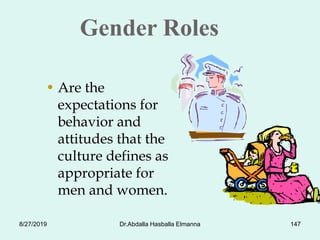
Gender Roles
• Are the
expectations for
behavior and
attitudes that the
culture defines as
appropriate for
men and women.
8/27/2019 Dr.Abdalla Hasballa Elmanna 147
Gender Identity
•An individual’s specific definition of
self, based on that person’s
understanding of what it means to
be a man or woman.
•Conforming to sanctions and
expectations – gender appropriate
behavior
8/27/2019 Dr.Abdalla Hasballa Elmanna 148
Gender and Social Control
• The socialization process controls us in
several ways:
– Gives us a definition of ourselves
– Defines the external world and our place
in it
– Provides our definition of others, our
relationships
– Encourages and discourages acquisition
of certain skills by gender
8/27/2019 Dr.Abdalla Hasballa Elmanna 149
Understanding Gender
•Refers to the complex social,
political, economic, and
psychological relations between men
and women in society
•Gender is part of the social structure.
•Gender speaks of unequal power
relations between men and women
8/27/2019 Dr.Abdalla Hasballa Elmanna 150
Characteristics of
Gender
• Relational – socially constructed
• Hierarchical – gender relations as
power relations
• Changes over time
• Context specific – varies with ethnicity,
class, culture, religion, etc.
• Institutional - Systemic
8/27/2019 Dr.Abdalla Hasballa Elmanna 151
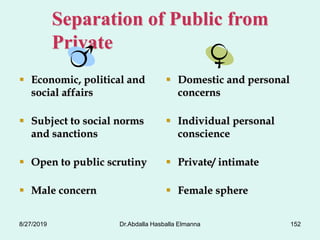
Separation of Public from
Private
 Economic, political and
social affairs
 Subject to social norms
and sanctions
 Open to public scrutiny
 Male concern
 Domestic and personal
concerns
 Individual personal
conscience
 Private/ intimate
 Female sphere
8/27/2019 Dr.Abdalla Hasballa Elmanna 152
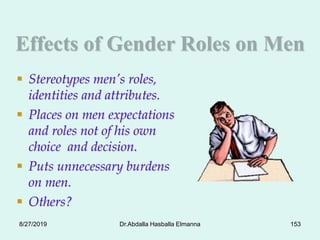
Effects of Gender Roles on Men
 Stereotypes men’s roles,
identities and attributes.
 Places on men expectations
and roles not of his own
choice and decision.
 Puts unnecessary burdens
on men.
 Others?
8/27/2019 Dr.Abdalla Hasballa Elmanna 153
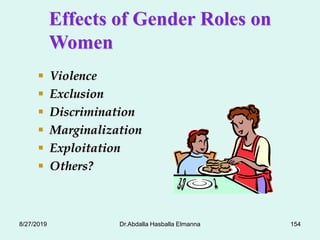
Effects of Gender Roles on
Women
 Violence
 Exclusion
 Discrimination
 Marginalization
 Exploitation
 Others?
8/27/2019 Dr.Abdalla Hasballa Elmanna 154
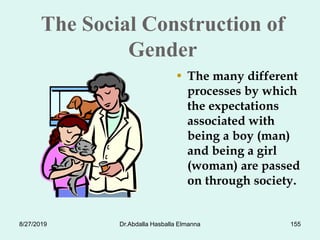
The Social Construction of
Gender
• The many different
processes by which
the expectations
associated with
being a boy (man)
and being a girl
(woman) are passed
on through society.
8/27/2019 Dr.Abdalla Hasballa Elmanna 155
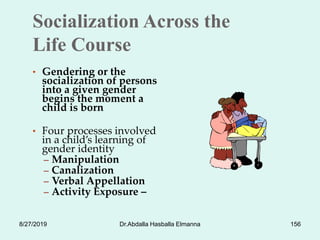
Socialization Across the
Life Course
• Gendering or the
socialization of persons
into a given gender
begins the moment a
child is born
• Four processes involved
in a child’s learning of
gender identity
– Manipulation
– Canalization
– Verbal Appellation
– Activity Exposure –
8/27/2019 Dr.Abdalla Hasballa Elmanna 156
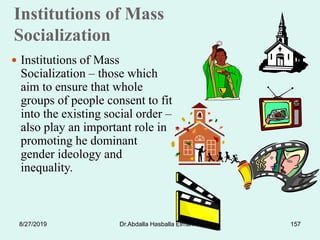
Institutions of Mass
Socialization
 Institutions of Mass
Socialization – those which
aim to ensure that whole
groups of people consent to fit
into the existing social order –
also play an important role in
promoting he dominant
gender ideology and
inequality.
8/27/2019 Dr.Abdalla Hasballa Elmanna 157
Our Gendered Institutions
• Gender is systematically structured in social
institutions, it is deeply embedded into our social
structures.
• Gender is created in the family, within our social
relationships, schools, religion, economy, even the
state.
• The total pattern of gender relations – stereotypes,
interpersonal relationships, men and women’s
different placements in social, economic, and political
hierarchies.
8/27/2019 Dr.Abdalla Hasballa Elmanna 158
Our Companies as Gendered
Institutions
 What are the gender issues and concerns?
 How can they be addressed?
 How do addressing these gender issues and
concerns translate to better business?
8/27/2019 Dr.Abdalla Hasballa Elmanna 159
Symbolic Interactionist
• Culture is maintained and modified
through everyday social interaction.
• Interaction between subculture groups
help introduce new cultural meaning
systems.
8/27/2019 Dr.Abdalla Hasballa Elmanna 160
Review Questions
• 1.What is the difference between material and non-
material culture?
• 2. How are folkways and mores different? Give an
example.
• 3. What is subculture?
• 4. What perspective says that culture reflects and
enforces society’s central values?
• 5. Why does cultural lag exist?
• 6. Why does material culture change more rapidly than
non-material culture?
• 7. OPINION: Is cultural leveling a good or bad thing?
Is it good for cultures to become more alike? Give real
life examples.
8/27/2019 Dr.Abdalla Hasballa Elmanna 161
Dr.Abdalla Hasballa Elmanna 162
LECTURE 12
Families in Society
8/27/2019
163
What Is a Family?
• A social unit of some number of people
who are linked intimately
– Related in some way
– Usually living together
– Engaging in sex
– Having responsibility for rearing children
– Functioning as an economic unit
8/27/2019 Dr.Abdalla Hasballa Elmanna
Dr.Abdalla Hasballa Elmanna 164
What is a Family
• Definition of the family: shared genetic
heritage, and law, meaning social
recognition and affirmation of the bond
– Boundaries are clear
– Enables tracking of who is related to whom
over time
8/27/2019
165
Types of Families
• Nuclear Family: a social unit composed of a husband, a
wife, and their children
– Family of orientation: family to which one was born
– Family of procreation: a person, spouse, and their children
– Blended family: spouses and their children from former
marriages live as a single nuclear family
– Binuclear family: divorced parents form separate households;
children divide their time with each
• Extended Family
– Composed of two or more generations of kin that functions as
an independent social and economic unit
8/27/2019 Dr.Abdalla Hasballa Elmanna
166
Kinship
• A network of people who are related by
marriage, blood, or social practice or the
state of being related to others culturally
learned, not necessarily determined by
biological ties
– Kinship is a means by which societies can
socialize children and transmit culture from
one generation to the next
– Kinship creates complex social bonds
8/27/2019 Dr.Abdalla Hasballa Elmanna
167
Marriage
• Two individuals involved in a socially
approved relationship
– Intimate, mutual long-term obligations
– Fulfilled customary ceremonial or legal
requirements
– Limits on who can marry
– A legal tie, determined by state
– Who can perform a marriage
8/27/2019 Dr.Abdalla Hasballa Elmanna
168
Types of Marriage
• Monogamy: form of marriage in which one woman and
one man are married only to each other
• Serial monogamy: when a person has several spouses
in his or her lifetime, but only one spouse at a time
• Polygamy: when an individual has several husbands or
wives simultaneously
• Polygyny: marriage of a man to more than one wife at a
time
• Polyandry: marriage of a woman to more than one
husband at the same time
8/27/2019 Dr.Abdalla Hasballa Elmanna
169
Courtship and Mate Selection
• Internet is new meeting place
• More people marrying later
• Endogamy: restriction of mate selection to
people within the same group
• Exogamy: requires mate selection outside
certain groups, usually one’s own family or
certain kin
• What is the difference between dating and
courting?
8/27/2019 Dr.Abdalla Hasballa Elmanna
170
Courtship
• The relationship between two people who are
preparing for marriage to each other
– Endogamy: people marry within their own group
– Exogamy: people marry outside of their own group
– Propinquity: people meet only when they are not
apart
– Ethnicity and race: people tend to marry within their
own groups
– Values: endogamy is reinforced by cultural values
8/27/2019 Dr.Abdalla Hasballa Elmanna
171
Courtship and Mate Selection
• What are criteria for a potential mate?
• Incest taboo: social norm common to virtually
all societies prohibiting sexual relationships
between certain culturally specified relatives
• Homogamy: conscious or unconscious
tendency to select mate with personal
characteristics similar to one’s own
8/27/2019 Dr.Abdalla Hasballa Elmanna
172
Functions of the Family
• What families do for society and for their
members
1. Reproduction
2. Socialization
3. Protection
4. Regulation of sexual behavior
5. Affection and companionship
6. Provision of social status
8/27/2019 Dr.Abdalla Hasballa Elmanna
173
Authority Patterns:
Who Rules?
• Patriarchy: society in which men
dominate in family decision making
• Matriarchy: society in which women
dominate in family decision making
• Egalitarian family: authority pattern in
which spouses are regarded as equals
8/27/2019 Dr.Abdalla Hasballa Elmanna
174
Authority Patterns:
Who Rules?
• Historically, family has legitimized and
perpetuated male dominance
• Social class of parents significantly
influences children’s socialization
– Socioeconomic status of a child’s family will
have marked influence on his or her life
chances as an adult
8/27/2019 Dr.Abdalla Hasballa Elmanna
175
Dimensions of Marriage
and Family
• Residence
– Norms related to where married couples should
reside
• Matrilocal arrangement: kin lives with wife’s mother
• Patrilocal arrangement: kin lives with husband’s mother
• Neolocal arrangement: kin set up independent household
• Bilocal arrangement: each spouse maintains a separate
residence
8/27/2019 Dr.Abdalla Hasballa Elmanna
176
Dimensions of Marriage and Family
• Descent
– The system by which
kinship is traced over
generations
• Patrilineal: kinship is
traced through male
• Matrilineal: kinship is
traced through female
• Bilineal: kinship is
traced through both
sides of the family
• Power
– The system by which
power is assigned
• Patriarchy: male has
most power
• Matriarchy: female has
most power
– Matricentric: females
have some power
8/27/2019 Dr.Abdalla Hasballa Elmanna
177
Alternative Family Forms
• Serial monogamy
– More than one spouse but not at same time
• Single parent
– Mostly result of divorce
• Gay and lesbian
– Legal issues debated
• Cohabitation
– A household without marriage
• Independent living
– Men or women who live alone
8/27/2019 Dr.Abdalla Hasballa Elmanna
178
Marital Dissolution
• Divorce
– Dissolution of legal ties that bind a marriage
– Legal separation
• Couples agree to take up separate residences
• Informal separation: one spouse temporarily moves out
– Desertion
• One spouse leaves the other for a prolonged period of time
8/27/2019 Dr.Abdalla Hasballa Elmanna
179
Explaining Marital Dissolution
• Society
– Nuclear family is subject to many stresses but
has limited resources
– Lower social classes more vulnerable
• Falling out of love
– Passion yields to reality
• Women’s changing roles
– Less economic dependency
8/27/2019 Dr.Abdalla Hasballa Elmanna
180
Domestic Violence
• Amount
– 1/5 of women abused
• Class differences
– Type of violence and reporting patterns
• Stay or leave?
– Retribution and psychological dependence
• Options
– Shelters and legal system
• Global patterns
– National tolerance level
– Stress from rapid social change
8/27/2019 Dr.Abdalla Hasballa Elmanna
181
Functionalism and the Family
The Family Satisfies Common Social Functions
• Socialization
– Family is responsible for primary care and early learning
• Birth; regulates sexual activity
– Choosing mates and perpetuating population
• Economic
– Assigning assets
– Important economic production and consumption unit
• Support and comfort
– Help with problems
• Social placement
– Children inherit status and class of parents
8/27/2019 Dr.Abdalla Hasballa Elmanna
182
Family: Conflict Perspective
• Power relationships
– Men control wealth
– Norms require women to do most domestic
chores
• Perpetuation of social inequality
– Family is a model of patriarchy that dominates
society
8/27/2019 Dr.Abdalla Hasballa Elmanna
183
Family: Symbolic Interactionism
• People construct their own families
– No two families are alike
• Family is source of major roles and identity
– As new roles are learned
– New concepts of reality are created
8/27/2019 Dr.Abdalla Hasballa Elmanna
LECTURE13
• Sociology and Reproductive Health
Dr.Abdalla Hasballa Elmanna 1848/27/2019
Introduction to reproductive
Health
• The term “Reproductive Health “is most often associated
with one aspect of women’s lives; motherhood.
Complications associated with various maternal issues
are indeed major contributors to poor reproductive health
among millions of women worldwide. Half of the world’s
2.6 billion women are of 15 – 49 years of age. Without
proper health care services, this group is highly
vulnerable to problems related to sexual intercourse,
pregnancy, contraceptive side effects, etc. Death and
illnesses from reproductive causes are the highest
among poor women everywhere.
8/27/2019 Dr.Abdalla Hasballa Elmanna 185
Introduction
con………………………....
Women in developing countries and economically
disadvantaged women in the cities of some
industrial
nations suffer the highest rates of complications
from
pregnancy, sexually transmitted diseases, and
reproductive cancers.
8/27/2019 Dr.Abdalla Hasballa Elmanna 186
Introduction
con………………………....
• Lack of access to comprehensive reproductive
health care is the main reason that so many
women suffer and die. Most illnesses and deaths
from reproductive causes could be prevented or
treated with strategies and technologies well
within the reach of even the poorest countries.
Men also suffer from reproductive health
problems, most notably from STIs. But the
number and scope of risks is far greater for
women for a number of reasons.
8/27/2019 Dr.Abdalla Hasballa Elmanna 187
Concepts and Definitions
Reproductive health is defined as” A state of
complete physical, mental, and social well being
and not merely the absence of disease or infirmity,
in all matters related to the reproductive system
and to its functions and Process. Reproductive
health addresses the human sexuality and
reproductive processes, functions and system at
all stages of life and implies that people are able to
have “a responsible, satisfying and safe sex life
and that they have the capability to reproduce and
the freedom to decide if, when and how often to do
so.”
8/27/2019 Dr.Abdalla Hasballa Elmanna 188
Men and women have the right to be
informed and have access to safe, effective,
affordable and acceptable methods of their
choice for the regulation of fertility which are
not against the law, and the right of access
to appropriate health care services for safe
pregnancy and childbirth and provide
couples with the best chance of having a
healthy infant.
Concepts
con…………………………..
8/27/2019 Dr.Abdalla Hasballa Elmanna 189
Concepts
con……………………………….
Men and women have the right to be informed and
have access to safe, effective, affordable and
acceptable methods of their choice for the
regulation of fertility which are not against the law,
and the right of access to appropriate health care
services for safe pregnancy and childbirth and
provide couples with the best chance of having a
healthy infant. Reproductive health is life-long,
beginning even before women and men attain
sexual maturity and continuing beyond a woman's
child-bearing years.
8/27/2019 Dr.Abdalla Hasballa Elmanna 190
Reproductive health and
Sociology
• Reproductive behavior is shaped by social
relations and institutions at the local level,
such as kinship groups, informal social
networks, local political institutions, and
religious and spiritual advisors and
healers, which are influenced by and the
product of the wider social, political,
economic and historical processes.
8/27/2019 Dr.Abdalla Hasballa Elmanna 191
Reproductive health and
Sociology
Reproductive health is depends on
behavior that is fixed within specific social
relations and political and cultural contexts.
Creating conditions which support behavior
change is a critical dimension of health and
HIV/AIDS policy and program development.
However, the dominant conceptual
framework for understanding reproductive
behavior is highly individualistic.
8/27/2019 Dr.Abdalla Hasballa Elmanna 192
Sociology and Reproductive
health• The need for social analysis is to generate
an understanding of the diverse contexts of
reproductive health, the ways in which
needs and priorities are identified, especially
among marginalized groups. social analysis
should be addressed through inter alia
health-service provision) and the social
dynamics of exclusion and vulnerability.
8/27/2019 Dr.Abdalla Hasballa Elmanna 193
Sociology and Reproductive
health Con
…………………………..• The reproductive health of teenagers deserves a
special attention and must be regarded from the
viewpoint of their future prospects as well as
their social and cultural media. The mentioned
social-and-cultural factors affecting the
teenagers' attitude towards sexuality and
preconditioning their access to information and
services of healthcare have an impact on the
status of their reproductive health and on their
general well-being.
8/27/2019 Dr.Abdalla Hasballa Elmanna 194
Components of Reproductive
Health
• Quality family planning services
• Promoting safe motherhood: prenatal, safe
delivery and post natal care, including breast
Feeding.
• Prevention and treatment of infertility
• Prevention and management of
complications of unsafe abortion.
8/27/2019 Dr.Abdalla Hasballa Elmanna 195
Components
con………………………..
• Safe abortion services, where not against the law.
• Treatment of reproductive tract infections, including
sexually transmitted infections;
• Information and counseling on human sexuality,
responsible parenthood and sexual and reproductive
health.
Active discouragement of harmful practices, such
as female genital mutilation and violence related
to sexuality and reproduction.
8/27/2019 Dr.Abdalla Hasballa Elmanna 196
Gender and Reproductive
Health
• Sex refers to biological and physiological
attributes of that identify a person as male
or female.
• Gender refers to the economic, social and
cultural attributes and opportunities
associated with being male or female in a
particular social setting at a particular point
in time.
8/27/2019 Dr.Abdalla Hasballa Elmanna 197
Reproductive and gender
con………
• Gender equality means equal treatment of
women and men in laws and policies, and equal
access to resources and services within families,
communities and society at large.
• Gender equity means fairness and justice in the
distribution of benefits and responsibilities
between women and men. It often requires
women-specific programs and policies to end
existing inequalities.
8/27/2019 Dr.Abdalla Hasballa Elmanna 198
The Social Construction of
Gender
• The people involved, Family members,
peers, teachers and people in educational
and religious institutions are usually the
first to introduce a child to appropriate
codes of gendered behavior. The home or
family for example, school or for peers,
teachers and adults in general.
8/27/2019 Dr.Abdalla Hasballa Elmanna 199

Health Sociology

  • 1.
    Albaha University • Facultyof Applied Medical Sciences Health sociology • Dr. Abdalla Hasballa Elmanna Dr.Abdalla Hasballa Elmanna 18/27/2019
  • 2.
    LECTURE 1 • Conceptsof Sociology • OBJECTIVES • By the end of this lecture the students should be able to: • Understand the concepts of sociology and related terms. • Define society Dr.Abdalla Hasballa Elmanna 28/27/2019
  • 3.
    Concepts of sociology Asociety is a group of people who share a culture and live more or less together. They have a set of institutions which provide what they need to meet their physical, social, and psychological needs and which maintain order and the values of the culture. Social structures are the more or less stable patterns of people’s interactions and relationships. Institutions are the principal social structures that organize, direct, and execute the essential tasks of living. Societies represent the most comprehensive and complex type of social structure in today’s world. Some institutions are: Family, Medical, educational, economic, religious, legal and political systems
  • 4.
    4 Society Is StudiedBy…  Using Scientific methods to Study  Variations in social structures  Variations in social Institutions  How they are held together  How they change  How they effect the people who interact in them  This is what makes up sociology 8/27/2019 Dr.Abdalla Hasballa Elmanna
  • 5.
    5 What Is Sociology? •Sociology Focuses on: – How social relationships influence people’s attitudes and behavior – How major social institutions affect us – How we affect other individuals, groups, and organizations Dr.Abdalla Hasballa Elmanna8/27/2019
  • 6.
    6 Sociology: The systematicstudy of the relationship between the individual and society and of the consequences of different types of relationships. What Is Sociology? Dr.Abdalla Hasballa Elmanna8/27/2019
  • 7.
    The Sociological Perspective The sociological perspective helps us to see general social patterns in the behavior of particular individuals.  It allows or forces us to look beyond the outer appearances of our social world and discover new levels of reality  It also encourages us to realize that society guides our thoughts and deeds — to see the strange in the familiar  Sociology also encourages us to see individuality in social context.
  • 8.
    Dr.Abdalla Hasballa Elmanna •The sociological imagination provides the ability to see our private experiences and personal difficulties as entwined with the structural arrangements of our society and the times in which we live. • Understand social marginality, the state of being excluded from social activity as an “outsider.” People at the margins of social life are aware of social patterns that others rarely think about • C. Wright Mills described sociological imagination as “An awareness of the relationship between an individual and the wider society, and …the ability to view our society as an outsider might, rather than relying only on our individual perspective, which is shaped by our cultural biases” The Sociological Imagination 88/27/2019
  • 9.
    Dr.Abdalla Hasballa Elmanna9 Benefits of the sociological perspective • The sociological perspective helps us assess the truth of “common sense.” The sociological perspective helps us assess both opportunities and constraints in our lives. • The sociological perspective empowers us to be active participants in our society. • The sociological perspective helps us to live in a diverse world. It also encourages us to realize that society guides our thoughts and deeds — to see the strange in the familiar 8/27/2019
  • 10.
    Dr.Abdalla Hasballa Elmanna10 The Origins of Sociology Three major social changes during the seventeenth and eighteenth centuries are important to the development of sociology. 1. The rise of a factory-based industrial economy. 2. The emergence of great cities in Europe. 3. Political changes, including a rising concern with individual liberty and rights. 8/27/2019
  • 11.
    Founders of Sociology •Aguste Comte – System of Positive Polity, or Treatise on Sociology, Instituting the Religion of Humanity. • Emile Durkheim – The Division of Labor in Society – The Elementary Forms of Religious Life – Suicide • Karl Marx – Das Capital • Max Weber – The Protestant Ethic and the Rise of Capitalism – The Sociology of Religion – The theory of Social and Economic organization Dr.Abdalla Hasballa Elmanna 118/27/2019
  • 12.
    Dr.Abdalla Hasballa Elmanna12 Aguste Comte Auguste Comte: Lived 1798-1857 Comte saw sociology as the product of a three-stage historical development:  The theological stage, in which thought was guided by religion.  The metaphysical stage, a transitional phase.  The scientific stage 8/27/2019
  • 13.
    Dr.Abdalla Hasballa Elmanna13 Emile Durkheim • Lived 1858-1917 • Influential French sociologist, educator, and public official • Studied the ties that bind society together • Mechanical solidarity – Traditional societies are united by social similarities • Organic solidarity – Modern societies are united by interdependence • Anomie – Rapid social change leads to loss of social norms and produces many social problems 8/27/2019
  • 14.
    Dr.Abdalla Hasballa Elmanna14 Karl Marx • Lived 1818-1883 German philosopher Writer and social critic • Personally involved in social change • Believed social scientists should help to improve society • Struggle between owners and workers • Capitalist owners will oppress ordinary people • Eventually, people become alienated • People lose control over their lives 8/27/2019
  • 15.
    Dr.Abdalla Hasballa Elmanna 15 MaxWeber • Lived 1864-1920 • German scholar who studied wide variety of topics • Like other peers, he studied the impact of industrialization on peoples’ lives • Support for value free studies and objective research • Rationalization – Traditional societies emphasize emotion and personal ties – Modern societies emphasize calculation, efficiency, self control – Personal ties decline and people become “disenchanted” 8/27/2019
  • 16.
    Dr.Abdalla Hasballa Elmanna16 Marx, Durkheim, and Weber Compared • How is life treating you? – Marx’s alienated person • I really don’t care (because I’m detached from my work and from other people). – Durkheim’s anomic person • I’m distressed by it (because there are no common rules or norms to guide me). – Weber’s rational person • Let me think about it, and I’ll get back to you later (because I need to make some calculations before I know how to answer). 8/27/2019
  • 17.
    Dr.Abdalla Hasballa Elmanna17 Other Important Founders 2. Harriet Martineau: Feminist and Methodologist Studied social life in Britain and US, translated Comte. Studied the impact of inequality 3. Herbert Spencer and Social Darwinism An evolutionary model of society, known for “social Darwinism” but thought that attempts at social reform were wrong. 8/27/2019
  • 18.
    Lecture 2 • Thesociological theories • Define theory Dr.Abdalla Hasballa Elmanna 188/27/2019
  • 19.
    Dr.Abdalla Hasballa Elmanna19 Sociological Theory A theory is a statement of how and why specific facts are related. The goal of sociological theory is to explain social behavior in the real world.  Theories are based on theoretical paradigms, sets of assumptions that guide thinking and research. Sociologists ask two basic questions:  What issues should we study?  How should we connect the facts? I call this the plotting or outlining of how you want to tell the story of society.  In addition to the three perspectives today there are three ways of using the perspectives to look at social issues. 8/27/2019
  • 20.
    Dr.Abdalla Hasballa Elmanna20 • Three general theoretical orientations or perspectives for the study of society Sociological Meta Theories – Structural-Functionalism perspective – Conflict perspective – Interactionist perspective 8/27/2019
  • 21.
    Dr.Abdalla Hasballa Elmanna21 The Structural-Functionalist Perspective • Parts of a social system work together to maintain a balance – Functions are actions that have positive consequences – Dysfunctions are actions that have negative consequences – Manifest functions are intended – Latent functions are unintended 8/27/2019
  • 22.
    Dr.Abdalla Hasballa Elmanna22 Structural Functionalism ● The structural-functional theory is a framework for building theory that sees society as a complex system whose parts work together to promote solidarity and stability. - It asserts that our lives are guided by social structures (relatively stable patterns of social behavior). - Each social structure has social functions, or consequences, for the operation of society as a whole. - Key figures in the development of this paradigm include Auguste Comte, Emile Durkheim, Herbert Spencer, and Talcott Parsons and Robert Merton 8/27/2019
  • 23.
    Dr.Abdalla Hasballa Elmanna23 The Conflict Perspective • Society is held together by who has power at a moment in time – Power allows some to dominate others – Dominance leads to conflict – Conflict and change are inevitable – Conflict holds society together as new alliances are formed and others fail 8/27/2019
  • 24.
    Dr.Abdalla Hasballa Elmanna24 Social Conflict ●The social-conflict paradigm is a framework for building theory that sees society as an arena of inequality that generates conflict and change. -Most sociologists who favor the conflict paradigm attempt not only to understand society but also to reduce social inequality -Key figures in this tradition include Karl Marx, W. E. B. Du Bois, and Wright Mills ●This paradigm has developed rapidly in recent years. It has several weaknesses. - It ignores social unity based on mutual interdependence and shared values. - Because it is explicitly political, it cannot claim scientific objectivity. - Like the structural-functional paradigm, it envisions society in terms of broad abstractions. 8/27/2019
  • 25.
    Dr.Abdalla Hasballa Elmanna25 The Symbolic Interaction Perspective • Individuals construct the nature of their social world through social interaction – Social life is possible only because humans can communicate through symbols – All human communications take place through the perception and interpretation of symbols – How people define situations is important – There is a general consensus on how situations are defined – We do not respond directly to reality but to the symbolic meanings we attach to the real world 8/27/2019
  • 26.
    Table 1.1 (p.15) Comparison of Three Theoretical Perspectives
  • 27.
    Dr.Abdalla Hasballa Elmanna27 Sociology’s Four Realms(domains) • Basic Science – Expanding knowledge • Critical Sociology – Debate, argument, and controversy • Applied Research – Application of knowledge to real-world problems • Public Activism – Working for social change 8/27/2019
  • 28.
    Dr.Abdalla Hasballa Elmanna28 • Applied sociology: use of the discipline of sociology with the intent of yielding practical applications for human behavior and organizations Practicing Sociology • Clinical sociology: dedicated to facilitating change by altering social relationships or restructuring social institutions 8/27/2019
  • 29.
    Lecture 3 • Theprocess of socialization Dr.Abdalla Hasballa Elmanna 298/27/2019
  • 30.
  • 31.
    The socialization process- •Socialization is the process of learning how to become human and behave in ways which are acceptable to the expectations in others. As a process it begins at birth and continues throughout our lifespan. We never stop learning how to behave due to the ever changing nature of the society in which we live and due to new situations we made find ourselves in. There are two main types of socialization. 8/27/2019 Dr.Abdalla Hasballa Elmanna 31
  • 32.
    Primary socialization- • Primarysocialization occurs between the individual and those people in their life with whom they have primary relationships. A primary relationship can be categorised as one in which the individual has close, personal, face-to-face contact. The first primary relationship that the vast majority of us form is with our parents or guardians with whom our first primary socialization will occur. As we develop and age we form primary relationships with close friends, and other adults through work, marriage etc 8/27/2019 Dr.Abdalla Hasballa Elmanna 32
  • 33.
    Agents of socialization- •We call the people responsible for socialisation, agents of socialisation and by extension we can talk about agencies of socialisation such as the family, the education system, the workplace and so on. In this way the first agency responsible for primary socialisation is the family and the agents of socialisation are a child’s parents. Through primary socialisation a child learns things such as talking and walking as well as values such as the difference between right and wrong and how to act appropriately with others such as adults and authority figures. 8/27/2019 Dr.Abdalla Hasballa Elmanna 33
  • 34.
  • 35.
    • “Societies workor function because each individual member of that society plays particular roles and each role carries a status and norms which are informed by the values and beliefs of the culture of that society. The process of learning these roles and the norms and values appropriate to them from those around us is called socialisation.” (Barnard and Burgess (1996) “Sociology Explained”) 8/27/2019 Dr.Abdalla Hasballa Elmanna 35
  • 36.
    Agent 001- Parents? •The majority of children still grow up in a family headed by both natural parents. • The process of primary socialization carried out by parents might be split into 4 sub-processes… 8/27/2019 Dr.Abdalla Hasballa Elmanna 36
  • 37.
    1. Imitation- • Oneway children learn from their parents is through IMITATION. They may copy the way their parents’ talk or their table-manners for example. 8/27/2019 Dr.Abdalla Hasballa Elmanna 37
  • 38.
    • As childrenget older they use their parents as role-models. 8/27/2019 Dr.Abdalla Hasballa Elmanna 38
  • 39.
    2. Manipulation • Parentsalso deploy positive and negative sanctions, such as praising a child when they behave in the way the parent wants them to. For example, giving stickers to a young child as a reward. Parents use negative sanctions to discourage unwanted behaviour. 8/27/2019 Dr.Abdalla Hasballa Elmanna 39
  • 40.
    3. Canalization • Thisinvolves chaneling the child’s interests into toys and activities seen as normal. • The most obvious examples are associated with the acquisition of gender identity. 8/27/2019 Dr.Abdalla Hasballa Elmanna 40
  • 41.
    4. Verbal appellation •This is a method of social control which teaches children to identify the appropriate behavior through the use of voice inflection and the use of terms of endearment. 8/27/2019 Dr.Abdalla Hasballa Elmanna 41
  • 42.
    Diversity- • The socializationprocess may vary according to the particular type of family structure. • An absent father may find it difficult to act as a role- model to his children. • Factors such as social class an ethnicity are also likely to effect exactly how the process takes place.8/27/2019 Dr.Abdalla Hasballa Elmanna 42
  • 43.
    Lecture 4 The SocialModel of Health
  • 44.
    Discuss How can wemeasure how healthy our society is? 8/27/2019 Dr.Abdalla Hasballa Elmanna 44
  • 45.
    Measuring Health &Illness Two indicators are used: Morbidity and Mortality. It is impossible to measure morbidity with any validity or reliability because definitions of health and illness are so subjective. Therefore, mortality rates are the most commonly used to measure health/illness. 8/27/2019 Dr.Abdalla Hasballa Elmanna 45
  • 46.
    The Social Modelof Health The Social Model of Health is an umbrella term for a range of ideas and strategies about health and healthcare. It emerged as a result of criticisms against the biomedical model. RECAP: What were the key criticisms of the biomedical model? Write down at least two! 8/27/2019 Dr.Abdalla Hasballa Elmanna 46
  • 47.
    The Social Modelof Health • The biomedical model looks for the causes of illness within the individual. • The social model looks for the causes of illness within society. 8/27/2019 Dr.Abdalla Hasballa Elmanna 47
  • 48.
    McKeown (1976) • Thework of McKeown (and other medical historians) is one of the biggest criticisms of biomedicine – and demonstrates the importance of the social model. • The McKeown Thesis states that medical intervention has been largely ineffective in curing illness and disease. 8/27/2019 Dr.Abdalla Hasballa Elmanna 48
  • 49.
    Discuss • If medicaltreatment was so irrelevant, what were the social causes of improvement? 8/27/2019 Dr.Abdalla Hasballa Elmanna 49
  • 50.
    Social Factors 1. Nutrition •Improvement in people’s diet – due to advances in agriculture (e.g. new crops, increased availability) – from end of C17th onwards. • Better nutritional levels increase resistance to infectious disease (and reduce death by starvation). 8/27/2019 Dr.Abdalla Hasballa Elmanna 50
  • 51.
    Social Factors 2. PublicHygiene E.g. Cleaner, piped water and better sewage disposal. • This reduces exposure to disease (esp. water-borne diseases like cholera). • Improved food hygiene from 1900 also helped (e.g. Introduction of sterilisation and bottling).8/27/2019 Dr.Abdalla Hasballa Elmanna 51
  • 52.
    Social Factors 3. BirthLimitation • Fall in birth-rate and family size in the middle-classes from 1870s. • Limits on population crucial for health of a society. • Drop in birth-rate also nearly eliminates infanticide by reducing unwanted pregnancy.8/27/2019 Dr.Abdalla Hasballa Elmanna 52
  • 53.
    Criticisms of McKeown •Not all diseases respond to an improvement in the social environment. • Medicine was the decisive factor in curing/treating diseases like diphtheria and polio. 8/27/2019 Dr.Abdalla Hasballa Elmanna 53
  • 54.
    In Pairs... List fiveother social or environmental factors that might influence health. 8/27/2019 Dr.Abdalla Hasballa Elmanna 54
  • 55.
    The Social Model •Health and illness are not biological facts. They are relative. 8/27/2019 Dr.Abdalla Hasballa Elmanna 55
  • 56.
    Relative To… • Thesociety you live in • Your gender • Your Social Class • Your ethnicity • Your age In pairs: Identify at least two ways in which EACH ONE of the above could influence how healthy/ill you feel (5 mins) 8/27/2019 Dr.Abdalla Hasballa Elmanna 56
  • 57.
    Relative to… • Thesociety you live in (e.g. obesity) • Your gender (e.g. men less likely to define themselves as “ill”) • Your social class (e.g. working class accept higher levels of illness) • Your ethnicity (Punjabis in Bradford suffer from a ‘sinking heart’) • Your age (e.g. joint pains being accepted as normal) 8/27/2019 Dr.Abdalla Hasballa Elmanna 57
  • 58.
    The Social Model Nettleton(2006) • Health and disease are socially patterned. • Illness is not randomly distributed: There are clear patterns in terms of class, gender and ethnicity. • This suggests it is social and environmental factors that make some groups more vulnerable to disease than others. 8/27/2019 Dr.Abdalla Hasballa Elmanna 58
  • 59.
    The Social Model •Promotes the view that the definitions and judgements of lay people are just as valid as professional assessments. • Much illness is diagnosed and treated within the family. • Illness is a personal experience, not a medical one. 8/27/2019 Dr.Abdalla Hasballa Elmanna 59
  • 60.
    The Social Model •McKeown developed his work into a critique of modern healthcare. • He argues that we spend too much money on treating disease and not enough on prevention and health education. 8/27/2019 Dr.Abdalla Hasballa Elmanna 60
  • 61.
    Criticisms of theSocial Model • Most of the time, illness exists. It’s not relative or subjective: If you’re ill, you’re ill. • The social model doesn’t ‘replace’ the biomedical model: It puts it into perspective. 8/27/2019 Dr.Abdalla Hasballa Elmanna 61
  • 62.
    Health & SocietalDevelopment • Most diseases can be classified as acute or chronic diseases • The most effective and least expensive means of dealing with chronic disease is preventive medicine. • However, modern medicine is organized around curative medicine. 8/27/2019 Dr.Abdalla Hasballa Elmanna 62
  • 63.
    Classifying Countries • Threecategories according to economic status: – Developed countries have relatively high gross national income and have economies made up of many different industries. – Developing countries have relatively low gross national income and their economies are much simpler. – Least developed countries are the poorest countries of the world.8/27/2019 Dr.Abdalla Hasballa Elmanna 63
  • 64.
    Life Expectancy • Averagenumber of years individuals born in a given year can expect to live. • Infant mortality - Number of deaths of live- born infants under 1 year of age. 8/27/2019 Dr.Abdalla Hasballa Elmanna 64
  • 65.
    Maternal Mortality Rates •A measure of deaths that result from complications associated with pregnancy, childbirth, and unsafe abortion. • Maternal mortality is the leading cause of death and disability for women ages 15–49 in developing countries. • The most common causes of maternal death are hemorrhage, infection, and complications related to unsafe abortion. 8/27/2019 Dr.Abdalla Hasballa Elmanna 65
  • 66.
    Social Factors inHealth and Illness • Socioeconomic status – Those who are lower in income, educational attainment, and occupational attainment have substantially higher disease rates and death rates than their affluent counterparts. • Gender – Women appear to be healthier than men, especially if life expectancy is considered. But women have more acute, non-life-threatening illnesses. So reality is complicated on this issue. 8/27/2019 Dr.Abdalla Hasballa Elmanna 66
  • 67.
    Social Factors inHealth and Illness • Race –Some of the impact of race on health has to do with discrimination. • Lifestyle factors –Industrialization has improved people’s lives as well as created health hazards. 8/27/2019 Dr.Abdalla Hasballa Elmanna 67
  • 68.
    Lecture 5 • Medicineand Health Care Dr.Abdalla Hasballa Elmanna 688/27/2019
  • 69.
    Dr.Abdalla Hasballa Elmanna69 █ What does sociology contribute to something as seemingly biological as health? █ What is social epidemiology A Look Ahead 8/27/2019
  • 70.
    Dr.Abdalla Hasballa Elmanna70 • Epidemic – A widespread outbreak of a contagious disease • Pandemic – An outbreak of a contagious disease over a very large area or worldwide • Disease – A pathology that disrupts the usual functions of the body • Health – The capacity to satisfy role requirements DEFINTION OF RELATED TERMS 8/27/2019
  • 71.
    Dr.Abdalla Hasballa Elmanna71 Illness and Social Order • Illness is a threat to social order; if too many people are sick at one time, it affects our ability to perform tasks necessary for continued operation of society • Sick role: societal expectations about attitudes and behavior of a person labeled as ill 8/27/2019
  • 72.
    Dr.Abdalla Hasballa Elmanna72 Components of The KSA Health Care Delivery System • Do we have a health care or an illness treatment System? • Hospitals • Physicians • The Doctor-Patient Relationship • Nurses • Medical Schools • Public Health systems at various levels • Nursing Homes • Pharmaceutical / Drug Companies • Medical Device makers • Insurance Companies 8/27/2019
  • 73.
    Dr.Abdalla Hasballa Elmanna73 Health Care in the KSA • Physicians, Nurses, and Patients – Physicians (mostly male) have controlled interactions with patients and nurses (mostly female) – Increasing numbers of physicians are men ; may alter doctor–patient relationship • Alternatives to Traditional Health Care – Growing interest in holistic medicine – According to WHO, 80 percent of people who live in poorest countries use alternative medicine 8/27/2019
  • 74.
    Dr.Abdalla Hasballa Elmanna74 Medical Providers Primary Roles • Physicians – Have the authority to diagnose, prescribe treatment – Certify death or competency – Prestige results in many privileges – Most are specialists today • Nurses – Assist in medical settings under the supervision of a physician – Have less education than physician – Most are women 8/27/2019
  • 75.
    Dr.Abdalla Hasballa Elmanna75 Social Epidemiology • Social epidemiology: study of disease distribution, impairment, and general health status across a population – Contemporary epidemiology concerned with epidemics, and also nonepidemic diseases, injuries, drug addiction and alcoholism, suicide, and mental illness • Incidence: number of new cases of a specific disorder that occur within a given population during a stated period, usually a year 8/27/2019
  • 76.
    Dr.Abdalla Hasballa Elmanna76 Social Epidemiology • Prevalence: total number of cases of a specific disorder that exist at a given time • Morbidity rate: incidence of disease in a given population • Mortality rate: incidence of death in a given population 8/27/2019
  • 77.
    Dr.Abdalla Hasballa Elmanna77 Social Class • Studies show people in lower classes have higher rates of mortality and disability – Crowded living conditions – Substandard housing – Financial strain – Poor diet – Stress – Inability to afford quality health care 8/27/2019
  • 78.
    Lecture 6-8 • Beliefsand Values Norms and Culture Dr.Abdalla Hasballa Elmanna 788/27/2019
  • 79.
    Beliefs and Valuesand Culture The unseen core of every human group
  • 80.
    • Learning Outcome •Identify and explain the difference between values and beliefs • students are able to identify their own values and beliefs • Students will be able to identify values and beliefs of another country or culture 8/27/2019 Dr.Abdalla Hasballa Elmanna 80
  • 81.
    Introduction  Beliefs, valuesand norms within an group are a part of what is commonly referred to as “culture.”  Norms and beliefs are expressions of values.  Every group develops distinct beliefs and patterns over time. Many of these are subconscious or taken for granted.  They are demonstrated in the rituals, stories, ceremonies and other symbolic forms. List examples of ceremonies that show Saudi culture 8/27/2019 Dr.Abdalla Hasballa Elmanna 81
  • 82.
    Beliefs  A beliefsystem embodies the myths, values, and ideologies of the group.  beliefs are often invisible to those who hold them  they shape practices, guide how people do things, and, in turn, determine what skills and capabilities people develop  Why would you stand up for an old person on a bus? 8/27/2019 Dr.Abdalla Hasballa Elmanna 82
  • 83.
    Beliefs What tolook for… • What do buildings look like? • How are people dressed? • How much interaction is there? • Who is talking to whom? • How does the place “feel”? • Read news and other documents. • What values are emphasized? • Who is held up for praise? • Are prays, or other ceremonies mentioned? • What sorts of things are discussed? • What “face” is being presented to the world? 8/27/2019 Dr.Abdalla Hasballa Elmanna 83
  • 84.
    Review Statements • Whenbehaviors are in opposition with values, internal conflicts arise. • People can maintain their own values and still show respect for the values of others. • Respect yourself and others while you act according to your values. • The development of children’s values is greatly influenced by their parents. • Values are greatly revealed through personal choice and decisions. 8/27/2019 Dr.Abdalla Hasballa Elmanna 84
  • 85.
    Values Journal “There is somethingwithin us that gives meaning to life, something that provides the basis for ranking our various needs, wants and goals.”
  • 86.
    CONCEPTS OF VALUE •Qualities, Characteristic or ideas about which we feel very strongly. • Value define what is of worth. • Our values affect our decisions, goals and behavior. • A belief that someone or something is worthwhile. • Value help guide your actions and judgments. Believe it or not our values even affect the purchases we make. 8/27/2019 Dr.Abdalla Hasballa Elmanna 86
  • 87.
    • You havebeen given a check for $1000.00 to do whatever you like with it. What would you do with it? • Share with the class what you would do with it. Conclusion: • What you spend the money on has everything to do with what you value 8/27/2019 Dr.Abdalla Hasballa Elmanna 87
  • 88.
    Where do youget Values? Home Society School Friends TV Internet You Tube My Space Church Music Books Families Culture Employers The Years you were raised 8/27/2019 Dr.Abdalla Hasballa Elmanna 88
  • 89.
    Your age willinfluence your values • Ages 1-7 -- Parents • Ages 8-13 – Teacher, heroes (sports, rock, TV) • Ages 14-20 – Friends (choose good ones!) • Ages 21= Your values are established, but you may test your values from time to time. 8/27/2019 Dr.Abdalla Hasballa Elmanna 89
  • 90.
    Can you believe? •By the time you are seven years old you have already formed values from your parents. • Values need to be taught from the very beginning. 8/27/2019 Dr.Abdalla Hasballa Elmanna 90
  • 91.
    Characteristics of Values •Values are personal • Our actions point to what we really value • Our values give us our perception of the world • Inconsistent behavior may indicate and absence of values • Values change as experiences change 8/27/2019 Dr.Abdalla Hasballa Elmanna 91
  • 92.
    More Characteristics • Respectothers values • When faced with adversity, our values determine our choices • Our values give us identity • Values are subject to change! • When Behaviors are in opposition with values, internal conflict arises. 8/27/2019 Dr.Abdalla Hasballa Elmanna 92
  • 93.
    Types of Values 8/27/2019Dr.Abdalla Hasballa Elmanna 93
  • 94.
    Moral Values • Whatis right or wrong; codes by which to live • What is an example? 8/27/2019 Dr.Abdalla Hasballa Elmanna 94
  • 95.
    Aesthetic Values • Whatyou feel has beauty in nature and life • Do we all feel the same way about this? 8/27/2019 Dr.Abdalla Hasballa Elmanna 95
  • 96.
    Material Values • Thethings we want to spend our money on • How many of you only buy things on sale? 8/27/2019 Dr.Abdalla Hasballa Elmanna 96
  • 97.
    Intrinsic Values • Thingsthat have value to us in their own right • Example: An antique car, a best friend, a grandpa 8/27/2019 Dr.Abdalla Hasballa Elmanna 97
  • 98.
    Extrinsic Values • Youvalue something because it helps you get something you desire • Example: You are friends with someone because they are good at a sport and they can help you get better 8/27/2019 Dr.Abdalla Hasballa Elmanna 98
  • 99.
    Universal Values • Valuesthat most people agree. Equality, world peace, respect. • Does everyone feel this way? • (i.e.: US: value time – in hurry; Europeans: value people – take time to talk.) • Saudi value in ……………………… 8/27/2019 Dr.Abdalla Hasballa Elmanna 99
  • 100.
    Group Specific Values •Each region or groups values are specific to them. • Can you think of an example? 8/27/2019 Dr.Abdalla Hasballa Elmanna 100
  • 101.
    Personal Pyramid VALUES Long TermGoals Intermediate Goals Daily Tasks 8/27/2019 Dr.Abdalla Hasballa Elmanna 101
  • 102.
  • 103.
    What is culture? •The shared products of human groups. • Physical objects make up material culture. Ex: cars, books, buildings, clothes, computers, cooking utensils – Abstract human creations form a groups non- material culture. • Ex: , skills, family patterns, ideas, language, political ideology, rules, ideas 8/27/2019 Dr.Abdalla Hasballa Elmanna 103
  • 104.
    What is thedifference between society and culture? • Society consists of people, and culture consists of material and non-material products that people make. 8/27/2019 Dr.Abdalla Hasballa Elmanna 104
  • 105.
    Describe Saudi Culture •1. • 2. • 3. • 4. • 5. • 6. • 7. 8/27/2019 Dr.Abdalla Hasballa Elmanna 105
  • 106.
    Components of Culture 1.Technology 2. Symbols 3. Language 4. Values 5. Norms 8/27/2019 Dr.Abdalla Hasballa Elmanna 106
  • 107.
    Technology • A society’sculture not only consists of physical objects but also the rules for using those objects. • Using physical objects requires skill which is a part of non-material culture. 8/27/2019 Dr.Abdalla Hasballa Elmanna 107
  • 108.
    Explain the previousclip • 1. Using symbolic interactionist perspective. • 2. Using functionalist perspective. • 3. Using conflict perspective. 8/27/2019 Dr.Abdalla Hasballa Elmanna 108
  • 109.
    Symbols • Symbols arethe basis of human culture • All humans use symbols to communicate • A symbol is anything that represents something else.8/27/2019 Dr.Abdalla Hasballa Elmanna 109
  • 110.
  • 111.
    The sociology ofthe hand shake • Types: • Functionalist- • Symbolic Interaction • Conflict Theory 8/27/2019 Dr.Abdalla Hasballa Elmanna 111
  • 112.
    Language • One ofthe obvious aspects of any culture is language. • When organized by accepted rules of grammar, words can be used to express any idea.8/27/2019 Dr.Abdalla Hasballa Elmanna 112
  • 113.
    Values • Shared beliefs aboutwhat is desirable, right or wrong, good or bad. • In a rite of passage, some Nigerian girls spend months gaining weight and • learning customs in a special room. “To be called a ‘slim princess’ is an • abuse,” says a defender of the practice. 8/27/2019 Dr.Abdalla Hasballa Elmanna 113
  • 114.
  • 115.
    Norms • Shared rulesof conduct that reinforce values. • Some norms are formalized as written rules. • Others are taught through socialization at school and home. 8/27/2019 Dr.Abdalla Hasballa Elmanna 115
  • 116.
    Three types ofNorms 1. Folkways- address acceptable behavior but do not have moral significance. Ex: Using the wrong fork 2. Mores- address acceptable behavior with great moral consequence. Ex: Killing someone. 3. Laws- address unacceptable behavior enforced by government. 8/27/2019 Dr.Abdalla Hasballa Elmanna 116
  • 117.
    How to breaknorms… • – HAVE A ANIMATED CONVERSATION WITH YOURSELF IN PUBLIC • – LOOK UP ALL THE TIME • – SAY HELLO TO EVERYONE • – WHEN PEOPLE ASK YOU HOW YOU ARE DOING, TELL THEM ABOUT YOUR WHOLE DAY • – WEAR YOUR CLOTHES BACKWARDS • – DON’T TAKE YOUR HAT, COAT, & GLOVES OFF, EVEN INSIDE. • – VIOLATE PEOPLE’S PERSONAL SPACE • – WHISPER TO WHEN YOU TALK • – YELL WHEN YOU TALK • – ASK STRANGERS IF YOU CAN CUT IN LINE. IF THEY ASK WHY YOU NEED TO, THEN SAY YOU DON’T REALLY FEEL LIKE WAITING FOR VERY LONG. • – AT YOUR PARENTS HOME ASK FOR PERMISSION TO DO EVERYTHING (GET A DRINK, USE THE BATHROOM, WATCH TV, ETC) 8/27/2019 Dr.Abdalla Hasballa Elmanna 117
  • 118.
    Cultural Universals • Featuresthat are common to all human cultures: • 1. Arts and leisure • 2. Basic needs • 3. Beliefs • 4. Communication and education • 5. Family • 6. Government and economy • 7. Technology 8/27/2019 Dr.Abdalla Hasballa Elmanna 118
  • 119.
    Cultural Variations • Justas culture varies from place to place. There are also variations with in cultures. • Subculture- a group with its own unique values, norms, and behaviors with in a larger culture. • Counterculture- a group that rejects the values, norms and behaviors of the larger society and replaces them with a new set of cultural paterns. 8/27/2019 Dr.Abdalla Hasballa Elmanna 119
  • 120.
    How does culturechange? • Cultural diffusion- spreading of cultural ideas. • Cultural lag- time between changes • Cultural leveling- the process towards global culture. 8/27/2019 Dr.Abdalla Hasballa Elmanna 120
  • 121.
    Functionalist Perspective • Cultureenforces society’s central values. • It encourages harmony and stability. • Sub cultures diffuse discontent of sub groups. • Ethnocentrism encourages group solidarity. 8/27/2019 Dr.Abdalla Hasballa Elmanna 121
  • 122.
    Conflict Perspective • Culturereflects and enforces the values of those who hold power. • It encourages and maintains social inequality. • Subcultures and Countercultures challenge those in power. • Ethnocentrism encourages discrimination against the powerless. 8/27/2019 Dr.Abdalla Hasballa Elmanna 122
  • 123.
    Lecture 9 • Healthsociology & social medicine and scope. Dr.Abdalla Hasballa Elmanna 1238/27/2019
  • 124.
    Domains in healthSociology: Health Sociology study tow main parts: A/ The relationships between human beings and how these relations change or vary in different parts of the world and times. The unit of the study is the small group. B/ The human behavior. Human behavior is not only determined by biological and physical environmental factors but also by social factors. That means every kind of human behavior has a social component. Sociologists are interested in the study of the social determinants of human behavior, the final analysis of the social determinants of human behavior represent the aim of the sociology as a science. 8/27/2019 Dr.Abdalla Hasballa Elmanna 124
  • 125.
    Scope of sociology •In the field of knowledge • In the field of profession 8/27/2019 Dr.Abdalla Hasballa Elmanna 125
  • 126.
    Scope in thefield of knowledge • Society is the web of social institutions and all these institutions are interrelated and interlinked with each others. • The basic and primary objective of Sociologist is to build up knowledge about the society and social interaction. • Sociologist are required to gain the know- how about the social problems and their solutions. • The specialized fields of sociology which give knowledge to the students of sociology about different aspects of human social life 8/27/2019 Dr.Abdalla Hasballa Elmanna 126
  • 127.
    The Specialized fieldsof sociology • Rural Sociology • Urban Sociology • Medical Sociology • Social Psychology • Economic Sociology • Sociology of Religion • Industrial Sociology • Sociology of Social Problems • Sociology of Education • Sociology of the Family 8/27/2019 Dr.Abdalla Hasballa Elmanna 127
  • 128.
    • Teaching • Research •Administration In the field of profession 8/27/2019 Dr.Abdalla Hasballa Elmanna 128
  • 129.
  • 130.
    What is aSocial Problem ? Social problem is a condition that: – Affect the quality of life of a large number of people – Affect loved values. Social problem could be a condition (e.g., poverty) or a pattern of behaviour (e.g., violence). 8/27/2019 Dr.Abdalla Hasballa Elmanna 130
  • 131.
    Reasons for studdingSocial Problems? • To understand social forces that shape our lives on personal and societal levels • To gain new insights into ourselves and connections between our world and that of other people, and • To make more effective decisions about these concerns 8/27/2019 Dr.Abdalla Hasballa Elmanna 131
  • 132.
    How to measureSocial Health problem: To measure “social problems we need “a single quantitative measure of social well-being resulted in the development of the Index of Social Health (ISH) The Index focuses on specific social problems, to determine if there an improvement or a decline over time. 8/27/2019 Dr.Abdalla Hasballa Elmanna 132
  • 133.
    The Index ofSocial Health problem – Rate of Unemployment – Percentage of children in poverty – Average weekly earnings – Levels of child abuse – Health Insurance Coverage 8/27/2019 Dr.Abdalla Hasballa Elmanna 133
  • 134.
    Common Social healthrelated Problems: • Poverty and Economic Inequality • Crime and Violence • Drugs and Alcohol Abuse • Racial and Ethnic Relations • Sexism and Gender Inequality • Sexual Orientation and Homophobia • Aging and Ageism • Unemployment. • Health and Health Care • Population, Urbanization, and Environment • War and Terrorism • Obesity 8/27/2019 Dr.Abdalla Hasballa Elmanna 134
  • 135.
    Types of SocialProblems 1/ Acts and conditions that violate the norms and values present in society. 2/ Societal-induced conditions that cause psychic and material suffering for any segment of the population. 8/27/2019 Dr.Abdalla Hasballa Elmanna 135
  • 136.
    Reducing Social Problemsthrough Social Change Social change: alteration, modification, or transformation of public policy, culture, or social institutions over time Efforts can be: • Short-term, middle-term, or long-term • Micro-level, mid-range, or macro-level For most problems, a combination of strategies is required 8/27/2019 Dr.Abdalla Hasballa Elmanna 136
  • 137.
    Types of SocialMovements: • Reform movements: Seek to change some aspect of the social structure • Revolutionary movements: Seek to bring about a total change in society • Religious movements: Seek to renovate people through “inner change” • Alternative movements: Seek limited change in some aspects of behavior • Resistance movements: Seek to prevent or undo change8/27/2019 Dr.Abdalla Hasballa Elmanna 137
  • 138.
    Research on SocialProblems • Ethnography (field studies) - the close observation of interaction among people in a social group or organization »Provides in depth understanding of the nature of a problem • Demographic Studies - how social conditions are distributed in human populations »How many people are affected »Characteristics of the people that are affected 8/27/2019 Dr.Abdalla Hasballa Elmanna 138
  • 139.
    Research (cont.) • SurveyResearch – way of gathering information from a large population »Sample-representative part from the population to be studied »Cross-sectional data – data collected at one point in time »Longitudinal data – data collected at different points in time »Interviewing or administering a questionnaire to a sample 8/27/2019 Dr.Abdalla Hasballa Elmanna 139
  • 140.
    Research (cont.) • SocialExperiments – are studies that are conducted in a controlled setting • Random assignment of subjects to two groups »Experimental group »Control group • Test the effect of a treatment on the experimental group 8/27/2019 Dr.Abdalla Hasballa Elmanna 140
  • 141.
    LECTURE 10/11 • SOCIOLOGYAND GENDER Dr.Abdalla Hasballa Elmanna 1418/27/2019
  • 142.
    Topics to beDiscussed • Understanding Gender Concepts • Differentiating Sex from Gender • It’s implications on roles and identity • Gender and Social Construction • Gender Issues and how it affects men and women 8/27/2019 Dr.Abdalla Hasballa Elmanna 142
  • 143.
    Nature vs. Culture •Women are weak and very emotional therefore unfit to occupy leadership positions. • Men are natural leaders because they are very rational beings. • Women are naturally nurturing which is why they make good nurses and teachers. • Men are really “bread winners” as they are good economic providers • All women want to be wives and mothers. • Fathers remain to have the final say. • Childcare is the mother’s primary responsibility. • All men are good in sports. 8/27/2019 Dr.Abdalla Hasballa Elmanna 143
  • 144.
    Defining SEX  Thisabout differences of people based on biological characteristics, for example: Physical Characteristics - characteristics that are present only (exclusively) to men only or women only , for example: • primary sex characteristics – example male or female genitalia • secondary sex characteristics – facial and body hair • Characteristics that are present from birth (genitalia) • May be used as label or identification – male or female, man or woman, babae o lalaki 8/27/2019 Dr.Abdalla Hasballa Elmanna 144
  • 145.
    Defining Gender  Refersto the socially learned behaviors and expectations that are associated with the two sexes. This is set by culture and society Changes through time and history Attributes and designations may change depending on the place and the culture 8/27/2019 Dr.Abdalla Hasballa Elmanna 145
  • 146.
    Gender Expectations  One’sbiological sex usually establishes a pattern of gendered expectations , although biological sex is not always the same as gender identity. Femininity and masculinity are cultural concepts and as such have fluctuating meanings, are learned differently by different members of culture, and are relative to the historical and cultural contexts in which they emerge. 8/27/2019 Dr.Abdalla Hasballa Elmanna 146
  • 147.
    Gender Roles • Arethe expectations for behavior and attitudes that the culture defines as appropriate for men and women. 8/27/2019 Dr.Abdalla Hasballa Elmanna 147
  • 148.
    Gender Identity •An individual’sspecific definition of self, based on that person’s understanding of what it means to be a man or woman. •Conforming to sanctions and expectations – gender appropriate behavior 8/27/2019 Dr.Abdalla Hasballa Elmanna 148
  • 149.
    Gender and SocialControl • The socialization process controls us in several ways: – Gives us a definition of ourselves – Defines the external world and our place in it – Provides our definition of others, our relationships – Encourages and discourages acquisition of certain skills by gender 8/27/2019 Dr.Abdalla Hasballa Elmanna 149
  • 150.
    Understanding Gender •Refers tothe complex social, political, economic, and psychological relations between men and women in society •Gender is part of the social structure. •Gender speaks of unequal power relations between men and women 8/27/2019 Dr.Abdalla Hasballa Elmanna 150
  • 151.
    Characteristics of Gender • Relational– socially constructed • Hierarchical – gender relations as power relations • Changes over time • Context specific – varies with ethnicity, class, culture, religion, etc. • Institutional - Systemic 8/27/2019 Dr.Abdalla Hasballa Elmanna 151
  • 152.
    Separation of Publicfrom Private  Economic, political and social affairs  Subject to social norms and sanctions  Open to public scrutiny  Male concern  Domestic and personal concerns  Individual personal conscience  Private/ intimate  Female sphere 8/27/2019 Dr.Abdalla Hasballa Elmanna 152
  • 153.
    Effects of GenderRoles on Men  Stereotypes men’s roles, identities and attributes.  Places on men expectations and roles not of his own choice and decision.  Puts unnecessary burdens on men.  Others? 8/27/2019 Dr.Abdalla Hasballa Elmanna 153
  • 154.
    Effects of GenderRoles on Women  Violence  Exclusion  Discrimination  Marginalization  Exploitation  Others? 8/27/2019 Dr.Abdalla Hasballa Elmanna 154
  • 155.
    The Social Constructionof Gender • The many different processes by which the expectations associated with being a boy (man) and being a girl (woman) are passed on through society. 8/27/2019 Dr.Abdalla Hasballa Elmanna 155
  • 156.
    Socialization Across the LifeCourse • Gendering or the socialization of persons into a given gender begins the moment a child is born • Four processes involved in a child’s learning of gender identity – Manipulation – Canalization – Verbal Appellation – Activity Exposure – 8/27/2019 Dr.Abdalla Hasballa Elmanna 156
  • 157.
    Institutions of Mass Socialization Institutions of Mass Socialization – those which aim to ensure that whole groups of people consent to fit into the existing social order – also play an important role in promoting he dominant gender ideology and inequality. 8/27/2019 Dr.Abdalla Hasballa Elmanna 157
  • 158.
    Our Gendered Institutions •Gender is systematically structured in social institutions, it is deeply embedded into our social structures. • Gender is created in the family, within our social relationships, schools, religion, economy, even the state. • The total pattern of gender relations – stereotypes, interpersonal relationships, men and women’s different placements in social, economic, and political hierarchies. 8/27/2019 Dr.Abdalla Hasballa Elmanna 158
  • 159.
    Our Companies asGendered Institutions  What are the gender issues and concerns?  How can they be addressed?  How do addressing these gender issues and concerns translate to better business? 8/27/2019 Dr.Abdalla Hasballa Elmanna 159
  • 160.
    Symbolic Interactionist • Cultureis maintained and modified through everyday social interaction. • Interaction between subculture groups help introduce new cultural meaning systems. 8/27/2019 Dr.Abdalla Hasballa Elmanna 160
  • 161.
    Review Questions • 1.Whatis the difference between material and non- material culture? • 2. How are folkways and mores different? Give an example. • 3. What is subculture? • 4. What perspective says that culture reflects and enforces society’s central values? • 5. Why does cultural lag exist? • 6. Why does material culture change more rapidly than non-material culture? • 7. OPINION: Is cultural leveling a good or bad thing? Is it good for cultures to become more alike? Give real life examples. 8/27/2019 Dr.Abdalla Hasballa Elmanna 161
  • 162.
    Dr.Abdalla Hasballa Elmanna162 LECTURE 12 Families in Society 8/27/2019
  • 163.
    163 What Is aFamily? • A social unit of some number of people who are linked intimately – Related in some way – Usually living together – Engaging in sex – Having responsibility for rearing children – Functioning as an economic unit 8/27/2019 Dr.Abdalla Hasballa Elmanna
  • 164.
    Dr.Abdalla Hasballa Elmanna164 What is a Family • Definition of the family: shared genetic heritage, and law, meaning social recognition and affirmation of the bond – Boundaries are clear – Enables tracking of who is related to whom over time 8/27/2019
  • 165.
    165 Types of Families •Nuclear Family: a social unit composed of a husband, a wife, and their children – Family of orientation: family to which one was born – Family of procreation: a person, spouse, and their children – Blended family: spouses and their children from former marriages live as a single nuclear family – Binuclear family: divorced parents form separate households; children divide their time with each • Extended Family – Composed of two or more generations of kin that functions as an independent social and economic unit 8/27/2019 Dr.Abdalla Hasballa Elmanna
  • 166.
    166 Kinship • A networkof people who are related by marriage, blood, or social practice or the state of being related to others culturally learned, not necessarily determined by biological ties – Kinship is a means by which societies can socialize children and transmit culture from one generation to the next – Kinship creates complex social bonds 8/27/2019 Dr.Abdalla Hasballa Elmanna
  • 167.
    167 Marriage • Two individualsinvolved in a socially approved relationship – Intimate, mutual long-term obligations – Fulfilled customary ceremonial or legal requirements – Limits on who can marry – A legal tie, determined by state – Who can perform a marriage 8/27/2019 Dr.Abdalla Hasballa Elmanna
  • 168.
    168 Types of Marriage •Monogamy: form of marriage in which one woman and one man are married only to each other • Serial monogamy: when a person has several spouses in his or her lifetime, but only one spouse at a time • Polygamy: when an individual has several husbands or wives simultaneously • Polygyny: marriage of a man to more than one wife at a time • Polyandry: marriage of a woman to more than one husband at the same time 8/27/2019 Dr.Abdalla Hasballa Elmanna
  • 169.
    169 Courtship and MateSelection • Internet is new meeting place • More people marrying later • Endogamy: restriction of mate selection to people within the same group • Exogamy: requires mate selection outside certain groups, usually one’s own family or certain kin • What is the difference between dating and courting? 8/27/2019 Dr.Abdalla Hasballa Elmanna
  • 170.
    170 Courtship • The relationshipbetween two people who are preparing for marriage to each other – Endogamy: people marry within their own group – Exogamy: people marry outside of their own group – Propinquity: people meet only when they are not apart – Ethnicity and race: people tend to marry within their own groups – Values: endogamy is reinforced by cultural values 8/27/2019 Dr.Abdalla Hasballa Elmanna
  • 171.
    171 Courtship and MateSelection • What are criteria for a potential mate? • Incest taboo: social norm common to virtually all societies prohibiting sexual relationships between certain culturally specified relatives • Homogamy: conscious or unconscious tendency to select mate with personal characteristics similar to one’s own 8/27/2019 Dr.Abdalla Hasballa Elmanna
  • 172.
    172 Functions of theFamily • What families do for society and for their members 1. Reproduction 2. Socialization 3. Protection 4. Regulation of sexual behavior 5. Affection and companionship 6. Provision of social status 8/27/2019 Dr.Abdalla Hasballa Elmanna
  • 173.
    173 Authority Patterns: Who Rules? •Patriarchy: society in which men dominate in family decision making • Matriarchy: society in which women dominate in family decision making • Egalitarian family: authority pattern in which spouses are regarded as equals 8/27/2019 Dr.Abdalla Hasballa Elmanna
  • 174.
    174 Authority Patterns: Who Rules? •Historically, family has legitimized and perpetuated male dominance • Social class of parents significantly influences children’s socialization – Socioeconomic status of a child’s family will have marked influence on his or her life chances as an adult 8/27/2019 Dr.Abdalla Hasballa Elmanna
  • 175.
    175 Dimensions of Marriage andFamily • Residence – Norms related to where married couples should reside • Matrilocal arrangement: kin lives with wife’s mother • Patrilocal arrangement: kin lives with husband’s mother • Neolocal arrangement: kin set up independent household • Bilocal arrangement: each spouse maintains a separate residence 8/27/2019 Dr.Abdalla Hasballa Elmanna
  • 176.
    176 Dimensions of Marriageand Family • Descent – The system by which kinship is traced over generations • Patrilineal: kinship is traced through male • Matrilineal: kinship is traced through female • Bilineal: kinship is traced through both sides of the family • Power – The system by which power is assigned • Patriarchy: male has most power • Matriarchy: female has most power – Matricentric: females have some power 8/27/2019 Dr.Abdalla Hasballa Elmanna
  • 177.
    177 Alternative Family Forms •Serial monogamy – More than one spouse but not at same time • Single parent – Mostly result of divorce • Gay and lesbian – Legal issues debated • Cohabitation – A household without marriage • Independent living – Men or women who live alone 8/27/2019 Dr.Abdalla Hasballa Elmanna
  • 178.
    178 Marital Dissolution • Divorce –Dissolution of legal ties that bind a marriage – Legal separation • Couples agree to take up separate residences • Informal separation: one spouse temporarily moves out – Desertion • One spouse leaves the other for a prolonged period of time 8/27/2019 Dr.Abdalla Hasballa Elmanna
  • 179.
    179 Explaining Marital Dissolution •Society – Nuclear family is subject to many stresses but has limited resources – Lower social classes more vulnerable • Falling out of love – Passion yields to reality • Women’s changing roles – Less economic dependency 8/27/2019 Dr.Abdalla Hasballa Elmanna
  • 180.
    180 Domestic Violence • Amount –1/5 of women abused • Class differences – Type of violence and reporting patterns • Stay or leave? – Retribution and psychological dependence • Options – Shelters and legal system • Global patterns – National tolerance level – Stress from rapid social change 8/27/2019 Dr.Abdalla Hasballa Elmanna
  • 181.
    181 Functionalism and theFamily The Family Satisfies Common Social Functions • Socialization – Family is responsible for primary care and early learning • Birth; regulates sexual activity – Choosing mates and perpetuating population • Economic – Assigning assets – Important economic production and consumption unit • Support and comfort – Help with problems • Social placement – Children inherit status and class of parents 8/27/2019 Dr.Abdalla Hasballa Elmanna
  • 182.
    182 Family: Conflict Perspective •Power relationships – Men control wealth – Norms require women to do most domestic chores • Perpetuation of social inequality – Family is a model of patriarchy that dominates society 8/27/2019 Dr.Abdalla Hasballa Elmanna
  • 183.
    183 Family: Symbolic Interactionism •People construct their own families – No two families are alike • Family is source of major roles and identity – As new roles are learned – New concepts of reality are created 8/27/2019 Dr.Abdalla Hasballa Elmanna
  • 184.
    LECTURE13 • Sociology andReproductive Health Dr.Abdalla Hasballa Elmanna 1848/27/2019
  • 185.
    Introduction to reproductive Health •The term “Reproductive Health “is most often associated with one aspect of women’s lives; motherhood. Complications associated with various maternal issues are indeed major contributors to poor reproductive health among millions of women worldwide. Half of the world’s 2.6 billion women are of 15 – 49 years of age. Without proper health care services, this group is highly vulnerable to problems related to sexual intercourse, pregnancy, contraceptive side effects, etc. Death and illnesses from reproductive causes are the highest among poor women everywhere. 8/27/2019 Dr.Abdalla Hasballa Elmanna 185
  • 186.
    Introduction con……………………….... Women in developingcountries and economically disadvantaged women in the cities of some industrial nations suffer the highest rates of complications from pregnancy, sexually transmitted diseases, and reproductive cancers. 8/27/2019 Dr.Abdalla Hasballa Elmanna 186
  • 187.
    Introduction con……………………….... • Lack ofaccess to comprehensive reproductive health care is the main reason that so many women suffer and die. Most illnesses and deaths from reproductive causes could be prevented or treated with strategies and technologies well within the reach of even the poorest countries. Men also suffer from reproductive health problems, most notably from STIs. But the number and scope of risks is far greater for women for a number of reasons. 8/27/2019 Dr.Abdalla Hasballa Elmanna 187
  • 188.
    Concepts and Definitions Reproductivehealth is defined as” A state of complete physical, mental, and social well being and not merely the absence of disease or infirmity, in all matters related to the reproductive system and to its functions and Process. Reproductive health addresses the human sexuality and reproductive processes, functions and system at all stages of life and implies that people are able to have “a responsible, satisfying and safe sex life and that they have the capability to reproduce and the freedom to decide if, when and how often to do so.” 8/27/2019 Dr.Abdalla Hasballa Elmanna 188
  • 189.
    Men and womenhave the right to be informed and have access to safe, effective, affordable and acceptable methods of their choice for the regulation of fertility which are not against the law, and the right of access to appropriate health care services for safe pregnancy and childbirth and provide couples with the best chance of having a healthy infant. Concepts con………………………….. 8/27/2019 Dr.Abdalla Hasballa Elmanna 189
  • 190.
    Concepts con………………………………. Men and womenhave the right to be informed and have access to safe, effective, affordable and acceptable methods of their choice for the regulation of fertility which are not against the law, and the right of access to appropriate health care services for safe pregnancy and childbirth and provide couples with the best chance of having a healthy infant. Reproductive health is life-long, beginning even before women and men attain sexual maturity and continuing beyond a woman's child-bearing years. 8/27/2019 Dr.Abdalla Hasballa Elmanna 190
  • 191.
    Reproductive health and Sociology •Reproductive behavior is shaped by social relations and institutions at the local level, such as kinship groups, informal social networks, local political institutions, and religious and spiritual advisors and healers, which are influenced by and the product of the wider social, political, economic and historical processes. 8/27/2019 Dr.Abdalla Hasballa Elmanna 191
  • 192.
    Reproductive health and Sociology Reproductivehealth is depends on behavior that is fixed within specific social relations and political and cultural contexts. Creating conditions which support behavior change is a critical dimension of health and HIV/AIDS policy and program development. However, the dominant conceptual framework for understanding reproductive behavior is highly individualistic. 8/27/2019 Dr.Abdalla Hasballa Elmanna 192
  • 193.
    Sociology and Reproductive health•The need for social analysis is to generate an understanding of the diverse contexts of reproductive health, the ways in which needs and priorities are identified, especially among marginalized groups. social analysis should be addressed through inter alia health-service provision) and the social dynamics of exclusion and vulnerability. 8/27/2019 Dr.Abdalla Hasballa Elmanna 193
  • 194.
    Sociology and Reproductive healthCon …………………………..• The reproductive health of teenagers deserves a special attention and must be regarded from the viewpoint of their future prospects as well as their social and cultural media. The mentioned social-and-cultural factors affecting the teenagers' attitude towards sexuality and preconditioning their access to information and services of healthcare have an impact on the status of their reproductive health and on their general well-being. 8/27/2019 Dr.Abdalla Hasballa Elmanna 194
  • 195.
    Components of Reproductive Health •Quality family planning services • Promoting safe motherhood: prenatal, safe delivery and post natal care, including breast Feeding. • Prevention and treatment of infertility • Prevention and management of complications of unsafe abortion. 8/27/2019 Dr.Abdalla Hasballa Elmanna 195
  • 196.
    Components con……………………….. • Safe abortionservices, where not against the law. • Treatment of reproductive tract infections, including sexually transmitted infections; • Information and counseling on human sexuality, responsible parenthood and sexual and reproductive health. Active discouragement of harmful practices, such as female genital mutilation and violence related to sexuality and reproduction. 8/27/2019 Dr.Abdalla Hasballa Elmanna 196
  • 197.
    Gender and Reproductive Health •Sex refers to biological and physiological attributes of that identify a person as male or female. • Gender refers to the economic, social and cultural attributes and opportunities associated with being male or female in a particular social setting at a particular point in time. 8/27/2019 Dr.Abdalla Hasballa Elmanna 197
  • 198.
    Reproductive and gender con……… •Gender equality means equal treatment of women and men in laws and policies, and equal access to resources and services within families, communities and society at large. • Gender equity means fairness and justice in the distribution of benefits and responsibilities between women and men. It often requires women-specific programs and policies to end existing inequalities. 8/27/2019 Dr.Abdalla Hasballa Elmanna 198
  • 199.
    The Social Constructionof Gender • The people involved, Family members, peers, teachers and people in educational and religious institutions are usually the first to introduce a child to appropriate codes of gendered behavior. The home or family for example, school or for peers, teachers and adults in general. 8/27/2019 Dr.Abdalla Hasballa Elmanna 199