Sociology
Sociology is the scientific study of
human social life, groups and
societies
Ibn Khaldun
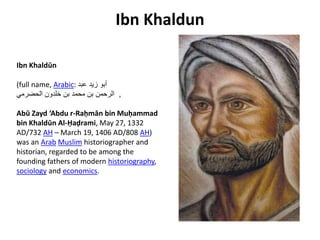
Ibn Khaldūn
(full name, Arabic: ‫عبد‬ ‫زيد‬ ‫أبو‬
‫الحضرمي‬ ‫خلدون‬ ‫بن‬ ‫محمد‬ ‫بن‬ ‫الرحمن‬ ,
Abū Zayd ‘Abdu r-Raḥmān bin Muḥammad
bin Khaldūn Al-Ḥaḍrami, May 27, 1332
AD/732 AH – March 19, 1406 AD/808 AH)
was an Arab Muslim historiographer and
historian, regarded to be among the
founding fathers of modern historiography,
sociology and economics.
Auguste Comte
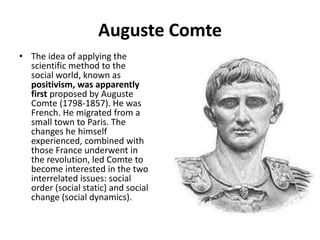
• The idea of applying the
scientific method to the
social world, known as
positivism, was apparently
first proposed by Auguste
Comte (1798-1857). He was
French. He migrated from a
small town to Paris. The
changes he himself
experienced, combined with
those France underwent in
the revolution, led Comte to
become interested in the two
interrelated issues: social
order (social static) and social
change (social dynamics).
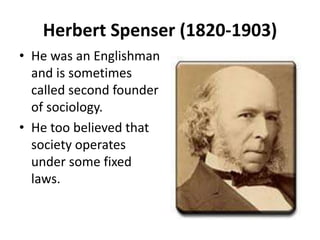
Herbert Spenser (1820-1903)
• He was an Englishman
and is sometimes
called second founder
of sociology.
• He too believed that
society operates
under some fixed
laws.
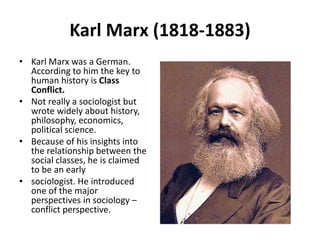
Karl Marx (1818-1883)
• Karl Marx was a German.
According to him the key to
human history is Class
Conflict.
• Not really a sociologist but
wrote widely about history,
philosophy, economics,
political science.
• Because of his insights into
the relationship between the
social classes, he is claimed
to be an early
• sociologist. He introduced
one of the major
perspectives in sociology –
conflict perspective.
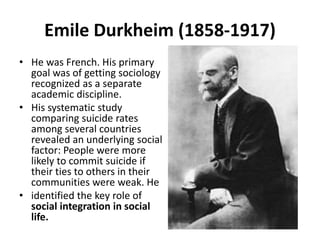
Emile Durkheim (1858-1917)
• He was French. His primary
goal was of getting sociology
recognized as a separate
academic discipline.
• His systematic study
comparing suicide rates
among several countries
revealed an underlying social
factor: People were more
likely to commit suicide if
their ties to others in their
communities were weak. He
• identified the key role of
social integration in social
life.
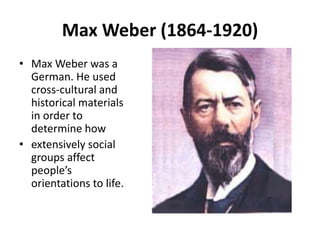
Max Weber (1864-1920)
• Max Weber was a
German. He used
cross-cultural and
historical materials
in order to
determine how
• extensively social
groups affect
people’s
orientations to life.
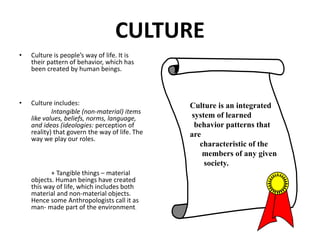
CULTURE
• Culture is people’s way of life. It is
their pattern of behavior, which has
been created by human beings.
• Culture includes:
Intangible (non-material) items
like values, beliefs, norms, language,
and ideas (ideologies: perception of
reality) that govern the way of life. The
way we play our roles.
+ Tangible things – material
objects. Human beings have created
this way of life, which includes both
material and non-material objects.
Hence some Anthropologists call it as
man- made part of the environment.
Culture is an integrated
system of learned
behavior patterns that
are
characteristic of the
members of any given
society.
21
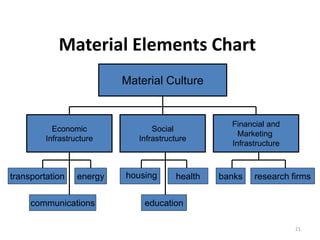
Material Elements Chart
transportation energy
communications
health banks research firms
Economic
Infrastructure
Social
Infrastructure
Financial and
Marketing
Infrastructure
Material Culture
education
housing
Some specific features of culture:
• Universality
• Variability
• Learned
• Shared
• Transmitted
• Changing
Universality
• Culture is universal. There is no society without culture.
As part of the cultures
• there are many aspects that are found in almost all the
societies. For example the institutions like marriage
and family, religion, education, polity, economy, and
sports are found all over the world.
• Societies have developed values, norms, beliefs, and
other patterns of behavior that govern the
• system of marriage and family. One could find such a
pattern all over the world, and the same is applicable
to religion, education, political behavior, economic
behavior, and so on.
Variability
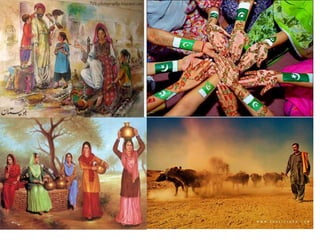
• There is variability in the universals of culture. By
looking at the institution of marriage and family one
could see so much of variation in it within Pakistan,
notwithstanding the differences in other societies.
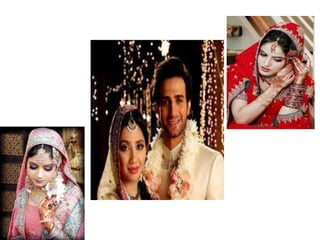
• The arranged marriages, love marriages,
exchange marriages, marriages by purchase,
marriages within as well as outside the kin
network, are all variations that are found in
Pakistan.
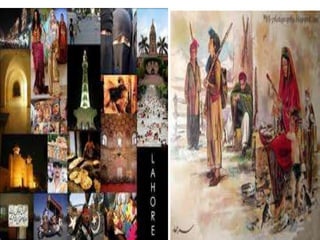
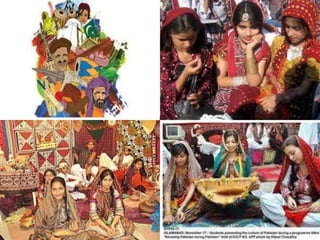
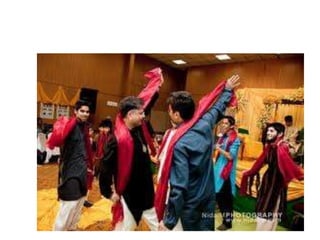
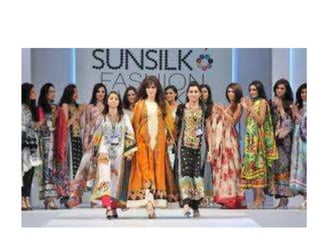
• Then one could see the differences in wedding ceremonies all
over the country. Joint families and nuclear families, single
earner families and dual earner families, patriarchal families
and patrilocal families and matrilocal families are some other
aspects reflecting the variability of family in Pakistani society.
Learned
• Culture is learned through the process of
interaction with others. It is not inherited through
the biological process. We learn to talk, to walk,
and to act as our elders train us.
• Nature has given us the potential to talk but we
speak variety of languages, which are all created
by human beings and there is so much of
variation within as well as outside Pakistan. Also
human being have the capacity to learn a variety
of languages. Similarly other ways of life, which is
culture, are learned.
Shared
• Culture is not the property of one individual or of
a group. It is shared with other
• members of society. You are sharing T V
transmission with others, sharing a classroom
with
• others, sharing the road with others, and sharing
the knowledge with others. You are sharing
• culture with others because you are a social
being.
Transmitted:
• Culture does not end with the death of a person
or a group. During its lifetime that
• individual or group tries to pass on its culture to
the future generation. This is how every new crop
• of babies does not start from a scratch rather
they build on what they have already received.
That
• is how culture grows and that is how our culture
becomes richer ad richer.
Changing
• Culture is continuously changing. The patterns of
behavior transmitted by one
• generation to another are continuously in the process
of modification for catering to the changing
• needs of time and demands of people. New
technologies are developed and are borrowed from
• other groups and societies. With the increase in the
contact between different societies the cultures
• are changing very fast and may be moving toward
some kind of global culture
Three similar terms: Culture, Nation,
and Society
• Culture: Shared way of life.
• Nation: A political entity within designated
borders.
• Society: The organized interaction of people
in a nation or within some other boundary.
Pakistan: nation and society, but may have many cultures.
Multicultural: Includes various ways of life that blend together.
Components of Culture
• Symbols
• Language
• Values
• Beliefs
• Norms
• Mores and Folkways
Symbols
• Anything that carries a particular meaning
recognized by people who share culture.
Whistle, flashing light, thumbs up are all
symbols.
• These symbols are used as means of communication and
thereby become part of our language. Even the buildings,
dress, the flag, and a type of color may be taken as
symbols indicating some aspect of human behavior as
well as society’s outlook. Red, green, white, blue, pink,
each of the colors stands for something in the society
Language
• System of symbols that allows members of a
society to communicate with one another.
May be oral and these could be written words.
We have oral cultural traditions.
• Human beings have developed different
alphabet as part of written language.
Language is the major means of cultural
transmission.
Values
• Culturally defined standards of desirability,
goodness, and beauty that serve as broad
guidelines for social living. What ought to be.
• Equal opportunity, Achievement or success, Material comfort, Activity and
work. Science, Freedom, Physical fitness, Health, Punctuality. Wealth,
Education, Competition and Merit. Honesty, Dignity of labor, Patriotism.
Justice and Democracy. Environmental protection, Charity and
Development.
Beliefs
• Specific statements that people hold to be
true. Values are broad principles that underlie
beliefs.
• Values are abstract standard of goodness, while beliefs are
particular matters that individuals consider to be
true or false
Norms
• Rules and expectations by which a society
guides the behavior of its members. These are
the shared expectations of the people that
govern their behavior.
• Proscriptive norms: Mandating what we should not do.
Forbidding from certain actions.
• Prescriptive norms: What we should do.
Mores and Folkways: W. G. Sumner
gave these concepts.
• Mores (MORE-ays): Society’s standards of proper moral
conduct. Such standards have been considered as
essential to maintaining a way of life. These are the
notions of right or wrong developed by society.
• Violation of mores brings a strong reaction from
others.
• Folkways: Society’s customs for routine, casual
interaction. These are of less moral significance.
Examples can be: proper dress, appropriate greetings,
and common courtesy. People usually ignore the
violation of folkways.
“Ideal” culture and “Real” Culture
• Ideal culture: Social patterns that are mandated by
cultural values and norms. The ideal values and norms,
which are prevalent in the society.
• Real culture: Actual social patterns those only
approximate cultural expectations. The norms and
value that people actually follow. It can also be how
many people follow these cultural patterns. Or how
much a person observes a cultural pattern. Since this
can be explained in numbers therefore it may also be
called a statistical norm.
Cultural Diversity
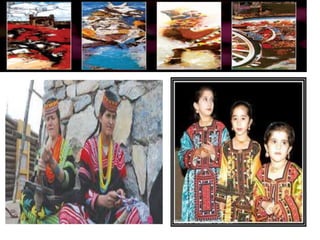
• There are many ways of life; hence there are
differences in culture. In one society there could
be differences in patterns of marriage and family,
patterns of education, patterns of worship, and
patterns of earning a living. One finds cultural
difference within the province and across the
provinces in Pakistan. Countries like Canada,
which are inhabited by immigrants, display a big
cultural diversity. People have migrated from all
over the globe to Canada and brought cultural
differences with them and in many cases are
trying to continue with them.
Culture by social class
• People often divide society in different social
classes and find that each class represents
differences in their norms, values, beliefs,
attitudes, and thinking.
• These norms, values, and attitudes may relate to
the institutions of marriage and family, religion,
education, earning a living, or their political
behavior, one could find the differences
culture is often divided
• High culture: Cultural patterns that distinguish
a society’s elite.
• Popular culture: Cultural patterns those are
widespread among a society’s population.
• Culture of poverty: Cultural patterns shared by
the poor.
Sub-Culture
• Cultural patterns that set apart some
segments of a society’s population. Cluster of
patterns which both are related to the general
culture of the society yet distinguishable from
it.
The example could be: student subculture,
business sub-culture
Multiculturalism
• A policy followed by some governments
whereby they recognize cultural diversity in
the society and promote the equality of all
cultural traditions. Canadian government is
following such a policy.
Counter-Culture
• It is a subculture, which is in active opposition
to the dominant culture. Cultural patterns that
strongly oppose widely accepted patterns
within a society. Example could be of hippies,
and drug users.
Cultural change
• Cultural change is the process of alteration of
culture over time. Any difference in a
particular pattern between two points in time
may be called cultural change. This may be a
change in the family pattern, which is
changing from ‘joint family system’ to a
‘nuclear family system’ in Pakistani society.
Cultural Lag
• All parts (elements) of culture do not change
at the same rate; some of them change faster
than the other.
For example material culture may change
faster than the non-material culture. We often
see it is difficult to change the habits quickly.
Causes of cultural change
• Inventions: The process of creating new cultural elements out of the
existing(wheel)
• Discovery:It is the process of finding that already exists.
• Diffusion: It means the spread of cultural traits from one society to another
• Ethnocentrism: The practice of judging other’s culture by the standards of
one’s own culture. People consider their own culture as superior to others
and apply their standards for evaluating the patterns of behavior of others.
• Xeno-centrism: Considering other’s culture as superior to one’s own.
Causes of cultural change continue
• Cultural relativism: The practice of judging a culture by its own
standards; a particular pattern of behavior is right or
wrong as it is declared by the people who follow it. the same practice
may be useful for one group and may be harmful for the other in the same society.
• global culture
• The global economy: the flow of goods.
• Global communication: the flow of information.
• Global migration: the flow of people.
• Culture and Human Freedom
• THE END

Sociology 3 culture

  • 1.
    Sociology Sociology is thescientific study of human social life, groups and societies
  • 2.
    Ibn Khaldun Ibn Khaldūn (fullname, Arabic: ‫عبد‬ ‫زيد‬ ‫أبو‬ ‫الحضرمي‬ ‫خلدون‬ ‫بن‬ ‫محمد‬ ‫بن‬ ‫الرحمن‬ , Abū Zayd ‘Abdu r-Raḥmān bin Muḥammad bin Khaldūn Al-Ḥaḍrami, May 27, 1332 AD/732 AH – March 19, 1406 AD/808 AH) was an Arab Muslim historiographer and historian, regarded to be among the founding fathers of modern historiography, sociology and economics.
  • 3.
    Auguste Comte • Theidea of applying the scientific method to the social world, known as positivism, was apparently first proposed by Auguste Comte (1798-1857). He was French. He migrated from a small town to Paris. The changes he himself experienced, combined with those France underwent in the revolution, led Comte to become interested in the two interrelated issues: social order (social static) and social change (social dynamics).
  • 4.
    Herbert Spenser (1820-1903) •He was an Englishman and is sometimes called second founder of sociology. • He too believed that society operates under some fixed laws.
  • 5.
    Karl Marx (1818-1883) •Karl Marx was a German. According to him the key to human history is Class Conflict. • Not really a sociologist but wrote widely about history, philosophy, economics, political science. • Because of his insights into the relationship between the social classes, he is claimed to be an early • sociologist. He introduced one of the major perspectives in sociology – conflict perspective.
  • 6.
    Emile Durkheim (1858-1917) •He was French. His primary goal was of getting sociology recognized as a separate academic discipline. • His systematic study comparing suicide rates among several countries revealed an underlying social factor: People were more likely to commit suicide if their ties to others in their communities were weak. He • identified the key role of social integration in social life.
  • 7.
    Max Weber (1864-1920) •Max Weber was a German. He used cross-cultural and historical materials in order to determine how • extensively social groups affect people’s orientations to life.
  • 20.
    CULTURE • Culture ispeople’s way of life. It is their pattern of behavior, which has been created by human beings. • Culture includes: Intangible (non-material) items like values, beliefs, norms, language, and ideas (ideologies: perception of reality) that govern the way of life. The way we play our roles. + Tangible things – material objects. Human beings have created this way of life, which includes both material and non-material objects. Hence some Anthropologists call it as man- made part of the environment. Culture is an integrated system of learned behavior patterns that are characteristic of the members of any given society.
  • 21.
    21 Material Elements Chart transportationenergy communications health banks research firms Economic Infrastructure Social Infrastructure Financial and Marketing Infrastructure Material Culture education housing
  • 22.
    Some specific featuresof culture: • Universality • Variability • Learned • Shared • Transmitted • Changing
  • 23.
    Universality • Culture isuniversal. There is no society without culture. As part of the cultures • there are many aspects that are found in almost all the societies. For example the institutions like marriage and family, religion, education, polity, economy, and sports are found all over the world. • Societies have developed values, norms, beliefs, and other patterns of behavior that govern the • system of marriage and family. One could find such a pattern all over the world, and the same is applicable to religion, education, political behavior, economic behavior, and so on.
  • 24.
    Variability • There isvariability in the universals of culture. By looking at the institution of marriage and family one could see so much of variation in it within Pakistan, notwithstanding the differences in other societies. • The arranged marriages, love marriages, exchange marriages, marriages by purchase, marriages within as well as outside the kin network, are all variations that are found in Pakistan. • Then one could see the differences in wedding ceremonies all over the country. Joint families and nuclear families, single earner families and dual earner families, patriarchal families and patrilocal families and matrilocal families are some other aspects reflecting the variability of family in Pakistani society.
  • 25.
    Learned • Culture islearned through the process of interaction with others. It is not inherited through the biological process. We learn to talk, to walk, and to act as our elders train us. • Nature has given us the potential to talk but we speak variety of languages, which are all created by human beings and there is so much of variation within as well as outside Pakistan. Also human being have the capacity to learn a variety of languages. Similarly other ways of life, which is culture, are learned.
  • 26.
    Shared • Culture isnot the property of one individual or of a group. It is shared with other • members of society. You are sharing T V transmission with others, sharing a classroom with • others, sharing the road with others, and sharing the knowledge with others. You are sharing • culture with others because you are a social being.
  • 27.
    Transmitted: • Culture doesnot end with the death of a person or a group. During its lifetime that • individual or group tries to pass on its culture to the future generation. This is how every new crop • of babies does not start from a scratch rather they build on what they have already received. That • is how culture grows and that is how our culture becomes richer ad richer.
  • 28.
    Changing • Culture iscontinuously changing. The patterns of behavior transmitted by one • generation to another are continuously in the process of modification for catering to the changing • needs of time and demands of people. New technologies are developed and are borrowed from • other groups and societies. With the increase in the contact between different societies the cultures • are changing very fast and may be moving toward some kind of global culture
  • 29.
    Three similar terms:Culture, Nation, and Society • Culture: Shared way of life. • Nation: A political entity within designated borders. • Society: The organized interaction of people in a nation or within some other boundary. Pakistan: nation and society, but may have many cultures. Multicultural: Includes various ways of life that blend together.
  • 30.
    Components of Culture •Symbols • Language • Values • Beliefs • Norms • Mores and Folkways
  • 31.
    Symbols • Anything thatcarries a particular meaning recognized by people who share culture. Whistle, flashing light, thumbs up are all symbols. • These symbols are used as means of communication and thereby become part of our language. Even the buildings, dress, the flag, and a type of color may be taken as symbols indicating some aspect of human behavior as well as society’s outlook. Red, green, white, blue, pink, each of the colors stands for something in the society
  • 32.
    Language • System ofsymbols that allows members of a society to communicate with one another. May be oral and these could be written words. We have oral cultural traditions. • Human beings have developed different alphabet as part of written language. Language is the major means of cultural transmission.
  • 33.
    Values • Culturally definedstandards of desirability, goodness, and beauty that serve as broad guidelines for social living. What ought to be. • Equal opportunity, Achievement or success, Material comfort, Activity and work. Science, Freedom, Physical fitness, Health, Punctuality. Wealth, Education, Competition and Merit. Honesty, Dignity of labor, Patriotism. Justice and Democracy. Environmental protection, Charity and Development.
  • 34.
    Beliefs • Specific statementsthat people hold to be true. Values are broad principles that underlie beliefs. • Values are abstract standard of goodness, while beliefs are particular matters that individuals consider to be true or false
  • 35.
    Norms • Rules andexpectations by which a society guides the behavior of its members. These are the shared expectations of the people that govern their behavior. • Proscriptive norms: Mandating what we should not do. Forbidding from certain actions. • Prescriptive norms: What we should do.
  • 36.
    Mores and Folkways:W. G. Sumner gave these concepts. • Mores (MORE-ays): Society’s standards of proper moral conduct. Such standards have been considered as essential to maintaining a way of life. These are the notions of right or wrong developed by society. • Violation of mores brings a strong reaction from others. • Folkways: Society’s customs for routine, casual interaction. These are of less moral significance. Examples can be: proper dress, appropriate greetings, and common courtesy. People usually ignore the violation of folkways.
  • 37.
    “Ideal” culture and“Real” Culture • Ideal culture: Social patterns that are mandated by cultural values and norms. The ideal values and norms, which are prevalent in the society. • Real culture: Actual social patterns those only approximate cultural expectations. The norms and value that people actually follow. It can also be how many people follow these cultural patterns. Or how much a person observes a cultural pattern. Since this can be explained in numbers therefore it may also be called a statistical norm.
  • 38.
    Cultural Diversity • Thereare many ways of life; hence there are differences in culture. In one society there could be differences in patterns of marriage and family, patterns of education, patterns of worship, and patterns of earning a living. One finds cultural difference within the province and across the provinces in Pakistan. Countries like Canada, which are inhabited by immigrants, display a big cultural diversity. People have migrated from all over the globe to Canada and brought cultural differences with them and in many cases are trying to continue with them.
  • 39.
    Culture by socialclass • People often divide society in different social classes and find that each class represents differences in their norms, values, beliefs, attitudes, and thinking. • These norms, values, and attitudes may relate to the institutions of marriage and family, religion, education, earning a living, or their political behavior, one could find the differences
  • 40.
    culture is oftendivided • High culture: Cultural patterns that distinguish a society’s elite. • Popular culture: Cultural patterns those are widespread among a society’s population. • Culture of poverty: Cultural patterns shared by the poor.
  • 41.
    Sub-Culture • Cultural patternsthat set apart some segments of a society’s population. Cluster of patterns which both are related to the general culture of the society yet distinguishable from it. The example could be: student subculture, business sub-culture
  • 42.
    Multiculturalism • A policyfollowed by some governments whereby they recognize cultural diversity in the society and promote the equality of all cultural traditions. Canadian government is following such a policy.
  • 43.
    Counter-Culture • It isa subculture, which is in active opposition to the dominant culture. Cultural patterns that strongly oppose widely accepted patterns within a society. Example could be of hippies, and drug users.
  • 44.
    Cultural change • Culturalchange is the process of alteration of culture over time. Any difference in a particular pattern between two points in time may be called cultural change. This may be a change in the family pattern, which is changing from ‘joint family system’ to a ‘nuclear family system’ in Pakistani society.
  • 45.
    Cultural Lag • Allparts (elements) of culture do not change at the same rate; some of them change faster than the other. For example material culture may change faster than the non-material culture. We often see it is difficult to change the habits quickly.
  • 46.
    Causes of culturalchange • Inventions: The process of creating new cultural elements out of the existing(wheel) • Discovery:It is the process of finding that already exists. • Diffusion: It means the spread of cultural traits from one society to another • Ethnocentrism: The practice of judging other’s culture by the standards of one’s own culture. People consider their own culture as superior to others and apply their standards for evaluating the patterns of behavior of others. • Xeno-centrism: Considering other’s culture as superior to one’s own.
  • 47.
    Causes of culturalchange continue • Cultural relativism: The practice of judging a culture by its own standards; a particular pattern of behavior is right or wrong as it is declared by the people who follow it. the same practice may be useful for one group and may be harmful for the other in the same society. • global culture • The global economy: the flow of goods. • Global communication: the flow of information. • Global migration: the flow of people. • Culture and Human Freedom
  • 48.