Today, I will learn…
Ground plane
Lighting types
Focus
Learning Goals
Ground Planes
Ground Planes
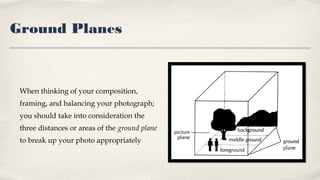
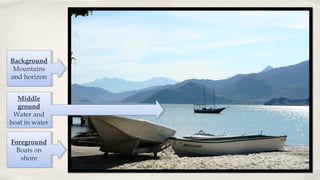
When thinking of your composition,
framing, and balancing your photograph;
you should take into consideration the
three distances or areas of the ground plane
to break up your photo appropriately
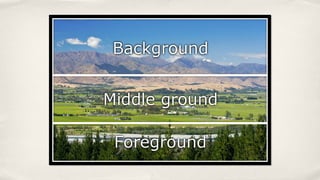
Foreground
Boats on
shore
Foreground
Boats on
shore
Middle
ground
Water and
boat in water
Middle
ground
Water and
boat in water
Background
Mountains
and horizon
Background
Mountains
and horizon
Lighting
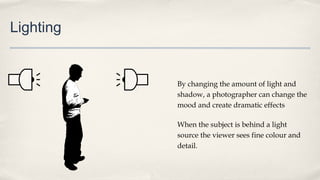
By changing the amount of light and
shadow, a photographer can change the
mood and create dramatic effects
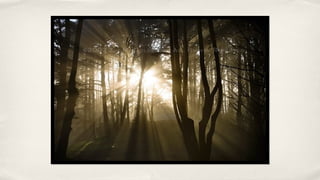
When the subject is behind a light
source the viewer sees fine colour and
detail.
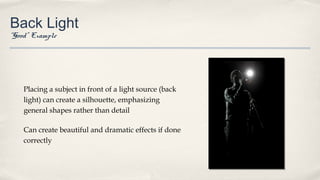
Back Light
“Good” Example
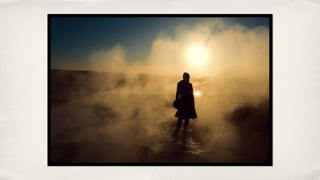
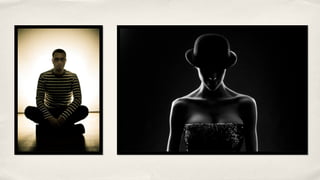
Placing a subject in front of a light source (back
light) can create a silhouette, emphasizing
general shapes rather than detail
Can create beautiful and dramatic effects if done
correctly
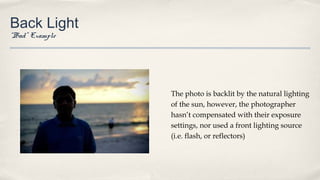
Back Light
“Bad” Example
The photo is backlit by the natural lighting
of the sun, however, the photographer
hasn’t compensated with their exposure
settings, nor used a front lighting source
(i.e. flash, or reflectors)
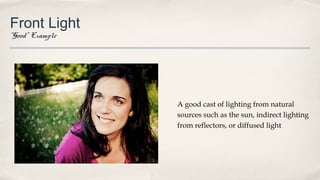
Front Light
“Good” Example
A good cast of lighting from natural
sources such as the sun, indirect lighting
from reflectors, or diffused light
Front Light
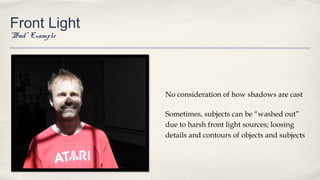
“Bad” Example
No consideration of how shadows are cast
Sometimes, subjects can be “washed out”
due to harsh front light sources; loosing
details and contours of objects and subjects
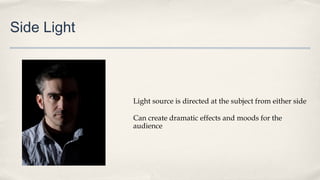
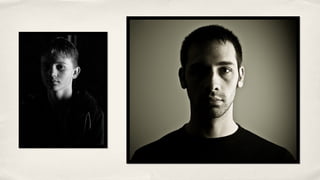
Side Light
Light source is directed at the subject from either side
Can create dramatic effects and moods for the
audience
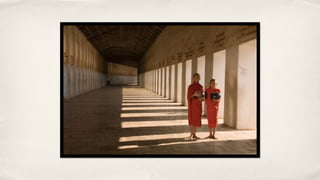
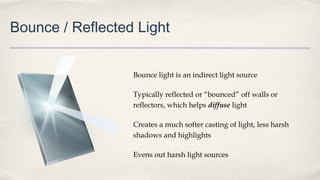
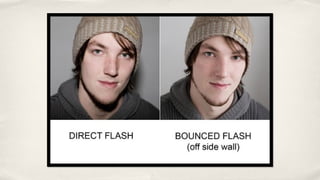
Bounce / Reflected Light
Bounce light is an indirect light source
Typically reflected or “bounced” off walls or
reflectors, which helps diffuse light
Creates a much softer casting of light, less harsh
shadows and highlights
Evens out harsh light sources
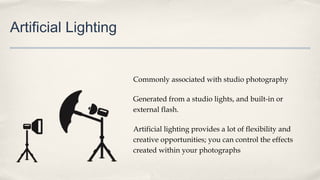
Artificial Lighting
Commonly associated with studio photography
Generated from a studio lights, and built-in or
external flash.
Artificial lighting provides a lot of flexibility and
creative opportunities; you can control the effects
created within your photographs
Focus
Focus
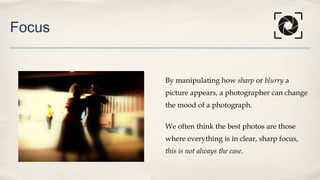
By manipulating how sharp or blurry a
picture appears, a photographer can change
the mood of a photograph.
We often think the best photos are those
where everything is in clear, sharp focus,
this is not always the case.
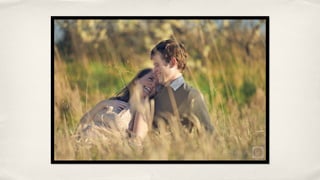
Soft Focus
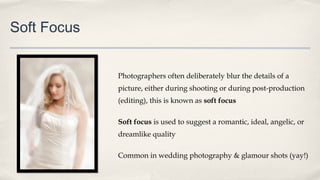
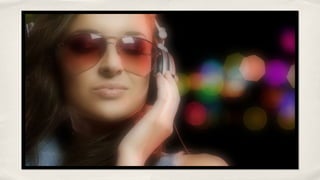
Photographers often deliberately blur the details of a
picture, either during shooting or during post-production
(editing), this is known as soft focus
Soft focus is used to suggest a romantic, ideal, angelic, or
dreamlike quality
Common in wedding photography & glamour shots (yay!)
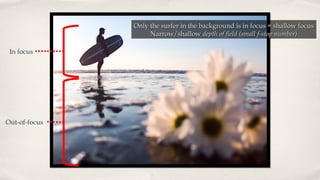
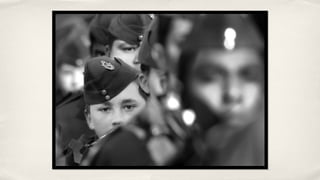
Shallow Focus
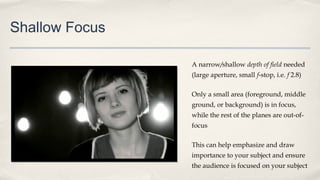
A narrow/shallow depth of field needed
(large aperture, small f-stop, i.e. f 2.8)
Only a small area (foreground, middle
ground, or background) is in focus,
while the rest of the planes are out-of-
focus
This can help emphasize and draw
importance to your subject and ensure
the audience is focused on your subject
Only the surfer in the background is in focus = shallow focusOnly the surfer in the background is in focus = shallow focus
Narrow/shallowNarrow/shallow depth of field (small f-stop number)depth of field (small f-stop number)
In focus
Out-of-focus
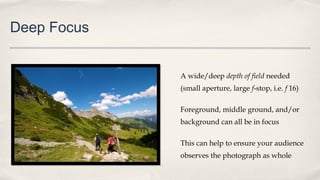
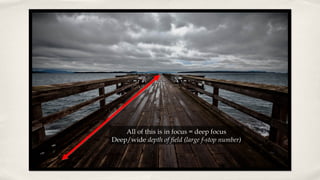
Deep Focus
A wide/deep depth of field needed
(small aperture, large f-stop, i.e. f 16)
Foreground, middle ground, and/or
background can all be in focus
This can help to ensure your audience
observes the photograph as whole
All of this is in focus = deep focusAll of this is in focus = deep focus
Deep/wideDeep/wide depth of field (large f-stop number)depth of field (large f-stop number)
Practice
Practice your composition & framing skills;
Take photos of objects, buildings, people;
anything that catches your eye
Move around; think about your composition and
how you position your subjects within your
camera frame
Experiment with different camera shots, angles,
aperture settings (to get different DoFs/focuses),
and shutter speeds (to capture motion blur)
To Do
Reflection #1 – Overdue
Journal #1 (Rule-of-thirds) – Overdue
‘Composition…’ article questions – Overdue
Camera techniques glossary – Due today!
Journal #2 (Exposure) – Due today!
Detailed instructions on Edmodo

Lesson 8 • Focus & Lighting Introduction

  • 1.
    Today, I willlearn… Ground plane Lighting types Focus Learning Goals
  • 2.
  • 3.
    Ground Planes When thinkingof your composition, framing, and balancing your photograph; you should take into consideration the three distances or areas of the ground plane to break up your photo appropriately
  • 5.
    Foreground Boats on shore Foreground Boats on shore Middle ground Waterand boat in water Middle ground Water and boat in water Background Mountains and horizon Background Mountains and horizon
  • 6.
    Lighting By changing theamount of light and shadow, a photographer can change the mood and create dramatic effects When the subject is behind a light source the viewer sees fine colour and detail.
  • 7.
    Back Light “Good” Example Placinga subject in front of a light source (back light) can create a silhouette, emphasizing general shapes rather than detail Can create beautiful and dramatic effects if done correctly
  • 11.
    Back Light “Bad” Example Thephoto is backlit by the natural lighting of the sun, however, the photographer hasn’t compensated with their exposure settings, nor used a front lighting source (i.e. flash, or reflectors)
  • 12.
    Front Light “Good” Example Agood cast of lighting from natural sources such as the sun, indirect lighting from reflectors, or diffused light
  • 15.
    Front Light “Bad” Example Noconsideration of how shadows are cast Sometimes, subjects can be “washed out” due to harsh front light sources; loosing details and contours of objects and subjects
  • 16.
    Side Light Light sourceis directed at the subject from either side Can create dramatic effects and moods for the audience
  • 19.
    Bounce / ReflectedLight Bounce light is an indirect light source Typically reflected or “bounced” off walls or reflectors, which helps diffuse light Creates a much softer casting of light, less harsh shadows and highlights Evens out harsh light sources
  • 21.
    Artificial Lighting Commonly associatedwith studio photography Generated from a studio lights, and built-in or external flash. Artificial lighting provides a lot of flexibility and creative opportunities; you can control the effects created within your photographs
  • 22.
  • 23.
    Focus By manipulating howsharp or blurry a picture appears, a photographer can change the mood of a photograph. We often think the best photos are those where everything is in clear, sharp focus, this is not always the case.
  • 24.
    Soft Focus Photographers oftendeliberately blur the details of a picture, either during shooting or during post-production (editing), this is known as soft focus Soft focus is used to suggest a romantic, ideal, angelic, or dreamlike quality Common in wedding photography & glamour shots (yay!)
  • 30.
    Shallow Focus A narrow/shallowdepth of field needed (large aperture, small f-stop, i.e. f 2.8) Only a small area (foreground, middle ground, or background) is in focus, while the rest of the planes are out-of- focus This can help emphasize and draw importance to your subject and ensure the audience is focused on your subject
  • 31.
    Only the surferin the background is in focus = shallow focusOnly the surfer in the background is in focus = shallow focus Narrow/shallowNarrow/shallow depth of field (small f-stop number)depth of field (small f-stop number) In focus Out-of-focus
  • 34.
    Deep Focus A wide/deepdepth of field needed (small aperture, large f-stop, i.e. f 16) Foreground, middle ground, and/or background can all be in focus This can help to ensure your audience observes the photograph as whole
  • 35.
    All of thisis in focus = deep focusAll of this is in focus = deep focus Deep/wideDeep/wide depth of field (large f-stop number)depth of field (large f-stop number)
  • 37.
    Practice Practice your composition& framing skills; Take photos of objects, buildings, people; anything that catches your eye Move around; think about your composition and how you position your subjects within your camera frame Experiment with different camera shots, angles, aperture settings (to get different DoFs/focuses), and shutter speeds (to capture motion blur)
  • 38.
    To Do Reflection #1– Overdue Journal #1 (Rule-of-thirds) – Overdue ‘Composition…’ article questions – Overdue Camera techniques glossary – Due today! Journal #2 (Exposure) – Due today! Detailed instructions on Edmodo